Modi Hands Over Made-in-India Vessel to Seychelles: SAGAR, Maritime Diplomacy, Blue Economy & UPSC Notes

Introduction
When India hands over a Made-in-India vessel to Seychelles, it is far more than a diplomatic gift. It represents India’s vision of being a “Net Security Provider” in the Indian Ocean. It strengthens maritime security, enhances regional stability, promotes indigenous defence manufacturing, and reinforces India’s strategic influence in a region where major powers are increasingly competing for influence.
For UPSC aspirants, this seemingly simple news item opens the door to multiple important themes:
- India’s maritime strategy
- SAGAR (Security and Growth for All in the Region)
- Neighbourhood First Policy
- Blue Economy
- Indian Ocean geopolitics
- Indo-Pacific strategy
- Defence diplomacy
- Make in India in defence
- Shipbuilding industry
- Maritime security and international law
Understanding these interconnected concepts is essential because UPSC often uses current affairs as an entry point to test static knowledge.
Why in News?
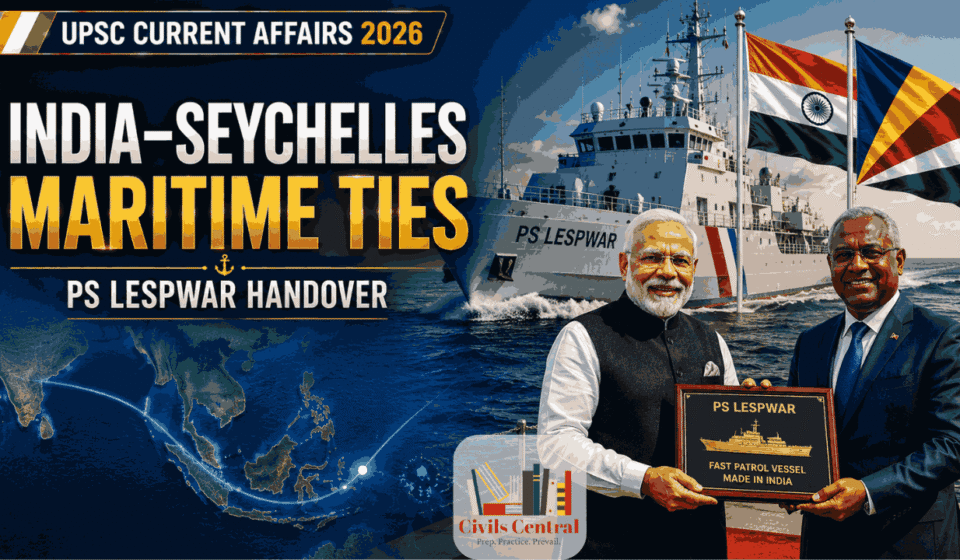
Prime Minister Narendra Modi formally handed over a Made-in-India Fast Patrol Vessel to the Government of Seychelles as part of India’s continued maritime cooperation with the island nation.The vessel was built by an Indian shipyard under the Government of India’s efforts to promote indigenous defence manufacturing. The transfer reflects India’s long-standing commitment to enhancing Seychelles’ maritime surveillance capabilities, protecting its Exclusive Economic Zone (EEZ), combating illegal fishing, piracy, smuggling, and ensuring maritime safety.
The event also demonstrates the practical implementation of India’s SAGAR (Security and Growth for All in the Region) vision and its broader Indo-Pacific strategy. Rather than merely exporting military equipment, India is building long-term security partnerships based on capacity building, trust and mutual development.
Why This Topic Matters for UPSC?
| Examination | Relevance |
|---|---|
| Prelims | SAGAR, Blue Economy, Indian Ocean, EEZ, Seychelles, Indo-Pacific |
| GS-II | India and neighbourhood, International relations |
| GS-III | Internal security, maritime security, defence technology |
| Essay | India’s rise as a global power, Ocean governance |
| Ethics | International cooperation, responsible leadership |
| Interview | India’s maritime vision and foreign policy |
Why Has the Indian Ocean Always Been Important?
To understand India’s maritime policy, we must first understand the history of the Indian Ocean. For thousands of years, the Indian Ocean served as one of the world’s busiest maritime highways. Ancient civilizations of:
- India
- Egypt
- Mesopotamia
- East Africa
- Arabia
- Southeast Asia
were connected through maritime trade.
Indian merchants exported:
- spices
- cotton textiles
- silk
- precious stones
- steel
- knowledge
- religion
- culture
The spread of Buddhism and Hinduism to Southeast Asia was largely facilitated through maritime trade routes. During the colonial period, European powers recognized the strategic importance of controlling these sea routes. Portugal, the Netherlands, France, and Britain established naval dominance to control trade and resources.
After independence, India’s strategic focus remained largely land-centric due to conflicts with Pakistan and China. However, globalization, energy security, and China’s growing naval presence shifted India’s attention back to the seas. Today, the Indian Ocean has once again become the centre of global geopolitics.
Why Oceans Matter?
Nearly all major economies depend on the oceans for trade, energy, fisheries, and communication. More than 90% of India’s trade by volume and a significant share of its energy imports move through sea routes. Therefore, maritime security directly affects economic growth and national security.
India’s Maritime Vision: From Continental to Maritime Power
For decades after independence, India’s strategic thinking was dominated by continental threats. However, several developments changed this perspective:
- Rising dependence on seaborne trade
- Energy imports through sea routes
- China’s expanding naval presence
- Piracy in the Indian Ocean
- Maritime terrorism (e.g., the 26/11 Mumbai attacks)
- Growing importance of the Indo-Pacific
India began investing in:
- Modern naval capabilities
- Coastal surveillance
- Maritime domain awareness
- Island infrastructure
- Regional partnerships
- Indigenous shipbuilding
The objective is to transform India into a leading maritime power capable of ensuring security and stability in the Indian Ocean Region.
What is Maritime Security?
Maritime security refers to the protection of a nation’s maritime interests from threats arising at sea. It includes safeguarding:
- Territorial waters
- Exclusive Economic Zone (EEZ)
- Shipping routes
- Ports
- Offshore energy infrastructure
- Fisheries
- Marine biodiversity
- Undersea communication cables
Maritime security is multidimensional, involving naval defence, law enforcement, environmental protection, and disaster response.
Components of Maritime Security
Maritime Security
        ↓
Safe Sea Routes
        ↓
Trade Protection
        ↓
Energy Security
        ↓
Economic Growth
        ↓
National Development
At the same time:
Maritime Security
        ↓
Prevent Piracy
Prevent Smuggling
Prevent Terrorism
Protect Fisheries
Disaster Response
Marine Conservation
India’s SAGAR Doctrine
One of the most important concepts for UPSC is SAGAR. SAGAR stands for Security and Growth for All in the Region. It was articulated by Prime Minister Narendra Modi in 2015 as India’s strategic vision for the Indian Ocean Region. The doctrine emphasizes that maritime security and economic development are interconnected and should benefit all countries in the region.
Pillars of SAGAR
- Maritime security
- Capacity building
- Economic cooperation
- Disaster relief
- Sustainable development
- Respect for sovereignty
- Collective regional security
Rather than creating military blocs, SAGAR seeks cooperative security through partnerships, training, information sharing, humanitarian assistance, and development cooperation.
Why Does India Promote SAGAR?
India’s interests include:
- Safe trade routes
- Secure energy supplies
- Regional stability
- Countering piracy
- Humanitarian assistance
- Disaster response
- Preventing extra-regional military dominance
SAGAR strengthens India’s role as a responsible regional power while respecting the sovereignty of partner countries.
Neighbourhood First Policy
India’s foreign policy gives priority to strengthening relations with neighbouring countries. The policy recognizes that India’s own security and development are closely linked to the stability and prosperity of its neighbours. For maritime neighbours such as Seychelles, Mauritius, Maldives, Sri Lanka, and the island nations of the Indian Ocean, India focuses on:
- Infrastructure development
- Defence cooperation
- Capacity building
- Humanitarian assistance
- Maritime surveillance
- Disaster management
- Training of personnel
The transfer of patrol vessels is an important instrument of this policy.
Why Small Island Nations Matter?
Small island states may have limited land area but often possess vast Exclusive Economic Zones rich in fisheries, minerals, and strategic sea lanes. Their location makes them critical partners for maritime security and regional cooperation.
UPSC Takeaway: Strategic importance depends on geography, not merely size.
India’s Indo-Pacific Vision
The Indo-Pacific refers to the interconnected maritime space extending from the eastern coast of Africa through the Indian Ocean to the western and central Pacific Ocean. India’s Indo-Pacific vision is based on:
- Free and open seas
- Respect for international law
- Freedom of navigation
- Peaceful resolution of disputes
- ASEAN centrality
- Inclusive regional cooperation
- Sustainable development
Unlike military alliance-based approaches, India emphasizes inclusivity and rules-based order.
Building Trust Through Security Cooperation
Defence diplomacy involves using defence-related cooperation to strengthen international relations. It includes:
- Joint military exercises
- Training programmes
- Defence exports
- Technology sharing
- Port visits
- Humanitarian assistance
- Capacity building
When India transfers a patrol vessel to Seychelles, it builds trust, enhances interoperability, and contributes to regional stability.
India’s Defence Manufacturing: From Importer to Exporter
Historically, India relied heavily on imports for defence equipment. In recent years, policy initiatives such as:
- Make in India
- Atmanirbhar Bharat
- Defence Production and Export Promotion Policy
- Positive Indigenisation Lists
have encouraged domestic manufacturing. India now exports patrol vessels, missile systems, radars, helicopters, artillery systems, and naval platforms to friendly countries. This shift enhances strategic autonomy, generates employment, and strengthens India’s defence industrial base.
Seychelles: A Small Country with Huge Strategic Importance
Many UPSC aspirants make the mistake of assuming that a country’s importance depends on its land area or population. In geopolitics, location often matters more than size.
Seychelles is a small island nation in the western Indian Ocean, northeast of Madagascar, comprising 115 islands scattered across a vast maritime area. Although its land area is only about 459 sq km, it controls an Exclusive Economic Zone (EEZ) of nearly 1.3 million sq km—almost three times the size of Germany.
This illustrates an important UPSC concept:
A small island can command a massive maritime space.
Its location places it close to major Sea Lines of Communication (SLOCs) through which global trade and energy supplies pass.
Why is Seychelles Strategically Important for India?
From India’s perspective, Seychelles is important for several reasons:
1. Guardian of Critical Sea Lanes
A significant portion of global maritime trade, including India’s crude oil imports, passes through the western Indian Ocean. Instability in this region can disrupt:
- Energy security
- International trade
- Supply chains
- Food security
Strengthening Seychelles’ maritime capabilities contributes to the security of these sea lanes.
2. Maritime Surveillance
Seychelles’ vast EEZ is vulnerable to:
- Illegal fishing
- Drug trafficking
- Human trafficking
- Piracy
- Arms smuggling
Since Seychelles has limited naval resources, India assists by:
- Providing patrol vessels
- Coastal surveillance systems
- Radar networks
- Training personnel
- Joint maritime exercises
3. Countering Extra-Regional Influence
The Indian Ocean has become an arena of strategic competition among major powers. India seeks to ensure that the region remains:
- Free
- Open
- Inclusive
- Rules-based
Strong partnerships with countries such as Seychelles reduce strategic vulnerabilities and promote regional stability.
Sea Lines of Communication (SLOCs)
Sea Lines of Communication are the principal maritime routes used for international trade, naval movement, and transportation of energy resources.
Why are they Important?
Nearly all major economies depend on uninterrupted maritime trade. Disruption of SLOCs can:
- Increase shipping costs
- Delay trade
- Raise oil prices
- Threaten national security
The Western Indian Ocean: A Region of Growing Importance
The western Indian Ocean includes the waters surrounding:
- Seychelles
- Mauritius
- Madagascar
- Comoros
- Mozambique
- Tanzania
- Kenya
- Somalia
This region is significant because it connects:
- Africa
- Asia
- Europe
- The Middle East
It also contains major chokepoints such as the approaches to the Bab-el-Mandeb Strait, linking the Indian Ocean with the Red Sea and the Suez Canal. Any disruption in this region affects global commerce.
What is an Exclusive Economic Zone (EEZ)?
An Exclusive Economic Zone is a maritime zone extending up to 200 nautical miles from a coastal state’s baseline, as provided under the United Nations Convention on the Law of the Sea (UNCLOS). Within the EEZ, the coastal state has sovereign rights to:
- Explore natural resources
- Exploit marine resources
- Manage fisheries
- Produce energy from water, currents, and wind
- Conduct marine scientific research (subject to international rules)
However, unlike territorial waters, the EEZ is not part of the sovereign territory of the state. Other countries retain freedoms of:
- Navigation
- Overflight
- Laying submarine cables
- Laying pipelines
Maritime Zones
Land
   ↓
Baseline
   ↓
Territorial Sea (12 nautical miles)
   ↓
Contiguous Zone (24 nautical miles)
   ↓
Exclusive Economic Zone (200 nautical miles)
   ↓
High Seas
Difference Between Sovereignty and Sovereign Rights
Sovereignty
Complete legal authority over territory.
Applies to:
- Land
- Internal waters
- Territorial sea
Sovereign Rights
Limited rights for specific purposes such as resource exploration and exploitation.
Applies to:
- Exclusive Economic Zone
- Continental Shelf
Remember:
A coastal state has sovereign rights in the EEZ, not full sovereignty.
UNCLOS: The Constitution of the Oceans
The United Nations Convention on the Law of the Sea (UNCLOS), adopted in 1982, is often described as the “Constitution of the Oceans.” It establishes the legal framework governing the use of the world’s oceans.
Objectives
- Define maritime zones
- Protect marine resources
- Ensure freedom of navigation
- Promote peaceful dispute resolution
- Regulate seabed mining
- Conserve marine biodiversity
Maritime Zones under UNCLOS
| Maritime Zone | Extent | Rights of Coastal State |
|---|---|---|
| Internal Waters | Landward of baseline | Complete sovereignty |
| Territorial Sea | Up to 12 nautical miles | Full sovereignty (subject to innocent passage) |
| Contiguous Zone | Up to 24 nautical miles | Enforcement of customs, immigration, fiscal and sanitary laws |
| EEZ | Up to 200 nautical miles | Sovereign rights over resources |
| Continental Shelf | Natural extension of landmass | Rights over seabed resources |
| High Seas | Beyond national jurisdiction | Freedom for all states |
Maritime Domain Awareness (MDA)
Modern maritime security depends not only on ships but also on information. Maritime Domain Awareness (MDA) refers to the effective understanding of everything happening at sea that could affect security, economy, or the environment.
Components of MDA
- Coastal radar stations
- Satellite surveillance
- Automatic Identification System (AIS)
- Long-range tracking
- Naval patrol aircraft
- Patrol vessels
- Intelligence sharing
Why is MDA Important?
Without timely information, countries cannot effectively respond to:
- Piracy
- Illegal fishing
- Smuggling
- Maritime terrorism
- Environmental disasters
India has been assisting several Indian Ocean countries, including Seychelles, in strengthening their MDA capabilities.
Illegal, Unreported and Unregulated (IUU) Fishing
What is IUU Fishing?
It refers to fishing activities that violate national laws or international conservation measures.
Why is it Dangerous?
- Depletes fish stocks
- Harms marine biodiversity
- Reduces livelihoods of local fishermen
- Causes economic losses
- Weakens food security
Small island nations often lack adequate patrol assets to curb IUU fishing, making India’s support significant.
Anti-Piracy Operations
Piracy off the coast of Somalia once threatened global shipping in the western Indian Ocean. Pirates targeted:
- Oil tankers
- Cargo vessels
- Fishing boats
India has played an active role by:
- Deploying naval ships
- Escorting merchant vessels
- Conducting rescue missions
- Cooperating with international partners
This has enhanced India’s image as a responsible maritime power.
India as a Net Security Provider
A Net Security Provider is a country that contributes more to regional security than it consumes. India performs this role through:
- Humanitarian Assistance and Disaster Relief (HADR)
- Maritime surveillance
- Naval exercises
- Defence training
- Capacity building
- Coastal radar networks
- Defence exports
- Search and rescue operations
The transfer of patrol vessels to Seychelles is an example of this approach.
China’s String of Pearls vs India’s SAGAR
| Feature | String of Pearls | SAGAR |
|---|---|---|
| Nature | Strategic infrastructure network | Cooperative maritime vision |
| Objective | Secure maritime access | Regional security and development |
| Focus | Port development and connectivity | Capacity building and partnerships |
| Approach | Strategic presence | Inclusive cooperation |
| India’s View | Strategic challenge | India’s own maritime framework |
Hard Power vs Soft Maritime Power
| Hard Power | Soft Maritime Power |
|---|---|
| Military deployment | Capacity building |
| Force projection | Training |
| Bases | Development partnerships |
| Coercion | Cooperation |
| Strategic dominance | Shared security |
India increasingly combines both approaches.
India’s Maritime Partnerships
India works with several regional organisations to strengthen maritime cooperation.
Indian Ocean Rim Association (IORA)
Focuses on:
- Maritime safety
- Trade
- Fisheries
- Blue Economy
- Disaster management
Indian Ocean Commission (IOC)
A regional grouping of island states promoting sustainable development and maritime cooperation.
Colombo Security Conclave
Members include:
- India
- Sri Lanka
- Maldives
- Mauritius (Observer and later participant)
- Other partners in specific engagements
It focuses on:
- Maritime security
- Counter-terrorism
- Cyber security
- Disaster response
Why Does India Export Patrol Vessels Instead of Warships?
Patrol vessels are primarily designed for:
- Coastal surveillance
- Search and rescue
- Fisheries protection
- Anti-smuggling operations
- EEZ monitoring
By supplying patrol vessels, India helps partner countries strengthen maritime governance without contributing to an arms race.
Revision Points
- Seychelles controls a vast EEZ despite its small land area.
- EEZ extends up to 200 nautical miles.
- UNCLOS is known as the “Constitution of the Oceans.”
- India supports Seychelles through patrol vessels, radar systems, training, and maritime surveillance.
- Maritime Domain Awareness is essential for tackling piracy, smuggling, and illegal fishing.
- India’s SAGAR vision emphasises cooperative security.
- India seeks to be a Net Security Provider in the Indian Ocean.
- The western Indian Ocean is strategically important due to major global shipping routes.
Constitutional Foundation
Although the Constitution of India does not contain a separate chapter on maritime affairs, several provisions provide the legal and philosophical basis for India’s maritime policy.
Article 51: Promotion of International Peace and Security
Article 51, contained in the Directive Principles of State Policy, directs the State to:
- Promote international peace and security.
- Maintain just and honourable relations among nations.
- Foster respect for international law and treaty obligations.
- Encourage settlement of international disputes through arbitration.
Why is Article 51 Relevant?
When India supplies patrol vessels, conducts humanitarian missions, or assists island nations in maritime surveillance, it is not merely advancing strategic interests. It is also fulfilling the constitutional aspiration of promoting peaceful international cooperation.
UPSC Insight: Article 51 frequently appears in questions related to India’s foreign policy, international law, and the United Nations.
Article 246 and the Seventh Schedule
The Seventh Schedule distributes legislative powers between the Union and the States. Under the Union List, Parliament has exclusive authority over:
- Defence of India
- Armed Forces
- Naval Forces
- Shipping and Navigation
- Ports declared as Major Ports
- Maritime Trade
- International Relations
Article 297
One of the most important constitutional provisions for UPSC is Article 297.
What Does It Provide?
All lands, minerals and other valuable resources underlying the ocean within the territorial waters, continental shelf and Exclusive Economic Zone vest in the Union of India.
Why is this Important?
Suppose offshore petroleum reserves are discovered in India’s EEZ. Who owns them? Not the coastal State Government. The ownership belongs to the Union Government under Article 297. This ensures strategic resources remain under national control.
Fundamental Duty: Article 51A(g)
Every citizen has a duty to protect and improve the natural environment, including forests, lakes, rivers and wildlife. Although oceans are not explicitly mentioned, marine biodiversity and coastal ecosystems fall within this broader environmental responsibility. This constitutional duty supports initiatives against marine pollution, illegal fishing, and degradation of coastal ecosystems.
Legal Framework Governing Maritime Affairs
India’s maritime governance is supported by a comprehensive legal architecture.
1. Maritime Zones of India Act, 1976
This Act defines:
- Territorial Waters
- Contiguous Zone
- Exclusive Economic Zone
- Continental Shelf
It aligns Indian domestic law with the principles later incorporated under UNCLOS.
Why is it Important?
It determines:
- India’s maritime jurisdiction.
- Resource rights.
- Law enforcement powers.
- Offshore resource management.
2. Territorial Waters, Continental Shelf, Exclusive Economic Zone and Other Maritime Zones
The Act empowers India to:
- Regulate resource extraction.
- Prevent illegal activities.
- Exercise sovereign rights over marine resources.
- Protect offshore infrastructure.
3. Coast Guard Act, 1978
The Indian Coast Guard was established under this Act. Its responsibilities include:
- Maritime law enforcement
- Protection of offshore installations
- Anti-smuggling operations
- Search and Rescue (SAR)
- Marine pollution response
- Fisheries protection
Unlike the Navy, the Coast Guard primarily performs law enforcement and peacetime security functions.
4. Merchant Shipping Act
The Act regulates:
- Registration of ships
- Safety standards
- Marine pollution prevention
- Seafarer welfare
- Shipping operations
It plays a crucial role in ensuring safe maritime commerce.
5. Admiralty (Jurisdiction and Settlement of Maritime Claims) Act, 2017
This Act modernized India’s admiralty laws by empowering High Courts to adjudicate maritime disputes such as:
- Ship arrest
- Maritime liens
- Cargo disputes
- Salvage claims
Efficient dispute resolution enhances India’s attractiveness as a maritime trading nation.
Institutional Framework
Maritime governance requires coordination among multiple institutions.
Ministry of External Affairs (MEA)
Responsible for:
- Maritime diplomacy
- Bilateral maritime cooperation
- Defence partnerships
- Regional forums
The transfer of patrol vessels to Seychelles is coordinated through diplomatic engagement led by the MEA.
Ministry of Defence
Responsible for:
- Naval strategy
- Defence exports
- Maritime security
- Strategic partnerships
Indian Navy
The Indian Navy is the principal maritime military force. Its peacetime roles include:
- Maritime surveillance
- Anti-piracy patrols
- Humanitarian Assistance and Disaster Relief (HADR)
- Capacity building
- Joint exercises
- Protection of Sea Lines of Communication
The Navy is a key instrument of India’s maritime diplomacy.
Indian Coast Guard
The Coast Guard acts as India’s maritime law enforcement agency. Think of the distinction this way:
- Indian Navy = Defends against military threats.
- Indian Coast Guard = Enforces maritime laws and ensures coastal security.
National Security Council Secretariat (NSCS)
Coordinates maritime security policy across different ministries and agencies.
Directorate General of Shipping
Regulates:
- Merchant shipping
- Maritime safety
- Port operations
- Seafarer certification
Indian National Centre for Ocean Information Services (INCOIS)
Provides:
- Ocean forecasts
- Tsunami warnings
- Marine weather services
- Fisheries advisories
These services support both economic activities and disaster preparedness.
Government Initiatives
1. SAGAR (Security and Growth for All in the Region)
Launched in 2015, SAGAR is India’s overarching maritime vision.
Objectives
- Enhance regional maritime security.
- Build capacity in neighbouring countries.
- Promote sustainable development.
- Encourage economic cooperation.
- Strengthen disaster response.
Key Achievements
- Coastal surveillance radar networks.
- Patrol vessel assistance.
- Training of foreign naval personnel.
- Humanitarian missions.
- Maritime information sharing.
Challenges
- Limited financial resources.
- Increasing geopolitical competition.
- Capacity constraints in partner countries.
2. Maritime India Vision 2030
Prepared by the Ministry of Ports, Shipping and Waterways, this roadmap seeks to transform India into a leading maritime nation.
Focus Areas
- Port modernization.
- Logistics efficiency.
- Shipbuilding.
- Coastal shipping.
- Cruise tourism.
- Green ports.
- Digitalization.
3. Sagarmala Programme
Objective
Reduce logistics costs by promoting port-led development.
Components
- Port modernization.
- Port connectivity.
- Coastal economic zones.
- Skill development.
- Coastal community development.
Why is Sagarmala Important?
India transports a large share of its freight by road, which is relatively expensive. Enhancing port connectivity and coastal shipping lowers logistics costs and improves export competitiveness.
4. Blue Economy Policy
The Blue Economy aims to utilize ocean resources sustainably for economic growth while protecting marine ecosystems.
Components
- Fisheries
- Marine biotechnology
- Renewable ocean energy
- Coastal tourism
- Seabed minerals
- Maritime transport
Administrative Perspective
Economic growth should not come at the cost of marine biodiversity. Sustainable resource management is central to the Blue Economy.
5. Atmanirbhar Bharat in Defence
India is increasingly promoting indigenous defence production through:
- Positive Indigenisation Lists
- Defence Industrial Corridors
- Innovation for Defence Excellence (iDEX)
- Defence exports
The patrol vessel supplied to Seychelles demonstrates India’s growing capability in indigenous shipbuilding and defence manufacturing.
International Perspective
Maritime challenges transcend national boundaries. No single country can ensure maritime security alone.
United Nations Convention on the Law of the Sea (UNCLOS)
UNCLOS provides the legal framework for:
- Maritime boundaries.
- Navigation rights.
- Resource management.
- Marine environmental protection.
- Peaceful dispute settlement.
India consistently supports a rules-based maritime order founded on UNCLOS.
Sustainable Development Goal 14
SDG 14: Life Below Water
Targets include:
- Reducing marine pollution.
- Protecting marine ecosystems.
- Ending overfishing.
- Conserving coastal resources.
- Promoting sustainable fisheries.
India’s Blue Economy initiatives align closely with SDG 14.
International Maritime Organization (IMO)
The IMO develops global standards for:
- Maritime safety.
- Marine pollution prevention.
- Ship design.
- Maritime security.
Compliance with IMO conventions improves global shipping efficiency and environmental protection.
Global Best Practices
Japan
Japan has invested heavily in:
- Maritime infrastructure.
- Port efficiency.
- Coast Guard modernization.
- Disaster-resilient coastal systems.
Australia
Australia integrates:
- Maritime surveillance.
- Fisheries management.
- Marine conservation.
- Indigenous coastal community participation.
European Union
The EU promotes Integrated Maritime Policy, bringing together environmental protection, shipping, fisheries, research, and coastal development under a unified governance framework.
Lessons for India
- Strengthen maritime governance through inter-agency coordination.
- Invest in advanced maritime technologies.
- Improve coastal resilience.
- Encourage sustainable ocean-based economic activities.
Challenges Facing India’s Maritime Strategy
1. Geopolitical Challenges
The Indian Ocean has become an arena of strategic competition.
Major powers are increasing their naval presence, infrastructure investments, and strategic partnerships, creating complex security dynamics.
2. Illegal Fishing
IUU fishing threatens:
- Marine biodiversity.
- Livelihoods of coastal communities.
- Food security.
- National revenue.
3. Maritime Terrorism
The 26/11 Mumbai attacks highlighted how maritime routes can be exploited by terrorists. Strengthening coastal security remains a national priority.
4. Climate Change
Small island nations face:
- Sea-level rise.
- Coral bleaching.
- Coastal erosion.
- Extreme weather events.
Climate resilience has become an essential component of maritime cooperation.
5. Marine Pollution
Plastic waste, oil spills, untreated sewage, and industrial effluents degrade marine ecosystems and threaten fisheries and tourism.
6. Infrastructure Constraints
India has improved port capacity but still faces challenges related to:
- Port congestion.
- Last-mile connectivity.
- Shipbuilding competitiveness.
- Logistics efficiency.
7. Financial Constraints
Maintaining modern naval fleets, surveillance systems, and maritime infrastructure requires sustained investment and technological upgrades.
Way Forward
A stronger maritime future requires a comprehensive strategy.
Strengthen Indigenous Shipbuilding
Expand domestic manufacturing of patrol vessels, naval platforms, and marine technologies to enhance strategic autonomy and defence exports.
Enhance Maritime Domain Awareness
Integrate satellites, artificial intelligence, drones, and coastal radar systems to improve real-time monitoring of maritime activities.
Deepen Regional Partnerships
Expand cooperation with Indian Ocean island nations through training, information sharing, joint exercises, and capacity building.
Promote the Blue Economy
Balance economic utilization of marine resources with conservation, ensuring sustainable fisheries, clean oceans, and resilient coastal ecosystems.
Improve Port-Led Development
Accelerate Sagarmala projects, multimodal logistics, and hinterland connectivity to reduce logistics costs and boost competitiveness.
Build Climate-Resilient Coastal Infrastructure
Adopt nature-based solutions such as mangrove restoration, strengthen early warning systems, and integrate climate adaptation into coastal planning.
Uphold a Rules-Based Maritime Order
Continue supporting UNCLOS, freedom of navigation, peaceful dispute resolution, and multilateral cooperation to ensure stability in the Indo-Pacific.
Role of a District Administration in Coastal Security
Although maritime defence is primarily the responsibility of the Navy and Coast Guard, district administration plays a crucial supporting role.
Coordination Among Agencies
The District Magistrate should establish effective coordination among:
- Indian Coast Guard
- Indian Navy
- Marine Police
- Fisheries Department
- Customs Department
- Port Authorities
- Disaster Management Authorities
- Local Panchayats
- Intelligence Agencies
A lack of coordination often creates gaps that can be exploited by smugglers, traffickers, or terrorists.
Strengthening Coastal Surveillance
An administrator should ensure:
- Registration of fishing boats
- Biometric identification of fishermen
- Installation of vessel tracking systems
- Community-based coastal vigilance
- Regular coastal patrolling
- Maintenance of coastal infrastructure
Local fishermen are often the first observers of suspicious maritime activities. Their participation strengthens maritime security.
Disaster Preparedness
Coastal districts frequently face:
- Cyclones
- Storm surges
- Tsunamis
- Coastal flooding
- Oil spills
An effective administrator should:
- Prepare district disaster management plans.
- Conduct mock drills.
- Strengthen early warning dissemination.
- Develop cyclone shelters.
- Ensure evacuation protocols.
- Promote community awareness.
Preparedness saves lives more effectively than post-disaster relief.
Promoting the Blue Economy
The Blue Economy is not merely a national policy—it has local implications. A District Magistrate can promote:
- Sustainable fisheries
- Eco-tourism
- Coastal entrepreneurship
- Marine skill development
- Women-led coastal livelihoods
- Seaweed cultivation
- Aquaculture
Economic development should improve local livelihoods without degrading marine ecosystems.
Balancing Development and Conservation
Suppose a proposal is received for constructing a large commercial port. An administrator must balance competing interests:
Economic Benefits
- Employment generation
- Trade expansion
- Investment
- Logistics efficiency
Environmental Concerns
- Mangrove destruction
- Coral reef damage
- Coastal erosion
- Marine pollution
- Fishermen’s livelihoods
The objective is sustainable development—not development at any cost.
Practice MCQs
MCQ 1
With reference to the Exclusive Economic Zone (EEZ), consider the following statements:
- It extends up to 200 nautical miles from the baseline.
- The coastal State enjoys complete sovereignty over the EEZ.
- Other States enjoy freedom of navigation in the EEZ.
Which of the statements given above is/are correct?
Options
(a) 1 and 2 only
(b) 1 and 3 only
(c) 2 and 3 only
(d) 1, 2 and 3
Correct Answer
(b) 1 and 3 only
Explanation
Statement 1 is correct because UNCLOS defines the EEZ up to 200 nautical miles.
Statement 2 is incorrect because the coastal State has sovereign rights, not full sovereignty.
Statement 3 is correct since freedom of navigation and overflight continue in the EEZ.
MCQ 2
The SAGAR doctrine primarily relates to:
(a) India’s nuclear doctrine
(b) Maritime security and regional cooperation
(c) Space exploration
(d) Cyber security
Answer: (b)
Explanation
SAGAR (Security and Growth for All in the Region) is India’s maritime vision aimed at promoting regional security, capacity building, and sustainable development in the Indian Ocean Region.
MCQ 3
Which of the following organisations is primarily concerned with global maritime safety and security standards?
(a) IORA
(b) IMO
(c) WTO
(d) ASEAN
Answer: (b)
Explanation
The International Maritime Organization (IMO) develops international regulations relating to shipping safety, marine pollution prevention, and maritime security.
MCQ 4
Which one of the following best describes India’s role as a Net Security Provider?
(a) Permanent deployment of military forces in foreign countries
(b) Assisting neighbouring countries in enhancing their security capacities while contributing to regional stability
(c) Restricting foreign naval movement in the Indian Ocean
(d) Establishing military alliances against rival countries
Answer: (b)
MCQ 5
Illegal, Unreported and Unregulated (IUU) Fishing primarily affects:
- Marine biodiversity
- Food security
- Coastal livelihoods
- National security
Select the correct answer.
(a) 1 and 2 only
(b) 1, 2 and 3 only
(c) 2, 3 and 4 only
(d) 1, 2, 3 and 4
Answer: (d)
Explanation
IUU fishing has ecological, economic, and security implications. It depletes fish stocks, threatens livelihoods, undermines food security, and often overlaps with transnational maritime crimes.
MCQ 6
Which constitutional provision directs the State to promote international peace and security?
(a) Article 48A
(b) Article 51
(c) Article 297
(d) Article 355
Answer: (b)
MCQ 7
The Blue Economy seeks to:
(a) Maximise exploitation of marine resources
(b) Promote unrestricted deep-sea mining
(c) Balance economic growth with sustainable use of ocean resources
(d) Replace conventional fisheries with aquaculture
Answer: (c)
MCQ 8
The transfer of patrol vessels by India to countries such as Seychelles primarily demonstrates:
(a) Territorial expansion
(b) Maritime diplomacy and capacity building
(c) Naval militarisation
(d) Economic sanctions
Answer: (b)
UPSC Mains Practice Questions
10 Marks (150 Words)
“The Indian Ocean has emerged as the centre of twenty-first century geopolitics.” Discuss India’s maritime strategy with special reference to the SAGAR doctrine and its cooperation with island nations such as Seychelles.
15 Marks (250 Words)
“India’s maritime diplomacy reflects the convergence of security, development, and strategic autonomy.” Examine this statement in the context of defence exports, the Blue Economy, and India’s role as a Net Security Provider in the Indian Ocean Region.
Revision Table
| Concept | Key Point |
|---|---|
| SAGAR | Security and Growth for All in the Region |
| EEZ | 200 nautical miles; sovereign rights over resources |
| UNCLOS | Legal framework governing oceans |
| Blue Economy | Sustainable use of marine resources |
| Maritime Diplomacy | Security cooperation through partnerships |
| Seychelles | Strategic island nation in the western Indian Ocean |
| Indian Coast Guard | Maritime law enforcement |
| Indian Navy | Maritime defence and strategic operations |
Mind Map
Made-in-India Vessel to Seychelles
│
├── Maritime Diplomacy
│   ├── Capacity Building
│   ├── Defence Exports
│   └── Strategic Partnerships
│
├── SAGAR
│   ├── Security
│   ├── Growth
│   ├── Cooperation
│   └── Regional Stability
│
├── Maritime Security
│   ├── Anti-Piracy
│   ├── IUU Fishing
│   ├── Coastal Security
│   └── Maritime Domain Awareness
│
├── International Law
│   ├── UNCLOS
│   ├── EEZ
│   ├── Territorial Sea
│   └── Continental Shelf
│
├── Blue Economy
│   ├── Fisheries
│   ├── Tourism
│   ├── Renewable Energy
│   └── Marine Conservation
│
└── India's Maritime Vision
    ├── Indo-Pacific
    ├── Neighbourhood First
    ├── Atmanirbhar Bharat
    └── Net Security Provider
Also Read:
- Blue Economy: Concepts, Opportunities and Challenges.
- United Nations Convention on the Law of the Sea (UNCLOS).
- Indo-Pacific: Evolution, Importance and India’s Strategy.
- Indian Ocean Rim Association (IORA).
- Sagarmala Programme Explained.
- India’s Defence Exports and Atmanirbhar Bharat.
- Indian Coast Guard: Roles and Responsibilities.
- Maritime Security Challenges in India.
- Neighbourhood First Policy.
- India’s Foreign Policy: Key Doctrines and Initiatives.
Conclusion
The transfer of a Made-in-India vessel to Seychelles is far more than a ceremonial diplomatic event. It encapsulates India’s evolving role as a maritime power committed to regional security, sustainable development, and cooperative diplomacy. Through initiatives such as SAGAR, the Blue Economy, and indigenous defence manufacturing, India is strengthening partnerships while promoting a free, open, and rules-based Indian Ocean.
For UPSC aspirants, this topic is an excellent example of how a single current affairs event can connect multiple dimensions of the syllabus—International Relations, Internal Security, Environment, Economy, Governance, Ethics, and Essay. The key to mastering such topics lies not in memorising the news, but in understanding the underlying concepts and their wider policy significance.
About The Author