Operation Amistad: India’s Humanitarian Mission to Venezuela | UPSC Notes

Introduction
India has increasingly emerged as a responsible global power that extends assistance beyond its borders during natural disasters and humanitarian crises. The launch of Operation Amistad to support earthquake-affected Venezuela reflects India’s growing commitment to Humanitarian Assistance and Disaster Relief (HADR) and reinforces its image as the ‘First Responder’ in times of crisis.
For UPSC aspirants, Operation Amistad is significant not merely as a current event but as a topic that connects International Relations, Disaster Management, India’s Foreign Policy, Defence, and Humanitarian Diplomacy. Understanding the mission also provides insights into India’s soft power and its role in promoting global solidarity.
Why in News?
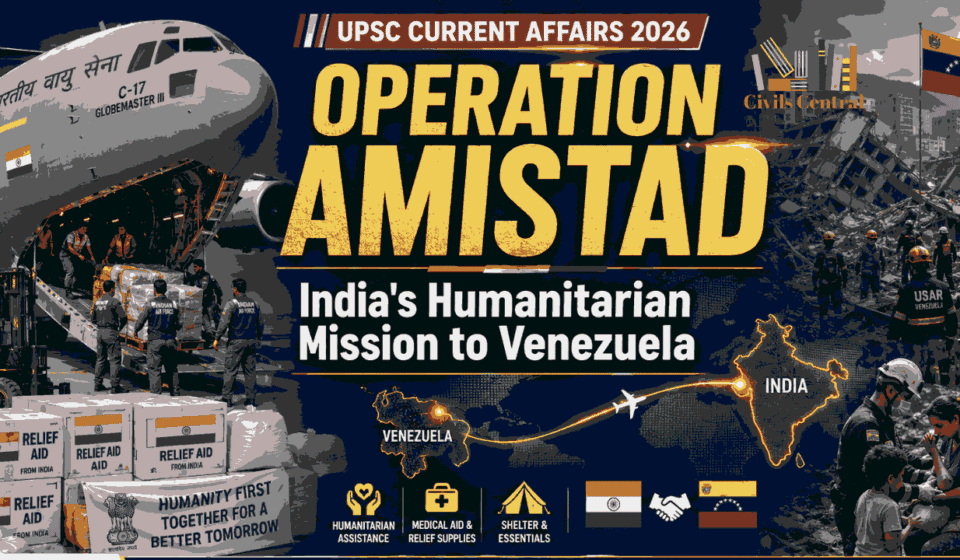
India launched Operation Amistad to provide humanitarian assistance to Venezuela after devastating earthquakes caused widespread destruction and casualties.
As part of the operation, India dispatched:
- Indian Air Force C-17 Globemaster aircraft carrying relief material.
- A 41-member medical team from the 60 Para Field Hospital of the Indian Army.
- BHISHM Cube portable hospital units.
- Medicines, medical equipment and emergency relief supplies.
The operation demonstrates India’s commitment to providing timely humanitarian assistance to countries affected by disasters.
Understanding the Topic
What is Operation Amistad?
Operation Amistad is India’s humanitarian relief mission launched to assist Venezuela following a major earthquake. The term “Amistad” means “Friendship” in Spanish, symbolising India’s solidarity with the people of Venezuela.
Unlike military operations aimed at combat, Operation Amistad is a Humanitarian Assistance and Disaster Relief (HADR) mission designed to save lives, provide emergency medical care and support relief efforts.
What is Humanitarian Assistance and Disaster Relief (HADR)?
Humanitarian Assistance and Disaster Relief (HADR) refers to the assistance provided by a country to populations affected by:
- Earthquakes
- Floods
- Cyclones
- Tsunamis
- Pandemics
- Armed conflicts (humanitarian evacuation)
- Other natural or human-induced disasters
The primary objective of HADR is to save lives, reduce suffering, and support early recovery rather than achieve military or political objectives.
Key Components of HADR
| Component | Purpose |
|---|---|
| Search and Rescue | Locate and rescue survivors trapped after disasters |
| Emergency Medical Care | Treat injured persons and prevent disease outbreaks |
| Relief Supplies | Food, water, tents, medicines and essential items |
| Engineering Support | Restore roads, bridges and critical infrastructure |
| Communication Support | Establish emergency communication networks |
| Logistics | Rapid transportation of personnel and relief material |
Why is HADR Important?
Disasters often overwhelm the affected country’s response capacity, especially during the first 72 hours, known as the Golden Hours of disaster response. International assistance during this period can significantly reduce casualties.
For India, HADR serves multiple objectives:
- Demonstrates India’s commitment to global humanitarian values.
- Enhances India’s international image as a responsible power.
- Strengthens diplomatic ties with partner countries.
- Builds trust and goodwill among nations.
- Promotes regional and global stability.
Thus, HADR is not merely disaster response—it is also an important instrument of humanitarian diplomacy.
Humanitarian Diplomacy: A Growing Dimension of India’s Foreign Policy
Humanitarian diplomacy refers to the use of humanitarian assistance to strengthen international cooperation, build goodwill, and reinforce diplomatic relationships. Instead of using military or economic pressure, countries provide assistance during crises to foster long-term partnerships. India’s humanitarian diplomacy is guided by the philosophy of: “Vasudhaiva Kutumbakam” (The World is One Family).
This approach has become increasingly visible through India’s disaster relief missions, vaccine assistance during COVID-19, and evacuation operations during international conflicts.
Humanitarian diplomacy can be linked with:
- India’s Neighbourhood First Policy
- SAGAR (Security and Growth for All in the Region)
- Global South leadership
- Soft Power
- International Relations
- Disaster Management
India as a First Responder
A First Responder is a country capable of providing rapid assistance immediately after a disaster strikes.
India has gradually developed this capability due to:
- Strategic geographical location.
- Strong airlift capability of the Indian Air Force.
- Capabilities of the Indian Navy for overseas relief.
- Trained medical teams.
- National Disaster Response Force (NDRF).
- Experience in managing large-scale disasters.
Today, India is increasingly recognised as the First Responder in the Indian Ocean Region and is expanding this role beyond its immediate neighbourhood.
Features of India’s First Responder Policy
- Rapid mobilisation of relief material.
- Deployment of military aircraft and naval ships.
- Medical assistance.
- Search and rescue operations.
- Restoration of essential services.
- Humanitarian support without political conditions.
BHISHM Cube: A Portable Emergency Hospital
One of the highlights of Operation Amistad is the deployment of the BHISHM Cube. The BHISHM Cube is a rapidly deployable modular medical facility designed to provide emergency healthcare in disaster-hit areas where hospitals may have been damaged or become inaccessible.
Key Features
- Portable and modular design.
- Can be transported by aircraft.
- Quick installation in disaster zones.
- Equipped for emergency surgeries and trauma care.
- Supports treatment of large numbers of patients.
Why is it Important?
In major disasters, the destruction of hospitals often becomes a secondary crisis. Portable hospitals bridge this gap by enabling doctors to provide treatment immediately at the disaster site, thereby improving survival rates.
60 Para Field Hospital
The 60 Para Field Hospital is a specialised medical unit of the Indian Army trained to provide emergency medical support during:
- Natural disasters.
- Humanitarian crises.
- Peacekeeping operations.
- Armed conflicts.
Its personnel are experienced in operating under challenging conditions with limited infrastructure, making them highly effective during international relief missions. The deployment of this unit under Operation Amistad reflects India’s ability to combine military capabilities with humanitarian objectives.
Key Features of Operation Amistad
- Rapid deployment of humanitarian assistance.
- Medical support through specialised Army teams.
- Airlift capability using IAF C-17 aircraft.
- Deployment of portable hospitals.
- Humanitarian assistance without political conditions.
- Demonstration of India’s disaster response capability.
- Strengthening India’s global humanitarian image.
Previous Major Humanitarian Missions by India
| Operation | Year | Purpose |
|---|---|---|
| Operation Maitri | 2015 | Earthquake relief in Nepal |
| Operation Raahat | 2015 | Evacuation from Yemen |
| Operation Sankat Mochan | 2016 | Evacuation from South Sudan |
| Operation Samudra Setu | 2020 | Repatriation during COVID-19 |
| Operation Brahma | 2025 | Humanitarian assistance after Myanmar earthquake |
| Operation Amistad | 2026 | Earthquake relief assistance to Venezuela |
These operations demonstrate the evolution of India’s humanitarian diplomacy from regional assistance to global disaster response.
India’s Perspective
Although Venezuela is geographically distant from India, Operation Amistad demonstrates that India’s foreign policy increasingly extends beyond its immediate neighbourhood. The mission highlights India’s aspiration to be a responsible global power that contributes to international peace, stability, and humanitarian welfare.
Why Does Operation Amistad Matter for India?
Strengthens India’s Soft Power
Soft power refers to a country’s ability to influence others through goodwill, values, culture, and humanitarian actions rather than military or economic coercion. By assisting countries during disasters, India builds trust and enhances its global image.
Expands India’s Humanitarian Diplomacy
Humanitarian missions create long-term goodwill that can strengthen political, economic, and strategic partnerships. Such assistance reflects India’s commitment to “Vasudhaiva Kutumbakam” and positions India as a reliable development partner.
Demonstrates Defence Preparedness
Operations like Amistad showcase the Indian Armed Forces’ capability to undertake rapid overseas deployments for non-combat missions. This reflects improved logistics, coordination, and strategic airlift capacity.
Strengthens India’s Global Leadership
India’s increasing participation in humanitarian missions complements its leadership role in the Global South and supports its aspiration for greater influence in international institutions.
Challenges in International Humanitarian Missions
Despite their importance, overseas humanitarian missions face several challenges.
Long-Distance Logistics
Transporting medical teams, relief supplies, and heavy equipment across continents requires significant planning, coordination, and financial resources.
Coordination with Local Authorities
Effective relief operations require close coordination with the affected country’s government, local administration, and international relief agencies.
Damaged Infrastructure
Earthquakes often destroy airports, roads, communication systems, and hospitals, making relief operations more difficult.
Security and Health Risks
Relief personnel may face aftershocks, disease outbreaks, disrupted public services, or unstable security conditions while working in disaster-hit regions.
Resource Constraints
Countries must balance domestic disaster preparedness with international humanitarian commitments to ensure adequate resources are available for both.
Way Forward
India can further strengthen its role in global humanitarian assistance through the following measures:
- Expand strategic airlift and maritime logistics capabilities for faster deployment.
- Strengthen coordination among the Armed Forces, NDRF, MEA, and health agencies.
- Invest in advanced portable medical facilities like the BHISHM Cube.
- Enhance disaster-response training and international joint exercises.
- Promote technology-driven disaster response using drones, satellite communication, GIS, and AI-based damage assessment.
- Deepen cooperation with UN agencies and regional disaster-response mechanisms.
- Continue integrating humanitarian diplomacy into India’s foreign policy.
UPSC Perspective
Prelims Focus
Aspirants should revise the following concepts:
- Operation Amistad
- Humanitarian Assistance and Disaster Relief (HADR)
- Soft Power
- Humanitarian Diplomacy
- First Responder
- BHISHM Cube
- 60 Para Field Hospital
- C-17 Globemaster
- Disaster Relief Operations
Mains Focus
GS Paper II
Relevant Topics:
- India and its bilateral relations
- India’s role in global affairs
- Humanitarian diplomacy
- International cooperation
GS Paper III
Relevant Topics:
- Disaster Management
- Role of technology in disaster response
- Internal and external security logistics
Possible Analytical Areas
- Humanitarian assistance as an instrument of foreign policy.
- India’s emergence as the First Responder in disaster situations.
- Role of the Armed Forces in non-combat humanitarian operations.
- Disaster diplomacy and India’s global image.
PYQ Connection
UPSC CSE Mains 2020
“Discuss the role of India’s ‘Neighbourhood First’ policy in strengthening regional cooperation.”
UPSC CSE Mains 2015
“Humanitarian diplomacy is emerging as an important dimension of foreign policy.” Discuss.
Practice MCQs
Q1. Humanitarian Assistance and Disaster Relief (HADR) primarily aims to:
A. Expand military influence abroad
B. Provide humanitarian support during disasters
C. Promote international trade
D. Establish overseas military bases
Answer: B
Explanation: HADR focuses on saving lives, reducing suffering, and supporting disaster-affected populations.
Q2. Which of the following best describes India’s role as a “First Responder”?
A. Conducting military interventions
B. Providing immediate assistance during disasters and emergencies
C. Leading UN peacekeeping operations only
D. Offering financial loans after disasters
Answer: B
Q3. The BHISHM Cube is associated with:
A. Satellite communication
B. Portable emergency medical facilities
C. Earthquake monitoring
D. Missile defence
Answer: B
Q4. Which organisation primarily coordinates India’s external humanitarian assistance?
A. Ministry of External Affairs in coordination with relevant ministries and the Armed Forces
B. Election Commission of India
C. Finance Commission
D. UPSC
Answer: A
Q5. Humanitarian diplomacy mainly enhances a country’s:
A. Hard Power
B. Soft Power
C. Nuclear capability
D. Trade barriers
Answer: B
UPSC Mains Practice Question
“Humanitarian Assistance and Disaster Relief (HADR) has emerged as an important instrument of India’s foreign policy.” Discuss with reference to Operation Amistad. (15 Marks)
Quick Revision Box
| Topic | Key Points |
|---|---|
| Current Event | Operation Amistad |
| Purpose | Humanitarian assistance to earthquake-hit Venezuela |
| Meaning of Amistad | Friendship (Spanish) |
| Key Concept | Humanitarian Assistance and Disaster Relief (HADR) |
| Medical Support | 60 Para Field Hospital |
| Technology | BHISHM Cube portable hospital |
| Transport | IAF C-17 Globemaster |
| Foreign Policy Dimension | Humanitarian Diplomacy |
| Strategic Significance | India’s role as a Global First Responder |
| GS Papers | GS II & GS III |
Also Read:
- Venezuela Earthquake: Key Disaster Management Lessons for India
- Disaster Management Act, 2005: Complete UPSC Notes
- Sendai Framework for Disaster Risk Reduction
- India’s Disaster Response Force (NDRF): Functions and Role
- India’s Soft Power and Humanitarian Diplomacy
SEO Meta Description
Learn about Operation Amistad, India’s humanitarian mission to Venezuela, HADR, BHISHM Cube, First Responder policy, and UPSC-focused analysis with MCQs and Mains practice.
SEO Tags (Comma-Separated)
Operation Amistad, Operation Amistad UPSC, HADR, Humanitarian Assistance and Disaster Relief, India First Responder, Humanitarian Diplomacy, Soft Power, Venezuela Earthquake, India Venezuela Relations, BHISHM Cube, 60 Para Field Hospital, C-17 Globemaster, Disaster Relief, Disaster Management, India’s Foreign Policy, Global South, GS Paper 2, GS Paper 3, UPSC Current Affairs, UPSC International Relations, UPSC Disaster Management, UPSC Prelims, UPSC Mains, JKAS Current Affairs, CivilsCentral
About The Author