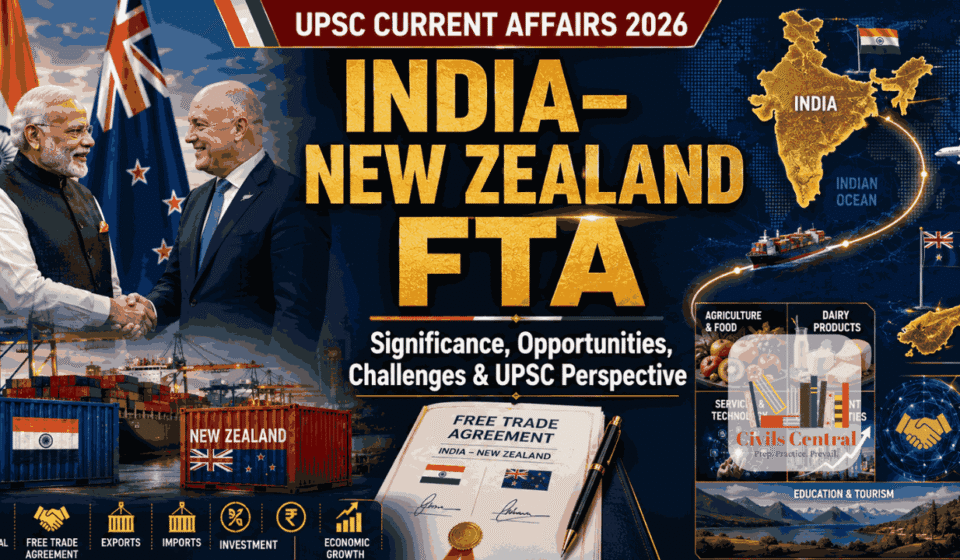
India–New Zealand Free Trade Agreement (FTA): Significance, Opportunities, Challenges and UPSC Perspective

Introduction
India’s growing network of Free Trade Agreements (FTAs) reflects its strategy of integrating more deeply with the global economy while strengthening its geopolitical partnerships. The proposed India–New Zealand Free Trade Agreement (FTA) is one such initiative that aims to enhance bilateral trade, investment, technology cooperation, and supply chain resilience between two democratic Indo-Pacific nations.
Although India and New Zealand enjoy cordial diplomatic relations, bilateral trade has remained relatively modest compared to its potential. A comprehensive FTA seeks to unlock new opportunities by reducing tariff and non-tariff barriers, facilitating investment, improving market access, and promoting cooperation in emerging sectors such as digital trade, education, renewable energy, and agri-technology.
For UPSC aspirants, the India–New Zealand FTA is important because it connects multiple dimensions of the syllabus, including:
- India’s foreign trade policy
- International economic relations
- WTO and multilateral trade
- Indo-Pacific strategy
- Agriculture and dairy policy
- Services trade and skilled migration
- Supply chain diversification
- Economic diplomacy
Understanding this agreement requires not only knowledge of the latest developments but also a clear grasp of the underlying concepts of international trade, trade agreements, comparative advantage, tariff liberalisation, and India’s broader economic strategy.
Why in News?
India and New Zealand have restarted negotiations for a comprehensive Free Trade Agreement (FTA) after a gap of nearly a decade. The renewed discussions reflect the commitment of both countries to strengthen economic ties amid changing global trade dynamics and efforts to diversify supply chains. The negotiations are expected to cover goods, services, investment, customs procedures, digital trade, government procurement, and regulatory cooperation.
The revival comes at a time when India has accelerated its trade engagement with major economies through agreements such as those with the UAE, Australia, and the United Kingdom, while New Zealand is seeking to expand its trade partnerships in the Indo-Pacific region.
The renewed negotiations also align with India’s broader objective of increasing exports, attracting foreign investment, integrating into global value chains, and reducing dependence on limited markets.
Background of India–New Zealand Economic Relations
India and New Zealand established diplomatic relations in 1952, and over the decades the relationship has expanded beyond political engagement to include trade, education, agriculture, sports, tourism, and people-to-people ties.
Despite friendly relations, bilateral trade remains relatively low compared to India’s trade with Australia, ASEAN, Japan, or the European Union. This indicates substantial untapped potential for economic cooperation.
Some major characteristics of the bilateral relationship include:
- Stable diplomatic relations based on democratic values.
- Membership in the Commonwealth.
- Cooperation in the Indo-Pacific region.
- Growing educational linkages, with Indian students forming one of the largest international student communities in New Zealand.
- Collaboration in agriculture, food processing, research, renewable energy, and innovation.
An FTA is expected to provide an institutional framework to expand this partnership.
India–New Zealand Trade at a Glance
| Parameter | India | New Zealand |
|---|---|---|
| Type of Economy | Large emerging economy | Advanced developed economy |
| Major Strengths | Manufacturing, IT services, pharmaceuticals, textiles | Dairy, agriculture, horticulture, forestry, education |
| Nature of Trade | Complementary | Complementary |
| Strategic Region | South Asia and Indian Ocean | South Pacific and Indo-Pacific |
Major Indian Exports
India exports a diversified basket of products to New Zealand, including:
- Pharmaceuticals
- Textiles and garments
- Machinery
- Electrical equipment
- Engineering goods
- Automobiles and auto components
- Organic chemicals
- Jewellery
India also exports a growing range of IT-enabled services and professional services.
Major Imports from New Zealand
India imports:
- Wool
- Timber
- Pulp and paper
- Fruits (especially kiwi apples)
- Dairy-related products (limited due to tariffs)
- Agricultural products
- Aluminium products
Evolution of FTA Negotiations
The idea of a bilateral Free Trade Agreement has existed for more than a decade.
Early Negotiations
Negotiations formally began in 2010, with several rounds of discussions held over the following years.
However, talks gradually stalled because of significant differences on several sensitive issues, including:
- Market access for dairy products.
- Tariff liberalisation.
- Services mobility.
- Agricultural safeguards.
- Investment rules.
Why Negotiations Stalled?
The major hurdle was the dairy sector. New Zealand is among the world’s largest exporters of dairy products and sought greater access to the Indian market. India, however, viewed unrestricted dairy imports as a potential threat to the livelihoods of millions of small dairy farmers and dairy cooperatives.
Other issues included:
- Rules of origin.
- Tariff reduction schedules.
- Services market access.
- Labour mobility.
- Intellectual property provisions.
Why Talks Have Restarted?
The current geopolitical and economic environment has significantly changed since the earlier negotiations.
Several developments have encouraged both countries to resume discussions:
- Reconfiguration of global supply chains.
- India’s focus on export-led growth.
- Greater emphasis on trusted economic partnerships.
- Indo-Pacific strategic cooperation.
- Expansion of digital economy.
- Demand for resilient trade networks.
- Increasing investment opportunities.
The experience gained from India’s recent trade agreements has also improved its negotiating capacity.
Why is the India–New Zealand FTA Important?
The proposed agreement is significant not only for bilateral trade but also for India’s broader economic and strategic objectives.
1. Expanding Export Markets
Indian exporters could gain improved access to a high-income developed market with strong purchasing power.
Potential beneficiaries include:
- Pharmaceuticals
- Engineering goods
- Textiles
- Gems and jewellery
- Processed food
- Chemicals
2. Strengthening the Services Sector
India enjoys a comparative advantage in services.
The agreement could improve opportunities in:
- Information Technology
- Digital services
- Financial services
- Professional services
- Education
- Healthcare
- Consulting
Since services account for a large share of India’s GDP, greater market access can generate significant employment.
3. Investment Opportunities
An FTA generally improves investor confidence by creating transparent and predictable trade rules.
This can encourage:
- Foreign Direct Investment (FDI)
- Joint ventures
- Technology transfer
- Innovation partnerships
- Startup collaboration
4. Diversification of Supply Chains
The COVID-19 pandemic highlighted the risks of excessive dependence on a limited number of trading partners. India is pursuing diversified supply chains through partnerships with trusted countries.
New Zealand can contribute in sectors such as:
- Food processing
- Agricultural technology
- Renewable energy
- Biotechnology
- Logistics
5. Indo-Pacific Strategic Importance
Beyond economics, the FTA has strategic implications.
Both countries support:
- A free, open, inclusive, and rules-based Indo-Pacific.
- Maritime security.
- Sustainable economic growth.
- Regional stability.
- Resilient supply chains.
Thus, the agreement strengthens India’s broader Indo-Pacific engagement.
UPSC Important Topics:
| Topic | UPSC Importance |
|---|---|
| Free Trade Agreements | Economy (GS III & Prelims) |
| WTO | Prelims & GS III |
| India’s Trade Policy | GS III |
| Indo-Pacific | GS II |
| Agriculture & Dairy | GS III |
| Global Value Chains | Economy |
| Economic Diplomacy | International Relations |
| Supply Chain Resilience | Current Affairs + Economy |
Key Takeaways
- India and New Zealand have revived negotiations for a comprehensive Free Trade Agreement after nearly a decade.
- The agreement seeks to enhance trade, investment, services, digital cooperation, and economic integration.
- Dairy market access remains one of the most sensitive negotiating issues.
- The FTA aligns with India’s strategy of expanding exports, strengthening global value chains, and deepening Indo-Pacific partnerships.
- The topic is highly relevant for UPSC Prelims, GS-II (International Relations), GS-III (Economy), Essay, and the Personality Test.
Understanding Free Trade Agreements and Global Trade Architecture
The India–New Zealand Free Trade Agreement (FTA) cannot be understood in isolation. It is part of a broader framework of international trade governed by the World Trade Organization (WTO), regional trade agreements, and national trade policies. UPSC frequently tests these foundational concepts in both Prelims and Mains.
What is International Trade?
International trade refers to the exchange of goods and services between countries. It enables nations to specialize in producing goods and services in which they have a comparative advantage, thereby improving efficiency, productivity, and consumer welfare.
Why Do Countries Trade?
Countries trade because:
- Natural resources are unevenly distributed.
- Climatic conditions vary across regions.
- Countries possess different levels of technology and capital.
- Labour costs differ.
- Consumer preferences vary.
- Trade allows specialization and economies of scale.
Benefits of International Trade
- Efficient allocation of resources.
- Access to larger markets.
- Lower prices for consumers.
- Increased competition and innovation.
- Employment generation.
- Technology transfer.
- Higher foreign exchange earnings.
- Integration into Global Value Chains (GVCs).
UPSC Tip: Trade is not merely about exports and imports. It is also a tool of foreign policy, strategic partnerships, and economic diplomacy.
What is a Free Trade Agreement (FTA)?
A Free Trade Agreement (FTA) is an agreement between two or more countries to reduce or eliminate tariffs and other trade barriers on a substantial number of goods and services.
Unlike a customs union, each country under an FTA retains its own trade policy towards non-member countries.
Objectives of an FTA
- Promote bilateral or regional trade.
- Increase market access.
- Encourage investments.
- Facilitate technology transfer.
- Improve competitiveness.
- Strengthen economic cooperation.
Key Features
- Reduction or elimination of customs duties.
- Liberalisation of trade in services.
- Investment protection provisions.
- Customs cooperation.
- Trade facilitation measures.
- Rules of Origin.
- Dispute settlement mechanisms.
- Intellectual Property Rights (IPR) provisions (in some FTAs).
Example
If India removes tariffs on New Zealand’s horticultural products while New Zealand reduces tariffs on Indian pharmaceuticals and textiles, trade between the two countries becomes cheaper and more competitive.
UPSC Concept Box
Why Doesn’t an FTA Eliminate All Tariffs?
Most FTAs do not remove tariffs on every product.
Countries maintain protection for sensitive sectors, such as:
- Agriculture
- Dairy
- Defence production
- Strategic industries
- Infant industries
India’s reluctance to liberalise dairy imports in negotiations with New Zealand is an example of protecting a sensitive domestic sector.
What is a Preferential Trade Agreement (PTA)?
A Preferential Trade Agreement (PTA) is the most basic form of trade agreement, where participating countries agree to reduce tariffs on selected goods, but do not eliminate them completely.
Features
- Partial tariff concessions.
- Covers limited products.
- Less comprehensive than an FTA.
Example
A country may reduce the import duty on selected agricultural products from another country while maintaining normal tariffs on all other products.
What is a Comprehensive Economic Cooperation Agreement (CECA)?
A Comprehensive Economic Cooperation Agreement (CECA) goes beyond trade in goods. It includes broader economic cooperation.
It generally covers:
- Goods
- Services
- Investment
- Technology
- Intellectual Property
- Customs cooperation
- Capacity building
A CECA is broader in scope than a traditional FTA.
What is a Comprehensive Economic Partnership Agreement (CEPA)?
A Comprehensive Economic Partnership Agreement (CEPA) is an advanced form of trade agreement that integrates trade with wider economic collaboration.
Typical Components
- Trade in goods.
- Trade in services.
- Investment.
- Digital trade.
- Movement of professionals.
- Mutual recognition of qualifications.
- Regulatory cooperation.
- Innovation and research.
- Government procurement.
- Competition policy.
India has entered into CEPAs with several countries, reflecting its preference for comprehensive agreements rather than narrow tariff-focused FTAs.
Difference Between PTA, FTA, CECA and CEPA
| Feature | PTA | FTA | CECA | CEPA |
|---|---|---|---|---|
| Tariff Reduction | Partial | Significant | Significant | Significant |
| Goods | Limited | Yes | Yes | Yes |
| Services | Usually No | Sometimes | Yes | Yes |
| Investment | No | Limited | Yes | Yes |
| Technology Cooperation | No | Limited | Yes | Yes |
| Regulatory Cooperation | No | Limited | Moderate | Extensive |
| Scope | Narrow | Moderate | Broad | Very Broad |
Exam Note: UPSC often asks the difference between these agreements in conceptual MCQs.
What is a Customs Union?
A Customs Union is a deeper level of economic integration than an FTA.
Members:
- Remove tariffs among themselves.
- Adopt a Common External Tariff (CET) against non-member countries.
Example
If Country A and Country B form a customs union, both charge the same import tariff on goods coming from Country C. Unlike an FTA, individual members cannot independently determine tariffs for non-members.
What is a Common Market?
A Common Market includes all the features of a customs union and additionally allows the free movement of factors of production.
This means:
- Goods move freely.
- Services move freely.
- Capital moves freely.
- Labour moves freely.
This requires greater policy coordination among member states.
What is an Economic Union?
An Economic Union represents one of the highest levels of economic integration.
It includes:
- Common market.
- Harmonised economic policies.
- Common competition policy.
- Fiscal coordination.
- In some cases, a common currency.
This level of integration requires significant political and economic cooperation.
Stages of Economic Integration
| Stage | Key Feature |
|---|---|
| Preferential Trade Agreement | Reduced tariffs on selected goods |
| Free Trade Agreement | Elimination of tariffs among members |
| Customs Union | FTA + Common External Tariff |
| Common Market | Customs Union + Free movement of labour and capital |
| Economic Union | Common Market + Harmonised economic policies |
| Political Union | Complete political integration |
What are Tariffs?
A tariff is a tax imposed by a government on imported goods.
Objectives
- Protect domestic industries.
- Raise government revenue.
- Correct trade imbalances.
- Encourage domestic production.
- Reduce dumping.
Types of Tariffs
Ad Valorem Tariff
Calculated as a percentage of the product’s value.
Example:
- 20% import duty on electronics.
Specific Tariff
A fixed amount charged per unit.
Example:
- ₹100 per kilogram of imported apples.
Mixed Tariff
Combination of ad valorem and specific tariffs.
What are Non-Tariff Barriers (NTBs)?
Even when tariffs are reduced, trade may still be restricted through Non-Tariff Barriers (NTBs).
Examples include:
- Import quotas.
- Licensing requirements.
- Sanitary and Phytosanitary (SPS) standards.
- Technical Barriers to Trade (TBT).
- Complex customs procedures.
- Product certification requirements.
- Environmental regulations.
Why Are NTBs Important?
Developed countries increasingly use technical standards instead of tariffs to regulate imports. For exporters, complying with these standards is often more challenging than paying tariffs.
UPSC Concept
Sanitary and Phytosanitary (SPS) Measures
Meaning: Measures adopted to protect humans, animals, and plants from diseases, pests, and contaminants.
Examples:
- Food safety standards.
- Animal health regulations.
- Plant quarantine requirements.
UPSC Relevance: SPS measures frequently appear in WTO-related questions and are important in agricultural trade negotiations.
What are Rules of Origin (RoO)?
Rules of Origin determine the country from which a product is considered to originate. They prevent trade deflection, where goods from a non-member country are routed through an FTA member to benefit from lower tariffs.
Example
Suppose India has an FTA with New Zealand but not with Country X.
Without Rules of Origin:
- Country X could export products to New Zealand.
- Re-export them to India.
- Illegitimately enjoy lower tariffs.
Rules of Origin ensure that only goods meeting specified criteria qualify for FTA benefits.
What are Safeguard Measures?
Safeguard measures are temporary restrictions imposed when a sudden surge in imports threatens domestic industries.
They may include:
- Temporary tariffs.
- Import quotas.
- Emergency restrictions.
These measures provide time for domestic industries to adjust.
Trade Creation vs Trade Diversion
Understanding these concepts is essential for evaluating whether an FTA is beneficial.
| Trade Creation | Trade Diversion |
|---|---|
| Efficient producers replace inefficient domestic producers. | Efficient non-member producers are replaced by less efficient FTA partners due to tariff preferences. |
| Improves economic welfare. | May reduce global efficiency. |
| Increases competition. | Can distort trade patterns. |
Example
If India imports cheaper dairy products from an efficient New Zealand producer instead of producing them domestically at a higher cost, this is trade creation. If India shifts imports from a more efficient non-member country merely because New Zealand enjoys tariff concessions, it is trade diversion.
Comparative Advantage
The theory of Comparative Advantage, developed by economist David Ricardo, explains why countries benefit from trade even if one country is more efficient in producing all goods. A country should specialize in producing goods that it can produce at a lower opportunity cost than others.
India’s Comparative Advantages
- IT and digital services.
- Pharmaceuticals.
- Engineering goods.
- Textiles.
- Skilled workforce.
New Zealand’s Comparative Advantages
- Dairy.
- Sheep farming.
- Horticulture.
- Forestry.
- Food processing.
An FTA allows each country to leverage these strengths.
World Trade Organization (WTO): The Global Trade Regulator
The World Trade Organization (WTO) is the principal international organization responsible for regulating global trade. It came into existence on 1 January 1995, replacing the General Agreement on Tariffs and Trade (GATT), 1947.
Objectives
- Promote free and fair trade.
- Reduce trade barriers.
- Resolve trade disputes.
- Ensure transparency in trade rules.
- Facilitate trade negotiations.
Key Principles
- Most Favoured Nation (MFN): Equal treatment for all WTO members.
- National Treatment: Imported goods should be treated no less favourably than domestic goods after entering the market.
- Transparency: Clear and predictable trade rules.
- Non-Discrimination: Equal opportunities for all trading partners.
UPSC Insight: FTAs are an exception to the WTO’s MFN principle under specific conditions, allowing members to grant preferential treatment to each other without extending the same benefits to all WTO members.
India’s FTA Strategy: A Shift in Approach
India’s approach to FTAs has evolved significantly. Earlier, India adopted a cautious stance due to concerns about trade deficits and domestic industry protection.
In recent years, India has pursued high-quality, balanced, and mutually beneficial FTAs to:
- Increase exports.
- Integrate with Global Value Chains (GVCs).
- Attract investment.
- Strengthen strategic partnerships.
- Promote domestic manufacturing under initiatives such as Make in India and Atmanirbhar Bharat.
The proposed India–New Zealand FTA is part of this broader strategy.
India–New Zealand Free Trade Agreement in Detail
The proposed India–New Zealand Free Trade Agreement (FTA) is more than a conventional tariff reduction agreement. It represents a strategic economic partnership aimed at enhancing bilateral trade, investment, services, innovation, and cooperation in the Indo-Pacific.
Evolution of India–New Zealand FTA Negotiations
Beginning of Negotiations (2010)
India and New Zealand formally launched negotiations for a comprehensive FTA in 2010. Several rounds of discussions were held over the next few years with the objective of expanding bilateral trade and investment.
The proposed agreement aimed to cover:
- Trade in goods
- Trade in services
- Investment
- Customs cooperation
- Rules of Origin
- Intellectual Property Rights (IPR)
- Trade facilitation
- Sanitary and Phytosanitary (SPS) measures
Despite initial progress, negotiations eventually stalled due to differences over market access and sensitive sectors.
Why Did the Negotiations Stall?
The most significant obstacle was the dairy sector, although other issues also contributed.
1. Dairy Market Access
New Zealand is one of the world’s largest exporters of dairy products, including:
- Milk powder
- Butter
- Cheese
- Infant formula
Its dairy industry is highly efficient, technologically advanced, and export-oriented.
India, on the other hand:
- Is the world’s largest producer of milk.
- Has millions of small and marginal dairy farmers.
- Depends on dairy as a major source of rural livelihoods.
- Operates through cooperative models such as Amul and other state milk federations.
Opening India’s dairy market to duty-free imports could expose small producers to intense international competition. Therefore, India has consistently treated dairy as a sensitive sector in FTA negotiations.
UPSC Concept Box
Why is Dairy a Sensitive Sector for India?
Economic Reasons
- Livelihood security for millions of rural households.
- Major source of supplementary income.
- Employment generation, especially for women.
Social Reasons
- Supports nutritional security.
- Reduces rural poverty.
- Strengthens cooperative institutions.
Political Reasons
- Dairy cooperatives have significant socio-economic importance.
- Sudden import liberalisation may face resistance from farmers.
2. Services Mobility
India sought greater market access for:
- IT professionals
- Engineers
- Doctors
- Architects
- Chartered Accountants
- Skilled workers
Movement of professionals is a major priority for India in trade negotiations because the services sector contributes significantly to GDP and exports. Negotiations focused on easing visa procedures, recognition of professional qualifications, and temporary movement of skilled workers.
3. Tariff Liberalisation
Both countries negotiated the pace and extent of tariff reductions.
India preferred a phased approach, especially for:
- Agriculture
- Dairy
- Processed food
- Sensitive manufacturing sectors
New Zealand sought faster and broader tariff elimination.
4. Rules of Origin
India emphasised robust Rules of Origin to prevent:
- Trade deflection
- Circumvention of tariffs
- Misuse of FTA benefits by third countries
This has become increasingly important after India’s experience with certain trade agreements where imports from non-member countries were allegedly routed through FTA partners.
Why Have Negotiations Been Revived?
Several developments have reshaped the global trade landscape since negotiations first began.
Changing Global Supply Chains
The COVID-19 pandemic exposed vulnerabilities in global production networks.
Countries now seek:
- Diversified sourcing
- Trusted trade partners
- Reduced dependence on single-country supply chains
India’s trade policy increasingly reflects these priorities.
India’s New Trade Strategy
India has shifted from a cautious approach towards FTAs to negotiating balanced and mutually beneficial agreements. Recent agreements with partners such as the UAE, Australia, and the UK (signed in principle before implementation) demonstrate this renewed strategy.
Key objectives include:
- Boosting exports
- Increasing manufacturing competitiveness
- Attracting investment
- Integrating with Global Value Chains (GVCs)
Indo-Pacific Cooperation
India and New Zealand are important stakeholders in the Indo-Pacific region. Economic cooperation complements broader strategic objectives such as:
- Free and open sea lanes
- Maritime security
- Supply chain resilience
- Rules-based international order
- Sustainable development
Thus, the FTA has both economic and geopolitical significance.
What Does India Seek from the FTA?
India’s negotiating priorities extend beyond tariff reduction.
1. Greater Market Access for Goods
India seeks improved access for products such as:
- Pharmaceuticals
- Textiles
- Apparel
- Engineering goods
- Machinery
- Auto components
- Chemicals
- Gems and jewellery
- Leather products
Reducing tariffs on these products would improve India’s export competitiveness.
2. Expansion of Services Exports
Services are among India’s strongest competitive sectors.
Key priorities include:
- Information Technology (IT)
- IT-enabled services (ITES)
- Financial services
- Education
- Healthcare
- Professional consultancy
- Legal and accounting services (subject to domestic regulations)
India also seeks easier mobility for professionals under Mode 4 of the WTO’s General Agreement on Trade in Services (GATS).
3. Investment Promotion
India aims to attract New Zealand investment in:
- Renewable energy
- Food processing
- Logistics
- Cold chain infrastructure
- Smart agriculture
- Dairy technology
- Water management
- Sustainable infrastructure
Such investments can contribute to employment generation and technology transfer.
4. Technology and Innovation
Areas of cooperation include:
- Agri-tech
- Biotechnology
- Artificial Intelligence
- Digital public infrastructure
- Climate-resilient agriculture
- Clean energy technologies
Innovation partnerships can strengthen India’s knowledge economy.
What Does New Zealand Seek?
New Zealand’s priorities reflect its export-oriented economy.
Improved Access for Agricultural Products
Key export interests include:
- Dairy products
- Meat
- Fruits
- Wine
- Horticultural products
- Processed food
Agriculture contributes significantly to New Zealand’s exports.
Services and Education
New Zealand also seeks to expand cooperation in:
- Higher education
- Skill development
- Tourism
- Research collaboration
- Student mobility
India represents an important source of international students.
Investment Opportunities
New Zealand businesses are interested in sectors such as:
- Renewable energy
- Food processing
- Infrastructure
- Agri-business
- Logistics
- Technology partnerships
Sector-Wise Opportunities Under the FTA
Pharmaceuticals
India is among the world’s leading producers of affordable generic medicines.
Potential benefits include:
- Easier regulatory approvals
- Expanded exports
- Healthcare collaboration
- Medical research partnerships
Textiles and Apparel
Tariff reductions can improve the competitiveness of Indian garments and textiles in New Zealand.
Potential gains include:
- Higher exports
- Employment generation
- Support for MSMEs
Engineering Goods
India’s engineering exports include:
- Industrial machinery
- Pumps
- Electrical equipment
- Machine tools
- Automotive components
Reduced trade barriers could increase export opportunities.
Information Technology
India’s globally competitive IT sector could benefit from:
- Cross-border digital services
- Cloud computing
- Cybersecurity cooperation
- Software exports
- Digital transformation projects
Agriculture
Agricultural cooperation may include:
- Precision farming
- Seed technology
- Irrigation
- Farm mechanisation
- Climate-smart agriculture
- Food processing
Rather than competing directly, both countries can collaborate in technology and value addition.
Renewable Energy
Potential cooperation areas include:
- Solar energy
- Green hydrogen
- Wind energy
- Energy storage
- Climate technologies
This aligns with India’s commitment to achieving Net Zero emissions by 2070.
Education
India and New Zealand already have strong educational ties.
Future cooperation may include:
- Student exchange programmes
- Joint research
- Skill development
- Mutual recognition of qualifications
- Digital education
Education services are likely to become an increasingly important component of bilateral relations.
Sensitive Sectors in the Negotiations
Not all sectors are expected to be fully liberalised.
Dairy
India is likely to continue protecting dairy because of:
- Rural employment
- Cooperative movement
- Food security
- Livelihood concerns
Agriculture
India may also retain safeguards for:
- Cereals
- Pulses
- Plantation crops
- Horticultural products
where necessary to protect farmers.
MSMEs
Micro, Small and Medium Enterprises (MSMEs) often face challenges in competing with imported products.
India may negotiate:
- Longer tariff reduction schedules
- Transitional safeguards
- Technical support measures
Potential Benefits of the India–New Zealand FTA
Economic Benefits
- Higher bilateral trade
- Greater export opportunities
- Increased FDI
- Better technology transfer
- Improved productivity
- Enhanced competitiveness
Strategic Benefits
- Stronger Indo-Pacific partnership
- Supply chain diversification
- Economic resilience
- Enhanced regional influence
Social Benefits
- Employment generation
- Skill development
- Educational cooperation
- Innovation ecosystem
- Consumer choice
Risks and Concerns
Despite its potential, the FTA presents certain challenges.
Import Competition
Domestic industries may face pressure from imported products.
Trade Deficit
If imports rise faster than exports, India’s trade deficit could widen.
Adjustment Costs
Certain sectors may require:
- Skill upgradation
- Technological modernisation
- Government support
Regulatory Compliance
Indian exporters must comply with:
- SPS standards
- Technical Barriers to Trade (TBT)
- Product certification requirements
- Environmental standards
Failure to meet these standards may reduce the benefits of tariff concessions.
How Does This FTA Fit into India’s Trade Strategy?
The proposed India–New Zealand FTA complements India’s broader objectives of:
- Becoming a global manufacturing hub.
- Increasing merchandise and services exports.
- Strengthening participation in Global Value Chains.
- Promoting Make in India.
- Supporting Atmanirbhar Bharat through competitive integration rather than protectionism.
- Enhancing economic engagement with the Indo-Pacific.
Instead of pursuing trade liberalisation at any cost, India is increasingly negotiating balanced FTAs that protect sensitive sectors while opening new opportunities for competitive industries.
Key Takeaways
- The India–New Zealand FTA aims to deepen trade, investment, services, and strategic cooperation.
- Dairy remains the most sensitive issue due to its importance for India’s rural economy.
- India seeks greater market access for pharmaceuticals, textiles, engineering goods, and IT services.
- New Zealand prioritises improved access for agricultural and dairy exports.
- The agreement reflects India’s evolving FTA strategy focused on balanced liberalisation, resilient supply chains, and Indo-Pacific partnerships.
Important Terminologies, Comparison Tables and Multidimensional Analysis
The India–New Zealand Free Trade Agreement (FTA) is closely linked to several concepts in international trade, economics, and international relations. UPSC often frames conceptual questions around these terms rather than asking directly about a particular FTA. Therefore, understanding these concepts is essential.
Important Terminologies
1. Trade Balance
The Trade Balance is the difference between the value of a country’s exports and imports of goods over a specific period.
Formula
Trade Balance = Exports – Imports
Types
- Trade Surplus: Exports exceed imports.
- Trade Deficit: Imports exceed exports.
- Balanced Trade: Exports equal imports.
Why is it Important?
- Reflects the competitiveness of domestic industries.
- Influences foreign exchange reserves.
- Affects economic growth and employment.
- Impacts the Current Account Balance.
UPSC Insight: A trade deficit is not always undesirable. If imports consist of capital goods, technology, or raw materials that enhance productive capacity, they can support long-term economic growth.
2. Balance of Payments (BoP)
The Balance of Payments (BoP) is a comprehensive record of all economic transactions between residents of a country and the rest of the world during a given period.
Components of the BoP
- Current Account
- Trade in goods
- Trade in services
- Income (interest, dividends)
- Current transfers (remittances)
- Capital Account
- Capital transfers
- Acquisition or disposal of non-produced, non-financial assets
- Financial Account
- Foreign Direct Investment (FDI)
- Foreign Portfolio Investment (FPI)
- External Commercial Borrowings (ECBs)
- Banking capital
- Reserve assets
3. Global Value Chains (GVCs)
A Global Value Chain (GVC) refers to the process where different stages of production are carried out across multiple countries before a product reaches consumers.
Example
A smartphone may involve:
- Design in one country.
- Semiconductor manufacturing in another.
- Display production elsewhere.
- Assembly in a different country.
- Marketing globally.
Why are GVCs Important?
- Improve efficiency.
- Encourage specialization.
- Attract investment.
- Promote technology transfer.
- Generate employment.
India’s Objective
India aims to increase its participation in GVCs through:
- Make in India
- Production Linked Incentive (PLI) Scheme
- National Logistics Policy
- High-quality FTAs
4. Market Access
Market Access refers to the conditions under which goods and services from one country can enter another country’s market.
It depends on:
- Tariffs
- Quotas
- Technical regulations
- Licensing requirements
- Standards
- Customs procedures
Example
If New Zealand reduces tariffs on Indian pharmaceuticals, India gains better market access.
5. Most Favoured Nation (MFN)
The Most Favoured Nation (MFN) principle is a cornerstone of the WTO. It requires a country to treat all WTO members equally regarding trade concessions.
Example
If a country reduces tariffs for one WTO member, the same benefit should generally be extended to all WTO members.
Exception
Free Trade Agreements (FTAs) are a recognized exception under WTO rules, allowing member countries to grant preferential treatment to each other.
6. National Treatment
The National Treatment principle requires that imported goods, once they have entered a country’s market, must be treated no less favourably than similar domestically produced goods.
Example
An imported pharmaceutical product should not face discriminatory taxes or regulations compared to a domestically manufactured equivalent after customs clearance.
7. Foreign Direct Investment (FDI)
FDI occurs when an investor acquires a lasting interest and a significant degree of control in an enterprise located in another country.
Characteristics
- Long-term investment.
- Transfer of technology.
- Management participation.
- Employment generation.
8. Foreign Portfolio Investment (FPI)
FPI refers to investments in financial assets such as:
- Shares
- Bonds
- Mutual funds
Unlike FDI, FPI does not provide managerial control and is generally more volatile.
9. Trade Facilitation
Trade facilitation involves simplifying and harmonizing international trade procedures to reduce costs and delays.
Measures Include
- Electronic customs documentation.
- Single Window clearance.
- Digital certification.
- Risk-based inspections.
- Faster cargo clearance.
Importance
- Lowers transaction costs.
- Enhances export competitiveness.
- Improves ease of doing business.
10. Sanitary and Phytosanitary (SPS) Measures
SPS measures protect:
- Human health.
- Animal health.
- Plant health.
Examples include:
- Food safety regulations.
- Pest control measures.
- Animal disease prevention.
- Plant quarantine standards.
These measures are governed by the WTO SPS Agreement.
11. Technical Barriers to Trade (TBT)
TBTs are technical regulations and standards that products must satisfy before entering a market.
Examples include:
- Product quality standards.
- Safety certifications.
- Environmental standards.
- Packaging requirements.
- Labelling norms.
Unlike SPS measures, TBTs focus on technical compliance rather than biological safety.
Comparison Tables
FDI vs FPI
| Feature | FDI | FPI |
|---|---|---|
| Nature | Long-term investment | Short-term financial investment |
| Ownership | Significant control | No managerial control |
| Stability | Relatively stable | Highly volatile |
| Technology Transfer | Yes | No |
| Employment Generation | High | Limited |
Trade in Goods vs Trade in Services
| Goods | Services |
|---|---|
| Physical products | Intangible activities |
| Cross customs borders | Often supplied digitally or through people |
| Subject to tariffs | Generally not subject to tariffs |
| Example: Textiles | Example: IT services |
SPS vs TBT
| SPS | TBT |
|---|---|
| Protects human, animal, and plant health | Ensures technical quality and safety |
| Biological risks | Technical standards |
| Example: Food safety | Example: Product labelling |
Tariff vs Non-Tariff Barrier
| Tariff | Non-Tariff Barrier |
|---|---|
| Tax on imports | Regulatory restriction |
| Easy to quantify | Often difficult to measure |
| Revenue source | Usually not a revenue source |
UPSC Concept
Why Are Modern FTAs Different from Traditional FTAs?
Earlier FTAs primarily focused on reducing tariffs on goods.
Modern FTAs include:
- Digital trade
- E-commerce
- Investment
- Intellectual Property Rights (IPR)
- Competition policy
- Government procurement
- Environmental standards
- Labour standards
- Data governance
- MSME cooperation
UPSC Relevance: Contemporary trade agreements increasingly address behind-the-border regulatory issues in addition to border tariffs.
India’s Perspective
The India–New Zealand FTA is significant not only from a trade standpoint but also for India’s strategic, developmental, and geopolitical objectives.
Economic Dimension (GS Paper III)
Export Diversification
India seeks to reduce dependence on a limited number of export markets by expanding access to developed economies like New Zealand.
Employment Generation
Labour-intensive sectors such as:
- Textiles
- Leather
- Engineering goods
- Food processing
- Pharmaceuticals
could benefit from increased exports.
MSME Growth
Improved market access can help Indian MSMEs:
- Scale up production.
- Access global markets.
- Integrate into GVCs.
Technology Transfer
Investment from New Zealand can support:
- Agri-tech
- Dairy technology
- Renewable energy
- Logistics
- Biotechnology
International Relations Dimension (GS Paper II)
Indo-Pacific Strategy
India and New Zealand share an interest in:
- Freedom of navigation.
- Rules-based international order.
- Maritime security.
- Regional connectivity.
The FTA strengthens India’s engagement in the Indo-Pacific.
Economic Diplomacy
Trade agreements increasingly serve as instruments of foreign policy.
They:
- Build strategic partnerships.
- Increase political trust.
- Expand economic influence.
- Reduce geopolitical vulnerabilities.
Agriculture Dimension (GS Paper III)
Agriculture presents both opportunities and challenges.
Opportunities
- Precision agriculture.
- Climate-smart farming.
- Cold chain development.
- Food processing.
- Agricultural research.
- Irrigation technologies.
Challenges
- Dairy imports.
- Farmer livelihoods.
- Competition from highly efficient exporters.
Therefore, India is expected to adopt a calibrated approach, liberalizing where beneficial while protecting vulnerable sectors.
Science & Technology Dimension
Potential cooperation includes:
- Biotechnology.
- Artificial Intelligence.
- Precision agriculture.
- Food technology.
- Renewable energy.
- Digital public infrastructure.
Such collaboration can contribute to innovation-led growth.
Environment Dimension
India and New Zealand can cooperate in:
- Climate-resilient agriculture.
- Renewable energy.
- Sustainable forestry.
- Green technologies.
- Carbon emission reduction.
- Circular economy practices.
This aligns with commitments under the Paris Agreement and the Sustainable Development Goals (SDGs).
Governance Dimension
Trade facilitation measures encourage:
- Transparent customs procedures.
- Digital governance.
- Paperless trade.
- Improved regulatory coordination.
- Ease of doing business.
These reforms benefit domestic governance in addition to international trade.
Social Dimension
Greater cooperation can promote:
- Educational exchanges.
- Skill development.
- Research partnerships.
- Tourism.
- Cultural understanding.
- Employment opportunities.
Strategic Dimension
The agreement contributes to India’s objective of becoming a trusted economic partner in the Indo-Pacific.
It complements broader initiatives such as:
- Act East Policy.
- Indo-Pacific Oceans Initiative (IPOI).
- Supply Chain Resilience efforts.
- India’s aspiration to become a global manufacturing hub.
Challenges
1. Protecting India’s Dairy Sector
The dairy sector remains the most sensitive issue in the negotiations.
Why is Dairy Sensitive?
India is the world’s largest milk producer, but unlike New Zealand, production is largely undertaken by small and marginal farmers. Dairy farming provides:
- Regular household income
- Nutritional security
- Employment for women
- Livelihood support for landless families
- Strength to cooperative institutions
Highly subsidised or competitive imports could adversely affect millions of rural households.
2. Trade Deficit Concerns
Although FTAs aim to increase bilateral trade, imports may sometimes grow faster than exports.
This can lead to:
- Widening trade deficits
- Pressure on domestic industries
- Reduced competitiveness of MSMEs
India has become increasingly cautious after reviewing outcomes of some earlier FTAs.
3. Non-Tariff Barriers
Even if tariffs are reduced, exporters may still face barriers such as:
- Stringent food safety standards
- Quality certification requirements
- Environmental regulations
- Packaging and labelling norms
- Technical compliance costs
Indian exporters, especially MSMEs, often face difficulties in meeting these standards.
4. Competitiveness of Domestic Industries
Many Indian industries still face challenges related to:
- High logistics costs
- Infrastructure gaps
- Limited economies of scale
- Technology deficits
- High compliance costs
Without improving competitiveness, tariff reductions alone may not significantly increase exports.
5. Global Economic Uncertainty
International trade is increasingly influenced by:
- Geopolitical tensions
- Supply chain disruptions
- Inflation
- Commodity price volatility
- Climate-related risks
These uncertainties can affect the effectiveness of any FTA.
6. Balancing Economic and Strategic Interests
Trade agreements are no longer purely economic instruments.
Countries increasingly consider:
- National security
- Supply chain resilience
- Critical minerals
- Digital sovereignty
- Trusted technology partnerships
India must therefore negotiate agreements that support both economic growth and strategic autonomy.
Way Forward
A successful India–New Zealand FTA should be comprehensive, balanced, and development-oriented.
1. Protect Sensitive Sectors
India should continue to protect sectors that directly affect livelihoods, particularly:
- Dairy
- Certain agricultural commodities
- Vulnerable MSMEs
This can be achieved through:
- Gradual tariff reduction
- Tariff Rate Quotas (TRQs)
- Safeguard mechanisms
- Longer transition periods
2. Improve Export Competitiveness
Trade agreements alone cannot boost exports.
Complementary domestic reforms are necessary, including:
- Better logistics
- Improved port infrastructure
- Reduced compliance burden
- Skill development
- Quality certification
- Research and innovation
Government initiatives such as PM Gati Shakti, the National Logistics Policy, and the Production Linked Incentive (PLI) Scheme can support these objectives.
3. Strengthen MSMEs
The government should assist MSMEs through:
- Export finance
- Technology upgradation
- Digitalisation
- Market intelligence
- Capacity building
- Compliance with international standards
4. Promote Services Exports
India should continue to seek:
- Easier movement of professionals
- Recognition of professional qualifications
- Expansion of digital trade
- Cross-border service delivery
Given India’s comparative advantage, services should remain a central pillar of trade negotiations.
5. Enhance Agricultural Cooperation
Instead of focusing solely on market access, both countries can collaborate in:
- Precision farming
- Dairy technology
- Food processing
- Climate-resilient agriculture
- Cold-chain infrastructure
- Agricultural research
This approach creates mutual gains without undermining farmer welfare.
6. Build Resilient Supply Chains
The agreement should encourage cooperation in:
- Critical technologies
- Renewable energy
- Green hydrogen
- Semiconductors (where feasible)
- Food security
- Logistics
This aligns with India’s objective of becoming a trusted global manufacturing and supply-chain partner.
7. Promote Sustainable Trade
Future trade agreements should integrate:
- Climate resilience
- Environmental sustainability
- Circular economy principles
- Green technologies
- Renewable energy cooperation
Sustainable trade will become increasingly important as countries adopt carbon-related trade measures.
UPSC Perspective
Prelims Focus
Aspirants should remember:
Important Concepts
- Free Trade Agreement (FTA)
- Preferential Trade Agreement (PTA)
- CEPA
- CECA
- WTO
- MFN Principle
- National Treatment
- Rules of Origin
- Tariff
- Non-Tariff Barriers
- SPS Measures
- TBT
- Trade Diversion
- Trade Creation
- Comparative Advantage
- GATS Mode 4
- Global Value Chains (GVCs)
Mains Focus
GS Paper II
International Relations
Relevant themes:
- India’s economic diplomacy
- Indo-Pacific partnerships
- Bilateral relations
- Strategic trade partnerships
GS Paper III
Relevant syllabus areas include:
- Indian Economy
- International Trade
- Agriculture
- Infrastructure
- Inclusive Growth
- Globalisation
- Investment
- Technology
- Supply Chains
Essay
Possible themes:
- Trade as an instrument of diplomacy.
- Balancing globalization with self-reliance.
- India’s role in shaping the Indo-Pacific economic order.
- Free trade and inclusive development.
Ethics (GS IV)
Possible ethical dilemmas include:
- Balancing farmer welfare with consumer interests.
- Protecting livelihoods while promoting efficiency.
- Equity versus economic competitiveness.
- Intergenerational responsibility in sustainable trade.
PYQ Connection
Although UPSC has not asked a question specifically on the India–New Zealand FTA, it has repeatedly tested related concepts.
Previous Areas Asked
- World Trade Organization (WTO)
- Regional Trade Agreements
- Rules of Origin
- Trade Facilitation
- India’s Foreign Trade Policy
- Balance of Payments
- Globalisation
- Agricultural Trade
- Regional Economic Groupings
- India’s bilateral trade agreements
Practice MCQs
MCQ 1
With reference to a Free Trade Agreement (FTA), consider the following statements:
- All tariffs between member countries are completely eliminated immediately after signing an FTA.
- Member countries retain independent trade policies towards non-member countries.
Which of the statements given above is/are correct?
A. 1 only
B. 2 only
C. Both 1 and 2
D. Neither 1 nor 2
Answer: B
Explanation
Statement 1 is incorrect because FTAs generally eliminate tariffs gradually and often exclude sensitive sectors.
Statement 2 is correct because each member maintains its own external tariff policy.
MCQ 2
Which of the following sectors has been the most sensitive issue in the India–New Zealand FTA negotiations?
A. Pharmaceuticals
B. Textiles
C. Dairy
D. Information Technology
Answer: C
Explanation
India seeks to protect millions of small dairy farmers from import competition.
MCQ 3
Which WTO principle generally requires equal treatment of all WTO members?
A. National Treatment
B. Most Favoured Nation
C. Trade Facilitation
D. Rules of Origin
Answer: B
MCQ 4
Which of the following is NOT a Non-Tariff Barrier?
A. Product labelling standards
B. Import licensing
C. Customs duty
D. Food safety regulations
Answer: C
MCQ 5
Rules of Origin are primarily intended to:
A. Increase customs revenue.
B. Prevent trade deflection.
C. Promote export subsidies.
D. Restrict foreign investment.
Answer: B
MCQ 6
Mode 4 under the General Agreement on Trade in Services (GATS) relates to:
A. Digital delivery of services.
B. Temporary movement of natural persons.
C. Foreign direct investment.
D. Cross-border transport.
Answer: B
MCQ 7
Consider the following:
- Global Value Chains involve production across multiple countries.
- Participation in GVCs can enhance technology transfer.
- FTAs may facilitate integration into GVCs.
Which of the statements given above are correct?
A. 1 and 2 only
B. 2 and 3 only
C. 1 and 3 only
D. 1, 2 and 3
Answer: D
UPSC Mains Practice Questions
10 Marks
“Free Trade Agreements have evolved from tariff reduction mechanisms into comprehensive instruments of economic diplomacy.” Discuss in the context of the proposed India–New Zealand Free Trade Agreement.
15 Marks
While Free Trade Agreements promote economic integration, they also raise concerns regarding domestic industries and livelihoods. Examine this statement with reference to the India–New Zealand Free Trade Agreement.
15 Marks
Critically analyse the role of bilateral Free Trade Agreements in strengthening India’s participation in Global Value Chains and achieving sustainable economic growth.
Quick Revision Box
| Topic | Key Points |
|---|---|
| Agreement | India–New Zealand Free Trade Agreement (under negotiation) |
| Negotiations Began | 2010 |
| Nature | Comprehensive bilateral FTA |
| Major Objective | Trade, investment, services, digital cooperation |
| Sensitive Sector | Dairy |
| India’s Priorities | Pharmaceuticals, textiles, engineering goods, IT services, investment |
| New Zealand’s Priorities | Dairy, agriculture, education, investment |
| Important WTO Concepts | MFN, National Treatment, SPS, TBT |
| Related GS Papers | GS II, GS III |
| Keywords | GVC, Rules of Origin, Trade Facilitation, Comparative Advantage |
Beyond the News
The India–New Zealand Free Trade Agreement represents a broader shift in India’s external economic policy—from cautious engagement to calibrated and strategic trade integration.
In an era marked by geopolitical competition, supply-chain disruptions, technological transformation, and climate challenges, trade agreements are increasingly instruments of economic statecraft. They influence not only market access but also resilience, innovation, standards-setting, and strategic partnerships.
For India, the challenge is to pursue high-quality, balanced FTAs that expand opportunities for globally competitive sectors while safeguarding vulnerable communities, particularly farmers and MSMEs. The success of such agreements will depend not only on tariff negotiations but also on domestic reforms that improve infrastructure, logistics, innovation, skill development, and regulatory efficiency.
For future administrators and policymakers, the India–New Zealand FTA illustrates an important lesson: effective trade policy is not merely about opening markets—it is about aligning international engagement with national development objectives, social equity, and long-term strategic interests.
Also Read:
- Free Trade Agreements (FTA): Complete UPSC Guide
- World Trade Organization (WTO): Structure, Functions and Challenges
- India’s Foreign Trade Policy: Objectives and Recent Developments
- Global Value Chains (GVCs): Significance for India’s Manufacturing Sector
- India and the Indo-Pacific: Strategy, Initiatives and Challenges
About The Author