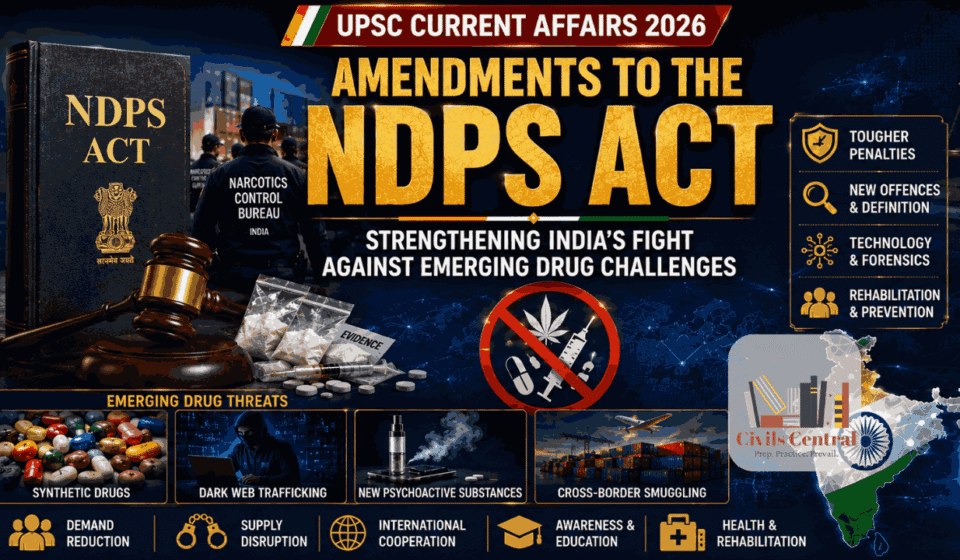
Amendments to the NDPS Act: Strengthening India’s Fight Against Emerging Drug Challenges

Introduction
India’s fight against narcotic drugs and psychotropic substances has entered a new phase. With the rapid evolution of synthetic drugs, darknet-enabled trafficking, cryptocurrency-based payments, and the growing involvement of transnational criminal networks, conventional enforcement mechanisms are no longer sufficient. Recognising these emerging challenges, Union Home Minister Amit Shah, while chairing the 10th Apex-Level Meeting of the Narco-Coordination Centre (NCORD) in June 2026, announced that the Government would amend the Narcotic Drugs and Psychotropic Substances (NDPS) Act, 1985 and the accompanying Rules to make India’s anti-drug framework more effective.
Alongside the proposed legislative amendments, the Ministry of Home Affairs launched the Vision Document on Narcotics Control (2026–2029), released the NCB Annual Report 2025, inaugurated new zonal offices of the Narcotics Control Bureau (NCB), and initiated a nationwide Online Drug Disposal Fortnight Campaign. These measures reflect the Government’s shift from reactive enforcement to a technology-driven, intelligence-led, and whole-of-government strategy against narcotics.
For UPSC aspirants, this development is significant because it combines Governance, Internal Security, Polity, International Relations, Social Issues, Public Health, and India’s international obligations under the UN drug control regime.
Why in News?
The issue was in the news because:
- Union Home Minister Amit Shah announced that the NDPS Act and NDPS Rules would be amended to address emerging drug-related challenges.
- The Ministry of Home Affairs released the Vision Document on Narcotics Control (2026–2029) during the 10th Apex-Level NCORD Meeting.
- An Online Drug Disposal Fortnight Campaign was launched to facilitate the destruction of over 2 lakh kilograms of seized narcotic drugs.
- New NCB Zonal Offices were inaugurated in Jammu and Guwahati to strengthen regional enforcement.
- The Government reiterated its commitment to achieving Prime Minister Narendra Modi’s vision of a Drug-Free India through a coordinated national strategy.
Why is Drug Trafficking a Major Internal Security Concern?
Drug trafficking is no longer merely a law-and-order issue. It has evolved into a multidimensional national security challenge.
It affects:
- Internal security
- Public health
- Youth population
- Border management
- Terror financing
- Organised crime
- Economic stability
- Social cohesion
Drug trafficking networks often overlap with networks involved in arms smuggling, human trafficking, money laundering, fake currency circulation, and terrorism.
GS Paper III treats narcotics as part of Internal Security, while GS Paper II examines it from the perspective of governance and international cooperation.
Understanding the NDPS Act, 1985
Why was the NDPS Act enacted?
Before 1985, India regulated narcotic drugs through multiple fragmented laws such as the Opium Act and the Dangerous Drugs Act. These laws were inadequate to deal with organised drug trafficking and did not align with India’s obligations under international conventions. To create a comprehensive legal framework, Parliament enacted the Narcotic Drugs and Psychotropic Substances Act, 1985. The Act consolidated earlier laws and established stringent penalties for offences involving narcotic drugs and psychotropic substances.
Objectives of the NDPS Act
The Act seeks to:
- Prevent illicit production of narcotic drugs.
- Regulate legitimate medical and scientific use.
- Combat organised drug trafficking.
- Enable confiscation of illegally acquired property.
- Fulfil India’s international treaty obligations.
Thus, the Act balances strict enforcement with the availability of controlled substances for legitimate medical purposes.
What are Narcotic Drugs?
A narcotic drug is a substance that induces sleep, relieves pain, and may produce dependence when misused.
Examples include:
- Opium
- Morphine
- Heroin
- Codeine
What are Psychotropic Substances?
Psychotropic substances primarily affect the brain and alter mood, behaviour, perception, or consciousness.
Examples include:
- LSD
- MDMA (Ecstasy)
- Amphetamines
- Methamphetamine
Many synthetic drugs fall within this category and are increasingly responsible for modern drug abuse.
What are Controlled Substances?
Controlled substances are chemicals used in manufacturing narcotic drugs. Examples include precursor chemicals required for producing synthetic drugs. Regulating these substances helps prevent illegal drug manufacturing before it begins.
UPSC Concept
Narcotic Drug vs Psychotropic Substance
| Basis | Narcotic Drugs | Psychotropic Substances |
|---|---|---|
| Primary effect | Pain relief and sedation | Alters mental functions |
| Examples | Heroin, Morphine, Opium | LSD, MDMA, Methamphetamine |
| Medical use | Pain management | Psychiatric treatment |
| Abuse potential | High | Very High |
UPSC Tip: The distinction is conceptual rather than absolute. Certain substances may have both therapeutic and abuse potential.
Salient Features of the NDPS Act
The Act provides for:
- Prohibition on cultivation, production, possession, sale, transport, and consumption except for authorised purposes.
- Strict punishment based on quantity involved.
- Enhanced penalties for repeat offenders.
- Forfeiture of illegally acquired assets.
- Powers for search, seizure, and arrest.
- Establishment of Special Courts for speedy trial.
- Regulation of medical use of essential narcotic drugs.
Quantity-Based Punishment under the NDPS Act
One unique feature of the Act is that punishment depends upon the quantity of drugs involved.
| Category | Nature |
|---|---|
| Small Quantity | Lesser punishment |
| Quantity Greater than Small but Less than Commercial | Moderate punishment |
| Commercial Quantity | Very stringent punishment including long imprisonment and heavy fines |
The Government specifies “small” and “commercial” quantities separately for different drugs through notifications. This approach aims to distinguish between individual users, small-scale offenders, and organised traffickers.
Why is the NDPS Act Being Amended?
When enacted in 1985, the Act primarily addressed conventional narcotic drugs such as heroin, opium, and cannabis. However, today’s drug ecosystem has changed dramatically.
Emerging Challenges
- Synthetic designer drugs
- Darknet marketplaces
- Cryptocurrency payments
- Cross-border trafficking
- Drone-based smuggling
- Online sale of narcotics
- Encrypted communication
- Chemical precursors
- Organised international crime syndicates
Many of these challenges were not envisaged four decades ago. Consequently, the Government has proposed amendments to modernise the legal framework.
What are the Likely Focus Areas of the Proposed Amendments?
While the detailed amendment Bill is awaited, official statements indicate that the revised framework will strengthen:
Technology-driven investigation
Greater use of:
- Artificial Intelligence
- Data analytics
- Digital surveillance
- Financial intelligence
- Cyber investigation
Stronger control over synthetic drugs
The law is expected to respond more effectively to rapidly evolving synthetic narcotics that can easily evade existing schedules.
Improved interdiction
Authorities aim to strengthen interdiction capabilities across:
- Land borders
- Coastal regions
- Air routes
- Inland transport corridors
Better inter-agency coordination
The amendments seek to improve coordination among:
- Central Ministries
- State Governments
- Enforcement agencies
- Intelligence agencies
- Customs authorities
- Border guarding forces
Intelligence-led policing
Instead of merely arresting drug carriers, agencies will increasingly target:
- Drug financiers
- Organised criminal syndicates
- International trafficking networks
- Supply chains
- Financial assets
This represents a shift from person-centric policing to network-centric investigation, which is considered a global best practice.
National Drug Control Architecture in India
India follows a multi-agency approach because narcotics affect several sectors simultaneously.
The major institutions include:
| Institution | Primary Role |
|---|---|
| Ministry of Home Affairs | Overall policy coordination |
| Narcotics Control Bureau (NCB) | Apex drug law enforcement agency |
| Directorate of Revenue Intelligence | International smuggling investigations |
| Customs | Border interception |
| State Police | Local enforcement |
| BSF | Land border surveillance |
| Coast Guard | Maritime interdiction |
| Financial Intelligence Unit | Tracking money laundering |
Narcotics Control Bureau (NCB): India’s Apex Drug Law Enforcement Agency
The Narcotics Control Bureau (NCB) is the apex central law enforcement agency responsible for combating drug trafficking, illicit production of narcotic drugs, psychotropic substances, and precursor chemicals in India. It acts as the nodal agency for coordinating anti-narcotics efforts among various Central and State enforcement agencies.
Although the Narcotic Drugs and Psychotropic Substances (NDPS) Act, 1985 provides the legal framework for controlling narcotic drugs, the NCB was created to ensure its effective implementation through coordinated intelligence gathering, investigation, and enforcement.
Constitutional Basis
India’s anti-drug policy is rooted in the Directive Principles of State Policy (DPSPs).
Article 47 of the Constitution
Article 47 directs the State to improve public health and specifically requires the State to endeavour to bring about the prohibition of the consumption of intoxicating drinks and drugs injurious to health, except for medicinal purposes.
Thus, India’s anti-narcotics policy is not merely a criminal justice initiative but also a constitutional obligation aimed at protecting public health.
UPSC Tip: Article 47 is frequently linked with public health policies, prohibition, substance abuse, and narcotics control.
International Commitments Behind India’s Drug Policy
India’s narcotics control framework is also shaped by its obligations under three major United Nations conventions.
1. Single Convention on Narcotic Drugs, 1961
- Regulates cultivation, production, manufacture, and trade in narcotic drugs.
- Allows their use only for medical and scientific purposes.
2. Convention on Psychotropic Substances, 1971
- Extends international control to synthetic and psychotropic substances such as LSD and amphetamines.
3. UN Convention Against Illicit Traffic in Narcotic Drugs and Psychotropic Substances, 1988
- Focuses on combating international drug trafficking.
- Addresses money laundering, extradition, mutual legal assistance, precursor chemicals, and confiscation of proceeds of crime.
India is a signatory to all three conventions, and the NDPS Act, 1985 has been framed in conformity with these international obligations.
Legislative Framework Governing Narcotics in India
India’s narcotics control regime is based on three major Central legislations.
| Legislation | Purpose |
|---|---|
| Drugs and Cosmetics Act, 1940 | Regulates manufacture, quality, import, and sale of medicines and pharmaceuticals. |
| Narcotic Drugs and Psychotropic Substances (NDPS) Act, 1985 | Principal law regulating narcotic drugs, psychotropic substances, and precursor chemicals. |
| Prevention of Illicit Traffic in Narcotic Drugs and Psychotropic Substances (PITNDPS) Act, 1988 | Provides for preventive detention of persons engaged in illicit drug trafficking. |
UPSC Note: Aspirants often confuse the NDPS Act with the PITNDPS Act. The former regulates narcotics, while the latter provides preventive detention powers against habitual traffickers.
Establishment of the NCB
The Narcotics Control Bureau was established in 1986 under the Narcotic Drugs and Psychotropic Substances Act, 1985. Initially, it functioned under the Ministry of Finance, but it was subsequently transferred to the Ministry of Home Affairs (MHA) in recognition of the growing internal security dimensions of narcotics trafficking. Today, the NCB functions under the Ministry of Home Affairs, reflecting the Government’s approach of treating narcotics as both a law enforcement and national security issue.
Why Was the NCB Created?
Before the establishment of the NCB, drug law enforcement responsibilities were scattered among multiple agencies such as Customs, Police, Excise Departments, and Intelligence Agencies. This often resulted in poor coordination and duplication of efforts.
The NCB was established to serve as the national coordinating authority for anti-drug operations by:
- Integrating intelligence from multiple agencies.
- Coordinating interstate investigations.
- Facilitating international cooperation.
- Monitoring implementation of the NDPS Act.
- Assisting State Governments in major narcotics investigations.
Functions of the NCB
The NCB performs a wide range of operational, intelligence, and coordination functions.
1. Enforcement of the NDPS Act
- Detects and investigates offences under the NDPS Act.
- Conducts search, seizure, and arrest operations.
- Coordinates with State Police and other agencies during major investigations.
2. Intelligence Collection
The Bureau gathers intelligence relating to:
- International drug syndicates
- Domestic trafficking networks
- Darknet drug markets
- Synthetic drug laboratories
- Financial transactions linked to narcotics
This intelligence supports proactive and intelligence-led policing.
3. Coordination Among Agencies
One of the NCB’s most important responsibilities is ensuring coordination among:
- State Police
- Directorate of Revenue Intelligence (DRI)
- Customs
- Central Bureau of Investigation (CBI)
- Border Security Force (BSF)
- Assam Rifles
- Indian Coast Guard
- Financial Intelligence Unit (FIU-IND)
- State Excise Departments
This role has become even more important through the Narco-Coordination Centre (NCORD) mechanism.
4. International Cooperation
Drug trafficking is a transnational crime.
The NCB represents India in cooperation with:
- United Nations Office on Drugs and Crime (UNODC)
- International Narcotics Control Board (INCB)
- Interpol
- Foreign drug enforcement agencies
It facilitates:
- Exchange of intelligence
- Joint investigations
- Controlled deliveries
- Extradition support
- Capacity building
5. Monitoring Drug Disposal
The NCB supervises the scientific destruction of seized narcotic substances to prevent their re-entry into illegal markets.
The recently launched Online Drug Disposal Fortnight Campaign is an example of this function.
6. Capacity Building
The Bureau regularly conducts:
- Training programmes
- Workshops
- Awareness campaigns
- Technical guidance
- International cooperation exercises
for enforcement agencies across the country.
7. Demand Reduction and Public Awareness
Although primarily an enforcement agency, the NCB also supports initiatives aimed at:
- Drug abuse prevention
- Public awareness
- School and college campaigns
- Community participation
- De-addiction efforts in collaboration with other ministries
NCB vs NCORD
| Feature | NCB | NCORD |
|---|---|---|
| Nature | Law enforcement agency | Coordination mechanism |
| Established | 1986 | Multi-agency mechanism under MHA |
| Primary Role | Investigation and enforcement | Policy coordination and inter-agency cooperation |
| Functions | Intelligence, investigation, seizures, international cooperation | Information sharing, monitoring, strategic coordination |
| Headed By | Director General | Apex-level meetings chaired by Union Home Minister |
UPSC Tip: A common Prelims trap is treating NCORD as an enforcement agency. It is not; it is a coordination platform. Enforcement is carried out by agencies such as the NCB, State Police, Customs, and others.
Why is the NCB in the News?
The NCB has gained renewed prominence following:
- Release of the Vision Document on Narcotics Control (2026–2029).
- Expansion of zonal offices in Jammu and Guwahati.
- Launch of the Online Drug Disposal Fortnight Campaign.
- Proposed amendments to the NDPS Act to address synthetic drugs, darknet-enabled trafficking, drones, and cryptocurrency-based narcotics trade.
UPSC Prelims Fact Box
| Particular | Details |
|---|---|
| Agency | Narcotics Control Bureau (NCB) |
| Established | 1986 |
| Ministry | Ministry of Home Affairs |
| Legal Framework | NDPS Act, 1985 |
| Constitutional Basis | Article 47 (DPSP) |
| International Basis | UN Conventions of 1961, 1971 & 1988 |
| Nature | Apex drug law enforcement and coordination agency |
| Recent Development | Vision Document on Narcotics Control (2026–2029) and expansion of zonal offices |
Narco-Coordination Centre (NCORD)
One of India’s most important institutional innovations against drug trafficking is the Narco-Coordination Centre (NCORD).
What is NCORD?
NCORD is a multi-agency coordination mechanism established by the Ministry of Home Affairs to ensure seamless cooperation among Central and State agencies involved in narcotics control. Unlike the NCB, which is an enforcement agency, NCORD functions as a coordination platform.
Its objectives include:
- Information sharing
- Joint planning
- Intelligence integration
- Policy coordination
- Monitoring enforcement actions
- Improving Centre-State cooperation
The 10th Apex-Level NCORD Meeting chaired by the Union Home Minister underscored the Government’s commitment to a “whole-of-government” approach against the drug menace.
Vision Document on Narcotics Control (2026–2029)
One of the most significant outcomes of the 10th Apex-Level NCORD Meeting was the release of the Vision Document on Narcotics Control (2026–2029). Unlike routine policy statements, this document provides a strategic roadmap for strengthening India’s response to the rapidly evolving narcotics ecosystem. The Vision Document seeks to transform India’s anti-drug policy from a reactive, enforcement-centric model to a preventive, technology-driven, intelligence-led, and citizen-centric approach.
Its broader objective is to realise the Government’s vision of a “Drug-Free India” by integrating law enforcement, public health, technology, community participation, and international cooperation.
Key Pillars of the Vision Document
1. Prevention over Punishment
The document emphasises that reducing drug demand is as important as curbing drug supply. It advocates:
- Public awareness campaigns
- School and college sensitisation programmes
- Community participation
- Family counselling
- Early identification of vulnerable youth
The focus is on preventing addiction before it begins.
2. Intelligence-Led Enforcement
Traditional policing often focuses on arresting street-level peddlers. However, modern narcotics control requires dismantling entire criminal networks.
The Vision Document promotes:
- Intelligence-based investigations
- Financial tracking of drug syndicates
- Asset confiscation
- Targeting kingpins instead of merely arresting carriers
- Integration of national databases
This aligns with international best practices in combating organised crime.
3. Technology-Driven Drug Control
Drug trafficking has increasingly shifted to digital platforms. Criminals now use encrypted messaging applications, cryptocurrencies, darknet marketplaces, and drone technology.
To counter these threats, the document advocates:
- Artificial Intelligence (AI)-based profiling
- Big Data analytics
- Predictive policing
- Real-time intelligence sharing
- Cyber forensic capabilities
- Drone surveillance in border areas
- GIS-based mapping of trafficking routes
Technology is expected to become a force multiplier for enforcement agencies.
4. Strengthening Inter-Agency Coordination
Drug trafficking involves multiple jurisdictions and agencies. Effective enforcement therefore requires seamless coordination.
The Vision Document aims to improve coordination among:
- Ministry of Home Affairs
- Narcotics Control Bureau
- State Police
- Directorate of Revenue Intelligence
- Customs
- Border Security Force
- Indian Coast Guard
- Financial Intelligence Unit
- State Excise Departments
NCORD acts as the central coordination platform for these institutions.
5. Capacity Building
The document recognises that enforcement agencies require continuous training to deal with emerging narcotics trends.
It recommends:
- Specialised forensic laboratories
- Modern investigative techniques
- Cybercrime training
- Financial investigation skills
- International best practices
- Joint exercises among agencies
Online Drug Disposal Fortnight Campaign
An important initiative announced during the meeting was the Online Drug Disposal Fortnight Campaign.
Why is Drug Disposal Important?
Large quantities of seized narcotic substances remain stored as evidence during investigation and trial.
If not disposed of properly, they pose risks such as:
- Theft
- Pilferage
- Re-entry into illegal markets
- Environmental hazards
- High storage costs
The campaign aims to scientifically destroy over 2 lakh kilograms of seized narcotic drugs through authorised procedures while maintaining transparency and legal compliance.
Emerging Challenges in Narcotics Control
The proposed amendments to the NDPS Act must be understood in the context of changing patterns of drug trafficking.
1. Rise of Synthetic Drugs
Unlike traditional plant-based drugs such as opium or cannabis, synthetic drugs are manufactured in clandestine laboratories using chemical precursors.
Examples include:
- Methamphetamine
- MDMA (Ecstasy)
- Fentanyl analogues
- Amphetamine-type stimulants
Why are they a challenge?
- Easy to manufacture
- High profit margins
- Difficult to detect
- Constantly changing chemical composition
- Can evade existing legal schedules
Synthetic drugs have become one of the fastest-growing threats globally.
2. Darknet Drug Markets
Drug traffickers increasingly use the Darknet, an encrypted part of the internet inaccessible through conventional search engines.
Characteristics include:
- Anonymous transactions
- Cryptocurrency payments
- Encrypted communication
- Global customer base
- Difficult attribution
This has significantly complicated law enforcement.
3. Cryptocurrency-Based Transactions
Drug traffickers increasingly rely on cryptocurrencies to conceal financial transactions.
Unlike traditional banking channels, cryptocurrency transactions may:
- Cross borders instantly
- Reduce traceability
- Facilitate money laundering
- Finance organised crime
This necessitates stronger financial intelligence and cyber investigation capabilities.
4. Drone-Based Smuggling
India has witnessed increasing use of drones for transporting narcotics across international borders, particularly in border states.
Drones enable traffickers to:
- Avoid traditional checkpoints
- Deliver small but valuable consignments
- Operate remotely
- Reduce human risk
Counter-drone technologies are therefore becoming increasingly important.
5. Cross-Border Drug Trafficking
India’s geographical location exposes it to narcotics originating from two major illicit production regions.
Golden Crescent
Includes:
- Afghanistan
- Iran
- Pakistan
Traditionally associated with:
- Opium
- Heroin
Golden Triangle
Includes:
- Myanmar
- Laos
- Thailand
Known for:
- Opium
- Methamphetamine
- Synthetic drugs
India lies between these two regions, making it vulnerable as a destination as well as a transit route.
UPSC Concept
Golden Crescent vs Golden Triangle
| Feature | Golden Crescent | Golden Triangle |
|---|---|---|
| Region | Southwest Asia | Southeast Asia |
| Countries | Afghanistan, Iran, Pakistan | Myanmar, Laos, Thailand |
| Major Drugs | Opium, Heroin | Opium, Methamphetamine |
| Relevance for India | Western border trafficking | Northeastern border trafficking |
International Framework Against Narcotic Drugs
Drug trafficking is a transnational problem. No country can combat it alone. India actively cooperates through international mechanisms.
Major UN Conventions
Single Convention on Narcotic Drugs, 1961
Provides the international framework for controlling narcotic drugs while permitting their legitimate medical use.
Convention on Psychotropic Substances, 1971
Extends international control to synthetic and psychotropic substances.
UN Convention Against Illicit Traffic in Narcotic Drugs and Psychotropic Substances, 1988
Focuses on:
- Money laundering
- Extradition
- Mutual legal assistance
- International cooperation
- Asset confiscation
India is a party to these conventions and has aligned its domestic laws, including the NDPS Act, with these obligations.
Drug Trafficking and Internal Security
Drug trafficking has direct implications for national security.
It contributes to:
- Terror financing
- Insurgency
- Organised crime
- Illegal arms trade
- Human trafficking
- Fake currency networks
- Money laundering
- Corruption
The nexus between drugs, organised crime, and terrorism makes narcotics control an integral component of India’s internal security strategy.
Challenges in India’s Drug Control Framework
Despite significant progress, several structural challenges persist.
- Vast and porous international borders.
- Growing use of encrypted digital technologies.
- Rapid emergence of new psychoactive substances.
- Limited forensic infrastructure.
- Delays in investigation and prosecution.
- Coordination challenges among multiple agencies.
- Increasing drug abuse among adolescents and youth.
- Cross-border trafficking supported by organised criminal networks.
- Limited rehabilitation facilities in some regions.
- Difficulties in monitoring precursor chemicals.
Way Forward
An effective narcotics policy must balance strict enforcement, public health, and rehabilitation.
Key policy priorities include:
- Expeditious enactment of the proposed NDPS amendments.
- Greater use of Artificial Intelligence and predictive analytics in investigations.
- Strengthening cyber forensics and cryptocurrency tracking capabilities.
- Enhancing coastal and border surveillance through smart technologies.
- Improving Centre-State coordination through NCORD.
- Expanding de-addiction and rehabilitation infrastructure.
- Community-based awareness campaigns focusing on schools and colleges.
- International intelligence sharing with neighbouring countries and UN agencies.
- Modernising forensic laboratories and fast-tracking drug analysis.
- Strengthening financial investigations to dismantle criminal networks.
UPSC Perspective
Prelims Focus
Aspirants should remember:
- NDPS Act, 1985
- Narcotics Control Bureau (NCB)
- NCORD
- Golden Crescent
- Golden Triangle
- UN Drug Conventions (1961, 1971, 1988)
- Difference between narcotic drugs and psychotropic substances
- Role of precursor chemicals
- Vision Document on Narcotics Control (2026–2029)
Mains Focus
GS Paper II
- Centre-State coordination
- Governance reforms
- International cooperation
GS Paper III
- Internal Security
- Organised crime
- Terror financing
- Border management
- Cyber-enabled crime
- Technology in policing
Previous Year Question (PYQ) Connection
UPSC CSE Mains 2018 (GS III)
“Cross-border movement of insurgents is only one of the several security challenges facing the policing of the border in North-East India. Examine the various challenges currently emanating across the India-Myanmar border.”
Why relevant?
Drug trafficking through the Golden Triangle, cross-border organised crime, and insurgent financing remain interconnected challenges.
Practice MCQs
Q1. The NDPS Act, 1985 primarily regulates:
A. Wildlife trafficking
B. Narcotic drugs and psychotropic substances
C. Arms licensing
D. Cybercrime
Answer: B
Explanation: The Act provides the legal framework for regulating narcotic drugs, psychotropic substances, and precursor chemicals.
Q2. NCORD is primarily a:
A. Drug rehabilitation centre
B. Coordination mechanism among enforcement agencies
C. Financial regulator
D. UN agency
Answer: B
Q3. Which of the following countries are part of the Golden Triangle?
- Myanmar
- Laos
- Thailand
Select the correct answer.
A. 1 only
B. 1 and 2 only
C. 2 and 3 only
D. 1, 2 and 3
Answer: D
Q4. The Narcotics Control Bureau functions under:
A. Ministry of Finance
B. Ministry of Home Affairs
C. Ministry of Health
D. Ministry of External Affairs
Answer: B
Q5. Which UN Convention specifically addresses illicit trafficking and money laundering related to narcotic drugs?
A. 1961 Convention
B. 1971 Convention
C. 1988 Convention
D. UNTOC
Answer: C
UPSC Mains Practice Question
“Drug trafficking has transformed from a law-and-order problem into a multidimensional national security challenge. Discuss in the light of the proposed amendments to the NDPS Act and India’s evolving narcotics control strategy.” (15 Marks, 250 Words)
Quick Revision Box
| Topic | Key Points |
|---|---|
| NDPS Act | 1985 |
| Apex Agency | Narcotics Control Bureau (NCB) |
| Coordination Platform | NCORD |
| Vision Document | Narcotics Control (2026–2029) |
| Major UN Conventions | 1961, 1971, 1988 |
| Drug Regions | Golden Crescent & Golden Triangle |
| Key Focus | Intelligence-led, technology-driven enforcement |
| Emerging Threats | Synthetic drugs, darknet, drones, cryptocurrency |
Common Mistakes Aspirants Make
- NCB and NCORD are not the same. NCB is an enforcement agency, whereas NCORD is a coordination mechanism.
- Drug users and traffickers are treated differently under the NDPS framework, with punishment varying based on quantity and the nature of the offence.
- Drug trafficking is not merely a public health issue. It also affects internal security, organised crime, border management, and terrorism.
- Golden Crescent and Golden Triangle are distinct regions located on India’s western and eastern peripheries, respectively.
Beyond the News
The proposed amendments to the NDPS Act represent more than a routine legislative update. They signify India’s recognition that the nature of narcotics crime has fundamentally changed. Modern drug trafficking is intertwined with cybercrime, financial crimes, organised criminal syndicates, and transnational terrorism. Consequently, India’s response must move beyond seizures and arrests toward intelligence-led investigations, technological innovation, financial disruption of criminal networks, and international cooperation.
For future administrators, the challenge lies in balancing strict law enforcement with public health, rehabilitation, and community participation. Success will depend not only on stronger laws but also on robust institutions, informed citizens, and coordinated governance. As India aspires to build a “Drug-Free India,” the proposed reforms to the NDPS Act could become a cornerstone of a more resilient and future-ready national narcotics control framework.
Also Read:
- NDPS Act, 1985: Complete UPSC Notes
- Organised Crime and Internal Security in India
- Money Laundering and the Prevention of Money Laundering Act (PMLA)
- Border Management in India: Challenges and Strategies
- Cybercrime and Internal Security: Emerging Threats for UPSC
About The Author