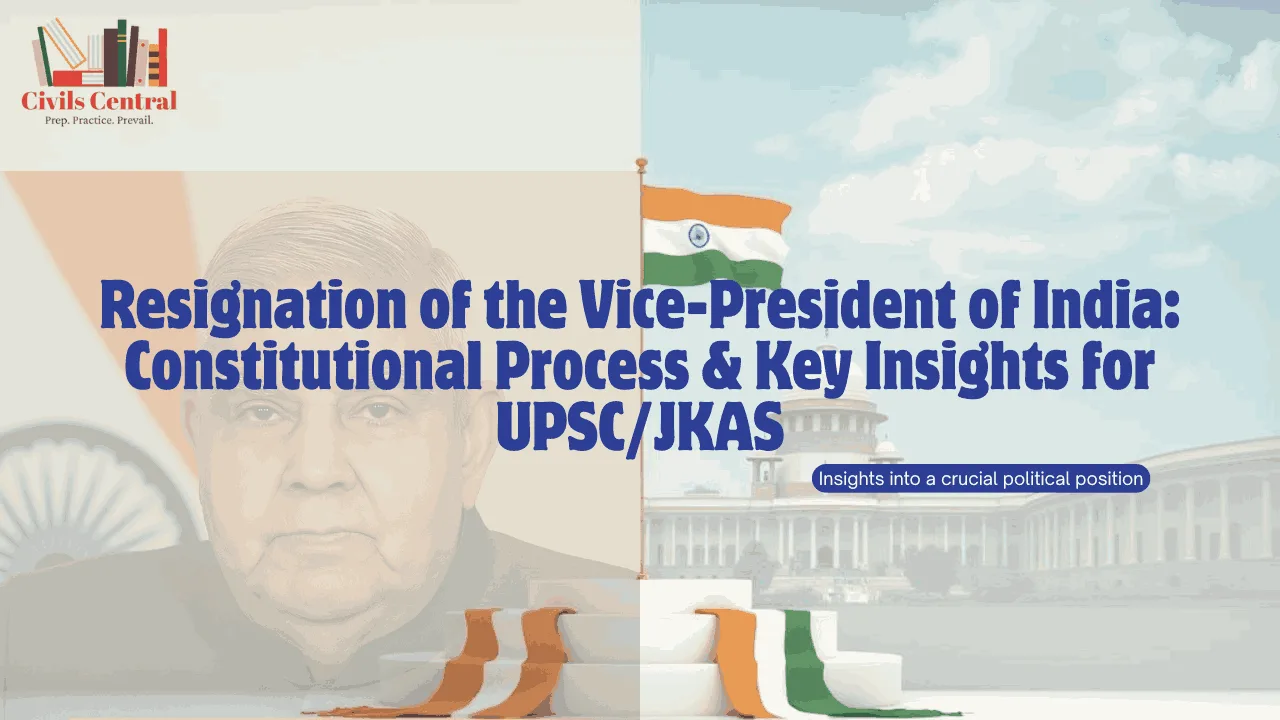
Resignation of the Vice-President of India: Constitutional Process & Key Insights for UPSC

🧭 Introduction – Vice‑President
The Vice-President of India is the second-highest constitutional office after the President. This office is a part of the Indian parliamentary framework, primarily serving as the Ex-officio Chairman of the Rajya Sabha, and stepping in as the acting President under special circumstances. Understanding this office in depth is crucial for UPSC and JKAS aspirants, particularly in GS Paper II (Polity and Constitution) and Prelims Polity section.
📜 Constitutional Framework (Articles 63–71)
The Constitution of India lays down the provisions related to the Vice-President under Articles 63 to 71 in Part V (Union Executive):
| Article | Provision |
|---|---|
| 63 | Provides for a Vice-President of India. |
| 64 | Vice-President to be ex-officio Chairman of the Rajya Sabha. |
| 65 | Vice-President to act as President or to discharge his functions during casual vacancies. |
| 66 | Election of the Vice-President. |
| 67 | Term of office, resignation, and removal. |
| 68 | Time of holding election to fill vacancy in the office. |
| 69 | Oath or affirmation by the Vice-President. |
| 70 | Discharge of President’s functions in other contingencies. |
| 71 | Matters relating to or connected with the election of a President or Vice-President. |
✅ Eligibility Criteria for Vice-President (Article 66(3))
To be eligible for the office of the Vice-President, a person must:
- Be a citizen of India.
- Have completed 35 years of age.
- Be qualified for election as a member of the Rajya Sabha.
- Not hold any office of profit under the Union or State Government or any local or other authority subject to the control of these governments.
🔍 What is an “Office of Profit”?
An office of profit refers to a position that brings to the person holding it some financial gain, advantage, or benefit. Holding such an office can lead to a conflict of interest.
📌 Nomination Process:
- Requires at least 20 MPs as proposers and 20 MPs as seconders.
- A security deposit of ₹15,000 must be submitted along with the nomination papers.
This ensures that only serious candidates contest for this high constitutional office.
🗳️ Election of the Vice-President (Article 66)
The Vice-President is elected indirectly through an Electoral College.
📌 Electoral College:
- Members of both Houses of Parliament (Lok Sabha and Rajya Sabha) — including nominated members.
- Members of State Legislative Assemblies do not participate in this election (unlike the Presidential election).
📌 Voting System:
- Proportional Representation by means of Single Transferable Vote (STV).
- Secret ballot system is followed.
This system ensures a more representative and fair election process. MPs can vote based on their conscience, as whip does not apply during this election.
🧾 Election Process is Conducted by:
- Election Commission of India, which handles:
- Notification and schedule of elections
- Scrutiny of nominations
- Polling and counting
- Declaration of results
The election is held in the Parliament House, using paper ballots.
⏳ Tenure, Re-election and Oath
🕰️ Tenure:
- The Vice-President holds office for a term of 5 years.
- However, he continues to hold office until his successor takes charge.
🔁 Re-election:
- There is no bar on re-election; a Vice-President can be re-elected any number of times.
🗣️ Oath of Office (Article 69):
- Administered by the President of India.
- The oath includes:
- Allegiance to the Constitution
- Faithfully discharging the duties of the office
🏛️ Powers and Functions
1. Ex-officio Chairman of Rajya Sabha (Article 64)
As the Chairman of the Upper House:
- Presides over its sessions.
- Maintains decorum and discipline.
- Decides on points of order.
- Has the power to cast a vote in case of a tie (only a casting vote, not a regular vote).
- Cannot vote in the first instance.
Unlike the Speaker of Lok Sabha, the Chairman is not a member of the Rajya Sabha.
2. Acts as President (Article 65)
The Vice-President acts as President in the following circumstances:
- Death of the President
- Resignation
- Removal
- Absence due to illness or travel
In such cases, the Vice-President discharges the functions of the President until a new President is elected (within 6 months).
🧩 Key Distinction:
- When the President is unavailable temporarily, the VP acts as President.
- When vacancy is created, the VP discharges functions till new President is elected.
✍️ Resignation of Vice-President (Article 67(a))
The resignation process is clearly laid out:
- Vice-President may resign at any time by writing under his hand addressed to the President.
- Resignation is immediate upon submission.
- There is no requirement for formal acceptance.
🔁 Can Resignation be Withdrawn?
- The Constitution is silent.
- Legally, resignation can be withdrawn if not acted upon or communicated to the President.
- Once accepted or made public by the President, it becomes final.
🔁 Removal of Vice-President (Article 67(b))
⚙️ Removal Process:
- Initiated in the Rajya Sabha with a resolution.
- Must be passed by an effective majority (majority of the total membership of the House, not just those present and voting).
- Must be agreed to by the Lok Sabha with a simple majority.
- Requires 14 days’ advance notice.
❌ Grounds:
- No specific grounds for removal are mentioned.
- However, a Vice-President can also be disqualified under Article 102, as per decision of the President on advice of the Election Commission.
| Feature | Resignation | Removal |
| Initiated by | Vice-President | Rajya Sabha |
| To whom | President | Parliament (RS → LS) |
| Voting | Not needed | Effective majority in RS + simple majority in LS |
| Notice | Not required | 14 days |
| Grounds | Voluntary | Not mentioned |
⚠️ Vacancy in the Office of Vice-President
A vacancy can arise due to:
- Term completion
- Resignation
- Removal
- Death
🕒 Timeline:
- The Election Commission must conduct the election within 6 months.
🪑 Interim Arrangements:
- In his absence, the Deputy Chairman of Rajya Sabha presides over the House.
Historical Resignation – V.V. Giri (1969) – Read More
- Resigned as Vice-President to contest the Presidential election after the sudden death of Dr. Zakir Husain
- His resignation was voluntary, invoking Article 67(a)
- Set a precedent for voluntary resignation for political advancement
Recent Resignation – Jagdeep Dhankhar (2025)
- Date: 21 July 2025
- Reason: Personal health issues
- Invoked: Article 67(a)
- Submitted To: President Droupadi Murmu
- Became the second Vice-President in Indian history to resign voluntarily, after V.V. Giri
Key Takeaways for UPSC/JKAS Prelims
- Article 63–71: Related to Vice-President
- Article 67(a): Resignation
- Article 67(b): Removal
- Electoral college includes nominated and elected MPs
- Voting method: Single Transferable Vote
- Vice-President can act as President under Article 65
- Election must be held within 6 months in case of vacancy
Answer Writing Tips for Mains
- Introduction: Define the office and constitutional role
- Body:
- Explain election, term, and functions
- Focus on resignation mechanism and compare with removal
- Include V.V. Giri and Jagdeep Dhankhar examples
- Conclusion:
- Link with democratic values and institutional continuity
- Discuss constitutional morality
Previous Year Questions (PYQs)
UPSC Prelims
- Which of the following Articles deals with the resignation of the Vice-President of India?
→ Article 67(a) - The Vice-President of India is elected by which of the following?
→ Members of both Houses of Parliament (elected + nominated)
UPSC Mains
- Discuss the constitutional provisions regarding the election and resignation of the Vice-President of India.
- What are the roles of the Vice-President in the Indian parliamentary system? Evaluate how resignation affects this continuity.
JKAS Prelims
- Under which Article can the Vice-President resign from office?
→ Article 67(a) - The Vice-President serves as the ex-officio chairman of which House?
→ Rajya Sabha
JKAS Mains
- Evaluate the constitutional significance of the Vice-President’s resignation in the context of Indian parliamentary democracy.
- Discuss the mechanism for filling the vacancy created by the resignation of the Vice-President of India.
Conclusion
The resignation of the Vice-President is a rare but constitutionally significant event. Understanding this process in depth—along with Articles 63 to 71, case studies like V.V. Giri and Jagdeep Dhankhar, and electoral procedures—is essential for UPSC and JKAS aspirants. This knowledge not only helps in cracking Prelims with precision but also adds weight to your Mains answers through a constitutional and analytical approach.
🔔 Latest News (For Contemporary Relevance)
- Jagdeep Dhankhar, the current Vice-President, resigned on 21 July 2025, citing health reasons.
- His resignation took place at the start of the Monsoon Session of Parliament.
- This resignation reaffirms the constitutional simplicity and flexibility provided under Article 67(a).
About The Author