Skip to content
-
Subscribe to our newsletter & never miss our best posts. Subscribe Now!
Civilscentral.com Civils Central

Prep.Practice.Prevail.

Civilscentral.com Civils Central

Prep.Practice.Prevail.

  • Home
  • History
    • Ancient History
    • Medieval History
  • Contact Us
  • About Us
  • Home
  • History
    • Ancient History
    • Medieval History
  • Contact Us
  • About Us
  • https://www.facebook.com/
  • https://twitter.com/
  • https://t.me/
  • https://www.instagram.com/
  • https://youtube.com/
Civilscentral.com Civils Central

Prep.Practice.Prevail.

Civilscentral.com Civils Central

Prep.Practice.Prevail.

  • Home
  • History
    • Ancient History
    • Medieval History
  • Contact Us
  • About Us
  • Home
  • History
    • Ancient History
    • Medieval History
  • Contact Us
  • About Us
  • https://www.facebook.com/
  • https://twitter.com/
  • https://t.me/
  • https://www.instagram.com/
  • https://youtube.com/
Home/Current Affairs/V.V. Giri’s 1969 Resignation: A Landmark in Constitutional Morality and Political Transformation
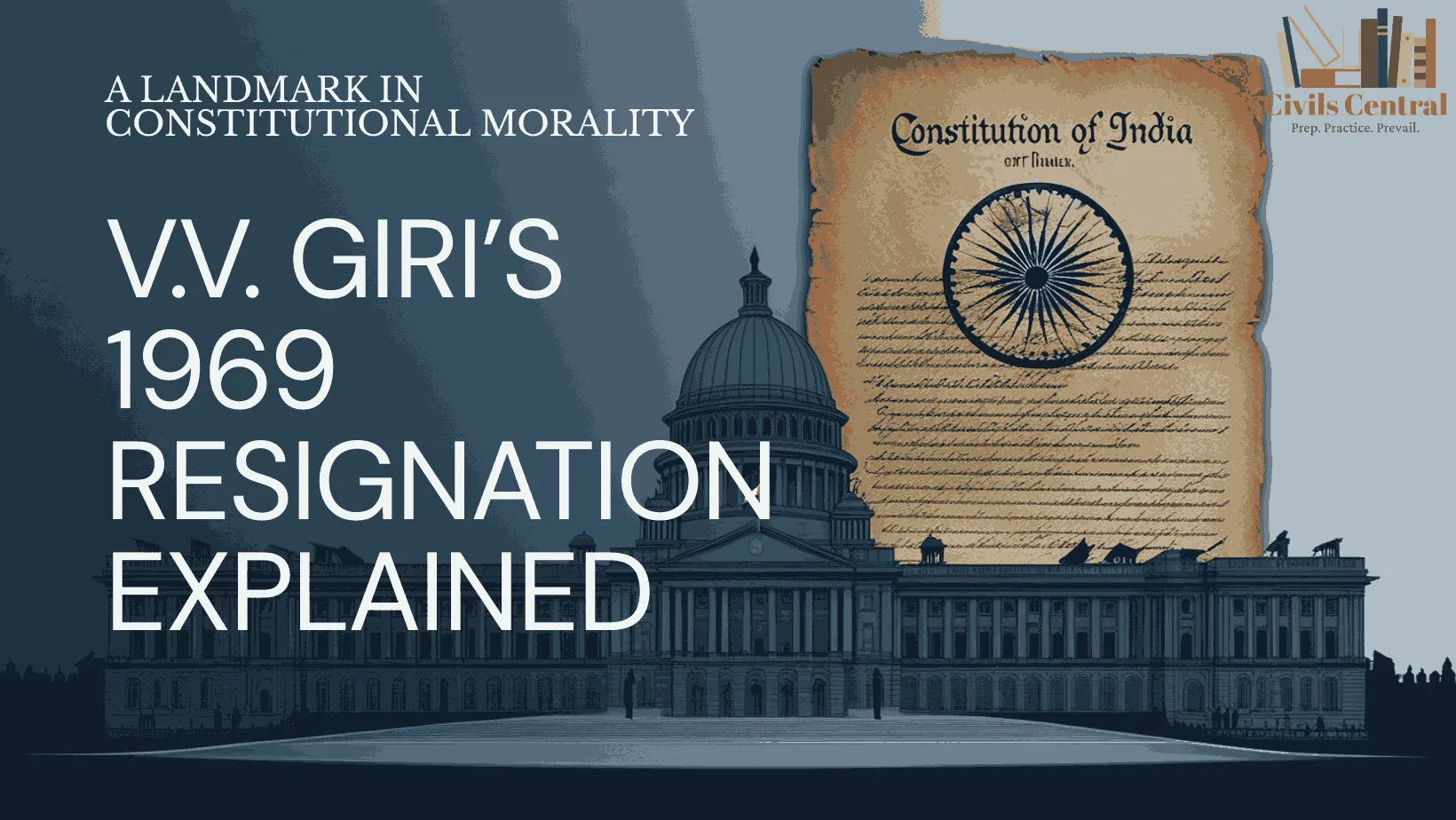
Archival-style featured image depicting V.V. Giri’s resignation with Indian political elements and constitutional symbolism.
Current AffairsPolity & Constitution

V.V. Giri’s 1969 Resignation: A Landmark in Constitutional Morality and Political Transformation

By Rohit Thapa

🔰 Introduction – V.V. Giri’s 1969 resignation

The resignation of V.V. Giri as Vice-President of India in 1969 is more than a procedural event — it is a remarkable instance of constitutional propriety, political foresight, and ethical conduct. At a time when the Indian Republic was navigating political instability following the sudden demise of President Dr. Zakir Husain, Giri’s actions exemplified the principles enshrined in the Constitution — neutrality, dignity of office, and democratic values.

📜 Constitutional Basis: Article 67(a)

Article 67(a) of the Indian Constitution provides that:
“*The Vice-President may resign his office by writing under his hand addressed to the President.*”

Since President Zakir Husain had passed away, the resignation was addressed to the Chief Justice of India, following constitutional conventions. This reflects the importance of constitutional propriety, even in the absence of rigid rules for such transitional circumstances.

📌 Why Giri’s Resignation is Constitutionally Important

1. Voluntary Resignation Without Constitutional Compulsion:
   – The Constitution does not bar the Vice-President from contesting the Presidential election, nor does it require resignation.
   – Yet, Giri voluntarily resigned, respecting the doctrine of neutrality in constitutional functioning.

2. Avoidance of Conflict of Interest:
   – Giri was both Acting President and a Presidential candidate — an ethically sensitive situation.
   – His resignation removed any doubts about misuse of office or influence over the electoral process.

3. Example of Constitutional Morality:
   – In line with B.R. Ambedkar’s vision, where constitutional morality must guide the functioning of institutions.
   – Reinforced the idea that public office is a public trust, not a personal entitlement.

🗳️ The 1969 Presidential Election and the Giri-Indira Alliance

The Congress party was in turmoil, divided between:
– The Syndicate (old guard) who supported Neelam Sanjiva Reddy.
– Indira Gandhi, who defied the party and encouraged a “vote of conscience” in favor of V.V. Giri.

Giri’s candidature was seen as a proxy battle between Indira and the Syndicate. His victory through cross-voting revealed:
– The eroding power of the party high command.
– The rise of personality-centric politics.
– The increasing assertiveness of Indira Gandhi as a mass leader.

⚖️ Ethical & Political Dimensions

Ethical: Resignation upheld the principle of impartiality. Giri prioritized institutional credibility over personal ambition.

Political: Altered the course of Indian politics. Led to a split in the Congress Party (1969), eventually resulting in the formation of Congress (I).

Legal-constitutional: Reinforced constitutional conventions not explicitly written — such as the need to maintain neutrality in electoral contests.

Democratic: Highlighted the role of individual conscience in elections, seen through Indira’s support for “free voting” by MPs and MLAs.

🔗 Linkage with UPSC GS Paper II Topics

– Structure, Functioning, Conduct of Business of Constitutional Bodies
– Separation of Powers and Checks and Balances
– Salient Features of the Indian Constitution
– Role of Ethics and Integrity in Public Life (GS Paper IV)

🧠 Conceptual Takeaways for UPSC Mains

– Resignation of V.V. Giri = Convergence of constitutional theory, moral judgment, and realpolitik.
– Shows how constitutional offices operate in political environments, but can still uphold dignity and neutrality.
– Reinforces how actions of individuals, even within a well-laid structure, can shape democratic norms.
– Demonstrates how internal party democracy, or the lack of it, can impact national politics.

📝 Model Answer Snippet – UPSC Mains GS II

Q. “The resignation of V.V. Giri from the Vice-Presidency in 1969 was an assertion of constitutional morality and democratic values.” Discuss.

Answer Framework:
– Intro: Brief background of Giri’s resignation amidst Presidential election.
– Constitutional and legal context: Article 67(a), acting President, conflict of interest.
– Ethical evaluation: Why voluntary resignation matters in a democracy.
– Political significance: Role in Congress party dynamics, Indira Gandhi’s emergence.
– Conclusion: Legacy of the event in Indian polity and its contemporary relevance.

🧾 Static + Dynamic Linkage for UPSC

Static Topic: Article 67(a), Article 65
Dynamic Correlation: Resignation procedures in constitutional offices

Static Topic: Role of Vice-President
Dynamic Correlation: Recent political debates around Vice-President’s neutrality

Static Topic: President-VP electoral processes
Dynamic Correlation: Election Commission reforms and neutrality discussions

Static Topic: Ethics in Public Office
Dynamic Correlation: Case studies for GS IV ethics paper

✅ Conclusion

V.V. Giri’s resignation in 1969 was a watershed moment in Indian political history, where a constitutional office-bearer placed the sanctity of the institution above personal ambition. It continues to inspire discussions on constitutional morality, ethics in public life, and the transformative power of democratic decisions. For UPSC aspirants, it offers both a case study in polity and a lesson in ethics.

About The Author

Rohit Thapa

See author's posts

Tags:

1969 Presidential ElectionArticle 67(a)Constitutional morality IndiaEthics in politicsIndian Constitution case studyIndian Polity UPSCIndira Gandhi vs SyndicateUPSC Mains GS 2V.V. Giri resignationVice President resignation India
Author

Rohit Thapa

Follow Me
Other Articles
Illustration of GM crops, DNA strand, and policy documents for an educational blog
Previous

GEAC Amendment & GM Crop Policy: A Must-Know Topic for UPSC/JKAS 2025

“Formal graphic for Indian Vice-President with tricolor theme and Parliament silhouette background.”
Next

Resignation of the Vice-President of India: Constitutional Process & Key Insights for UPSC

No Comment! Be the first one.

    Leave a Reply Cancel reply

    Your email address will not be published. Required fields are marked *

    This site uses Akismet to reduce spam. Learn how your comment data is processed.

    Recent Posts

    • Operation Amistad: India’s Humanitarian Mission to Venezuela | UPSC Notes
    • Queen’s Proclamation of 1858: Background, Provisions, Significance, Criticism and Impact on British Rule in India
    • Government of India Act, 1858: Features, Objectives, Impact and Historical Significance 
    • Venezuela Earthquake: Key Disaster Management Lessons for India | UPSC Current Affairs
    • Historical Significance of the Revolt of 1857: Was it a Sepoy Mutiny, a Popular Revolt, or the First War of Independence?

    Categories

    • Ancient History
    • Current Affairs
    • Defence
    • Disaster Management
    • Environment & Ecology
    • Exam Strategy
    • Finance
    • Governance
    • International Organisations
    • International Relations
    • Latest Notifications
    • Medieval History
    • Modern History
    • Modern History
    • Physics
    • polity
    • Polity & Constitution
    • Science & Technology
    • Statutory Bodies
    • UPSC

    RECENT POSTS

    • Operation Amistad: India’s Humanitarian Mission to Venezuela | UPSC Notes
    • Queen’s Proclamation of 1858: Background, Provisions, Significance, Criticism and Impact on British Rule in India
    • Government of India Act, 1858: Features, Objectives, Impact and Historical Significance 
    • Venezuela Earthquake: Key Disaster Management Lessons for India | UPSC Current Affairs
    • Historical Significance of the Revolt of 1857: Was it a Sepoy Mutiny, a Popular Revolt, or the First War of Independence?
    • Ancient History (15)
    • Current Affairs (20)
    • Defence (2)
    • Disaster Management (1)
    • Environment & Ecology (3)
    • Exam Strategy (1)
    • Finance (3)
    • Governance (2)
    • International Organisations (3)
    • International Relations (6)
    • Latest Notifications (1)
    • Medieval History (13)
    • Modern History (7)
    • Modern History (11)
    • Physics (1)
    • polity (1)
    • Polity & Constitution (4)
    • Science & Technology (4)
    • Statutory Bodies (1)
    • UPSC (15)

    Archives

    • June 2026
    • March 2026
    • February 2026
    • August 2025
    • July 2025
    • June 2025

    You May Have Missed

    Operation Amistad
    Current Affairs Defence International Relations

    Operation Amistad: India’s Humanitarian Mission to Venezuela | UPSC Notes

    Rohit Thapa
    By Rohit Thapa
    June 28, 2026
    Queens Proclamation of 1858
    Modern History

    Queen’s Proclamation of 1858: Background, Provisions, Significance, Criticism and Impact on British Rule in India

    Rohit Thapa
    By Rohit Thapa
    June 28, 2026
    Government of India Act, 1858
    Modern History UPSC

    Government of India Act, 1858: Features, Objectives, Impact and Historical Significance 

    Rohit Thapa
    By Rohit Thapa
    June 28, 2026
    Venezuela Earthquake Key Disaster Lessons for India
    Current Affairs Disaster Management

    Venezuela Earthquake: Key Disaster Management Lessons for India | UPSC Current Affairs

    Rohit Thapa
    By Rohit Thapa
    June 28, 2026
    Modern History UPSC

    Historical Significance of the Revolt of 1857: Was it a Sepoy Mutiny, a Popular Revolt, or the First War of Independence?

    Rohit Thapa
    By Rohit Thapa
    June 7, 2026
    Modern History

    Consequences of the Revolt of 1857: Political, Administrative, Military, Economic and Social Impact

    Rohit Thapa
    By Rohit Thapa
    June 7, 2026
    Modern History

    Why Did the Revolt of 1857 Fail? A Critical Analysis

    Rohit Thapa
    By Rohit Thapa
    June 7, 2026
    Modern History

    Major Leaders of the Revolt of 1857: Contributions, Role and Legacy

    Rohit Thapa
    By Rohit Thapa
    June 6, 2026
    Modern History

    Revolt of 1857: Causes, Events, Leaders, Consequences and Historical Significance

    Rohit Thapa
    By Rohit Thapa
    June 6, 2026
    Civilscentral.com
    • Operation Amistad: India’s Humanitarian Mission to Venezuela | UPSC Notes
    • Queen’s Proclamation of 1858: Background, Provisions, Significance, Criticism and Impact on British Rule in India
    • Government of India Act, 1858: Features, Objectives, Impact and Historical Significance 
    • Venezuela Earthquake: Key Disaster Management Lessons for India | UPSC Current Affairs
    • Historical Significance of the Revolt of 1857: Was it a Sepoy Mutiny, a Popular Revolt, or the First War of Independence?
    • Operation Amistad: India’s Humanitarian Mission to Venezuela | UPSC Notes
    • Queen’s Proclamation of 1858: Background, Provisions, Significance, Criticism and Impact on British Rule in India
    • Government of India Act, 1858: Features, Objectives, Impact and Historical Significance 
    • Venezuela Earthquake: Key Disaster Management Lessons for India | UPSC Current Affairs
    • Historical Significance of the Revolt of 1857: Was it a Sepoy Mutiny, a Popular Revolt, or the First War of Independence?
    Copyright 2026 — Civils Central. All rights reserved.