Skip to content
-
Subscribe to our newsletter & never miss our best posts. Subscribe Now!
Civilscentral.com Civils Central

Prep.Practice.Prevail.

Civilscentral.com Civils Central

Prep.Practice.Prevail.

  • Home
  • History
    • Ancient History
    • Medieval History
  • Contact Us
  • About Us
  • Home
  • History
    • Ancient History
    • Medieval History
  • Contact Us
  • About Us
  • https://www.facebook.com/
  • https://twitter.com/
  • https://t.me/
  • https://www.instagram.com/
  • https://youtube.com/
Civilscentral.com Civils Central

Prep.Practice.Prevail.

Civilscentral.com Civils Central

Prep.Practice.Prevail.

  • Home
  • History
    • Ancient History
    • Medieval History
  • Contact Us
  • About Us
  • Home
  • History
    • Ancient History
    • Medieval History
  • Contact Us
  • About Us
  • https://www.facebook.com/
  • https://twitter.com/
  • https://t.me/
  • https://www.instagram.com/
  • https://youtube.com/
Home/Ancient History/The Kalinga War and Ashoka’s Rock Edicts: A Transformation from Conquest to Conscience
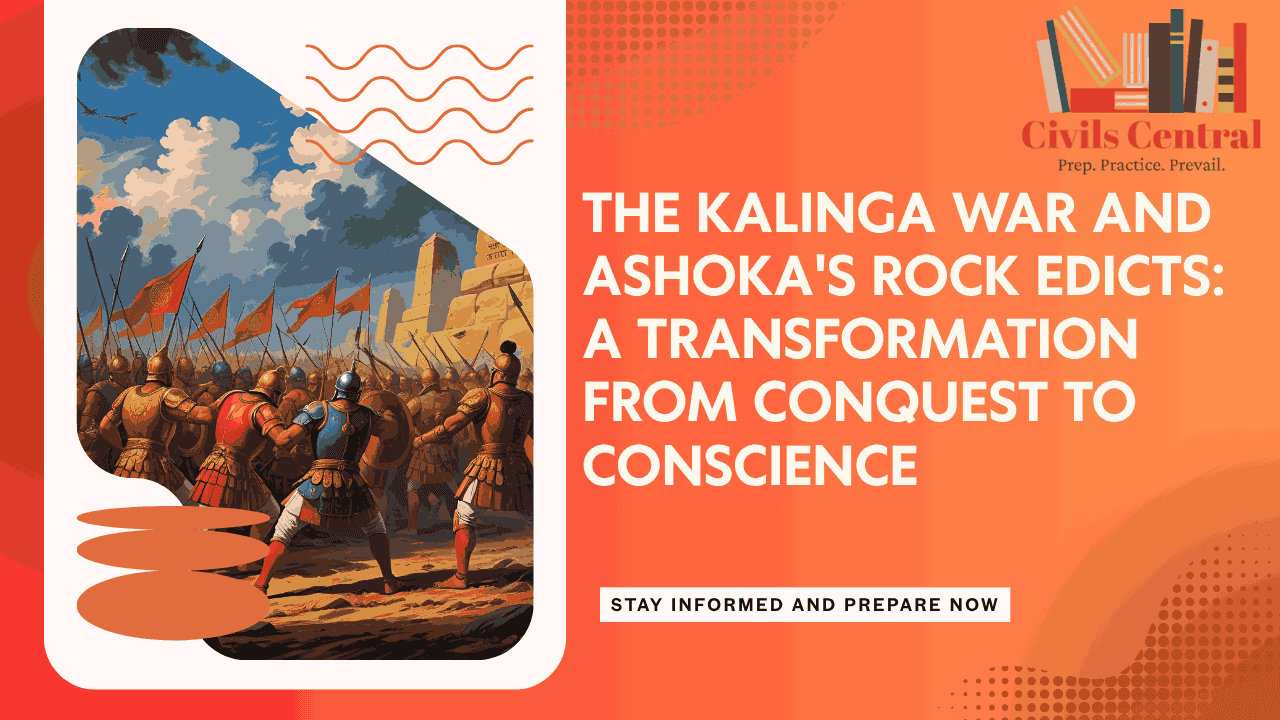
Illustration of the Kalinga War and Ashoka's transformation through Rock Edicts, symbolizing the shift from conquest to moral governance in ancient India.
Ancient History

The Kalinga War and Ashoka’s Rock Edicts: A Transformation from Conquest to Conscience

By Rohit Thapa

📜 Ancient Indian History Series | UPSC & JKAS Focused Notes


🧱 Introduction: A War that Changed Indian History

The Kalinga War (261 BCE) marks a turning point in Indian history, not only due to its scale and brutality but because of the profound transformation it sparked in Emperor Ashoka. Following his victory, Ashoka renounced aggressive conquest and embraced a policy of Dhamma (righteous conduct) rooted in compassion, tolerance, and non-violence.

This shift in governance and philosophy is documented in the 14 Major Rock Edicts, which provide unique first-person insights into ancient Indian statecraft, public administration, and ethical leadership. Together, the Kalinga War and Ashoka’s edicts form a foundational episode in India’s civilizational ethos.


⚔️ The Kalinga War: Background and Aftermath

🔶 Where was Kalinga?

  • Kalinga was a strategically located coastal kingdom in present-day Odisha and parts of northern Andhra Pradesh.
  • It was known for its maritime trade, cultural heritage, and fierce independence.

🔶 Causes of the War:

  1. Strategic Significance: Kalinga controlled key trade routes along the eastern coast.
  2. Political Autonomy: It remained independent from Magadhan rule, challenging Ashoka’s goal of imperial consolidation.

🔶 The Battle and Its Cost:

  • Ashoka led a massive military campaign against Kalinga in 261 BCE.
  • According to Ashoka’s own inscriptions (Edict XIII): “One and a half lakh people were deported, a lakh were killed, and many times that number perished.”

🔶 Aftermath and Ashoka’s Transformation:

  • Witnessing the death and destruction, Ashoka experienced deep remorse.
  • He embraced Buddhism and launched a governance model based on Dhamma — emphasizing compassion, non-violence, and public welfare.

“Ashoka’s remorse was not weakness, but wisdom — choosing to win hearts instead of lands.”


🕊️ Ashoka’s Edicts: Voice of an Ethical Ruler

Ashoka’s inscriptions, etched on rocks and pillars across the subcontinent, offer a remarkable insight into his moral vision and administrative reforms.

🔶 Classification of Edicts:

  • Major Rock Edicts (14): Core principles of Dhamma and state policy.
  • Minor Rock Edicts: Personal declarations and Buddhist commitments.
  • Pillar Edicts: Decrees on justice, governance, and social welfare.

🤖 The 14 Major Rock Edicts – Explained in Detail

Edict No.ThemeExplanation
IAnimal welfareBan on animal sacrifices; promotes non-violence.
IIMedical careFree treatment for humans and animals; import of medicinal herbs.
IIIMoral behaviorEmphasizes respect for elders, truthfulness, and charity.
IVDecline of crueltyDeclares that cruelty and immoral practices have reduced after Dhamma policy.
VDhamma MahamatrasEstablishes special officers to enforce Dhamma and ensure justice and compassion.
VIPublic accountabilityAshoka invites feedback and stresses open communication with citizens.
VIIReligious harmonyAdvocates for mutual respect among sects and tolerance.
VIIIDhamma YatrasAshoka replaces military tours with pilgrimages promoting ethical governance.
IXTrue religious actsCriticizes hollow rituals; promotes compassion and ethical living.
XGlory in DhammaDeclares moral conquest (Dhamma Vijaya) superior to war.
XIDhamma in daily lifeLists everyday moral duties: kindness, gratitude, restraint.
XIIInter-religious respectUrges understanding of all religions and not just blind praise of one’s own.
XIIIKalinga WarExpresses deep remorse over the war; commits to Dhamma-based foreign policy.
XIVPurpose of edictsJustifies edict issuance in various languages and regions for public instruction.

🌎 Geography of Ashokan Inscriptions

SiteStateImportance
DhauliOdishaEdict XIII; site of Kalinga War; remorse inscription.
GirnarGujaratComplete set of Major Rock Edicts; outreach to western India.
KalsiUttarakhandMentions Greek kings; northernmost inscription.
ShahbazgarhiPakistanEdicts in Kharosthi script.
KandaharAfghanistanEdict in Greek and Aramaic; international diplomacy.

🔎 Significance of the Kalinga War + Edicts for UPSC/JKAS

📝 Mains Themes:

  • State transformation through ethical introspection.
  • Ashoka as a model of moral governance.
  • Religious harmony and public welfare as pillars of ancient polity.
  • Earliest ruler-to-subject communication in Indian history.

📌 Prelims Pointers:

  • Kalinga War: 261 BCE
  • Dhamma Mahamatras: Appointed via Edict V
  • Remorse for Kalinga War: Edict XIII
  • Edicts in Prakrit (Brahmi), Kharosthi, Greek, and Aramaic

🕊️ Conclusion

The Kalinga War and Ashoka’s Major Rock Edicts together symbolize one of the most powerful moral revolutions in world history. Ashoka’s transformation from a ruthless conqueror to a compassionate ruler reflects the timeless Indian values of repentance, justice, and ethical leadership.

His edicts serve not just as historical sources, but as guiding principles in governance, diplomacy, and interfaith harmony — values still relevant in today’s democratic India.


About The Author

Rohit Thapa

See author's posts

Tags:

Ancient Indian HistoryAncient WarfareAshokaAshoka's Rock EdictsAshokan DhammaBuddhism and AshokacivilscentralConquest to ConscienceEdicts of AshokaHistorical Battles of IndiaHistory Optional UPSCIndian Administration HistoryIndian EmpiresJKAS PreparationKalinga WarMauryan EmpireMoral GovernanceUPSC HistoryUPSC Mains HistoryUPSC Study Material
Author

Rohit Thapa

Follow Me
Other Articles
Illustration of Emperor Ashoka standing near stone pillars and inscriptions, representing the legacy of the Mauryan Empire in India.
Previous

Mauryan Empire: India’s First Imperial Power and the Legacy of Ashoka

Post-Mauryan Art and Culture - Gandhara, Mathura, and Amaravati Schools of Sculpture
Next

Post Mauryan Art and Culture: Gandhara, Mathura & Coinage – UPSC Notes

No Comment! Be the first one.

    Leave a Reply Cancel reply

    Your email address will not be published. Required fields are marked *

    This site uses Akismet to reduce spam. Learn how your comment data is processed.

    Recent Posts

    • Drain of Wealth Theory: Dadabhai Naoroji and the Nationalist Critique of Colonial Economic Exploitation
    • Economic Impact of British Rule in India: Colonialism and the Transformation of the Indian Economy
    • Economic Impact of British Land Revenue Policies: Transformation of Agriculture and Rural Society in Colonial India
    • Mahalwari Settlement: Village-Based Land Revenue System in North India
    • Ryotwari Settlement: Munro’s Land Revenue System in Madras and Bombay

    Categories

    • Ancient History
    • Chapter 1.1
    • CivilsCentral Knowledge Library
    • Current Affairs
    • Defence
    • Disaster Management
    • Economics
    • Environment & Ecology
    • Exam Strategy
    • Finance
    • Geography
    • Governance
    • Government Schemes
    • International Organisations
    • International Relations
    • International Relations
    • Latest Notifications
    • Medieval History
    • Modern History
    • Physics
    • polity
    • Polity & Constitution
    • Science & Technology
    • Statutory Bodies
    • Uncategorized
    • UPSC

    RECENT POSTS

    • Drain of Wealth Theory: Dadabhai Naoroji and the Nationalist Critique of Colonial Economic Exploitation
    • Economic Impact of British Rule in India: Colonialism and the Transformation of the Indian Economy
    • Economic Impact of British Land Revenue Policies: Transformation of Agriculture and Rural Society in Colonial India
    • Mahalwari Settlement: Village-Based Land Revenue System in North India
    • Ryotwari Settlement: Munro’s Land Revenue System in Madras and Bombay
    • Ancient History (15)
    • Chapter 1.1 (1)
    • CivilsCentral Knowledge Library (2)
    • Current Affairs (53)
    • Defence (4)
    • Disaster Management (1)
    • Economics (5)
    • Environment & Ecology (10)
    • Exam Strategy (1)
    • Finance (3)
    • Geography (1)
    • Governance (16)
    • Government Schemes (2)
    • International Organisations (3)
    • International Relations (12)
    • International Relations (2)
    • Latest Notifications (1)
    • Medieval History (12)
    • Modern History (29)
    • Physics (1)
    • polity (1)
    • Polity & Constitution (8)
    • Science & Technology (8)
    • Statutory Bodies (1)
    • Uncategorized (4)
    • UPSC (36)

    Archives

    • August 2026
    • July 2026
    • June 2026
    • March 2026
    • February 2026
    • August 2025
    • July 2025
    • June 2025

    You May Have Missed

    Drain of Wealth Theory: Dadabhai Naoroji and the Nationalist Critique of Colonial Economic Exploitation
    Modern History UPSC

    Drain of Wealth Theory: Dadabhai Naoroji and the Nationalist Critique of Colonial Economic Exploitation

    Rohit Thapa
    By Rohit Thapa
    August 9, 2026
    Economic Impact of British Rule in India: Colonialism and the Transformation of the Indian Economy
    Modern History UPSC

    Economic Impact of British Rule in India: Colonialism and the Transformation of the Indian Economy

    Rohit Thapa
    By Rohit Thapa
    August 9, 2026
    Economic Impact of British Land Revenue Policies: Transformation of Agriculture and Rural Society in Colonial India
    Modern History UPSC

    Economic Impact of British Land Revenue Policies: Transformation of Agriculture and Rural Society in Colonial India

    Rohit Thapa
    By Rohit Thapa
    August 9, 2026
    Mahalwari Settlement: Village-Based Land Revenue System in North India
    Modern History UPSC

    Mahalwari Settlement: Village-Based Land Revenue System in North India

    Rohit Thapa
    By Rohit Thapa
    August 8, 2026
    Ryotwari Settlement: Munro's Land Revenue System in Madras and Bombay
    Modern History UPSC

    Ryotwari Settlement: Munro’s Land Revenue System in Madras and Bombay

    Rohit Thapa
    By Rohit Thapa
    August 7, 2026
    Permanent Settlement (1793): Zamindari System, Features, Objectives, Impact and Legacy
    Modern History UPSC

    Permanent Settlement (1793): Zamindari System, Features, Objectives, Impact and Legacy

    Rohit Thapa
    By Rohit Thapa
    August 5, 2026
    Lord Cornwallis (1786–1793): Administrative, Judicial and Revenue Reforms
    Modern History UPSC

    Lord Cornwallis (1786–1793): Administrative, Judicial and Revenue Reforms

    Rohit Thapa
    By Rohit Thapa
    August 5, 2026
    Pitt's India Act (1784): Dual Control and Parliamentary Supervision over the East India Company
    Modern History UPSC

    Pitt’s India Act (1784): Dual Control and Parliamentary Supervision over the East India Company

    Rohit Thapa
    By Rohit Thapa
    August 4, 2026
    Supreme Court at Calcutta (1774) and the Nand Kumar Case (1775): Beginning of the British Judicial System in India
    Modern History UPSC

    Supreme Court at Calcutta (1774) and the Nand Kumar Case (1775): Beginning of the British Judicial System in India

    Rohit Thapa
    By Rohit Thapa
    August 3, 2026
    Civilscentral.com
    • Drain of Wealth Theory: Dadabhai Naoroji and the Nationalist Critique of Colonial Economic Exploitation
    • Economic Impact of British Rule in India: Colonialism and the Transformation of the Indian Economy
    • Economic Impact of British Land Revenue Policies: Transformation of Agriculture and Rural Society in Colonial India
    • Mahalwari Settlement: Village-Based Land Revenue System in North India
    • Ryotwari Settlement: Munro’s Land Revenue System in Madras and Bombay
    • Drain of Wealth Theory: Dadabhai Naoroji and the Nationalist Critique of Colonial Economic Exploitation
    • Economic Impact of British Rule in India: Colonialism and the Transformation of the Indian Economy
    • Economic Impact of British Land Revenue Policies: Transformation of Agriculture and Rural Society in Colonial India
    • Mahalwari Settlement: Village-Based Land Revenue System in North India
    • Ryotwari Settlement: Munro’s Land Revenue System in Madras and Bombay
    Copyright 2026 — Civils Central. All rights reserved.