
Introduction
The oceans cover nearly 71% of the Earth’s surface and constitute one of humanity’s most valuable shared resources. They regulate the global climate, sustain marine biodiversity, facilitate over 80% of international trade by volume, provide food security to billions of people, and contain enormous reserves of hydrocarbons, minerals, and renewable energy resources. As maritime technology advanced during the twentieth century, competition among States for control over ocean spaces intensified. Disputes over fishing grounds, offshore oil and gas reserves, maritime boundaries, navigation rights, and seabed resources became increasingly common.
The absence of a universally accepted legal framework governing the oceans often resulted in conflicting national claims and geopolitical tensions. Different countries asserted varying widths for their territorial seas, while advances in offshore drilling and deep-sea exploration raised complex legal questions regarding ownership and exploitation of marine resources. Recognizing the need for a comprehensive legal regime, the international community negotiated the United Nations Convention on the Law of the Sea (UNCLOS), which was adopted in 1982 and entered into force in 1994.
Today, UNCLOS is widely regarded as the “Constitution of the Oceans.” It establishes a comprehensive legal framework governing all activities in marine and maritime spaces, including navigation, fisheries, resource exploration, marine scientific research, environmental protection, maritime boundary delimitation, and dispute settlement. More than merely defining maritime zones, the Convention balances the sovereign rights of coastal States with the collective interests of the international community in maintaining freedom of navigation and sustainable use of ocean resources.
For India, UNCLOS has profound strategic importance. With a coastline exceeding 7,500 kilometres, an Exclusive Economic Zone (EEZ) of approximately 2.37 million square kilometres, and a growing role in the Indo-Pacific region, India’s maritime interests are closely linked to the Convention. Issues such as the Blue Economy, maritime security, anti-piracy operations, deep-sea mining, protection of sea lanes of communication, and disputes in the South China Sea all derive their legal foundations from UNCLOS.
Understanding the Law of the Sea
The term Law of the Sea refers to the body of international law governing the rights and responsibilities of States in relation to the world’s oceans. It regulates the use of marine resources, maritime boundaries, navigation, marine scientific research, environmental protection, and peaceful settlement of maritime disputes.
Unlike domestic laws enacted by individual countries, the Law of the Sea represents an international legal order developed through customary international law, judicial decisions, and multilateral treaties. UNCLOS codified and expanded these principles into a single comprehensive convention accepted by most countries.
The Convention seeks to balance two competing interests:
- The sovereign rights of coastal States to utilize and manage marine resources adjacent to their coasts.
- The common interests of the international community in maintaining open navigation, peaceful use of the oceans, and equitable sharing of marine resources.
This balance explains why UNCLOS simultaneously recognizes coastal State jurisdiction in certain maritime zones while preserving freedoms enjoyed by all States in areas beyond national jurisdiction.
Historical Evolution of the Law of the Sea
The development of the modern Law of the Sea spans several centuries and reflects changing geopolitical, economic, and technological realities.
Early Concepts
For centuries, oceans were largely regarded as open spaces beyond the effective control of States. Maritime powers sought unrestricted navigation to facilitate trade, exploration, and naval operations.
In the seventeenth century, the Dutch jurist Hugo Grotius articulated the doctrine of Mare Liberum (Freedom of the Seas) in 1609. He argued that the seas could not be appropriated by any single nation because of their vastness and should remain open to all for navigation and commerce.
In contrast, the English jurist John Selden advocated the doctrine of Mare Clausum (Closed Sea), asserting that States could exercise sovereignty over adjacent maritime areas. This intellectual debate laid the foundation for centuries of evolving maritime law.
The Cannon Shot Rule
During the eighteenth century, the Italian jurist Ferdinando Galiani proposed what became known as the Cannon Shot Rule, under which a coastal State’s sovereignty extended only as far as it could effectively defend its coastline with shore-based artillery. This practical rule gave rise to the traditional three nautical mile territorial sea, which remained widely accepted for many years.
However, rapid technological progress in naval warfare, fishing, and offshore resource extraction eventually rendered the three-mile rule inadequate.
Growing Maritime Claims in the Twentieth Century
Following the Second World War, technological advances enabled States to exploit offshore petroleum reserves and distant fishing grounds. Many countries began asserting wider claims over adjacent seas to secure these valuable resources.
A major turning point occurred in 1945, when U.S. President Harry Truman issued the Truman Proclamation asserting American jurisdiction over the natural resources of the continental shelf adjoining the United States. This proclamation inspired many other countries to assert similar claims. By the 1950s, different States claimed territorial seas ranging from 3 to 200 nautical miles, creating legal uncertainty and increasing maritime disputes.
The international community therefore recognised the urgent need for a universally accepted legal framework.
The Geneva Conventions on the Law of the Sea (1958)
The First United Nations Conference on the Law of the Sea (UNCLOS I) convened in Geneva in 1958 under the auspices of the United Nations. The conference adopted four important conventions:
- Convention on the Territorial Sea and Contiguous Zone
- Convention on the High Seas
- Convention on the Continental Shelf
- Convention on Fishing and Conservation of Living Resources of the High Seas
These conventions successfully codified many customary rules but failed to resolve the most contentious issue—the maximum breadth of the territorial sea.
UNCLOS II (1960)
A second conference was held in 1960 to settle disagreements over the territorial sea. Despite extensive negotiations, participating States failed to reach consensus. Differences between maritime powers favouring narrower territorial seas and coastal States demanding wider jurisdiction remained unresolved.
The failure of UNCLOS II demonstrated that a more comprehensive and inclusive negotiation process would be necessary.
UNCLOS III (1973–1982)
Recognising the limitations of earlier efforts, the United Nations convened the Third United Nations Conference on the Law of the Sea (UNCLOS III) in 1973. This remains one of the longest and most ambitious diplomatic negotiations in history.
Key features included:
- Participation of over 160 countries
- Consensus-based negotiations
- Consideration of interests of developed, developing, coastal, landlocked, and island States
- Negotiation over nine years
Unlike previous conferences that focused only on maritime boundaries, UNCLOS III addressed nearly every aspect of ocean governance.
Its agenda included:
- Territorial seas
- Exclusive Economic Zones
- Continental Shelf
- Navigation rights
- Marine environmental protection
- Fisheries management
- Marine scientific research
- Deep seabed mining
- Settlement of maritime disputes
The negotiations reflected a growing recognition that oceans constitute a shared global resource requiring cooperative governance.
Adoption of UNCLOS
After nearly a decade of negotiations, the United Nations Convention on the Law of the Sea was adopted on 10 December 1982 at Montego Bay, Jamaica. The Convention contains:
- 320 Articles
- 17 Parts
- 9 Annexes
It entered into force on 16 November 1994 after receiving the required number of ratifications. Today, it serves as the principal legal framework governing maritime affairs and has been ratified by the overwhelming majority of States.
Why Was UNCLOS Needed?
Several factors made a comprehensive law of the sea indispensable:
- Increasing disputes over maritime boundaries.
- Discovery of offshore oil, gas, and mineral resources.
- Expansion of distant-water fishing fleets and depletion of fish stocks.
- Need to protect freedom of navigation for global trade.
- Rising concerns about marine pollution and environmental degradation.
- Growing importance of scientific research in marine ecosystems.
- Cold War strategic competition across the world’s oceans.
- Requirement for peaceful mechanisms to resolve maritime disputes.
- Equitable management of deep-sea resources beyond national jurisdiction.
- Balancing sovereign rights with the principle that certain ocean resources constitute the common heritage of humankind.
These challenges could not be effectively addressed through fragmented customary law or bilateral agreements alone, making a comprehensive global convention essential.
Objectives of UNCLOS
The Convention was designed to achieve several interrelated objectives:
- Establish a stable and universally accepted legal order for the oceans.
- Clearly define maritime zones and the rights associated with each.
- Promote peaceful uses of the seas.
- Ensure freedom of navigation and overflight.
- Facilitate equitable utilization of marine resources.
- Protect and preserve the marine environment.
- Encourage marine scientific research.
- Promote conservation of living marine resources.
- Create mechanisms for peaceful settlement of disputes.
- Recognize the seabed beyond national jurisdiction as the Common Heritage of Humankind.
Maritime Zones under UNCLOS
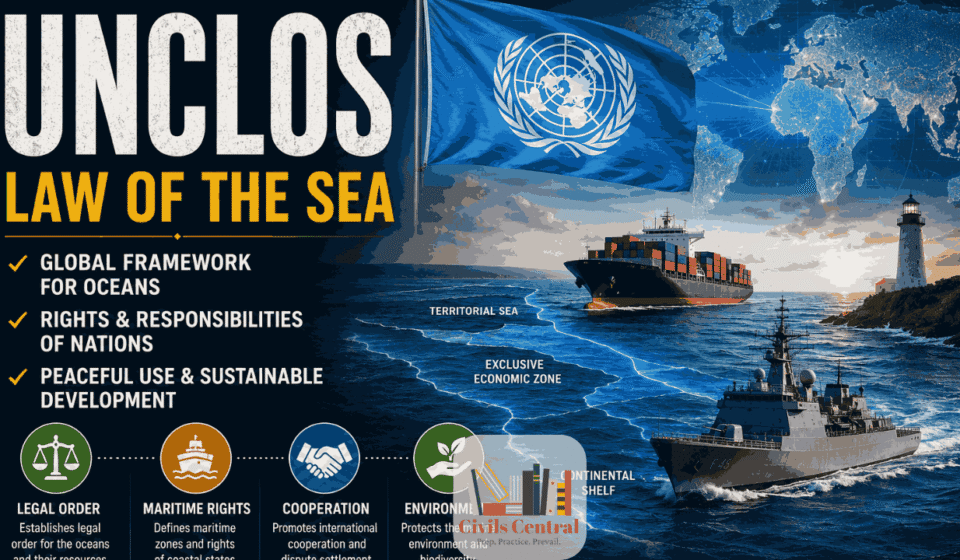
One of the greatest achievements of the United Nations Convention on the Law of the Sea (UNCLOS) is the establishment of a clear legal framework dividing the world’s oceans into different maritime zones. Before UNCLOS, coastal States often made overlapping and inconsistent claims over adjacent waters, leading to disputes regarding fisheries, navigation, offshore resources, and security. By defining the extent of each maritime zone and the rights attached to it, UNCLOS brought predictability and stability to international maritime law.
A fundamental principle underlying these maritime zones is that a coastal State’s rights gradually decrease as the distance from its coast increases. While a State exercises complete sovereignty over its internal waters and territorial sea, its authority becomes progressively limited in the contiguous zone and Exclusive Economic Zone (EEZ), eventually giving way to the freedoms enjoyed by all States on the high seas. This carefully balanced system seeks to reconcile the sovereign interests of coastal States with the collective interests of the international community in maintaining open and peaceful use of the oceans.
Understanding these maritime zones is essential for interpreting contemporary issues such as the South China Sea dispute, offshore oil exploration, fisheries management, anti-piracy operations, freedom of navigation exercises, submarine cable protection, and India’s maritime strategy in the Indian Ocean Region.
Baselines: The Starting Point of Maritime Zones
Every maritime zone recognized under UNCLOS is measured from a legally defined baseline. The baseline serves as the reference line from which distances such as the 12-nautical-mile territorial sea or the 200-nautical-mile EEZ are calculated. Without a standardized baseline, maritime claims would vary significantly depending on tides and coastal geography.
Types of Baselines
1. Normal Baseline
The normal baseline is the low-water line along the coast, as officially marked on large-scale nautical charts recognized by the coastal State. This is the most common baseline used by countries with relatively smooth coastlines.
2. Straight Baseline
Where the coastline is deeply indented, highly irregular, or fringed with islands, drawing a normal baseline becomes impractical. In such cases, UNCLOS permits States to connect appropriate coastal points using straight lines known as straight baselines. Countries such as Norway, Canada, and Indonesia extensively use straight baselines due to their complex coastal geography.
3. Archipelagic Baseline
Archipelagic States composed entirely of islands may draw archipelagic baselines joining the outermost islands of the archipelago. Examples include:
- Indonesia
- Philippines
- Fiji
India is not an archipelagic State, although island groups such as Andaman & Nicobar Islands and Lakshadweep are important in determining India’s maritime claims.
Internal Waters
Internal waters are all waters located landward of the baseline. These include:
- Rivers
- Lakes connected to the sea
- Harbours
- Ports
- Bays meeting UNCLOS criteria
- Estuaries
Legal Status
Internal waters enjoy the same legal status as the land territory of the coastal State. The coastal State exercises complete sovereignty over:
- Water
- Seabed
- Airspace above
- Subsoil beneath
Foreign vessels possess no automatic right of navigation unless permitted through domestic law or bilateral agreements.
Examples
For India:
- Mumbai Harbour
- Kochi Port
- Visakhapatnam Harbour
- Chennai Port
are considered internal waters.
Territorial Sea
The Territorial Sea is the maritime belt extending up to 12 nautical miles from the baseline. Within this zone, the coastal State enjoys sovereignty almost identical to that exercised over its land territory.
Rights of Coastal States
The coastal State exercises sovereignty over:
- Water column
- Seabed
- Subsoil
- Airspace
It may regulate:
- Navigation
- Customs
- Immigration
- Fisheries
- Resource extraction
- Environmental protection
- Criminal jurisdiction
Innocent Passage
Although the coastal State exercises sovereignty, UNCLOS preserves an important exception known as Innocent Passage. Foreign ships—including merchant vessels—may pass through the territorial sea without prior authorization, provided their passage is:
- Continuous
- Expeditious
- Non-threatening
- Peaceful
Passage ceases to be innocent if the vessel engages in activities such as:
- Weapons exercises
- Espionage
- Illegal fishing
- Smuggling
- Pollution
- Propaganda
- Intelligence gathering
The coastal State may temporarily suspend innocent passage in specified areas for security reasons.
Submarines
Submarines exercising innocent passage must:
- Navigate on the surface
- Display their national flag
Failure to do so violates UNCLOS provisions.
Contiguous Zone
The Contiguous Zone extends up to 24 nautical miles from the baseline, meaning it lies immediately beyond the territorial sea. Unlike the territorial sea, the coastal State does not enjoy full sovereignty in this zone. Instead, it possesses limited enforcement powers.
Purpose
The contiguous zone enables a State to prevent or punish violations relating to:
- Customs
- Fiscal laws
- Immigration
- Sanitation (health regulations)
The objective is preventive rather than territorial. For example, if authorities suspect that a ship carrying contraband intends to enter Indian territory illegally, action may be taken within the contiguous zone before the violation actually occurs.
Exclusive Economic Zone (EEZ)
The Exclusive Economic Zone represents one of UNCLOS’s most innovative concepts. It extends up to 200 nautical miles from the baseline. Unlike the territorial sea, the EEZ is not part of the sovereign territory of the coastal State. Instead, the coastal State enjoys sovereign rights specifically related to economic activities.
Rights of Coastal States in the EEZ
The coastal State has exclusive rights over:
- Exploration of natural resources
- Exploitation of marine resources
- Conservation of living resources
- Fisheries
- Offshore oil
- Offshore natural gas
- Offshore wind energy
- Tidal energy
- Ocean thermal energy
- Marine scientific research (subject to UNCLOS provisions)
The State also exercises jurisdiction over:
- Artificial islands
- Offshore platforms
- Marine environmental protection
Rights of Other States
Other States continue to enjoy several freedoms within another country’s EEZ. These include:
- Freedom of navigation
- Freedom of overflight
- Laying submarine cables
- Laying pipelines
- Peaceful military navigation
This distinction frequently gives rise to geopolitical disagreements.
India’s EEZ
India possesses an EEZ of approximately 2.37 million square kilometres, making it one of the largest in the world. This vast maritime area contains:
- Fisheries
- Offshore hydrocarbons
- Renewable energy potential
- Critical minerals
It is central to India’s Blue Economy strategy.
Continental Shelf
The Continental Shelf refers to the natural underwater extension of a country’s land territory. Its legal concept differs significantly from the EEZ. Whereas the EEZ concerns the water column and associated resources, the continental shelf concerns the seabed and subsoil.
Rights over the Continental Shelf
The coastal State enjoys sovereign rights to explore and exploit:
- Oil
- Natural gas
- Minerals
- Sedentary species attached to the seabed
These rights exist automatically and do not require occupation or proclamation. Importantly, other States remain free to navigate over the waters above the continental shelf.
Extended Continental Shelf
In certain geological circumstances, a country’s continental margin extends beyond 200 nautical miles. UNCLOS permits States to claim an Extended Continental Shelf beyond 200 nautical miles if scientific evidence demonstrates that the continental margin naturally extends farther. Such claims are evaluated by the Commission on the Limits of the Continental Shelf (CLCS). India has submitted claims for an extended continental shelf in parts of the Indian Ocean.
High Seas
The High Seas begin beyond national jurisdiction. No State may claim sovereignty over them. Instead, they remain open to all States under the principle of Freedom of the High Seas.
Freedoms on the High Seas
All States enjoy equal rights relating to:
- Navigation
- Fishing (subject to conservation rules)
- Scientific research
- Overflight
- Submarine cables
- Pipelines
These freedoms must be exercised responsibly and in accordance with international law.
The Area
Beyond national jurisdiction lies the seabed known simply as “The Area.” Unlike the high seas, which concern the water column, “The Area” refers specifically to the seabed and ocean floor beyond national jurisdiction. Its mineral resources belong to all humankind collectively. UNCLOS declares these resources to be the Common Heritage of Humankind. No State may claim sovereignty over them. Their exploration and exploitation are regulated by the International Seabed Authority (ISA).
This principle seeks to ensure equitable sharing of benefits derived from deep-sea mineral resources, particularly with developing countries.
Comparative Summary of Maritime Zones
| Maritime Zone | Extent from Baseline | Nature of Coastal State Rights |
|---|---|---|
| Internal Waters | Landward of baseline | Complete sovereignty |
| Territorial Sea | Up to 12 nautical miles | Complete sovereignty (subject to innocent passage) |
| Contiguous Zone | Up to 24 nautical miles | Enforcement jurisdiction for customs, fiscal, immigration, and sanitation laws |
| Exclusive Economic Zone | Up to 200 nautical miles | Sovereign rights over economic resources |
| Continental Shelf | Up to 200 nautical miles (or beyond if extended) | Rights over seabed and subsoil resources |
| High Seas | Beyond national jurisdiction | Open to all States |
| The Area | Seabed beyond national jurisdiction | Common Heritage of Humankind |
Navigation Rights under UNCLOS
A key objective of UNCLOS is to preserve international navigation while respecting coastal State interests.
Innocent Passage
- Applies in the Territorial Sea.
- Continuous and expeditious transit.
- Must not threaten the coastal State.
Transit Passage
Transit Passage applies to international straits connecting one part of the high seas or EEZ to another.
Examples include:
- Strait of Malacca
- Strait of Hormuz
- Bab el-Mandeb
Unlike innocent passage, transit passage cannot generally be suspended by the coastal State. Ships and aircraft enjoy uninterrupted transit.
Archipelagic Sea Lanes Passage
Archipelagic States must designate sea lanes through which foreign vessels and aircraft may exercise passage rights. This ensures uninterrupted international navigation through archipelagic waters. Indonesia provides one of the most important examples.
Freedom of Navigation
Beyond the territorial sea, ships enjoy extensive navigation freedoms under UNCLOS. This principle underpins global maritime trade and naval mobility. Freedom of Navigation Operations (FONOPs), particularly by the United States, are conducted to challenge maritime claims considered inconsistent with UNCLOS.
Right of Hot Pursuit
A coastal State may pursue a foreign vessel that violates its laws within internal waters, territorial sea, or contiguous zone. Conditions include:
- Pursuit must begin while the vessel is within the relevant maritime zone.
- Pursuit must be continuous.
- It ends once the vessel enters the territorial sea of another State.
The right of hot pursuit is particularly important in combating:
- Illegal fishing
- Smuggling
- Piracy-related offences
- Maritime pollution
Institutional Framework of UNCLOS
While the maritime zones established under UNCLOS define the rights and obligations of States, the Convention goes much further by creating an institutional framework to implement, monitor, and enforce these rules. Unlike earlier treaties that relied solely on voluntary compliance, UNCLOS established permanent international institutions responsible for administering seabed resources, resolving maritime disputes, and examining scientific claims related to the continental shelf.
These institutions have become increasingly significant in the twenty-first century as maritime disputes intensify, demand for critical minerals grows, and concerns about marine biodiversity, climate change, and sustainable ocean governance assume global importance. Questions relating to the South China Sea, deep-sea mining, underwater cables, fisheries conservation, and maritime boundary delimitation frequently involve the interpretation and application of UNCLOS through these institutional mechanisms.
Institutional Framework under UNCLOS
UNCLOS established three principal institutions to implement different aspects of the Convention:
- International Seabed Authority (ISA)
- International Tribunal for the Law of the Sea (ITLOS)
- Commission on the Limits of the Continental Shelf (CLCS)
Each institution performs a distinct function, ensuring that the Convention operates effectively across different domains of ocean governance.
International Seabed Authority (ISA)
The International Seabed Authority (ISA) is an autonomous international organization established under Part XI of UNCLOS and operational since 1994. It is headquartered in Kingston, Jamaica.
The ISA is responsible for regulating all mineral-related activities in “The Area”—the seabed and ocean floor beyond national jurisdiction. Under UNCLOS, these resources are designated as the Common Heritage of Humankind, meaning that no State may claim sovereignty over them or exploit them unilaterally. The Authority ensures that exploration and future exploitation of deep-sea mineral resources are conducted for the benefit of all humanity, with particular consideration for the interests of developing countries.
Objectives of ISA
The International Seabed Authority seeks to:
- Organize and regulate activities in the Area.
- Ensure equitable sharing of benefits from seabed resources.
- Protect the marine environment from harmful mining activities.
- Promote marine scientific research.
- Encourage technology transfer to developing countries.
- Develop regulations governing deep-sea mining.
Organizational Structure
Assembly
- Supreme decision-making body.
- Consists of all member States.
- Determines general policies.
Council
- Executive organ.
- Responsible for supervising implementation.
- Approves contracts for exploration and exploitation.
Secretariat
- Administrative arm.
- Headed by the Secretary-General.
Legal and Technical Commission
- Composed of experts.
- Evaluates mining applications.
- Conducts environmental assessments.
- Advises the Council.
Mineral Resources Governed by ISA
The Area contains significant deposits of critical minerals required for modern industries. Important resources include:
Polymetallic Nodules
Rich in:
- Manganese
- Nickel
- Copper
- Cobalt
Found mainly in:
- Clarion–Clipperton Zone (Pacific Ocean)
- Central Indian Ocean Basin
Polymetallic Sulphides
Contain:
- Copper
- Zinc
- Gold
- Silver
Usually occur near hydrothermal vents.
Cobalt-rich Ferromanganese Crusts
Found on underwater mountains.
Contain:
- Cobalt
- Nickel
- Rare earth elements
India and ISA
India became one of the earliest Pioneer Investors in deep-sea mining. India has been granted exploration rights in the Central Indian Ocean Basin by the ISA for polymetallic nodules. These nodules contain strategic minerals essential for batteries, renewable energy technologies, and high-tech manufacturing. India’s Deep Ocean Mission complements these efforts by developing indigenous technologies for deep-sea exploration and resource extraction.
Deep-Sea Mining
Deep-sea mining refers to the extraction of minerals from the ocean floor at depths often exceeding 4,000–6,000 metres. Growing demand for critical minerals used in electric vehicles, renewable energy systems, semiconductors, and advanced electronics has increased global interest in deep-sea mining.
Potential Benefits
Deep-sea mining may:
- Reduce dependence on terrestrial mining.
- Supply critical minerals for clean energy transitions.
- Strengthen energy security.
- Support technological development.
- Promote Blue Economy initiatives.
Environmental Concerns
Despite its economic promise, deep-sea mining raises significant environmental concerns. Potential impacts include:
- Destruction of fragile deep-sea ecosystems.
- Loss of unique marine biodiversity.
- Sediment plumes affecting marine organisms.
- Noise pollution.
- Disturbance of carbon storage in seabed sediments.
- Irreversible ecological damage due to slow ecosystem recovery.
Consequently, several countries and environmental organizations have called for a precautionary pause or moratorium until sufficient scientific knowledge is available.
International Tribunal for the Law of the Sea (ITLOS)
The International Tribunal for the Law of the Sea (ITLOS) is an independent judicial body established under Annex VI of UNCLOS. It is headquartered in Hamburg, Germany. ITLOS adjudicates disputes arising out of the interpretation and application of UNCLOS.
Composition
- 21 independent judges.
- Judges are elected by States Parties.
- Nine-year terms.
- Representation from major legal systems and geographical regions.
Jurisdiction
ITLOS may hear disputes concerning:
- Maritime boundary delimitation.
- Fisheries.
- Marine environmental protection.
- Navigation.
- Arrest of ships.
- Prompt release of vessels.
- Marine scientific research.
- Deep-sea mining disputes.
Seabed Disputes Chamber
One of ITLOS’s most significant components is the Seabed Disputes Chamber, which has jurisdiction over disputes involving activities in the Area. It handles matters relating to:
- Mining contractors.
- International Seabed Authority.
- State obligations under Part XI.
Commission on the Limits of the Continental Shelf (CLCS)
The Commission on the Limits of the Continental Shelf (CLCS) is a scientific and technical body established under Annex II of UNCLOS. Unlike ITLOS, the CLCS is not a judicial body. Its principal function is to evaluate scientific evidence submitted by coastal States seeking recognition of an Extended Continental Shelf beyond 200 nautical miles.
Composition
- 21 experts.
- Specialization in:
- Geology
- Geophysics
- Hydrography
Members act in their personal capacity.
Functions
The CLCS:
- Examines scientific submissions.
- Evaluates geological evidence.
- Recommends outer limits of continental shelves.
- Ensures consistency with UNCLOS criteria.
Its recommendations help establish the outer legal limits of a State’s continental shelf.
India and CLCS
India has submitted claims relating to the extension of its continental shelf in the Indian Ocean. Recognition of these claims would enhance India’s rights over seabed mineral resources beyond its standard 200-nautical-mile EEZ.
Marine Scientific Research
UNCLOS recognizes marine scientific research as essential for:
- Understanding ocean ecosystems.
- Climate studies.
- Resource exploration.
- Disaster management.
- Sustainable development.
The Convention encourages international cooperation while respecting the rights of coastal States. Within the EEZ and continental shelf, marine scientific research generally requires the consent of the coastal State.
Protection and Preservation of the Marine Environment
One of UNCLOS’s most progressive features is its comprehensive framework for marine environmental protection. The Convention obliges States to:
- Prevent marine pollution.
- Protect marine biodiversity.
- Cooperate internationally.
- Develop environmental standards.
- Conduct environmental impact assessments where appropriate.
Sources of Marine Pollution
UNCLOS addresses pollution arising from:
- Land-based sources.
- Ships.
- Offshore installations.
- Seabed activities.
- Dumping.
- Atmospheric pollution.
States must adopt laws to minimize these forms of pollution.
Marine Biodiversity
Marine ecosystems face increasing threats from:
- Plastic pollution.
- Overfishing.
- Coral bleaching.
- Ocean acidification.
- Climate change.
- Habitat destruction.
UNCLOS provides the legal basis for international cooperation in conserving marine biodiversity, although subsequent agreements have expanded these protections.
Marine Protected Areas (MPAs)
Marine Protected Areas are designated zones established to conserve marine ecosystems. They help:
- Protect endangered species.
- Preserve coral reefs.
- Maintain fisheries.
- Enhance climate resilience.
UNCLOS provides the broader legal framework within which many MPAs operate.
Marine Genetic Resources
Marine organisms contain unique genetic materials valuable for:
- Pharmaceuticals.
- Biotechnology.
- Agriculture.
- Industrial innovation.
Questions regarding access to marine genetic resources beyond national jurisdiction have gained increasing attention and led to negotiations culminating in the BBNJ Agreement.
Dispute Settlement under UNCLOS
One of UNCLOS’s major strengths is its compulsory dispute settlement system. When disputes cannot be resolved through negotiation, States may choose one of several mechanisms.
1. International Tribunal for the Law of the Sea (ITLOS)
Suitable for many maritime disputes requiring specialized expertise.
2. International Court of Justice (ICJ)
States may submit maritime disputes to the ICJ if they mutually agree.
3. Arbitration under Annex VII
The default mechanism where parties have not chosen another forum. This mechanism was used in the South China Sea Arbitration (Philippines v. China, 2016).
4. Special Arbitration (Annex VIII)
Applicable to technical disputes involving:
- Fisheries.
- Marine environment.
- Marine scientific research.
- Navigation.
Experts are appointed according to subject specialization.
Exceptions to Compulsory Jurisdiction
UNCLOS permits States to exclude certain disputes from compulsory settlement, including:
- Military activities.
- Historic bays.
- Maritime boundary delimitation (under specified declarations).
These exceptions seek to balance legal certainty with national sovereignty concerns.
Significance of UNCLOS Institutions
Collectively, the ISA, ITLOS, and CLCS have transformed ocean governance by:
- Providing legal certainty.
- Encouraging peaceful dispute resolution.
- Facilitating sustainable resource management.
- Promoting scientific cooperation.
- Protecting global commons.
- Supporting equitable access to marine resources.
- Strengthening international maritime law.
Their relevance continues to grow as technological advances make previously inaccessible marine resources economically viable.
India and UNCLOS
The United Nations Convention on the Law of the Sea (UNCLOS) is not merely an international treaty for India; it is the legal foundation upon which the country’s maritime strategy, economic development, national security, and diplomatic engagement are built. India’s geographical location in the Indian Ocean, a coastline of over 7,500 km, an Exclusive Economic Zone (EEZ) of approximately 2.37 million sq. km, and island territories such as the Andaman & Nicobar Islands and Lakshadweep make maritime governance central to its national interests.
More than 95% of India’s trade by volume and nearly 70% by value is transported through sea routes. India is also heavily dependent on maritime routes for the import of crude oil, liquefied natural gas (LNG), fertilizers, and other critical commodities. Consequently, freedom of navigation, secure sea lanes of communication (SLOCs), sustainable use of marine resources, and a rules-based maritime order are vital to India’s economic and strategic security.
UNCLOS provides the legal framework that enables India to safeguard these interests while contributing to international peace, sustainable ocean governance, and maritime cooperation.
India and UNCLOS
India’s Participation
India actively participated in the negotiations of the Third United Nations Conference on the Law of the Sea (UNCLOS III) from 1973 to 1982. India signed the Convention in 1982 and ratified it in 1995, becoming a State Party committed to implementing its provisions.
India has subsequently aligned several domestic laws and maritime policies with UNCLOS, including legislation related to maritime zones, fisheries, offshore resource management, and coastal security.
India’s Maritime Zones under UNCLOS
Under UNCLOS, India exercises jurisdiction over several maritime zones:
Internal Waters
- Ports
- Harbours
- Estuaries
- Bays
India exercises complete sovereignty.
Territorial Sea
- Extends 12 nautical miles from the baseline.
- India exercises full sovereignty over water, seabed, subsoil, and airspace.
- Foreign ships enjoy the right of innocent passage.
Contiguous Zone
- Extends 24 nautical miles from the baseline.
- India enforces customs, immigration, fiscal, and sanitary laws.
Exclusive Economic Zone (EEZ)
- Extends 200 nautical miles.
- Covers approximately 2.37 million sq. km.
India possesses exclusive sovereign rights over:
- Fisheries
- Offshore oil
- Natural gas
- Renewable ocean energy
- Marine scientific research (subject to UNCLOS)
- Artificial islands
Continental Shelf
India possesses sovereign rights over the exploration and exploitation of seabed resources. India has also submitted claims to the Commission on the Limits of the Continental Shelf (CLCS) for an extended continental shelf beyond 200 nautical miles in parts of the Indian Ocean.
India’s Maritime Security Strategy
India’s maritime security extends beyond protecting territorial waters. It encompasses safeguarding trade routes, preventing piracy, combating maritime terrorism, securing offshore infrastructure, and maintaining stability across the Indian Ocean Region (IOR). Key institutions include:
- Indian Navy
- Indian Coast Guard
- National Maritime Domain Awareness (NMDA) framework
- Information Fusion Centre – Indian Ocean Region (IFC-IOR)
UNCLOS provides the legal basis for many maritime security operations, including anti-piracy patrols, search and rescue operations, and cooperation with other States.
SAGAR: Security and Growth for All in the Region
Launched in 2015, SAGAR represents India’s vision for the Indian Ocean. Its objectives include:
- Maritime security
- Regional cooperation
- Sustainable use of marine resources
- Capacity building
- Disaster response
- Freedom of navigation
- Respect for international law, particularly UNCLOS
SAGAR reinforces India’s commitment to a free, open, inclusive, and rules-based Indo-Pacific.
Blue Economy
The Blue Economy refers to the sustainable use of ocean resources for economic growth while preserving marine ecosystems. It seeks to balance economic development with environmental sustainability.
Major Components
- Fisheries and aquaculture
- Offshore renewable energy
- Maritime transport
- Tourism
- Marine biotechnology
- Deep-sea mining
- Coastal infrastructure
- Port-led development
Importance for India
India’s Blue Economy contributes to:
- Employment generation
- Food security
- Energy security
- Export growth
- Coastal livelihoods
- Climate resilience
Government initiatives include:
- Deep Ocean Mission
- Sagarmala Programme
- PM Matsya Sampada Yojana
- Maritime India Vision 2030
Deep Ocean Mission
Approved in 2021, the Deep Ocean Mission aims to:
- Develop deep-sea exploration technologies.
- Explore polymetallic nodules.
- Build manned submersibles.
- Study marine biodiversity.
- Promote marine research.
- Strengthen India’s Blue Economy.
The mission complements India’s rights under UNCLOS and its exploration contracts with the International Seabed Authority.
South China Sea Dispute
Why is it Important?
The South China Sea is one of the world’s busiest maritime regions. Approximately one-third of global maritime trade passes through it. The region contains:
- Rich fisheries
- Oil reserves
- Natural gas deposits
- Strategic sea lanes
Claimant States
Multiple countries assert overlapping claims, including:
- China
- Philippines
- Vietnam
- Malaysia
- Brunei
- Taiwan
China’s Nine-Dash Line
China claims historic rights over nearly the entire South China Sea through the Nine-Dash Line. This claim overlaps with the Exclusive Economic Zones of several Southeast Asian countries. Many of these claims are considered inconsistent with UNCLOS.
Philippines v. China Arbitration (2016)
In 2013, the Philippines initiated arbitration under Annex VII of UNCLOS. The arbitral tribunal delivered its award in 2016.
Key Findings
- China’s Nine-Dash Line has no legal basis under UNCLOS.
- Artificial islands do not generate full maritime zones.
- Several disputed features are legally classified as rocks or low-tide elevations rather than islands.
- China violated the Philippines’ sovereign rights within its EEZ.
- China’s activities caused environmental harm to coral reef ecosystems.
China rejected the award, but it remains a landmark interpretation of UNCLOS.
India’s Position on the South China Sea
India:
- Does not take sides on competing sovereignty claims over islands.
- Supports peaceful resolution of disputes.
- Emphasizes dialogue and diplomacy.
- Advocates adherence to international law.
- Supports freedom of navigation and overflight.
- Reaffirms the centrality of UNCLOS in maritime governance.
India consistently states that UNCLOS provides the legal framework for all maritime activities.
Freedom of Navigation Operations (FONOPs)
Freedom of Navigation Operations (FONOPs) are conducted by certain countries to challenge maritime claims considered excessive under international law. The United States frequently undertakes such operations in the South China Sea. India generally avoids unilateral FONOPs but strongly supports freedom of navigation in accordance with UNCLOS.
Biodiversity Beyond National Jurisdiction (BBNJ) Agreement
The Agreement on the Conservation and Sustainable Use of Marine Biological Diversity of Areas Beyond National Jurisdiction (BBNJ Agreement) is an implementing agreement under UNCLOS. It addresses conservation and sustainable use of marine biodiversity in areas beyond national jurisdiction.
Four Main Pillars
- Marine Genetic Resources (MGRs) and benefit-sharing.
- Area-Based Management Tools (including Marine Protected Areas).
- Environmental Impact Assessments (EIAs).
- Capacity building and transfer of marine technology.
The BBNJ Agreement strengthens the environmental dimension of global ocean governance.
Emerging Challenges in Ocean Governance
Despite its comprehensive framework, UNCLOS faces several new challenges:
Climate Change
- Sea-level rise affecting baselines and maritime boundaries.
- Coral bleaching.
- Ocean acidification.
- Coastal erosion.
Illegal, Unreported and Unregulated (IUU) Fishing
IUU fishing threatens:
- Marine biodiversity.
- Food security.
- Coastal livelihoods.
Strengthened international cooperation is required to address this challenge.
Marine Plastic Pollution
Millions of tonnes of plastic enter oceans annually. Microplastics now threaten marine ecosystems and human health.
Underwater Cables
More than 95% of global internet traffic passes through submarine fibre-optic cables. Protecting these cables has become a major strategic priority.
Autonomous Maritime Systems
Unmanned surface and underwater vehicles raise new legal and security questions not explicitly addressed by UNCLOS.
Deep-Sea Mining Governance
Balancing demand for critical minerals with environmental protection remains one of the most debated issues in international ocean governance.
Probable UPSC Mains Questions
GS Paper II
“UNCLOS represents a balance between coastal State sovereignty and the principle of freedom of the seas.” Critically examine.
GS Paper II
Discuss the legal significance of the 2016 South China Sea Arbitration Award. Why does it continue to shape maritime geopolitics?
GS Paper III
Explain the concept of the Blue Economy. Examine how UNCLOS supports India’s maritime development strategy while ensuring environmental sustainability.
GS Paper III
Deep-sea mining offers strategic opportunities but poses significant ecological risks. Discuss in the context of UNCLOS and the International Seabed Authority.
Revision
| Topic | Key Fact |
|---|---|
| Adopted | 10 December 1982 |
| Entered into Force | 16 November 1994 |
| Articles | 320 |
| Parts | 17 |
| Annexes | 9 |
| Territorial Sea | 12 nautical miles |
| Contiguous Zone | 24 nautical miles |
| EEZ | 200 nautical miles |
| High Seas | Beyond national jurisdiction |
| The Area | Seabed beyond national jurisdiction |
| ISA HQ | Kingston, Jamaica |
| ITLOS HQ | Hamburg, Germany |
| CLCS | Scientific body for continental shelf claims |
| Common Heritage of Humankind | Governs the Area |
| Key Case | Philippines v. China (2016) |
| India’s EEZ | ~2.37 million sq. km |
| Key Indian Initiative | SAGAR, Deep Ocean Mission |
Conclusion
UNCLOS has transformed the governance of the world’s oceans by establishing a comprehensive legal order that balances the sovereign rights of coastal States with the collective interests of the international community. From defining maritime zones and protecting freedom of navigation to regulating seabed resources and promoting marine environmental conservation, the Convention remains the cornerstone of international maritime law.
For India, UNCLOS is indispensable to safeguarding maritime security, advancing the Blue Economy, ensuring sustainable use of ocean resources, and supporting a free, open, and inclusive Indo-Pacific. As emerging issues such as deep-sea mining, climate change, marine biodiversity, and technological advancements reshape ocean governance, the Convention will continue to provide the legal framework for peaceful cooperation and sustainable development.
About The Author