
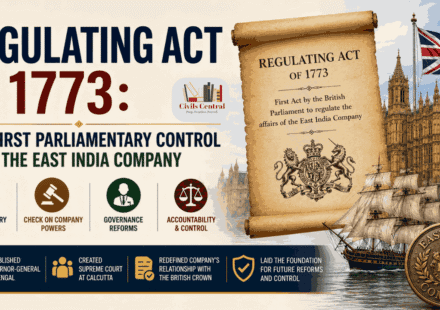
Regulating Act 0f 1773 : The First Parliamentary Control over the East India Company

The Regulating Act 0f 1773 was the first major constitutional measure passed by the British Parliament to regulate the administration of the English East India Company in India. Enacted in response to corruption, administrative failures, the Great Bengal…
Read More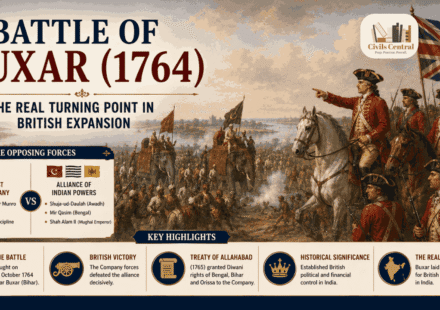
Battle of Buxar (1764): Causes, Course, Consequences and the Establishment of British Supremacy
The Battle of Buxar (22 October 1764) was one of the most decisive events in the history of modern India. Fought between the English East India Company, led by Major Hector Munro, and the combined forces of Mir Qasim, Shuja-ud-Daulah, and Shah Alam II,…
Read More
Anglo-French Rivalry in India: The Carnatic Wars (1746–1763): The Struggle for European Supremacy in India
Master the Anglo-French Rivalry in India and the Carnatic Wars (1746–1763) with exam-oriented notes covering the causes, course, and outcomes of the three Carnatic Wars. Learn about the roles of Dupleix, Robert Clive, Joseph François Dupleix, Count de…
Read More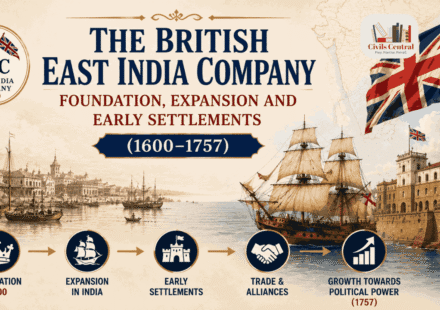
British East India Company: Foundation, Expansion and Early Settlements (1600–1757)
Discover the Foundation, Expansion, and Early Settlements of the British East India Company (1600–1757), from its royal charter by Queen Elizabeth I to the establishment of trading factories at Surat, Madras, Bombay, and Calcutta. Learn how the Company…
Read More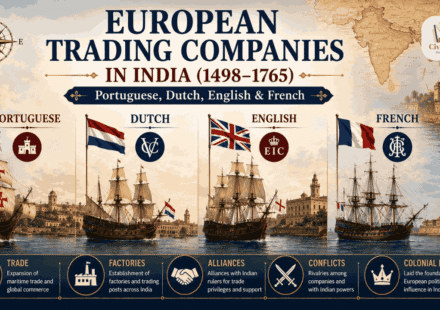
European Trading Companies in India (1498–1765): Portuguese, Dutch, English and French
Learn about the European Trading Companies in India (1498–1765), including the Portuguese, Dutch, English, and French. Understand their arrival, trading activities, settlements, conflicts, and rivalry for supremacy in India, along with the factors that…
Read More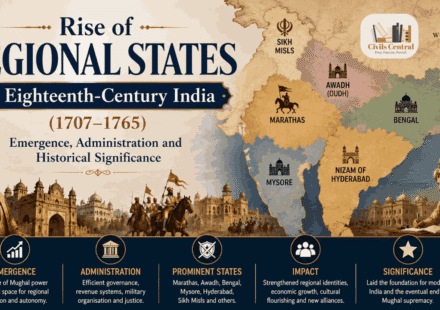
Rise of Regional States in Eighteenth-Century India (1707–1765): Emergence, Administration and Historical Significance
Explore the Rise of Regional States in Eighteenth-Century India (1707–1765) and understand how the decline of the Mughal Empire led to the emergence of powerful regional kingdoms such as Bengal, Awadh, Hyderabad, Mysore, the Marathas, Sikhs, and Jats.…
Read More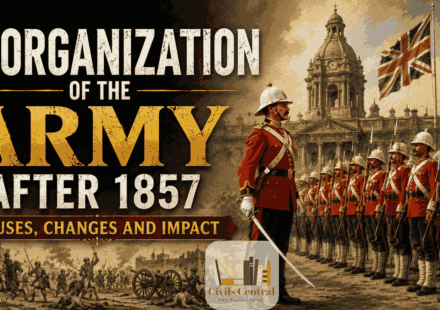
Reorganization of the Army after 1857: Causes, Changes and Impact
The Revolt of 1857 marked a turning point in the history of British rule in India. One of its most significant consequences was the complete restructuring of the Army, as the British realized that the existing military organization under the East India…
Read More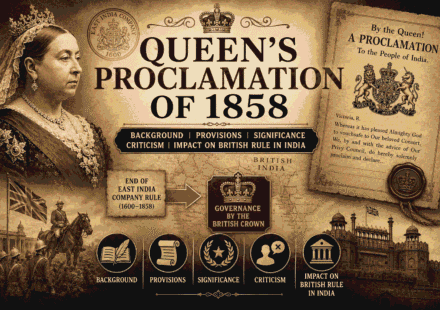
Queen’s Proclamation of 1858: Background, Provisions, Significance, Criticism and Impact on British Rule in India
The Queen's Proclamation of 1858, also known as Queen Victoria's Proclamation, was one of the most significant constitutional and administrative documents in the history of British India.
Read More
Government of India Act, 1858: Features, Objectives, Impact and Historical Significance
The Government of India Act, 1858 was a landmark legislation passed by the British Parliament that fundamentally transformed the system of governance in India. Enacted in the aftermath of the Revolt of 1857, the Act abolished the rule of the East India…
Read More