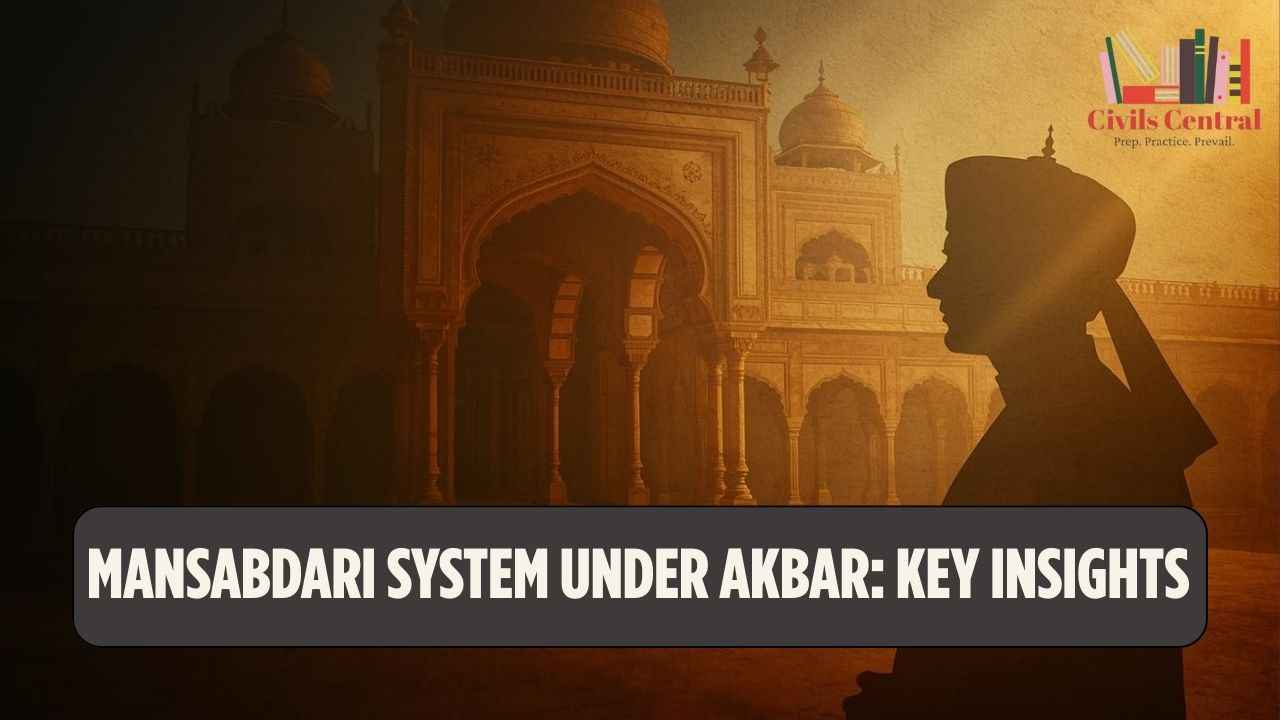
Mansabdari System under Akbar: Structure, Features, and Significance for UPSC/JKAS

Introduction
The Mansabdari System was a unique administrative–military framework introduced by Akbar during the consolidation of the Mughal Empire in the 16th century. The term ‘Mansab’ literally means rank or position, and every officer (mansabdar) in the empire was assigned a numerical rank that determined his status, salary, and military responsibilities.
This system formed the backbone of Mughal governance by integrating civil administration with military organization. It ensured centralized control, prevented the rise of hereditary feudal lords, and maintained a standing cavalry for imperial expansion and defense. The Mansabdari system also worked closely with the Jagirdari system, through which revenue assignments (jagirs) were granted in lieu of salary.
For UPSC and JKAS aspirants, the Mansabdari system is a crucial topic under Medieval Indian History, frequently tested in both Prelims (concept-based questions) and Mains (analytical questions on Mughal administration and decline). A clear understanding of its structure—particularly the distinction between Zat and Sawar ranks—is essential for scoring well in examinations.
Meaning and Origin of the Mansabdari System
The term Mansab is derived from an Arabic–Persian word meaning rank, office, or position. Under the administrative reforms of Akbar, every noble or officer in the Mughal Empire was assigned a mansab, which determined:
- His official status in the imperial hierarchy
- The salary he was entitled to receive
- The number of cavalry (sawar) he was required to maintain for the emperor
Origin and Background
Although elements of ranking systems existed in earlier Central Asian and Persian administrative traditions, the Mansabdari system was systematically organized and institutionalized by Akbar around 1571–72 CE. It evolved as part of Akbar’s broader administrative consolidation after the initial phase of territorial expansion.
The system was not purely military; it combined civil and military responsibilities, making Mughal officials both administrators and commanders when required. This integrated structure strengthened imperial authority and reduced the chances of autonomous feudal power centers.
Historians consider the Mansabdari system a key pillar of Mughal centralization, as it ensured that all nobles—whether Turani, Irani, Afghan, Rajput, or Indian Muslim—were directly dependent on the emperor for rank, promotion, and dismissal.
Objectives of the Mansabdari System
The Mansabdari system introduced by Akbar was not merely a military arrangement but a carefully designed administrative mechanism to strengthen the foundations of the Mughal Empire. Its objectives were both political and administrative.
1. Centralization of Power
Akbar aimed to ensure that all nobles and officers were directly subordinate to the emperor. Since mansabs were granted, promoted, or withdrawn at the emperor’s discretion, it prevented the emergence of independent or hereditary feudal lords.
2. Efficient Military Organization
The system created a well-structured cavalry-based military force. Each mansabdar was required to maintain a specified number of mounted soldiers (sawar), ensuring quick mobilization during wars and expansion campaigns.
3. Integration of Civil and Military Administration
Unlike purely military feudal systems, the Mansabdari system combined civil duties with military responsibilities. Officials could serve in revenue administration, provincial governance, or military command depending on imperial needs.
4. Loyalty and Political Stability
By incorporating nobles from diverse backgrounds—Turani, Irani, Afghan, Rajput, and Indian Muslim—Akbar strengthened political unity. Since rank and income depended entirely on imperial favor, loyalty to the emperor was reinforced.
5. Financial Regulation and Accountability
The ranking system determined salary and military obligations clearly, reducing arbitrary power. The branding of horses (dagh) and descriptive rolls (chehra) were introduced to prevent corruption and false musters.
Key Features of the Mansabdari System
The Mansabdari system under Akbar formed the core administrative–military structure of the Mughal Empire. Its design ensured hierarchy, accountability, and imperial control. The following were its principal features:
1. Numerical Ranking System
The Mansabdari system was a unique evolutionary product of Central Asian military traditions (the decimal system of Genghis Khan) and Indian administrative needs.
- Hierarchy and Graduation: It was a single service encompassing both civil and military responsibilities. A Mansabdar could be a Governor (Subahdar) one day and a frontline General the next.
- Expansion of Ranks: Under Akbar, the highest rank for a commoner was 5,000, while Princes held ranks up to 10,000. By the time of Aurangzeb and the later Mughals, these ranks were inflated to 40,000 or more, leading to “Rank Inflation,” which diluted the prestige of the system.
- Calculation of Salary: The rank determined the Talab (pay claim). If paid in cash (Naqdi), it was straightforward; if paid in land, it involved complex revenue assessments (Jama).
2. Dual Rank – Zat and Sawar
Introduced by Akbar in the 11th year of his reign, this dual mechanism refined the relationship between status and obligation.
- Zat (Personal Status): This fixed the Mansabdar’s place in the court protocol and his personal pay. It was the “theoretical” rank.
- Sawar (Military Obligation): This fixed the actual number of cavalrymen (Tabinan) the officer had to bring to the muster.
- Classification: Based on the ratio of Zat to Sawar, Mansabdars were grouped into three classes:
- First Class: Sawar rank equal to Zat rank.
- Second Class: Sawar rank half or more than half of the Zat rank.
- Third Class: Sawar rank less than half of the Zat rank.
3. Non-Hereditary Nature
The Mughal nobility was an “open-ended” aristocracy, not a hereditary landed gentry like in Medieval Europe.
- Doctrine of Escheat (Qanun-e-Zabt): Upon the death of a Mansabdar, all his assets and the Jagir reverted to the Crown. The Emperor would then settle the debts of the deceased and provide a subsistence allowance to the family.
- Meritocracy over Lineage: This ensured that the nobility remained dependent on the Emperor’s favor. It prevented the rise of independent local power centers—at least until the central authority weakened in the 18th century.
4. Payment through Jagirs
While the system was salary-based, the shortage of liquid cash led to the Jagirdari system.
- Assignment of Revenue: A Jagir was not a grant of land but a grant of the right to collect land revenue. The Mansabdar was a Jagirdar who acted as a state agent.
- Transferability: To prevent the development of local roots and vested interests, Jagirdars were transferred every 3 to 4 years. This “rolling” system kept the nobility mobile and loyal to the center.
- Khalisa Land: Highly productive lands were kept as Khalisa (Crown lands) to pay the Naqdi (cash-paid) troops and the Emperor’s personal expenses.
5. Strict Inspection and Branding System
To ensure the state wasn’t paying for “paper soldiers,” Akbar revived and perfected the systems of Sher Shah Suri.
- Dagh-i-Mahalli (Branding): Horses were branded with two marks—the Imperial mark and the Mansabdar’s mark—to prevent the same horse from being presented by multiple officers during inspection (Dag-o-Tashiha).
- Chehra (Descriptive Rolls): A detailed physical description (Huliya) of every soldier was recorded to prevent the substitution of trained soldiers with menials or civilians during reviews.
- The Dah-Bisti System: For every 10 cavalrymen, the Mansabdar was required to maintain 20 horses (to account for fatigue and battle losses), ensuring the army’s mobility.
6. Inclusive Nobility
Akbar deliberately designed the Mansabdari system to be a multi-ethnic platform.
- Counter-Balancing Forces: By recruiting Turani (Central Asian), Irani (Persian), Afghan, Rajput, and Indian Muslims (Shaikhzadas), Akbar ensured that no single ethnic group could challenge the throne.
- Integration of Rajputs: The inclusion of Rajputs into the high Mansabs gave the Mughal Empire a “National” character and a reliable military backbone that served them for 150 years.
- Political Integration: It turned potential regional rebels into imperial stakeholders, effectively centralizing the subcontinent’s elite under one umbrella.
Structure of the Mansabdari System: Zat and Sawar Explained
The structural foundation of the Mansabdari system under Akbar rested on a dual-ranking mechanism—Zat and Sawar. This classification determined an officer’s status, remuneration, and military obligations within the Mughal Empire.
1. Zat Rank (Personal Status and Salary)
The Zat was the “Personal Rank” that defined a noble’s existence within the Mughal ecosystem.
- The “Table of Precedence”: It determined where a noble stood in the Diwan-i-Aam (Hall of Public Audience). A higher Zat rank meant the noble was closer to the Emperor’s person, reflecting their “intrinsic value” to the state.
- Salary Calculation (Talab): The Zat rank was the basis for calculating the noble’s personal pay. This salary was intended to cover the noble’s household, his harem, his transport (elephants, camels), and his retinue of personal servants.
- Administrative Significance: Not all Zat holders were military commanders; some were scholars, physicians, or artists (like Birbal), proving that the Zat was a civil-cum-military grade.
2. Sawar Rank (Military Responsibility)
While Zat was about status, Sawar was about utility. It was the “Conditional Rank” added to the Zat to determine the actual military strength a noble contributed to the Empire.
- The Cavalry Requirement: The Sawar rank dictated the number of Tabinan (cavalrymen) the noble had to muster. For every Sawar unit, the noble was generally expected to maintain a specific ratio of horses (the Dah-Bisti or 10:20 rule) to ensure remounts were available during long campaigns.
- Three Categories of Mansabdars: Based on the mathematical relationship between Zat and Sawar, Akbar established a three-tier classification:
- First Class: $Zat = Sawar$. (e.g., 5000 Zat / 5000 Sawar). This was the highest honor, usually reserved for Princes or top-tier generals.
- Second Class: $Sawar \geq \frac{1}{2} Zat$. (e.g., 5000 Zat / 3000 Sawar).
- Third Class: $Sawar < \frac{1}{2} Zat$. (e.g., 5000 Zat / 2000 Sawar).
- Financial Separation: The salary for the Sawar rank (Sawar-rank pay) was separate from the Zat pay and was specifically meant to cover the costs of the soldiers’ salaries, horses, and equipment.
3. Du-Aspah and Sih-Aspah System (Later Modification)
As the Empire expanded, the cost of increasing Zat ranks became unsustainable. Jahangir introduced the Du-Aspah Sih-Aspah (2-horse, 3-horse) system to increase military strength without inflating the noble’s personal status or protocol.
- Mechanism: A noble with a rank of “4,000 Zat / 4,000 Sawar, Du-Aspah Sih-Aspah” was required to maintain double the number of soldiers and horses (8,000) than his nominal Sawar rank suggested.
- The “Mashrut” (Conditional) Rank: This allowed the Emperor to reward a general for a specific campaign. Once the campaign ended, the Du-Aspah status could be revoked, returning the noble to his original Sawar obligation.
- Fiscal Efficiency: It was a clever “hack” to strengthen the army. The state paid more for the additional troops, but the noble’s personal salary (Zat) remained unchanged, saving the treasury from long-term pension liabilities.
Relation between the Mansabdari and Jagirdari Systems
The Mansabdari system functioned in close coordination with the Jagirdari system under Akbar in the Mughal Empire. While the Mansabdari system determined an officer’s rank, status, and military obligations, the Jagirdari system provided the financial mechanism to pay those officers.
1. Meaning of Jagir
A Jagir was a revenue assignment granted to a mansabdar in lieu of cash salary. Instead of receiving direct payment from the imperial treasury, the mansabdar was authorized to collect land revenue from a specified territory.
📌 Important: The mansabdar did not own the land. He only had the right to collect revenue for a fixed period.
2. Functional Relationship
- Mansab → Rank and obligation
- Jagir → Source of salary
Thus, every mansabdar was usually assigned a jagir corresponding to his Zat and Sawar rank.
3. Types of Jagirs (Brief Overview)
- Tankha Jagir – Given in lieu of salary.
- Watan Jagir – Granted to local chiefs (especially Rajputs) in their hereditary territories.
- Khalisa Land – Revenue directly collected by the state (not assigned as jagir).
4. System of Transfers
Jagirs were frequently transferred to prevent the mansabdar from establishing a permanent power base. This strengthened imperial control but also created administrative instability in some regions.
5. Administrative Check
Revenue assessment was based on the Zabt system introduced by Akbar, ensuring that jagir assignments were approximately equal to the salary due.
Changes and Developments under Later Mughals
Although the Mansabdari system was institutionalized by Akbar, it underwent important modifications under his successors to meet changing political and military needs of the Mughal Empire.
1. Reforms under Jahangir
Under Jahangir, the system was refined through the introduction of the:
Du-Aspah and Sih-Aspah System
- Du-Aspah (two-horse) and Sih-Aspah (three-horse) ranks required selected mansabdars to maintain double or triple the number of cavalrymen.
- This was a method to reward loyal nobles without formally increasing their Zat rank.
- It strengthened the cavalry while maintaining hierarchical control.
📌 Exam Insight: This reform increased military obligations without proportionally increasing rank prestige.
2. Modifications under Shah Jahan
Under Shah Jahan:
- The size of the nobility expanded significantly.
- Greater emphasis was placed on strict branding (dagh) and descriptive rolls (chehra) to prevent fraud.
- Financial pressure began to increase due to the growing number of high-ranking mansabdars.
3. Crisis under Aurangzeb
During the reign of Aurangzeb:
- The empire expanded territorially (especially in the Deccan), leading to an increase in mansabdars.
- However, there was a shortage of productive jagirs, causing the famous Jagirdari crisis.
- Many mansabdars were assigned jagirs that yielded less revenue than their sanctioned salary.
- This led to corruption, oppression of peasants, and administrative inefficiency.
4. Structural Weakening in the 18th Century
After Aurangzeb:
- Frequent wars and political instability reduced imperial control.
- Mansabdars began acting more autonomously.
- The system gradually lost its centralized character, contributing to Mughal decline.
Importance and Significance of the Mansabdari System
The Mansabdari system was the backbone of Mughal administration, especially under Akbar. It played a decisive role in consolidating and sustaining the authority of the Mughal Empire across vast territories.
1. Foundation of Centralized Administration
The system ensured that all nobles derived their authority directly from the emperor. Since ranks were transferable and non-hereditary, it prevented the emergence of autonomous feudal powers. This strengthened imperial supremacy.
2. Efficient Military Organization
By linking rank with the obligation to maintain cavalry, the system created a ready and disciplined military force. The branding (dagh) and descriptive roll (chehra) systems ensured accountability and reduced fraudulent practices.
3. Integration of Diverse Nobility
The Mansabdari system incorporated nobles from various ethnic and regional backgrounds—Turani, Irani, Afghan, Rajput, and Indian Muslim elites. This inclusiveness promoted political stability and minimized factional rebellions.
4. Administrative Flexibility
Since mansabdars could be appointed to civil or military posts, the empire maintained a flexible bureaucratic structure. Officials could serve as provincial governors (Subedars), revenue officers, or military commanders depending on imperial requirements.
5. Financial Regulation through Jagirdari
The linkage between mansab ranks and jagir assignments created a systematic method of remuneration. Although it later contributed to fiscal strain, initially it ensured an organized revenue–expenditure mechanism.
6. Contribution to Mughal Expansion
The system supported territorial expansion during the reigns of Akbar and his successors by ensuring quick mobilization of forces and efficient provincial control.
Limitations and Criticisms of the Mansabdari System
While the Mansabdari system strengthened the foundations of the Mughal Empire under Akbar, it developed structural weaknesses over time, especially during the later Mughal period.
1. Jagirdari Crisis
With the rapid territorial expansion under Aurangzeb, the number of mansabdars increased significantly. However, there was a shortage of productive jagirs to assign as salary.
- Many mansabdars were given jagirs with low revenue yield.
- This led to over-assessment of peasants and administrative corruption.
- The fiscal imbalance weakened imperial finances.
2. Frequent Transfers and Instability
Jagirs were frequently transferred to prevent nobles from building local power bases. While this ensured central control, it resulted in:
- Short-term exploitation of peasants
- Lack of long-term developmental interest in assigned territories
- Administrative discontinuity
3. Corruption and False Musters
Despite systems like Dagh (branding of horses) and Chehra (descriptive rolls), many mansabdars:
- Exaggerated troop numbers
- Maintained fewer cavalrymen than required
- Engaged in revenue malpractice
This reduced military efficiency over time.
4. Growing Nobility and Fiscal Pressure
Under later Mughals, the size of the nobility expanded disproportionately. High Zat ranks were granted for political appeasement, increasing salary obligations without proportional revenue growth.
5. Absence of Institutional Permanence
The system depended heavily on a strong emperor. After the death of Aurangzeb, weakening central authority led to:
- Rise of regional powers
- Semi-autonomous governors
- Breakdown of centralized control
Conclusion
The Mansabdari System stands as one of the most sophisticated administrative innovations of medieval India. Institutionalized by Akbar, it provided a structured framework that combined rank, revenue, and military responsibility under direct imperial control within the Mughal Empire.
By introducing a non-hereditary, transferable ranking system based on Zat and Sawar, the Mughals ensured centralized authority, administrative flexibility, and efficient military organization. The integration of diverse nobles into a unified imperial service strengthened political stability and enabled territorial expansion.
However, over time, structural pressures—especially the jagirdari crisis, fiscal strain, and administrative corruption—exposed the limitations of the system. Under weaker successors, the same mechanisms that once guaranteed centralization began contributing to instability and decline.
For UPSC/JKAS aspirants, the Mansabdari system should be understood not merely as a military arrangement but as a centralized bureaucratic-military structure that shaped both the rise and gradual weakening of Mughal authority. Linking its strengths under Akbar with its later distortions provides the analytical depth required for high-scoring Mains answers.
About The Author