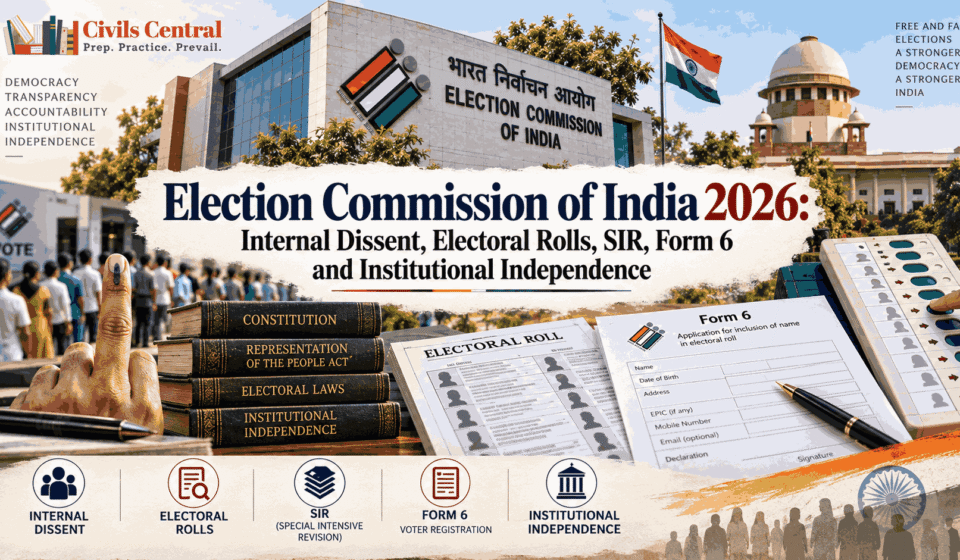
Election Commission of India 2026: Internal Dissent, Electoral Rolls, SIR, Form 6 and Institutional Independence

Why in News?
An investigation published by The Indian Express on September 23, 2026 reported that Election Commissioners Sukhbir Singh Sandhu and Vivek Joshi had formally recorded objections on at least 14 occasions over a period of 10 months concerning decisions or orders associated with the Election Commission of India (ECI). According to the report, their objections related to new-voter registration, deletion of names from electoral rolls, changes to Form 6, the handling and control of electoral-roll data, the Special Intensive Revision (SIR) of electoral rolls, and the increasing centralisation of electoral-roll-related functions. The report stated that four objections were recorded on a single day.
The reported controversy is significant because these issues concern the electoral roll itself, which is the legal foundation from which the electorate is identified before an election is conducted. The dispute therefore goes beyond an internal disagreement between office-holders. It brings together several important constitutional and governance questions: how a multi-member constitutional body should function, how electoral rolls are prepared and revised, who exercises operational authority over electoral databases, how new voters are registered, what safeguards accompany deletion of names, and how institutional independence can be reconciled with transparency and accountability.
The Election Commission has subsequently said that written notes, suggestions and differing views are part of its internal decision-making process and that decisions of the Commission during the relevant period were ultimately taken unanimously. The Indian Express reported on September 24 that the Commission did not dispute the existence, dates or contents of the 14 notes but characterised them as suggestions.
For aspirants, therefore, the correct approach is not to treat the reported objections as a judicial finding of illegality. The appropriate examination question is broader: what does the episode reveal about the constitutional design, functioning and accountability of India’s election-management institution?
What Exactly Is New?
The immediate development is not the creation of a new constitutional power of the Election Commission. Nor is SIR itself a newly invented electoral process.
The underlying constitutional and statutory framework is much older. Article 324 has long vested the ECI with the superintendence, direction and control of elections and the preparation of electoral rolls, while the Representation of the People Act, 1950 (RPA 1950) and the Registration of Electors Rules, 1960 provide the statutory and procedural framework for electoral-roll administration.
What is new is the current institutional controversy surrounding the exercise of these functions, particularly during the large-scale SIR exercise and the increasing use of centralised digital systems for electoral-roll management. The reported objections therefore provide a current entry point into a much older constitutional architecture.
What Existed Earlier?
India has always operated through a constitutional Election Commission supported by statutory electoral law and a field-level administrative machinery.
Electoral rolls are not permanent lists. They are prepared, revised and corrected under the RPA 1950. The Act contains separate provisions dealing with disqualification, multiple registration, conditions of registration, ordinary residence, preparation and revision of rolls, correction of entries, inclusion of names and appeals.
Likewise, the ECI has historically exercised powers of electoral-roll revision, including intensive forms of revision. The ECI’s June 24, 2025 SIR order itself records that intensive revisions had been undertaken at different points in India’s electoral history and places the exercise within Article 324, the RPA 1950 and the Registration of Electors Rules, 1960.
The important point is therefore:
SIR, electoral-roll revision and ECI supervision are not products of the 2026 controversy. What is new is the scale, digital architecture and institutional disagreement surrounding their contemporary implementation.
What Has Changed?
The present controversy brings several changes or developments into focus.
First, electoral-roll revision is increasingly being administered through digitised and centralised information systems. The ECI’s voter-service portal now integrates SIR-related services, new-voter registration and other electoral-roll functions through its digital ecosystem.
Second, SIR has moved from being a relatively specialised electoral-roll exercise into a major national administrative process. The ECI has described the objective of the 2026 SIR as ensuring that no eligible citizen is left out while no ineligible person is included.
Third, the controversy has brought the internal functioning of the three-member Commission into public attention. The question is not simply whether individual Commissioners can disagree; it is whether the institutional structure provides adequate mechanisms for consultation, recording of dissent, decision-making and accountability.
Fourth, the Supreme Court’s 2026 judgment concerning Bihar SIR has added an important judicial dimension. The Court examined the ECI’s authority under Article 324 and Section 21(3) of the RPA 1950, the proportionality of the exercise, procedural safeguards and the extent to which citizenship-related issues may be examined for electoral purposes.
1. Background: Why Electoral Rolls Matter
An election cannot begin with the ballot alone. Before votes can be cast, the electoral system must determine who is legally entitled to participate. The electoral roll performs this foundational function. It is the official record of electors for a constituency. Consequently, errors can operate in two opposite directions.
An inaccurate roll may contain:
- duplicate entries;
- names of deceased persons;
- persons who have shifted residence;
- persons otherwise disqualified;
- multiple registrations.
But the opposite problem is equally important: an eligible voter may be wrongly omitted.
This creates the central administrative dilemma: Electoral-roll integrity requires both accuracy and inclusion.
A roll that contains ineligible entries may undermine electoral integrity. A process that wrongly excludes eligible citizens can undermine democratic participation.
This tension explains why electoral-roll revision is constitutionally significant even though it occurs before polling day.
2. Constitutional Foundation of the Election Commission
The constitutional foundation is Article 324.
Article 324 vests in the Election Commission the superintendence, direction and control of:
- the preparation of electoral rolls; and
- the conduct of elections to Parliament;
- State Legislatures;
- the offices of President and Vice-President.
The provision is therefore much broader than merely supervising polling.
It connects the ECI directly with the preparation and maintenance of the electorate itself. The ECI’s own SIR order expressly invokes Article 324 alongside the RPA 1950 as the legal foundation for its electoral-roll responsibilities.
Part XV of the Constitution
The constitutional provisions dealing specifically with elections should be studied together:
| Article | Core subject |
|---|---|
| 324 | Election Commission |
| 325 | One general electoral roll; prohibition of exclusion on specified discriminatory grounds |
| 326 | Elections based on adult suffrage |
| 327 | Parliament’s power to make election laws |
| 328 | State Legislature’s power to make provisions concerning elections, subject to parliamentary law |
| 329 | Bar on judicial interference in electoral matters except through constitutionally prescribed mechanisms |
These provisions together form the constitutional skeleton of India’s electoral system.
3. Article 324: Why the Wording Matters
UPSC can easily test the exact language of Article 324. The Constitution does not merely say that the ECI conducts elections.
It gives the Commission: superintendence, direction and control, over the specified electoral functions. This language is important because it gives the ECI substantial constitutional authority over electoral administration, while Parliament simultaneously has legislative competence over elections under Articles 327 and related provisions.
Thus: Constitutional authority of ECI does not mean absence of Parliamentary legislation. The statutory electoral framework operates alongside Article 324.
4. Constitutional Status vs Statutory Framework
The ECI is a constitutional body because its existence and basic authority arise from the Constitution. But much of its day-to-day functioning is governed through legislation and rules.
The broad architecture is:
Constitution
↓
Article 324 and related provisions
↓
Representation of the People Act, 1950
↓
Representation of the People Act, 1951
↓
Registration of Electors Rules, 1960 and other election rules/instructions
This distinction is important because UPSC can combine constitutional and statutory provisions in the same question.
5. RPA 1950 and RPA 1951: The Fundamental Distinction
One of the most useful distinctions for Prelims is between the two Representation of the People Acts.
Representation of the People Act, 1950
Its central concern is the electoral foundation.
It deals with matters including:
- electoral rolls;
- qualifications and disqualifications for registration;
- electoral registration;
- preparation and revision of rolls;
- inclusion and correction of names;
- appeals.
The Act expressly contains Sections 21, 22, 23 and 24 dealing respectively with preparation and revision, correction, inclusion and appeals.
Representation of the People Act, 1951
Its central concern is the conduct and legal consequences of elections.
It covers matters such as:
- conduct of elections;
- qualifications and disqualifications for membership;
- corrupt practices;
- electoral offences;
- election petitions and related matters.
A useful conceptual distinction
RPA 1950 asks: Who is on the electoral roll?
RPA 1951 asks: How is the election conducted and challenged?
This is a simplification for revision, but it is highly useful for building the basic conceptual map.
6. Who Manages the Electoral Roll?
A common misconception is that every electoral-roll function is physically performed by the ECI headquarters. The system has multiple administrative layers.
Election Commission of India
The constitutional apex authority with overall superintendence, direction and control.
Chief Electoral Officer — CEO
The state-level electoral administration authority.
District Election Officer — DEO
Coordinates election-related administration at the district level.
Electoral Registration Officer — ERO
The officer responsible for electoral-roll functions for the relevant constituency.
Assistant Electoral Registration Officer — AERO
Assists the ERO.
The RPA 1950 expressly recognises the offices of Chief Electoral Officers, Electoral Registration Officers and Assistant Electoral Registration Officers, among others. This hierarchy is crucial to understanding the current controversy over centralised databases.
7. The ERO: Why This Office Matters
The Electoral Registration Officer occupies a particularly important position because electoral-roll decisions eventually have to be implemented at the constituency level.
The ERO deals with issues such as:
- inclusion;
- correction;
- deletion;
- claims and objections;
- verification;
- revision.
Therefore, an important governance principle emerges: Constitutional supervision can be centralised, but electoral-roll administration necessarily has a substantial field-level component.
The tension between these two levels becomes more significant as digital systems increasingly centralise data and software.
8. What Is Special Intensive Revision — SIR?
Special Intensive Revision (SIR) is an intensive exercise for revising electoral rolls. It is different from routine updating or summary revision because it involves a more extensive verification process.
The ECI’s June 24, 2025 order stated that Article 324 and the RPA 1950 vest the Commission with responsibility over electoral-roll preparation and that the electoral-roll framework is provided by the RPA 1950 and Registration of Electors Rules, 1960. The order also referred to earlier intensive revisions conducted in different periods.
The ECI’s stated objective for the 2026 SIR has been: ensuring that eligible citizens are not left out while ineligible persons are not included in the electoral roll. This formulation is important because it captures the two-sided nature of electoral-roll integrity.
9. SIR vs Summary Revision
These concepts should not be treated as interchangeable.
| Feature | Summary Revision | Intensive Revision / SIR |
|---|---|---|
| Nature | Routine updating mechanism | More comprehensive verification exercise |
| Existing roll | Important starting point | Greater emphasis on verification |
| Objective | Keep roll updated | Deeper examination of electoral-roll accuracy |
| Field verification | Present within prescribed process | More intensive |
| Current relevance | Continuing electoral administration | Major current-affairs issue |
The Registration of Electors Rules, 1960 recognise different modes of revision, while Section 21 of the RPA 1950 provides the statutory framework for preparation and revision of electoral rolls.
10. Why Has SIR Become a Major Constitutional Issue?
The issue is not simply whether electoral rolls should be revised. There is broad administrative logic behind keeping electoral rolls accurate. The more difficult question is: What procedures can be used to achieve that objective without wrongly excluding eligible voters?
The controversy therefore involves competing constitutional values: Purity of electoral rolls versus inclusion of eligible electors versus procedural fairness versus administrative efficiency.
The Supreme Court’s 2026 Bihar SIR judgment specifically examined whether the exercise had a legitimate purpose, whether the measures were proportionate and whether the procedure complied with the RPA 1950 and Registration of Electors Rules.
11. Supreme Court and Bihar SIR: 2026 Judgment
In Association for Democratic Reforms v. Election Commission of India, decided on May 27, 2026, the Supreme Court considered challenges to the Bihar SIR.
The questions before the Court included:
- whether the ECI possessed the power to conduct SIR;
- whether the exercise had a legitimate purpose;
- whether the measures adopted were proportionate;
- whether the procedure complied with the RPA 1950 and Registration of Electors Rules, 1960;
- and whether the ECI could scrutinise citizenship status for electoral-roll purposes.
The Court upheld the ECI’s authority to conduct the Bihar SIR under Article 324 read with Section 21(3) of the RPA 1950, while the judgment also addressed procedural safeguards and the limited nature of citizenship-related inquiry for electoral purposes.
The judgment is particularly important because it demonstrates that Article 324 is not an unlimited licence for arbitrary electoral administration. Constitutional power remains subject to statutory requirements, constitutional standards and judicial review.
12. Citizenship and Electoral Registration: A Crucial Distinction
One of the most difficult conceptual issues surrounding SIR is the relationship between:
citizenship and electoral eligibility.
Citizenship is governed by the constitutional and statutory framework relating to citizenship, while electoral registration is governed by electoral law.
The Supreme Court’s Bihar SIR judgment recognised that the ECI may undertake a limited inquiry relevant to electoral eligibility, but this should not be confused with the ECI becoming the general authority for finally determining citizenship status. The Court’s judgment treated citizenship-related scrutiny in the context of electoral entitlement and provided for referral to the competent authority where necessary.
This is an important Prelims distinction: Electoral-roll verification is not identical to a general citizenship determination.
13. Form 6: The New Voter’s Entry Point
Form 6 is the application form for inclusion of a person’s name in the electoral roll as a new elector. The ECI’s official voter-service portal currently identifies Form 6 for persons who are 18 or above, or who will attain the qualifying age within the applicable period.
The official Form 6 itself is titled: “Application Form for New Voters.”
This makes Form 6 an important current-affairs term.
14. Form 6 vs Form 6A vs Form 7
This is a classic Prelims distinction.
| Form | Broad purpose |
|---|---|
| Form 6 | Inclusion of name as a new elector |
| Form 6A | Registration of an overseas elector |
| Form 7 | Deletion of an existing electoral-roll entry |
The ECI’s voter portal explicitly lists Form 6 for new voter registration, Form 6A for eligible overseas Indian citizens and Form 7 for deletion.
Prelims trap
A statement saying “Form 7 is used for new voter registration” is incorrect.
15. Why Was Form 6 in the News?
According to The Indian Express, a change to Form 6 on the ECI’s digital portal introduced questions connecting a new applicant with the electoral roll of the previous SIR. The report said applicants were asked to indicate whether their own name, or that of a parent or grandparent, appeared in the previous SIR-era roll, or whether none did.
The report further said that Sandhu and Joshi objected to this change, characterising it as unauthorised and seeking its removal. These are reported objections by the two Commissioners, not a judicial determination that the modification was legally invalid.
The examination relevance lies in understanding the relationship between:
→ new-voter registration
→ electoral-roll verification
→ SIR
→ administrative rules
→ institutional authority.
16. Electoral Roll Deletion: Why Due Process Matters
Deletion of an electoral-roll entry can arise from legally recognised circumstances, including death, shifting of residence, duplication or disqualification. The RPA 1950 contains separate provisions dealing with correction and inclusion, while the electoral-roll rules provide procedural mechanisms for revision and claims and objections.
The central governance principle is: Deletion must be based on a legally recognised ground and accompanied by the applicable procedural safeguards.
This is why notice, verification, hearing and appeal mechanisms matter. A technically efficient database is not sufficient if the person affected has no meaningful way to correct an error.
17. Claims, Objections and Appeals
Electoral-roll administration is not intended to be a one-way administrative process.
The statutory architecture includes:
Preparation / revision
↓
Claims and objections
↓
Verification
↓
Decision
↓
Appeal
The RPA 1950 expressly provides for appeals under Section 24.
This becomes especially important in SIR because large-scale verification can produce large-scale disputes.
For UPSC, remember:
Electoral-roll revision is not simply a database-cleaning exercise; it is a legally structured administrative process.
18. The Digital Electoral Database Issue
The present controversy adds a modern layer to an old constitutional problem.
Historically, electoral-roll administration involved:
- physical forms;
- local verification;
- printed rolls;
- field-level officers;
- manual corrections.
Today, electoral administration increasingly involves:
- centralised databases;
- software platforms;
- digital applications;
- online verification;
- data integration;
- automated identification of discrepancies.
The ECI’s current voter-service portal integrates SIR services, previous-roll searches, new-voter registration and deletion-related functions. Digitalisation can improve electoral administration, but it also creates new questions about data governance and institutional accountability.
19. Centralisation: Efficiency vs Accountability
Centralisation can offer genuine administrative benefits.
A unified digital architecture can improve:
- standardisation;
- interoperability;
- data consistency;
- monitoring;
- cybersecurity;
- speed of processing;
- detection of duplicate entries.
But excessive centralisation can create different risks:
- concentration of administrative power;
- dependence on a single technical system;
- difficulty correcting software-generated errors;
- weaker visibility of field-level decisions;
- unclear accountability when a local officer’s decision cannot be implemented digitally;
- cybersecurity and data-integrity risks.
The current controversy therefore presents a classic governance question:
How can electoral administration combine central technological standards with decentralised statutory responsibility and effective local accountability?
20. Why the ERO–Database Relationship Matters
The reported controversy is particularly important because the ERO is a statutory field-level actor while digital systems may be centrally administered.
The Indian Express reported an example from Goa in which 97 people were reportedly found eligible by the ERO but the software controlled from ECI headquarters did not permit those decisions to be recorded. This is a newspaper-reported account and should be treated as such rather than as a judicially established finding.
The larger institutional question is nevertheless important:
Should a digital system merely implement a legally authorised administrative decision, or can the technical architecture effectively determine whether that decision can take effect?
This is a modern form of the classic “who exercises public power?” question.
21. The Three-Member Election Commission
The present controversy also requires a proper understanding of the ECI as a multi-member constitutional body.
The Commission currently comprises:
- Chief Election Commissioner Gyanesh Kumar
- Election Commissioner Sukhbir Singh Sandhu
- Election Commissioner Vivek Joshi.
The constitutional design permits the President to determine the number of Election Commissioners. The significance of a multi-member Commission is that electoral administration is not designed simply as the personal office of the CEC.
The Supreme Court has previously recognised the importance of plurality in the Commission. In a March 2024 order concerning the 2023 appointment law, the Court stated that the presence of additional Election Commissioners provides a balance and check, and referred to the concept of plurality under Article 324.
22. Is the CEC the Sole Decision-Maker?
No. The Commission is a multi-member constitutional body. The current controversy has therefore revived discussion around the proposition that the CEC should be understood as “first among equals” within the Commission rather than as an institutionally superior Election Commissioner.
This does not mean that the CEC has no special role. The CEC is the head of the Commission and has specific constitutional protections, including a distinctive removal mechanism.
But:
CEC as head of the Commission ≠ CEC as the sole constitutional authority for every substantive decision of the Commission.
This distinction has high Prelims and Mains value.
23. What Does “Dissent” Mean Inside a Constitutional Body?
Dissent itself is not necessarily evidence of institutional failure. In a multi-member body, members may:
- question a proposal;
- seek clarification;
- suggest modification;
- record objections;
- request reconsideration;
- disagree with an administrative approach.
The important institutional questions are:
Was the member heard?
Was the objection recorded?
Was the final decision taken through the legally prescribed process?
Is the decision attributable to the Commission collectively?
Can the institution explain the basis of its decision?
This is why the present controversy is best understood as an issue of institutional process, not merely personality or political disagreement.
24. Internal Dissent vs Final Decision
The ECI’s response is important to understand alongside the Indian Express report.
The Commission has said that differing views and written notes form part of internal checks and that decisions were ultimately taken unanimously. The Indian Express reported this response on September 24, while also noting that the Commission did not dispute the existence, dates or contents of the 14 notes.
This produces an important analytical distinction:
| Internal process | Final institutional decision |
|---|---|
| Individual member may object | Commission may ultimately decide |
| Suggestions may be recorded | Final order represents institutional action |
| Dissent may exist | Final decision can still be unanimous |
| Internal disagreement ≠ automatic invalidity | Legality depends on applicable constitutional/statutory procedure |
For Mains, this is much more useful than treating “dissent” as inherently good or bad.
25. Independence, Collegiality and Accountability
The current issue brings three principles into a single constitutional framework.
Independence
The ECI must be able to discharge its constitutional responsibilities without inappropriate external pressure.
Collegiality
A multi-member Commission should function through meaningful participation and institutional deliberation.
Accountability
The Commission must remain subject to constitutional and legal standards and should be capable of explaining the exercise of public power.
These principles are not mutually exclusive.
A robust constitutional institution requires: independence from improper influence + internal checks + procedural transparency + judicial review.
26. Appointment of Election Commissioners
The appointment mechanism is another important part of the institutional-independence debate. Article 324(2) provides for appointment by the President, subject to any law made by Parliament. For many years, Parliament had not enacted a comprehensive statutory framework governing the appointment process. This became the subject of judicial intervention.
In Anoop Baranwal v. Union of India (2023), the Supreme Court prescribed an interim mechanism involving:
Prime Minister + Leader of Opposition + Chief Justice of India
until Parliament enacted a law.
Parliament subsequently enacted the Chief Election Commissioner and Other Election Commissioners (Appointment, Conditions of Service and Term of Office) Act, 2023.
27. The 2023 Appointment Act
Under the statutory framework introduced by Parliament, the Selection Committee comprises:
- Prime Minister — Chairperson
- Union Cabinet Minister nominated by the Prime Minister
- Leader of Opposition in the Lok Sabha, or the leader of the single largest opposition party where applicable.
The President makes the appointment on the recommendation of this committee.
The Supreme Court’s March 2024 order expressly recorded the challenge to Section 7(1) of the 2023 Act, particularly the substitution of the Chief Justice of India with a Union Cabinet Minister nominated by the Prime Minister.
28. Anoop Baranwal and the Appointment Debate
The significance of Anoop Baranwal lies not simply in the names on the selection committee.
The deeper constitutional principle was that the absence of parliamentary legislation had created a legislative vacuum, and the Court supplied an interim mechanism until Parliament legislated. The Supreme Court later explained that its earlier directions were expressly intended to operate only until Parliament enacted a law.
This distinction is important:
Judicially prescribed interim mechanism ≠ permanent constitutional requirement.
Once Parliament enacted legislation, the statutory framework became the operative framework unless and until altered through the constitutional/legal process.
29. Current Legal Status of the 2023 Appointment Law
The appointment framework itself has been challenged. In March 2024, the Supreme Court declined to stay the operation of the 2023 Act at the interim stage. The Court emphasised that the constitutional challenge remained pending and that its observations at that stage were tentative rather than final.
Therefore, an aspirant should avoid writing: “The Supreme Court has declared the 2023 appointment law unconstitutional.”
That would be incorrect.
The proper formulation is:
The statutory appointment framework has faced constitutional challenge, and judicial scrutiny concerns questions of institutional independence, transparency and the relationship between the appointment process and free and fair elections.
30. Removal of the CEC and Other Election Commissioners
Another high-value constitutional distinction concerns removal.
Chief Election Commissioner
The CEC enjoys special removal protection comparable to that of a Supreme Court judge, subject to the constitutional procedure involving Parliament.
Other Election Commissioners
Other Election Commissioners and Regional Election Commissioners may be removed by the President on the recommendation of the CEC.
Therefore: CEC and ECs do not have identical removal protections. This is a classic UPSC statement-based area.
31. Why Appointment and Removal Matter
An election-management institution must regulate the process through which political power is allocated.
Therefore, institutional independence depends partly on whether its members can:
- be appointed through a credible process;
- exercise their functions without inappropriate pressure;
- enjoy adequate tenure protection;
- deliberate independently;
- and remain accountable under law.
This is why debates about appointment, tenure and removal are not merely administrative matters.
They are part of the larger constitutional principle of free and fair elections.
32. Free and Fair Elections: More Than Polling Day
Electoral integrity is sometimes reduced to: “Was the voting process peaceful?” That is too narrow.
A free and fair election requires integrity across the entire electoral cycle:
Accurate electoral roll
↓
Accessible voter registration
↓
Fair candidate process
↓
Impartial campaign regulation
↓
Secure polling
↓
Transparent counting
↓
Credible dispute resolution
Thus, electoral integrity begins before polling day.
This explains why disputes concerning Form 6, deletion of names and electoral databases can have constitutional significance even though they occur before voting.
33. Right to Vote: A Major Prelims Trap
The right to vote in Indian elections should not be described as a Fundamental Right under Part III. Article 326 provides the constitutional basis of elections to the Lok Sabha and State Legislative Assemblies through adult suffrage, subject to constitutionally and statutorily permitted qualifications and disqualifications.
The legal framework governing electoral registration is primarily statutory.
Therefore: Right to vote is not simply equivalent to a Fundamental Right under Part III.
At the same time, wrongful exclusion from the electoral process can raise constitutional questions involving equality, due process and democratic participation.
This distinction is important.
34. Article 325: One General Electoral Roll
Article 325 provides for one general electoral roll for every territorial constituency and prohibits exclusion from such a roll on grounds only of:
- religion;
- race;
- caste;
- sex.
The provision is important because it establishes an anti-discriminatory constitutional principle within the electoral-roll system. It should be distinguished from Article 326.
Article 325
Nature of electoral roll and non-discrimination
Article 326
Adult suffrage
35. Article 326: Universal Adult Suffrage
Article 326 establishes adult suffrage as the basis of elections to the Lok Sabha and State Legislative Assemblies. The contemporary electoral system therefore begins from the constitutional presumption of broad political inclusion, subject to lawful qualifications and disqualifications.
This is precisely why electoral-roll revision must balance: purification with inclusion.
36. The Data Governance Dimension
The current controversy also belongs to a much larger transformation in public administration.
Traditional public administration was largely: paper + officials + local records
Modern electoral administration increasingly combines: officials + databases + software + digital identity/documentation + centralised information systems.
This can improve state capacity, but it also changes the nature of administrative power.
A software rule can determine:
- what information an officer can enter;
- which applications are flagged;
- which records are matched;
- which discrepancies are identified;
- whether a decision can be processed.
Consequently, algorithmic or software-mediated administration must remain subordinate to law and accountable to authorised public institutions.
37. The “System Hurdle” Problem
Suppose:
- A citizen submits the required documents.
- The ERO verifies eligibility.
- The ERO decides that the person should be included.
- A central software system prevents the order from being recorded.
The constitutional question is not merely technological.
It becomes: Who is exercising the legal decision-making power — the statutory officer or the software architecture?
A sound digital governance model should ensure that: law → authorised officer → accountable decision → digital implementation
rather than: software rule → administrative outcome → unclear accountability.
This is a valuable Governance + Polity + Technology connection.
38. Data Centralisation: Benefits and Risks
| Centralisation can improve | Excessive centralisation can risk |
|---|---|
| Uniformity | Concentration of power |
| Standardisation | Reduced local discretion |
| Data integration | Single-point failures |
| Duplicate detection | Difficulty correcting errors |
| Monitoring | Accountability gaps |
| Cybersecurity architecture | High-value cybersecurity target |
| Faster processing | Dependence on central systems |
The appropriate question is therefore not whether centralisation is inherently good or bad.
It is: What institutional safeguards ensure that centralised technology remains transparent, auditable and accountable?
39. The Administrative Federalism Dimension
Election administration combines national constitutional authority with substantial field-level implementation.
The architecture can broadly be understood as:
ECI
↓
Chief Electoral Officer
↓
District Election Officer
↓
Electoral Registration Officer
↓
Field-level electoral machinery
This is why the current debate about centralised electoral databases also has an administrative-federal dimension.
The constitutional authority is national, but the practical identification and verification of electors occurs through a distributed administrative network.
40. Election Commission vs Electoral Registration Officer
This distinction deserves special emphasis.
ECI
Has constitutional superintendence, direction and control.
ERO
Performs specified electoral-roll functions for the relevant constituency under the statutory framework.
Therefore: The ERO is not an independent constitutional election commission.
But neither is the ERO merely an informal subordinate with no statutory role.
41. Election Commission vs Returning Officer
Another common confusion:
Electoral Registration Officer
Primarily associated with electoral rolls.
Returning Officer
Primarily associated with the conduct of a particular election in a constituency.
Thus:
ERO → Who is on the roll?
RO → How is the election conducted in the constituency?
This distinction is simple but highly useful.
42. SIR and the Burden of Proof
A particularly important conceptual issue is what happens when an existing electoral-roll entry is subjected to intensive verification. An electoral roll is not simply a static database entry. A revision exercise can require verification of eligibility.
The Supreme Court’s Bihar SIR judgment examined the legal basis of such verification and the procedural safeguards surrounding inclusion and exclusion.
For Mains, the issue can be framed as: How can the State verify electoral eligibility without converting verification into an unreasonable barrier to political participation?
The answer lies in:
- clear legal criteria;
- reasonable documentation;
- notice;
- hearing;
- reasoned decisions;
- appeal;
- judicial review;
- accessible correction mechanisms.
43. Judicial Review and Electoral Administration
The ECI is constitutionally autonomous, but it is not above the Constitution.
The judiciary can examine:
- constitutional validity;
- statutory compliance;
- procedural legality;
- arbitrariness;
- proportionality where applicable;
- violation of constitutional rights.
The Supreme Court’s Bihar SIR litigation illustrates this.
The Court did not simply ask: “Does Article 324 exist?”
It examined the relationship between:
- Article 324
- RPA 1950
- Registration of Electors Rules
- constitutional safeguards
- procedural fairness.
This is the correct model for understanding constitutional administrative power.
44. Institutional Independence Does Not Mean Institutional Immunity
This is one of the most important conceptual conclusions. A constitutional body requires independence to perform its functions.
But independence cannot mean:
- no judicial review;
- no legal constraints;
- no internal checks;
- no procedural accountability;
- no explanation of major decisions.
The constitutional model is better expressed as:
Autonomy within the Constitution, not autonomy outside the Constitution.
45. Significance of the Current Controversy
The present episode has significance at several levels.
Constitutional significance
It raises questions about the functioning of a multi-member constitutional body established under Article 324.
Electoral significance
The disputed issues concern the electoral roll — the foundation of voter eligibility.
Governance significance
The episode highlights the relationship between centralised technology and decentralised administrative authority.
Legal significance
SIR has generated questions concerning statutory power, procedural safeguards, proportionality and citizenship-related verification.
Institutional significance
It raises questions about how dissent, consensus and accountability operate within an autonomous constitutional authority.
Technological significance
Digital electoral databases introduce new dimensions of cybersecurity, auditability and administrative control.
46. Challenges in Electoral-Roll Administration
The current controversy should not be reduced to one institutional dispute. India faces structural challenges in maintaining accurate electoral rolls.
These include:
- internal migration;
- urbanisation;
- frequent changes of residence;
- deaths not being promptly reflected;
- duplicate registration;
- spelling and demographic errors;
- incomplete documentation;
- digital-data mismatches;
- differences between historical and current records;
- difficulty reaching vulnerable populations;
- software-related errors;
- large-scale administrative workload.
The challenge is therefore simultaneously administrative, technological and constitutional.
47. The Inclusion–Purity Dilemma
This is the most useful conceptual framework for Mains.
If the system prioritises only inclusion
It may fail to adequately remove:
- duplicate entries;
- deceased voters;
- shifted voters;
- ineligible persons.
If the system prioritises only purification
It may create a risk of:
- wrongful exclusion;
- documentation barriers;
- administrative errors;
- difficulty appealing decisions.
Therefore, the objective should be: Accurate electoral rolls without creating disproportionate barriers to eligible political participation.
The Supreme Court’s Bihar SIR judgment is particularly relevant because it examined SIR through the lens of legitimate purpose, proportionality and procedural safeguards.
48. Government / Institutional Response
The ECI has continued to implement SIR through multiple phases during 2026. In its May 31, 2026 announcement for Phase III, the Commission stated that it was exercising powers under Article 324 and Section 21 of the RPA 1950 and reiterated the objective that eligible citizens should not be excluded while ineligible persons should not be included.
The ECI’s digital voter-service portal now provides SIR-related facilities including:
- enumeration;
- searching previous SIR rolls;
- submitting documents against notices;
- new voter registration;
- deletion-related forms.
The Supreme Court’s Bihar SIR judgment has also established important judicial guidance regarding the scope of the ECI’s power and procedural safeguards. The current internal controversy, however, concerns how such powers and systems are administered within the Commission.
49. Way Forward
A credible electoral-roll system requires accuracy, accessibility and accountability simultaneously.
First, the legal responsibility of each institutional layer should remain clearly defined. Centralised technological infrastructure should support rather than obscure the statutory responsibilities of EROs and other field authorities.
Second, significant changes to voter-registration forms or electoral-roll procedures should have a transparent legal and administrative trail. This reduces uncertainty about who authorised a change and under what provision.
Third, digital electoral systems should incorporate strong audit trails, allowing authorised authorities to identify who changed a record, when it was changed and under which order or instruction.
Fourth, deletion mechanisms should preserve meaningful opportunities for notice, hearing, correction and appeal.
Fifth, internal disagreement within a constitutional body should be capable of being formally recorded and institutionally resolved. The objective is not to eliminate disagreement but to ensure that disagreement does not become invisible.
Sixth, the ECI’s technological architecture should be designed around the principle that software implements lawful administrative decisions; it should not become an opaque substitute for them.
Finally, institutional independence should be accompanied by transparent procedures and appropriate judicial review. This combination can strengthen public confidence without compromising the autonomy necessary for election management.
50. CivilsCentral Current Affairs Insight
CivilsCentral Insight
The deeper significance of the present Election Commission controversy lies in the transformation of electoral administration from a primarily field-based administrative process into a digitally integrated constitutional function. The question is no longer only whether an Electoral Registration Officer has the legal authority to decide whether a person should be included in a roll; it increasingly concerns whether the institutional and technological architecture allows that lawful decision to be implemented, audited and challenged. This reflects a broader transformation of the Indian State: as governance becomes more data-driven, constitutional accountability must increasingly extend to the systems through which administrative decisions are executed. Electoral integrity in the digital age therefore requires not only accurate rolls and impartial institutions, but also transparent data architecture, traceable decision-making and meaningful human oversight.
51. Prelims Perspective
High-Value Facts
1. Constitutional foundation
Article 324 is the principal constitutional provision concerning the Election Commission.
2. Electoral rolls
The RPA 1950 is a central statutory framework for preparation and revision of electoral rolls.
3. Article 325
Provides for one general electoral roll and prohibits exclusion on specified discriminatory grounds.
4. Article 326
Provides for adult suffrage.
5. Form 6
Used for new voter registration.
6. Form 6A
Used for eligible overseas electors.
7. Form 7
Used for deletion of an existing electoral-roll entry.
8. SIR
Special Intensive Revision is an electoral-roll revision exercise and is not synonymous with routine summary revision.
9. Section 21, RPA 1950
Concerns preparation and revision of electoral rolls.
10. Section 24, RPA 1950
Provides for appeals.
11. ERO
Electoral Registration Officer is associated with electoral-roll administration.
12. Returning Officer
Primarily associated with conduct of an election in a constituency.
13. ECI
A constitutional body, not merely a statutory body.
14. Appointment framework
The 2023 Act replaced the CJI in the statutory Selection Committee with a Union Cabinet Minister nominated by the Prime Minister.
15. SIR judicial development
The Supreme Court’s 2026 Bihar judgment examined the scope of ECI’s SIR power under Article 324 read with Section 21(3) of the RPA 1950.
52. Common Prelims Traps
Trap 1: ECI is a statutory body.
Incorrect. It is a constitutional body.
Trap 2: Article 324 deals only with conduct of elections.
Incorrect. It also covers preparation of electoral rolls.
Trap 3: Form 6 is used for deletion.
Incorrect. Form 6 is for new voter registration.
Trap 4: Form 7 is for new voter registration.
Incorrect. Form 7 is associated with deletion.
Trap 5: SIR is simply another name for Summary Revision.
Incorrect. SIR represents a more intensive revision exercise.
Trap 6: ERO and Returning Officer perform the same function.
Incorrect. Their institutional responsibilities differ.
Trap 7: The CJI remains a member of the statutory Election Commissioner selection committee.
Incorrect under the 2023 Act. The committee includes the Prime Minister, a Union Cabinet Minister nominated by the PM and the LoP/appropriate opposition leader.
Trap 8: The Supreme Court has declared the 2023 appointment law unconstitutional.
Incorrect. The constitutional challenge has been subject to judicial consideration; the March 2024 Supreme Court order declined interim stay and left the substantive challenge pending.
Trap 9: Aadhaar is proof of citizenship.
Incorrect. The Supreme Court’s Bihar SIR proceedings distinguished identity verification from proof of citizenship.
Trap 10: Internal disagreement among Commissioners automatically invalidates a Commission decision.
Incorrect. The legal validity of a decision depends on the applicable constitutional and statutory framework and the procedure through which the Commission acts.
53. Prelims–Mains Bridge
| Prelims knowledge | Mains application |
|---|---|
| Article 324 | Constitutional independence of ECI |
| Article 325 | Inclusive electoral rolls |
| Article 326 | Universal adult suffrage |
| RPA 1950 | Electoral-roll governance |
| Section 21 | Revision of electoral rolls |
| Section 24 | Appeals |
| Form 6 | New-voter inclusion |
| Form 7 | Deletion |
| ERO | Field-level electoral administration |
| SIR | Electoral integrity and inclusion |
| Digital databases | Technology and governance |
| Multi-member ECI | Collegiality and institutional checks |
| 2023 appointment law | Independence and appointment design |
| Judicial review | Accountability of constitutional institutions |
54. Mains Perspective
GS Paper II Linkages
This topic directly connects with:
- Indian Constitution;
- constitutional bodies;
- representation and elections;
- electoral reforms;
- governance;
- transparency and accountability;
- institutional independence;
- judicial review;
- digital governance;
- democratic participation.
Strong analytical dimensions
Institutional dimension: How should a multi-member constitutional body function?
Constitutional dimension: How should Article 324 interact with legislation and judicial review?
Electoral dimension: How can electoral-roll purity be reconciled with inclusion?
Technological dimension: How should centralised digital systems interact with field-level statutory authority?
Governance dimension: How can efficiency coexist with transparency and accountability?
Democratic dimension: How can electoral administration preserve public confidence?
55. Possible UPSC-Style Questions
Question 1
“Electoral integrity begins with the preparation of an accurate and inclusive electoral roll, not merely with the conduct of polling.” Discuss in the context of the Election Commission of India and Special Intensive Revision.
Question 2
The effectiveness of a constitutional institution depends not only on formal independence but also on internal collegiality, procedural transparency and accountability. Examine with reference to the Election Commission of India.
Question 3
Digitalisation and centralisation of electoral-roll management can strengthen administrative efficiency, but may also create new accountability challenges. Discuss.
Question 4
Explain the constitutional and statutory framework governing preparation and revision of electoral rolls in India. What safeguards are necessary to prevent wrongful exclusion of eligible voters?
Question 5
How does the multi-member structure of the Election Commission contribute to institutional checks and balances? Discuss in light of contemporary debates over decision-making within the Commission.
56. Answer-Writing Framework
For a 250-word GS-II answer on electoral-roll reform, a strong structure would be:
Introduction
Begin with Article 324 and explain that electoral integrity begins with a credible electoral roll.
Context
Mention the current SIR-related controversy and reported internal objections without treating the newspaper report as a judicial finding.
Core Analysis
Discuss:
- ECI’s constitutional mandate;
- RPA 1950;
- ERO/CEO structure;
- SIR;
- Form 6;
- inclusion vs purification;
- digital centralisation.
Institutional Dimension
Discuss:
- independence;
- collegiality;
- internal dissent;
- transparency;
- accountability.
Challenges
Mention:
- migration;
- duplication;
- data errors;
- wrongful exclusion;
- centralised systems;
- cybersecurity;
- administrative capacity.
Way Forward
Suggest:
- transparent procedures;
- audit trails;
- decentralised accountability;
- accessible appeals;
- clear legal authority;
- human oversight of digital systems.
Conclusion
Conclude that credible elections require not merely accurate voting machinery but an electoral-roll system that is accurate, inclusive, transparent and legally accountable.
57. PYQ Linkage
There is no direct UPSC Prelims or Mains PYQ on the September 2026 internal objections of Sukhbir Singh Sandhu and Vivek Joshi because this is a current development.
However, the topic overlaps strongly with previously tested UPSC themes concerning:
- constitutional bodies;
- Election Commission;
- electoral reforms;
- representation;
- constitutional provisions;
- democratic institutions;
- judicial review;
- governance and accountability.
Therefore, the current controversy should be used as a current-affairs trigger for permanent polity knowledge, rather than memorised as an isolated news event.
58. J&K / JKAS Dimension
The issue has genuine relevance for JKAS because electoral administration is directly connected with governance, democratic participation and Union Territory administration. The Election Commission’s official portal includes Jammu & Kashmir among the jurisdictions connected with electoral-roll claims and objections.
For JKAS, the useful connection is not to artificially import every national controversy into J&K. Instead, aspirants should understand:
- electoral-roll administration in J&K;
- role of the Chief Electoral Officer;
- constituency-level electoral registration;
- claims and objections;
- voter registration;
- electoral participation;
- relationship between central constitutional supervision and local administration.
The topic is therefore relevant at the intersection of Polity + Governance + J&K administration.
59. Important Institutions at a Glance
| Institution | Core role |
|---|---|
| Election Commission of India | Constitutional supervision, direction and control of elections and electoral rolls |
| Chief Election Commissioner | Head of the Commission |
| Election Commissioners | Members of the multi-member Commission |
| Chief Electoral Officer | State-level electoral administration |
| District Election Officer | District-level electoral administration |
| Electoral Registration Officer | Electoral-roll administration for constituency |
| Assistant Electoral Registration Officer | Assists ERO |
| Returning Officer | Conduct of election in constituency |
| Supreme Court / High Courts | Judicial review and adjudication within constitutional/statutory framework |
| Parliament | Electoral legislation within constitutional competence |
60. Important Legal Provisions
| Provision | What to remember |
|---|---|
| Article 324 | ECI; superintendence, direction and control |
| Article 325 | One general electoral roll; specified non-discrimination |
| Article 326 | Adult suffrage |
| Article 327 | Parliament’s election-law power |
| Article 328 | State Legislature’s election-law power, subject to parliamentary law |
| Article 329 | Judicial interference in electoral matters |
| RPA 1950, Section 15 | Electoral roll for every constituency |
| Section 16 | Disqualifications |
| Section 17 | No registration in more than one constituency |
| Section 18 | No multiple registration in same constituency |
| Section 19 | Conditions of registration |
| Section 21 | Preparation and revision |
| Section 22 | Correction |
| Section 23 | Inclusion |
| Section 24 | Appeals |
The statutory provisions above are drawn from the current RPA 1950 text.
61. One-Minute Revision
Remember the chain:
Article 324
→ Election Commission
→ electoral rolls + elections
→ RPA 1950
→ preparation/revision of electoral rolls
→ ERO
→ constituency-level roll administration
→ Form 6
→ new voter
→ Form 7
→ deletion
→ SIR
→ intensive electoral-roll revision
→ digital electoral databases
→ centralisation + data governance
→ CEC + ECs
→ multi-member constitutional body
→ collegiality
→ internal deliberation
→ 2023 Appointment Act
→ PM + nominated Union Cabinet Minister + LoP
→ judicial review
→ institutional independence + accountability.
62. Remember These
- ECI is a constitutional body.
- Article 324 is its principal constitutional foundation.
- Article 325 concerns one general electoral roll and specified non-discrimination.
- Article 326 concerns adult suffrage.
- RPA 1950 is central to electoral-roll administration.
- Section 21 concerns preparation and revision of electoral rolls.
- Form 6 = new voter.
- Form 7 = deletion.
- ERO = electoral-roll administration; RO = conduct of election.
- SIR is an intensive electoral-roll revision exercise.
- SIR is not the same as routine summary revision.
- The Supreme Court’s 2026 Bihar judgment upheld the ECI’s authority to conduct SIR under Article 324 read with Section 21(3), while addressing procedural safeguards and citizenship-related inquiry.
- The 2023 appointment law replaced the CJI with a PM-nominated Union Cabinet Minister in the selection committee.
- Internal dissent does not by itself establish that a final institutional decision is unlawful.
- Electoral integrity requires both accuracy and inclusion.
63. Chapter Summary
The September 2026 controversy surrounding objections reportedly recorded by Election Commissioners Sukhbir Singh Sandhu and Vivek Joshi provides an unusually rich entry point into India’s electoral architecture. The immediate issues — new voter registration, Form 6, deletion of names, SIR and centralised voter databases — all lead back to a common constitutional foundation: the Election Commission’s responsibility under Article 324 for the preparation of electoral rolls and the conduct of elections.
The larger lesson is that electoral administration is no longer simply a matter of polling stations and ballot papers. It now involves a complex interaction between constitutional institutions, statutory electoral law, field-level officers and digital databases. As this system becomes more technologically integrated, questions of auditability, human oversight, institutional collegiality and procedural transparency become increasingly important.
For aspirants, the essential conceptual balance is clear: electoral rolls must be accurate enough to protect the integrity of elections, but electoral administration must also be inclusive enough to prevent eligible citizens from being wrongly excluded. The constitutional challenge is to achieve both through lawful procedures, accountable institutions and effective safeguards.
That is why the present episode should be retained not as a short-lived political controversy, but as a permanent Polity and Governance topic connecting Article 324 → electoral rolls → RPA 1950 → ERO → SIR → Form 6 → digital governance → multi-member ECI → institutional independence → judicial review → electoral integrity.
64. FAQs
1. Is the Election Commission of India a constitutional body?
Yes. Its constitutional foundation is primarily Article 324.
2. What is the difference between RPA 1950 and RPA 1951?
RPA 1950 is centrally concerned with electoral rolls and elector-related matters, while RPA 1951 primarily governs the conduct of elections, candidates, corrupt practices and election disputes.
3. What is SIR?
Special Intensive Revision is an intensive process for revision and verification of electoral rolls.
4. Is SIR the same as Summary Revision?
No. SIR represents a more intensive form of electoral-roll revision.
5. What is Form 6?
Form 6 is used for application for inclusion of a person’s name as a new elector.
6. What is Form 7?
Form 7 is used for deletion of an existing electoral-roll entry.
7. Who is an Electoral Registration Officer?
The ERO is the statutory electoral officer responsible for electoral-roll administration for the relevant constituency.
8. Does internal disagreement among Election Commissioners automatically invalidate an ECI decision?
No. The legal validity of a decision depends on the applicable constitutional and statutory framework and the procedure through which the Commission takes the decision.
9. What did the Supreme Court decide about Bihar SIR in 2026?
The Supreme Court upheld the ECI’s authority to conduct the Bihar SIR under Article 324 read with Section 21(3) of the RPA 1950, while addressing proportionality, procedural safeguards and the scope of citizenship-related inquiry.
10. Why is digital centralisation of electoral data important?
Because digital systems increasingly mediate how electoral-roll decisions are recorded and implemented. This creates new questions concerning data integrity, cybersecurity, auditability, decentralised responsibility and institutional accountability.
Knowledge Network
Election Commission
→ Article 324
→ Electoral Rolls
→ RPA 1950
→ ERO / CEO
→ SIR
→ Form 6 / Form 7
→ Digital Electoral Database
→ Electoral Integrity
→ Election Commission Independence
→ Electoral Reforms
About The Author