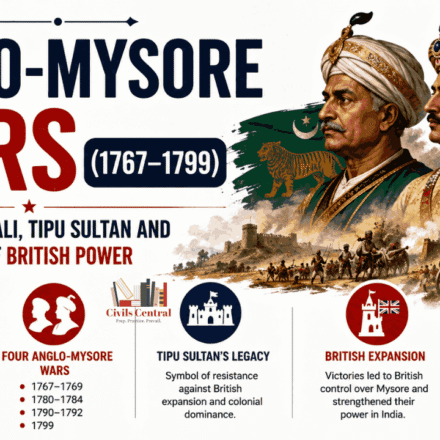
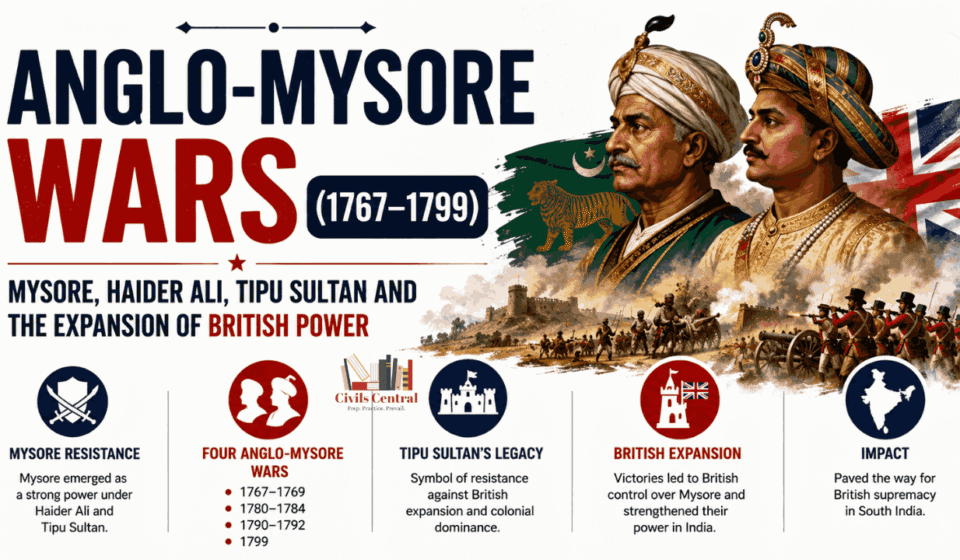
Anglo-Mysore Wars (1767–1799): Mysore, Haider Ali, Tipu Sultan and the Expansion of British Power

Anglo-Mysore Wars (1767–1799): Mysore, Haider Ali, Tipu Sultan and the Expansion of British Power
Learning Dashboard-Anglo-Mysore Wars
| Chapter Information | Details |
|---|---|
| Series | Modern History of India (1707–1947) |
| Historical Period | 1767–1799 |
| Historical Phase | British Territorial Expansion and Regional Resistance |
| Previous Chapter | Permanent Settlement (1793): Zamindari System, Features, Objectives, Impact and Legacy |
| Current Chapter | Anglo-Mysore Wars (1767–1799): Mysore, Haider Ali, Tipu Sultan and the Expansion of British Power |
| Next Chapter | Anglo-Maratha Wars (1775–1818): British Expansion and the Decline of Maratha Power |
| Core Theme | The Anglo-Mysore Wars represented one of the most sustained challenges to British expansion in eighteenth-century India. Under Haider Ali and Tipu Sultan, Mysore developed into a powerful, centralised and militarily innovative state that repeatedly resisted the British East India Company. Across four wars, the British gradually shifted from direct confrontation to coalition-building, diplomatic isolation and political subordination, culminating in the fall of Seringapatam and the death of Tipu Sultan in 1799. |
| Major Events Covered | Rise of Haider Ali, First Anglo-Mysore War (1767–1769), Treaty of Madras (1769), Second Anglo-Mysore War (1780–1784), Battle of Pollilur (1780), Battle of Porto Novo (1781), Death of Haider Ali (1782), Treaty of Mangalore (1784), Rise and State-Building of Tipu Sultan, Third Anglo-Mysore War (1790–1792), Capture of Bangalore, Treaty of Seringapatam (1792), Lord Wellesley and the French Factor, Fourth Anglo-Mysore War (1799), Siege and Fall of Seringapatam, Death of Tipu Sultan, Reorganisation of Mysore |
| Key Personalities | Haider Ali, Tipu Sultan, Lord Cornwallis, Lord Wellesley, Sir Eyre Coote, George Harris, Arthur Wellesley, Nizam of Hyderabad, Maratha leaders |
| Key Concepts | Anglo-Mysore Wars, Mysorean State-Building, Military Modernisation, Mysorean Rockets, Coalition Warfare, Treaty of Madras, Treaty of Mangalore, Treaty of Seringapatam, French Factor, British Expansion, Fiscal-Military State, Subsidiary Alliance |
| Exam Relevance | UPSC CSE, JKPSC, JKAS, State PCS, CDS, CAPF, SSC, UGC-NET (History), University Examinations |
Why This Chapter Matters
The Anglo-Mysore Wars were among the most consequential conflicts of eighteenth-century India. Fought between the Kingdom of Mysore and the British East India Company, with changing combinations of Indian and European allies, the four wars stretched from 1767 to 1799. Their importance goes far beyond the battles themselves. They reveal how the British East India Company gradually transformed from a commercial organisation into a territorial and military power. They also demonstrate that British expansion was neither automatic nor uncontested.
For more than three decades, Haider Ali and Tipu Sultan represented one of the most formidable challenges to British expansion in southern India. Mysore possessed a strong military establishment, substantial economic resources, a centralised political structure and access to the western coast. Its rulers actively adopted new military technologies and sought diplomatic relations with European powers.
The British ultimately prevailed not simply because of superior battlefield performance. Their victory emerged from the combination of Bengal’s financial resources, military organisation, naval power, logistical capacity, diplomatic alliances and the ability to isolate Mysore from potential allies.
The final defeat of Tipu Sultan in 1799 therefore represents an important stage in the evolution of British paramountcy.
The four wars were:
- First Anglo-Mysore War — 1767–1769
- Second Anglo-Mysore War — 1780–1784
- Third Anglo-Mysore War — 1790–1792
- Fourth Anglo-Mysore War — 1799
Introduction
The eighteenth century witnessed a fundamental transformation of Indian politics. The weakening of Mughal authority did not immediately produce British supremacy. Instead, it created a competitive political environment in which regional states such as Mysore, Hyderabad and the Maratha Confederacy expanded their power. At the same time, the European trading companies were becoming increasingly involved in Indian political affairs. The Carnatic Wars had demonstrated that European companies could intervene in succession disputes and use disciplined infantry, artillery and diplomacy to influence Indian politics.
The British East India Company emerged from this competition with increasing military and financial strength. After the victories at Plassey (1757) and Buxar (1764) and the acquisition of the Diwani of Bengal in 1765, the Company’s financial base expanded substantially. The Company could increasingly use Indian revenues to finance military operations outside Bengal.
This development had enormous consequences. The British position in southern India was centred on the Madras Presidency, but the Company’s influence did not extend far into the interior. Between Madras and the western coast stood powerful Indian states, especially Mysore. Mysore therefore became one of the principal obstacles to further British expansion.
The conflict was complicated by the presence of several other powers. The Nizam of Hyderabad and the Maratha Confederacy had their own interests in Mysore. Travancore controlled strategically important territory in the south-west, while the French remained a potential source of military assistance and diplomatic support for anti-British forces. The Anglo-Mysore Wars consequently emerged from a larger contest for the political future of southern India.
The central historical question is therefore not merely: Who won the four wars?
It is: How did the British transform a contested regional position into political dominance in southern India between 1767 and 1799?
The answer lies in the interaction of military power, fiscal resources, diplomacy, alliance-building, technology and political strategy.
Part I — Mysore Before the Anglo-Mysore Wars
1. The Wadiyar Kingdom
Mysore had been ruled by the Wadiyar dynasty for centuries. By the eighteenth century, however, the authority of the nominal ruler had weakened, while military commanders and ministers acquired greater practical influence. This political environment enabled the rise of Haider Ali. Mysore’s location made it particularly important. It occupied the strategic interior of southern India and had access toward both the eastern and western coasts.
Its geographical position also placed it between several competing powers:
- the British Madras Presidency to the east;
- the Marathas to the north;
- Hyderabad to the north-east;
- the Carnatic to the south-east;
- Travancore to the south-west; and
- European commercial interests along the western coast.
Mysore could therefore not remain politically isolated.
2. Rise of Haider Ali
Haider Ali rose through the Mysorean military establishment. His military experience during the conflicts of the Carnatic region exposed him to European methods of warfare. He recognised the growing importance of disciplined infantry, artillery and firearms. By 1761, Haider Ali had become the dominant political and military figure in Mysore. Although the Wadiyar ruler continued as the nominal monarch, effective authority rested increasingly with Haider Ali. His rise was significant because it coincided with a broader transformation in eighteenth-century Indian politics.
Military power increasingly depended upon the ability of rulers to:
- maintain standing forces;
- secure regular revenues;
- acquire firearms and artillery;
- employ trained specialists;
- build fortifications;
- control strategic territory; and
- sustain prolonged warfare.
Haider Ali understood this relationship between state power and military power.
3. Haider Ali’s State-Building
Haider Ali strengthened the Mysorean state by expanding its territorial and fiscal base. He attempted to create a more centralised military structure and increased the state’s ability to mobilise resources. Mysore’s expansion brought additional revenue but also increased the number of enemies who regarded Mysore as a threat.
This created a strategic dilemma. The stronger Mysore became, the more likely neighbouring powers were to cooperate against it. That dilemma would recur throughout the Anglo-Mysore Wars.
4. Why Did the British Regard Mysore as a Threat?
The British interest in Mysore developed from several overlapping concerns.
Strategic Threat to Madras
Mysore’s eastern expansion brought it closer to the Carnatic and the Company’s principal southern settlement at Madras. A powerful Mysorean army operating in the interior could threaten British communications and territory.
Control of the Carnatic
The Nawab of the Carnatic was closely connected with the British. Mysorean expansion into the Carnatic therefore threatened the Company’s political and strategic interests.
Western Coast and Malabar
Mysore’s expansion toward the Malabar Coast brought it into contact with important commercial networks and European settlements. Control of the western coast also offered access to maritime trade.
French Connection
French military expertise had already influenced Mysorean military development. The possibility that Mysore could establish a durable strategic relationship with France worried the British.
Regional Balance of Power
Mysore’s rise altered the balance among Mysore, Hyderabad and the Marathas. The British increasingly sought to prevent any single Indian power from becoming strong enough to dominate southern India.
CivilsCentral Historical Insight
Mysore became a British target because it was not merely another regional kingdom.
It occupied strategically important territory, possessed a powerful military establishment, had access to the western coast and was capable of resisting British political expansion. The conflict was therefore fundamentally about the emerging balance of power in southern India.
Part II — The First Anglo-Mysore War (1767–1769)
1. Background to the War
The First Anglo-Mysore War developed within the unstable alliance politics of the Deccan. The British were concerned about Haider Ali’s expansion and sought to contain Mysore.
A coalition involving the:
- British East India Company,
- Nizam of Hyderabad, and
- Maratha power
was initially directed against Mysore. The coalition, however, was inherently unstable. Each participant had different objectives. The Marathas wanted territorial and financial gains. The Nizam wanted to strengthen Hyderabad and prevent Mysorean expansion. The British wanted to protect and expand their position in the Carnatic. Haider Ali exploited these conflicting interests.
2. Mysore and the Nizam
The Nizam initially cooperated with the British. However, Haider Ali succeeded in negotiating with the Nizam and persuading him to change sides. This was characteristic of eighteenth-century Indian diplomacy. Alliances were often transactional rather than ideological. States could change sides when the distribution of costs and benefits changed.
The First Anglo-Mysore War therefore became a contest not only of armies but also of diplomacy.
3. Military Campaign
The British and their allies attempted to pressure Mysore from different directions. British forces under Colonel Joseph Smith achieved important successes, including the engagement at Tiruvannamalai/Trinamalai in 1767. However, British operations into the Mysorean interior faced serious logistical difficulties.
Mysore’s cavalry was highly mobile, and Haider Ali avoided allowing the British to dictate the terms of engagement. The Company’s army could fight effectively but depended heavily upon secure supply lines. Mysore’s geographical environment therefore became an important military advantage.
4. Haider Ali’s Strategic Mobility
Haider Ali’s greatest strength was not simply battlefield bravery. It was his ability to move rapidly, exploit weaknesses and use diplomacy alongside military pressure. He understood that the British were strongest when they could concentrate their forces and maintain supply lines. He therefore attempted to disrupt the strategic conditions that made British armies effective. This combination of mobility + diplomacy + pressure on communications allowed Mysore to survive repeated British operations.
5. The Advance Toward Madras
By 1769, Haider Ali had turned the strategic situation around. Instead of Mysore being forced into submission, Haider Ali advanced rapidly toward Madras. The British found themselves in a difficult position. The possibility of Mysorean forces reaching the Company’s principal southern settlement demonstrated the limits of British power at this stage. The Company was therefore compelled to negotiate.
Part III — Treaty of Madras, 1769
The war ended with the Treaty of Madras in 1769. The settlement broadly restored conquered territories and included an arrangement for mutual assistance against external attack. The treaty was important because it did not establish British supremacy over Mysore. Instead, it demonstrated that the British had been unable to defeat Haider Ali decisively.
Significance
The First Anglo-Mysore War established several important realities:
First, Mysore was a major military power.
Second, the British could not yet impose their will upon southern India.
Third, alliance politics could determine the outcome of a war.
Fourth, Haider Ali had demonstrated the importance of combining diplomacy with military mobility.
Fifth, the treaty contained a mutual-assistance principle that would become important in the origins of the next conflict.
Part IV — Between the First and Second Wars
The peace of 1769 did not remove the causes of rivalry. In fact, the period between the first two wars made the second conflict almost inevitable.
1. Maratha Invasion of Mysore
The Marathas attacked Mysore in the early 1770s. Haider Ali expected British assistance under the mutual-defence arrangement created by the Treaty of Madras. The British did not provide the support he expected. This convinced Haider Ali that the Company could not be relied upon as a treaty partner. The experience influenced his subsequent policy toward the British.
2. British Expansion
The Company continued strengthening its position in southern India. The British were increasingly concerned that Mysore might become too powerful. At the same time, Haider Ali recognised that British territorial expansion represented a long-term threat to Mysorean independence.
3. French-British Rivalry
The international environment also changed. The American War of Independence brought Britain into conflict with France and other European powers. The Anglo-French struggle therefore acquired a renewed global dimension. For Mysore, the French offered the possibility of military and diplomatic support against Britain. For Britain, any strengthening of French influence in Mysore represented a strategic threat.
4. The Mahe Crisis
The French settlement of Mahe on the Malabar Coast was closely connected with Mysorean interests. Haider Ali regarded Mahe as being under his protection. When the British seized Mahe in 1779, the incident became a major trigger for renewed conflict. Thus, the Second Anglo-Mysore War resulted from the convergence of:
Mysorean grievances + British expansion + French-British rivalry + the Mahe question + the failure of the 1769 alliance.
CivilsCentral Historical Insight
The transition from the First to the Second Anglo-Mysore War demonstrates that treaties could postpone conflict without eliminating structural rivalry.
The British and Mysore had conflicting long-term objectives. Mysore wanted to preserve and expand its independence; the Company wanted to secure and enlarge its political and commercial position. The unresolved rivalry eventually produced a much larger war.
Part V — The Second Anglo-Mysore War (1780–1784)
1. Causes
The Second Anglo-Mysore War had several interconnected causes.
British Failure to Support Haider Ali
Haider Ali regarded the British refusal to assist him during the Maratha attack as a breach of the spirit of the Treaty of Madras.
British Seizure of Mahe
The British attack on Mahe directly affected Mysorean interests.
French Connection
Haider Ali viewed France as a potential counterweight to British power.
British Expansion
The continuing growth of British influence in the Carnatic threatened Mysore’s strategic position.
International War
The Anglo-French conflict created an opportunity for Haider Ali to challenge Britain while its European commitments were substantial.
Part VI — The Second War: Course and Major Battles
1. Haider Ali’s Grand Offensive of 1780
Haider Ali prepared a large Mysorean army and invaded the Carnatic in 1780. The speed and scale of the Mysorean offensive placed the British in a difficult position. Mysorean forces moved through the Carnatic, threatening British positions and communications. The campaign demonstrated the continued effectiveness of Mysorean cavalry and the ability of Haider Ali to mobilise substantial forces.
2. Battle of Pollilur, 1780
The Battle of Pollilur was one of the most important Mysorean victories of the entire Anglo-Mysore conflict. A British force under Colonel William Baillie was defeated by Mysorean forces. The defeat was especially significant because it demonstrated the vulnerability of British field forces when operating without adequate support and under conditions favourable to Mysorean mobility. Pollilur also became associated with the effective use of Mysorean rockets.
3. Mysorean Rockets
Mysore’s military system included the organised use of iron-cased rockets. Rocket warfare was not entirely new to India, but Mysorean forces developed and deployed the technology on a significant military scale. The iron casing gave the rockets greater structural strength and enabled more effective propulsion and range than many earlier forms of rocket artillery. The weapons could create both physical disruption and psychological effects on opposing troops. Their military significance attracted British attention, and captured Mysorean technology later influenced British experimentation with military rockets.
4. British Recovery
Despite early defeats, the British were not destroyed. They reorganised their forces and brought experienced commanders into the conflict. Sir Eyre Coote played a major role in the British recovery. The British victory at Porto Novo in 1781 was particularly important. It demonstrated that Mysorean battlefield superiority was not absolute. The war subsequently became a prolonged struggle in which neither side could easily obtain decisive victory.
5. Battle of Porto Novo
Porto Novo was important because it demonstrated the ability of disciplined British infantry and artillery to withstand a larger Mysorean force. The British had learned from their earlier failures.
They increasingly emphasised:
- disciplined infantry formations;
- artillery coordination;
- defensive positions;
- supply management;
- strategic concentration; and
- experienced command.
This represented an important stage in the evolution of Company warfare.
6. Death of Haider Ali
Haider Ali died in December 1782 while the war was still continuing. His death could have resulted in the collapse of Mysorean resistance. Instead, his son Tipu Sultan assumed leadership and continued the conflict. This succession is historically important because it demonstrates that Mysorean resistance had become institutional rather than entirely dependent upon one individual’s leadership.
7. Tipu Sultan Continues the War
Tipu Sultan inherited a powerful but exhausted state. He had to manage:
- continuing warfare;
- financial pressure;
- military mobilisation;
- diplomatic relations;
- relations with other Indian powers; and
- the possibility of French assistance.
He nevertheless continued resistance. The war gradually became costly for both sides. The British faced military expenditure and logistical challenges, while Mysore faced the pressure of prolonged conflict against a financially stronger opponent.
Part VII — Treaty of Mangalore, 1784
The Second Anglo-Mysore War ended with the Treaty of Mangalore in 1784. The treaty broadly restored the pre-war territorial position and provided for the release of prisoners. Its significance was considerable. The British had failed to impose a decisive settlement upon Mysore. The treaty therefore demonstrated that even after Plassey, Buxar and the acquisition of Bengal’s revenues, the Company still faced serious limits in its ability to conquer powerful regional states.
Why Was the Treaty Important?
It:
- ended four years of warfare;
- confirmed Mysore’s continued independence;
- enhanced Tipu Sultan’s standing;
- frustrated British ambitions;
- exposed the limitations of British military power;
- demonstrated Mysore’s ability to survive prolonged warfare.
The Second War therefore represents the high point of Mysorean resistance to British expansion.
CivilsCentral Historical Insight
The Second Anglo-Mysore War demonstrates that British financial superiority did not automatically translate into military supremacy.
The Company possessed growing resources, but Mysore still had the leadership, military organisation, strategic geography and diplomatic flexibility required to prevent decisive British victory.
Part VIII — Tipu Sultan and the Mysorean State
1. Tipu Sultan as a State-Builder
Tipu Sultan inherited Haider Ali’s military state and sought to strengthen it further. His reign should be understood within the broader eighteenth-century process of state consolidation. He sought greater control over:
- revenue;
- military organisation;
- trade;
- administrative officials;
- strategic territories; and
- foreign relations.
2. Centralisation
Tipu attempted to strengthen the authority of the central state. Greater centralisation allowed Mysore to mobilise resources more effectively, but it also increased the state’s intervention in local economic and political structures.
3. Revenue and Agriculture
A strong army required reliable revenue. Mysore therefore sought to increase the productivity and fiscal yield of agricultural territories.The state attempted to exercise greater control over revenue collection and reduce the ability of local intermediaries to undermine central authority. This was not simply an economic policy.
It was part of a larger relationship:
Revenue → State capacity → Army → Territorial expansion → More revenue.
The same fiscal-military relationship would later become central to British expansion.
4. Military Modernisation
Tipu continued Haider Ali’s efforts to modernise the military. Mysore employed European specialists and incorporated:
- artillery;
- firearms;
- disciplined infantry;
- cavalry;
- fortification techniques; and
- rockets.
Mysore therefore represented an important example of indigenous military adaptation to the changing nature of eighteenth-century warfare.
5. Commercial Policy
Tipu recognised the relationship between economic independence and military power. The Mysorean state attempted to regulate trade and encourage state involvement in commercial activity. The government also sought connections with foreign merchants and overseas markets. Tipu’s economic policies therefore had both commercial and strategic objectives.
6. Foreign Relations
Tipu attempted to build diplomatic relationships beyond the immediate Indian political system. His contacts included attempts to communicate with:
- the Ottoman Empire;
- France;
- Afghanistan; and
- other foreign powers.
The objective was essentially strategic: If Britain had European enemies, Mysore could potentially use those rivalries to preserve its independence.
Part IX — The Third Anglo-Mysore War (1790–1792)
1. The Changed Balance of Power
The political environment of the Third Anglo-Mysore War was very different from that of the first two wars. The British had learned an important lesson: Mysore was difficult to defeat in a direct bilateral conflict. The solution was to prevent Mysore from fighting Britain alone. The British therefore constructed a coalition involving:
- the British East India Company;
- the Nizam of Hyderabad; and
- the Maratha Confederacy.
This coalition transformed the strategic balance.
2. The Travancore Question
The immediate crisis involved Travancore. Travancore had established close relations with the British and had expanded its position along the Malabar Coast. Tipu Sultan regarded Travancore’s defensive arrangements and territorial position as a threat. In December 1789, Tipu attacked Travancore. The British treated Travancore as falling within their sphere of strategic protection and used the conflict as the immediate basis for war. The Third Anglo-Mysore War began in 1790.
Part X — Cornwallis and the Mysorean Campaign
1. British Strategy
The British did not intend to repeat the mistakes of earlier wars. The objective was not simply to defeat Mysore in a single battle.
It was to:
- isolate Tipu diplomatically;
- mobilise allied forces;
- secure supply lines;
- capture strategic fortresses;
- move systematically toward Seringapatam; and
- force Mysore into an unequal settlement.
2. The Role of William Medows
The initial British campaign was conducted under General William Medows. The British advance, however, did not immediately produce decisive results. The Mysorean terrain and defensive strategy continued to create difficulties.
3. Cornwallis Assumes Command
Governor-General Lord Cornwallis eventually assumed direct command. Cornwallis recognised the importance of coordination with the Nizam and the Marathas. This was a major departure from earlier British strategy. The British were now using Indian regional powers as military partners against another Indian state.
4. Capture of Bangalore
The capture of Bangalore in 1791 was a major British strategic achievement. Bangalore was important because it provided a strong base from which the British could advance toward Seringapatam. The campaign therefore moved from a war of manoeuvre toward a struggle over strategic fortifications and the Mysorean capital.
5. Advance Toward Seringapatam
Cornwallis advanced toward Seringapatam. However, logistical problems prevented an immediate decisive assault. This reveals an important feature of eighteenth-century warfare:
Capturing territory was easier than sustaining an army deep inside enemy territory.
Supply, transport, provisions and communications could determine the outcome of a campaign as much as battlefield tactics. Cornwallis therefore temporarily withdrew and reorganised. The British subsequently returned with better preparation and stronger allied support.
Part XI — Treaty of Seringapatam, 1792
The British and their allies eventually placed Seringapatam under severe pressure. Tipu recognised that continuing the war risked the destruction of his state. The result was the Treaty of Seringapatam, signed on 18 March 1792.
Major Terms
The settlement imposed severe conditions upon Mysore. Tipu:
- surrendered approximately half of his territory;
- agreed to pay a substantial indemnity;
- released prisoners; and
- surrendered two of his sons as hostages until the financial obligations were fulfilled.
The territory surrendered by Mysore was distributed among the victorious powers.
Impact on Mysore
The treaty dramatically reduced Mysore’s territorial strength. Its strategic depth was weakened, its revenues were reduced and its position became more vulnerable. However, Tipu’s state survived. This distinction is important.
The Third War weakened Mysore but did not destroy it.
Impact on the British
The British emerged with:
- additional territory;
- strategic advantages;
- greater prestige;
- increased influence in southern India; and
- a much stronger position from which to conduct future operations.
CivilsCentral Historical Insight
The Third Anglo-Mysore War transformed the nature of British expansion.
In the first two wars, the British struggled to defeat Mysore directly. In the third, they demonstrated the power of coalition warfare. The British victory was therefore diplomatic as well as military.
Part XII — Between the Third and Fourth Wars
The Treaty of Seringapatam did not end the British-Mysorean rivalry. Instead, it created a temporary balance that was increasingly unstable.
1. Tipu’s Attempt to Rebuild
Tipu attempted to rebuild Mysore’s military and economic strength. The reduction of territory made this difficult because the state’s fiscal base had been weakened. Nevertheless, Tipu continued military preparations.
2. Diplomatic Search for Support
Tipu increasingly looked beyond India. France remained particularly important. The emergence of revolutionary France changed the strategic environment. The British feared that French military involvement could transform Mysore into a powerful anti-British centre.
3. British Fear of French Influence
By the late 1790s, the French threat had become more important in British strategic thinking. The possibility of French forces or advisers establishing themselves in southern India was viewed as unacceptable. This perception helped justify a more aggressive policy toward Tipu.
4. Arrival of Lord Wellesley
Lord Wellesley became Governor-General in 1798. His approach differed significantly from the more cautious policies of earlier Company governments. Wellesley believed that British security required the political subordination of Indian states that might become aligned with France. This approach became the basis for the Subsidiary Alliance system.
Part XIII — The Fourth Anglo-Mysore War (1799)
1. Why Did the Fourth War Break Out?
The final conflict resulted from the convergence of:
- Tipu’s attempts to strengthen foreign relations;
- British fear of French influence;
- Mysorean resistance to British political demands;
- Wellesley’s expansionist strategy; and
- the changing balance of power in southern India.
The British sought to prevent Mysore from becoming a centre of French influence. Tipu, however, could not accept a settlement that effectively destroyed Mysorean independence. The conflict therefore became unavoidable.
2. British Diplomatic Preparation
The Fourth War demonstrates the importance of British diplomacy. The Company sought to isolate Mysore before launching the main military campaign. The Nizam of Hyderabad was brought firmly into the British system.
The Maratha factor was also managed so that Tipu would not receive meaningful assistance from the Maratha power. The British therefore entered the war with a substantial strategic advantage.
3. British Forces
The main British army was commanded by General George Harris. Among the officers associated with the campaign was Arthur Wellesley, the future Duke of Wellington. The campaign also involved forces from the Bombay Presidency and troops supplied by British allies.
The operation was therefore larger and more coordinated than many earlier British campaigns. Macquarie University’s archival material on the 1799 campaign notes that British forces approached Seringapatam through coordinated eastern and western axes, with forces from the Madras and Bombay establishments.
Part XIV — Campaign of 1799
1. Advance Toward Mysore
British forces advanced from multiple directions. The objective was to prevent Tipu from concentrating his forces against a single British army. The British advance also demonstrated improved logistical planning.
This was critical. Earlier British campaigns had repeatedly suffered from supply difficulties deep inside Mysorean territory. In 1799, the Company entered the campaign with better preparation and stronger allied support.
2. Battle of Mallavelly
The British defeated Mysorean forces at Mallavelly in March 1799. The defeat reduced Tipu’s ability to prevent the British advance toward Seringapatam.
3. Siege of Seringapatam
The British then moved toward the Mysorean capital. Seringapatam was strategically and symbolically central to Mysorean power. The city stood on an island formed by the Kaveri River, making it naturally defensible and heavily fortified. Macquarie University’s archival description identifies Seringapatam as the capital of Haider Ali and Tipu Sultan and the site of major sieges in both 1792 and 1799. The British artillery gradually weakened the fortifications.
4. The Final Assault
On 4 May 1799, British forces stormed Seringapatam. The assault broke through the city’s defences. Tipu Sultan was killed during the fighting. His death ended the independent Mysorean challenge to British expansion.
Part XV — Death of Tipu Sultan
Tipu Sultan’s death was one of the most consequential events of late eighteenth-century Indian history. He had fought the British for much of his political career and had attempted to combine:
- military modernisation;
- centralised state-building;
- economic intervention;
- diplomatic activism; and
- foreign alliances.
His death removed the principal ruler capable of sustaining Mysore as an independent military counterweight to the British in southern India. However, the British did not simply annex every part of Mysore. The post-war settlement reflected an increasingly sophisticated British strategy.
Instead of destroying the political identity of Mysore completely, the British restored the Wadiyar dynasty under British influence and retained substantial strategic advantages. This approach anticipated the broader logic of indirect rule and subsidiary alliances.
Part XVI — Settlement of Mysore After 1799
The settlement following Tipu’s death was designed to prevent the emergence of another independent Mysorean power.
1. Restoration of the Wadiyar Dynasty
The traditional Wadiyar dynasty was restored. The young Krishna Raja Wadiyar III became ruler under British supervision. This was not a restoration of Mysore’s previous independence. It was a political settlement in which the British became the dominant external power.
2. Territorial Redistribution
The Mysorean territories were reorganised. The British and their allies retained or acquired strategically important territories. Mysore was therefore reduced in territorial and military strength.
3. Political Subordination
The restored Mysore entered into a subordinate relationship with the British. The settlement is therefore important for understanding the transition from: Military conquest → Political dependency.
This was increasingly the model through which Wellesley sought to construct British paramountcy.
CivilsCentral Historical Insight
The British victory in 1799 was not simply the conquest of a kingdom. It represented a change in the method of empire-building.
The British increasingly preferred to retain Indian rulers where possible while controlling their external relations, military arrangements and strategic decisions. Mysore therefore became an important precursor to the wider system of British indirect control.
Part XVII — Why Did Mysore Resist the British So Effectively?
1. Centralised Political Authority
Mysore under Haider Ali and Tipu possessed a stronger central political structure than many fragmented regional powers. This allowed the rulers to mobilise resources for warfare.
2. Military Modernisation
Mysore adopted European military techniques without simply copying European institutions. The army incorporated:
- infantry;
- artillery;
- cavalry;
- firearms;
- fortification techniques; and
- rockets.
3. Strong Leadership
Haider Ali possessed exceptional military and diplomatic ability. Tipu continued many of his father’s policies and maintained resistance despite the loss of territory after 1792.
4. Strategic Geography
Mysore’s plateau, forests, rivers and fortified positions made military penetration difficult. The British had to overcome not merely an army but also a challenging geographical environment.
5. Economic Resources
Mysore possessed substantial agricultural and commercial resources. These supported military expenditure and state-building.
6. Access to the Western Coast
Control over parts of the Malabar region gave Mysore access to maritime commerce and foreign connections.
7. Diplomatic Flexibility
Haider Ali and Tipu attempted to exploit rivalries between:
- Britain;
- France;
- the Marathas;
- Hyderabad; and
- other regional powers.
Part XVIII — Why Did the British Eventually Defeat Mysore?
The British victory cannot be explained by one factor.
1. Bengal’s Financial Resources
The Company’s acquisition of the Diwani in 1765 gave it access to substantial revenues. These resources strengthened the Company’s ability to maintain armies and finance prolonged campaigns. This creates a direct connection between:
Buxar → Diwani → Revenue → Military expenditure → Expansion.
2. Military Organisation
The Company developed increasingly professional armies. Its forces combined:
- European officers;
- Indian sepoys;
- artillery;
- engineers;
- cavalry;
- disciplined infantry; and
- established logistical systems.
3. Naval Power
British maritime power restricted Mysore’s ability to receive sustained foreign assistance. This was particularly important because Mysore sought French connections.
4. Coalition Building
The British learned that they could weaken Mysore by preventing it from fighting on favourable terms. The alliance with the Nizam and Marathas during the Third War was decisive.
5. Political Isolation
By 1799, Tipu was increasingly isolated. The British had constructed a political environment in which Mysore faced the Company without a comparable coalition of its own.
6. Strategic Learning
The British learned from earlier defeats. They improved:
- logistics;
- intelligence;
- military coordination;
- artillery deployment;
- siege warfare; and
- diplomatic preparation.
7. Wellesley’s Expansionist Policy
Wellesley transformed the strategic objective.
The question was no longer simply: How can Britain defend Madras?
It increasingly became: How can Britain prevent any Indian power from threatening British supremacy?
That was a fundamentally different imperial strategy.
Part XIX — The Anglo-Mysore Wars: Comparative Analysis
| War | Period | Principal Mysorean Leader | British Strategy | Major Features | Outcome |
|---|---|---|---|---|---|
| First Anglo-Mysore War | 1767–1769 | Haider Ali | Coalition and direct military pressure | Shifting alliances; Mysorean advance toward Madras | Treaty of Madras |
| Second Anglo-Mysore War | 1780–1784 | Haider Ali → Tipu Sultan | Large-scale direct warfare | Pollilur, Porto Novo, French factor | Treaty of Mangalore |
| Third Anglo-Mysore War | 1790–1792 | Tipu Sultan | Coalition warfare | Travancore crisis; British-Nizam-Maratha alliance; Cornwallis | Treaty of Seringapatam |
| Fourth Anglo-Mysore War | 1799 | Tipu Sultan | Coalition + diplomatic isolation + decisive invasion | Mallavelly; siege of Seringapatam | Tipu killed; Mysore subordinated |
Part XX — Evolution of British Strategy Across the Four Wars
One of the most important analytical lessons of the Anglo-Mysore Wars is the evolution of British strategy.
First War: Containment
The British attempted to contain Mysore through alliances. But the coalition fractured. Result: Haider Ali survived and reached the gates of Madras.
Strategic lesson:
Indian alliances could not be assumed to remain loyal.
Second War: Direct Confrontation
The British confronted Mysore in a major war. Mysore achieved significant early victories. The British eventually recovered but could not impose decisive terms.
Strategic lesson:
Direct military confrontation with Mysore was costly and uncertain.
Third War: Coalition Warfare
The British constructed a powerful coalition with Hyderabad and the Marathas. This weakened Mysore before the final campaign began.
Strategic lesson:
Defeating a powerful Indian state required preventing it from assembling its own coalition.
Fourth War: Isolation and Subordination
By 1799, the British had:
- isolated Tipu;
- strengthened relations with Hyderabad;
- neutralised wider Indian opposition;
- mobilised superior resources; and
- adopted an aggressive strategic policy under Wellesley.
Strategic lesson:
The most effective form of British expansion combined military superiority with diplomatic isolation and political subordination.
Part XXI — Role of Haider Ali and Tipu Sultan
Haider Ali
Haider Ali was the architect of Mysore’s transformation into a major military power.
His significance lies in:
Military State-Building
He strengthened the army and developed a stronger fiscal-military state.
Strategic Mobility
His rapid movements repeatedly disrupted British plans.
Diplomatic Flexibility
He successfully manipulated rivalries among the British, Marathas and Nizam.
Resistance to British Expansion
He recognised early that British commercial power could develop into territorial domination.
Tipu Sultan
Tipu Sultan inherited the conflict and attempted to strengthen Mysore further.
Military Modernisation
He continued investment in firearms, artillery, fortifications and rockets.
Administrative Centralisation
He strengthened central authority and sought greater state control over resources.
Economic Policy
He attempted to strengthen state commerce and reduce dependence on European commercial interests.
Foreign Policy
He actively sought diplomatic and military relationships beyond India.
Anti-British Resistance
He refused to accept permanent British political domination.
Part XXII — Military Technology and the Mysorean Rockets
The Mysorean rockets deserve special attention because they demonstrate that technological innovation in eighteenth-century warfare was not exclusively European.
1. Traditional Rocket Warfare
Rocket weapons had existed in South Asia before the rise of Mysore. The innovation associated with Mysore was the systematic military deployment of iron-cased rockets.
2. Iron Casing
The use of iron casings strengthened the rocket body and improved its propulsion characteristics. This allowed rockets to be deployed more effectively against massed troops.
3. Psychological Impact
Rockets were unpredictable. They could:
- disrupt formations;
- frighten cavalry;
- create confusion;
- interfere with artillery;
- inflict casualties.
Their psychological effect could therefore exceed their purely physical destructive capacity.
4. British Learning
British forces encountered Mysorean rockets during the wars. Captured examples and knowledge of Mysorean rocket technology later influenced British military experimentation. The development of the Congreve rocket in Britain is associated with this broader process of technological transfer.
CivilsCentral Historical Insight
The Mysorean rockets challenge a simplistic interpretation of colonial warfare in which technological innovation flowed only from Europe to India.
The Anglo-Mysore Wars instead reveal a process of military adaptation and technological exchange, in which Indian states adopted European techniques while European armies also learned from Indian military innovations.
Part XXIII — Economic and Administrative Dimensions
The Anglo-Mysore Wars were also wars of fiscal capacity.
1. War Required Revenue
Large eighteenth-century armies required enormous resources. A state had to finance:
- soldiers;
- horses;
- artillery;
- weapons;
- fortifications;
- transport;
- food supplies;
- intelligence; and
- administrative machinery.
Mysore therefore strengthened its revenue system as it strengthened its army.
2. British Fiscal Advantage
The British possessed an increasingly important advantage after the conquest of Bengal. The acquisition of the Diwani in 1765 gave the Company access to substantial revenue resources. The significance of Bengal therefore extended far beyond Bengal itself. The Company’s growing fiscal capacity could be converted into military power elsewhere.
This produced an important imperial cycle:
Territorial conquest → Revenue → Military expenditure → Further conquest → More revenue.
3. Mysorean State-Building
Haider Ali and Tipu also pursued this fiscal-military logic. The state sought to:
- improve revenue collection;
- increase agricultural productivity;
- strengthen state control;
- regulate trade; and
- maintain a standing army.
Mysore was therefore not simply defending itself. It was itself an expanding early-modern state competing for territory and resources.
Part XXIV — Historiography
The historical interpretation of Haider Ali and Tipu Sultan has been deeply contested.
1. Colonial Interpretation
Early colonial accounts frequently portrayed Mysore as an aggressive and unstable power. Tipu in particular was often depicted as a despotic ruler whose policies justified British intervention. This interpretation must be treated critically because colonial historians were writing within the political context of British expansion.
2. Nationalist Interpretation
Indian nationalist historians subsequently emphasised Tipu’s resistance to British imperialism. In this interpretation, Tipu became a symbol of:
- patriotism;
- military courage;
- resistance to foreign domination; and
- indigenous state-building.
His refusal to submit to British power became central to his historical memory.
3. Modern Interpretation
Modern scholarship generally adopts a more nuanced position. Tipu can be understood simultaneously as:
- an opponent of British expansion;
- a centralising ruler;
- a military innovator;
- an ambitious territorial sovereign;
- an economic reformer; and
- a ruler whose policies toward different regions and communities must be examined in their specific political contexts.
A balanced interpretation therefore avoids two extremes: Colonial demonisation and uncritical heroisation. The historical task is to understand Tipu within the political realities of eighteenth-century state formation.
Part XXV — Historical Significance of the Anglo-Mysore Wars
1. Mysore as a Major Obstacle to British Expansion
For more than three decades, Mysore prevented the Company from exercising uncontested dominance in southern India.
2. Demonstration That British Supremacy Was Not Inevitable
The first two wars demonstrate that British victory was not predetermined. Mysore was capable of defeating British armies and forcing favourable settlements.
3. Development of British Coalition Politics
The British increasingly learned to exploit rivalries among Indian powers. The Third War provides the clearest example.
4. Expansion of British Territory
The wars resulted in substantial British territorial gains, particularly after 1792 and 1799.
5. Decline of French Influence
Mysore had been one of the principal Indian powers willing to cultivate French connections. Its defeat reduced the possibility of a powerful French-aligned Indian state in southern India.
6. Rise of British Paramountcy
The defeat of Mysore contributed directly to the emergence of British political supremacy in southern India.
7. Military Modernisation
The wars demonstrate the changing nature of eighteenth-century warfare. European techniques, Indian innovations and technological adaptation interacted on the battlefield.
8. Fiscal-Military State Formation
Both Mysore and the Company demonstrate how increasingly centralised states relied on revenue extraction to sustain military power.
Part XXVI — Anglo-Mysore Wars in the Larger Story of British Expansion
The Anglo-Mysore Wars cannot be separated from the earlier British conquest of Bengal.
The larger chain was:
Stage 1 — Bengal
Plassey, 1757
↓
British political influence in Bengal
Stage 2 — Buxar
Buxar, 1764
↓
British military supremacy over the combined forces of Mir Qasim, Shuja-ud-Daulah and Shah Alam II
Stage 3 — Diwani
1765
↓
Company gains revenue rights in Bengal
Stage 4 — Fiscal-Military Expansion
Bengal revenue
↓
Greater military capacity
Stage 5 — Southern Expansion
First Anglo-Mysore War, 1767
↓
Mysore resists
Stage 6 — Continued Resistance
Second Anglo-Mysore War, 1780–84
↓
British unable to impose decisive settlement
Stage 7 — Coalition Warfare
Third Anglo-Mysore War, 1790–92
↓
Mysore severely weakened
Stage 8 — Wellesley’s Policy
1798
↓
Aggressive British expansion
Stage 9 — Final Mysorean Defeat
Fourth Anglo-Mysore War, 1799
↓
Tipu Sultan killed
Stage 10 — Political Subordination
Mysore reorganised under British influence
↓
Subsidiary Alliance era
This demonstrates that British imperial expansion was cumulative.
Bengal provided fiscal resources; military expansion converted those resources into territorial power; diplomacy then transformed territorial power into political supremacy.
Advantages and Limitations of Mysorean Resistance
Advantages
1. Strong Leadership
Haider Ali and Tipu Sultan provided capable military and political leadership.
2. Centralisation
Mysore possessed a relatively strong central state capable of mobilising resources.
3. Military Innovation
Mysore adopted European methods while developing indigenous innovations.
4. Strategic Geography
The Mysorean plateau and fortified capital made invasion difficult.
5. Economic Resources
Agricultural and commercial resources supported a substantial military establishment.
6. Diplomatic Flexibility
Mysore attempted to exploit British conflicts with France and rivalries among Indian powers.
Limitations
1. Diplomatic Isolation
Mysore struggled to construct a durable coalition against Britain.
2. Multiple Enemies
The state faced pressure from Britain, the Marathas, Hyderabad and other regional powers.
3. Limited Naval Capacity
Mysore could not match British maritime power.
4. Fiscal Pressure
Repeated wars and territorial losses placed increasing pressure on Mysorean finances.
5. Loss of Territory in 1792
The Treaty of Seringapatam sharply reduced Mysore’s strategic depth.
6. Uncertain Foreign Assistance
French support never developed into a sustained military alliance capable of transforming the balance of power.
7. British Coalition-Building
The Company increasingly prevented Mysore from obtaining powerful Indian allies.
UPSC/JKAS Analytical Themes
Theme 1 — Was British victory over Mysore inevitable?
No. The First Anglo-Mysore War ended without British supremacy. The Second War also ended without decisive British victory. These outcomes demonstrate that British dominance was historically contingent rather than predetermined. British victory resulted from the gradual accumulation of:
- fiscal strength;
- military organisation;
- logistical capacity;
- diplomatic skill;
- coalition-building; and
- strategic adaptation.
Theme 2 — Why was the Third Anglo-Mysore War a turning point?
Because the British demonstrated that they could use Indian regional powers as instruments of imperial expansion. The alliance with the Nizam and Marathas substantially reduced Mysore’s ability to fight Britain alone. The war therefore marked a transition from:
British vs Mysore to: British-led coalition vs Mysore.
Theme 3 — Why was the Fourth War decisive?
The Fourth War occurred after Mysore had already been weakened by the Treaty of Seringapatam. Wellesley’s policy then combined:
diplomatic isolation + military mobilisation + fear of French influence + coalition-building.
The fall of Seringapatam and death of Tipu removed Mysore as an independent military challenger.
Theme 4 — What explains Mysore’s military strength?
Mysore combined:
- centralised administration;
- revenue mobilisation;
- military modernisation;
- European expertise;
- indigenous technology;
- strategic geography;
- strong leadership.
This made it unusually resilient.
Theme 5 — What explains British success?
British victory was structural rather than purely tactical.
The Company possessed:
larger fiscal resources + professional military institutions + naval power + logistical networks + diplomatic alliances.
The British therefore became increasingly capable of sustaining long wars.
Theme 6 — How were the Anglo-Mysore Wars connected to colonial economic power?
The conquest of Bengal provided the Company with substantial revenue. That revenue helped finance armies that could subsequently operate against powerful states such as Mysore. Thus:
Economic conquest in Bengal → Fiscal power → Military expansion → Political conquest elsewhere.
This is one of the most important analytical connections in eighteenth-century Indian history.
Prelims Revision Zone
Important Dates
| Year | Event |
|---|---|
| 1761 | Haider Ali emerges as the dominant political figure in Mysore |
| 1767–1769 | First Anglo-Mysore War |
| 1769 | Treaty of Madras |
| 1770–72 | Maratha pressure/war against Mysore; Haider’s dissatisfaction with British non-assistance |
| 1779 | British seizure of Mahe |
| 1780–1784 | Second Anglo-Mysore War |
| 1780 | Battle of Pollilur |
| 1781 | Battle of Porto Novo |
| 1782 | Death of Haider Ali |
| 1782 | Tipu Sultan assumes leadership of Mysore |
| 1784 | Treaty of Mangalore |
| 1789 | Tipu’s attack on Travancore |
| 1790–1792 | Third Anglo-Mysore War |
| 1791 | British capture of Bangalore |
| 1792 | Treaty of Seringapatam |
| 1798 | Lord Wellesley becomes Governor-General |
| 1799 | Fourth Anglo-Mysore War |
| 4 May 1799 | Tipu Sultan dies during the fall of Seringapatam |
Major Battles
| Battle | Year | Significance |
|---|---|---|
| Tiruvannamalai/Trinamalai | 1767 | Important British success during First War |
| Pollilur | 1780 | Major Mysorean victory over British forces |
| Porto Novo | 1781 | Important British recovery under Eyre Coote |
| Bangalore | 1791 | Strategic British victory during Third War |
| Mallavelly | 1799 | British victory during Fourth War |
| Seringapatam | 1792 & 1799 | Site of decisive sieges; final fall in 1799 |
Major Treaties
Treaty of Madras — 1769
Ended: First Anglo-Mysore War
Key significance: Mutual assistance arrangement and restoration of territories.
Treaty of Mangalore — 1784
Ended: Second Anglo-Mysore War
Key significance: Broad restoration of the pre-war territorial position.
Treaty of Seringapatam — 1792
Ended: Third Anglo-Mysore War
Key significance: Mysore surrendered substantial territory and accepted a heavy indemnity.
Frequently Confused Facts
Haider Ali vs Tipu Sultan
Haider Ali: Dominant ruler of Mysore from the 1760s; led the first two wars until his death in 1782.
Tipu Sultan: Succeeded Haider Ali and continued the struggle through the Second, Third and Fourth Wars.
Treaty of Madras vs Treaty of Mangalore
Treaty of Madras → First War → 1769
Treaty of Mangalore → Second War → 1784
Treaty of Seringapatam
Third Anglo-Mysore War → 1792
It imposed severe territorial and financial terms upon Tipu Sultan.
Tipu Sultan’s Death
Tipu Sultan died on 4 May 1799 during the British assault on Seringapatam.
Lord Cornwallis vs Lord Wellesley
Cornwallis → Third Anglo-Mysore War → 1790–92
Wellesley → Fourth Anglo-Mysore War → 1799
Pollilur vs Porto Novo
Pollilur → Mysorean victory → 1780
Porto Novo → British victory → 1781
Chapter Summary
The Anglo-Mysore Wars constituted one of the longest and most important struggles between the British East India Company and an Indian regional power during the eighteenth century. Mysore emerged as a powerful state under Haider Ali, who strengthened its military and fiscal capacity. His rise coincided with the growing involvement of the British in southern Indian politics. The First Anglo-Mysore War (1767–1769) developed from the unstable alliance politics of the Deccan. Haider Ali successfully exploited divisions among the British, Nizam and Marathas and eventually advanced toward Madras. The resulting Treaty of Madras demonstrated that the British could not yet impose their will upon Mysore.
The Second Anglo-Mysore War (1780–1784) was triggered by unresolved rivalry, the British seizure of Mahe and the wider Anglo-French conflict. Haider Ali launched a major offensive and achieved an important victory at Pollilur. British forces subsequently recovered under Eyre Coote. After Haider’s death in 1782, Tipu Sultan continued the war. The Treaty of Mangalore (1784) ended the conflict without decisive British supremacy. Tipu then strengthened Mysore’s military, administrative and economic institutions. He sought foreign alliances, particularly with France, and attempted to preserve Mysorean independence.
The Third Anglo-Mysore War (1790–1792) marked the decisive turning point. Following the Travancore crisis, the British constructed an alliance with the Nizam and Marathas. Under Lord Cornwallis, British forces advanced toward Seringapatam and compelled Tipu to accept the Treaty of Seringapatam. Mysore lost substantial territory and accepted a heavy financial settlement. The arrival of Lord Wellesley in 1798 produced a more aggressive British policy. Fear of French influence, combined with Wellesley’s expansionist approach, led to the Fourth Anglo-Mysore War in 1799.
British forces advanced upon Seringapatam, defeated Mysorean resistance and stormed the capital on 4 May 1799. Tipu Sultan was killed during the fighting. The settlement that followed reduced Mysore’s independence and restored the Wadiyar dynasty under British influence. The historical importance of the Anglo-Mysore Wars therefore lies in the transformation of British power.
The British moved from:
defending Madras → confronting Mysore → building anti-Mysore coalitions → isolating Mysore → politically subordinating Mysore.
The wars also reveal the importance of Bengal’s revenues in financing British military expansion, the significance of alliance politics and the role of military technology in eighteenth-century warfare. Ultimately, the defeat of Mysore removed one of the strongest obstacles to British expansion in southern India and prepared the political environment for the wider system of British paramountcy and subsidiary alliances.
FAQs
1. How many Anglo-Mysore Wars were fought?
Four Anglo-Mysore Wars were fought between 1767 and 1799.
2. Who was the dominant ruler of Mysore during the First Anglo-Mysore War?
Haider Ali.
3. Who succeeded Haider Ali?
His son Tipu Sultan succeeded him after his death in 1782.
4. Which treaty ended the First Anglo-Mysore War?
The Treaty of Madras, 1769.
5. Which treaty ended the Second Anglo-Mysore War?
The Treaty of Mangalore, 1784.
6. Which treaty ended the Third Anglo-Mysore War?
The Treaty of Seringapatam, 1792.
7. Why did the Third Anglo-Mysore War begin?
The immediate crisis followed Tipu Sultan’s attack on Travancore, which had close relations with the British. The British used the conflict as the immediate basis for war.
8. Who led the British campaign during the Third Anglo-Mysore War?
Lord Cornwallis eventually assumed direct command of the major British campaign.
9. Who was the British Governor-General during the Fourth Anglo-Mysore War?
Lord Wellesley.
10. When did Tipu Sultan die?
4 May 1799, during the fall of Seringapatam.
11. What was the significance of the Treaty of Seringapatam?
It imposed severe territorial and financial terms upon Mysore and substantially weakened Tipu Sultan’s state.
12. What was the importance of the Treaty of Mangalore?
It ended the Second Anglo-Mysore War and demonstrated that the British had still not achieved decisive supremacy over Mysore.
13. What made Mysore militarily important?
Mysore possessed a strong central state, substantial revenues, cavalry, infantry, artillery, fortifications and sophisticated rocket warfare.
14. Why did the British ultimately defeat Mysore?
British success resulted from a combination of financial resources, military organisation, logistics, naval power, coalition-building and the political isolation of Tipu Sultan.
15. Why are the Anglo-Mysore Wars important for UPSC and JKAS?
They explain the transition from British commercial power to territorial and political supremacy, while also illustrating the role of regional states, military modernisation, diplomacy and fiscal capacity in eighteenth-century Indian history.
About The Author