
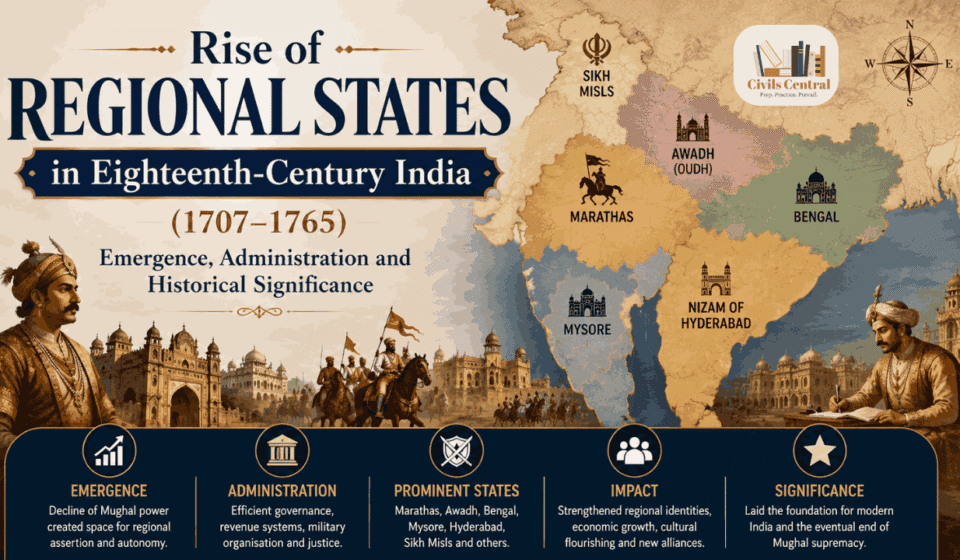
Rise of Regional States in Eighteenth-Century India (1707–1765): Emergence, Administration and Historical Significance

Chapter Summary
| Chapter Information | Details |
|---|---|
| Series | Modern History of India (1707–1947) |
| Historical Period | 1707–1765 |
| Historical Phase | Political Decentralization and the Emergence of Regional States |
| Previous Chapter | Decline of the Mughal Empire (1707–1761): Causes, Course and Historical Consequences |
| Current Chapter | Rise of Regional States in Eighteenth-Century India (1707–1765): Emergence, Administration and Historical Significance |
| Next Chapter | Maratha Expansion and the Rise of the Peshwas (1707–1761): From Shahu to the Third Battle of Panipat |
| Core Theme | The emergence of successor and independent regional states after the decline of Mughal authority, their administrative innovations, economic prosperity, military developments, and their role in shaping eighteenth-century India’s political transformation. |
| Major Regional States | Hyderabad, Awadh, Bengal, Maratha Confederacy, Mysore, Sikh Misls, Rajput States, Jat Kingdom (Bharatpur), Rohilkhand |
| Key Personalities | Nizam-ul-Mulk Asaf Jah I, Saadat Khan Burhan-ul-Mulk, Murshid Quli Khan, Alivardi Khan, Baji Rao I, Balaji Baji Rao, Chhatrapati Shahu, Haider Ali, Ahmad Shah Abdali, Suraj Mal |
| Key Concepts | Successor States, Independent States, Political Decentralization, Provincial Autonomy, Administrative Continuity, Confederacy, Regional State Formation, Revenue Administration, Military Innovation, Historiography |
| Exam Relevance | UPSC CSE, JKPSC, JKAS, State PCS, CDS, CAPF, SSC, UGC-NET (History), University Examinations |
Chapter Timeline
| Year | Event |
|---|---|
| 1707 | Death of Aurangzeb and beginning of Mughal decline |
| 1722 | Saadat Khan establishes autonomous rule in Awadh |
| 1724 | Nizam-ul-Mulk founds the Asaf Jahi State of Hyderabad |
| 1740 | Alivardi Khan becomes Nawab of Bengal |
| 1740s–1760s | Expansion of the Maratha Confederacy across India |
| 1748–1761 | Ahmad Shah Abdali’s invasions reshape North Indian politics |
| 1761 | Third Battle of Panipat |
| 1765 | East India Company acquires the Diwani of Bengal, Bihar and Orissa |
In the previous chapter, we examined how the Mughal Empire gradually lost its political, administrative, military, and financial strength after the death of Aurangzeb. By the middle of the eighteenth century, the emperor in Delhi had become largely a symbolic figure, while real authority increasingly shifted to provincial governors, military chiefs, and ambitious regional rulers.
An important question naturally arises at this stage: Did the decline of the Mughal Empire plunge India into complete political chaos, or did new political systems emerge to replace imperial authority?
For a long time, many historians described the eighteenth century as an “Age of Anarchy.” According to this interpretation, the collapse of Mughal authority produced widespread disorder that eventually enabled British conquest.
Modern historical research, however, presents a far more nuanced picture. While the Mughal Empire undoubtedly declined, the political vacuum was not left empty. Across the Indian subcontinent, numerous regional powers established stable governments, reorganized revenue administration, strengthened local economies, patronized culture, and built powerful armies. Some of these states inherited Mughal institutions almost unchanged, while others introduced entirely new political and military systems suited to regional conditions.
Understanding these regional states is essential because they formed the political bridge between the Mughal Empire and British India. The British East India Company did not conquer a unified empire; it confronted a complex landscape of competing Indian powers, each pursuing its own ambitions.
This chapter therefore explores how eighteenth-century India transformed from an empire ruled from Delhi into a mosaic of regional kingdoms, successor states, and confederacies. It examines not only how these states emerged but also how they governed, competed, cooperated, and ultimately shaped the political environment in which British colonial rule took root.
The Eighteenth Century: An Age of Decline or an Age of Political Transformation?
Few periods in Indian history have generated as much historical debate as the eighteenth century. Traditionally, it was portrayed as an era defined by decline—the collapse of Mughal authority, repeated invasions, political instability, and economic disruption. Such narratives emphasized imperial disintegration while overlooking the remarkable vitality that characterized many parts of the subcontinent.
Modern historians increasingly challenge this interpretation. Rather than viewing the eighteenth century simply as the end of Mughal power, they describe it as a period of political transformation, regional state formation, and administrative adaptation. As imperial authority weakened, new centres of power emerged across India. These states did not merely replace the Mughal administration; they reshaped it according to regional needs, local social structures, and changing military realities.
The emergence of these regional powers fundamentally altered the political geography of India. Hyderabad became the dominant force in the Deccan. Awadh developed into one of the wealthiest states of northern India. Bengal emerged as an economic powerhouse with flourishing agriculture and commerce. The Marathas expanded rapidly across much of the subcontinent, while the Sikhs, Jats, Rajputs, Rohillas, and Mysore each carved out important spheres of influence.
Despite their diversity, these states shared certain common characteristics. Most inherited Mughal administrative institutions, relied upon land revenue as their principal source of income, maintained professional armies, encouraged trade, and sought legitimacy through a combination of imperial recognition and regional authority. Yet they also differed significantly in political organization, military strategy, and relations with neighbouring powers.
The rise of regional states therefore represents far more than the fragmentation of an empire. It marks the emergence of a new political order—one in which power became decentralized, regional identities grew stronger, and the balance of authority shifted away from a single imperial centre.
At the same time, this transformation carried important long-term consequences. The rivalry among regional states prevented the emergence of another pan-Indian empire capable of replacing the Mughals. Their competition created opportunities for European trading companies, particularly the British East India Company, to intervene in Indian politics. Thus, the story of the regional states is inseparable from the larger narrative of British expansion.
To understand eighteenth-century India, one must therefore move beyond the simplistic idea of “Mughal decline” and instead examine how new political systems emerged, evolved, and interacted in one of the most dynamic periods of Indian history.
Historical Insight
“The eighteenth century was not merely the collapse of an old empire; it was the birth of a new political order.”
This insight lies at the heart of modern historiography. While earlier historians focused on imperial decline, contemporary scholars emphasize that regional states preserved many Mughal institutions while simultaneously creating new administrative and political traditions. The eighteenth century should therefore be understood as a period of transition, not simply of decay.
From Imperial Provinces to Independent Kingdoms: Why Did Regional States Emerge?
The emergence of regional states during the eighteenth century was one of the most significant political developments in Indian history. At first glance, it may appear that these states arose simply because the Mughal Empire collapsed. Such an explanation, however, is incomplete. The rise of regional kingdoms was not merely the consequence of imperial decline; it was the result of a long historical process in which structural weaknesses within the Mughal system combined with regional political ambitions, economic prosperity, military opportunities, and changing patterns of governance.
To understand why regional states emerged, one must first appreciate the nature of the Mughal Empire itself. Unlike a modern nation-state governed through centralized institutions alone, the Mughal Empire depended upon a delicate balance between imperial authority and provincial administration. Governors, nobles, zamindars, military commanders, and local elites all participated in governing the empire under the ultimate sovereignty of the emperor. As long as the emperor possessed sufficient military strength, financial resources, and political prestige, this system functioned effectively. However, once the centre weakened, the provinces acquired increasing freedom to pursue independent policies.
Thus, the rise of regional states was not an accidental event but the natural outcome of the gradual decentralization of imperial authority.
The Weakening of the Mughal Centre
The death of Aurangzeb in 1707 marked the beginning of a prolonged political crisis. His successors inherited a vast empire but lacked the authority, military ability, and financial resources necessary to govern it effectively.
Repeated wars of succession weakened the monarchy and diverted enormous resources away from administration. Powerful nobles increasingly controlled court politics, often deciding who would occupy the imperial throne. Provincial governors observed these developments closely. As confidence in the emperor declined, loyalty to the imperial centre weakened correspondingly.
The emperor in Delhi gradually ceased to function as the unquestioned source of political authority. Instead, provincial officials began to exercise greater independence in matters of administration, taxation, military organization, and diplomacy.
This transformation did not occur overnight. Rather, it unfolded gradually over several decades as imperial control became increasingly symbolic rather than practical.
Provincial Governors Became Regional Rulers
One of the most striking features of eighteenth-century India was that many regional kingdoms were founded not by rebels or foreign conquerors but by former Mughal officials themselves.
Governors appointed by the Mughal emperor initially continued to administer their provinces in the emperor’s name. Over time, however, they began to retain larger portions of provincial revenue, appointed their own officials, maintained independent armies, and made important political decisions without seeking approval from Delhi.
The rulers of Hyderabad, Awadh, and Bengal followed this pattern.
Although they formally acknowledged the Mughal emperor’s sovereignty, their governments functioned almost entirely independently. They issued administrative orders, collected revenue, negotiated with neighbouring powers, and organized military campaigns according to their own interests.
This gradual transition from imperial governors to autonomous rulers explains why historians describe these kingdoms as Successor States. They succeeded the Mughal administration rather than overthrowing it.
Regional Ambitions and Local Political Aspirations
Not all regional powers emerged from the Mughal administrative system. Several political communities that had long resisted Mughal expansion now found unprecedented opportunities to establish independent states.
The Marathas, who had challenged Mughal authority throughout Aurangzeb’s reign, expanded rapidly after his death under capable leaders such as Baji Rao I. Their military mobility and decentralized political organization enabled them to establish influence across much of western, central, and northern India.
Similarly, the Sikhs gradually consolidated power in Punjab through the formation of the Misls, while the Jats established an important kingdom centred at Bharatpur. Rajput rulers strengthened their autonomy, and the Rohillas emerged as a significant political force in Rohilkhand.
Unlike the Successor States, these regional powers developed outside the Mughal provincial administrative framework. Their authority rested upon regional identities, military leadership, and local political traditions rather than appointments from the Mughal emperor.
Consequently, historians often distinguish between Successor States, which inherited Mughal institutions, and Independent Regional States, which emerged through indigenous political movements.
Economic Prosperity Encouraged Political Independence
Political independence required more than military strength; it also demanded financial resources.
Many regions of eighteenth-century India possessed flourishing agricultural economies, thriving urban centres, and extensive commercial networks. Bengal’s textile industry supplied international markets, Awadh benefited from fertile agricultural land, Hyderabad controlled important trade routes across the Deccan, and western Indian ports facilitated maritime commerce with West Asia and Europe.
The economic prosperity of these provinces enabled their rulers to finance standing armies, maintain efficient administrations, construct public works, and patronize art and culture without depending upon financial assistance from Delhi. As provincial revenues increasingly remained within regional capitals instead of being transferred to the imperial treasury, the economic foundations of Mughal authority weakened further while regional governments became progressively stronger.
Thus, economic decentralization reinforced political decentralization.
Military Changes Favoured Regional Powers
The military conditions of the eighteenth century also contributed significantly to the emergence of regional states. The Mughal army had traditionally relied upon a centralized command structure supported by the Mansabdari system. As this system deteriorated, provincial rulers increasingly organized their own military establishments.
Some states maintained permanent armies financed directly from provincial revenues. Others relied upon mobile cavalry forces, local militias, or alliances with influential chiefs.
The Marathas, in particular, demonstrated remarkable flexibility by combining rapid cavalry movement with decentralized command. Their military methods differed considerably from the traditional Mughal style and proved highly effective across large parts of the subcontinent.
As military authority shifted from the imperial centre to regional governments, political authority naturally followed.
Foreign Invasions Accelerated Decentralization
The invasions of Nadir Shah (1739) and Ahmad Shah Abdali (1748–1761) dramatically accelerated the process of regionalization. These invasions exposed the inability of the Mughal government to defend its own capital, protect provincial territories, or preserve internal stability. Provincial rulers increasingly recognized that they could no longer rely upon imperial military protection.
Consequently, they invested heavily in strengthening their own armies, fortifications, and diplomatic alliances. In effect, foreign invasions transformed provincial autonomy from a political choice into a practical necessity.
The Nature of Eighteenth-Century Political Decentralization
It is important to understand that political decentralization did not imply the disappearance of government. Many earlier historians portrayed eighteenth-century India as an age of disorder following the collapse of Mughal authority. Modern research, however, paints a more balanced picture.
Regional rulers continued to collect land revenue, administer justice, regulate trade, maintain armies, construct roads, patronize scholars, and encourage economic activity. In many areas, administrative continuity remained remarkably strong because regional governments retained large portions of the Mughal bureaucratic framework.
What changed was not the existence of governance but the location of political authority.
Power shifted away from a single imperial capital toward multiple regional capitals such as Hyderabad, Murshidabad, Lucknow, Poona, Srirangapatna, Lahore, and Bharatpur. The political map of India became more decentralized, but it also became more diverse and dynamic.
The Political Landscape of Eighteenth-Century India
By the middle of the eighteenth century, India had evolved into a complex political mosaic comprising three broad categories of states:
- Successor States, such as Hyderabad, Awadh, and Bengal, which inherited Mughal administrative institutions while exercising practical independence.
- Independent Regional States, including the Maratha Confederacy, Sikh Misls, Jat Kingdom, Rajput states, Rohillas, and Mysore, whose authority emerged primarily from regional political movements and military strength.
- European Trading Settlements, particularly those controlled by the British, French, Dutch, Portuguese, and Danish companies, which initially remained commercial centres but increasingly participated in Indian politics.
The interaction among these three groups would shape the future course of Indian history and eventually determine the success of British colonial expansion.
Historical Insight
The emergence of regional states did not signify the end of governance in India; it signified the transfer of political authority from one imperial centre to multiple regional centres.
Modern historians therefore describe the eighteenth century as an era of political decentralization rather than one of complete anarchy. This reinterpretation has fundamentally changed our understanding of the period and highlights the resilience of Indian political institutions even after the decline of Mughal supremacy.
Successor States of the Mughal Empire: Hyderabad, Awadh and Bengal
The first major political powers to emerge after the weakening of the Mughal Empire were not entirely new kingdoms. Rather, they evolved from within the imperial administrative system itself. These states were established by experienced Mughal governors who, while formally acknowledging the authority of the emperor, gradually assumed complete control over provincial administration.
Historians describe these kingdoms as Successor States because they represented a continuation—not a rejection—of the Mughal political tradition. Their rulers had served the Mughal Empire, understood its administrative institutions, and largely retained its systems of revenue collection, judicial administration, military organization, and governance. The most prominent among them were Hyderabad, Awadh, and Bengal.
These states illustrate an important feature of eighteenth-century Indian history: the Mughal Empire declined, but Mughal institutions survived. Instead of disappearing, they were adapted to regional circumstances by ambitious provincial rulers.
Hyderabad: The First Great Successor State
Among all the successor states, Hyderabad was the earliest and perhaps the most influential. It was founded by Nizam-ul-Mulk Asaf Jah I, one of the most capable administrators and military commanders of the later Mughal period.
Nizam-ul-Mulk and the Foundation of Hyderabad
Nizam-ul-Mulk, whose original name was Mir Qamar-ud-Din Khan, enjoyed a distinguished career under the Mughal emperors. He held several important administrative positions and was eventually appointed Wazir (Prime Minister) of the Mughal Empire.
During his service at the imperial court, he became increasingly dissatisfied with factional politics in Delhi. Court intrigues, rivalry among nobles, and the growing weakness of the emperor convinced him that effective administration was becoming impossible at the centre.
In 1724, he left Delhi and established his authority over the Deccan, laying the foundation of the Asaf Jahi dynasty, which ruled Hyderabad for more than two centuries.
Although he continued to recognize the Mughal emperor symbolically by issuing coins and reading the Khutba in the emperor’s name, Hyderabad functioned as an independent kingdom in every practical sense.
Administration of Hyderabad
One of the reasons for Hyderabad’s remarkable stability was the administrative experience of its founder.
Instead of dismantling the Mughal system, Nizam-ul-Mulk preserved many of its institutions. Revenue officials, judicial officers, military commanders, and provincial administrators continued to function within a familiar bureaucratic framework.
At the same time, the Nizam introduced several important reforms aimed at reducing corruption and strengthening provincial finances. Revenue collection became more closely supervised, local administration became more efficient, and the authority of powerful nobles was carefully balanced to prevent excessive concentration of power.
This combination of administrative continuity and pragmatic reform enabled Hyderabad to become one of the strongest regional states of eighteenth-century India.
Strategic Importance
Hyderabad occupied a strategically significant position in the Deccan. Its territory connected northern and southern India, controlled important commercial routes, and contained fertile agricultural regions. The state benefited from both inland commerce and long-distance trade, enabling it to maintain a substantial military establishment.
Its strategic location also made Hyderabad an important participant in the political struggles involving the Marathas, Mysore, and later the British and French East India Companies. Consequently, Hyderabad became one of the principal centres of eighteenth-century Indian politics.
Awadh: Prosperity in the Gangetic Plain
While Hyderabad emerged in the Deccan, another important successor state developed in the fertile plains of northern India. The state of Awadh was founded by Saadat Khan Burhan-ul-Mulk, who was appointed governor of the province in 1722.
Like the Nizam of Hyderabad, Saadat Khan initially governed on behalf of the Mughal emperor. However, as imperial authority weakened, he steadily expanded his own political independence. Within a few years, Awadh had become an autonomous kingdom whose rulers exercised effective control over administration, finance, and military affairs while maintaining only nominal allegiance to Delhi.
Administrative Development
The prosperity of Awadh rested primarily upon its highly productive agricultural economy. The fertile plains of the Ganga and Gomti rivers generated substantial land revenue, providing the financial resources necessary to support an efficient administration and a well-equipped army.
The Nawabs of Awadh carefully reorganized revenue collection, strengthened provincial administration, and maintained relatively stable relations with local zamindars. Unlike many regions experiencing political instability, Awadh enjoyed considerable internal order, which encouraged agricultural expansion, commercial activity, and urban growth.
The capital gradually developed into one of northern India’s leading political and cultural centres.
Cultural Flourishing
Awadh became famous not only for political stability but also for its extraordinary cultural achievements. Persian literature, music, painting, architecture, and courtly traditions flourished under the patronage of the Nawabs. The state attracted poets, scholars, artists, musicians, and craftsmen from different parts of India and Central Asia.
This cultural development demonstrates that the eighteenth century was not merely an age of political conflict but also an era of remarkable artistic and intellectual creativity. The later city of Lucknow would become one of the greatest cultural capitals of India, symbolizing the refinement and sophistication associated with the Nawabs of Awadh.
Bengal: The Wealthiest Successor State
Among all the successor states, Bengal possessed the strongest economic foundations. Its fertile river valleys, highly productive agriculture, thriving textile industry, and extensive maritime trade made it one of the richest provinces of the former Mughal Empire.
This immense prosperity enabled Bengal to emerge as perhaps the most economically significant regional state of eighteenth-century India.
From Murshid Quli Khan to Alivardi Khan
The movement toward provincial autonomy in Bengal began under Murshid Quli Khan, who reorganized revenue administration and shifted the provincial capital from Dhaka to Murshidabad. His reforms greatly increased provincial revenues while simultaneously reducing dependence upon Delhi.
Later rulers continued this process of administrative consolidation. Among them, Alivardi Khan, who became Nawab in 1740, proved to be one of Bengal’s most capable rulers. He successfully defended the province against repeated Maratha raids, improved administrative efficiency, and sought to preserve Bengal’s political autonomy amid increasing European commercial activity.
Economic Strength of Bengal
The prosperity of Bengal rested upon a remarkably diversified economy. The province produced rice, sugar, indigo, silk, saltpetre, cotton textiles, and numerous other commodities that were highly valued in both Indian and international markets.
Bengal’s textile industry, particularly the production of fine muslin and silk fabrics, enjoyed worldwide demand. European trading companies—including the British, French, Dutch, and Danish—competed vigorously for commercial privileges within the province.
Its flourishing ports connected Bengal with Southeast Asia, the Middle East, and Europe, making it one of the most commercially integrated regions of the eighteenth-century world.
This economic prosperity explains why Bengal eventually became the primary target of British political expansion.
Administration and Governance
Like Hyderabad and Awadh, Bengal retained many essential features of Mughal administration. Revenue officials continued to supervise land taxation, judicial institutions remained largely intact, and provincial bureaucracy functioned with considerable efficiency.
The Nawabs exercised greater independence in financial and military matters while preserving the appearance of loyalty to the Mughal emperor. For several decades, Bengal enjoyed both political stability and economic prosperity.
Ironically, these very strengths attracted increasing attention from the British East India Company, whose commercial ambitions would soon transform the province into the centre of colonial expansion.
Common Features of the Successor States
Despite important regional differences, Hyderabad, Awadh, and Bengal shared several fundamental characteristics that distinguished them from both the declining Mughal Empire and the independent regional powers.
First, all three states were founded by experienced Mughal governors who had risen through the imperial administrative system.
Second, they retained most Mughal institutions rather than replacing them. Revenue administration, judicial organization, provincial bureaucracy, and military structures continued to reflect Mughal traditions.
Third, their rulers acknowledged the Mughal emperor symbolically but exercised complete practical independence in matters of governance.
Fourth, these states depended heavily upon prosperous agricultural economies and expanding commercial networks, which enabled them to finance stable governments and professional armies.
Finally, each state became an important centre of culture, learning, architecture, and economic development, demonstrating that regionalization often encouraged innovation rather than decline.
Successor States at a Glance
| Feature | Hyderabad | Awadh | Bengal |
|---|---|---|---|
| Founder | Nizam-ul-Mulk Asaf Jah I | Saadat Khan Burhan-ul-Mulk | Murshid Quli Khan (administrative foundation); consolidated by Alivardi Khan |
| Year of Emergence | 1724 | 1722 | Early 18th century (autonomy consolidated by 1740) |
| Capital | Hyderabad | Initially Faizabad; later Lucknow became the principal political and cultural centre | Murshidabad |
| Economic Base | Agriculture and Deccan trade | Fertile Gangetic agriculture | Agriculture, textiles, maritime commerce |
| Relation with Mughals | Nominal loyalty, practical independence | Nominal loyalty, practical independence | Nominal loyalty, practical independence |
| Historical Importance | Dominant power in the Deccan | Powerful state in North India | Wealthiest province; later first major British conquest |
Independent Regional Powers: The Marathas, Sikhs, Jats, Rajputs, Rohillas and Mysore
While the Successor States of Hyderabad, Awadh, and Bengal emerged from within the Mughal administrative framework, another group of regional powers followed an entirely different path. These states did not derive their authority from appointments made by the Mughal emperor. Instead, they emerged through regional political movements, military resistance, local leadership, and the growing aspirations of communities that had long sought greater autonomy.
The rise of these Independent Regional Powers fundamentally transformed the political geography of eighteenth-century India. Unlike the Successor States, which largely preserved Mughal institutions, these kingdoms developed political systems shaped by their own historical experiences, military traditions, and regional identities.
Among them, the Marathas emerged as the most powerful force, challenging Mughal supremacy across much of the subcontinent. The Sikhs consolidated their influence in Punjab, the Jats established a prosperous kingdom in Bharatpur, the Rajputs strengthened their hereditary principalities, the Rohillas created a powerful Afghan state in Rohilkhand, and Mysore emerged as a formidable military power in southern India.
Together, these states ensured that the eighteenth century was not merely an era of imperial fragmentation but also a period of remarkable political innovation and regional state-building.
The Maratha Confederacy: The Greatest Challenge to Mughal Supremacy
Among all the regional powers that emerged during the eighteenth century, none matched the military reach and political influence of the Maratha Confederacy. By the middle of the century, Maratha armies operated from the Arabian Sea to Bengal and from the Deccan to the outskirts of Delhi, making them the strongest indigenous political force in India.
Their rise represented one of the most significant shifts in the balance of power after the decline of the Mughal Empire.
From Shivaji’s Kingdom to a Confederacy
The foundations of Maratha power had been laid during the seventeenth century by Chhatrapati Shivaji Maharaj, who established an independent kingdom in western India through administrative reforms, military innovation, and resistance against Mughal expansion.
After Shivaji’s death, the Marathas experienced internal conflicts and prolonged wars with Aurangzeb. However, the death of the Mughal emperor in 1707 created new opportunities for expansion.
Under Chhatrapati Shahu, real executive authority increasingly passed into the hands of the Peshwas, who served as the chief ministers of the Maratha state.
The office of the Peshwa gradually became the centre of political power, while the Chhatrapati assumed a more ceremonial role.
Baji Rao I and Maratha Expansion
The transformation of the Marathas into a pan-Indian power was largely the achievement of Peshwa Baji Rao I (1720–1740). An exceptional cavalry commander and military strategist, Baji Rao believed that the weakening Mughal Empire created an unprecedented opportunity for Maratha expansion.
He famously declared that instead of defending the Deccan, the Marathas should strike at the heart of Mughal power in northern India. Through rapid cavalry campaigns, flexible military organization, and bold strategic planning, the Marathas extended their influence across Malwa, Bundelkhand, Gujarat, and large parts of northern and central India.
Unlike the Mughal army, which often depended upon large, slow-moving forces, Maratha cavalry emphasized speed, mobility, and surprise. These advantages enabled them to dominate battlefields across vast distances.
By the middle of the eighteenth century, the Marathas had become the principal successors to Mughal military power.
The Maratha Confederacy
As Maratha influence expanded, their political organization also evolved. Instead of establishing a highly centralized empire similar to that of the Mughals, the Marathas developed a confederacy.
Several powerful Maratha families exercised authority over different regions while recognizing the leadership of the Peshwa at Poona (Pune).
Among the most important houses were:
- Scindias (Sindhias) of Gwalior.
- Holkars of Indore.
- Gaekwads of Baroda.
- Bhonsles of Nagpur.
This decentralized structure enabled rapid territorial expansion because regional commanders enjoyed considerable autonomy. However, it also produced internal rivalries that later weakened Maratha unity.
Administration and Revenue
The Marathas retained several administrative practices inherited from earlier Deccan kingdoms while introducing important innovations. One of the principal sources of income was the collection of Chauth, amounting to one-fourth of the revenue of conquered territories.
They also levied Sardeshmukhi, an additional charge traditionally associated with the hereditary rights of the Maratha ruler. Revenue from these sources financed military campaigns and administrative activities across the expanding confederacy.
Although the Marathas established effective regional administrations in many areas, they often exercised indirect authority over distant territories by collecting tribute rather than introducing complete administrative integration. This distinction would later influence both their strengths and their limitations.
The Sikhs: From Religious Community to Political Power
The emergence of Sikh political authority represents another remarkable development of the eighteenth century. The Sikh community had undergone profound transformation under successive Gurus, particularly after the establishment of the Khalsa by Guru Gobind Singh in 1699.
During the eighteenth century, repeated conflicts with Mughal officials and Afghan invaders encouraged greater political and military organization.
Formation of the Sikh Misls
Rather than establishing a centralized kingdom immediately, Sikh power developed through the formation of several autonomous military confederacies known as Misls. Each Misl controlled particular territories while cooperating with others during periods of external threat.
This decentralized political structure enabled the Sikhs to survive repeated Afghan invasions and gradually strengthen their position in Punjab. Although the various Misls remained politically independent, they shared common religious traditions and collective military objectives.
This laid the foundation for the later unification of Punjab under Maharaja Ranjit Singh in the early nineteenth century.
The Jat Kingdom of Bharatpur
The Jats, originally an important agrarian community of northern India, also emerged as a significant regional political force during the eighteenth century. Repeated conflicts with Mughal authorities strengthened their military organization and encouraged political consolidation.
The most distinguished ruler of the Jats was Maharaja Suraj Mal, often described as one of the most capable rulers of eighteenth-century northern India. Under his leadership, Bharatpur expanded considerably and developed into a prosperous kingdom characterized by efficient administration, agricultural development, and strong defensive fortifications.
The famous Lohagarh Fort at Bharatpur became renowned for its military strength and later resisted repeated British attacks.
The Rajput States
The Rajputs had maintained important kingdoms long before the establishment of Mughal rule. During the Mughal period, many Rajput rulers entered into political alliances with the emperors while preserving substantial internal autonomy.
As Mughal authority declined, states such as Jaipur, Jodhpur, Udaipur, Bikaner, and Kota strengthened their independence.
Rather than seeking to establish a pan-Indian empire, most Rajput rulers concentrated upon protecting their hereditary territories, promoting regional administration, and preserving their dynastic traditions.
Although their political influence remained largely regional, the Rajput states continued to play an important role in eighteenth-century diplomacy and warfare.
The Rohillas
The Rohillas were Afghan chiefs who settled in the fertile region between the Ganga and the Himalayan foothills, later known as Rohilkhand. Under leaders such as Ali Muhammad Khan, they established an independent state characterized by a strong military tradition.
The Rohillas frequently became involved in the complex political rivalries among Awadh, the Marathas, and the Afghan ruler Ahmad Shah Abdali. Their strategic location made Rohilkhand an important centre of eighteenth-century North Indian politics.
Mysore: The Rise of a Southern Military Power
In southern India, the Kingdom of Mysore gradually emerged as one of the most dynamic regional powers. Although the Wodeyar dynasty had ruled Mysore for centuries, the state’s political and military importance increased dramatically during the middle of the eighteenth century.
The rise of Haider Ali, an exceptionally capable military commander, transformed Mysore into a modern and expansionist state. Haider Ali reorganized the army, improved artillery, strengthened administration, and challenged both neighbouring Indian powers and the British East India Company.
His achievements would later be carried forward by his son, Tipu Sultan, making Mysore one of Britain’s strongest Indian opponents during the late eighteenth century. Although the most famous phase of Mysore’s history belongs to a slightly later period, its emergence during the eighteenth century formed an important part of the broader process of regional state formation.
Comparing the Independent Regional Powers
Although these regional powers differed greatly in origin and political organization, they shared several common features.
Unlike the Successor States, their legitimacy generally rested upon regional leadership, military strength, and community support rather than Mughal appointments. Most relied upon highly mobile armies, regional revenue systems, and decentralized political institutions.
They also promoted local cultures, languages, and traditions, contributing significantly to the growing regional diversity of eighteenth-century India. Yet their objectives often differed. The Marathas sought extensive territorial expansion; the Sikhs focused initially on consolidating Punjab; the Rajputs prioritized dynastic stability; Bharatpur emphasized regional consolidation; while Mysore increasingly pursued military modernization.
These differences shaped the complex political landscape into which European powers would later intervene.
Historical Insight
The Independent Regional Powers represented the emergence of new political centres rooted in regional identities rather than imperial authority. Their rise demonstrated that the decline of the Mughal Empire did not create a political vacuum; instead, it redistributed power among multiple ambitious Indian states.
However, despite their remarkable achievements, these powers rarely acted together. Their frequent rivalries, competing ambitions, and shifting alliances prevented the emergence of a unified Indian empire capable of replacing the Mughals. This fragmentation would prove decisive when the British East India Company began transforming commercial influence into political power.
Administration, Economy and Society under the Regional States: Continuity, Adaptation and Regional Innovation
Did the Mughal Decline Lead to Administrative Collapse?
One of the most persistent misconceptions about eighteenth-century India is that the decline of the Mughal Empire plunged the subcontinent into complete political disorder and administrative chaos. Traditional historical narratives often portrayed this period as an “Age of Anarchy”, suggesting that once imperial authority weakened after Aurangzeb’s death in 1707, governance collapsed, agriculture declined, trade stagnated, and society entered a prolonged phase of instability. In this interpretation, the rise of the British East India Company appeared almost inevitable because India supposedly lacked any effective political or administrative institutions.
Modern historical research, however, presents a very different picture.
The weakening of the Mughal Empire certainly produced political fragmentation, but fragmentation was not the same as collapse. The disappearance of a powerful imperial centre did not mean that administration vanished across the country. Instead, political authority shifted from one imperial capital—Delhi—to numerous regional capitals such as Hyderabad, Murshidabad, Lucknow, Poona, Srirangapatna, Jaipur, and Bharatpur. Governance became decentralized, not dysfunctional.
This distinction is fundamental for understanding eighteenth-century India.
The regional states that emerged after the decline of Mughal authority inherited a sophisticated administrative tradition that had evolved over nearly two centuries. Their rulers did not begin with a blank slate, nor did they seek to dismantle existing institutions merely because they had been created by the Mughals. On the contrary, they recognized that the stability of their newly established kingdoms depended upon preserving efficient systems of taxation, justice, record-keeping, provincial administration, and military organization.
As a result, the eighteenth century witnessed an interesting combination of institutional continuity and political innovation. The machinery of governance largely survived, but it now operated under regional rulers whose priorities reflected local political realities rather than imperial ambitions.
Understanding this balance between continuity and change is essential because it explains two major historical developments. First, it demonstrates why many regional kingdoms remained remarkably prosperous despite the decline of Mughal supremacy. Second, it helps explain how the British East India Company was eventually able to establish colonial rule. The Company did not create an entirely new administrative system from scratch; instead, it inherited and gradually modified institutions that had already been preserved and refined by the regional states.
Thus, the history of eighteenth-century India should not be viewed merely as the story of an empire that declined. It is equally the story of new governments that learned to govern, adapting inherited institutions to regional needs while laying the foundations of a new political order.
Rethinking the Eighteenth Century: From the “Age of Anarchy” to the “Age of Regional State Formation”
For much of the nineteenth and early twentieth centuries, British historians described eighteenth-century India as a period of almost complete disorder. According to this interpretation, the collapse of Mughal authority destroyed political stability, encouraged endless warfare, disrupted economic life, and created a vacuum that only British rule could fill. Colonial administrators frequently used this narrative to justify imperial expansion, arguing that British governance restored peace and efficient administration after decades of chaos.
This interpretation deeply influenced early Indian historiography. Even eminent historians such as Sir Jadunath Sarkar, while acknowledging the achievements of several regional rulers, largely emphasized the destructive consequences of Mughal decline. Continuous warfare among the Marathas, Afghans, Jats, Sikhs, Rohillas, and various successor states appeared to support the view that the eighteenth century represented an age of political disintegration.
From the second half of the twentieth century onwards, however, historians began to reassess this interpretation by examining Persian administrative records, revenue documents, merchant correspondence, regional chronicles, and European commercial accounts. Their findings revealed a much more complex historical reality.
Scholars such as Satish Chandra, Muzaffar Alam, C. A. Bayly, Seema Alavi, and others demonstrated that while the Mughal Empire undoubtedly declined as a centralized political authority, many of its administrative institutions remained remarkably resilient. Provincial governments continued to collect land revenue, supervise agriculture, administer justice, regulate markets, maintain armies, and encourage commercial activity. Far from disappearing, governance simply became regionalized.
This reinterpretation has transformed the study of eighteenth-century India. Historians now increasingly describe the period as an Age of Regional State Formation, emphasizing that new political centres emerged across the subcontinent with considerable administrative capacity and economic vitality.
The regional states were therefore not temporary fragments waiting to be absorbed by the British. They were functioning governments that sought to establish political legitimacy, maintain internal order, promote economic prosperity, and preserve regional interests. Their success explains why several of them—particularly Hyderabad, Awadh, Bengal, Mysore, and the Maratha Confederacy—became powerful political actors in their own right before eventually confronting expanding European influence.
The eighteenth century, therefore, should be understood not as the end of Indian statecraft but as one of its most dynamic phases of adaptation and reinvention.
CivilsCentral Insight
The decline of the Mughal Empire created a crisis of central authority, not a collapse of governance. Regional states inherited Mughal institutions, adapted them to local conditions, and built new centres of political power. Modern historiography therefore views the eighteenth century as an era of regional state formation rather than an age of anarchy.
The Legacy of the Mughal Administrative System: Why Regional Rulers Preserved Imperial Institutions
The emergence of regional states after the decline of the Mughal Empire raises an important historical question. If these rulers were establishing independent kingdoms, why did they continue to use Mughal administrative institutions instead of creating entirely new systems of governance?
At first glance, one might expect political independence to be accompanied by administrative revolution. In many parts of the world, the fall of an empire often leads to the destruction of its institutions and their replacement by new structures reflecting the ideology of the succeeding rulers. Eighteenth-century India, however, followed a different path. Although the authority of the Mughal emperor steadily declined, the administrative machinery developed under Mughal rule continued to function with remarkable resilience.
This apparent contradiction can only be understood by appreciating the difference between political sovereignty and administrative capability. The regional rulers rejected the political supremacy of Delhi, but they did not reject the administrative experience that the Mughal Empire had accumulated over nearly two centuries. They recognized that effective governance required stable institutions, experienced officials, and predictable systems of taxation and justice. Rather than dismantling these institutions, they sought to adapt them to regional circumstances.
Thus, one of the defining characteristics of eighteenth-century India was administrative continuity amidst political change.
The Mughal Administrative Legacy
By the beginning of the eighteenth century, the Mughal Empire possessed one of the most sophisticated administrative systems in the early modern world. Successive emperors—from Akbar to Aurangzeb—had developed a highly organized framework for governing an empire that stretched across most of the Indian subcontinent.
This administrative structure rested upon several interrelated institutions. The empire was divided into Subahs (provinces), each administered by governors appointed by the emperor. Provincial governments supervised revenue collection, maintained law and order, administered justice, and coordinated military affairs. At the district and local levels, a network of officials ensured that imperial policies reached villages and market towns.
Equally important was the elaborate revenue administration. Land surveys, revenue assessments, detailed record-keeping, and an organized bureaucracy enabled the Mughal state to collect taxes from one of the world’s largest agrarian economies. Persian functioned as the language of administration, providing a uniform bureaucratic culture across the empire.
Although political authority was concentrated in the emperor, the day-to-day functioning of the empire depended upon thousands of trained officials who possessed considerable administrative expertise.
When imperial authority weakened after Aurangzeb’s death, these institutions did not suddenly disappear. The emperor’s political influence declined far more rapidly than the administrative framework that supported governance.
Why Destroying the Mughal System Was Neither Practical nor Desirable
The new regional rulers inherited territories that were densely populated, economically productive, and administratively complex. Governing such regions required more than military success; it required the ability to collect revenue, resolve disputes, maintain roads, supervise markets, organize armies, and manage relations with local elites.
Creating an entirely new administrative structure would have been both expensive and politically risky.
The Mughal system had already demonstrated its effectiveness over generations. It possessed established procedures, experienced officials, standardized documentation, and widespread public acceptance. Abandoning these institutions would have disrupted revenue collection, weakened state finances, and undermined political stability at precisely the moment when the new regional governments were attempting to consolidate their authority.
Instead, regional rulers adopted a more pragmatic approach. They retained the administrative machinery they inherited while transferring its loyalty from the emperor in Delhi to the regional court. In other words, the institutions remained largely the same, but the centre of authority changed.
This explains why historians often describe the successor states as heirs to the Mughal administrative tradition rather than revolutionary regimes.
The Continuity of Bureaucracy
One of the clearest examples of administrative continuity was the survival of the bureaucratic class.
The decline of the Mughal Empire did not eliminate its administrators. Thousands of revenue officials, accountants, judges, military officers, scribes, and provincial administrators remained active across India. These men possessed specialized knowledge that could not easily be replaced.
Regional rulers therefore preferred to retain experienced officials instead of recruiting entirely new administrations.
In Hyderabad, Nizam-ul-Mulk continued to employ many former Mughal officials while reorganizing provincial governance. In Bengal, Murshid Quli Khan relied upon an efficient bureaucracy to strengthen revenue administration. The Nawabs of Awadh similarly preserved much of the existing administrative apparatus.
Even the Marathas, who had emerged independently of the Mughal system, frequently employed Persian-trained administrators and adopted several Mughal administrative practices in newly acquired territories.
This continuity ensured that governance remained functional despite political change.
Persian as the Language of Governance
Administrative continuity was reinforced by the continued use of Persian as the principal language of government. For nearly two centuries, Persian had served as the language of official correspondence, judicial records, revenue documents, diplomatic communication, and administrative manuals throughout much of India.
Regional governments found no immediate reason to replace it.
Officials were already trained in Persian administrative terminology, legal procedures, and record-keeping practices. Retaining the language ensured continuity in governance and facilitated communication among administrators across different regions.
Although regional languages such as Marathi, Bengali, Telugu, Kannada, Punjabi, and Hindi increasingly gained prominence in literature and local administration, Persian remained the dominant language of higher administration in many regional states until the early nineteenth century.
The continued use of Persian illustrates that political decentralization did not produce bureaucratic fragmentation.
The Survival of Revenue Institutions
If there was one institution that every regional ruler sought to preserve, it was the revenue system. Agriculture remained the principal source of state income, and efficient revenue collection was essential for maintaining armies, paying officials, constructing public works, and sustaining political authority.
The Mughal revenue system had evolved through decades of administrative experience. It included methods for land measurement, crop assessment, tax collection, accounting, and record maintenance. Regional rulers retained these procedures because they ensured financial stability.
However, preservation did not mean stagnation.
Many governments modified revenue policies according to local conditions. Bengal emphasized stricter fiscal supervision under Murshid Quli Khan. Awadh strengthened cooperation with influential zamindars to improve collections. Hyderabad introduced reforms to reduce corruption and increase administrative efficiency. The Marathas supplemented traditional land revenue with Chauth and Sardeshmukhi, adapting fiscal practices to the needs of an expanding confederacy.
Thus, continuity and innovation operated simultaneously.
Governing Through Local Elites
Another reason for the endurance of Mughal institutions was the continued importance of local intermediaries. No eighteenth-century state possessed the administrative capacity to govern every village directly from the capital. Instead, rulers relied upon a network of zamindars, village headmen, local chiefs, merchants, and influential families to implement government policies.
This arrangement had existed under the Mughal Empire and continued under the regional states. The relationship was based upon mutual dependence. The state required local elites for revenue collection and rural administration, while local elites depended upon state recognition to maintain their authority and economic privileges.
Successful regional rulers therefore avoided unnecessary confrontation with established social groups. Instead, they integrated them into the new political order, ensuring continuity in administration while strengthening regional legitimacy.
This explains why many regions experienced relatively stable governance despite frequent changes at the highest political level.
Administrative Adaptation Rather Than Administrative Revolution
Although regional rulers preserved much of the Mughal administrative framework, they did not simply imitate it without modification. Each state adapted inherited institutions according to its own geographical conditions, political priorities, and military requirements. Hyderabad developed a more autonomous provincial administration independent of Delhi.
Awadh reorganized revenue management to maximize agricultural income. Bengal strengthened fiscal administration to exploit its extraordinary commercial wealth. The Marathas combined inherited administrative practices with decentralized political institutions suited to a confederacy.
Mysore, under Haider Ali and later Tipu Sultan, introduced innovations in military organization, state finance, and industrial production while still utilizing several existing administrative structures.
These examples demonstrate that eighteenth-century governance was characterized not by rigid continuity but by creative adaptation. The regional states treated the Mughal administrative system as a foundation upon which they could construct governments suited to their own circumstances.
Administrative Continuity as the Foundation of Political Stability
The preservation of Mughal institutions had consequences that extended far beyond the eighteenth century. Because administration remained functional, agriculture continued to produce substantial revenues, merchants continued to invest in commerce, urban centres continued to expand, and governments retained the financial capacity to support armies and cultural patronage.
This institutional continuity also explains why the British East India Company was able to establish political authority relatively quickly after acquiring territory. Rather than designing an entirely new administrative framework, Company officials initially relied upon existing revenue systems, local officials, judicial practices, and bureaucratic procedures that had been preserved by the regional states.
In this sense, the administrative legacy of the Mughal Empire continued to influence Indian governance long after the empire itself had ceased to exist as an effective political power.
Historiographical Perspective
Earlier colonial historians often interpreted the decline of the Mughal Empire as evidence of administrative collapse. Contemporary scholarship, however, draws a clear distinction between the decline of imperial sovereignty and the continuity of administrative institutions.
Historians such as Muzaffar Alam, C. A. Bayly, Satish Chandra, and Seema Alavi argue that the regional states were not merely fragments of a disintegrating empire. They were capable governments that inherited, preserved, and adapted Mughal institutions to serve regional interests. This perspective has fundamentally reshaped our understanding of eighteenth-century India, shifting the emphasis from decline to institutional resilience and state formation.
CivilsCentral Historical Insight
Empires may collapse before their institutions do. The Mughal Empire lost its political supremacy during the eighteenth century, but its administrative framework survived because it had become deeply embedded in Indian governance. The regional states inherited this institutional legacy, modified it according to local needs, and transformed it into the foundation of their own authority. Their success demonstrates that political decentralization did not produce administrative anarchy; it produced administrative regionalization.
From Imperial Administration to Regional Governance: How the Regional States Adapted the Mughal Legacy
If the regional rulers inherited the administrative framework of the Mughal Empire, an equally important question follows: Did they merely preserve the existing system, or did they transform it to meet new political realities?
The answer lies at the heart of eighteenth-century Indian history.
The regional states were neither passive custodians of Mughal institutions nor revolutionary regimes that rejected everything associated with imperial rule. Instead, they adopted a pragmatic approach. They accepted that the Mughal administrative framework had proved remarkably effective in governing a vast and diverse society, but they also recognized that the political environment of the eighteenth century differed fundamentally from that of Akbar or Shah Jahan’s age. The empire had fragmented into competing kingdoms, military threats had multiplied, commercial networks had expanded, and European trading companies had begun intervening in Indian politics.
Under these changing circumstances, simply preserving Mughal institutions was insufficient. Regional rulers had to adapt inherited administrative practices to regional priorities, local economies, military challenges, and changing diplomatic realities.
Consequently, the eighteenth century witnessed one of the most important yet often overlooked developments in Indian history—the transformation of imperial administration into regional governance. The foundations remained Mughal, but the methods, priorities, and objectives increasingly reflected regional interests.
Each major state adapted the inherited system differently, creating distinctive models of governance that reflected its geography, economy, and political ambitions.
Hyderabad: Building Stability Through Administrative Discipline
Among all the successor states, Hyderabad most clearly demonstrated the transition from Mughal provincial administration to an autonomous regional government.
When Nizam-ul-Mulk Asaf Jah I established his authority over the Deccan in 1724, he did not attempt to dismantle the administrative machinery he had inherited. Having served as one of the Mughal Empire’s most experienced administrators, he understood both its strengths and its weaknesses. His objective was not to create a new bureaucracy but to free an existing one from the instability of imperial court politics.
The Mughal administration had increasingly become hostage to factional struggles in Delhi. Frequent changes in ministers, competition among powerful nobles, and weak emperors often prevented provincial governors from administering their territories effectively. By shifting the centre of authority from Delhi to Hyderabad, the Nizam insulated provincial administration from these disruptions.
He retained the familiar hierarchy of officials, continued the established revenue system, and preserved Persian as the language of administration. At the same time, he introduced stricter supervision over provincial officers, reduced opportunities for corruption, and strengthened fiscal discipline. Administrative appointments were increasingly based upon competence and loyalty to the regional state rather than political influence at the imperial court.
This produced a more stable government than the one operating in the declining Mughal capital.
Hyderabad therefore illustrates that administrative continuity did not mean institutional stagnation. Instead, it represented institutional consolidation, where inherited structures were made more efficient by freeing them from imperial instability.
Awadh: Regional Governance Rooted in Agricultural Prosperity
The administrative evolution of Awadh followed a somewhat different trajectory.
Located in the fertile Gangetic plain, Awadh possessed one of the richest agricultural economies in northern India. Unlike Hyderabad, whose political importance stemmed partly from its strategic location in the Deccan, Awadh derived its strength primarily from the productivity of its rural economy. Its rulers therefore concentrated upon building an administration capable of protecting agricultural production while ensuring regular revenue collection.
The Nawabs retained the Mughal system of provincial administration but gradually shifted its emphasis. Instead of viewing the province merely as a source of revenue for the imperial treasury, they governed it as the economic foundation of an independent regional kingdom.
Relations with zamindars provide an excellent illustration of this shift.
Under the later Mughals, conflicts between imperial officials and local landed elites had often weakened administrative authority. The Nawabs of Awadh adopted a more conciliatory policy. Influential zamindars were incorporated into the regional political order through negotiation, recognition of hereditary privileges, and administrative cooperation. By reducing unnecessary confrontation, the state secured more reliable revenue while strengthening political stability in the countryside.
The administration of Awadh also paid considerable attention to public order, commercial security, and judicial administration. Stable governance encouraged agricultural expansion, increased market activity, and promoted urban development, eventually transforming Lucknow into one of the most prosperous and sophisticated cities of eighteenth-century India.
Thus, the administrative success of Awadh rested upon a simple but effective principle: a prosperous countryside created a prosperous state.
Bengal: Fiscal Efficiency as the Basis of Political Power
If Hyderabad represented administrative consolidation and Awadh demonstrated agrarian governance, Bengal exemplified the power of fiscal administration.
Few provinces of the former Mughal Empire possessed economic resources comparable to Bengal. Fertile river valleys, a flourishing textile industry, thriving ports, and extensive commercial networks generated immense wealth. Yet this prosperity could benefit the state only if it was efficiently administered.
The transformation began under Murshid Quli Khan, who reorganized Bengal’s revenue administration with exceptional rigor. Land revenue assessments became more systematic, financial records more carefully maintained, and provincial income more effectively supervised. By reducing leakages in revenue collection and strengthening fiscal discipline, he significantly increased the financial capacity of the state.
His successors, particularly Alivardi Khan, continued this emphasis upon administrative efficiency.
Unlike many earlier provincial governors, the Nawabs increasingly treated revenue not as tribute owed to Delhi but as the financial foundation of an autonomous government. Provincial income was invested in strengthening the army, maintaining administration, and defending Bengal against external threats, including repeated Maratha incursions.
Equally significant was Bengal’s relationship with commerce.
European trading companies were permitted to conduct business, but the Nawabs sought to regulate their commercial privileges in accordance with the interests of the regional state. The administration understood that commerce generated wealth only when it remained subject to political authority.
Ironically, the extraordinary efficiency of Bengal’s administration and the immense prosperity it produced attracted the growing ambitions of the British East India Company. The province became the first major target of British territorial expansion not because it was weak, but because it was wealthy.
The Marathas: Adapting Administration to a Confederacy
Unlike Hyderabad, Awadh, and Bengal, the Marathas did not inherit an entire Mughal province. Their political system evolved through military expansion across widely dispersed territories.
Consequently, their administrative challenge differed fundamentally from that of the successor states.
Instead of governing a compact territorial kingdom, the Marathas administered an expanding confederacy stretching across large parts of western, central, and northern India. This required a more flexible form of governance.
The office of the Peshwa emerged as the principal coordinating authority, while influential Maratha families such as the Scindias, Holkars, Gaekwads, and Bhonsles exercised considerable autonomy within their respective spheres. Rather than attempting to impose rigid centralization, the Marathas combined regional autonomy with confederate coordination.
Administrative flexibility became one of their greatest strengths.
In newly acquired territories, the Marathas frequently retained existing local officials instead of replacing them wholesale. Persian-trained administrators continued to serve alongside Marathi officials, while established systems of land revenue were often preserved with suitable modifications.
At the same time, the Marathas introduced distinctive fiscal practices such as Chauth and Sardeshmukhi, which reflected the financial needs of a rapidly expanding military power.
Their administration therefore represented a synthesis of inherited Mughal practices and indigenous political traditions.
This decentralized model enabled rapid expansion but also created structural weaknesses. As regional chiefs accumulated increasing authority, maintaining political unity became progressively more difficult. The same flexibility that facilitated expansion later contributed to internal rivalry and reduced central coordination.
Mysore: Administrative Modernization Beyond the Mughal Framework
The evolution of Mysore illustrates yet another model of regional governance.
Unlike the successor states, Mysore did not simply preserve Mughal institutions because much of southern India had never been fully integrated into the Mughal administrative system. Nevertheless, Mysore selectively adopted administrative practices that had proven effective elsewhere while introducing important innovations of its own.
The transformation became particularly evident under Haider Ali and later Tipu Sultan.
Recognizing that changing military conditions required stronger state institutions, they centralized administrative authority to a greater extent than many contemporary regional rulers. Revenue collection became more directly supervised by the state, military organization underwent significant reform, and increasing attention was given to manufacturing, artillery production, and commercial regulation.
Unlike many Indian states that depended primarily upon traditional military structures, Mysore consciously experimented with modern methods of warfare and administration, including the adoption of certain European techniques without surrendering political independence.
The state also sought greater control over strategic industries, foreign trade, and diplomatic relations, reflecting a more interventionist conception of governance. In many respects, Mysore anticipated several administrative developments that would become more widespread in the nineteenth century.
Adaptation Rather Than Uniformity
Although Hyderabad, Awadh, Bengal, the Marathas, and Mysore all emerged during the same historical period and inherited elements of the Mughal administrative tradition, they did not evolve into identical political systems. Each kingdom adapted its administration according to its geographical setting, economic resources, military requirements, and political objectives. This diversity demonstrates that the regional states were not simply reproducing the Mughal model; they were reshaping it to meet the challenges of a changing age.
Hyderabad, for instance, was governed by experienced Mughal nobles who believed that political stability depended upon a disciplined and efficient bureaucracy. Consequently, the Nizams concentrated on preserving administrative continuity while insulating the provincial government from the factional politics of Delhi. Awadh, on the other hand, derived its strength primarily from the fertile Gangetic plain. Its rulers therefore paid greater attention to agrarian administration, maintaining cooperative relations with zamindars, encouraging agricultural production, and ensuring that a prosperous countryside remained the financial backbone of the state.
Bengal adopted yet another path. Possessing one of the richest agrarian and commercial economies in Asia, its Nawabs regarded efficient fiscal administration as the foundation of political authority. Revenue collection, financial supervision, and regulation of commerce received exceptional attention because the prosperity of the province depended upon maintaining confidence among cultivators, merchants, bankers, and foreign trading companies. Administrative efficiency in Bengal was therefore inseparable from economic management.
The Marathas faced an entirely different challenge. Their authority extended over a vast and constantly expanding confederacy rather than a single compact province. Instead of constructing a highly centralized bureaucracy, they developed a flexible administrative structure that allowed influential chiefs considerable autonomy while recognizing the leadership of the Peshwa. This decentralized system enabled rapid territorial expansion and remarkable military mobility, although it also created internal rivalries that later weakened confederate unity.
Mysore represented perhaps the most innovative model of regional governance. Under Haider Ali and Tipu Sultan, the state moved beyond merely preserving inherited institutions and consciously pursued administrative modernization. Greater control over revenue, military organization, state industries, and commercial activity reflected an increasingly centralized conception of government, one that anticipated several features of the modern state.
Despite these significant differences, the regional states were united by a common administrative philosophy. None believed that political legitimacy rested solely upon military conquest or dynastic prestige. Their rulers understood that enduring authority required an effective administrative machinery capable of collecting revenue, maintaining public order, protecting commerce, supervising local officials, and sustaining economic growth. Consequently, they retained those elements of the Mughal system that had proved effective while modifying others to suit regional conditions.
The eighteenth century should therefore not be viewed as a period of administrative fragmentation but as an era of administrative diversification. The single imperial model centred on Delhi gradually gave way to multiple regional models of governance, each reflecting local circumstances while remaining rooted in a shared administrative tradition. This transformation illustrates the remarkable adaptability of Indian statecraft and explains why many regional kingdoms remained politically viable and economically prosperous even after the decline of Mughal imperial authority.
Comparative Perspective: Five Models of Regional Governance
| Regional State | Administrative Priority | Major Innovation | Historical Contribution |
|---|---|---|---|
| Hyderabad | Political stability and bureaucratic discipline | Consolidated Mughal provincial administration under an autonomous regional government | Demonstrated that institutional continuity could strengthen regional sovereignty. |
| Awadh | Agricultural prosperity and rural stability | Integrated zamindars into regional governance and strengthened agrarian administration | Showed how cooperation with local elites could create both political legitimacy and fiscal stability. |
| Bengal | Fiscal efficiency and commercial prosperity | Reorganized revenue administration and linked state finance with expanding commerce | Became the wealthiest regional state and the financial centre of eighteenth-century India. |
| Maratha Confederacy | Administrative flexibility across a vast confederacy | Combined inherited Mughal institutions with decentralized regional authority | Created the largest indigenous political power after the Mughal decline. |
| Mysore | Centralization and military modernization | Expanded direct state supervision over finance, industry, and the army | Anticipated elements of the modern centralized state in India. |
CivilsCentral Historical Insight
The regional states did not merely preserve the Mughal administrative legacy—they reinterpreted it. Their governments demonstrate that successful state formation requires adaptation rather than imitation. Hyderabad sought stability, Awadh nurtured agricultural prosperity, Bengal perfected fiscal administration, the Marathas developed flexible confederate governance, and Mysore pioneered administrative modernization. Together, they transformed a single imperial administrative tradition into multiple regional models of governance, proving that eighteenth-century India was an era of institutional creativity rather than administrative decline.
Revenue Administration and Fiscal Foundations: How Agriculture, Taxation, Banking and Commerce Sustained the Regional States
If political authority was the visible face of the regional states, revenue administration was their lifeblood. No kingdom—whether Hyderabad, Awadh, Bengal, the Maratha Confederacy, or Mysore—could maintain armies, administer justice, build roads, patronize culture, or conduct diplomacy without a stable flow of income. Military victories might establish a kingdom, but only an efficient fiscal system could sustain it.
This explains why nearly every successful regional ruler devoted extraordinary attention to revenue administration. While political boundaries changed frequently during the eighteenth century, the fundamental economic reality remained unchanged: India was overwhelmingly an agrarian society. Nearly four-fifths of the population depended directly or indirectly on agriculture, and land revenue constituted the principal source of state income.
Consequently, the survival of every regional state rested upon a delicate relationship between the cultivator who produced the wealth, the intermediary who collected it, and the government that redistributed it. Maintaining this relationship required far more than coercion. It demanded administrative efficiency, accurate record-keeping, cooperation with local elites, commercial prosperity, and public confidence in the state’s ability to govern.
The fiscal systems that emerged during the eighteenth century therefore reveal not merely how taxes were collected but also how regional states transformed economic resources into political authority.
Agriculture: The Economic Foundation of the State
Throughout the eighteenth century, agriculture remained the single largest source of wealth in India. Fertile river valleys, monsoon-dependent cultivation, irrigation networks, and village-based agricultural communities produced the grain, cotton, sugar, indigo, silk, and other commodities that sustained both the population and the state.
Unlike industrial economies, where governments derive substantial income from manufacturing or corporate taxation, eighteenth-century Indian governments depended primarily upon agricultural surplus. Every successful harvest strengthened the treasury, while repeated crop failures threatened not only rural livelihoods but also the financial stability of the kingdom itself.
Regional rulers therefore viewed agriculture not merely as an economic activity but as the foundation of political power.
This perspective explains why many governments devoted considerable attention to protecting cultivation. Stable administration, secure property rights, maintenance of irrigation works, and peaceful rural conditions were essential because they directly influenced state revenue. A prosperous peasantry ultimately produced a prosperous government.
The regional states thus inherited from the Mughals a simple but enduring principle: the prosperity of the treasury depended upon the prosperity of the cultivator.
Land Revenue: The Backbone of State Finance
The principal source of government income continued to be land revenue, generally assessed as a share of agricultural production or its estimated monetary value.
Most regional rulers retained the broad framework established under Mughal administration because it had already demonstrated its effectiveness. Land continued to be surveyed, cultivated areas assessed, revenue records maintained, and taxes collected through an established hierarchy of officials.
However, the regional governments were not content merely to preserve inherited procedures. They introduced important modifications that reflected local circumstances and administrative priorities.
In Bengal, Murshid Quli Khan reorganized the entire revenue administration, tightening supervision over officials, improving financial record-keeping, and ensuring that provincial income reached the treasury more efficiently. His reforms substantially increased the fiscal strength of the state and transformed Bengal into the wealthiest province in eighteenth-century India.
The Nawabs of Awadh emphasized stability in rural administration. Instead of imposing excessively harsh assessments that might discourage cultivation, they generally sought to maintain productive relations with influential landed interests. Regular revenue was considered preferable to short-term extraction that damaged agricultural prosperity.
In Hyderabad, the Nizams strengthened administrative supervision and attempted to reduce corruption among revenue officials. Better financial discipline enabled the state to maintain political stability despite the uncertainties surrounding the declining Mughal Empire.
The Marathas retained conventional land revenue wherever they established direct administration, but they supplemented it through the collection of Chauth and Sardeshmukhi from territories under their influence. These additional fiscal arrangements reflected the military character of the expanding Maratha Confederacy and became an important source of state income.
Thus, while the principle of land taxation remained common across India, each regional state adapted its fiscal administration to its own political and economic needs.
The Role of Zamindars: Between the State and the Cultivator
Efficient revenue administration depended not only upon government officials but also upon a network of local intermediaries.
Among the most important were the zamindars, whose role has often been misunderstood. They were not simply landlords in the modern sense of the term. Rather, they functioned as influential local magnates who exercised varying degrees of authority over land, revenue collection, rural administration, and village society.
Under the Mughal Empire, zamindars had acted as intermediaries between the imperial administration and the cultivators. The regional states largely retained this arrangement because direct administration of thousands of villages was practically impossible.
Successful rulers therefore sought to integrate zamindars into the new political order rather than eliminate them.
In Awadh, cooperation with powerful landed families contributed significantly to political stability. In Bengal, zamindars remained central to revenue administration even as the Nawabs strengthened fiscal supervision. The Marathas similarly relied upon local chiefs and hereditary officials in many newly acquired territories.
This relationship was not always harmonious. Conflicts occasionally arose when zamindars resisted revenue demands or asserted excessive autonomy. Nevertheless, both sides recognized their mutual dependence. The state required local cooperation to collect taxes efficiently, while zamindars depended upon state recognition to maintain their social and economic influence.
The eighteenth-century fiscal system therefore rested upon negotiation as much as authority.
Beyond Agriculture: Expanding Sources of Revenue
Although land revenue remained dominant, regional governments increasingly recognized that prosperous economies generated income through many other channels.
Taxes on trade, customs duties, transit levies, port charges, market taxes, mining revenues, and monopolies over certain commodities supplemented agricultural income. These sources became especially important in commercially vibrant states such as Bengal, Hyderabad, and Mysore.
Bengal’s flourishing textile exports generated substantial customs revenue through its ports and commercial centres. Hyderabad benefited from its strategic position on inland trade routes connecting northern and southern India. Mysore, particularly under Haider Ali and Tipu Sultan, expanded state involvement in commercial activities and sought greater control over strategic products such as sandalwood, spices, and silk.
These developments indicate that the regional states increasingly appreciated the connection between commerce and fiscal strength. Economic diversification reduced excessive dependence upon agriculture and provided governments with greater financial flexibility.
Merchants, Bankers and the Financial Revolution
One of the most remarkable developments of the eighteenth century was the growing importance of merchants and banking families in the functioning of regional states.
Large-scale commerce required sophisticated financial institutions capable of transferring money across long distances, providing credit, financing trade, and supporting government expenditure. Indian merchant communities had already developed highly advanced banking practices, and regional rulers increasingly relied upon their expertise.
Among the most influential banking houses were the Jagat Seths of Bengal, whose financial resources rivalled those of many contemporary governments. They financed trade, extended credit to rulers, facilitated revenue transfers, and played an important role in provincial politics.
Similar merchant-banking networks operated in Surat, Banaras, Poona, Hyderabad, and other commercial centres. Bills of exchange (hundis) enabled merchants to transfer large sums without physically transporting precious metals, reducing both cost and risk.
The relationship between governments and bankers became increasingly close. Rulers required loans to finance military campaigns, meet administrative expenses, and respond to emergencies. Merchants, in turn, depended upon political stability, secure trade routes, and predictable taxation.
This mutual dependence strengthened both the state and the commercial economy.
It also explains why the British East India Company quickly sought alliances with influential Indian banking families after establishing territorial control. Financial institutions created during the eighteenth century became essential components of colonial expansion.
Commerce as an Instrument of State Power
Trade during the eighteenth century was far more extensive than older historical accounts once suggested.
Internal commercial networks connected villages with market towns, regional capitals, and major ports. Agricultural products, textiles, salt, metals, spices, timber, horses, and luxury goods moved across the subcontinent through well-established trading routes.
International commerce linked India with Southeast Asia, Central Asia, the Persian Gulf, East Africa, and Europe. Indian textiles, silk, indigo, saltpetre, sugar, pepper, and precious stones enjoyed enormous demand in global markets.
Rather than discouraging commerce, many regional rulers actively promoted it. Roads were maintained, markets supervised, customs duties regulated, and commercial centres protected because rulers understood that thriving trade expanded the taxable wealth of the kingdom.
In Bengal, commercial prosperity became inseparable from political power. In Hyderabad, inland trade strengthened state finances. In the Maratha territories, commercial taxation supplemented military revenues, while Mysore attempted to expand state participation in overseas trade.
Economic policy thus became an increasingly important aspect of governance.
Fiscal Strength and Political Authority
The fiscal success of the regional states demonstrates an important principle of early modern governance: political authority ultimately rested upon economic capacity.
A ruler who could collect revenue efficiently could maintain a disciplined army, reward loyal officials, build administrative institutions, patronize scholars and artists, undertake public works, and negotiate confidently with neighbouring powers. Conversely, weak fiscal administration inevitably produced military weakness and political instability.
This explains why eighteenth-century rulers devoted so much attention to revenue administration despite frequent warfare. They understood that armies marched not merely on courage but on revenue; bureaucracies functioned not merely through authority but through regular salaries; and political legitimacy depended as much upon economic prosperity as upon military success.
The prosperity of Hyderabad, Awadh, Bengal, Mysore, and even the expanding Maratha Confederacy was therefore rooted not simply in conquest but in their ability to convert economic resources into durable state power.
Historiographical Perspective
Earlier colonial historians frequently portrayed eighteenth-century India as an economy in decline, emphasizing warfare and political instability. However, modern historians such as C. A. Bayly, Irfan Habib, Muzaffar Alam, and Seema Alavi have shown that many regional economies remained dynamic despite political fragmentation. Agricultural production continued on a large scale, banking networks expanded, commercial activity flourished, and regional governments developed increasingly sophisticated fiscal systems. Their research suggests that the eighteenth century witnessed not economic collapse but a reorientation of economic power from the imperial centre to regional states.
CivilsCentral Historical Insight
The strength of the eighteenth-century regional states was measured less by the size of their armies than by the efficiency of their treasuries. Agriculture generated wealth, revenue administration transformed that wealth into state income, merchants and bankers expanded the financial capacity of governments, and commerce linked regional economies with global markets. The regional states that mastered this fiscal chain became the dominant political powers of their age.
Military Organization and the Changing Nature of Warfare: How Regional States Reshaped Power in Eighteenth-Century India
The rise of the regional states was not sustained by administration and revenue alone. Behind every successful kingdom stood a military system capable of defending its territory, enforcing political authority, and competing with rival powers. If fiscal administration formed the economic foundation of the state, military organization constituted its political shield.
The eighteenth century witnessed one of the most significant transformations in the military history of India. The decline of the Mughal Empire did not merely change political boundaries; it fundamentally altered the methods through which wars were fought, armies were organized, and military power was exercised. The imperial military structure that had served the Mughals for nearly two centuries gradually gave way to a variety of regional military systems, each shaped by local geography, economic resources, and political ambitions.
This transformation reflected a broader reality. The regional rulers inherited a changing strategic environment. They faced not only rival Indian kingdoms but also repeated Afghan invasions, the growing influence of European trading companies, and rapid developments in military technology. Surviving in such an environment required more than courage on the battlefield. It demanded innovation in recruitment, organization, logistics, artillery, and command.
Consequently, the eighteenth century became an age of military experimentation, during which different regional states developed distinctive methods of warfare that reflected their own strengths and circumstances.
The Decline of the Mughal Military System
To understand the military innovations of the regional states, one must first understand why the Mughal military structure weakened.
The Mughal Empire had relied upon the Mansabdari system, under which military commanders held ranks (mansabs) and maintained contingents of cavalry in return for salaries or jagirs. For much of the sixteenth and seventeenth centuries, this system enabled the empire to mobilize large armies across the subcontinent while maintaining centralized imperial control.
However, by the early eighteenth century, the system was under increasing strain.
The prolonged Deccan campaigns of Aurangzeb had exhausted imperial finances. The growing Jagirdari Crisis, shortage of assignable jagirs, corruption in military recruitment, and frequent transfers of officers weakened the efficiency of the imperial army. Many mansabdars maintained fewer troops than officially required, while others exaggerated military strength to secure higher revenues from their jagirs.
Equally damaging was the decline of strong central leadership. Successive emperors lacked the authority to discipline powerful nobles or undertake large-scale military reforms. Court factions increasingly influenced military appointments, often placing political loyalty above professional competence.
As the authority of Delhi diminished, provincial governors and regional rulers could no longer depend upon the imperial army for protection. They were therefore compelled to establish military forces directly under their own command.
Thus, the decline of the Mughal military system created the opportunity—and the necessity—for regional military innovation.
Regional Armies: From Imperial Service to State-Controlled Forces
One of the most important changes during the eighteenth century was the gradual replacement of imperial armies by regional military establishments.
Unlike Mughal provincial governors, who had previously relied upon forces raised in the emperor’s name, the rulers of Hyderabad, Awadh, Bengal, Mysore, and the Maratha Confederacy increasingly maintained armies whose loyalty was directed primarily towards the regional state.
This shift had profound political consequences.
Military authority now became closely linked with regional sovereignty. A ruler who controlled his own army no longer depended upon imperial military support from Delhi. Consequently, independent military organization strengthened the political autonomy of the regional kingdoms.
At the same time, maintaining a permanent army required substantial financial resources. This explains why revenue administration and military organization became closely interconnected. Efficient taxation financed military expansion, while military strength protected the very economic resources upon which the state depended.
In the eighteenth century, therefore, administration and warfare became two complementary pillars of regional state formation.
The Marathas: Mobility as a Military Strategy
Among all the regional powers, the Marathas introduced perhaps the most distinctive military system. Unlike the Mughal armies, which relied heavily upon large cavalry formations supported by elaborate logistical arrangements, the Marathas emphasized speed, mobility, and operational flexibility.
Their cavalry could travel extraordinary distances in remarkably short periods, enabling commanders to strike unexpectedly, avoid prolonged sieges whenever possible, and withdraw before opponents could organize an effective response.
This method of warfare reflected both geography and political necessity.
The rugged terrain of the Western Ghats had already encouraged the development of highly mobile military tactics during the age of Shivaji. During the eighteenth century, these methods were refined and expanded under the leadership of the Peshwas.
Rather than seeking decisive pitched battles in every campaign, Maratha commanders frequently relied upon rapid movement, intelligence gathering, disruption of enemy supply lines, and repeated cavalry raids that gradually weakened opposing armies.
Such methods enabled the Marathas to project influence across vast regions of India despite possessing comparatively limited administrative infrastructure in many newly conquered territories. However, the very strengths of this system also revealed its limitations.
Rapid cavalry warfare proved exceptionally effective against fragmented regional powers, but it became less successful against disciplined infantry supported by modern artillery. These limitations became increasingly evident during later confrontations with European-trained armies.
Mysore: Military Modernization and Technological Innovation
If the Marathas represented mobility, Mysore represented modernization. Under Haider Ali and Tipu Sultan, Mysore undertook one of the most ambitious military reform programmes in eighteenth-century India.
Recognizing that warfare was changing rapidly, the rulers of Mysore sought to create a more disciplined and technologically advanced army. Infantry units received greater attention than in many contemporary Indian states, artillery was significantly strengthened, and increasing efforts were made to manufacture military equipment within the kingdom itself.
One of Mysore’s most remarkable contributions was the development and systematic use of iron-cased rockets.
Although rockets had been used in earlier forms elsewhere, Mysorean engineers substantially improved their design by employing iron cylinders capable of withstanding greater pressure than traditional bamboo rockets. These weapons possessed greater range and destructive potential and were used effectively against British forces during the Anglo-Mysore Wars.
The British were sufficiently impressed by these weapons that they later studied captured Mysorean rockets and developed the Congreve rocket, which subsequently appeared in European warfare.
Thus, Mysore was not merely adopting foreign military technology; it was contributing innovations that attracted international attention.
Hyderabad and Awadh: Stability Through Standing Armies
The successor states of Hyderabad and Awadh pursued a different military strategy. Unlike the Marathas, whose strength lay in rapid cavalry operations, or Mysore, which emphasized modernization, these kingdoms focused upon maintaining relatively stable standing armies capable of preserving internal order and defending territorial integrity.
Both states retained many features of the Mughal military tradition while gradually strengthening direct state control over recruitment, command, and finance. The Nizams of Hyderabad invested heavily in maintaining disciplined forces capable of resisting both Maratha expansion and external intervention in the Deccan.
Similarly, the Nawabs of Awadh organized substantial military establishments to secure the fertile Gangetic plain, protect trade routes, and preserve political independence in northern India. As European influence expanded during the second half of the eighteenth century, both states also employed European officers to train sections of their armies according to contemporary military techniques.
These developments demonstrate that regional rulers were increasingly aware that military professionalism had become essential for political survival.
The Sikh Misls: Decentralized Military Organization
The military organization of the Sikhs differed fundamentally from that of both the successor states and the Marathas. Rather than maintaining a centralized standing army under a single ruler, Sikh military power developed through a confederation of autonomous Misls.
Each Misl maintained its own forces under local leadership while cooperating with others during periods of external threat. This decentralized structure provided considerable flexibility and resilience. Repeated invasions by Ahmad Shah Abdali and continuing conflicts in Punjab required rapid mobilization and close cooperation among different Sikh groups. The Misl system allowed local commanders to respond quickly without waiting for instructions from a distant central authority.
Although political unity remained limited during much of the eighteenth century, this military organization enabled the Sikhs to survive one of the most turbulent periods in Punjab’s history.
It also laid the institutional foundations upon which Maharaja Ranjit Singh would later construct the powerful Sikh Empire.
European Military Influence and the Changing Nature of Warfare
The eighteenth century was also a period of increasing interaction between Indian and European military traditions. Initially, European trading companies participated primarily in commerce. Gradually, however, their settlements became fortified, and private armies expanded to protect commercial interests.
Indian rulers carefully observed European methods of warfare.
Disciplined infantry formations, standardized drill, improved artillery, regular salaries, and centralized military administration attracted growing attention. Several regional states employed European officers to train their troops, manufacture modern weapons, and improve battlefield tactics.
Yet it would be misleading to conclude that European influence simply replaced Indian military traditions. In reality, eighteenth-century warfare in India became a process of military synthesis. Indigenous cavalry traditions, Mughal administrative practices, regional innovations, and selected European techniques interacted to produce increasingly complex military systems.
The states that adapted most effectively to these changing conditions generally proved more resilient than those that relied exclusively upon older methods.
Military Power and State Formation
Military organization during the eighteenth century served purposes that extended far beyond the battlefield.
Armies defended frontiers, suppressed rebellions, protected commercial routes, enforced revenue collection, and reinforced political legitimacy. Their effectiveness depended not only upon weapons or numbers but also upon administrative efficiency, financial stability, logistical organization, and the confidence of soldiers in their commanders.
The evolution of regional military systems therefore mirrored the broader transformation of Indian politics. Just as administration became regionalized after the decline of Mughal authority, military power also shifted from a single imperial army to multiple regional forces, each adapted to its own political environment.
The diversity of these military institutions illustrates that the eighteenth century was an age of strategic innovation rather than military stagnation.
Historiographical Perspective
Earlier historical writing often interpreted the repeated wars of the eighteenth century as evidence of military decline. Modern historians, however, argue that this period witnessed significant experimentation in military organization. Scholars such as Dirk H. A. Kolff, Kaushik Roy, Seema Alavi, and Randolf G. S. Cooper have emphasized that Indian states actively reorganized recruitment, logistics, cavalry tactics, artillery, and infantry training in response to changing political and technological conditions. Rather than marking the collapse of military institutions, the eighteenth century represented a transition from a centralized imperial military order to diverse regional military systems.
CivilsCentral Historical Insight
The armies of eighteenth-century India were not relics of a declining empire but instruments of emerging regional states. While the Mughal military system weakened, Hyderabad refined bureaucratic control over standing forces, Awadh strengthened territorial defence, the Marathas revolutionized mobile warfare, the Sikhs perfected decentralized military organization, and Mysore pioneered technological modernization. Together, these developments transformed the character of warfare in India and shaped the political balance of power on the eve of British expansion.
Society, Urban Growth and Cultural Renaissance: How Regional States Reshaped the Social and Cultural Landscape of Eighteenth-Century India
Political change rarely remains confined to governments alone. Whenever the centre of political authority shifts, society, economy, urban life, and culture inevitably undergo transformation. The emergence of regional states in eighteenth-century India illustrates this relationship with remarkable clarity. As imperial authority moved away from Delhi and new centres of power arose across the subcontinent, the effects of this political reorganization became visible not only in administration and warfare but also in the everyday lives of people.
For a long time, historians interpreted the eighteenth century as an age of social and cultural decline. Since the Mughal court had long been regarded as the principal patron of art, literature, architecture, and learning, its weakening was assumed to have caused a corresponding decline in India’s cultural life. According to this view, artists lost patronage, cities deteriorated, trade stagnated, and intellectual activity diminished until British rule supposedly restored stability.
Modern scholarship, however, offers a much more nuanced interpretation.
Rather than witnessing cultural collapse, India experienced a redistribution of cultural energy. Patronage did not disappear; it shifted. Wealth did not vanish; it circulated through new commercial centres. Scholars, poets, musicians, architects, merchants, and craftsmen did not cease their activities; instead, they migrated towards emerging regional capitals that increasingly replaced Delhi as centres of political and cultural life.
Thus, one of the defining characteristics of eighteenth-century India was not the decline of civilization but its regionalization. Political decentralization produced cultural diversification, giving rise to multiple centres of artistic creativity and intellectual activity across the subcontinent.
Society in Transition: Continuity Amid Political Change
Although the political map of India changed dramatically after the decline of Mughal authority, the basic structure of Indian society displayed remarkable continuity.
Agriculture continued to dominate the economy, and the village remained the principal unit of social and economic life. Most people lived in rural settlements where cultivation, artisanal production, local trade, and community institutions shaped everyday existence. Village panchayats continued to settle disputes, customary practices remained influential, and traditional social hierarchies largely persisted despite changes in political authority.
This continuity reminds us that changes at the level of dynasties did not necessarily transform the daily lives of ordinary cultivators immediately. A peasant in Bengal or Awadh was far more directly affected by the local revenue official or zamindar than by the identity of the ruler in the provincial capital.
At the same time, political decentralization gradually strengthened several regional elites. Zamindars, merchant communities, bankers, military commanders, and hereditary chiefs acquired greater influence because the new regional governments increasingly depended upon their cooperation. Their growing importance reshaped local power structures and contributed to the emergence of new political and economic elites outside the Mughal imperial framework.
Thus, while the social foundations of Indian society remained largely stable, the distribution of influence within that society underwent significant change.
The Rise of Regional Capitals
Perhaps the most visible consequence of political decentralization was the emergence of new urban centres.
Under the Mughal Empire, Delhi had functioned as the principal centre of imperial administration, diplomacy, and cultural patronage. As imperial authority declined, however, political power became dispersed across numerous regional capitals. These cities gradually developed into administrative headquarters, commercial hubs, military centres, and centres of artistic patronage.
This process fundamentally altered the urban geography of India.
Hyderabad, established as the capital of the Asaf Jahi state, became one of the most important cities of the Deccan. Its administrative offices, markets, educational institutions, and architectural projects attracted officials, merchants, scholars, and artisans from different parts of India and beyond.
Murshidabad, the capital of Bengal, emerged as one of the wealthiest cities in Asia during the first half of the eighteenth century. The prosperity generated by Bengal’s textile industry and international commerce transformed it into a major financial centre where merchants, bankers, and European trading companies conducted extensive commercial activities.
In northern India, Lucknow gradually replaced Faizabad as the political and cultural capital of Awadh. Under the Nawabs, the city became renowned for its refined courtly culture, architecture, literature, music, and etiquette, acquiring a reputation that extended far beyond the boundaries of the kingdom.
Similarly, Poona (Pune) developed into the administrative heart of the Maratha Confederacy, while Srirangapatna became the military and political centre of Mysore. Cities such as Jaipur, Bharatpur, and Lahore also acquired increasing prominence as regional governments invested in administrative buildings, fortifications, markets, and cultural institutions.
The rise of these cities demonstrates that urbanization during the eighteenth century did not decline; rather, it became multi-centred, reflecting the emergence of several regional states instead of a single imperial capital.
Commerce, Urban Society and the Growth of a New Elite
The expansion of regional capitals was closely connected with commercial growth. Every prosperous city required merchants to supply goods, bankers to finance trade, artisans to manufacture products, transporters to move commodities, and administrators to regulate markets. As commerce expanded, these occupational groups acquired increasing economic influence.
Merchant communities such as the Marwaris, Oswals, Chettiars, Bohras, and numerous regional trading groups extended commercial networks across the subcontinent. Banking houses developed sophisticated systems of credit, bills of exchange (hundis), and financial transfers that linked distant markets without requiring the physical movement of large quantities of precious metals.
Consequently, wealth increasingly became concentrated not only in landed aristocracies but also among commercial and financial elites. This development had important political consequences.
Regional rulers frequently depended upon merchants and bankers for loans, wartime finance, revenue advances, and commercial taxation. In return, governments provided security, regulated markets, and protected trade routes.
The relationship between commerce and politics therefore became increasingly interdependent, contributing to the growth of a powerful urban elite whose influence extended well beyond the marketplace.
Migration of Scholars and Artists
One of the most remarkable cultural developments of the eighteenth century was the movement of intellectuals and artists from the declining Mughal capital to the courts of regional rulers.
For centuries, Delhi had served as the principal destination for poets, scholars, painters, musicians, architects, historians, and craftsmen seeking imperial patronage. As the financial resources of the Mughal court diminished, many of these individuals looked elsewhere for opportunities.
The newly established regional courts eagerly welcomed them.
This migration transformed cities such as Hyderabad, Lucknow, Murshidabad, Jaipur, and Poona into vibrant centres of intellectual life. Regional rulers understood that patronage of learning and the arts enhanced both their prestige and their political legitimacy. By supporting scholars and artists, they projected themselves as rightful successors to the great traditions of Indian kingship.
The consequence was not the disappearance of cultural activity but its geographical redistribution. The cultural map of India became richer and more diverse because artistic creativity was no longer concentrated in a single imperial court.
Literature, Music and Regional Languages
The spread of regional patronage encouraged remarkable literary and intellectual developments. Persian continued to occupy an important place in administration and high culture, but regional languages increasingly flourished under the patronage of local rulers.
Marathi literature expanded under the Marathas. Punjabi literary traditions grew alongside the rise of Sikh political power.
Bengali, Telugu, Kannada, and other regional languages received increasing encouragement through royal patronage, religious institutions, and literary academies. This linguistic diversification reflected the broader political transformation taking place across India.
Music also experienced significant regional development. The courts of Awadh became famous for their patronage of Hindustani classical music, while regional traditions in dance, theatre, and devotional performance continued to evolve under local rulers.
Rather than producing cultural fragmentation, political decentralization created multiple centres of artistic excellence.
Architecture and Regional Artistic Traditions
Architecture provides perhaps the clearest visual evidence of the cultural vitality of the regional states. Although the construction of monumental imperial buildings declined with the weakening of Mughal authority, regional rulers invested heavily in palaces, forts, temples, mosques, gardens, administrative buildings, and public works.
The architectural styles that emerged during this period combined Mughal influences with local artistic traditions, producing distinctive regional forms. The Nawabs of Awadh developed an architectural tradition characterized by elegance and refinement. The Nizams of Hyderabad sponsored mosques, palaces, and civic buildings that reflected both Mughal and Deccani influences.
Rajput rulers expanded forts, palaces, and temples that blended indigenous architectural forms with selected Mughal elements. Mysore’s rulers strengthened military architecture while also encouraging religious and civic construction.
These developments illustrate that architecture during the eighteenth century became increasingly regional in expression while remaining connected to broader Indian artistic traditions.
Religion, Society and Political Legitimacy
Religion continued to play an important role in the legitimacy of regional rulers, but the relationship between religion and politics remained more complex than simple sectarian identity. Most rulers understood that governing diverse populations required political pragmatism.
The Nizams of Hyderabad ruled over a predominantly Hindu population while maintaining administrative cooperation with local elites. The Nawabs of Awadh similarly employed officials from different religious backgrounds and encouraged economic activity without rigid sectarian discrimination.
The Marathas promoted Hindu political traditions while frequently employing Muslim administrators and military officers.
Mysore under Haider Ali and Tipu Sultan likewise retained many Hindu officials within the administration despite later controversies surrounding particular military campaigns.
These examples demonstrate that political considerations generally outweighed purely religious ones in the administration of the regional states. The primary objective of most governments remained the preservation of political authority, fiscal stability, and social order.
A New Cultural Geography of India
By the middle of the eighteenth century, India’s cultural landscape had been fundamentally transformed. Instead of a single imperial centre dominating artistic, literary, and intellectual life, numerous regional capitals now competed to attract scholars, merchants, architects, musicians, and craftsmen.
This competition stimulated innovation.
Different courts developed distinctive styles of painting, architecture, literature, music, dress, cuisine, and etiquette. Regional identities became stronger without severing their connections to broader Indian cultural traditions.
The eighteenth century therefore witnessed the emergence of a plural cultural order, one in which diversity became a defining characteristic of Indian civilization. Far from representing cultural decline, this period laid many of the regional cultural foundations that continue to shape India today.
CivilsCentral Historical Insight
The regional states transformed India’s cultural geography. As political authority moved away from Delhi, wealth, patronage, and intellectual life flowed towards Hyderabad, Lucknow, Murshidabad, Poona, Jaipur, Srirangapatna, and other regional capitals. This redistribution did not diminish Indian civilization; it diversified it. The eighteenth century was therefore an age in which regional identities matured, urban culture flourished, and artistic creativity found new centres of expression, leaving a legacy that continues to enrich India’s cultural landscape.
Why Did the Regional States Fail to Replace the Mughal Empire? Structural Weaknesses, Internal Rivalries and the Road to British Supremacy
By the middle of the eighteenth century, the regional states had achieved what would have seemed impossible only a few decades earlier. They had established stable governments, reorganized revenue administration, maintained powerful armies, encouraged commerce, patronized art and literature, and transformed provincial capitals into thriving political centres. In many respects, they governed their territories more efficiently than the weakening Mughal Empire had governed its provinces during its final decades.
This naturally raises an important historical question.
If the regional states were administratively efficient, economically prosperous, and militarily capable, why did none of them succeed in replacing the Mughal Empire as the dominant power in India?
The answer lies not in a single weakness but in a combination of structural, political, military, and diplomatic factors. Individually, the regional kingdoms were often strong enough to defend their territories and challenge their neighbours. Collectively, however, they failed to create a stable political order capable of replacing the imperial unity that the Mughal Empire had once provided. Their strengths remained largely regional, while the challenges confronting them increasingly assumed an all-India and even global character.
It was precisely within this widening gap between regional capability and subcontinental leadership that the British East India Company gradually established its political dominance.
The Absence of Political Unity
The most fundamental limitation of the regional states was that they remained regional powers rather than national powers.
Their political ambitions rarely extended beyond securing or expanding their own territories. Hyderabad sought to dominate the Deccan, Bengal concentrated on protecting its immense commercial wealth, Awadh focused upon the Gangetic plain, the Marathas pursued expansion across northern and central India, while Mysore attempted to establish supremacy in southern India.
Each state viewed the others primarily as competitors rather than potential partners.
Consequently, the decline of the Mughal Empire did not produce a new unified political order. Instead, it created a multipolar system in which several powerful kingdoms continuously competed for influence without recognizing any common political objective.
This rivalry prevented the emergence of a successor empire comparable to the Mughal state. Unlike Akbar, who gradually integrated diverse regions into a single imperial framework, eighteenth-century rulers generally concentrated on strengthening their own kingdoms. The political vacuum left by the Mughal decline therefore remained unfilled.
Constant Warfare and Mutual Rivalries
Political fragmentation naturally produced frequent warfare.
Conflicts among the Marathas, Hyderabad, Mysore, Awadh, Bengal, the Rajputs, the Sikhs, and numerous smaller powers became a regular feature of eighteenth-century politics. Military campaigns consumed enormous financial resources, disrupted agricultural production, damaged trade routes, and diverted administrative attention away from long-term institution building.
These wars rarely produced decisive political settlements.
Instead, shifting alliances, temporary victories, and recurring conflicts became the norm. A state that defeated one rival often found itself immediately confronted by another. Political energy was therefore spent maintaining regional balances of power rather than constructing enduring institutions of subcontinental governance.
Perhaps the greatest consequence of these rivalries was psychological.
Indian rulers increasingly viewed neighbouring Indian kingdoms as immediate threats, while underestimating the long-term ambitions of European trading companies. By the time many rulers recognized the political intentions of the British East India Company, it had already established a firm territorial and financial base.
Thus, internal competition unintentionally created opportunities for external intervention.
Limited Administrative Integration
Although the regional states governed their own territories effectively, few succeeded in integrating newly conquered regions into a durable administrative framework.
This problem became particularly evident in rapidly expanding powers such as the Maratha Confederacy.
Military conquest often proceeded much faster than administrative consolidation. Newly acquired territories frequently retained considerable local autonomy, while central governments lacked sufficient bureaucratic capacity to supervise distant provinces directly.
As territories expanded, communication became increasingly difficult. Differences in language, geography, local political traditions, and administrative practices complicated efforts at centralized governance.
Consequently, several regional kingdoms remained politically influential without developing the institutional cohesion necessary for sustaining a large empire over multiple generations.
In contrast, the Mughal Empire at its height had gradually constructed an integrated administrative network that linked provincial governments to the imperial centre.
The regional states inherited portions of this system but rarely succeeded in extending it across all the territories they acquired through conquest.
Economic Strength Without Economic Coordination
One of the greatest paradoxes of eighteenth-century India was that political fragmentation occurred alongside remarkable economic vitality. Far from being impoverished, many of the regional states governed some of the most productive agricultural lands and commercially vibrant regions in Asia. Their treasuries derived revenue from flourishing agriculture, expanding trade, thriving urban centres, and sophisticated financial institutions. In terms of economic resources, several regional kingdoms were stronger than many contemporary states elsewhere in the world.
The distribution of this wealth, however, reflected the regional character of eighteenth-century politics. Bengal emerged as the commercial powerhouse of the subcontinent, renowned for its fertile delta, prosperous textile industry, and extensive maritime trade. Its exports of silk, cotton textiles, saltpetre, sugar, and other commodities connected Indian producers with markets stretching from Southeast Asia to Europe. Awadh, with its exceptionally fertile Gangetic plains, generated enormous agricultural wealth that sustained both its administration and military establishment. Hyderabad benefited from its strategic location in the Deccan, controlling important inland trade routes that linked northern and southern India, while Mysore actively promoted manufacturing, state-regulated commerce, and the production of valuable commodities such as silk, sandalwood, and spices. The Maratha Confederacy, through an extensive network of revenue collection and commercial taxation, commanded substantial financial resources across large parts of western and central India.
Despite this impressive economic prosperity, these regional economies remained largely disconnected from one another at the political level. Each state pursued fiscal policies designed primarily to strengthen its own treasury rather than to promote wider economic integration across the subcontinent. Customs duties, competing commercial interests, regional rivalries, and separate systems of taxation often limited the development of a coordinated economic framework that might have served broader political objectives. Wealth circulated extensively within and between regions, but there existed no common economic policy capable of transforming India’s immense productive capacity into the financial foundation of a unified political order.
Even the highly sophisticated banking and commercial networks that linked different parts of India operated according to economic rather than political considerations. Merchant communities and banking houses such as the Jagat Seths financed trade, transferred capital through hundis, and extended credit to multiple regional governments simultaneously. Their activities greatly facilitated commercial expansion, but they did not function as instruments of political integration. Instead, they adapted pragmatically to the changing balance of power, supporting whichever authority could provide stability and protect commercial interests.
This fragmentation of economic power created opportunities that the British East India Company was quick to exploit. Initially entering India as a commercial enterprise, the Company gradually embedded itself within existing networks of trade, finance, and banking before converting economic influence into political authority. The acquisition of Bengal after the Battle of Plassey and the Diwani of Bengal, Bihar, and Orissa after the Battle of Buxar provided it not merely with territorial control but with access to one of the richest revenue systems in the world. These enormous financial resources subsequently financed military campaigns against other Indian states, allowing the Company to use the wealth of one region to conquer another.
The decisive advantage of the East India Company, therefore, did not lie in creating India’s economic prosperity but in harnessing it more effectively than the regional kingdoms themselves. While the Indian states possessed immense wealth, that wealth remained divided among competing political authorities. The Company, by contrast, progressively centralized the revenues it acquired and employed them in pursuit of a single long-term objective—territorial expansion. In this sense, the absence of economic coordination among the regional states proved almost as significant as the absence of political or military unity in facilitating the establishment of British supremacy over India.
Military Innovation Without Strategic Coordination
One of the most remarkable features of eighteenth-century India was that military innovation was by no means absent. On the contrary, almost every major regional state demonstrated a remarkable capacity to adapt its armed forces to changing political and technological conditions. The weakening of the Mughal military system encouraged regional rulers to experiment with new methods of recruitment, organization, tactics, and weaponry, producing a diverse military landscape that reflected the varying geographical and strategic requirements of different parts of the subcontinent.
These innovations, however, evolved largely in isolation. The Marathas perfected a highly mobile system of cavalry warfare that emphasized speed, surprise, and operational flexibility, enabling them to project power across vast distances with extraordinary effectiveness. Mysore, under Haider Ali and Tipu Sultan, pursued a different path by modernizing its infantry and artillery, establishing state-controlled military industries, and pioneering the use of iron-cased rockets that later attracted the attention of European military planners. In northern India, the Sikh Misls developed a decentralized yet resilient military structure that allowed autonomous chiefs to cooperate against external threats while retaining considerable local independence. Meanwhile, the successor states of Hyderabad and Awadh concentrated on maintaining disciplined standing armies capable of preserving internal stability and defending their territorial frontiers.
Taken individually, these military systems demonstrated that the regional states were neither technologically stagnant nor strategically incapable. They successfully adapted inherited Mughal traditions to their own political environments and, in several instances, introduced innovations that compared favourably with contemporary military developments elsewhere. The weakness of the regional states therefore did not arise from an absence of military capability but from the absence of strategic coordination among those capabilities.
Despite facing a common external challenge, the regional kingdoms never succeeded in developing a permanent framework for collective defence. Alliances remained temporary and were usually shaped by immediate political convenience rather than long-term strategic objectives. A ruler who viewed one neighbouring kingdom as the principal threat often regarded the support of a European power as an acceptable means of securing regional advantage. Consequently, Indian states frequently entered into shifting diplomatic arrangements, recruited soldiers trained by rival powers, and at times even collaborated with European companies against fellow Indian kingdoms. Such policies might provide short-term military gains, but they steadily weakened the possibility of presenting a united resistance to colonial expansion.
The British East India Company understood these divisions with remarkable clarity and transformed them into one of its greatest strategic advantages. Rather than attempting to subdue all the regional powers simultaneously, it pursued a carefully calculated policy of defeating them one at a time. Diplomatic negotiations isolated potential opponents, financial resources sustained prolonged campaigns, intelligence networks identified political divisions, and alliances with rival Indian rulers ensured that the Company rarely confronted a united coalition. Victories at Plassey, Buxar, and later Anglo-Mysore and Anglo-Maratha conflicts were therefore not merely battlefield successes; they reflected the Company’s ability to convert India’s political fragmentation into a decisive strategic advantage.
The decisive contrast between the regional states and the East India Company was thus not simply one of military technology or battlefield discipline. It lay in the level at which military power was organized. While the regional kingdoms developed sophisticated armies that served regional political objectives, the Company integrated military force with diplomacy, finance, intelligence, and long-term political planning. This unified strategy enabled it to overcome opponents who were often formidable individually but seldom coordinated collectively. In the end, the absence of strategic unity among the regional states proved far more consequential than any deficiency in their military institutions themselves.
The British East India Company: A Different Kind of Political Power
Perhaps the greatest challenge confronting the regional states was that they misunderstood the nature of the British East India Company itself.
Initially, most Indian rulers regarded the Company as one among several foreign trading organizations operating under the protection of local governments. European merchants had traded in India for centuries, and there appeared little reason to assume that the British would behave differently.
However, the East India Company differed fundamentally from earlier commercial enterprises.
It possessed access to international capital markets, maintained disciplined standing armies, enjoyed naval superiority, and increasingly received political and military support from the British state. Its objectives gradually expanded beyond commerce towards territorial control, revenue collection, and political sovereignty.
Many regional rulers recognized this transformation only after the Company had already secured decisive advantages through victories such as Plassey (1757) and Buxar (1764).
By then, the balance of power had begun shifting irreversibly.
From Regional Multipolarity to Colonial Supremacy
The gradual decline of the regional states cannot be attributed to a single decisive military defeat or the failure of one particular ruler. Instead, it was the cumulative outcome of several interconnected structural weaknesses that slowly eroded their ability to resist an emerging colonial power. Individually, many of these kingdoms remained prosperous, well-administered, and militarily capable. Collectively, however, they failed to construct a political order that could replace the integrative role once performed by the Mughal Empire.
One of the greatest obstacles was the absence of enduring political cooperation among the regional powers. Although they shared a common interest in preserving their independence, each kingdom remained primarily concerned with securing its own territorial ambitions. The Marathas competed with Hyderabad for influence in the Deccan, Mysore confronted both the Marathas and the Nizam, Awadh focused upon protecting its northern frontiers, while Bengal remained preoccupied with safeguarding its commercial prosperity. As a result, enormous political and military resources were consumed in conflicts among Indian powers themselves rather than being directed towards the emerging colonial challenge.
These rivalries also prevented the development of institutions capable of sustaining subcontinental political integration. Many regional states established remarkably efficient administrations within their own territories, yet few succeeded in extending those administrative structures across the vast regions they conquered. Expansion often occurred more rapidly than consolidation. Newly acquired territories continued to retain considerable local autonomy, making it difficult to transform military victories into durable imperial authority. Unlike the Mughal Empire at its height, which gradually integrated diverse provinces into a coherent administrative framework, most eighteenth-century kingdoms remained powerful regional states rather than stable pan-Indian empires.
Economic prosperity likewise remained fragmented. Bengal accumulated immense commercial wealth through its textile exports and international trade, Awadh benefited from one of the most productive agricultural regions of India, Hyderabad controlled important inland commercial routes, while Mysore actively promoted manufacturing and state-controlled industries. Yet these economic strengths were never combined into a broader political or strategic framework. The commercial networks that connected different regions of India generated extraordinary wealth, but that wealth continued to serve competing regional governments instead of strengthening a unified political authority.
A similar pattern can be observed in military affairs. The eighteenth century witnessed remarkable military innovation, with different states adapting successfully to changing conditions of warfare. The Marathas perfected highly mobile cavalry tactics, Mysore pioneered technological innovations such as iron-cased rockets, the Sikhs developed a resilient confederate military structure, and Hyderabad and Awadh invested heavily in professional standing armies. Nevertheless, these impressive military achievements remained isolated within individual states. No permanent military alliance emerged that could coordinate strategy, pool resources, or collectively resist external expansion. Instead, shifting alliances and regional rivalries frequently enabled European powers to intervene in Indian politics by supporting one kingdom against another.
It was within this fragmented political environment that the British East India Company steadily expanded its influence. Unlike the regional kingdoms, whose objectives were often shaped by immediate territorial concerns, the Company pursued a long-term strategy that integrated diplomacy, finance, intelligence, military organization, and commercial expansion into a single political project. Victories on the battlefield certainly contributed to its success, but they were effective largely because they were supported by superior financial management, disciplined administration, extensive intelligence networks, and a remarkable ability to exploit divisions among Indian rulers.
The contrast between the regional states and the East India Company was therefore not simply one of military strength but of political organization. Indian kingdoms confronted the colonial challenge as separate regional powers, each pursuing its own interests and responding independently to external threats. The Company, by contrast, approached India with a unified institutional strategy, enabling it to convert commercial influence into political authority and political authority into territorial sovereignty.
Seen from this perspective, the transition from the age of regional states to the age of British supremacy was neither sudden nor inevitable. It emerged gradually from the interaction between a politically fragmented Indian state system and a highly coordinated colonial-commercial enterprise. The inability of the regional powers to transform their individual successes into a collective political order ultimately allowed the British East India Company to succeed where no single Indian kingdom could—establishing supremacy over much of the Indian subcontinent.
Were the Regional States Destined to Fail?
It would be historically inaccurate to conclude that the decline of the regional states was inevitable.
Modern historians increasingly reject older colonial interpretations that portrayed Indian kingdoms as inherently weak or incapable of effective governance. The evidence presented throughout this chapter demonstrates precisely the opposite. These states developed efficient administrations, prosperous economies, sophisticated financial systems, vibrant cultural centres, and innovative military organizations.
Their principal weakness lay not in governance but in political coordination.
The regional rulers successfully replaced Mughal authority within their own territories, but they failed to construct a new political framework capable of unifying the subcontinent at a time when European colonial powers were expanding rapidly across Asia.
In this sense, the tragedy of eighteenth-century India was not the absence of capable states but the absence of a durable mechanism through which those states could cooperate in defending their shared political interests.
Historiographical Debate: Decline or Transition?
For much of the nineteenth century, colonial historians argued that the failure of the regional states demonstrated the political bankruptcy of pre-colonial India and justified British conquest as a necessary restoration of order. This interpretation strongly influenced early imperial historiography.
Contemporary historians have fundamentally revised this perspective. Scholars such as C. A. Bayly, Muzaffar Alam, Seema Alavi, P. J. Marshall, Irfan Habib, and Satish Chandra argue that the eighteenth century should be understood as a period of political transition rather than civilizational decline. They emphasize that regional states remained dynamic, economically resilient, and administratively capable. Their failure stemmed not from institutional collapse but from the inability to transform regional success into subcontinental political unity while confronting an expanding colonial-commercial power supported by global financial and naval resources.
This reinterpretation has profoundly altered modern understandings of eighteenth-century India. Rather than viewing the regional kingdoms as the final phase of decline, historians increasingly regard them as the bridge between the Mughal Empire and the colonial state.
CivilsCentral Historical Insight
The regional states did not fail because they lacked capable rulers, efficient administrations, prosperous economies, or powerful armies. They failed because their strengths remained regional while the challenge they faced had become imperial and global. Their inability to create political unity enabled the British East India Company to transform commercial influence into territorial sovereignty. Thus, the eighteenth century should not be remembered merely as the end of Mughal India, but as the decisive transition during which regional state formation inadvertently prepared the stage for colonial expansion.
Historiographical Perspectives: From the “Age of Anarchy” to the “Age of Regional State Formation”
History is shaped not only by events but also by the way historians interpret those events. Few periods in Indian history demonstrate this more clearly than the eighteenth century. For nearly two centuries, scholars have debated a fundamental question: Did the decline of the Mughal Empire plunge India into an age of political and economic chaos, or did it give birth to a new phase of regional state formation and institutional transformation?
The answer to this question has profound implications for understanding both the rise of the regional states and the emergence of British rule. If the eighteenth century is viewed merely as an age of disorder, then British conquest appears as a necessary restoration of stability. If, however, the same period is understood as an era of political transition and regional innovation, then colonial expansion must be explained not as the inevitable consequence of Indian decline but as the result of complex interactions between dynamic Indian states and an increasingly powerful European commercial empire.
For this reason, interpretations of the eighteenth century have changed significantly over time. Modern historiography no longer accepts a single explanation but instead reflects a gradual evolution in historical thinking.
The Colonial Interpretation: The “Age of Anarchy”
The earliest systematic interpretation of eighteenth-century India was developed by colonial historians during the nineteenth century. Writing in the context of British imperial rule, historians such as James Mill, Vincent Arthur Smith, and several early imperial scholars portrayed the decline of the Mughal Empire as the beginning of an “Age of Anarchy.” According to this interpretation, the collapse of central authority destroyed political stability, weakened administration, disrupted commerce, and produced widespread insecurity across the subcontinent.
In this narrative, the regional states were viewed primarily as opportunistic military powers that emerged from the ruins of the Mughal Empire without creating effective institutions of governance. Their frequent wars were presented as evidence of political irresponsibility, while their inability to establish lasting imperial authority was interpreted as proof of administrative weakness. British conquest therefore appeared not as foreign domination but as the logical restoration of law, order, and efficient government after decades of chaos.
This interpretation served an important ideological purpose. By emphasizing disorder before British rule, colonial historians could portray the British Empire as a civilizing force that rescued India from political fragmentation. The legitimacy of colonial rule was therefore strengthened through a particular reading of eighteenth-century history rather than through an objective assessment of the evidence.
Although enormously influential for many decades, this interpretation has been substantially revised by later historians.
Nationalist Historiography: Regional States as Defenders of Indian Political Traditions
During the late nineteenth and early twentieth centuries, Indian nationalist historians challenged many assumptions of colonial scholarship. They argued that the decline of the Mughal Empire did not signify the collapse of Indian civilization and rejected the notion that British rule alone restored political stability.
Historians such as Jadunath Sarkar, Govind Sakharam Sardesai, and other nationalist scholars devoted considerable attention to the achievements of indigenous rulers, particularly the Marathas. In their writings, regional powers were often presented as successors to declining imperial authority and as representatives of Indian political resilience in the face of internal disorder and foreign intervention.
This interpretation successfully restored historical agency to Indian rulers by emphasizing their military achievements, administrative reforms, and resistance to external domination. It also challenged the colonial assumption that pre-British India lacked capable political leadership.
At the same time, nationalist historiography sometimes focused more heavily on political and military achievements than on the broader social, economic, and institutional transformations taking place across different regional states. As a result, the diversity of eighteenth-century developments was occasionally overshadowed by narratives centred upon particular kingdoms or heroic rulers.
Nevertheless, nationalist historians played a crucial role in dismantling the colonial stereotype of the eighteenth century as nothing more than an era of decline.
The Cambridge School and the Politics of Regional Elites
From the 1960s onwards, a new group of historians associated with the Cambridge School, including Anil Seal, John Gallagher, and Gordon Johnson, shifted attention away from imperial decline and military conflict towards local politics and elite networks.
Rather than viewing eighteenth-century India through the lens of empire alone, they emphasized the importance of regional power structures, local landed elites, commercial interests, and patronage networks. According to this perspective, political authority was negotiated through complex relationships among provincial rulers, zamindars, bankers, merchants, and military leaders rather than imposed exclusively from a centralized imperial state.
Although the Cambridge School focused primarily on the nineteenth century, its emphasis on regional politics encouraged historians to reconsider the eighteenth century as a period in which local institutions and elite alliances acquired increasing significance.
However, critics argued that this approach sometimes underestimated broader economic changes and paid insufficient attention to structural transformations within Indian society.
Modern Revisionist Historiography: The Age of Regional State Formation
The most influential reinterpretation of eighteenth-century India has emerged through the work of modern historians such as C. A. Bayly, Muzaffar Alam, Satish Chandra, Seema Alavi, P. J. Marshall, Irfan Habib, and Richard Barnett.
Rejecting both the colonial narrative of complete decline and overly simplified nationalist interpretations, these historians argue that the eighteenth century should be understood as an Age of Regional State Formation.
According to this interpretation, the decline of Mughal imperial authority did not destroy political institutions. Instead, it transferred them from the imperial centre to emerging regional capitals. Administrative systems continued to function, revenue collection remained effective, commerce expanded in many regions, banking networks became increasingly sophisticated, and urban centres such as Hyderabad, Lucknow, Murshidabad, Pune, and Srirangapatna flourished under new political patronage.
Rather than witnessing institutional collapse, India experienced a process of political decentralization accompanied by administrative continuity and regional innovation. The regional states inherited much of the Mughal administrative framework but modified it according to local conditions, creating diverse yet effective systems of governance.
From this perspective, British conquest did not occur because India lacked functioning states. Instead, it occurred because a commercially organized and globally connected colonial power entered a politically fragmented but economically vibrant subcontinent whose regional kingdoms failed to coordinate against a common external challenge.
This interpretation has become the dominant framework in contemporary historical scholarship and has significantly reshaped modern understanding of eighteenth-century India.
Why Historiography Matters
The evolution of historical interpretations demonstrates that the eighteenth century cannot be understood through simplistic labels such as “decline” or “anarchy.” Every generation of historians has re-examined the same period from different intellectual perspectives, producing new questions and new conclusions.
Today, most historians agree that the weakening of Mughal authority undoubtedly created political instability in certain regions and intensified military competition among emerging powers. However, they also emphasize that this instability coexisted with administrative resilience, economic dynamism, commercial expansion, cultural creativity, and institutional adaptation.
The regional states were therefore neither failed kingdoms nor incomplete empires. They represented an important transitional phase in the evolution of the Indian state, preserving much of the administrative legacy of the Mughals while laying the foundations for many developments that later shaped both colonial governance and modern India.
The historiographical debate thus reminds us that the eighteenth century should not be viewed merely as the end of one empire but as the beginning of a new political order whose consequences extended well beyond the colonial period.
Comparative Perspectives on the Eighteenth Century
| School of Historiography | Major Historians | Core Interpretation | Main Limitation |
|---|---|---|---|
| Colonial School | James Mill, V. A. Smith | Eighteenth century was an “Age of Anarchy”; British restored order. | Overemphasized decline and justified colonial rule. |
| Nationalist School | Jadunath Sarkar, G. S. Sardesai | Regional states reflected Indian political resilience and indigenous statecraft. | Sometimes focused more on political achievements than broader structural changes. |
| Cambridge School | Anil Seal, Gordon Johnson, John Gallagher | Highlighted regional elites, local politics, and patronage networks. | Underplayed economic and institutional transformations. |
| Modern Revisionists | C. A. Bayly, Muzaffar Alam, Satish Chandra, Seema Alavi, P. J. Marshall, Irfan Habib | Viewed the eighteenth century as an Age of Regional State Formation marked by administrative continuity, economic vitality, and political decentralization. | Widely accepted, though debates continue over the extent of continuity and regional variation. |
CivilsCentral Historical Insight
The greatest contribution of modern historiography has been to replace the idea of an “Age of Anarchy” with the concept of an “Age of Regional State Formation.” The decline of Mughal imperial authority did not produce institutional collapse; it redistributed political power across multiple regional kingdoms that preserved administrative continuity while fostering new forms of governance, economic growth, and cultural patronage. British expansion succeeded not because India lacked capable states, but because those states remained politically fragmented in the face of an increasingly coordinated colonial enterprise.
Conclusion: The Rise of Regional States and the Transformation of Eighteenth-Century India
The eighteenth century occupies a unique position in Indian history because it marked the transition from one political order to another. It began with the gradual weakening of the Mughal Empire after the death of Aurangzeb in 1707 and concluded with the emergence of the British East India Company as the dominant political power after the Battles of Plassey (1757) and Buxar (1764). Between these two milestones lay one of the most dynamic phases of state formation in the history of the Indian subcontinent.
For many generations, this period was described simply as the era of Mughal decline. Such a description, however, captures only one dimension of the historical process. While imperial authority undoubtedly weakened, political power did not disappear. Instead, it was redistributed across numerous regional kingdoms that assumed responsibility for governance, revenue administration, military organization, economic management, and cultural patronage within their respective territories. The rise of Hyderabad, Awadh, Bengal, the Maratha Confederacy, Mysore, the Sikh Misls, the Jats, the Rajputs, and several other regional powers demonstrates that the decline of an empire can simultaneously become the beginning of new political experiments.
Throughout this chapter, we have seen that the regional states inherited much of the Mughal administrative framework rather than abandoning it. They preserved institutions that had proved effective, including systems of revenue collection, provincial administration, judicial practices, and bureaucratic organization, while adapting them to local political realities. This combination of continuity and innovation enabled many of these kingdoms to establish governments that were both stable and economically prosperous. Far from descending into administrative chaos, large parts of eighteenth-century India continued to experience effective governance under new centres of political authority.
The regional states also transformed the economic geography of the subcontinent. Agriculture remained the foundation of state finance, but commercial expansion, banking networks, manufacturing, and long-distance trade acquired increasing significance. Bengal became one of the richest commercial regions in the world, Awadh flourished through its fertile agricultural economy, Hyderabad controlled strategic inland trade routes, Mysore promoted state-directed industries, and the Marathas developed an extensive fiscal network across western and central India. Urban centres such as Hyderabad, Lucknow, Murshidabad, Pune, Jaipur, and Srirangapatna emerged as thriving capitals where administration, commerce, and culture reinforced one another. The prosperity of these cities illustrates that economic vitality continued despite political decentralization.
Equally important was the transformation of military organization. The weakening of the Mughal military system encouraged regional rulers to develop new methods of warfare suited to their own circumstances. The Marathas mastered highly mobile cavalry tactics, Mysore pioneered military modernization and iron-cased rockets, the Sikh Misls evolved a decentralized yet resilient military structure, while Hyderabad and Awadh strengthened professional standing armies. These developments reveal that eighteenth-century India was an era of military innovation rather than technological stagnation. Nevertheless, these innovations remained confined to individual kingdoms and were rarely integrated into a broader strategic framework capable of resisting external expansion.
It was this absence of political and strategic unity that ultimately shaped the destiny of the regional states. Although individually strong, they remained divided by competing ambitions and shifting alliances. Their administrative institutions, economic resources, and military capabilities served regional interests rather than a common subcontinental objective. The British East India Company successfully exploited this fragmented political environment, combining commercial wealth, disciplined military organization, diplomatic manoeuvring, and financial coordination to establish territorial control over one kingdom after another. British supremacy therefore emerged not because India lacked capable states, but because those states confronted a coordinated colonial enterprise without developing an equally coordinated political response.
Modern historiography has fundamentally transformed our understanding of this period. The older colonial image of the eighteenth century as an “Age of Anarchy” has largely given way to the interpretation of an Age of Regional State Formation. Contemporary historians emphasize that political decentralization was accompanied by administrative continuity, economic resilience, urban expansion, cultural creativity, and institutional adaptation. The regional states were not merely the remnants of a declining empire; they were active participants in reshaping the political landscape of early modern India. Their achievements and limitations together explain both the persistence of indigenous statecraft and the eventual success of colonial expansion.
The study of the regional states therefore offers an important lesson in historical change. The collapse of a centralized empire does not necessarily produce civilizational decline. It may instead create opportunities for new political institutions, new centres of economic growth, and new forms of cultural expression. At the same time, the experience of eighteenth-century India also demonstrates that regional strength alone is not sufficient to preserve political independence when confronted by a disciplined, coordinated, and expansionist external power.
The rise of the regional states thus represents far more than an intermediate phase between the Mughal Empire and British rule. It was a decisive chapter in the evolution of Indian statecraft, illustrating both the remarkable adaptability of indigenous political institutions and the profound consequences of political fragmentation in an age of global imperial expansion. Understanding this period is therefore essential for understanding not only the decline of Mughal authority but also the origins of colonial rule and the transformation of India during the eighteenth century.+
Key Takeaways
- The decline of Mughal authority after 1707 led to the emergence of powerful regional states rather than administrative collapse.
- Successor states such as Hyderabad, Awadh, and Bengal preserved Mughal institutions while adapting them to regional conditions.
- Independent powers like the Marathas, Mysore, and the Sikh Misls developed distinctive administrative and military systems suited to their political environments.
- Agriculture, land revenue, commerce, banking, and urbanization remained the economic foundations of regional state formation.
- Regional capitals such as Hyderabad, Lucknow, Murshidabad, Pune, and Srirangapatna became major centres of administration, trade, and cultural patronage.
- Military innovation was widespread, but the absence of strategic coordination among the regional states weakened collective resistance to colonial expansion.
- The British East India Company exploited political fragmentation by combining commercial resources, diplomacy, finance, and military power into a unified imperial strategy.
- Modern historians interpret the eighteenth century as an Age of Regional State Formation, emphasizing continuity, adaptation, and institutional innovation rather than decline.
- The regional states formed the crucial bridge between the Mughal Empire and the establishment of British colonial rule, making the eighteenth century one of the most transformative periods in Indian history.
Frequently Asked Questions (FAQs)
1. What are regional states in eighteenth-century India?
Regional states were autonomous kingdoms that emerged after the decline of the Mughal Empire during the eighteenth century. Many of them were originally Mughal provinces governed by powerful governors who gradually became independent, while others arose independently through military expansion and regional political movements. Prominent examples include Hyderabad, Awadh, Bengal, the Maratha Confederacy, Mysore, the Sikh Misls, the Jat Kingdom, and the Rajput states.
2. Why did regional states emerge after the death of Aurangzeb?
The rise of regional states resulted from a combination of factors, including the weakening of Mughal central authority after Aurangzeb’s death in 1707, the Jagirdari Crisis, succession disputes, financial exhaustion caused by prolonged wars, increasing autonomy of provincial governors, and repeated invasions by Nadir Shah and Ahmad Shah Abdali. Together, these developments weakened imperial control and enabled regional rulers to establish independent kingdoms.
3. What is the difference between successor states and independent states?
Successor states emerged from former Mughal provinces and largely retained Mughal administrative institutions while asserting political independence. Hyderabad, Awadh, and Bengal are classic examples. Independent states, such as the Marathas, Mysore, the Sikh Misls, and the Jats, developed largely outside the Mughal provincial framework and established their own political and administrative systems.
4. Did the regional states completely abandon the Mughal administrative system?
No. Most regional rulers retained the core features of the Mughal administrative framework, including revenue administration, provincial bureaucracy, judicial institutions, and Persian as the language of administration. However, they adapted these institutions to suit regional conditions, making governance more responsive to local political and economic realities.
5. Which were the most important regional states of eighteenth-century India?
The major regional states included Hyderabad under the Asaf Jahis, Awadh under the Nawabs, Bengal under Murshid Quli Khan and his successors, the Maratha Confederacy under the Peshwas, Mysore under Haider Ali and Tipu Sultan, the Sikh Misls in Punjab, the Jat Kingdom of Bharatpur, and the Rajput states of Rajasthan.
6. How did regional states strengthen their economies?
Regional rulers improved revenue administration, encouraged agriculture, promoted internal and overseas trade, protected commercial routes, supported banking networks, and developed thriving urban centres. Bengal became a leading commercial economy, Awadh prospered through agriculture, Hyderabad controlled major trade routes, while Mysore promoted manufacturing and state-regulated commerce.
7. What role did merchants and bankers play in the regional states?
Merchants and banking houses became essential partners of regional governments. They financed trade, provided credit, transferred money through hundis, advanced loans to rulers, and supported military expenditure. Banking families such as the Jagat Seths in Bengal exercised considerable economic and political influence during the eighteenth century.
8. How did military organization change under the regional states?
The regional states developed diverse military systems suited to their own needs. The Marathas emphasized highly mobile cavalry warfare, Mysore modernized its army and introduced iron-cased rockets, the Sikh Misls evolved a decentralized military structure, while Hyderabad and Awadh maintained disciplined standing armies. These innovations reflected regional adaptation rather than military decline.
9. Why did the regional states fail to prevent British expansion?
Although individually strong, the regional states lacked political and strategic unity. They remained divided by territorial rivalries, shifting alliances, and competing interests. The British East India Company exploited these divisions through diplomacy, financial superiority, military organization, and selective alliances, defeating Indian powers one after another instead of confronting them collectively.
10. Did the eighteenth century witness an “Age of Anarchy”?
Modern historians largely reject this colonial interpretation. While the decline of Mughal authority certainly produced political instability in some regions, recent scholarship describes the period as an Age of Regional State Formation. Administrative institutions, commercial networks, urban centres, and cultural patronage continued to flourish under the emerging regional kingdoms.
11. How did regional states contribute to Indian culture?
Regional rulers patronized literature, music, painting, architecture, and education. As political power shifted away from Delhi, cities such as Hyderabad, Lucknow, Murshidabad, Pune, Jaipur, and Srirangapatna emerged as vibrant centres of cultural activity. This led to the growth of regional languages, artistic traditions, and distinctive court cultures across India.
12. Why are the regional states important for UPSC and State PCS examinations?
The rise of regional states is a crucial topic because it explains the transition from the Mughal Empire to British colonial rule. It covers themes such as political decentralization, administrative continuity, revenue systems, military innovation, economic development, historiography, and the causes of British expansion. The topic is frequently tested in UPSC Prelims, UPSC Mains (GS-I), State PCS examinations, and university history curricula.
About The Author










[…] Rise of Regional States in Eighteenth-Century India (1707–1765): Emergence, Administration and His… […]