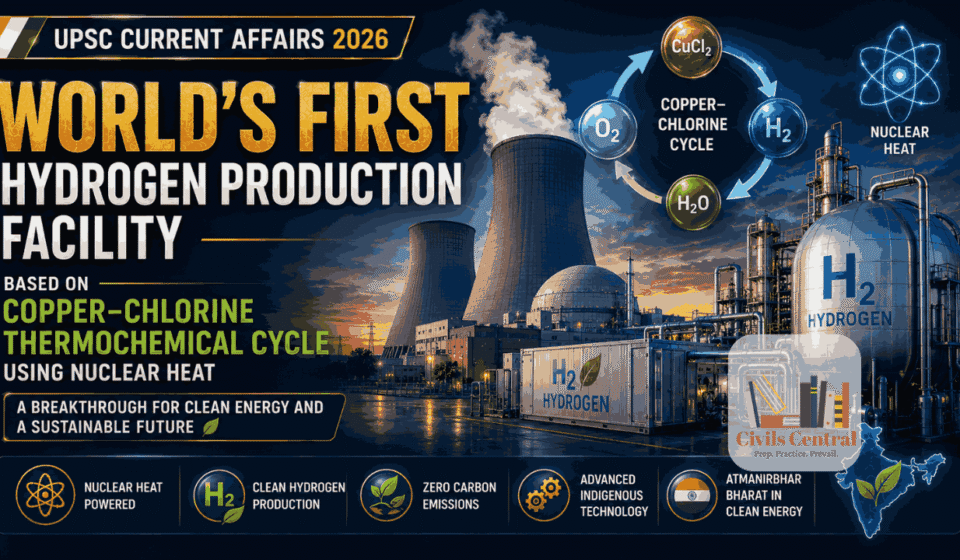
World’s First Hydrogen Production Facility Based on Copper–Chlorine Thermochemical Cycle Using Nuclear Heat

Introduction
India has taken a significant step toward realizing it with the inauguration of the world’s first hydrogen production facility based on the Copper–Chlorine (Cu–Cl) Thermochemical Cycle using nuclear heat from the Fast Breeder Test Reactor (FBTR).
Although the immediate news concerns the inauguration of a research facility, the underlying concepts extend far beyond hydrogen production. They encompass India’s three-stage nuclear programme, advanced nuclear reactor technology, the hydrogen economy, clean energy transition, climate change mitigation, energy security, and sustainable industrial development.
For UPSC aspirants, this topic integrates multiple dimensions of the syllabus:
- Nuclear energy
- Hydrogen economy
- Renewable and clean energy
- Climate change
- Advanced reactor technology
- India’s energy security
- Science & Technology
- Environment
- Industrial policy
Why in News?
The Department of Atomic Energy (DAE) inaugurated the world’s first hydrogen production facility based on the Copper–Chlorine (Cu–Cl) Thermochemical Cycle, utilizing nuclear heat from India’s Fast Breeder Test Reactor (FBTR).
The facility has been developed through collaboration between:
- Bhabha Atomic Research Centre (BARC), which developed the indigenous Copper–Chlorine hydrogen production technology.
- Indira Gandhi Centre for Atomic Research (IGCAR), Kalpakkam, where the facility has been established using the thermal energy available from the Fast Breeder Test Reactor.
This achievement is significant because it demonstrates that nuclear reactors can be employed not only for electricity generation but also for producing clean hydrogen, thereby expanding the scope of peaceful nuclear applications.
The project also reinforces India’s long-term commitment to:
- Clean energy transition
- Hydrogen economy
- Advanced nuclear technology
- Energy security
- Decarbonization of difficult-to-abate sectors
Unlike conventional hydrogen production methods that rely heavily on fossil fuels, this facility employs a thermochemical process powered by nuclear heat, substantially reducing greenhouse gas emissions. More importantly, it represents the successful translation of indigenous scientific research into practical technology, showcasing India’s growing capabilities in advanced reactor systems and non-electric applications of nuclear energy.
Why This Topic Matters for UPSC?
This single development spans multiple papers of the UPSC Civil Services Examination.
| Examination Component | Relevance |
|---|---|
| Prelims | Hydrogen economy, Nuclear reactors, Fast Breeder Reactor, Thermochemical Cycle, Green Hydrogen |
| GS Paper III | Science & Technology, Energy Security, Nuclear Technology, Climate Change |
| GS Paper II | Government policies on clean energy, National Green Hydrogen Mission |
| Essay | Sustainable Development, Energy Transition, Atmanirbhar Bharat, Innovation |
| Ethics (GS IV) | Intergenerational equity, Environmental stewardship, Scientific responsibility |
| Interview | India’s future energy mix, Hydrogen economy, Nuclear safety, Innovation ecosystem |
Why Is Hydrogen Becoming So Important?
To appreciate the significance of this development, we must first understand the global energy challenge. For over two centuries, humanity has relied primarily on fossil fuels such as coal, petroleum, and natural gas. These fuels have powered industries, transportation, electricity generation, and economic growth. However, they also release vast amounts of carbon dioxide (CO₂), contributing significantly to global warming and climate change.
Renewable energy sources like solar and wind have emerged as cleaner alternatives. Yet they face two major limitations:
- Intermittency – Solar panels generate electricity only during daylight hours, while wind turbines depend on wind availability.
- Limited suitability for certain sectors – Industries such as steel, cement, fertilizer production, shipping, aviation, and heavy transportation require continuous, high-energy fuels that electricity alone cannot efficiently provide.
This is where hydrogen assumes strategic importance. Hydrogen can serve as a clean energy carrier, storing and transporting energy generated from renewable or nuclear sources. When used in a fuel cell or combusted under controlled conditions, hydrogen produces water instead of carbon dioxide, making it an attractive option for decarbonizing sectors that are difficult to electrify.
Thus, hydrogen is increasingly viewed as a cornerstone of the global clean energy transition.
Evolution of the Hydrogen Economy
The concept of using hydrogen as a fuel is not new. Scientists have recognized hydrogen’s high energy content for decades. The challenge has always been producing it economically and sustainably.
Early Uses
Initially, hydrogen found applications in:
- Petroleum refining
- Fertilizer production (ammonia synthesis)
- Chemical industries
- Food processing
Most of this hydrogen was produced from natural gas through a process called Steam Methane Reforming (SMR), which emits substantial quantities of carbon dioxide. As concerns over climate change intensified, countries began searching for cleaner methods of hydrogen production.
Emergence of the Hydrogen Economy
The idea of a “Hydrogen Economy” gained momentum in the early 2000s. It envisions a future where hydrogen becomes a major energy carrier, similar to electricity today.
Under this vision:
- Renewable electricity powers electrolysers to produce hydrogen.
- Nuclear reactors provide heat and electricity for hydrogen production.
- Hydrogen fuels industries, transport, and power systems.
- Carbon emissions decline substantially.
Today, many developed economies—including Japan, South Korea, Germany, Australia, and the European Union—have adopted national hydrogen strategies. India joined this movement with the launch of the National Green Hydrogen Mission in 2023, aiming to become a global hub for the production, utilization, and export of green hydrogen.
What Is Hydrogen?
Hydrogen is the lightest, simplest, and most abundant element in the universe. Each hydrogen atom consists of:
- One proton
- One electron
- No neutron (in its most common form)
Despite being the most abundant element in the universe, hydrogen is rarely found in its pure molecular form (H₂) on Earth. Instead, it is chemically bonded with other elements. Common examples include:
- Water (H₂O)
- Methane (CH₄)
- Biomass
- Hydrocarbons
This means hydrogen is not a primary energy source like coal or sunlight. Rather, it is an energy carrier, similar to electricity.
Hydrogen as an Energy Carrier: How Does It Work?
The process can be visualized as follows:
Primary Energy Source
(Solar / Wind / Hydro / Nuclear)

            ↓

Electricity or High-Temperature Heat

            ↓

Hydrogen Production

            ↓

Storage

            ↓

Transportation

            ↓

Industrial Use / Fuel Cells / Transport / Power Generation

            ↓

Water + Useful Energy
Unlike electricity, which is difficult to store in large quantities for extended periods, hydrogen can be compressed, liquefied, or converted into derivatives such as ammonia, enabling long-term energy storage and global trade.
Understanding the “Colours” of Hydrogen
Hydrogen is often described using different colours, not because the gas itself has different colours—it is colourless—but to indicate the method of production and associated carbon emissions.
| Type | Production Method | Carbon Emissions | UPSC Relevance |
|---|---|---|---|
| Grey Hydrogen | Natural Gas (Steam Methane Reforming) | High | Most common today |
| Brown Hydrogen | Coal Gasification | Very High | Highly polluting |
| Blue Hydrogen | Fossil Fuels + Carbon Capture | Moderate | Transitional fuel |
| Green Hydrogen | Electrolysis using Renewable Energy | Near Zero | National Green Hydrogen Mission |
| Pink Hydrogen | Electrolysis using Nuclear Electricity | Near Zero | Emerging technology |
| Purple Hydrogen | Nuclear Energy-based Production | Near Zero | Alternative terminology |
| Turquoise Hydrogen | Methane Pyrolysis | Low | Produces solid carbon |
| White Hydrogen | Naturally occurring geological hydrogen | Minimal extraction emissions | Emerging research area |
The facility inaugurated by the Department of Atomic Energy represents a form of nuclear-assisted clean hydrogen production. Since it uses nuclear heat rather than fossil fuels, it belongs to the broader category of low-carbon or nuclear hydrogen, which complements green hydrogen in achieving net-zero goals.
Why Can’t We Simply Burn Hydrogen Found in Nature?
Question: If hydrogen is so abundant, why don’t we extract it directly?
Answer: Hydrogen on Earth is mostly bound within compounds such as water and hydrocarbons. Separating hydrogen from these compounds requires an input of energy.
This leads to a crucial scientific principle:
Hydrogen is not an energy source—it is an energy carrier.
The sustainability of hydrogen depends entirely on the source of the energy used to produce it.
- If coal is used, the hydrogen is carbon-intensive.
- If solar, wind, or nuclear energy is used, the hydrogen is low-carbon or carbon-free.
This distinction is fundamental for both the energy transition and UPSC examinations.
Nuclear Hydrogen Production – The Science Behind the Breakthrough
The inauguration of India’s Copper–Chlorine (Cu–Cl) Thermochemical Hydrogen Production Facility marks a paradigm shift in how nuclear energy can be utilized. Traditionally, nuclear reactors have been viewed solely as sources of electricity. However, modern reactor technologies are capable of supplying not only electricity but also high-temperature heat, which can drive industrial processes such as hydrogen production.
Why Do We Need New Methods of Producing Hydrogen?
Before understanding the Copper–Chlorine cycle, it is essential to appreciate why conventional hydrogen production methods are insufficient for a net-zero future. Currently, over 95% of the world’s hydrogen is produced from fossil fuels, primarily through Steam Methane Reforming (SMR) and coal gasification. While these methods are economically mature, they emit significant quantities of carbon dioxide.
The challenge, therefore, is to produce hydrogen without generating greenhouse gases. Scientists worldwide are exploring three major pathways:
- Renewable electricity-driven electrolysis (Green Hydrogen)
- Nuclear-assisted electrolysis
- Thermochemical water-splitting cycles using high-temperature heat
The Copper–Chlorine cycle belongs to the third category.
How Is Hydrogen Produced?
Water (H₂O)

        ↓

Energy Required to Break Water Molecules

        ↓

Three Possible Sources of Energy

────────────────────────────────────────────

Electricity (Electrolysis)

↓

Green Hydrogen

────────────────────────────────────────────

Electricity + Nuclear Energy

↓

Pink/Purple Hydrogen

────────────────────────────────────────────

High-Temperature Nuclear Heat

↓

Thermochemical Cycles

↓

Copper–Chlorine Cycle

↓

Hydrogen
Unlike electrolysis, thermochemical cycles require much less electrical energy because most of the energy comes directly as heat.
What is Thermochemical Hydrogen Production?
A thermochemical cycle is a sequence of chemical reactions that uses heat to split water into hydrogen and oxygen. Instead of passing electricity through water (as in electrolysis), thermochemical cycles use a combination of:
- Heat
- Chemical reactions
- Catalytic intermediates
At the end of the cycle, the chemicals are regenerated and reused. Only hydrogen and oxygen remain as final products.
Why Is Water Difficult to Split?
Water appears simple. Chemically it is: H₂O. However, oxygen and hydrogen atoms are connected through strong covalent bonds. Breaking these bonds requires substantial energy. Therefore, Hydrogen production is fundamentally an energy-conversion problem rather than a chemical availability problem.
The question scientists ask is:
What is the cleanest and most efficient source of energy for breaking water molecules?
The Copper–Chlorine cycle is one such answer.
What is the Copper–Chlorine (Cu–Cl) Thermochemical Cycle?
The Copper–Chlorine cycle is an advanced thermochemical process in which water is decomposed into hydrogen and oxygen through a sequence of chemical reactions involving copper and chlorine compounds.
Importantly,
- Copper is not consumed.
- Chlorine is not consumed.
- They continuously circulate within the process.
Hence the term cycle. The only net inputs are:
- Water
- Heat
- Small amount of electricity
The only useful output is:
- Hydrogen
Concept
Why is it called a “Cycle”?
The chemicals act like carriers. Just as blood transports oxygen throughout the human body without being consumed, copper and chlorine compounds facilitate reactions and are regenerated repeatedly. Therefore, No continuous supply of copper or chlorine is required after the system starts operating.
Why Is the Cu–Cl Cycle Considered Special?
Scientists have studied dozens of thermochemical cycles. Examples include:
- Sulfur–Iodine Cycle
- Hybrid Sulfur Cycle
- Zinc Oxide Cycle
- Iron-Chlorine Cycle
- Copper–Chlorine Cycle
Among them, the Copper–Chlorine cycle has attracted considerable attention because it operates at relatively lower temperatures.
| Parameter | Sulfur-Iodine Cycle | Copper-Chlorine Cycle |
|---|---|---|
| Operating Temperature | ~850°C | ~500°C |
| Heat Requirement | Very High | Moderate |
| Reactor Compatibility | Limited | Better suited to advanced reactors |
| Material Challenges | Severe | Comparatively manageable |
| Commercial Potential | High | High |
Lower operating temperatures mean:
- Reduced engineering complexity
- Lower material degradation
- Improved reactor compatibility
- Better operational safety
How Does the Copper–Chlorine Cycle Work?
Although the complete industrial process involves multiple reactions, the overall objective remains simple:
Input
- Water
- Heat from nuclear reactor
- Recyclable copper-chlorine compounds
↓
Several intermediate reactions
↓
Hydrogen released
↓
Copper compounds regenerated
↓
Cycle repeats
Copper–Chlorine Cycle
Water

↓

Reaction with Copper-Chlorine Compounds

↓

Heating Using Nuclear Heat

↓

Intermediate Chemical Reactions

↓

Hydrogen Gas Released

↓

Copper-Chlorine Chemicals Regenerated

↓

Reused Again

↓

Continuous Hydrogen Production
Why Is Nuclear Heat Used?
This is perhaps the most important conceptual question. A nuclear reactor produces enormous amounts of thermal energy. Traditionally, Most of this heat is converted into electricity through steam turbines. However, Not all heat is converted efficiently. Some remains available as high-grade thermal energy. Scientists realized: Instead of allowing this heat to go unused, it could directly drive industrial chemical processes such as:
- Hydrogen production
- Desalination
- Synthetic fuel production
- District heating
- Process heat for industries
Thus, Hydrogen production becomes an additional product of nuclear reactors.
Cogeneration
Meaning
Simultaneous production of electricity and another useful product from the same energy source.
Examples:
- Electricity + Hydrogen
- Electricity + Freshwater (Desalination)
- Electricity + Industrial Steam
Why Important?
It increases the overall efficiency of nuclear power plants by utilizing heat that would otherwise be wasted. Future nuclear reactors are expected to function as integrated energy parks, supplying multiple forms of clean energy.
Why Are Fast Reactors Particularly Suitable?
The Copper–Chlorine cycle requires high temperatures. Not all reactors provide sufficient temperatures efficiently. Fast reactors are particularly suitable because they operate at much higher temperatures than many conventional reactors. They therefore provide:
- Stable heat supply
- Continuous operation
- Reliable industrial-scale hydrogen production
- Better thermal efficiency
Understanding India’s Fast Breeder Test Reactor (FBTR)
The hydrogen production facility uses heat from the Fast Breeder Test Reactor (FBTR) located at Kalpakkam, Tamil Nadu. The FBTR occupies a special place in India’s nuclear programme. It is:
- India’s first fast breeder reactor.
- India’s only operational fast reactor research facility.
- A technology demonstrator for future breeder reactors.
The FBTR has been instrumental in validating India’s indigenous fast reactor technologies and now supports advanced applications such as nuclear-assisted hydrogen production.
Why Is It Called a Fast Reactor?
In most nuclear reactors, neutrons released during fission are slowed down using a moderator such as ordinary water or heavy water. Fast reactors operate differently. They use fast neutrons without slowing them down. This enables more efficient utilization of nuclear fuel and allows the breeding of additional fissile material.
Concept
Conventional Reactor

↓

Slow Neutrons

↓

Fission

↓

Electricity

────────────────────────────

Fast Breeder Reactor

↓

Fast Neutrons

↓

More Efficient Fuel Utilization

↓

Produces More Fissile Material

↓

Electricity + High Temperature Heat

↓

Hydrogen Production
Why Is It Called a “Breeder” Reactor?
Most reactors consume nuclear fuel. A breeder reactor goes a step further. It produces more fissile fuel than it consumes by converting fertile materials such as uranium-238 or thorium into fissile isotopes like plutonium-239 or uranium-233. This is particularly important for India because the country has:
- Limited uranium reserves.
- Vast thorium reserves.
Breeder reactors form the crucial second stage of India’s three-stage nuclear programme and improve long-term fuel sustainability.
FBTR at a Glance
| Feature | Details |
|---|---|
| Location | Kalpakkam, Tamil Nadu |
| Institution | Indira Gandhi Centre for Atomic Research (IGCAR) |
| Type | Sodium-cooled Fast Breeder Test Reactor |
| Purpose | Research, technology demonstration, fuel testing, advanced reactor development |
| Importance | Supports India’s Three-Stage Nuclear Programme and advanced non-electric applications such as hydrogen production |
Indira Gandhi Centre for Atomic Research (IGCAR)
IGCAR is India’s premier institution for advanced reactor research. Established at Kalpakkam, it specializes in:
- Fast breeder reactor technology
- Reactor materials
- Sodium cooling systems
- Nuclear fuel development
- Advanced reactor engineering
- Nuclear safety research
- Hydrogen production technologies using nuclear heat
Its work is essential for achieving India’s long-term objective of utilizing thorium as a major nuclear fuel.
Bhabha Atomic Research Centre (BARC): The Technology Developer
While IGCAR provides the reactor infrastructure and expertise in fast reactors, the Bhabha Atomic Research Centre (BARC) developed the indigenous Copper–Chlorine thermochemical hydrogen production technology. BARC is India’s leading multidisciplinary nuclear research institution, contributing to:
- Nuclear reactors
- Fuel cycle technologies
- Radiation applications
- Nuclear agriculture
- Healthcare technologies
- Hydrogen production research
- Advanced materials
The successful commissioning of this facility demonstrates effective collaboration between India’s two premier nuclear research institutions.
Roles of IGCAR and BARC
| Institution | Primary Role |
|---|---|
| BARC | Developed the indigenous Copper–Chlorine thermochemical hydrogen production technology |
| IGCAR | Integrated the technology with the Fast Breeder Test Reactor and demonstrated its practical application using nuclear heat |
This collaboration illustrates the transition from laboratory research to real-world deployment.
India’s Three-Stage Nuclear Programme and the Future of Nuclear Hydrogen
The inauguration of the world’s first Copper–Chlorine Thermochemical Hydrogen Production Facility is not merely a scientific achievement. It is a strategic milestone in India’s long-term nuclear vision. To fully appreciate its importance, one must understand why India chose fast breeder reactors, why thorium occupies a central place in India’s energy policy, and how hydrogen production aligns with the country’s clean energy transition.
Why Did India Adopt a Three-Stage Nuclear Programme?
Unlike countries such as the United States, Canada, or Australia, India possesses limited reserves of high-grade uranium, the conventional fuel used in nuclear reactors. However, India has one of the largest reserves of thorium (Th-232) in the world, particularly along the coastal sands of Kerala, Tamil Nadu, Andhra Pradesh, and Odisha.
This unique resource distribution posed a challenge:
How can India achieve long-term energy security despite limited uranium but abundant thorium?
To answer this question, Dr. Homi Jehangir Bhabha, the architect of India’s nuclear programme, proposed the Three-Stage Nuclear Power Programme in the 1950s. Its objective was to gradually transition from uranium-based reactors to thorium-based reactors, ensuring sustainable nuclear energy for centuries.
The inauguration of the hydrogen production facility using the Fast Breeder Test Reactor (FBTR) demonstrates that the technologies developed under this programme have applications beyond electricity generation.
India’s Three-Stage Nuclear Programme
Natural Uranium

↓

Stage I

Pressurized Heavy Water Reactors (PHWRs)

↓

Produces Electricity

+

Generates Plutonium-239

↓

Stage II

Fast Breeder Reactors (FBRs)

↓

Use Plutonium as Fuel

+

Convert Uranium-238 into More Plutonium

↓

Also Convert Thorium into Uranium-233

↓

Stage III

Advanced Thorium-Based Reactors

↓

Uranium-233 as Fuel

↓

Long-Term Sustainable Nuclear Energy

↓

Electricity + Hydrogen + Industrial Heat + Desalination
Stage I: Pressurized Heavy Water Reactors (PHWRs)
Objective
Generate electricity using natural uranium while producing plutonium for the next stage.
How Does It Work?
Natural uranium contains:
- Around 0.7% Uranium-235 (fissile)
- Around 99.3% Uranium-238 (fertile)
PHWRs use heavy water (D₂O) as both a moderator and coolant, allowing them to operate on natural uranium without requiring enrichment.
Why Is This Stage Important?
Besides electricity generation, PHWRs produce Plutonium-239, which becomes the fuel for Stage II. India is one of the few countries with extensive expertise in PHWR technology.
Stage II: Fast Breeder Reactors (FBRs)
This is the most strategically important stage for understanding the current hydrogen production facility.
Objective
- Utilize plutonium produced in Stage I.
- Breed more fissile material than is consumed.
- Prepare the pathway for thorium utilization.
Why Are They Called “Breeders”?
Unlike conventional reactors, breeder reactors generate additional fissile fuel during operation. This significantly enhances fuel efficiency and extends the usable life of nuclear resources.
Why Is FBTR Important?
The Fast Breeder Test Reactor (FBTR) serves as India’s experimental platform for:
- Testing fast reactor technologies.
- Developing advanced fuels.
- Improving reactor materials.
- Demonstrating non-electric applications such as hydrogen production.
It is therefore much more than a research reactor—it is the technological bridge between India’s present and future nuclear capabilities.
Stage III: Thorium-Based Nuclear Reactors
India possesses nearly 25% of the world’s thorium reserves but thorium cannot be directly used as reactor fuel. Thorium (Th-232) is a fertile material, not a fissile one. It must first absorb a neutron and undergo nuclear transformations to become Uranium-233 (U-233), which can sustain a nuclear chain reaction. The third stage aims to exploit this capability through advanced reactor designs such as the Advanced Heavy Water Reactor (AHWR).
Why Is This Stage Significant?
If successfully commercialized, thorium-based reactors could provide India with:
- Long-term energy security.
- Reduced dependence on imported uranium.
- Lower generation of long-lived radioactive waste.
- Greater sustainability.
Fissile vs Fertile Materials
| Term | Meaning | Example |
|---|---|---|
| Fissile Material | Can directly undergo nuclear fission with thermal neutrons | Uranium-235, Plutonium-239, Uranium-233 |
| Fertile Material | Cannot undergo fission directly but can be converted into fissile material | Uranium-238, Thorium-232 |
A common misconception is that thorium itself is a nuclear fuel. In reality, thorium is a fertile material that must first be converted into Uranium-233.
Where Does Hydrogen Fit into the Three-Stage Programme?
Earlier, the success of India’s nuclear programme was measured primarily by the amount of electricity generated. Today, the vision has expanded. Modern nuclear reactors are increasingly expected to support multiple sectors of the economy.
Traditional Role of Nuclear Reactors
- Electricity generation.
Emerging Role
- Hydrogen production.
- Industrial process heat.
- Desalination.
- Synthetic fuel production.
- District heating.
- Medical isotope production.
Thus, nuclear reactors are evolving into multi-purpose clean energy hubs. The Cu–Cl hydrogen facility exemplifies this transformation.
Nuclear Energy Beyond Electricity
Nuclear Reactor

↓

Produces Heat

↓

Electricity Generation

        +

High-Temperature Process Heat

↓

Hydrogen Production

↓

Clean Industrial Fuel

↓

Steel Industry

Fertilizer Industry

Oil Refineries

Heavy Transport

Shipping

Future Aviation Fuel
Why Is This Development Important for India’s Hydrogen Economy?
India has set ambitious targets to become a global producer and exporter of clean hydrogen. However, renewable energy alone may not always be sufficient due to intermittency. Nuclear-assisted hydrogen production offers several advantages:
- Continuous (24×7) operation.
- High capacity utilization.
- Reliable industrial-scale hydrogen supply.
- Low carbon emissions.
- Efficient use of existing nuclear infrastructure.
It complements rather than replaces renewable energy-based hydrogen production.
National Green Hydrogen Mission
Recognizing hydrogen’s strategic importance, the Government of India launched the National Green Hydrogen Mission in January 2023.
Vision
To establish India as a global hub for the production, utilization, and export of green hydrogen and its derivatives.
Key Objectives
- Promote domestic manufacturing of electrolysers.
- Reduce dependence on imported fossil fuels.
- Decarbonize hard-to-abate sectors such as steel, cement, refineries, fertilizers, shipping, and heavy mobility.
- Create employment and foster innovation.
- Position India as a major exporter of green hydrogen and green ammonia.
Why Is the Nuclear Hydrogen Facility Relevant?
Although the mission primarily emphasizes renewable energy-based green hydrogen, nuclear-assisted hydrogen production provides an additional low-carbon pathway that can ensure round-the-clock hydrogen availability and strengthen India’s clean hydrogen ecosystem.
Government Initiatives Supporting Hydrogen and Nuclear Energy
1. National Green Hydrogen Mission
Objective: Develop a comprehensive green hydrogen value chain.
Key Features:
- Production-linked incentives.
- Electrolyser manufacturing support.
- Demand creation.
- Pilot projects.
- Research and innovation.
2. National Green Hydrogen Standards
The Government has notified standards defining Green Hydrogen based on life-cycle greenhouse gas emissions.
Why Are Standards Necessary?
They ensure:
- Uniform certification.
- International acceptability.
- Carbon accounting.
- Export competitiveness.
3. National Hydrogen Energy Mission (Policy Vision)
This broader policy framework seeks to integrate hydrogen into:
- Transport.
- Industry.
- Power generation.
- Energy storage.
4. Expansion of Nuclear Energy
The Government continues to promote:
- Indigenous Pressurized Heavy Water Reactors.
- Fast Breeder Reactors.
- Small Modular Reactor (SMR) research.
- Private sector participation in selected nuclear supply-chain segments.
- International cooperation for advanced reactor technologies.
Constitutional Framework
Although the Constitution does not explicitly mention hydrogen or nuclear energy, several provisions are directly relevant.
| Constitutional Provision | Relevance |
|---|---|
| Article 21 | Right to life includes the right to a clean and healthy environment (as interpreted by the Supreme Court). |
| Article 48A | Directive Principle requiring the State to protect and improve the environment and safeguard forests and wildlife. |
| Article 51A(g) | Fundamental Duty of every citizen to protect and improve the natural environment. |
| Seventh Schedule – Union List (Entry 56) | Regulation and development of atomic energy fall within the exclusive legislative domain of Parliament. |
Legal and Institutional Framework
Department of Atomic Energy (DAE)
The apex governmental body responsible for India’s nuclear energy programme.
Functions
- Nuclear research.
- Reactor development.
- Fuel cycle management.
- Atomic energy applications.
- Strategic and civilian nuclear programmes.
Atomic Energy Commission (AEC)
Provides policy direction and oversight for India’s atomic energy programme.
Bhabha Atomic Research Centre (BARC)
India’s premier multidisciplinary nuclear research institution.
Role in the Current Development
- Developed the indigenous Copper–Chlorine thermochemical hydrogen production technology.
Indira Gandhi Centre for Atomic Research (IGCAR)
India’s leading institution for fast reactor research.
Role
- Established and integrated the hydrogen production facility with the Fast Breeder Test Reactor.
- Advances fast breeder reactor technologies, reactor materials, sodium cooling systems, and non-electric applications of nuclear energy.
Nuclear Power Corporation of India Limited (NPCIL)
Responsible for the construction and operation of commercial nuclear power plants in India.
International Perspective
Many countries are actively exploring nuclear-assisted hydrogen production.
| Country | Focus Area |
|---|---|
| Japan | Hydrogen economy and advanced nuclear reactors |
| France | Nuclear-powered hydrogen production |
| Canada | Small Modular Reactors for hydrogen generation |
| United States | High-temperature reactor research and nuclear hydrogen |
| South Korea | Hydrogen mobility integrated with nuclear energy |
Lessons for India
- Invest in high-temperature reactor technologies.
- Develop robust hydrogen infrastructure.
- Promote public-private partnerships.
- Establish global certification standards.
- Integrate hydrogen with industrial decarbonization strategies.
India’s Perspective: Why This Matters
The successful demonstration of nuclear-assisted hydrogen production can have far-reaching implications.
Energy Security
Reduces dependence on imported fossil fuels by diversifying clean energy sources.
Climate Commitments
Supports India’s goal of achieving net-zero emissions by 2070 and contributes to its Nationally Determined Contributions (NDCs).
Industrial Competitiveness
Provides low-carbon hydrogen for sectors such as steel, fertilizers, refineries, and chemicals, helping Indian industries remain competitive in a carbon-constrained global economy.
Technological Leadership
Positions India at the forefront of advanced nuclear and hydrogen technologies.
Strategic Autonomy
Strengthens indigenous research capabilities, reducing reliance on imported technologies and supporting the vision of Atmanirbhar Bharat.
Challenges in Scaling Nuclear-Assisted Hydrogen Production
While the inauguration of the world’s first Copper–Chlorine thermochemical hydrogen production facility is a landmark scientific achievement, transforming it into a commercially viable technology presents several challenges. Understanding these challenges is essential for UPSC because the examination often asks candidates to critically evaluate emerging technologies rather than merely describe them.
1. Technological Challenges
(a) Materials Degradation
The Copper–Chlorine cycle involves:
- High temperatures (~500°C)
- Corrosive chlorine compounds
- Continuous chemical reactions
Ordinary industrial materials cannot withstand such harsh operating conditions for extended periods. Therefore, specialized corrosion-resistant alloys and advanced ceramics are required, increasing capital costs. UPSC Insight: Materials science is often the limiting factor in advanced reactor technologies.
(b) Complex Multi-Step Chemical Process
Unlike electrolysis, which involves a single major reaction, the Cu–Cl cycle consists of multiple interconnected reactions. Challenges include:
- Maintaining reaction efficiency.
- Controlling intermediate products.
- Minimizing heat losses.
- Recycling copper and chlorine compounds effectively.
Even small inefficiencies can reduce overall hydrogen yield.
(c) Reactor Integration
The hydrogen production plant must be safely integrated with the nuclear reactor. Engineers must ensure:
- Thermal stability.
- Safe heat transfer.
- Isolation between radioactive and non-radioactive systems.
- Reliable emergency shutdown mechanisms.
This requires sophisticated engineering and regulatory oversight.
2. Economic Challenges
High Initial Investment
Establishing a nuclear-assisted hydrogen facility requires investments in:
- Nuclear infrastructure.
- Chemical processing units.
- Heat exchangers.
- Safety systems.
- Hydrogen storage and transport infrastructure.
Although operational costs may decline over time, the initial capital requirement remains substantial.
Cost Competitiveness
Currently, hydrogen produced from fossil fuels (Grey Hydrogen) is generally cheaper than low-carbon alternatives. For nuclear hydrogen to compete commercially, improvements are needed in:
- Reactor efficiency.
- Heat utilization.
- Scale of production.
- Manufacturing costs of specialized equipment.
Government support and carbon pricing mechanisms may play a role in bridging this gap.
3. Safety Challenges
Nuclear energy and hydrogen are both associated with unique safety considerations.
Nuclear Safety
Although India’s nuclear safety record is strong, public concerns regarding radiation and nuclear accidents persist. Maintaining stringent safety standards and transparent communication is essential.
Hydrogen Safety
Hydrogen:
- Is highly flammable.
- Has a wide ignition range.
- Burns with an almost invisible flame.
- Can leak easily due to its small molecular size.
Proper storage, transportation, and leak detection systems are therefore critical.
4. Infrastructure Challenges
Developing a hydrogen economy requires more than production facilities. India must also establish:
- Hydrogen pipelines.
- Storage terminals.
- Refueling stations.
- Port infrastructure for exports.
- Industrial hydrogen hubs.
Without adequate downstream infrastructure, production alone cannot create a viable hydrogen market.
5. Regulatory Challenges
The emergence of nuclear-assisted hydrogen production raises new regulatory questions:
- How should hydrogen produced using nuclear heat be classified?
- What safety standards should govern integrated nuclear-hydrogen facilities?
- How should lifecycle emissions be assessed?
- How can international certification be ensured for exports?
Developing a clear regulatory framework will be essential for commercialization.
6. Public Acceptance
Public perception remains an important factor. Concerns include:
- Nuclear safety.
- Radioactive waste.
- Environmental impacts.
- Hydrogen storage risks.
Building public trust through transparency, education, and effective communication is as important as technological advancement.
7. International Competition
Several countries, including Japan, France, Canada, the United States, and South Korea, are investing heavily in hydrogen technologies. India must compete in:
- Technology development.
- Cost reduction.
- Manufacturing capabilities.
- Global standards.
- Export markets.
Innovation and indigenous research will determine India’s long-term competitiveness.
Challenges
| Category | Key Issues | Possible Solutions |
|---|---|---|
| Technological | Corrosion, process complexity | Advanced materials, R&D |
| Economic | High capital costs | Government incentives, economies of scale |
| Safety | Nuclear and hydrogen risks | Robust regulations, advanced safety systems |
| Infrastructure | Storage and transport | Hydrogen hubs, pipelines, refueling stations |
| Regulatory | Lack of standards | Comprehensive policy framework |
| Social | Public perception | Awareness campaigns, transparency |
| Global | Competition | Innovation, indigenous technology development |
Way Forward
The successful demonstration of nuclear-assisted hydrogen production should be viewed as the beginning of a broader national strategy.
1. Accelerate Research and Development
India should continue investing in:
- Advanced thermochemical cycles.
- High-temperature reactors.
- Small Modular Reactors (SMRs).
- Advanced materials.
- Hydrogen storage technologies.
Collaboration between research institutions, academia, and industry should be strengthened.
2. Integrate Hydrogen into India’s Energy Planning
Hydrogen should not be treated as an isolated sector. It should be integrated with:
- Renewable energy.
- Nuclear power.
- Natural gas infrastructure.
- Industrial decarbonization.
- Urban transport planning.
A systems approach will maximize efficiency and resilience.
3. Promote Public-Private Partnerships
The commercialization of nuclear hydrogen will require participation from:
- Public sector research institutions.
- Private engineering firms.
- Energy companies.
- Equipment manufacturers.
- Financial institutions.
Such partnerships can accelerate technology transfer and reduce commercialization risks.
4. Develop Hydrogen Infrastructure
Priority areas include:
- Hydrogen pipelines.
- Storage facilities.
- Refueling stations.
- Port infrastructure.
- Export terminals.
Infrastructure development should proceed alongside production capacity expansion.
5. Strengthen International Cooperation
India should actively collaborate with:
- International Atomic Energy Agency (IAEA).
- International Partnership for Hydrogen and Fuel Cells in the Economy (IPHE).
- Mission Innovation initiatives.
- Bilateral partners working on advanced reactor technologies.
Such cooperation can facilitate technology exchange, standardization, and global market access.
6. Build Human Resource Capacity
The hydrogen economy will require professionals trained in:
- Nuclear engineering.
- Chemical engineering.
- Materials science.
- Hydrogen safety.
- Environmental management.
- Industrial operations.
Universities and technical institutions should introduce specialized programmes to build this workforce.
Essay Perspective
This topic can enrich essays on themes such as:
- Science and technology as instruments of national development.
- Sustainable development and energy security.
- Innovation for self-reliance.
- Climate change and clean energy transition.
- Balancing development with environmental protection.
- India’s journey towards net-zero emissions.
- Role of indigenous research in nation-building.
Use examples such as the Cu–Cl thermochemical facility, the National Green Hydrogen Mission, and India’s Three-Stage Nuclear Programme to strengthen essay arguments.
Practice MCQs
Q1. Which of the following best describes the Copper–Chlorine (Cu–Cl) thermochemical cycle?
(a) A method of producing hydrogen solely through electrolysis
(b) A thermochemical process that uses heat-driven chemical reactions to split water into hydrogen and oxygen
(c) A method of converting hydrogen into electricity using fuel cells
(d) A process for enriching uranium
Answer: (b)
Explanation: The Cu–Cl cycle is a thermochemical process that primarily uses high-temperature heat, along with a small amount of electricity, to split water into hydrogen and oxygen. It is distinct from electrolysis, fuel cells, or uranium enrichment.
Q2. Consider the following statements regarding the Fast Breeder Test Reactor (FBTR):
- It uses fast neutrons without a moderator.
- It is located at Kalpakkam.
- It forms part of India’s Three-Stage Nuclear Programme.
Which of the statements given above are correct?
(a) 1 and 2 only
(b) 2 and 3 only
(c) 1 and 3 only
(d) 1, 2 and 3
Answer: (d)
Explanation: The FBTR is a sodium-cooled fast breeder reactor at Kalpakkam. It uses fast neutrons and is central to the second stage of India’s nuclear programme.
Q3. Which institution developed the indigenous Copper–Chlorine thermochemical hydrogen production technology?
(a) NPCIL
(b) BARC
(c) IGCAR
(d) NITI Aayog
Answer: (b)
Explanation: BARC developed the indigenous Cu–Cl technology, while IGCAR integrated it with the FBTR.
Q4. Which of the following is not a direct advantage of nuclear-assisted hydrogen production?
(a) Continuous hydrogen production independent of sunlight or wind
(b) Utilization of high-temperature reactor heat
(c) Elimination of the need for any safety measures
(d) Low-carbon hydrogen production
Answer: (c)
Explanation: Nuclear and hydrogen systems require stringent safety measures. The other options are genuine advantages.
Q5. Thorium is classified as:
(a) A fissile material
(b) A fertile material that can be converted into Uranium-233
(c) A moderator used in nuclear reactors
(d) A coolant in fast breeder reactors
Answer: (b)
Explanation: Thorium-232 is fertile. It absorbs a neutron and is eventually converted into fissile Uranium-233.
UPSC Mains Practice Questions
10 Marks (150 Words)
Explain the significance of the Copper–Chlorine thermochemical cycle in advancing India’s clean hydrogen ecosystem.
15 Marks (250 Words)
Discuss how nuclear-assisted hydrogen production can contribute to India’s energy security and climate commitments. Highlight the opportunities and challenges associated with this technology.
Common Mistakes Aspirants Make
- Assuming hydrogen is an energy source rather than an energy carrier.
- Believing green hydrogen and nuclear-assisted hydrogen are identical pathways.
- Confusing fissile and fertile nuclear materials.
- Assuming fast breeder reactors exist only for electricity generation.
- Overlooking the role of high-temperature process heat in thermochemical hydrogen production.
Revision Table
| Topic | Key Point |
|---|---|
| Cu–Cl Cycle | Thermochemical water splitting using nuclear heat |
| FBTR | Fast Breeder Test Reactor at Kalpakkam |
| BARC | Developed indigenous Cu–Cl technology |
| IGCAR | Integrated technology with FBTR |
| National Green Hydrogen Mission | Policy framework for clean hydrogen |
Mind Map
World's First Nuclear Hydrogen Facility
│
├── Hydrogen Economy
│   ├── Energy Carrier
│   ├── Decarbonization
│   └── Hard-to-abate sectors
│
├── Cu–Cl Thermochemical Cycle
│   ├── Heat-driven process
│   ├── Copper & chlorine recycled
│   └── Lower operating temperature
│
├── Nuclear Heat
│   ├── FBTR
│   ├── Cogeneration
│   └── Industrial applications
│
├── Institutions
│   ├── DAE
│   ├── BARC
│   ├── IGCAR
│   └── NPCIL
│
└── Three-Stage Nuclear Programme
    ├── PHWR
    ├── Fast Breeder Reactor
    └── Thorium-based Reactors
Beyond the News
The inauguration of the world’s first Cu–Cl thermochemical hydrogen production facility signals a broader transformation in India’s energy strategy. It demonstrates that nuclear energy can evolve beyond electricity generation into a platform for producing clean fuels, supporting industrial decarbonization, and strengthening energy security. As India advances toward its net-zero commitments and seeks leadership in the global hydrogen economy, such indigenous innovations will be central to achieving technological self-reliance and sustainable development.
Also Read:
- National Green Hydrogen Mission Explained
- India’s Three-Stage Nuclear Programme
- Fast Breeder Reactors: Concept and Significance
- Nuclear Energy in India: Opportunities and Challenges
- Hydrogen Economy and India’s Net-Zero Strategy
- Small Modular Reactors (SMRs)
- India’s Energy Security: Challenges and Solutions
- Climate Change Mitigation Technologies
- India’s Nationally Determined Contributions (NDCs)
- Clean Energy Transition and Sustainable Development Goals
Conclusion
The world’s first Copper–Chlorine thermochemical hydrogen production facility is more than a technological milestone—it represents the convergence of advanced nuclear science, clean energy innovation, and strategic national planning. By harnessing nuclear heat for hydrogen production, India has demonstrated how its decades-long investment in indigenous reactor technology can contribute to the hydrogen economy, industrial decarbonization, and energy security. For UPSC aspirants, this topic exemplifies the interconnected nature of Science & Technology, Environment, Energy Policy, Governance, and International Commitments, making it a high-value area for both Prelims and Mains.
About The Author