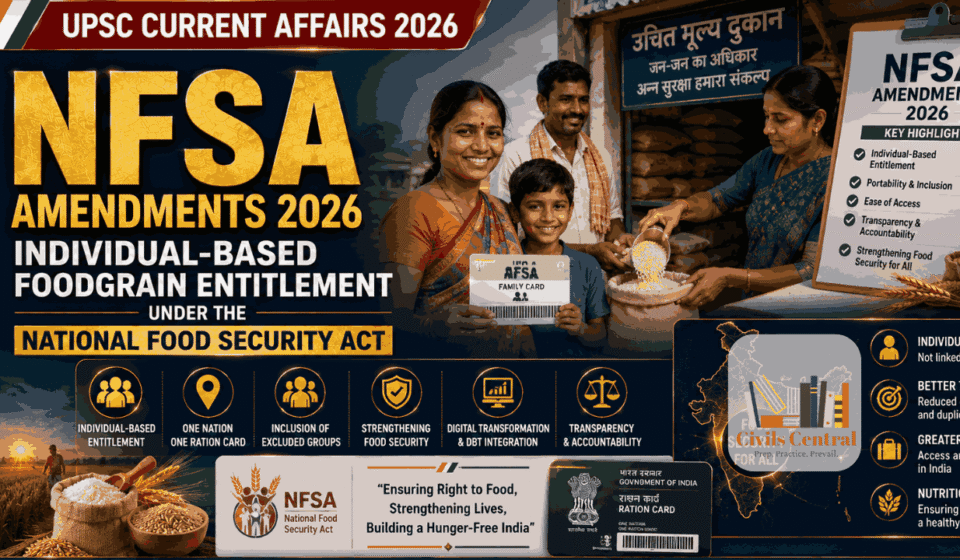
NFSA Amendments 2026: Individual-Based Foodgrain Entitlement under the National Food Security Act | UPSC Current Affairs

Introduction
Food security is one of the most important pillars of India’s welfare state. With nearly two-thirds of India’s population dependent on subsidised food grains under the National Food Security Act (NFSA), 2013, any amendment to the Act has far-reaching implications for governance, nutrition, public finance, federalism, and social justice.
The Union Government has recently released a draft amendment to the NFSA proposing a significant shift in the method of foodgrain allocation. Instead of allocating food grains based on the size of a household, the proposal seeks to provide 7 kg of food grains per eligible individual, subject to a maximum limit of 35 kg per household.
Although this appears to be a technical amendment, it raises important questions regarding equitable distribution, nutritional security, fiscal sustainability, Centre-State relations, and welfare targeting.
Why in News?
The Department of Food and Public Distribution has placed a draft amendment to the National Food Security Act, 2013 in the public domain for stakeholder consultation. The draft proposes replacing the current household-based allocation formula for Antyodaya Anna Yojana (AAY) beneficiaries with an individual-based entitlement.
Proposed Changes
| Existing Provision | Proposed Amendment |
|---|---|
| Household receives 35 kg irrespective of family size | Every eligible individual receives 7 kg |
| Small families receive higher per-capita allocation | Uniform entitlement for each person |
| Household-based approach | Individual-based approach |
| Maximum 35 kg for AAY household | Maximum remains 35 kg |
The proposal aims to improve equity in foodgrain distribution by ensuring that entitlement corresponds more closely to the number of eligible individuals in a household.
Understanding Food Security: The Static Foundation
Before understanding the amendment, it is essential to understand the broader concept of food security.
What is Food Security?
Food security exists when all people, at all times, have physical, social, and economic access to sufficient, safe, and nutritious food that meets their dietary needs for an active and healthy life. This widely accepted definition was developed by the Food and Agriculture Organization (FAO). Food security is not merely about producing enough food; it is about ensuring that people can consistently access adequate and nutritious food.
Four Pillars of Food Security
1. Availability
Availability refers to the presence of adequate food in a country.
It depends upon:
- Agricultural production
- Buffer stocks
- Food imports
- Supply chains
- Procurement by government agencies
Example: Even if India produces record wheat and rice, food security cannot be achieved unless the food reaches vulnerable populations.
2. Accessibility
Accessibility means people should have the ability to obtain food.
Accessibility has two dimensions:
- Physical access
- Markets should exist.
- Roads and transport should function.
- Economic access
- People should have sufficient purchasing power.
- Poor households require government support through subsidies.
This is where welfare schemes like NFSA become important.
3. Utilization
Food security is not achieved merely by consuming calories.
Food must also be:
- Nutritious
- Safe
- Hygienic
- Properly absorbed by the body
Therefore, nutrition, sanitation, drinking water, and healthcare are integral to food security.
4. Stability
Food should remain available throughout the year. Natural disasters, pandemics, wars, inflation, or climate change should not interrupt food access. India maintains buffer stocks precisely to ensure stability.
UPSC Concept Box
Food Security vs Nutritional Security
| Food Security | Nutritional Security |
|---|---|
| Focuses on sufficient food | Focuses on balanced nutrition |
| Mainly quantity | Quantity + quality |
| Prevents hunger | Prevents malnutrition |
| Cereals are sufficient | Requires proteins, vitamins, minerals and diversified diets |
UPSC Insight: India has largely improved food security but continues to face challenges in achieving nutritional security due to high levels of child stunting, wasting, and anaemia.
Evolution of Food Security in India
India’s food security framework evolved gradually through multiple policy interventions.
1960s: Green Revolution
The Green Revolution transformed India from a food-deficit nation into one of the world’s largest producers of wheat and rice.
Major features included:
- High-yielding varieties (HYV) of seeds
- Irrigation expansion
- Fertiliser use
- Mechanisation
- Minimum Support Price (MSP)
- Government procurement
The Green Revolution laid the foundation for India’s buffer stock policy and public distribution system.
Public Distribution System (PDS)
Initially introduced as a universal food distribution system, the PDS aimed to supply essential commodities at subsidised rates.
However, over time, challenges emerged:
- High subsidy burden
- Leakages and diversion
- Inclusion of non-poor households
- Exclusion of deserving beneficiaries
- Regional disparities
These issues led to reforms.
Targeted Public Distribution System (TPDS), 1997
To improve efficiency, India introduced the Targeted Public Distribution System (TPDS). Instead of providing subsidised food to everyone, TPDS classified households into different categories based on economic status.
The primary objectives were:
- Better targeting of subsidies
- Reduced fiscal burden
- Increased support for poor households
- Improved transparency
TPDS became the backbone of the National Food Security Act.
National Food Security Act (NFSA), 2013
The National Food Security Act transformed food assistance from a welfare programme into a legal entitlement. Instead of depending solely on government policy, eligible beneficiaries obtained a statutory right to receive subsidised food grains. The Act came into force in 2013 and covers approximately 67% of India’s population—up to 75% of the rural population and 50% of the urban population, based on the coverage specified under the Act. Its objective is to ensure access to affordable food while strengthening nutritional security, particularly for economically vulnerable households.
Objectives of NFSA
The Act seeks to:
- Ensure food and nutritional security.
- Reduce hunger and chronic undernutrition.
- Provide affordable food grains to eligible households.
- Protect vulnerable sections through legal entitlements.
- Improve transparency and accountability in food distribution.
Key Features of NFSA
The Act provides subsidised food grains through the Targeted Public Distribution System.
Eligible beneficiaries are broadly classified into:
- Priority Households (PHH)
- Antyodaya Anna Yojana (AAY) households
The Act also incorporates nutritional support for:
- Pregnant women
- Lactating mothers
- Children through ICDS and Mid-Day Meal (PM POSHAN) programmes
Food Grain Entitlements under NFSA
| Category | Existing Entitlement |
|---|---|
| Priority Households (PHH) | 5 kg per person per month |
| Antyodaya Anna Yojana (AAY) | 35 kg per household per month (current provision under the Act) |
The proposed amendment specifically concerns the AAY entitlement, seeking to move from a household-based allocation to an individual-based allocation with a cap of 35 kg per household.
Constitutional Basis of Food Security
Although the Right to Food is not expressly listed as a Fundamental Right, it has been derived through constitutional interpretation and Directive Principles of State Policy.
Article 21 – Right to Life
The Supreme Court has interpreted the Right to Life to include the right to live with dignity, which encompasses access to adequate food and nutrition.
Directive Principles of State Policy
- Article 39(b): Equitable distribution of material resources.
- Article 41: Public assistance in cases of need.
- Article 47: Duty of the State to raise the level of nutrition and improve public health.
Together, these provisions form the constitutional foundation of India’s food security framework.
Remember the progression:
Green Revolution → Public Distribution System → Targeted Public Distribution System (1997) → National Food Security Act (2013) → Draft NFSA Amendment (2026)
Detailed Analysis of the Proposed NFSA Amendment, 2026
The draft amendment to the National Food Security Act (NFSA), 2013 represents one of the most significant proposed reforms in India’s food security framework since the enactment of the Act. While the amendment appears limited to changing the method of foodgrain allocation under the Antyodaya Anna Yojana (AAY), it has wider implications for equity, targeting, public expenditure, Centre-State relations, and nutritional policy. Rather than merely changing the quantity of food grains, the proposal attempts to address the inherent inequities of a household-based entitlement system.
What Exactly Has Been Proposed?
The draft amendment proposes replacing the existing household-based entitlement under Section 3 of the NFSA with an individual-based entitlement.
Proposed Provision
Every eligible individual belonging to an Antyodaya household shall receive:
- 7 kg of food grains per month
- Subject to a maximum of 35 kg per household per month
The amendment also seeks to align foodgrain distribution more closely with the actual number of eligible beneficiaries within a household.
Existing vs Proposed System
| Feature | Existing NFSA Provision | Proposed Amendment |
|---|---|---|
| Unit of entitlement | Household | Individual |
| Quantity | 35 kg per household | 7 kg per eligible person |
| Maximum limit | 35 kg | 35 kg |
| Basis | Family size ignored | Family size considered |
| Objective | Household protection | Equity among beneficiaries |
Why Was This Amendment Considered Necessary?
To understand the rationale, one must first examine the shortcomings of the existing system.
Under the present law, every Antyodaya household receives 35 kg, irrespective of whether it has:
- One member
- Three members
- Five members
- Seven members
This creates substantial inequalities.
Illustration
| Household Size | Current Entitlement | Per Capita Allocation |
|---|---|---|
| 2 members | 35 kg | 17.5 kg/person |
| 3 members | 35 kg | 11.7 kg/person |
| 5 members | 35 kg | 7 kg/person |
| 7 members | 35 kg | 5 kg/person |
| 8 members | 35 kg | 4.4 kg/person |
Clearly, smaller households receive a much higher per-person allocation than larger households, despite both being equally poor. This violates the principle of horizontal equity, which requires that similarly placed individuals receive similar benefits.
Government’s Rationale Behind the Amendment
The Department of Food and Public Distribution has argued that the proposed amendment seeks to make foodgrain allocation more equitable and rational.
The key objectives include:
1. Improving Equity
The present household-based allocation often benefits smaller families disproportionately.
Under the proposed system:
- Every eligible individual is treated equally.
- Foodgrain entitlement reflects actual family size.
- Distribution becomes fairer.
2. Better Targeting of Welfare
The amendment shifts the focus from the household to the individual.
This is consistent with the broader trend in welfare governance, where beneficiaries are increasingly identified individually through:
- Aadhaar authentication
- Digital ration cards
- e-KYC
- National Food Security Portal
- Integrated beneficiary databases
3. Rationalisation of Subsidies
Food subsidy constitutes one of the largest components of India’s welfare expenditure.
A more rational allocation system could:
- Reduce distortions
- Improve efficiency
- Ensure benefits reach intended individuals
- Minimise over-allocation in smaller households
4. Better Nutritional Planning
Individual-based allocation allows policymakers to estimate:
- Per-capita cereal availability
- Nutritional gaps
- Population coverage
- State-wise demand
Such data are valuable for long-term food security planning.
Understanding Antyodaya Anna Yojana (AAY)
What is AAY?
The Antyodaya Anna Yojana (AAY) was launched in December 2000 to provide highly subsidised food grains to the poorest of the poor households. The term “Antyodaya” literally means “the rise of the last person”, reflecting the Gandhian philosophy later articulated by Pandit Deendayal Upadhyaya through the concept of Antyodaya.
AAY households include some of the most vulnerable sections of society, such as:
- Landless agricultural labourers
- Marginal farmers
- Rural artisans
- Destitute households
- Widows without support
- Elderly persons without regular income
- Persons with disabilities lacking adequate social support
- Particularly vulnerable tribal communities (as identified by States)
States identify eligible households based on guidelines issued by the Central Government.
Why Does AAY Receive Special Treatment?
Unlike Priority Households, AAY beneficiaries represent the poorest and most food-insecure segment of society.
Therefore, they historically received:
- Higher foodgrain entitlement
- Greater subsidy support
- Enhanced protection during economic distress
The proposed amendment retains this protection but modifies the method of allocation.
Household-Based vs Individual-Based Welfare
This amendment reflects a broader policy debate in welfare economics.
Household-Based Model
In this model:
- Benefits are assigned to the household.
- Internal distribution is assumed to be fair.
- Administrative costs are relatively low.
Advantages
- Simple implementation
- Easy record keeping
- Lower administrative burden
Limitations
- Ignores family size
- Creates unequal per-capita benefits
- Assumes equitable intra-household distribution
- May disadvantage women, children, and larger families
Individual-Based Model
Benefits are calculated separately for each eligible beneficiary.
Advantages
- Greater equity
- Better targeting
- Improved transparency
- Easier integration with digital identity systems
- Facilitates portability under One Nation One Ration Card (ONORC)
Challenges
- Requires accurate beneficiary databases
- Regular updating of births, deaths, and migrations
- Higher administrative complexity
UPSC Concept
Horizontal Equity vs Vertical Equity
| Horizontal Equity | Vertical Equity |
|---|---|
| Equal treatment of similarly placed individuals | Different treatment based on differing needs or capacities |
| Focuses on fairness among equals | Focuses on supporting the disadvantaged |
| Example: Equal foodgrain entitlement per eligible person | Example: Additional welfare for the poorest households |
UPSC Relevance: The proposed amendment primarily seeks to strengthen horizontal equity by reducing disparities arising solely from differences in household size.
Implications for Different Household Sizes
The proposed amendment affects households differently depending on the number of eligible members.
| Household Members | Existing Allocation | Proposed Allocation | Likely Impact |
|---|---|---|---|
| 1 | 35 kg | 7 kg | Significant reduction |
| 2 | 35 kg | 14 kg | Reduction |
| 3 | 35 kg | 21 kg | Reduction |
| 4 | 35 kg | 28 kg | Reduction |
| 5 | 35 kg | 35 kg | No change |
| 6 | 35 kg | 35 kg (cap) | No increase due to cap |
| 7 | 35 kg | 35 kg (cap) | No change |
This table illustrates why some States and civil society organisations have expressed concerns that smaller AAY households could receive substantially lower quantities than under the current system.
Potential Administrative Benefits
If implemented effectively, the amendment could improve governance through:
- Greater accuracy in beneficiary identification
- Better integration with Aadhaar-enabled PDS
- Improved transparency and auditability
- Reduced duplication and ghost beneficiaries
- Enhanced portability under One Nation One Ration Card
- More reliable beneficiary-level data for planning
Link with Digital Governance Reforms
The amendment complements several ongoing reforms in the public distribution system, including:
- One Nation One Ration Card (ONORC) for nationwide portability of ration benefits.
- Aadhaar-based authentication to reduce leakages.
- Electronic Point of Sale (ePoS) devices at Fair Price Shops.
- Digitisation of ration cards and beneficiary databases.
- Integrated Management of Public Distribution System (IM-PDS) for inter-state coordination.
- Supply Chain Management Systems (SCMS) to monitor procurement, storage, and distribution.
These initiatives aim to make food subsidy delivery more transparent, efficient, and portable.
Criticisms and Policy Debate Surrounding the Proposed NFSA Amendment
Every major welfare reform involves trade-offs. While the proposed NFSA amendment seeks to improve equity by moving towards an individual-based entitlement, several State governments, food rights activists, and policy experts have expressed concerns regarding its potential impact.
Understanding these debates is important because UPSC often frames questions that require balanced analysis rather than one-sided opinions.
Major Criticisms of the Amendment
1. Reduction in Foodgrain Allocation for Small Households
Under the current system:
- A two-member AAY household receives 35 kg every month.
Under the proposed amendment:
- The same household would receive 14 kg (7 × 2).
This represents a reduction of 21 kg per month, which critics argue could adversely affect vulnerable households such as:
- Elderly couples
- Widows living alone
- Persons with disabilities
- Single-member households
- Destitute individuals
Why is this important?
Many AAY households consist of elderly or socially vulnerable persons who may not have regular income sources. A reduction in foodgrain entitlement could increase food insecurity for these groups.
2. Household Consumption Does Not Always Equal Individual Consumption
The amendment assumes that food requirements increase proportionately with family size. However, household consumption patterns are more complex.
For example:
- Cooking fuel is shared.
- Food preparation is collective.
- Some food is stored.
- Wastage is lower in larger households.
Therefore, critics argue that simple per-capita allocation may not accurately reflect actual household needs.
3. Impact on Nutritional Security
Food security is increasingly being viewed through the lens of nutrition, rather than merely calorie availability. Reducing cereal allocation for certain households may:
- Increase dependence on market purchases.
- Reduce dietary adequacy among poor households.
- Affect vulnerable groups such as women and elderly persons.
Several nutrition experts argue that reforms should simultaneously expand access to:
- Pulses
- Millets
- Edible oils
- Fortified foods
rather than focusing only on cereals.
4. Concerns Raised by States
Some States have expressed apprehension that the amendment could reduce their overall foodgrain allocation.
Issues highlighted include:
- Larger administrative burden
- Frequent updating of beneficiary databases
- Potential reduction in allocations to households with fewer members
- Increased political sensitivity
States have also sought greater consultation before implementing any changes.
5. Administrative Challenges
Individual-based allocation requires highly accurate beneficiary records.
Challenges include:
- Births
- Deaths
- Migration
- Marriage
- Household division
- Duplicate records
Without regular updates, deserving beneficiaries may be excluded while ineligible persons continue receiving benefits.
Federalism Dimension
Food security in India operates through cooperative federalism.
Role of the Central Government
The Union Government is responsible for:
- Procurement of food grains
- Maintaining buffer stocks
- Allocation to States
- Subsidy payments
- Overall policy formulation
Role of State Governments
States undertake:
- Identification of beneficiaries
- Distribution through Fair Price Shops
- Monitoring
- Grievance redressal
- Last-mile delivery
Any amendment to the NFSA therefore requires effective Centre-State coordination.
Food Subsidy in India
The proposed amendment cannot be understood without examining India’s food subsidy system.
What is Food Subsidy?
Food subsidy is the financial assistance provided by the Government to make food grains available at prices lower than their economic cost.
The subsidy covers:
- Procurement
- Transportation
- Storage
- Distribution
- Difference between procurement cost and issue price
The Government bears this cost through the Union Budget.
Why Does India Provide Food Subsidy?
Food subsidy serves multiple objectives:
- Protect poor households
- Ensure minimum nutritional intake
- Stabilise food prices
- Support farmers through MSP procurement
- Maintain buffer stocks
- Prevent hunger during crises
Economic Cost vs Issue Price
One of the most important concepts for UPSC.
Economic Cost
Economic cost includes:
- MSP paid to farmers
- Procurement expenses
- Storage charges
- Transportation
- Distribution costs
Issue Price
Issue price refers to the price at which beneficiaries receive food grains under NFSA. Since the issue price is much lower than the economic cost, the difference is borne by the Government as food subsidy.
UPSC Concept
Economic Cost vs MSP
| MSP | Economic Cost |
|---|---|
| Price paid to farmers | Total cost incurred by Government |
| Procurement begins at MSP | Includes MSP + storage + transport + handling |
| Benefits farmers | Determines subsidy burden |
Remember: MSP is only one component of the economic cost.
Buffer Stock: Why It Matters?
India maintains one of the world’s largest public foodgrain stocks.
What is Buffer Stock?
A buffer stock is a reserve of food grains maintained by the Government to ensure:
- Food security
- Price stability
- Emergency relief
- Disaster response
- Welfare distribution
Objectives of Buffer Stocks
- Meet NFSA requirements.
- Supply food during droughts and floods.
- Stabilise market prices.
- Prevent shortages.
- Support procurement operations.
Buffer Stock Norms
The Government maintains minimum operational and strategic reserve norms for wheat and rice at different times of the year. These norms help ensure uninterrupted supply under the Public Distribution System and other welfare schemes.
Important Institutions Related to Food Security
Food Corporation of India (FCI)
The Food Corporation of India (FCI) is a statutory corporation established on 14 January 1965 under the Food Corporations Act, 1964. It functions under the Department of Food and Public Distribution (DFPD), which is part of the Ministry of Consumer Affairs, Food and Public Distribution. FCI was created to implement the Government of India’s food policy by ensuring effective procurement, storage, movement, and distribution of food grains across the country. Its establishment marked a significant step towards achieving self-sufficiency in food production and strengthening India’s food security framework, particularly in the aftermath of recurring food shortages during the 1950s and 1960s.
The primary function of FCI is the procurement of wheat and paddy (rice) from farmers at the Minimum Support Price (MSP) announced by the Government. This procurement system guarantees remunerative prices to farmers, protects them from distress sales, and encourages agricultural production. The procured grains form the Central Pool, which is used to meet the country’s food security requirements. FCI mainly procures wheat from states such as Punjab, Haryana, Madhya Pradesh, Uttar Pradesh, and Rajasthan, while major rice procurement takes place in Punjab, Telangana, Andhra Pradesh, Chhattisgarh, Odisha, and West Bengal. Through this procurement mechanism, FCI plays a vital role in ensuring income security for farmers while maintaining adequate food grain availability for the nation.
Another major responsibility of FCI is the scientific storage and transportation of food grains. It stores procured grains in its own warehouses, Cover and Plinth (CAP) storage facilities, and increasingly in modern steel silos to minimize post-harvest losses and preserve grain quality. FCI also hires storage capacity from organizations such as the Central Warehousing Corporation (CWC), State Warehousing Corporations (SWCs), and private agencies whenever required. The corporation operates one of the largest food grain logistics networks in the world, transporting grains primarily through railways and roadways from surplus-producing states to food-deficit regions, thereby ensuring an uninterrupted supply of food grains throughout the country.
FCI is also entrusted with the critical responsibility of buffer stock management, which involves maintaining reserve stocks of food grains to meet emergencies such as droughts, floods, crop failures, natural disasters, or sudden increases in demand. Buffer stocks help stabilize market prices, prevent food inflation, and ensure that sufficient food grains remain available even during periods of production shortfall. In addition to maintaining these strategic reserves, FCI undertakes quality control, monitors the condition of stored food grains through scientific inspection, modernizes storage infrastructure, and supports government interventions aimed at maintaining food price stability in the market.
One of the most important functions of FCI is the distribution of food grains to State Governments and Union Territories for implementation of the Public Distribution System (PDS) and other welfare schemes, including those under the National Food Security Act (NFSA), 2013. While FCI does not directly distribute food grains to beneficiaries, it ensures the timely allocation and transportation of food grains to states, which further distribute them through Fair Price Shops (FPS) to eligible households. Through its integrated responsibilities of procurement, storage, transportation, buffer stock management, and distribution, the Food Corporation of India remains the backbone of India’s food security architecture, supporting millions of farmers through assured procurement while ensuring affordable food for vulnerable sections of society and contributing to national food and nutritional security.
Commission for Agricultural Costs and Prices (CACP)
The Commission for Agricultural Costs and Prices (CACP) is an attached office of the Department of Agriculture and Farmers Welfare, functioning under the Ministry of Agriculture and Farmers Welfare. It was established in 1965 as the Agricultural Prices Commission (APC) and was renamed the Commission for Agricultural Costs and Prices (CACP) in 1985 to better reflect its broader mandate. The Commission is an advisory body, and its recommendations on agricultural pricing are not legally binding on the Government. Its primary objective is to recommend Minimum Support Prices (MSPs) for major agricultural crops, ensuring remunerative prices to farmers while balancing the interests of consumers and maintaining overall food price stability.
CACP recommends MSPs for 22 mandated crops and the Fair and Remunerative Price (FRP) for sugarcane. The mandated crops include 7 cereals (paddy, wheat, maize, barley, jowar, bajra, and ragi), 5 pulses (gram, tur, moong, urad, and lentil), 7 oilseeds (groundnut, rapeseed-mustard, soybean, sunflower seed, sesame, safflower, and nigerseed), and 3 commercial crops (copra, cotton, and raw jute). While CACP recommends MSPs for these crops, the Cabinet Committee on Economic Affairs (CCEA), chaired by the Prime Minister, takes the final decision on MSP announcements based on the Commission’s recommendations.
In formulating its recommendations, CACP considers several economic, agricultural, and social factors. These include the cost of cultivation, demand and supply conditions, changes in input prices, domestic and international market prices, inter-crop price parity, terms of trade between agriculture and non-agriculture, likely impact on consumers, and the overall implications for inflation and food security. Since the Union Budget 2018–19, the Government has followed the principle of fixing MSPs at at least 1.5 times the all-India weighted average cost of production (A2 + FL), with the objective of enhancing farmers’ income.
The recommendations of CACP play a crucial role in India’s agricultural economy by providing price assurance to farmers, encouraging higher agricultural production, promoting crop diversification, and supporting national food security. MSP recommendations also guide government procurement operations undertaken by agencies such as the Food Corporation of India (FCI) and state procurement agencies. Although the Commission performs an advisory role, its recommendations significantly influence agricultural policy, procurement strategies, market interventions, and the implementation of food security programmes, making CACP one of the key institutions in India’s agricultural price policy framework.
Central Warehousing Corporation (CWC)
The Central Warehousing Corporation (CWC) is a Navratna Central Public Sector Enterprise (CPSE) established in 1957 under the Warehousing Corporations Act, 1962 (originally incorporated under the Agricultural Produce (Development and Warehousing) Corporations Act, 1956). It functions under the Department of Food and Public Distribution, Ministry of Consumer Affairs, Food and Public Distribution. Headquartered in New Delhi, CWC serves as India’s premier warehousing agency, providing scientific storage and logistics services for agricultural produce and other notified commodities. Its establishment aimed to strengthen post-harvest infrastructure, reduce storage losses, and support the country’s food security system.
The primary function of CWC is to provide scientific storage facilities for agricultural produce, food grains, fertilizers, seeds, cotton, industrial raw materials, and other commodities. It owns and manages a nationwide network of warehouses, inland clearance depots (ICDs), container freight stations (CFSs), and custom-bonded warehouses. CWC also offers value-added services such as pest control, fumigation, quality inspection, collateral management, cargo handling, and logistics support. By adopting modern warehousing practices and quality management systems, the corporation helps minimize post-harvest losses and preserves the quality of stored commodities.
CWC plays a crucial role in India’s food grain management system by providing storage capacity to government agencies such as the Food Corporation of India (FCI), State Governments, procurement agencies, and other public sector organizations. It supports the procurement of food grains under the Minimum Support Price (MSP) mechanism and facilitates the maintenance of buffer stocks required for the Public Distribution System (PDS) and the National Food Security Act (NFSA), 2013. During periods of surplus production or emergencies, CWC’s warehousing infrastructure ensures the safe storage and efficient movement of food grains across the country.
Apart from warehousing, CWC contributes to agricultural marketing and rural development by enabling farmers to store their produce and access institutional credit through the Negotiable Warehouse Receipt (NWR) system. It is also actively modernizing its infrastructure through mechanization, digital inventory management, and the development of modern storage facilities to improve operational efficiency. By providing reliable storage, logistics, and supply chain services, the Central Warehousing Corporation plays a vital role in strengthening India’s food security architecture, reducing wastage, improving agricultural marketing, and supporting efficient distribution of essential commodities.
State Warehousing Corporations (SWCs)
State Warehousing Corporations (SWCs) are statutory warehousing organizations established under the Warehousing Corporations Act, 1962 to provide scientific storage and logistics facilities at the state level. They are jointly owned by the Central Warehousing Corporation (CWC) and the respective State Governments, with both generally holding an equal share in the equity. Each SWC operates within its respective state and functions under the overall policy framework of the Department of Food and Public Distribution, Ministry of Consumer Affairs, Food and Public Distribution, while also coordinating closely with the concerned State Government.
The primary objective of SWCs is to provide scientific storage facilities for agricultural produce, food grains, seeds, fertilizers, pesticides, agricultural implements, and other notified commodities. They own and manage warehouses across rural and urban areas, helping reduce post-harvest losses, preserve the quality of stored produce, and ensure efficient inventory management. In addition to storage, SWCs provide services such as fumigation, pest control, handling, transportation, and warehousing-based logistics to farmers, traders, cooperatives, and government agencies.
SWCs play a crucial role in India’s food security system by providing storage capacity to agencies such as the Food Corporation of India (FCI), State procurement agencies, and various government departments. They facilitate the storage of food grains procured under the Minimum Support Price (MSP) system and support the maintenance of buffer stocks required for the Public Distribution System (PDS) and the implementation of the National Food Security Act (NFSA), 2013. During emergencies such as droughts, floods, or other disruptions, SWCs help ensure the timely availability and movement of food grains within their respective states.
Apart from warehousing, SWCs promote agricultural marketing and improve farmers’ access to institutional credit through the Negotiable Warehouse Receipt (NWR) system, allowing farmers to store their produce and obtain loans against warehouse receipts instead of resorting to distress sales. By strengthening warehousing infrastructure, improving supply chain efficiency, and supporting procurement and distribution operations, State Warehousing Corporations constitute an important pillar of India’s agricultural marketing system and food security architecture.
National Cooperative Consumers’ Federation of India Ltd. (NCCF)
The National Cooperative Consumers’ Federation of India Ltd. (NCCF) is the apex cooperative organization for consumer cooperatives in India. It was established in 1965 and functions under the administrative control of the Department of Consumer Affairs, Ministry of Consumer Affairs, Food and Public Distribution. Registered under the Multi-State Cooperative Societies Act, 2002, NCCF serves as a national-level cooperative institution dedicated to protecting consumer interests, ensuring the availability of essential commodities, and promoting the cooperative movement across the country.
The primary objective of NCCF is to procure, distribute, and market essential commodities at reasonable prices while safeguarding consumers from price volatility and market distortions. It undertakes the procurement and distribution of food grains, pulses, onions, potatoes, edible oils, sugar, and other essential items on behalf of the Government whenever required. NCCF also implements various government interventions under the Price Stabilization Fund (PSF) by maintaining buffer stocks and conducting market interventions during periods of excessive price rise or supply shortages. Through these measures, it helps stabilize prices, curb hoarding and black marketing, and ensure the timely availability of essential goods to consumers.
NCCF plays a significant role in India’s food security and consumer protection framework by supporting government initiatives aimed at controlling inflation and ensuring equitable distribution of essential commodities. It works in close coordination with agencies such as the Food Corporation of India (FCI), National Agricultural Cooperative Marketing Federation of India (NAFED), State Governments, and cooperative societies for procurement, storage, transportation, and distribution operations. During periods of natural disasters, pandemics, or supply disruptions, NCCF assists the Government in maintaining uninterrupted supplies of essential commodities across different regions of the country.
Apart from market intervention, NCCF promotes the growth of consumer cooperatives by providing marketing support, capacity building, training, and institutional assistance to cooperative societies. It also undertakes import, export, e-commerce, and bulk procurement activities whenever required to improve supply chain efficiency and consumer welfare. By ensuring fair prices, strengthening cooperative institutions, and supporting government price stabilization measures, NCCF has emerged as an important institution in India’s consumer protection, agricultural marketing, and food security architecture.
National Agricultural Cooperative Marketing Federation of India (NAFED)
The National Agricultural Cooperative Marketing Federation of India Ltd. (NAFED) is the apex cooperative organization for the marketing of agricultural produce in India. It was established on 2 October 1958 and is registered under the Multi-State Cooperative Societies Act, 2002. NAFED functions under the administrative control of the Ministry of Agriculture and Farmers Welfare and plays a pivotal role in agricultural marketing, procurement, price support operations, and promoting cooperative marketing. Headquartered in New Delhi, it is one of the country’s largest cooperative institutions engaged in ensuring remunerative prices for farmers and strengthening agricultural value chains.
The primary objective of NAFED is to facilitate the marketing, procurement, storage, processing, and distribution of agricultural commodities while protecting farmers from price fluctuations and exploitation by intermediaries. It undertakes procurement of pulses, oilseeds, onions, and other notified crops under the Price Support Scheme (PSS), which forms part of the Pradhan Mantri Annadata Aay Sanrakshan Abhiyan (PM-AASHA). NAFED also acts as a nodal agency for implementing government procurement operations whenever market prices fall below the Minimum Support Price (MSP), thereby ensuring remunerative returns to farmers and encouraging agricultural production.
NAFED plays a crucial role in price stabilization by maintaining buffer stocks of essential agricultural commodities such as pulses and onions and conducting market intervention operations during periods of excessive price rise or supply shortages. It works closely with the Food Corporation of India (FCI), National Cooperative Consumers’ Federation of India (NCCF), State Governments, Farmer Producer Organizations (FPOs), and cooperative societies for procurement, storage, transportation, and distribution of agricultural produce. The federation also undertakes domestic trade, exports, imports, processing, warehousing, and value-addition activities to improve market efficiency and strengthen farmers’ access to national and international markets.
Apart from procurement and marketing, NAFED promotes the cooperative movement by providing technical assistance, market intelligence, capacity building, and institutional support to cooperative societies and farmers. It contributes significantly to the implementation of government initiatives aimed at enhancing farmers’ income, ensuring food security, and stabilizing agricultural markets. Through its integrated role in procurement, price support, buffer stock management, agricultural marketing, and market intervention, NAFED has emerged as one of the most important institutions in India’s agricultural marketing and food security architecture.
UPSC Prelims Facts
Major Functions: Agricultural marketing, procurement, MSP operations, price stabilization, exports, imports, storage, processing, and promotion of cooperative marketing.
Established: 2 October 1958
Type: Apex Multi-State Cooperative Society
Legal Status: Registered under the Multi-State Cooperative Societies Act, 2002
Administrative Ministry: Ministry of Agriculture and Farmers Welfare
Headquarters: New Delhi
Major Schemes: Price Support Scheme (PSS) under PM-AASHA, Market Intervention Operations, Buffer Stock Management (especially pulses and onions)
Sustainable Development Goals (SDGs)
The NFSA contributes directly to several SDGs:
| SDG | Relevance |
|---|---|
| SDG 1 – No Poverty | Reduces economic vulnerability through food support |
| SDG 2 – Zero Hunger | Ensures access to affordable food and addresses hunger |
| SDG 3 – Good Health and Well-being | Supports better nutrition and health outcomes |
| SDG 5 – Gender Equality | Women are often recognised as heads of ration card households, improving their role in food security |
| SDG 10 – Reduced Inequalities | Protects economically and socially disadvantaged populations |
International Perspective
Many countries implement food assistance through different models:
| Country | Model |
|---|---|
| United States | Supplemental Nutrition Assistance Program (SNAP) using electronic benefit cards |
| Brazil | Cash transfer programmes linked to food and nutrition security |
| China | Targeted poverty alleviation combined with grain reserves |
| India | In-kind foodgrain distribution through the Public Distribution System under NFSA |
India’s model is distinctive because it combines large-scale public procurement, buffer stocking, subsidised distribution, and legal entitlement under a single legislative framework.
Way Forward
The proposed amendment offers an opportunity to modernise India’s food security architecture. However, reforms must ensure that efficiency does not come at the cost of equity. Since the National Food Security Act is a rights-based legislation, any change should strengthen both food security and nutritional outcomes.
1. Adopt a Consultative Approach
Before finalising the amendment, the Union Government should undertake extensive consultations with:
- State Governments
- Food policy experts
- Nutrition specialists
- Civil society organisations
- Farmer organisations
- Parliamentary Standing Committees
Given that States implement the Public Distribution System (PDS), their concerns regarding allocation, logistics, and beneficiary identification deserve due consideration.
2. Protect Vulnerable Households
The shift to individual-based entitlement should not inadvertently reduce support for highly vulnerable households such as:
- Single elderly persons
- Widows
- Persons with disabilities
- Destitute individuals
- Tribal households living in remote areas
A possible approach could be introducing a minimum household entitlement in addition to the proposed per-person allocation.
3. Shift from Food Security to Nutritional Security
India has largely addressed chronic food shortages but continues to face significant nutritional challenges.
Future reforms should gradually diversify the food basket by increasing access to:
- Pulses
- Nutri-cereals (Millets/Shree Anna)
- Fortified rice
- Edible oils where necessary
This aligns with the objectives of:
- POSHAN Abhiyaan
- Anaemia Mukt Bharat
- Mission Poshan 2.0
- Sustainable Development Goal 2 (Zero Hunger)
4. Improve Beneficiary Databases
An individual-based system requires continuously updated databases.
Priority areas include:
- Birth registration
- Death registration
- Migration records
- Marriage-related household changes
- Aadhaar seeding with safeguards
- Regular social audits
Accurate databases reduce both inclusion errors and exclusion errors.
5. Strengthen Digital Public Distribution System
The Government should continue strengthening digital reforms such as:
- One Nation One Ration Card (ONORC)
- Aadhaar authentication with exception mechanisms
- Electronic Point of Sale (ePoS) devices
- GPS-based supply chain monitoring
- End-to-end computerisation of foodgrain movement
However, digital authentication should not deny benefits due to connectivity failures or biometric mismatches.
6. Reduce Post-Harvest Losses
Improving food security also requires reducing losses through:
- Modern warehouses
- Cold-chain infrastructure
- Scientific storage
- Better logistics
- Climate-resilient storage systems
This would reduce wastage and improve the efficiency of public expenditure.
7. Promote Crop Diversification
India’s procurement system remains heavily concentrated on wheat and rice.
Future reforms should encourage:
- Millets
- Pulses
- Oilseeds
- Climate-resilient crops
This would improve:
- Farmer incomes
- Nutritional diversity
- Water conservation
- Climate resilience
8. Strengthen Cooperative Federalism
Food security is a shared responsibility.
Regular Centre-State coordination should focus on:
- Updating beneficiary lists
- Improving portability
- Addressing implementation challenges
- Sharing best practices
- Monitoring grievance redressal mechanisms
UPSC Perspective
Prelims Focus Areas
Aspirants should be able to answer questions on:
Acts and Schemes
- National Food Security Act, 2013
- Antyodaya Anna Yojana (AAY)
- Targeted Public Distribution System (TPDS)
- One Nation One Ration Card (ONORC)
- POSHAN Abhiyaan
- PM POSHAN
Institutions
- Food Corporation of India (FCI)
- Commission for Agricultural Costs and Prices (CACP)
- Department of Food & Public Distribution
- NAFED
- Central Warehousing Corporation (CWC)
Constitutional Provisions
- Article 21
- Article 39(b)
- Article 41
- Article 47
Mains Perspective
GS Paper II
Topics
- Welfare Schemes
- Food Security
- Vulnerable Sections
- Governance
- Cooperative Federalism
GS Paper III
Topics
- Agriculture
- Public Distribution System
- Food Subsidy
- Buffer Stock Management
- Nutritional Security
- Inclusive Growth
Essay Themes
- Welfare State versus Fiscal Prudence
- Food Security in the Age of Climate Change
- Technology and Inclusive Governance
- Rights-Based Welfare Programmes
- Nutrition as Human Capital
PYQ Connection
UPSC Prelims 2020
With reference to the provisions contained in Part IV of the Constitution, which of the following is/are the Directive Principles of State Policy?
UPSC Mains (GS III)
“What are the major challenges of the Public Distribution System in India? Suggest reforms.”
Practice MCQs
MCQ 1
Which of the following is the primary objective of the proposed amendment to the National Food Security Act?
A. Increase procurement of wheat
B. Shift foodgrain entitlement from household-based allocation to individual-based allocation
C. Increase MSP
D. Reduce buffer stock norms
Answer
✅ B
Explanation
The draft amendment proposes an individual-based entitlement of 7 kg per eligible person, subject to a maximum of 35 kg per household.
MCQ 2
Which organisation is primarily responsible for procurement and buffer stock management in India?
A. NABARD
B. FCI
C. NAFED
D. APEDA
Answer
✅ B
Explanation
The Food Corporation of India procures, stores, and distributes food grains for the Public Distribution System.
MCQ 3
Which Article of the Constitution is most closely associated with the judicial recognition of the Right to Food?
A. Article 14
B. Article 19
C. Article 21
D. Article 32
Answer
✅ C
MCQ 4
The Commission for Agricultural Costs and Prices (CACP) primarily:
A. Procures food grains
B. Determines buffer stock
C. Recommends Minimum Support Prices
D. Operates Fair Price Shops
Answer
✅ C
MCQ 5
Food subsidy refers to:
A. MSP paid to farmers
B. Difference between economic cost and issue price borne by the Government
C. Storage charges only
D. Export subsidy
Answer
✅ B
MCQ 6
Which one of the following best distinguishes food security from nutritional security?
A. Food security concerns quantity, while nutritional security includes both quantity and quality.
B. Nutritional security concerns only cereals.
C. Food security concerns only availability.
D. Both are identical concepts.
Answer
✅ A
MCQ 7
One Nation One Ration Card primarily aims to:
A. Increase MSP
B. Enable nationwide portability of ration benefits
C. Replace Fair Price Shops
D. Procure food grains
Answer
✅ B
MCQ 8
Which of the following is a Directive Principle directly related to nutrition?
A. Article 32
B. Article 47
C. Article 356
D. Article 370
Answer
✅ B
UPSC Mains Practice Question
GS Paper II / GS Paper III (15 Marks)
The proposed amendments to the National Food Security Act seek to improve equity in foodgrain distribution. Critically examine the likely benefits and challenges of shifting from a household-based to an individual-based entitlement system. Suggest measures to ensure that reforms strengthen both food security and nutritional security.
Quick Revision
| Topic | Key Points |
|---|---|
| Act | National Food Security Act, 2013 |
| Current Issue | Draft amendment proposing 7 kg per eligible individual, subject to a maximum of 35 kg per household |
| Coverage under NFSA | Up to 75% rural and 50% urban population |
| Priority Household (PHH) | 5 kg per person per month |
| Antyodaya Anna Yojana (AAY) | Existing 35 kg per household; proposed individual-based allocation with 35 kg cap |
| Implementing Ministry | Ministry of Consumer Affairs, Food & Public Distribution |
| Procurement Agency | Food Corporation of India (FCI) |
| MSP Recommendation | Commission for Agricultural Costs and Prices (CACP) |
| Constitutional Basis | Articles 21, 39(b), 41, 47 |
| Major Reform | Shift from household-based to individual-based entitlement |
Common Mistakes Aspirants Make
| Incorrect Understanding | Correct Understanding |
|---|---|
| NFSA provides free food to all citizens | It covers eligible beneficiaries notified under the Act. |
| Food Security means nutrition | Food security and nutritional security are related but distinct concepts. |
| FCI fixes MSP | FCI procures food grains; MSP is recommended by CACP and approved by the Government. |
| MSP and Food Subsidy are the same | MSP supports farmers; food subsidy supports consumers. |
| Buffer stock is only for emergencies | It also stabilises prices and ensures continuous PDS supply. |
| NFSA amendment changes PHH entitlement | The current draft primarily concerns the AAY entitlement framework. |
Beyond the News
The proposed NFSA amendment reflects a broader transformation in India’s welfare architecture—from universal, household-centric schemes towards digitally enabled, individual-centric service delivery. It illustrates the growing emphasis on data-driven governance, portability of benefits, and rationalisation of public expenditure.
However, food security cannot be viewed solely through the lens of administrative efficiency. As India aspires to become a developed nation by 2047, the focus must evolve from ensuring calorie sufficiency to achieving comprehensive nutritional security. This requires integrating food distribution with health, sanitation, agriculture, social protection, and women’s empowerment.
For policymakers and administrators, the challenge is to strike a balance between equity, efficiency, fiscal sustainability, and the constitutional commitment to protecting vulnerable populations.
Also Read:
- Public Distribution System (PDS): Structure, Challenges and Reforms
- Minimum Support Price (MSP): Evolution, Issues and Way Forward
- One Nation One Ration Card (ONORC): Benefits and Challenges
- POSHAN Abhiyaan and India’s Nutrition Mission
- Food Corporation of India (FCI): Role in India’s Food Security
About The Author