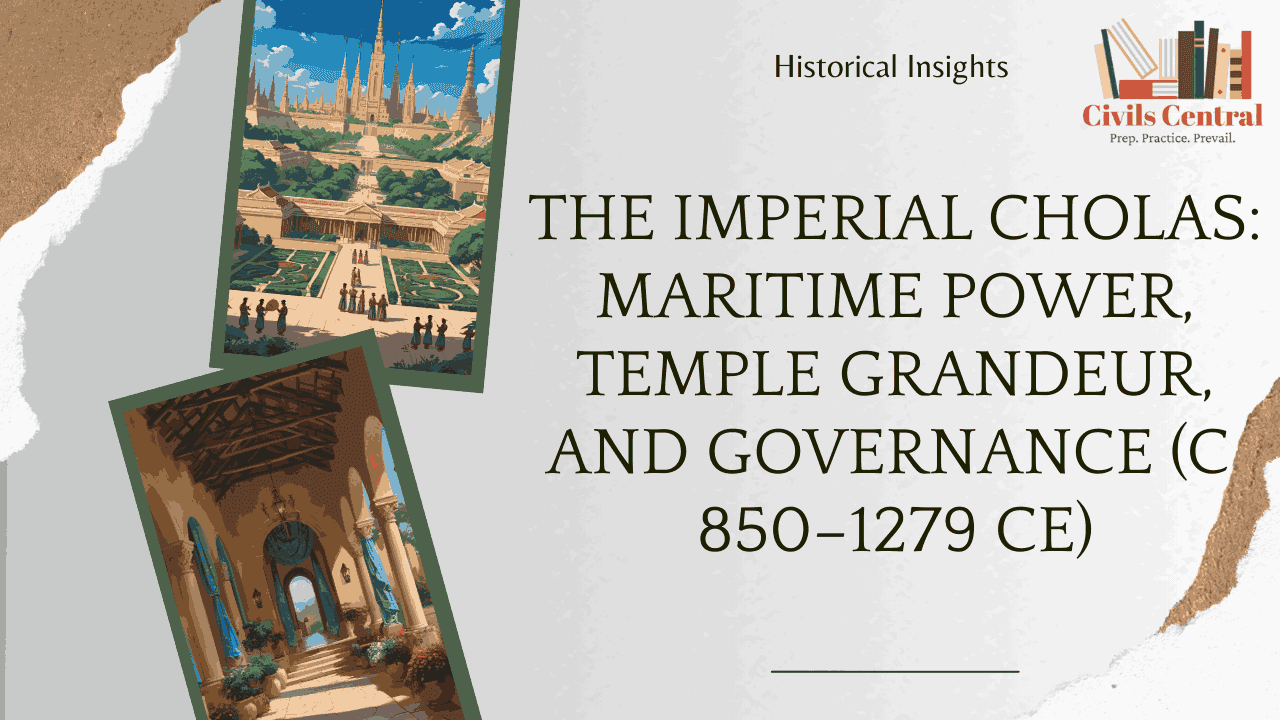
The Imperial Cholas: Maritime Power, Temple Grandeur, and Governance (c. 850–1279 CE)

🔗 Introduction: From Northern Rivalries to Southern Supremacy
While Northern India was entangled in the Tripartite Struggle between the Palas, Pratiharas, and Rashtrakutas, the southern peninsula saw the quiet yet steady rise of a new power — the Imperial Cholas. Under visionary leaders like Vijayalaya, Rajaraja I, and Rajendra I, the Cholas expanded their dominion, mastered maritime trade, and pioneered local self-governance. Their temples became not only centers of worship but also economic and administrative hubs — marking a golden era in South Indian history.
📜 Rise of the Imperial Cholas
- Vijayalaya Chola (c. 850 CE) laid the foundation by capturing Tanjavur from the Muttaraiyars, a local feudatory under the declining Pallavas. His rise marked the revival of Chola power after centuries of obscurity following the Sangam Age.
- He took the title of Narkesari.
- He consolidated the core Chola territory along the Kaveri delta and initiated temple building as a political and religious statement.
- He successfully defeated the Pallavas and checked the influence of the Pandyas, establishing Chola dominance in the Tamil region.
- His successors like Aditya I and Parantaka I carried forward this legacy by defeating Pallava remnants and Rashtrakuta allies, thus laying the groundwork for future imperial expansion.
- Aditya Chola I, defeated the Pallava king Aparajit captured Tondamandalam, and took the title of Maduraikonda. He built a shiva temple at Tanjore.
✅ Internal Link Suggestion:
*Link to related post: *Early Pallavas and the Sangam Age
👑 The Zenith: Rajaraja Chola I and Rajendra Chola I
🗅 Rajaraja I (985–1014 CE)
- Expanded Chola territory into Sri Lanka, Malabar, and parts of Karnataka, asserting Chola dominance over the entire southern peninsula. These military campaigns helped Rajaraja I consolidate internal stability and establish strong administrative control over conquered regions.
- Suppressed revolts in Kerala and reasserted authority over the Chera territories, securing the western coastline.
- Commissioned the grand Brihadeshwara Temple in Thanjavur (UNESCO World Heritage Site), a monumental example of Dravidian architecture and a symbol of imperial power and devotion to Lord Shiva.
- The temple served not only as a place of worship but also as a center for economic and social activities, housing detailed inscriptions about land grants, taxation, and governance.
- He reorganized the revenue system and made meticulous records of land surveys and tax assessments, a legacy that later empires adopted.
- Rajaraja also strengthened the administrative apparatus by appointing trusted military commanders to govern newly annexed regions, integrating diverse communities into the Chola polity.
📢 Rajendra I (1014–1044 CE)
- Undertook successful naval expeditions to Srivijaya (modern-day Indonesia) and the Ganges delta, marking a high point of Indian maritime ambition and assertion of power in Southeast Asia. These campaigns were not only military but also diplomatic in nature, aiming to control trade routes and assert Chola supremacy in the region.
- The Ganges expedition commemorated Rajendra’s northern campaign, symbolizing his pan-Indian authority. In recognition of this achievement, he adopted the title ‘Gangaikonda Chola’, or ‘the Chola who brought the Ganges.’
- To celebrate this conquest, he founded the new capital Gangaikonda Cholapuram, which was modeled on Thanjavur and featured a grand temple, royal palace, and a vast water tank symbolically linked to the Ganges.
- Rajendra also built upon his father’s administrative reforms, strengthening provincial governance and furthering the Chola naval capabilities by expanding dockyards and building ocean-going vessels.
- His reign also saw the dispatch of diplomatic missions to China and other countries, showcasing the Chola empire’s participation in global diplomacy.
🏧 Chola Administration: A Model of Efficiency
- Mandalams (provinces), Valanadus, and Nadus formed the administrative units.
- Local bodies like Sabhas (Brahmin villages) and Urs (non-Brahmin villages) enjoyed autonomy.
- Kudavolai System: A ballot-based method to elect local representatives — an early form of democratic governance.
- The Chola kings ensured meticulous documentation of land, taxes, and village council decisions in stone and copper-plate inscriptions.
- Revenue collection was efficient, with taxes imposed on agriculture, trade, craftsmen, and even festivals.
- Temples acted as financial institutions and landowners, often leasing land to cultivators and maintaining accounts of revenue and expenditure.
📎 Did You Know?
Many of these administrative details are preserved in temple inscriptions, especially in the Uttaramerur inscriptions.
🔕 Temple Architecture and Cultural Flourishing
- Cholas elevated the Dravidian architectural style:
- Brihadeshwara Temple, Airavatesvara Temple, and Gangaikondacholapuram Temple.
- Patronage to Tamil Bhakti poets, Shaivism, and Vaishnavism.
- Mastery in bronze sculpture — the iconic Nataraja statue is a prime example.
- The temples served not just religious purposes, but were hubs of learning, cultural performances, and administrative coordination.
- Detailed murals and inscriptions inside temples provide insights into society, economy, festivals, and governance.
- These temples attracted artisans, dancers, musicians, and scholars, making Chola cities vibrant cultural centers.
✅ Internal Link Suggestion:
*Link to: *Temple Architecture in South India – Comparative Analysis
🌊 Trade, Navy, and Maritime Ambitions
- Developed a strong navy to secure maritime trade routes, which was instrumental in projecting power across the Bay of Bengal and ensuring the security of commercial interests.
- Trade relations with Srivijaya, China, and the Middle East facilitated the exchange of textiles, spices, ivory, pearls, and horses, making the Chola economy one of the most prosperous in Asia at the time.
- Rajendra’s expedition to Southeast Asia was a calculated display of naval superiority, aimed at safeguarding Indian merchant vessels and expanding tributary networks.
- The Cholas actively participated in the Indian Ocean trade network, leveraging monsoon winds to connect ports from East Africa to Southeast Asia.
- Ports like Nagapattinam, Poompuhar, and Kaveripattinam became major hubs for maritime commerce, complete with warehouses, customs houses, and settlements of foreign traders.
- The empire welcomed merchants and diplomats from Arabia, Southeast Asia, and China, even sending missions to the Song dynasty court, which praised Chola rule for its prosperity and order.
- Inscriptions and accounts by foreign travelers like Chinese envoy Chau Ju-Kua confirm the high regard for Chola maritime capability and trade ethics.
📉 Decline of the Cholas
- Successors grew weak, and local chieftains gained power, leading to the fragmentation of centralized authority. The once-efficient administrative machinery gradually eroded as feudatories asserted independence.
- Repeated invasions by Hoysalas, Kalachuris, and resurgent Pandyas further weakened the empire. The decisive defeat by the Pandya ruler Jatavarman Sundara Pandya I marked a significant blow.
- By the late 13th century, the Chola power faded from the political scene, reduced to minor feudatories in their former strongholds.
- Additionally, changes in trade routes that shifted economic power toward the western coast and the rising dominance of Delhi Sultanate in the north contributed to their decline. Internal strife, loss of control over overseas trade, and a failure to adapt to changing geopolitical dynamics sealed the fate of the Chola Empire.
🏧 Legacy and Relevance
- The Cholas’ model of local governance remains a reference in Indian administrative history, particularly their grassroots election systems, land survey mechanisms, and autonomous village councils, which prefigured modern decentralization.
- Their temples continue to be architectural marvels and religious landmarks, representing the zenith of Dravidian temple design and serving as repositories of historical records, art, and sacred traditions.
- Cultural influence persists in Tamil Nadu, Sri Lanka, and parts of Southeast Asia, evident in language, temple styles, and even royal customs still traced to Chola diplomatic exchanges.
- The Chola period is remembered as a golden age of Tamil culture, inspiring developments in classical Tamil literature, devotional poetry (Bhakti), performing arts, and codified temple rituals — many of which are practiced to this day.
📸 Visual Tip: Embed images of:
- Brihadeshwara Temple
- Chola bronze sculpture (Nataraja)
- Map of Chola Empire & naval expeditions
🎯 Prelims Pointers
- 🔹 Brihadeshwara Temple → Built by Rajaraja I, it is a UNESCO World Heritage Site and a marvel of Dravidian architecture.
- 🔹 Gangaikonda Cholapuram → New capital established by Rajendra I to commemorate his northern conquests.
- 🔹 Srivijaya naval expedition → Launched by Rajendra I, showcasing Chola naval strength and diplomatic influence in Southeast Asia.
- 🔹 Kudavolai System → A ballot-based village election system used to choose administrative functionaries, especially in Brahmadeya villages.
📝 Mains Angle (GS I)
Q. Examine the administrative and cultural contributions of the Chola Empire. Highlight the roles played by village assemblies, temple architecture, and literary patronage in consolidating the Chola state.
Q. Discuss the significance of Chola naval expeditions in the context of Indian Ocean diplomacy and trade. How did these expeditions shape India’s influence in Southeast Asia and enhance its maritime economy?
❓ MCQs for SSC/JKSSB/EPFO
1. Who led the Chola naval expedition to Southeast Asia?
a) Rajaraja I
b) Rajendra I ✅ — He expanded Chola influence into Southeast Asia, including the Srivijaya kingdom.
c) Aditya I
d) Kulottunga I
2. What is the Kudavolai system related to?
a) Revenue collection
b) Temple rituals
c) Village administration ✅ — A ballot-based system of electing representatives, mainly in Brahmadeya villages.
d) Warfare techniques
3. Which Chola ruler built the Brihadeshwara Temple?
a) Rajaraja I ✅ — It remains one of the finest examples of Dravidian temple architecture.
b) Rajendra I
c) Kulottunga I
d) Vijayalaya
4. The title ‘Gangaikonda Chola’ was assumed by:
a) Rajaraja I
b) Aditya I
c) Rajendra I ✅ — After his successful northern expedition to the Ganges.
d) Parantaka I
🔚 Conclusion
The Imperial Cholas were not just rulers of land, but also masters of the sea, patrons of art, and pioneers of local governance. Their navy projected Indian influence into Southeast Asia, while their temples stood as beacons of both devotion and statecraft. The Cholas’ efficient administration, temple-centered economy, and patronage of Tamil literature contributed to a civilizational model that continues to inspire. Their legacy is deeply embedded in India’s cultural and administrative fabric. Understanding the Cholas gives us a lens into the potential of regional powers in shaping not only Indian but also Asian history, diplomacy, and cultural exchanges.
About The Author