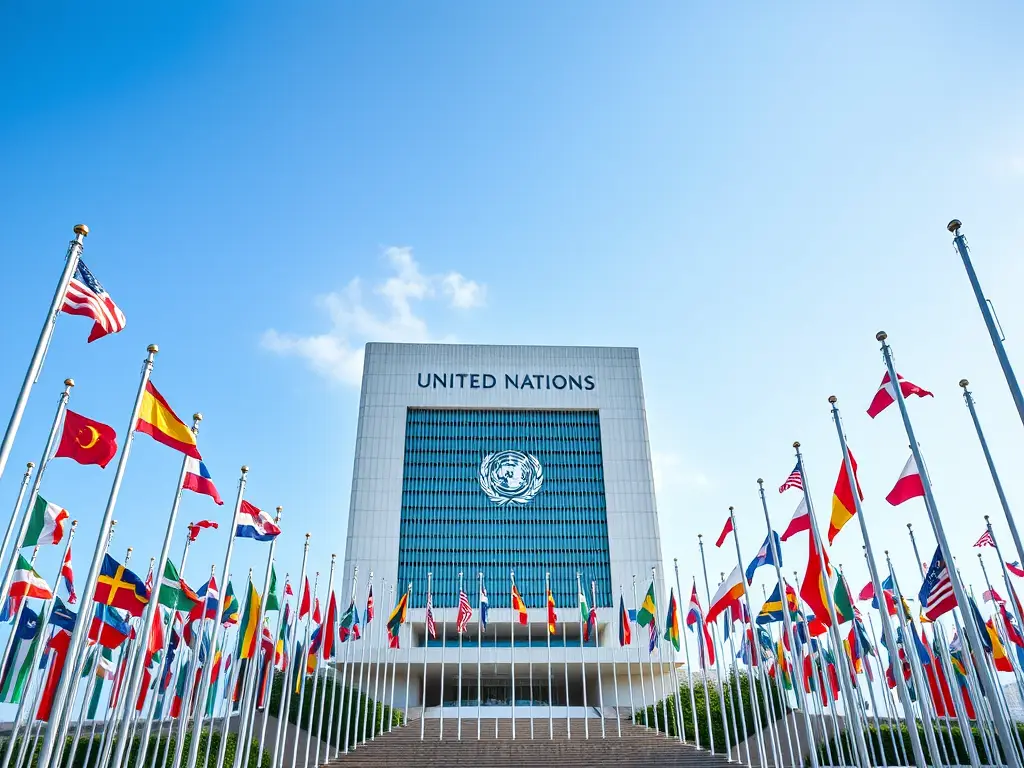

In this blog, we will explore all facets of the United Nations that are crucial for UPSC preparation and various other government examinations. Our discussion will be organized in the next structure:
The United Nations (UN) is the world’s largest and most influential international organization, formed to promote peace, cooperation, and development across the globe. Established in 1945, the UN currently has 193 member states. It plays a crucial role in tackling pressing global challenges. These challenges include armed conflicts, climate change, poverty, and violations of human rights.
From conducting peacekeeping operations to managing global responses to health crises such as COVID-19, the United Nations remains a fundamental pillar of international diplomacy. For students, those aiming for civil service roles, and inquisitive readers, it is crucial to comprehend the UN’s structure, goals, and functions—not only for exams like UPSC, SSC, or CDS but also to understand the workings of the contemporary world.
In this article, we provide a comprehensive, easy-to-understand overview of the United Nations, its history, core organs, specialized agencies, achievements, and challenges — along with India’s role on the global stage.
2: History of the United Nations?
The United Nations was born out of the ashes of World War II, a conflict that claimed millions of lives and caused immense destruction. World leaders realized that there was an urgent need for a global organization that could prevent future wars, encourage dialogue, and promote peace.
🗓️ Formation and Background
- The idea of an international organization was first discussed during World War II.
- In 1941, the Atlantic Charter was signed by U.S. President Franklin D. Roosevelt and British Prime Minister Winston Churchill, outlining the vision for a peaceful world.
- In 1942, 26 countries signed the Declaration by United Nations, pledging to fight against the Axis powers and work toward post-war peace and cooperation.
🏛️ San Francisco Conference (1945)
- From April to June 1945, representatives of 50 countries met in San Francisco, USA, to draft the Charter of the United Nations.
- On 24th October 1945, the UN Charter came into force after being ratified by the five permanent members of the Security Council and the majority of signatories.
🎉 October 24th is celebrated every year as United Nations Day.
👥 Founding Members
- The UN began with 51 member states, including India.
- Today, it has grown to 193 member states, making it nearly universal in representation.
The formation of the UN marked a major shift in how international relations were conducted — from war and power politics to diplomacy, cooperation, and multilateralism.
3: Objectives and Principles of the United Nations
The United Nations was established with a vision to create a more peaceful and just world. Its objectives are outlined in the Preamble and Article 1 of the UN Charter, and they guide the organization’s actions to this day.
🎯 Main Objectives of the United Nations
- To uphold international peace and security
- Prevent conflicts, mediate disputes, and deploy peacekeeping forces.
- To develop friendly relations among nations
- Promote diplomacy, tolerance, and respect for sovereignty and equality.
- To achieve international cooperation in solving global problems
- Tackle issues like poverty, illiteracy, diseases, terrorism, and climate change.
- To promote and encourage respect for human rights
- Ensure dignity, freedom, and justice for all people, regardless of race, religion, or nationality.
- To be a center for harmonizing the actions of nations
- Act as a forum where countries can work together for common goals.
🧭 Principles of the United Nations
These are the ethical and legal foundations of the UN’s work:
- Sovereign equality of all member states.
- Peaceful settlement of disputes.
- Non-intervention in the domestic affairs of states.
- Prohibition of the use of force, except in self-defense or with Security Council approval.
- Cooperation among states to achieve international peace and development.
These principles help maintain a rules-based international order, making the UN a unique platform where even the smallest nations have a voice.
4: Structure of the United Nations – 6 Main Organs
The United Nations operates through six main organs, each with specific roles and responsibilities. Together, they ensure the UN functions effectively in its mission to maintain peace, promote development, and uphold international law.
1️⃣ General Assembly (UNGA)
- Comprises all 193 member states, each having one vote.
- Meets annually in New York (September session).
- Discusses and makes recommendations on international issues like peace, development, and human rights.
- Although its resolutions are not legally binding, they possess significant moral and political influence.
2️⃣ Security Council (UNSC)
- Responsible for maintaining international peace and security.
- Consists of 15 members:
- 5 permanent members (P5): USA, UK, France, Russia, China (each has veto power).
- 10 non-permanent members, elected for 2-year terms.
- Can authorize sanctions, peacekeeping operations, and military actions.
- India has served as a non-permanent member multiple times and aspires for permanent membership.
3️⃣ Economic and Social Council (ECOSOC)
- Focuses on economic, social, and environmental issues.
- Coordinates the work of UN specialized agencies (e.g., WHO, UNESCO).
- Has 54 members elected by the General Assembly for 3-year terms.
- Plays a central role in monitoring progress on the Sustainable Development Goals (SDGs).
4️⃣ International Court of Justice (ICJ)
- The judicial organ of the UN.
- Settles legal disputes between states and gives advisory opinions on international legal issues.
- Located in The Hague, Netherlands.
- Composed of 15 judges elected for 9-year terms.
- India’s Judge Dalveer Bhandari has served on the ICJ.
5️⃣ Secretariat
- The executive arm of the UN.
- Headed by the Secretary-General, who serves a 5-year term (renewable).
- Provides administrative support and carries out day-to-day work.
- Current Secretary-General (as of 2025): António Guterres.
- Staffed by thousands of international civil servants.
6️⃣ Trusteeship Council
- Originally created to manage trust territories (colonies and territories transitioning to independence).
- Became inactive in 1994 after Palau, the last trust territory, gained independence.
- Still exists but meets only as and when needed.
These six organs form the backbone of the UN, allowing it to function as a comprehensive system that promotes peace, development, law, and cooperation on a global scale.
5: Specialized Agencies & Programs of the United Nations
The United Nations system is supported by a network of Specialized Agencies, Funds, and Programs that work across diverse sectors such as health, education, development, and finance. These bodies operate independently but are coordinated through the UN’s Economic and Social Council (ECOSOC).
Below are some of the most important agencies and programs:
🌐 Key Specialized Agencies of the UN
1️⃣ World Health Organization (WHO)
- Leads international efforts on public health.
- Played a key role during the COVID-19 pandemic, polio eradication, and Ebola control.
- Headquarters: Geneva, Switzerland.
2️⃣ United Nations Educational, Scientific and Cultural Organization (UNESCO)
- Promotes education, science, and culture.
- Famous for recognizing World Heritage Sites.
- Works for inclusive and equitable education.
3️⃣ International Monetary Fund (IMF)
- Provides financial assistance and policy advice to member countries.
- Aims to maintain global monetary stability.
- India is a founding member.
4️⃣ World Bank Group
- Offers loans and grants for development projects.
- Works to reduce poverty and support infrastructure, education, and health.
5️⃣ Food and Agriculture Organization (FAO)
- Works to eliminate hunger and malnutrition.
- Promotes sustainable agriculture and food security.
6️⃣ International Labour Organization (ILO)
- Sets global labor standards.
- Protects workers’ rights and promotes decent work conditions.
🌍 Important UN Programs and Funds
✅ United Nations Development Programme (UNDP)
- Focuses on poverty reduction, sustainable development, and governance.
- Supports countries in achieving the Sustainable Development Goals (SDGs).
✅ United Nations Children’s Fund (UNICEF)
- Works for child rights, education, health, and nutrition.
- Active in over 190 countries, including major projects in India.
✅ United Nations Environment Programme (UNEP)
- Coordinates global environmental efforts.
- Supports countries on climate change, biodiversity, and pollution control.
✅ United Nations High Commissioner for Refugees (UNHCR)
- Protects and supports refugees and displaced persons.
- Provides shelter, food, and legal aid during crises.
These agencies and programs make the UN’s work visible in real life, from schools in rural villages to emergency responses during natural disasters. They are crucial to fulfilling the UN’s global mission.
6: UN Peacekeeping Operations
One of the most visible and impactful roles of the United Nations is its peacekeeping efforts. UN Peacekeeping operations help countries torn by conflict create the conditions for lasting peace and stability.
🕊️ What is UN Peacekeeping?
- Peacekeeping is a UN-led mission where military personnel, police, and civilians are deployed to conflict zones.
- The goal is to monitor ceasefires, protect civilians, disarm fighters, and support the transition to political stability.
🔑 Key Features of UN Peacekeeping
- Mandated by the UN Security Council.
- Operates under three core principles:
- Consent of the parties involved
- Impartiality
- Non-use of force, except in self-defense or to protect the mandate.
🌍 Notable Peacekeeping Missions
- Congo (MONUSCO) – Ongoing mission to stabilize eastern Congo.
- South Sudan (UNMISS) – Supports peace agreement and protects civilians.
- Lebanon (UNIFIL) – Monitors ceasefire between Israel and Lebanon.
- Cyprus (UNFICYP) – One of the oldest missions, ongoing since 1964.
🇮🇳 India’s Contribution to UN Peacekeeping
- India is one of the largest troop contributors to UN Peacekeeping missions.
- Indian forces have served in Lebanon, Congo, South Sudan, Sudan, and Sierra Leone.
- India has also deployed female peacekeepers, including the first all-women UN peacekeeping unit in Liberia.
- Over 170 Indian peacekeepers have laid down their lives in service of peace.
UN Peacekeeping not only saves lives but also builds trust, stabilizes societies, and helps war-torn regions transition to democracy. Though not without its limitations, it remains one of the UN’s most respected and important functions.
7: Successes of the United Nations
Despite facing criticisms and challenges, the United Nations has achieved several landmark successes over the decades. From saving lives to building peace, the UN has made meaningful contributions to international stability and human progress.
🏆 1. Eradication of Smallpox
- Through its support to WHO (World Health Organization), the UN led a global campaign that completely eradicated smallpox by 1980 — one of the greatest public health victories in history.
🕊️ 2. Peacekeeping and Conflict Resolution
- UN Peacekeeping missions have helped restore peace in over 60 conflict zones.
- Successful missions in Namibia, Cambodia, El Salvador, and Mozambique helped end civil wars and facilitated free elections.
🧒 3. Promoting Child Welfare and Education
- UNICEF has dramatically improved child health, nutrition, and education across the world.
- Its campaigns on polio vaccination, child marriage, and girls’ education have impacted millions.
🌍 4. Sustainable Development Goals (SDGs)
- In 2015, the UN adopted 17 Sustainable Development Goals to fight poverty, protect the planet, and ensure peace by 2030.
- These goals have become a global framework for national and international development.
⚖️ 5. Promotion of Human Rights
- The Universal Declaration of Human Rights (1948) laid the foundation for global human rights standards.
- UN Human Rights Council regularly investigates violations and holds states accountable.
🌎 6. Coordinated Response to Global Crises
- During the COVID-19 pandemic, UN agencies like WHO, WFP (World Food Programme), and UNDP coordinated support to millions.
- The World Food Programme was awarded the Nobel Peace Prize in 2020 for its efforts in fighting hunger during crises.
🌐 7. Support for Decolonization
- The UN played a key role in the decolonization process after World War II.
- Over 80 former colonies gained independence with UN support, especially in Africa and Asia.
These achievements show that while the UN may not be perfect, it has made significant positive contributions to peace, health, human rights, and development worldwide.
8: Criticism & Challenges of the United Nations
While the United Nations has made remarkable contributions globally, it is not without flaws. Critics argue that the UN often falls short due to political bias, inefficiency, and lack of reforms. Understanding these challenges is important to assess the organization’s real-world impact.
⚖️ 1. Veto Power and Security Council Inequality
- The 5 permanent members (P5) of the Security Council — USA, UK, France, Russia, and China — hold veto power, which can block any resolution.
- This has paralyzed action in key global crises like Syria and Ukraine.
- Developing countries, including India, demand Security Council reform for fair representation.
🕒 2. Slow Response and Bureaucracy
- The UN is often criticized for delayed responses during humanitarian crises or conflicts.
- Layers of bureaucracy and political interference affect timely decision-making.
💰 3. Financial Dependence and Resource Shortage
- The UN relies heavily on donor contributions, especially from a few wealthy countries.
- Non-payment or delayed payment by member states affects its functionality and independence.
❌ 4. Limited Enforcement Power
- The UN has no standing army and limited capacity to enforce its resolutions.
- It must depend on member states’ political will, which reduces its effectiveness.
🛑 5. Ineffectiveness in Preventing Conflicts
- Despite its mandate, the UN has failed to prevent major conflicts like the Iraq War (2003), Rwandan Genocide (1994), and the ongoing crisis in Gaza.
- This raises questions about its moral authority and relevance.
📉 6. Politicization of Human Rights and Agencies
- Agencies like the Human Rights Council are often accused of bias or being influenced by member countries with poor rights records.
- Human rights investigations sometimes lack impartiality and enforcement.
These criticisms highlight the urgent need for reforms within the UN system. While it remains essential for global governance, its effectiveness depends on transparency, equality, and accountability in decision-making.
About The Author