
Why the Death of a Single Vulture Matters for Biodiversity, Ecosystem Health, and Environmental Governance
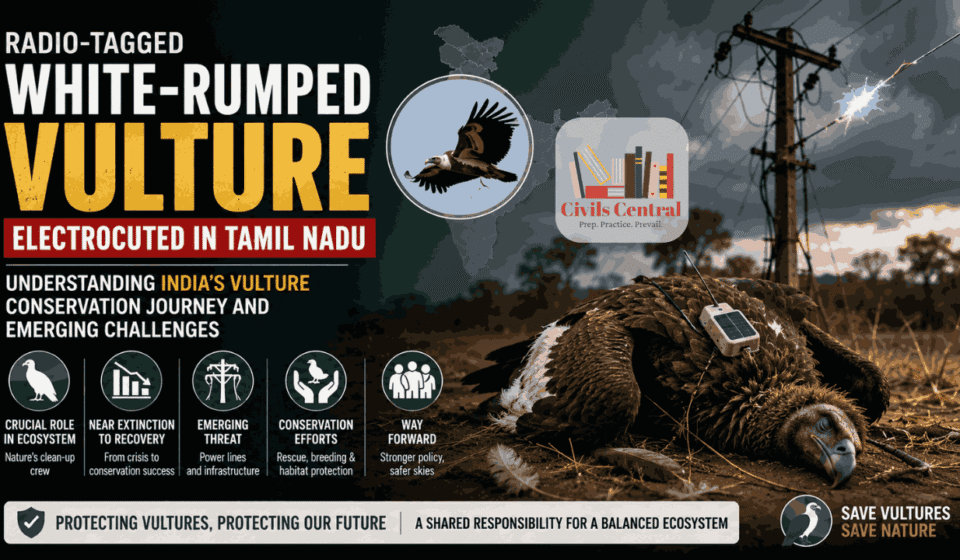
The recent electrocution of a radio-tagged White-rumped Vulture in Tamil Nadu has drawn national attention to the continuing threats faced by India’s critically endangered vultures. The bird, which was part of an ongoing scientific monitoring programme, died after coming into contact with an overhead power line. Because it carried a radio transmitter, conservationists were able to quickly locate the carcass and identify the cause of death.
At first glance, the incident may appear to be an isolated wildlife casualty. However, from a conservation perspective, it is far more significant. It demonstrates that although India has achieved considerable success in addressing the catastrophic decline of vultures caused by the veterinary drug diclofenac, new anthropogenic threats—including power transmission infrastructure, habitat degradation, accidental poisoning, and collisions with utility lines—continue to impede the recovery of these ecologically indispensable birds.
The incident also underscores the importance of science-based conservation. Radio telemetry has become an essential tool for monitoring wildlife movement, understanding habitat use, identifying mortality hotspots, and evaluating the effectiveness of conservation interventions. In this case, the technology not only tracked the bird during its lifetime but also helped researchers determine the precise threat responsible for its death, providing valuable evidence for future conservation planning.
For UPSC aspirants, this news is not merely about the death of a bird. It opens the door to understanding a much broader set of issues, including India’s biodiversity conservation framework, ecosystem services provided by scavengers, environmental governance, wildlife legislation, sustainable infrastructure planning, and the application of modern technology in conservation biology.
Why This Topic Matters for UPSC?
UPSC frequently frames questions by linking current events with the static syllabus. The electrocution of a radio-tagged White-rumped Vulture is an excellent example of such integration.
Static Areas Connected to the News
- Biodiversity and species conservation
- Threatened species and extinction risk
- Ecosystem functioning and ecological balance
- Wildlife Protection Act, 1972
- International conservation agreements
- Scientific methods in wildlife conservation
- Human-induced threats to biodiversity
- Sustainable infrastructure development
Understanding Vultures: Nature’s Most Efficient Scavengers
Vultures are among the most specialized scavenging birds in the world. Unlike predators that hunt living prey, vultures primarily feed on the carcasses of dead animals. This ecological specialization places them at the top of the scavenger food chain and makes them indispensable for maintaining environmental hygiene.
India is home to Old World vultures, belonging mainly to the genus Gyps. These birds rely on exceptional eyesight to locate carcasses during long soaring flights and often travel several kilometres in search of food. Their broad wings enable energy-efficient soaring on thermal currents, allowing them to cover vast landscapes with minimal energy expenditure.
One of the most remarkable adaptations of vultures is their highly acidic digestive system. Their stomach acid is capable of destroying dangerous pathogens, including bacteria responsible for diseases such as anthrax and botulism. As a result, vultures safely dispose of animal carcasses that might otherwise become breeding grounds for infectious diseases.
Because they rapidly remove dead livestock from the environment, vultures perform an ecosystem service that benefits wildlife, livestock, and humans alike. Their disappearance can lead to prolonged carcass decomposition, an increase in scavenging by feral dogs and rats, and a higher risk of zoonotic disease transmission.
For this reason, conservation biologists often describe vultures as “nature’s sanitation workers”, highlighting their irreplaceable contribution to ecosystem health.
White-rumped Vulture: Species Profile
The White-rumped Vulture (Gyps bengalensis) is one of India’s most iconic scavenging birds and historically was among the most abundant large raptors in South Asia. Until the early 1990s, millions of individuals were commonly observed across the Indian subcontinent. However, within little more than a decade, its population collapsed dramatically, making it one of the fastest recorded declines of any bird species.
Distribution
The species is found across:
- India
- Nepal
- Bangladesh
- Pakistan
- Parts of Southeast Asia
Within India, it occurs in:
- Open grasslands
- Agricultural landscapes
- Forest fringes
- Dry deciduous forests
- Village outskirts where livestock carcasses are available
Unlike many raptors that actively hunt prey, the White-rumped Vulture depends almost entirely on carrion. Its movements are therefore closely linked to livestock density and the availability of safe carcasses.
Identification Features
The species is characterised by:
- A medium-sized but powerful body.
- Dark brown to black plumage.
- Distinctive white rump patch, visible in flight.
- Bare greyish head and neck adapted for scavenging.
- Broad wings suited for soaring.
The featherless head reduces bacterial contamination while feeding deep inside carcasses, representing an important evolutionary adaptation.
Conservation Status
| Category | Status |
|---|---|
| IUCN Red List | Critically Endangered |
| Wildlife (Protection) Act, 1972 | Schedule I |
| CITES | Appendix II |
Its Critically Endangered status reflects an extremely high risk of extinction in the wild without sustained conservation efforts.
India’s Vulture Crisis
The story of vultures in India is regarded as one of the greatest wildlife conservation tragedies in modern history. Until the early 1990s, vultures were among the most common large birds across the Indian subcontinent. Large flocks of White-rumped Vultures, Indian Vultures, and Slender-billed Vultures could be seen circling villages, grazing fields, forests, and highways, rapidly disposing of livestock carcasses.
Within just a decade, however, these once-abundant birds almost vanished. Scientific surveys estimated that populations of the three resident Gyps vultures declined by more than 95–99% between the early 1990s and the mid-2000s. The White-rumped Vulture alone suffered a decline exceeding 99%, making it one of the fastest population crashes ever documented for any bird species.
Unlike many wildlife declines caused by habitat destruction or hunting, this collapse occurred despite the continued availability of food and nesting habitats. The mystery puzzled scientists until intensive research identified a single human-induced factor: the widespread veterinary use of diclofenac.
The episode demonstrated how a seemingly beneficial medical intervention for livestock could trigger a cascading ecological disaster, reinforcing the importance of adopting a One Health approach that recognises the interdependence of human, animal, and ecosystem health.
Timeline of India’s Vulture Crisis
| Period | Major Development |
|---|---|
| Before 1990 | Vultures among the most abundant large birds in India. |
| Early 1990s | Rapid and unexplained population decline observed. |
| Mid-1990s | Scientists began nationwide investigations into mass mortality. |
| 2003–2004 | Research identified veterinary diclofenac as the principal cause of mortality. |
| 2006 | India banned veterinary use of diclofenac. |
| 2008 onwards | Nepal, Pakistan and Bangladesh introduced similar restrictions. |
| 2020 | National Action Plan for Vulture Conservation (2020–2025) launched. |
| Present | Populations show signs of stabilisation in some regions but remain critically low, with emerging threats such as electrocution, poisoning, and unsafe power infrastructure. |
Diclofenac: The Drug That Changed India’s Ecology
What is Diclofenac?
Diclofenac is a Non-Steroidal Anti-Inflammatory Drug (NSAID) widely used to relieve pain, inflammation, and fever in humans and livestock. During the 1990s, veterinarians extensively administered diclofenac to cattle and buffaloes for treating:
- Joint inflammation
- Muscular injuries
- Fever
- Arthritis
- Post-operative pain
For farmers, it was an inexpensive and effective medicine. However, its devastating impact on vultures remained unknown.
How Did Diclofenac Kill Vultures?
The sequence of events was tragically simple.
Step 1: Livestock Treatment
Farm animals were injected with diclofenac shortly before death.
↓
Step 2: Carcass Disposal
After death, the carcasses retained small quantities of the drug in their tissues.
↓
Step 3: Vultures Fed on the Carcass
Being obligate scavengers, vultures consumed the contaminated meat.
↓
Step 4: Acute Kidney Failure
Even minute concentrations of diclofenac proved toxic to Gyps vultures, causing severe renal damage.
↓
Step 5: Visceral Gout
The kidneys failed to excrete uric acid, leading to the deposition of white urate crystals on internal organs—a condition known as visceral gout.
↓
Step 6: Death
Most affected vultures died within a few days of feeding.
Why Are Vultures So Sensitive to Diclofenac?
This question is often explored in conservation biology. Unlike many mammals, vultures have a unique physiology for processing metabolic waste. Their kidneys are highly efficient under natural conditions but are extremely vulnerable to diclofenac. Scientific studies indicate that vultures lack the biochemical capacity to metabolise the drug safely. Even trace quantities—harmless to cattle—can trigger irreversible kidney damage. This species-specific sensitivity explains why diclofenac caused catastrophic mortality in vultures while leaving other scavengers relatively unaffected.
Ecological Consequences of the Vulture Decline
The disappearance of vultures had consequences far beyond biodiversity loss.
1. Increase in Carcass Persistence
Without vultures, animal carcasses remained exposed for longer periods, creating breeding grounds for pathogens.
2. Rise in Feral Dog Populations
Carcasses that vultures would have consumed became an abundant food source for stray dogs. The increase in feral dog numbers has been linked to a higher risk of dog bites and the spread of rabies.
3. Public Health Risks
Delayed carcass decomposition increased opportunities for the transmission of diseases such as:
- Anthrax
- Brucellosis
- Botulism
- Rabies (indirectly through increased stray dogs)
This highlighted the close relationship between wildlife conservation and public health.
4. Economic Costs
The loss of free ecosystem services provided by vultures increased the burden on local authorities responsible for carcass disposal. Communities had to invest more resources in managing livestock waste that vultures had previously removed naturally.
5. Disruption of Ecological Balance
Vultures occupy a unique ecological niche. Their decline altered scavenger communities, increasing competition among:
- Feral dogs
- Jackals
- Crows
- Rats
Such changes affected ecosystem stability and disease dynamics.
One Health Perspective
The vulture crisis is now recognised as one of the clearest examples of the One Health concept. One Health acknowledges that the health of humans, domestic animals, wildlife, and ecosystems is interconnected. In this case:
- A veterinary medicine intended to improve livestock welfare caused the collapse of wild vulture populations.
- The disappearance of vultures increased carcass persistence.
- Increased food availability boosted stray dog populations.
- More stray dogs contributed to higher risks of rabies transmission.
- Public health costs increased.
Thus, the episode demonstrated that decisions in veterinary medicine can have far-reaching ecological and societal consequences.
The Ban on Veterinary Diclofenac
Recognising the scale of the crisis, India banned the veterinary use of diclofenac in 2006. The ban represented one of the country’s most significant wildlife conservation policy interventions.
Objectives of the Ban
- Eliminate the primary source of vulture mortality.
- Promote safer alternatives.
- Facilitate recovery of critically endangered vulture populations.
- Reduce contamination of livestock carcasses.
To strengthen enforcement, the Government later restricted the manufacture and sale of large multi-dose diclofenac vials intended for veterinary misuse.
Meloxicam: The Safe Alternative
Following extensive scientific evaluation, Meloxicam, another NSAID, was identified as a safe alternative for veterinary use. Unlike diclofenac, meloxicam does not cause kidney failure in vultures, making it the preferred analgesic for livestock treatment in regions supporting vulture populations. The promotion of meloxicam illustrates how evidence-based policy can balance animal welfare with biodiversity conservation.
Have India’s Vultures Recovered?
The diclofenac ban significantly reduced one of the principal causes of mortality, and in several regions vulture populations have begun to stabilise. However, recovery has been slower than expected because vultures are long-lived birds with low reproductive rates—most species raise only one chick per breeding season. Moreover, new threats have emerged, including:
- Electrocution from power lines.
- Collisions with transmission infrastructure.
- Poisoning from contaminated carcasses.
- Harmful veterinary drugs such as ketoprofen and aceclofenac.
- Habitat degradation and disturbance at nesting sites.
The recent death of a radio-tagged White-rumped Vulture in Tamil Nadu is therefore a reminder that conservation efforts must evolve beyond tackling diclofenac alone.
Why is the vulture decline considered a landmark conservation case?
- Demonstrated the unintended ecological consequences of veterinary pharmaceuticals.
- Highlighted the importance of scientific research in shaping environmental policy.
- Strengthened the adoption of the One Health approach.
- Led to one of the world’s largest species recovery programmes.
- Continues to influence biodiversity conservation, wildlife toxicology, and environmental governance.
Key Takeaways
- India lost over 95–99% of its Gyps vulture populations within a decade.
- Veterinary diclofenac was identified as the principal cause of the collapse.
- The drug caused acute kidney failure and visceral gout in vultures.
- The 2006 ban on veterinary diclofenac marked a turning point in conservation policy.
- Meloxicam is the recommended vulture-safe veterinary alternative.
- While poisoning has declined, emerging threats such as electrocution and power-line collisions now pose significant challenges to long-term recovery.
Radio Telemetry, Electrocution and Modern Vulture Conservation
The electrocution of the radio-tagged White-rumped Vulture in Tamil Nadu illustrates how modern conservation has evolved from merely protecting habitats to using advanced technologies for monitoring wildlife populations. Today, conservation biology increasingly relies on telemetry, satellite tracking, geographic information systems (GIS), and artificial intelligence to understand animal behaviour and design effective conservation strategies.
The recent incident demonstrates both the strengths and limitations of these technologies. While the transmitter enabled scientists to quickly identify the cause of death, it also revealed that emerging threats such as unsafe power infrastructure continue to jeopardize India’s vulture recovery efforts.
What is Wildlife Telemetry?
Wildlife telemetry is the science of remotely monitoring free-ranging animals using electronic devices that transmit information about their location, movement, behaviour, or physiological condition. The word telemetry literally means “measuring from a distance.” Scientists attach lightweight transmitters to animals, enabling researchers to monitor them without repeated physical capture. Wildlife telemetry has become an indispensable tool for:
- Studying migration routes
- Understanding habitat utilisation
- Identifying breeding and nesting sites
- Monitoring survival rates
- Detecting mortality events
- Planning species recovery programmes
- Assessing the impact of human activities on wildlife
For highly mobile birds such as vultures, telemetry provides information that would otherwise be impossible to obtain through field observations alone.
Types of Wildlife Telemetry
Modern wildlife conservation uses several forms of telemetry, each suited to different research objectives.
| Type | How it Works | Major Application |
|---|---|---|
| VHF (Very High Frequency) Radio Telemetry | Researchers track signals using handheld or vehicle-mounted receivers. | Short-range movement studies |
| GPS Telemetry | Records precise geographical coordinates using satellites. | Daily movement and habitat analysis |
| GSM Telemetry | Transmits GPS data through mobile phone networks. | Real-time monitoring in areas with network coverage |
| Satellite Telemetry | Sends data directly to satellites. | Long-distance migration and transboundary studies |
For large birds such as vultures, GPS-GSM and satellite transmitters are increasingly preferred because they provide accurate, continuous movement data over vast landscapes.
Why are Vultures Radio-tagged?
Radio-tagging is not merely about locating birds; it is a scientific tool that informs conservation decisions. Researchers tag vultures to:
Study Movement Patterns
Understanding how far vultures travel each day helps identify critical feeding grounds and roosting areas.
Locate Nesting Sites
Tracking breeding adults enables researchers to discover previously unknown nesting colonies.
Identify Mortality Hotspots
When a transmitter stops moving or sends a mortality signal, scientists can rapidly investigate the cause of death. This helps identify recurring threats such as:
- Poisoning
- Electrocution
- Collisions with power lines
- Hunting
- Habitat disturbance
Evaluate Conservation Programmes
Telemetry allows researchers to assess whether released captive-bred vultures survive, disperse, and reproduce successfully in the wild.
Guide Policy Decisions
Movement data helps governments prioritise areas for:
- Habitat protection
- Safe carcass zones
- Wildlife-friendly infrastructure
- Landscape-level conservation planning
Thus, telemetry transforms conservation from reactive management to evidence-based decision-making.
Electrocution: An Emerging Threat to India’s Vultures
Although diclofenac poisoning remains historically significant, electrocution and collisions with power infrastructure are becoming increasingly important causes of mortality. As India’s electricity transmission network expands to support economic growth and renewable energy integration, interactions between birds and power infrastructure have increased substantially. Large soaring birds such as vultures are particularly vulnerable because of their size, wingspan, and behaviour.
Why Are Vultures Vulnerable to Electrocution?
Unlike small birds, vultures possess wingspans exceeding 2 to 2.5 metres. When perched on electric poles or transmission towers, they may simultaneously touch:
- Two energized conductors, or
- An energized wire and a grounded metallic structure.
This completes an electrical circuit, causing fatal electrocution. Because vultures often gather communally at roosting sites and perch on elevated structures to survey their surroundings, transmission towers become attractive but dangerous resting places.
Electrocution vs Collision
These two threats are often confused in examinations.
| Electrocution | Collision |
|---|---|
| Bird touches electrical components, causing current to pass through its body. | Bird strikes an overhead wire during flight. |
| Common on distribution poles and transformers. | Common on high-voltage transmission lines. |
| Primarily affects large perching birds. | Affects soaring birds, cranes, bustards, storks, flamingos and vultures. |
Understanding this distinction is important for UPSC Prelims.
Why are Power Lines Difficult for Birds to Detect?
Power transmission wires are:
- Thin and difficult to perceive during flight.
- Often located across valleys, wetlands, grasslands, and open landscapes frequently used by soaring birds.
- Difficult to detect during poor visibility or while birds focus on locating food.
Species that depend on soaring rather than active flapping frequently look downward in search of carcasses or thermal currents, reducing their ability to avoid obstacles.
Beyond Vultures: Other Birds at Risk
Power infrastructure affects many large bird species in India, including:
- Great Indian Bustard
- Lesser Florican
- Sarus Crane
- Black-necked Crane
- Storks
- Eagles
- Kites
- Pelicans
Thus, bird-safe power infrastructure has become an important aspect of biodiversity conservation across multiple ecosystems.
Bird-safe Power Infrastructure
Conservation scientists recommend several engineering interventions to reduce bird mortality.
1. Bird Diverters
Brightly coloured reflective devices are attached to overhead wires, making them more visible to flying birds. These have proven effective in reducing collisions.
2. Insulated Conductors
Covering exposed conductors prevents birds from completing an electrical circuit while perching.
3. Modified Pole Designs
Increasing the distance between energized components reduces the likelihood of simultaneous contact.
4. Underground Cabling
In ecologically sensitive landscapes, underground transmission lines can eliminate collision risks altogether. However, high installation costs and maintenance challenges limit widespread adoption.
5. Strategic Route Planning
Before constructing transmission lines, environmental impact assessments should identify:
- Vulture nesting colonies
- Migratory flyways
- Wetlands
- Protected Areas
- High-use soaring corridors
Avoiding these areas significantly reduces wildlife mortality.
Technology and Artificial Intelligence in Conservation
Emerging technologies are transforming wildlife conservation.
Artificial Intelligence
AI algorithms can analyse telemetry data to detect unusual movement patterns indicating injury or mortality.
Geographic Information Systems (GIS)
GIS helps map:
- Nesting colonies
- Feeding grounds
- Mortality hotspots
- High-risk transmission corridors
This enables targeted conservation interventions.
Drones
Unmanned aerial vehicles assist in:
- Monitoring inaccessible nesting cliffs
- Surveying habitats
- Detecting illegal activities
- Assessing infrastructure impacts
Satellite Remote Sensing
Satellite imagery enables scientists to monitor habitat changes over large landscapes, supporting long-term conservation planning.
India’s Nine Vulture Species
India supports one of the world’s richest vulture assemblages, with nine species.
| Species | Scientific Name | IUCN Status | Distribution in India |
|---|---|---|---|
| White-rumped Vulture | Gyps bengalensis | Critically Endangered | Widespread but fragmented |
| Indian Vulture (Long-billed) | Gyps indicus | Critically Endangered | Peninsular India |
| Slender-billed Vulture | Gyps tenuirostris | Critically Endangered | Gangetic Plains and Northeast |
| Red-headed Vulture | Sarcogyps calvus | Critically Endangered | Central and Northern India |
| White-headed Vulture | Trigonoceps occipitalis | Not found in India (African species) | |
| Egyptian Vulture | Neophron percnopterus | Endangered | Widespread |
| Himalayan Griffon | Gyps himalayensis | Near Threatened | Himalayan region |
| Cinereous Vulture | Aegypius monachus | Near Threatened | Winter visitor to North India |
| Eurasian Griffon | Gyps fulvus | Least Concern | Winter visitor to Northwestern India |
| Bearded Vulture (Lammergeier) | Gypaetus barbatus | Near Threatened | Himalayas |
UPSC Note: India has nine regularly recorded vulture species. The White-headed Vulture is an African species and is not found in India. Avoid this common confusion in Prelims.
Case Study: Tamil Nadu Incident
The death of the radio-tagged White-rumped Vulture demonstrates the value of telemetry in conservation. Without the transmitter:
- The bird’s death may never have been detected.
- The cause of mortality would likely have remained unknown.
- The hazardous power-line location would not have been identified.
Instead, the incident has generated scientific evidence that can be used to:
- Retrofit dangerous power infrastructure.
- Improve environmental impact assessments.
- Identify additional mortality hotspots.
- Strengthen coordination between forest departments and power utilities.
This illustrates how technology not only monitors wildlife but also informs policy and management decisions, making conservation more proactive and evidence-based.
Conservation Framework, Legal Protection and the Way Forward for Vulture Conservation in India
The decline of vultures in India demonstrated that species conservation cannot rely solely on protected areas or legal protection. It requires a coordinated approach involving wildlife science, veterinary medicine, public health, infrastructure planning, legislation, community participation, and international cooperation.
Over the past two decades, India has adopted a comprehensive conservation framework aimed at reversing the decline of vultures. While notable progress has been achieved—particularly through the ban on veterinary diclofenac—the recent electrocution of a radio-tagged White-rumped Vulture highlights that conservation strategies must continually evolve to address emerging threats.
India’s Conservation Framework for Vultures
1. Action Plan for Vulture Conservation (2020–2025)
Recognising the continued vulnerability of vulture populations, the Ministry of Environment, Forest and Climate Change (MoEFCC) launched the Action Plan for Vulture Conservation (2020–2025).
Objectives
- Eliminate harmful veterinary drugs from the food chain.
- Ensure the availability of vulture-safe food.
- Strengthen scientific monitoring through telemetry and field surveys.
- Expand conservation breeding programmes.
- Establish and strengthen Vulture Safe Zones.
- Improve awareness among veterinarians, livestock owners, and local communities.
- Promote inter-state and international cooperation for vulture conservation.
The Action Plan adopts a landscape-based approach, recognising that vultures travel across administrative boundaries and require coordinated conservation efforts.
2. Vulture Safe Zones (VSZs)
A Vulture Safe Zone is a large geographical landscape where conservation measures ensure that vultures can feed, breed, and move safely.
Key Features
- Elimination of harmful veterinary drugs.
- Monitoring of livestock carcasses.
- Protection of nesting and roosting sites.
- Community participation.
- Scientific monitoring of vulture populations.
- Awareness programmes for veterinarians and livestock owners.
Rather than protecting individual nesting sites, the VSZ concept seeks to create entire landscapes that are safe for vultures.
3. Conservation Breeding Programme
Given the extremely low population of several vulture species, India established conservation breeding centres to prevent extinction.
Objectives
- Maintain genetically viable captive populations.
- Breed healthy individuals.
- Reintroduce vultures into suitable habitats.
- Support long-term species recovery.
Major breeding centres have been established with the support of:
- Central Zoo Authority (CZA)
- State Forest Departments
- Bombay Natural History Society (BNHS)
- International conservation organisations
Captive breeding is considered a supplementary strategy and cannot replace habitat conservation or the elimination of threats in the wild.
4. Scientific Monitoring
Modern conservation increasingly relies on evidence rather than assumptions. Researchers monitor vultures through:
- Population surveys
- Nest monitoring
- Satellite telemetry
- GPS tracking
- Radio-tagging
- Genetic studies
- Veterinary surveillance
The Tamil Nadu incident demonstrates the importance of continuous monitoring. Without telemetry, identifying mortality causes and designing targeted interventions would be far more difficult.
Institutions Involved in Vulture Conservation
Successful conservation requires collaboration among multiple institutions.
| Institution | Role |
|---|---|
| Ministry of Environment, Forest and Climate Change (MoEFCC) | National policy and coordination |
| Wildlife Institute of India (WII) | Scientific research and monitoring |
| Bombay Natural History Society (BNHS) | Research, awareness, and conservation programmes |
| Central Zoo Authority (CZA) | Conservation breeding |
| State Forest Departments | Habitat protection and field implementation |
| Veterinary Departments | Promotion of vulture-safe drugs |
| Local Communities | Protection of nesting sites and reporting threats |
This multi-stakeholder model reflects the interdisciplinary nature of wildlife conservation.
Legal and Constitutional Framework
Constitutional Provisions
Article 48A
Directs the State to protect and improve the environment and safeguard forests and wildlife.
Article 51A(g)
Makes it a Fundamental Duty of every citizen to protect the natural environment, including forests, lakes, rivers, wildlife, and to have compassion for living creatures. These provisions provide the constitutional foundation for biodiversity conservation in India.
Wildlife (Protection) Act, 1972
The White-rumped Vulture is protected under Schedule I, which provides the highest degree of legal protection. Offences involving Schedule I species attract stringent penalties, reflecting their conservation importance.
Biological Diversity Act, 2002
The Act promotes:
- Conservation of biological diversity.
- Sustainable use of biological resources.
- Fair and equitable sharing of benefits arising from biodiversity.
While it does not focus specifically on vultures, it supports ecosystem-based conservation.
Environment (Protection) Act, 1986
Provides the legal framework for environmental regulation, including measures that indirectly support habitat conservation and pollution control.
International Conservation Framework
Since vultures frequently cross national borders, their conservation requires international cooperation.
IUCN Red List
The International Union for Conservation of Nature (IUCN) assesses the global conservation status of species. The White-rumped, Indian, Slender-billed, and Red-headed Vultures are listed as Critically Endangered, reflecting their extremely high risk of extinction.
CITES
The Convention on International Trade in Endangered Species of Wild Fauna and Flora (CITES) regulates international trade in endangered species. The White-rumped Vulture is listed under Appendix II, ensuring that international trade does not threaten its survival.
Convention on Migratory Species (CMS)
Several migratory vulture species benefit from international cooperation under the CMS framework, which promotes coordinated conservation across national boundaries.
SAVE Consortium
The Saving Asia’s Vultures from Extinction (SAVE) consortium is a collaborative initiative involving governments, research institutions, and conservation organisations across South Asia. Its objectives include:
- Coordinating conservation strategies.
- Promoting vulture-safe veterinary practices.
- Supporting scientific research.
- Facilitating regional cooperation.
Emerging Challenges
Despite notable conservation successes, several challenges continue to impede vulture recovery.
1. Unsafe Power Infrastructure
As demonstrated by the Tamil Nadu incident, electrocution and collisions with transmission lines are becoming increasingly significant threats.
2. Harmful Veterinary Drugs
Although diclofenac has been banned for veterinary use, concerns remain regarding drugs such as:
- Ketoprofen
- Aceclofenac
- Nimesulide
These medicines may also be harmful to vultures and require continued monitoring and regulation.
3. Habitat Disturbance
Infrastructure development, quarrying, tourism, and urban expansion may disturb nesting and roosting sites.
4. Food Scarcity
Improved carcass disposal practices and changing livestock management have reduced the availability of safe carrion in some landscapes.
5. Climate Change
Changing weather patterns may alter:
- Thermal currents used for soaring.
- Distribution of prey and livestock.
- Nesting success.
- Habitat suitability.
Although research is ongoing, climate change is expected to become an increasingly important factor influencing vulture ecology.
Way Forward
India’s experience demonstrates that conservation success depends on integrating science, policy, engineering, and public participation.
Strengthen Bird-safe Infrastructure
- Install bird diverters on power lines.
- Insulate dangerous poles.
- Retrofit high-risk transmission corridors.
- Route new transmission lines away from critical habitats.
Expand Scientific Monitoring
Increase the use of:
- GPS telemetry.
- Satellite tracking.
- GIS-based habitat mapping.
- Artificial intelligence for mortality detection.
Promote Vulture-safe Veterinary Practices
- Strengthen enforcement of diclofenac restrictions.
- Encourage widespread use of meloxicam.
- Monitor emerging veterinary pharmaceuticals.
Enhance Community Participation
Local communities, livestock owners, veterinarians, and power utilities should be active partners in conservation efforts.
Integrate One Health into Policy
Future conservation strategies should recognise the interconnectedness of wildlife conservation, livestock health, ecosystem functioning, and public health.
Conclusion
The electrocution of a radio-tagged White-rumped Vulture in Tamil Nadu is more than an isolated wildlife incident—it is a reminder that conservation is an evolving process. India has demonstrated global leadership by identifying the role of diclofenac in the collapse of vulture populations and implementing one of the world’s most successful species recovery interventions. However, the emergence of new threats such as unsafe power infrastructure, harmful veterinary drugs, and habitat fragmentation shows that conservation strategies must continuously adapt to changing realities.
Protecting vultures is not merely about saving a single species. As nature’s most efficient scavengers, they maintain ecological balance, reduce disease transmission, and contribute to public health. Their conservation therefore represents an investment in biodiversity, ecosystem resilience, and sustainable development. The Tamil Nadu incident reinforces the need for a holistic approach that integrates scientific research, wildlife-friendly infrastructure, robust governance, and community participation to secure the future of India’s vulture populations.
Facts
| Topic | Correct Fact |
|---|---|
| White-rumped Vulture | Gyps bengalensis |
| Indian Vulture | Gyps indicus |
| Slender-billed Vulture | Gyps tenuirostris |
| Red-headed Vulture | Sarcogyps calvus |
| Egyptian Vulture | Neophron percnopterus |
| Himalayan Griffon | Gyps himalayensis |
| Bearded Vulture | Gypaetus barbatus |
UPSC Previous Year Question Linkages
Although UPSC has not frequently asked direct questions on the White-rumped Vulture, it has repeatedly tested concepts related to:
- IUCN Red List categories
- Wildlife Protection Act schedules
- CITES appendices
- Endangered species
- Biodiversity conservation programmes
- Ecosystem services
- Threatened fauna
- Human impacts on wildlife
This makes vulture conservation a recurring conceptual theme for both Prelims and Mains.
UPSC Prelims Practice MCQs
Q1.
With reference to the White-rumped Vulture, consider the following statements:
- It is listed as Critically Endangered by the IUCN.
- It is protected under Schedule I of the Wildlife (Protection) Act, 1972.
- Veterinary diclofenac was the principal reason for its population decline.
Which of the statements given above is/are correct?
A. 1 only
B. 1 and 2 only
C. 2 and 3 only
D. 1, 2 and 3
Answer: D
Q2.
Which one of the following veterinary drugs is considered safe for vultures?
A. Diclofenac
B. Ketoprofen
C. Meloxicam
D. Aceclofenac
Answer: C
Q3.
Radio telemetry is primarily used in wildlife conservation to:
A. Increase breeding success through artificial insemination
B. Measure soil fertility
C. Track movement and behaviour of animals
D. Estimate forest biomass
Answer: C
Q4.
Which of the following are major threats to India’s vultures?
- Electrocution
- Diclofenac poisoning
- Habitat degradation
- Collision with power lines
Select the correct answer:
A. 1 and 2 only
B. 2 and 3 only
C. 1, 2 and 4 only
D. 1, 2, 3 and 4
Answer: D
Q5.
The term “One Health” refers to:
A. Universal health insurance
B. Integration of human, animal, and ecosystem health
C. A WHO programme on nutrition
D. A wildlife breeding programme
Answer: B
GS Paper III Mains Questions
10 Marks
Q1. Explain the ecological significance of vultures. Why has their decline become a matter of environmental and public health concern?
10 Marks
Q2. Discuss the role of scientific monitoring techniques such as radio telemetry in wildlife conservation.
15 Marks
Q3. India’s success in controlling diclofenac poisoning has not eliminated the threats to vultures. Examine the emerging challenges to vulture conservation and suggest suitable policy measures.
15 Marks
Q4. Evaluate the importance of integrating biodiversity conservation into infrastructure planning with suitable examples.
15 Marks
Q5. The conservation of vultures illustrates the importance of the One Health approach. Discuss.
Mind Map
                 Radio-tagged White-rumped Vulture
                               │
        ┌──────────────────────┼──────────────────────┐
        │                      │                      │
    Species                Threats             Conservation
        │                      │                      │
 Gyps bengalensis      Diclofenac          Action Plan (2020–25)
 CR (IUCN)             Electrocution       Vulture Safe Zones
 Schedule I            Power-line          Captive Breeding
 CITES App II          Collision           Telemetry
        │                      │                      │
        └────────────── Ecosystem Services ───────────┘
                         │
      Carcass Disposal • Disease Control • One Health
                         │
                Public Health & Biodiversity
Key Takeaways
- The Tamil Nadu incident is not merely about the death of one vulture; it highlights the evolving challenges of conserving a species that has already survived one of the world’s most severe population collapses.
- India’s ban on veterinary diclofenac is recognised globally as a landmark conservation intervention, but long-term recovery now depends on addressing emerging threats such as electrocution, unsafe power infrastructure, and harmful alternative veterinary drugs.
- Vultures are indispensable for maintaining ecosystem health, preventing disease transmission, and supporting the One Health framework.
- Scientific tools such as radio telemetry, GPS tracking, GIS mapping, and artificial intelligence are transforming wildlife conservation by enabling evidence-based management.
- For UPSC, this topic exemplifies the integration of current affairs with biodiversity conservation, environmental governance, public health, constitutional duties, and sustainable development.
About The Author