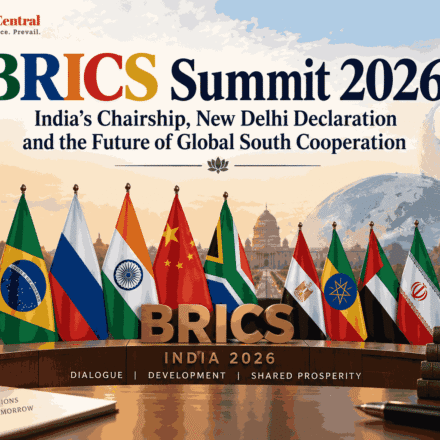
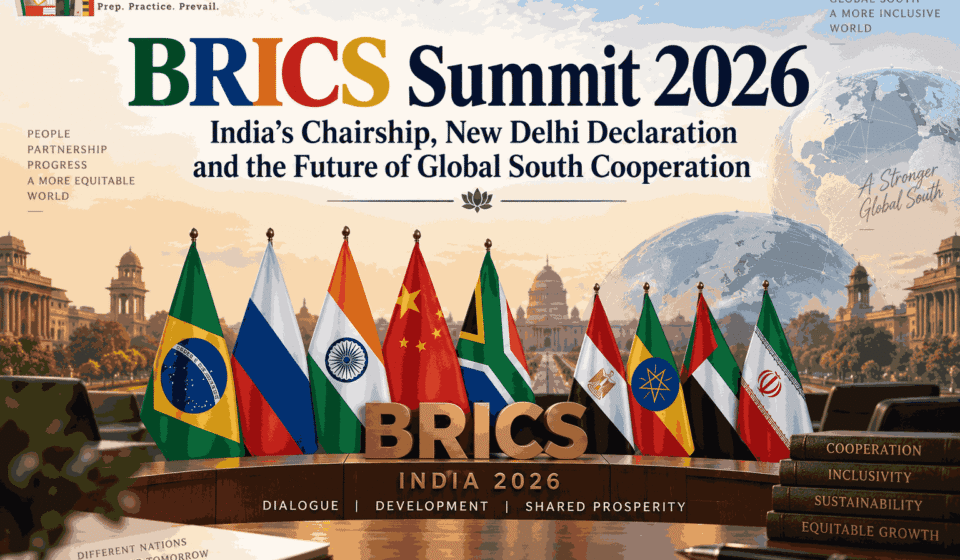
BRICS Summit 2026: India’s Chairship, New Delhi Declaration and the Future of Global South Cooperation

Learning Dashboard
Topic: BRICS Summit 2026
Exam Relevance: Very High — UPSC CSE + JKAS/JKPSC
Primary GS Linkages: GS-II — International Relations, Global Groupings, Global Governance; GS-III — Economy, Technology, Energy, Infrastructure
Current-Affairs Type: Current + Static + International Relations + Economy + J&K Security
Core themes to understand:
- BRICS as a Global South coordination forum
- Expansion of BRICS and its implications
- India’s role in BRICS
- Global governance reform
- Multipolarity and strategic autonomy
- NDB and Contingent Reserve Arrangement
- Local-currency trade and cross-border payments
- BRICS and de-dollarisation
- WTO and protectionism
- AI and digital public infrastructure
- Critical minerals and energy security
- Terrorism and the Pahalgam reference
- Limitations of BRICS as a diverse grouping
Why in News?
The 18th BRICS Summit was held in New Delhi on 12–13 September 2026 under India’s chairship. India assumed the BRICS Presidency on 1 January 2026, making 2026 the fourth occasion on which India has chaired the grouping. The summit was held under the theme “Building for Resilience, Innovation, Cooperation and Sustainability”, reflecting India’s broader people-centric “Humanity First” approach. The year also marks two decades since BRICS cooperation began at the foreign-minister level.
The summit culminated in the New Delhi Declaration, which reaffirmed cooperation across the expanded BRICS under three broad pillars: political and security cooperation; economic and financial cooperation; and cultural and people-to-people cooperation. The declaration also placed considerable emphasis on global governance reform, sustainable development, technology, trade, cross-border payments, the New Development Bank, energy and counter-terrorism.
The summit is particularly important for India because it provided a platform to simultaneously pursue Global South leadership, reform of multilateral institutions, economic cooperation, technological cooperation and strategic autonomy, while managing the divergent interests of major powers such as China and Russia alongside countries with different geopolitical orientations.
1. What Exactly Is BRICS?
BRICS should not be understood as a conventional military alliance, regional organisation or treaty-based international organisation.
It is essentially a political, diplomatic and economic coordination forum among major emerging and developing countries. The grouping does not have a constitutive treaty, its own independent budget or a permanent secretariat. Its presidency rotates, and much of its institutional functioning rests upon summit declarations, ministerial meetings, working groups and consensus-based cooperation.
This distinction is extremely important for UPSC because a statement such as “BRICS is an international organisation with a permanent secretariat” would be incorrect.
Evolution of the term
The original grouping was BRIC: Brazil + Russia + India + China
The first BRIC leaders’ summit took place at Yekaterinburg, Russia, in 2009, against the backdrop of the global financial crisis and debatesover reform of the international financial architecture. South Africa joined in 2011, transforming BRIC into BRICS.
The next major expansion was decided at the Johannesburg Summit in 2023, with Egypt, Ethiopia, Iran, Saudi Arabia and the UAE joining the expanded grouping from 2024. Indonesia subsequently became a full member in January 2025, taking the membership to 11.
Present BRICS membership
As of the 2026 New Delhi Summit, the 11 full members are:
| Original/earlier members | Expanded members |
|---|---|
| Brazil | Egypt |
| Russia | Ethiopia |
| India | Iran |
| China | Saudi Arabia |
| South Africa | UAE |
| Indonesia |
The expansion has significantly altered the geographical and economic character of the grouping.
CivilsCentral Insight
The transformation of BRICS from a five-country grouping into an 11-member forum is more significant than a simple increase in membership. It represents an attempt to build a wider platform through which emerging and developing countries can coordinate on global governance, finance, trade, technology and development. At the same time, expansion has increased the diversity of political systems, economic structures and strategic interests within the grouping, making consensus both more valuable and more difficult.
2. From BRIC to Expanded BRICS: Why the Expansion Matters
The expansion reflects the changing distribution of economic and political power in the international system. The original BRIC configuration was centred on four large emerging economies. South Africa added an important African dimension, while the 2024 expansion brought in countries from the Middle East and Africa, and Indonesia added a major Southeast Asian economy.
The broader membership gives BRICS a stronger claim to represent the Global South, particularly in debates concerning:
- international financial institutions;
- development finance;
- global trade;
- climate finance;
- technology governance;
- energy;
- reform of the United Nations;
- greater representation of developing countries in global decision-making.
The official BRICS framework emphasises geographic balance, good relations with existing members and support for global-governance reforms among the criteria relevant to expansion.
But expansion creates a contradiction
A larger grouping increases its geographical and economic weight.
But: More members → more interests → more divergence → greater difficulty in consensus-building.
For example, BRICS contains countries with very different relationships with the United States, Europe, China and Russia. It includes strategic competitors such as India and China, while also bringing together states with differing positions on conflicts and international economic policy.
Therefore, BRICS’ future effectiveness depends less on its numerical size and more on its ability to translate broad common interests into practical cooperation.
3. BRICS Partner Countries: Do Not Confuse Members and Partners
One of the most important developments following the expansion was the creation of a BRICS Partner Country category at the 2024 Kazan Summit. The partner mechanism allows countries to participate in selected BRICS engagements without becoming full members. The initial partner countries included Belarus, Bolivia, Cuba, Kazakhstan, Malaysia, Nigeria, Thailand, Uganda and Uzbekistan; Vietnam subsequently became the tenth partner country.
This creates an important distinction:
| Category | Nature |
|---|---|
| Full Member | Participates as a member in BRICS decision-making |
| Partner Country | Participates in specified engagements without full membership |
| BRICS Outreach / BRICS Plus | Broader engagement formats with invited countries |
The New Delhi Declaration explicitly recognised the contribution of partner countries and encouraged their increasing participation in BRICS cooperation.
Prelims Trap
Do not treat every country attending a BRICS Summit as a full member.
A country can participate in the summit as: Member ≠ Partner ≠ Outreach Invitee.
This distinction has become increasingly important after BRICS expansion.
4. BRICS Is Not Just an Economic Group
The original perception of BRICS was largely economic. However, its agenda has progressively expanded.
The three broad pillars now encompass:
Political and Security Cooperation
Includes:
- international peace and security;
- terrorism;
- global governance;
- multilateralism;
- UN reform.
Economic and Financial Cooperation
Includes:
- trade;
- investment;
- development finance;
- infrastructure;
- local-currency settlements;
- cross-border payments;
- financial resilience.
Cultural and People-to-People Cooperation
Includes:
- education;
- health;
- culture;
- youth;
- academic exchanges;
- civil society;
- tourism.
The New Delhi Declaration explicitly reaffirmed this three-pillar structure.
Thus, UPSC preparation should not reduce BRICS to:
“Five/eleven emerging economies.”
It should be understood as an evolving multi-dimensional cooperation mechanism.
5. The 2026 New Delhi Summit: What Did India Try to Achieve?
India’s chairship was guided by four central ideas:
- Resilience
- Innovation
- Cooperation
- Sustainability
The Indian approach emphasised a people-centric and development-oriented BRICS, with an attempt to move beyond declarations towards practical cooperation. India stated that more than 350 meetings were organised during its chairship across nearly 30 Indian cities.
The New Delhi Declaration described the desired BRICS approach as:
balanced + practical + actionable + inclusive + development-oriented + people-centred.
This reveals an important feature of India’s BRICS diplomacy: India wants BRICS to remain a platform for strategic coordination without becoming a rigid anti-Western bloc. That distinction is important.
6. BRICS and Global Governance Reform
One of the oldest and most consistent BRICS objectives has been reform of the institutions created around the post-Second World War international order.
The concern is that institutions such as:
- United Nations Security Council
- IMF
- World Bank
- international financial governance structures
do not fully reflect the distribution of economic and demographic power in the twenty-first century. The New Delhi Declaration therefore reaffirmed the objective of a more representative, fairer and more inclusive international order and support for reform of the multilateral system.
Why does India care?
India’s interest is particularly strong because it seeks:
- permanent membership of a reformed UN Security Council;
- greater representation for developing countries;
- greater voice in international financial institutions;
- greater recognition of the Global South;
- a rules-based international order that is not dominated by a limited group of powers.
CivilsCentral Insight
For India, BRICS is valuable not because it replaces existing institutions but because it increases India’s bargaining space within the international system. India can simultaneously engage with the G7, G20, Quad, SCO, BRICS and other platforms. This reflects a broader strategy of issue-based and multi-aligned diplomacy rather than exclusive alignment with any single geopolitical bloc.
7. BRICS and the Global South
The concept of the Global South is central to understanding contemporary BRICS diplomacy. The Global South broadly refers to developing and emerging countries, particularly those seeking greater representation in global economic and political governance.
BRICS provides these countries a platform to discuss:
- development finance;
- food and energy security;
- climate finance;
- technology access;
- trade;
- reform of global institutions;
- development inequalities.
The expanded BRICS therefore has significance beyond the original five members.
Its political proposition is essentially: The governance of the international system should better reflect the economic, demographic and developmental realities of the twenty-first century.
But this should not be confused with a unified Global South position. Developing countries have different national interests, and BRICS itself demonstrates this diversity.
8. New Development Bank — The Most Important Static Institution Linked to BRICS
The New Development Bank (NDB) is perhaps the single most important institution an aspirant must understand in relation to BRICS. The NDB was established following the 2014 Fortaleza Summit to mobilise resources for infrastructure and sustainable-development projects in BRICS and other emerging/developing economies. Its authorised capital is US$100 billion.
Its headquarters are in Shanghai, China.
Why was the NDB created?
The broader rationale was the perceived inadequacy of existing development-finance arrangements in meeting the infrastructure and sustainable-development needs of developing economies.
It therefore represents: BRICS cooperation → development finance → greater institutional autonomy.
Important distinction
BRICS membership does NOT automatically mean NDB membership. (This is a very important Prelims point.)
The NDB has its own membership structure. Its current members include the five founding BRICS countries along with Bangladesh, UAE, Egypt, Algeria and Uzbekistan; several other countries are listed as prospective members subject to completion of accession requirements.
9. New Development Bank vs Contingent Reserve Arrangement
Do not confuse these two.
| Feature | New Development Bank | Contingent Reserve Arrangement |
|---|---|---|
| Nature | Multilateral development bank | Financial safety mechanism |
| Main purpose | Infrastructure and sustainable development | Balance-of-payments/liquidity support |
| Origin | Fortaleza Summit, 2014 | Fortaleza Summit, 2014 |
| Broader role | Development finance | Financial stability |
| Headquarters | Shanghai | No equivalent permanent institutional headquarters |
The Contingent Reserve Arrangement (CRA) is a mutual financial support mechanism designed to assist participating BRICS countries facing balance-of-payments difficulties. The arrangement has a committed resource framework of US$100 billion among the original participants.
UPSC distinction
NDB = development finance
CRA = financial safety/liquidity support
This distinction has high elimination value.
10. BRICS and De-dollarisation: What Is Actually Happening?
This is one of the most misunderstood aspects of BRICS. The 2026 New Delhi Declaration did not establish a common BRICS currency.
Instead, BRICS is working towards:
- greater use of national currencies;
- cross-border payment interoperability;
- reducing transaction costs;
- facilitating trade and investment settlements;
- strengthening financial cooperation.
The declaration specifically acknowledged work by the BRICS Payment Task Force on interoperability of payment and messaging channels and on trade settlements using BRICS local currencies. India’s position has been pragmatic: local-currency settlement is being explored, but there is no current proposal for a common BRICS currency.
Therefore:
BRICS local-currency settlement ≠ BRICS common currency, and: de-dollarisation efforts ≠ immediate replacement of the US dollar.
This distinction is highly likely to have Prelims statement value because it allows UPSC to create plausible but incorrect statements.
11. Why Does Local-Currency Trade Matter?
International trade is often denominated and settled in major reserve currencies, particularly the US dollar. If two BRICS countries settle more transactions directly in their national currencies, potential benefits include:
- reduced currency-conversion costs;
- lower dependence on intermediary currencies;
- greater resilience against financial disruptions;
- increased monetary autonomy;
- potentially greater resilience against sanctions-related financial restrictions.
However, large-scale local-currency settlement also faces challenges:
- exchange-rate volatility;
- convertibility;
- depth of financial markets;
- capital-account restrictions;
- confidence in currencies;
- payment-system interoperability;
- differing macroeconomic conditions.
Therefore, BRICS’ current approach is incremental rather than revolutionary.
12. BRICS, Trade and the WTO
The New Delhi Declaration expressed concern over:
- protectionism;
- rising tariffs and non-tariff barriers;
- unilateral trade-restrictive measures;
- distortions in the multilateral trading system.
BRICS also reaffirmed support for a rules-based multilateral trading system and WTO reform, including restoration of an effective dispute-settlement mechanism. India has a particular interest in this issue because its developmental priorities include:
- agricultural livelihoods;
- food security;
- policy space for developing economies;
- special and differential treatment;
- access to global markets.
A contemporary example: CBAM
The BRICS declaration criticised what it viewed as discriminatory trade measures pursued under environmental objectives, with the EU Carbon Border Adjustment Mechanism (CBAM) forming an important contemporary context.
This creates a useful UPSC intersection:
BRICS → WTO → climate policy → trade → carbon border measures → developing-country interests.
13. BRICS and Artificial Intelligence
AI has become an increasingly important part of BRICS cooperation. The 2026 declaration emphasised the importance of AI governance and cooperation in ensuring that emerging technologies are:
- safe;
- inclusive;
- accessible;
- responsible;
- beneficial to developing countries.
India’s chairship also promoted cooperation around digital public infrastructure and technology. The declaration supported the development of a BRICS Digital Public Infrastructure Repository, aimed at facilitating the sharing and scaling of digital public goods.
This is particularly relevant for India because of its experience with:
- Aadhaar;
- UPI;
- digital identity;
- digital payments;
- interoperable digital platforms;
- public digital infrastructure.
Thus, BRICS provides another avenue for India to project its Digital Public Infrastructure model internationally.
14. BRICS and Critical Minerals
Critical minerals have acquired strategic importance because modern economies increasingly depend upon minerals used in:
- semiconductors;
- electric vehicles;
- batteries;
- renewable-energy systems;
- advanced electronics;
- defence technologies.
The New Delhi Declaration emphasised the importance of resilient, diversified and sustainable critical-mineral supply chains, while also recognising the sovereignty of resource-rich countries over their natural resources.
For India, this intersects with:
critical minerals → energy transition → manufacturing → strategic autonomy → supply-chain security.
This is a particularly useful example of how UPSC can connect one current-affairs topic to multiple GS domains.
15. BRICS and Energy Security
The energy transition creates a difficult policy balance.
Developing economies require:
- affordable energy;
- energy security;
- industrialisation;
- access to modern technologies.
At the same time, they face pressure to:
- decarbonise;
- expand renewables;
- reduce emissions;
- finance climate adaptation.
The BRICS approach recognises the developmental realities of emerging economies and stresses technology cooperation and sustainable development while retaining space for different national energy pathways. This is where the principle of Common But Differentiated Responsibilities and Respective Capabilities (CBDR-RC) becomes relevant in climate negotiations.
16. BRICS and Terrorism: The J&K Dimension
For JKAS aspirants, this is one of the most important parts of the 2026 Summit.
The New Delhi Declaration explicitly condemned the 22 April 2025 terrorist attack in Pahalgam, Jammu & Kashmir, in which 26 people were killed. It reiterated a position of zero tolerance towards terrorism and called for action against terrorist safe havens, financing and cross-border movement of terrorists.
This has direct significance for India’s diplomatic narrative because India has consistently sought greater international recognition of:
- cross-border terrorism;
- terrorist financing;
- safe havens;
- accountability of terrorist organisations and their supporters.
The declaration also reiterated that terrorism should not be associated with any religion, nationality, civilisation or ethnic group.
JKAS relevance
This creates a direct linkage:
BRICS Summit → international terrorism discourse → Pahalgam → J&K → India’s counter-terrorism diplomacy.
This is not an artificial J&K angle; it is explicitly present in the summit’s final declaration.
CivilsCentral Insight
The Pahalgam reference demonstrates how J&K-related security issues increasingly intersect with India’s wider multilateral diplomacy. For JKAS aspirants, the significance is not limited to remembering that BRICS condemned the attack; the deeper point is that India seeks to internationalise the principle that terrorism, terrorist financing and safe havens require collective international action while resisting attempts to treat terrorism as merely a bilateral or domestic-security issue.
17. Why Is BRICS Strategically Important for India?
India’s interest in BRICS is multi-dimensional.
1. Global South leadership
India can use BRICS to strengthen its role as a voice for developing countries.
2. Global governance reform
It supports India’s demand for more representative international institutions.
3. Strategic autonomy
BRICS allows India to cooperate with Russia, China, Iran and other countries without entering into an exclusive alliance.
4. Economic diversification
Expanded BRICS creates additional markets, investment opportunities and supply-chain partnerships.
5. Development finance
The NDB provides another source of infrastructure and sustainable-development finance.
6. Technology cooperation
BRICS provides platforms for cooperation in:
- AI;
- digital public infrastructure;
- advanced manufacturing;
- technology;
- innovation.
7. Energy security
The membership gives India deeper engagement with major energy producers and consumers.
8. Counter-terrorism
The grouping provides another multilateral platform for India’s counter-terrorism diplomacy.
18. But BRICS Is Not Without Problems
A mature UPSC answer must not portray BRICS as an inevitable alternative to the Western-led international order.
Divergent strategic interests
India and China have unresolved strategic and territorial differences.
Different relationships with the West
Some members are deeply integrated with Western economies, while others are under severe geopolitical pressure from Western countries.
Economic asymmetry
China’s economic weight within BRICS is considerably greater than that of several other members.
Consensus problem
As membership expands, reaching consensus becomes more difficult.
Limited institutionalisation
The absence of a permanent secretariat and treaty-based structure provides flexibility but can also constrain implementation.
Gap between declarations and implementation
BRICS has produced numerous declarations and initiatives, but the real measure of its influence lies in whether members can convert them into:
institutions + financing + trade + technology + implementation.
19. BRICS vs G7: Understand the Conceptual Difference
A simplistic comparison is misleading.
| BRICS | G7 |
|---|---|
| Broad grouping of emerging/developing powers | Advanced industrial economies |
| Strong Global South orientation | Developed-economy orientation |
| More heterogeneous political/economic systems | More politically aligned |
| Focus on reform of global governance | Strong influence over existing global economic governance |
| Consensus-based cooperation | Political coordination among relatively like-minded states |
The key point is not that one will automatically replace the other. The international system is increasingly characterised by overlapping institutions and competing centres of influence.
20. BRICS as an Expression of Multipolarity
The growth of BRICS reflects the broader movement towards a more multipolar international system.
Multipolarity does not necessarily mean: “The West disappears.” Rather, it means: more centres of economic, political and strategic influence. BRICS is one expression of this trend.
Other platforms include:
- G20
- SCO
- ASEAN
- African Union
- IBSA
- Quad
- G7
India’s foreign policy increasingly operates across several of these platforms simultaneously. This is why BRICS should be understood as part of India’s broader strategy of multi-alignment / issue-based alignment.
21. Why BRICS Matters for India’s Foreign Policy
India’s BRICS participation illustrates an important principle: Strategic autonomy does not mean strategic isolation.
India can:
- cooperate with the United States through the Quad;
- cooperate with Russia through bilateral mechanisms;
- cooperate with China in BRICS;
- cooperate with Central Asian states through the SCO;
- work with Europe on trade and technology;
- engage developing countries through the Global South.
This is not necessarily contradictory. It represents an attempt to maximise India’s strategic options in a fragmented international system.
22. What the 2026 Summit Tells Us About the Future of BRICS
The New Delhi Summit suggests that BRICS is moving from a primarily symbolic grouping towards practical sectoral cooperation, particularly in:
- payments;
- local-currency trade;
- development finance;
- AI;
- digital infrastructure;
- energy;
- critical minerals;
- trade;
- agriculture;
- health;
- education.
However, the grouping’s future influence will depend upon whether these initiatives become operational.
The most important test is therefore: Can BRICS convert consensus into institutions, financing mechanisms, interoperable systems and measurable outcomes?
That is more consequential than the number of countries joining the grouping.
23. Prelims Perspective
High-Value Facts
| Topic | Remember |
|---|---|
| First BRICS Summit | Yekaterinburg, Russia, 2009 |
| Original grouping | BRIC — Brazil, Russia, India, China |
| South Africa | Joined in 2011 |
| Major expansion | Decided at Johannesburg, 2023; new members from 2024 |
| Indonesia | Full member from January 2025 |
| 2026 Summit | 18th BRICS Summit |
| 2026 venue | New Delhi |
| 2026 dates | 12–13 September |
| 2026 Chair | India |
| 2026 theme | Building for Resilience, Innovation, Cooperation and Sustainability |
| BRICS nature | Coordination/cooperation forum, not treaty-based international organisation |
| Permanent secretariat | None |
| Decision-making | Consensus-based |
| NDB | Multilateral development bank |
| NDB HQ | Shanghai |
| NDB origin | Fortaleza Summit, 2014 |
| CRA | Financial safety mechanism for balance-of-payments difficulties |
| Partner-country category | Created at Kazan, 2024 |
| 2026 partner addition | Vietnam is a BRICS partner country |
The institutional characteristics of BRICS and NDB are supported by official BRICS and NDB sources.
Prelims Traps
Trap 1
BRICS has a permanent secretariat.
❌ Incorrect.
Trap 2
BRICS has a constitutive treaty.
❌ Incorrect.
Trap 3
NDB is headquartered in Beijing.
❌ Incorrect.
Shanghai is correct.
Trap 4
NDB membership automatically follows BRICS membership.
❌ Incorrect.
The two membership structures are distinct.
Trap 5
BRICS has adopted a common currency in 2026.
❌ Incorrect.
The current emphasis is on local-currency settlements and payment-system interoperability, not a common BRICS currency.
Trap 6
Partner countries are full BRICS members.
❌ Incorrect.
Partner status is distinct from full membership.
Trap 7
The NDB and CRA perform the same function.
❌ Incorrect.
NDB = development finance.
CRA = financial safety mechanism.
Trap 8
BRICS is an anti-Western military alliance.
❌ Incorrect.
It is a cooperation and coordination forum with a broad and increasingly diverse agenda.
24. PYQ Linkage — Extremely Important
BRICS is a proven UPSC theme, not merely a fashionable current-affairs topic.
UPSC Prelims 2014
UPSC asked about:
- the first BRICS Summit;
- South Africa’s entry into the grouping.
The question required precise chronological knowledge rather than merely knowing the acronym.
UPSC Prelims 2015
UPSC asked: The Fortaleza Declaration was related to which grouping?
The correct association was BRICS.
UPSC Prelims 2016
UPSC tested the New Development Bank, asking whether it was established by APEC and where its headquarters were located. The correct combination required distinguishing BRICS from APEC and knowing Shanghai as the NDB headquarters.
UPSC Mains 2012
UPSC asked candidates to:
Compare the significance of IBSA and BRICS in the context of India’s multilateral diplomacy.
This required understanding India’s broader diplomatic strategy rather than simply describing the two groupings.
UPSC Mains 2014
UPSC asked:
How will the roles of NDB and AIIB differ? Discuss the strategic significance of these two Banks for India.
This transformed BRICS from a factual topic into an India’s foreign policy + international institutions + development finance question.
UPSC Prelims 2025
UPSC returned directly to BRICS and tested:
- Kazan Summit;
- Russian chairship;
- Indonesia’s full membership;
- the exact wording of the summit theme.
The deliberate substitution of “multiculturalism” for “multilateralism” is especially instructive: UPSC tested statement-level precision, not merely broad awareness.
What does this PYQ history tell us?
BRICS should be studied through: Chronology + membership + institutions + headquarters + summit themes + declarations + India’s diplomacy + development finance + global governance.
Not simply: “BRICS = Brazil, Russia, India, China, South Africa.”
CivilsCentral Insight
The BRICS PYQ trajectory itself demonstrates the evolution of UPSC’s treatment of current affairs. Earlier questions emphasised chronology and institutional facts; later questions increasingly connect BRICS with India’s multilateral diplomacy, development finance and changing global governance. The 2025 question further demonstrates that UPSC can test a very small factual distinction embedded within a contemporary summit. Therefore, future BRICS preparation must combine broad strategic understanding with precise institutional and chronological knowledge.
25. Mains Perspective
Possible UPSC-Style Question
“BRICS has evolved from a grouping of emerging economies into a broader platform for Global South cooperation. Examine its significance for India’s pursuit of strategic autonomy and reform of global governance.”
Introduction
BRICS has evolved from the original BRIC grouping into an expanded platform of emerging and developing countries seeking greater cooperation and a more representative international order.
Body
1. Global governance
- UN reform
- IMF/World Bank reform
- greater voice for developing countries
2. Strategic autonomy
- simultaneous engagement with competing powers
- diversified diplomatic partnerships
3. Economic significance
- NDB
- local-currency settlements
- trade
- supply chains
- infrastructure finance
4. Global South
- development finance
- climate finance
- technology access
- food and energy security
5. Challenges
- India-China tensions
- geopolitical divergence
- China’s economic weight
- consensus problem
- implementation deficit
Conclusion
BRICS is unlikely to replace existing global institutions in the near term, but it can strengthen India’s bargaining capacity and contribute to a more plural and representative international order if cooperation moves from declarations towards practical implementation.
26. A Second Mains Question
“The expansion of BRICS enhances its global weight but simultaneously complicates its ability to achieve consensus. Discuss.”
A good answer should analyse:
Expansion
→ greater population
→ larger economic footprint
→ wider geography
→ stronger Global South representation
but also:
Expansion
→ divergent geopolitical interests
→ different economic priorities
→ competing national strategies
→ harder consensus
→ weaker policy coherence.
The conclusion should recognise that size creates influence only when accompanied by institutional coherence and implementation capacity.
27. One-Minute Revision
BRICS in one chain:
BRIC
→ Brazil + Russia + India + China
→ First Summit, Yekaterinburg, 2009
→ South Africa, 2011
→ Expansion decided, Johannesburg 2023
→ New members from 2024
→ Indonesia, 2025
→ 11 full members
→ Partner-country category, Kazan 2024
→ India Chairship, 2026
→ New Delhi Summit, September 2026.
Financial architecture:
BRICS → NDB + CRA
NDB → development finance
CRA → balance-of-payments support
Current economic direction:
Local currencies + payment interoperability ≠ Common BRICS currency
India’s strategic objective:
Global South + strategic autonomy + global governance reform + development finance + economic diversification
J&K link:
Pahalgam terror attack → BRICS New Delhi Declaration → zero tolerance for terrorism.
28. Chapter Summary
The 2026 BRICS Summit demonstrates that the grouping has moved far beyond its original identity as a collection of emerging economies. From the original BRIC configuration of Brazil, Russia, India and China, it has developed into an expanded 11-member forum with a separate partner-country mechanism and an increasingly broad agenda encompassing political security, economic and financial cooperation, technology, health, education, energy and people-to-people relations.
For India, the importance of BRICS lies less in the idea of replacing Western institutions and more in expanding India’s strategic room for manoeuvre. The NDB, local-currency settlement discussions, digital cooperation, critical-mineral initiatives and Global South coordination provide practical instruments, while global-governance reform provides the broader diplomatic objective.
At the same time, BRICS faces an inherent contradiction. Its expanding membership increases its international weight but also makes consensus more difficult. The future relevance of BRICS will therefore depend on whether it can transform declarations into effective institutions, financial mechanisms, trade facilitation, technological cooperation and coordinated diplomatic outcomes.
For UPSC and JKAS aspirants, the correct approach is consequently not to memorise BRICS membership alone. The topic must be understood through institutional architecture, chronology, NDB/CRA, global governance, India’s strategic autonomy, local-currency settlements, Global South diplomacy, technology and the direct J&K counter-terrorism dimension.
29. FAQs
1. Is BRICS an international organisation?
No. BRICS functions as a political, diplomatic and cooperation forum and does not have a constitutive treaty, permanent secretariat or independent budget.
2. How many full BRICS members are there in 2026?
There are 11 full members.
3. Is Indonesia a BRICS member?
Yes. Indonesia became a full BRICS member in January 2025.
4. Is Vietnam a BRICS member?
No. Vietnam is a BRICS Partner Country.
5. Where is the New Development Bank headquartered?
Shanghai, China.
6. Is the NDB the same as the Contingent Reserve Arrangement?
No. NDB provides development finance, whereas the CRA is a financial safety mechanism intended to support members facing balance-of-payments difficulties.
7. Has BRICS created a common currency?
No. The 2026 focus is on local-currency settlements and cross-border payment interoperability.
8. Why is the 2026 Summit particularly relevant for JKAS?
Because the New Delhi Declaration specifically condemned the 2025 Pahalgam terrorist attack in Jammu & Kashmir and reiterated zero tolerance towards terrorism.
About The Author