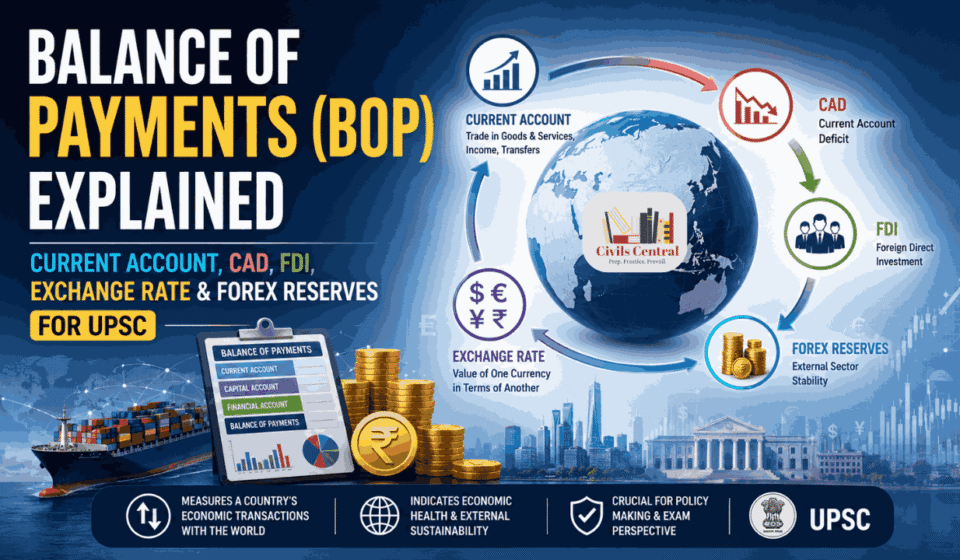
Balance of Payments (BoP) Explained | Current Account, CAD, FDI, Exchange Rate & Forex Reserves for UPSC

Introduction
Every economy interacts continuously with the rest of the world. India exports pharmaceuticals to Africa, imports crude oil from West Asia, receives billions of dollars in remittances from Indians working abroad, attracts foreign investment into infrastructure and manufacturing, repays external loans, and maintains foreign exchange reserves through the Reserve Bank of India (RBI). Each of these cross-border transactions affects the country’s external economic position.
To systematically record and analyse these transactions, economists use a comprehensive accounting framework known as the Balance of Payments (BoP). Far more than a statistical statement, the BoP serves as the financial diary of a nation’s interactions with the global economy. It reflects the strength of a country’s external sector, influences exchange rate movements, guides monetary and fiscal policy, and shapes international investor confidence.
For India, maintaining a healthy BoP has become increasingly important in an era of globalization, volatile capital flows, geopolitical uncertainties, and changing trade patterns. Episodes such as the 1991 Balance of Payments Crisis, the Global Financial Crisis (2008), the COVID-19 pandemic, the Russia–Ukraine conflict, and fluctuations in global crude oil prices have demonstrated how external sector vulnerabilities can directly affect domestic growth, inflation, employment, and financial stability.
From the perspective of the UPSC Civil Services Examination, the Balance of Payments is one of the foundational concepts in the Economy syllabus. Questions are frequently asked on topics such as the Current Account Deficit (CAD), capital flows, foreign exchange reserves, exchange rates, foreign direct investment (FDI), foreign portfolio investment (FPI), and India’s external debt. A strong conceptual understanding of the BoP also enriches answers in General Studies, Essay, and the Personality Test.
Why is the Balance of Payments Frequently in the News?
Although the Balance of Payments is a static economic concept, it remains a recurring topic in current affairs because India’s external economic position changes continuously.
Recent developments that often bring the BoP into focus include:
- Release of quarterly Balance of Payments data by the Reserve Bank of India (RBI).
- Changes in the Current Account Deficit or surplus.
- Movements in India’s foreign exchange reserves.
- Fluctuations in crude oil prices affecting import bills.
- Volatility in Foreign Portfolio Investment (FPI) inflows and outflows.
- Changes in the value of the Indian Rupee.
- Growth in services exports, particularly IT and business process outsourcing.
- Rising remittances from the Indian diaspora.
- New Free Trade Agreements (FTAs) and bilateral trade arrangements.
- Global geopolitical events affecting international trade and capital flows.
Thus, every major international economic development ultimately leaves its imprint on the Balance of Payments.
Understanding the External Sector of an Economy
To appreciate the importance of the Balance of Payments, one must first understand what economists mean by the external sector.
Every nation has two broad spheres of economic activity:
- Domestic Sector, where production, consumption, investment, and government expenditure occur within national boundaries.
- External Sector, which consists of all economic transactions between residents of a country and the rest of the world.
These transactions are remarkably diverse. They include the export and import of goods, trade in services such as software and tourism, cross-border investments, external borrowings, remittances sent by migrant workers, grants, aid, and changes in foreign exchange reserves.
Because these transactions involve payments and receipts in foreign currencies, governments need a standardized framework to record them. This framework is the Balance of Payments.
What is the Balance of Payments?
The Balance of Payments (BoP) is a systematic statistical statement that records all economic transactions between the residents of a country and the rest of the world during a specified period, usually a quarter or a financial year.
The emphasis on the word residents is crucial. In BoP accounting, transactions are classified based on residency rather than nationality. For example, an Indian citizen living and working abroad for several years may be treated as a non-resident, while a foreign national employed in India for an extended period may be treated as a resident for statistical purposes, following internationally accepted standards.
The BoP captures every inflow of foreign exchange into the country and every outflow of foreign exchange from the country. Since it follows the principles of double-entry accounting, every transaction is recorded with equal and opposite entries, ensuring that the accounts remain balanced in an accounting sense.
Definition by the International Monetary Fund (IMF)
The International Monetary Fund (IMF) defines the Balance of Payments as a statistical statement that systematically summarizes, for a specific period, the economic transactions of an economy with the rest of the world. This internationally accepted definition ensures comparability of external sector statistics across countries.
Why is the Balance of Payments Important?
The Balance of Payments is much more than an accounting document. It is one of the most important indicators of a country’s macroeconomic health.
A persistent Current Account Deficit may indicate that a country is consuming more than it produces, making it dependent on foreign capital. Large capital inflows may support economic growth but can also create vulnerabilities if they are volatile. Strong foreign exchange reserves enhance confidence in the economy and enable the central bank to stabilize the currency during periods of external stress.
Governments, central banks, investors, credit rating agencies, multinational corporations, and international organizations such as the IMF and the World Bank closely monitor BoP statistics because they provide insights into a country’s external sustainability, exchange rate stability, debt-servicing capacity, and investment attractiveness.
Objectives of Maintaining the Balance of Payments
The Balance of Payments serves several important purposes:
| Objective | Why it Matters |
|---|---|
| Recording international transactions | Provides a comprehensive record of all economic dealings with the rest of the world. |
| Policy formulation | Helps governments design trade, exchange rate, fiscal, and monetary policies. |
| External stability assessment | Indicates whether the country’s external position is sustainable. |
| Exchange rate management | Assists the central bank in managing currency volatility. |
| Investment analysis | Enables investors to assess external vulnerabilities and economic strength. |
| International comparison | Allows comparison of countries using standardized statistical methods. |
Historical Evolution of India’s Balance of Payments
India’s external sector has undergone profound changes since Independence. In the decades immediately after 1947, India followed an import-substitution strategy characterized by high tariffs, extensive import licensing, and strict foreign exchange controls. Limited exports and heavy dependence on imports often placed pressure on foreign exchange reserves.
The most significant turning point came in 1991, when India faced a severe Balance of Payments crisis. Foreign exchange reserves had fallen to levels sufficient to finance only a few weeks of imports. The crisis compelled India to seek assistance from the IMF and undertake wide-ranging economic reforms, including trade liberalization, industrial delicensing, deregulation, and greater openness to foreign investment.
Since then, India’s external sector has become far more integrated with the global economy. Services exports, remittances, foreign investment, and expanding trade have transformed the composition of the BoP. Today, India is one of the world’s largest recipients of remittances and a leading exporter of information technology services, although it continues to run a merchandise trade deficit due to substantial imports of crude oil, electronics, and gold.
The Accounting Principle Behind the Balance of Payments
The Balance of Payments follows the principle of double-entry bookkeeping, similar to financial accounting.
Every international transaction has two sides:
- A credit entry, representing an inflow of foreign exchange or a reduction in foreign assets.
- A debit entry, representing an outflow of foreign exchange or an increase in foreign assets.
For example, when India exports pharmaceuticals worth US$100 million, the export is recorded as a credit. If the payment is received as a deposit in a foreign bank, the corresponding financial transaction is recorded as a debit. Thus, the accounts remain balanced.
This does not imply that every country has equal exports and imports. Rather, it means that any imbalance in one component is offset by changes in another component or by adjustments in foreign exchange reserves.
Flow of a Typical International Transaction
Indian Firm Exports Goods
            │
            ▼
Foreign Buyer Makes Payment
            │
            ▼
Foreign Currency Enters India
            │
            ▼
Recorded as Credit in Current Account
            │
            ▼
Corresponding Financial Entry Recorded
            │
            ▼
Balance of Payments Remains Balanced
Understanding Credits and Debits in the BoP
Students often confuse credits and debits in BoP accounting because the terminology differs from everyday language.
A credit refers to a transaction that results in a receipt of foreign exchange by the country. Examples include exports of goods and services, remittances received from abroad, foreign investment into India, and external borrowings.
A debit refers to a transaction that results in a payment of foreign exchange to the rest of the world. Examples include imports, Indians travelling abroad and spending foreign exchange, repayment of external loans, or Indian firms investing overseas.
The key is to think in terms of foreign exchange inflows and outflows, not profits or losses.
Common Misconceptions About the Balance of Payments
Several misconceptions surround the BoP. One common misunderstanding is that a BoP deficit means the accounts do not balance. In reality, because of double-entry accounting, the Balance of Payments always balances mathematically. What may be in deficit is the Current Account, which must then be financed through capital inflows or a reduction in foreign exchange reserves.
Another misconception is that a trade deficit automatically implies economic weakness. Many rapidly growing economies import large quantities of capital goods, machinery, and technology to support industrialization. The sustainability of the deficit depends on how it is financed and whether imports contribute to future productive capacity.
Concept Check
Before proceeding further, remember these foundational ideas:
- The Balance of Payments records all economic transactions between residents of India and the rest of the world.
- It is broader than merchandise trade and includes services, investment, remittances, and reserve assets.
- Every transaction is recorded using double-entry accounting, ensuring that the BoP always balances as an accounting identity.
- A Current Account Deficit is not the same as a Balance of Payments deficit.
- The BoP is one of the most important indicators of a country’s external economic health.
What is the Current Account?
The Current Account is the component of the Balance of Payments that records transactions involving goods, services, primary income, and secondary income (current transfers) between residents of a country and the rest of the world during a given period.
It essentially answers a simple economic question: Is the country earning enough from its regular economic activities with the rest of the world to pay for what it consumes from abroad?
If receipts exceed payments, the country records a Current Account Surplus. If payments exceed receipts, it records a Current Account Deficit (CAD).
Why is it Called the “Current” Account?
The term “current” refers to transactions that occur as part of the normal, recurring economic activities of households, firms, and governments. These transactions affect current income and expenditure rather than ownership of assets or liabilities.
For example:
- Exporting pharmaceuticals generates current income.
- Importing crude oil creates current expenditure.
- Receiving software export earnings is a current receipt.
- Paying shipping charges to foreign companies is a current payment.
- Receiving remittances from Indians working abroad is a current transfer.
In contrast, purchasing a foreign company or borrowing from abroad changes the stock of assets or liabilities and therefore belongs to the financial side of the BoP rather than the Current Account.
Components of the Current Account
The Current Account consists of four major components:
                     CURRENT ACCOUNT
                           │
      ┌────────────────────┼────────────────────┐
      │                    │                    │
      ▼                    ▼                    ▼
 Trade in Goods     Trade in Services     Primary Income
                                              │
                                              ▼
                                      Secondary Income
Each component captures a distinct category of international transactions. Together, they provide a complete picture of the country’s external earnings and expenditures.
Component I: Trade in Goods (Merchandise Trade)
Trade in goods records exports and imports of physical, tangible commodities. Exports are treated as credits because they bring foreign exchange into the country. Imports are treated as debits because they require payments to foreign suppliers.
Examples of India’s merchandise exports include:
- Petroleum products
- Pharmaceuticals
- Engineering goods
- Chemicals
- Textiles
- Agricultural products
- Gems and jewellery
Major imports include:
- Crude oil
- Gold
- Electronic goods
- Machinery
- Fertilisers
- Coal
- Defence equipment
India’s economy is structurally dependent on imports of crude oil, making international oil prices one of the most important determinants of the country’s trade balance.
What is the Trade Balance?
The Trade Balance, also called the Balance of Trade (BoT), is simply the difference between the value of merchandise exports and merchandise imports.
Trade Balance = Merchandise Exports − Merchandise Imports
If exports exceed imports, the country records a trade surplus. If imports exceed exports, it records a trade deficit. For India, merchandise imports have generally exceeded exports for several decades, resulting in a persistent merchandise trade deficit.
Example
Suppose India records:
- Merchandise Exports = US$ 450 billion
- Merchandise Imports = US$ 700 billion
Trade Balance: = 450 – 700 = –US$250 billion
Thus, India records a merchandise trade deficit of US$250 billion.
Why Does India Usually Have a Trade Deficit?
A merchandise trade deficit is not necessarily a sign of economic weakness. It reflects the structure of India’s economy.
Several factors contribute to India’s persistent trade deficit:
- Heavy dependence on imported crude oil.
- Large imports of electronic goods and semiconductor components.
- Significant gold imports driven by household demand.
- Import of advanced machinery and capital goods for industrial development.
- Growing domestic demand accompanying rapid economic growth.
Many of these imports contribute to long-term productive capacity rather than mere consumption.
Component II: Trade in Services (Invisible Trade)
Unlike goods, services are intangible. Nevertheless, they constitute one of India’s greatest economic strengths.
The services account records exports and imports of services such as:
- Information Technology (IT)
- Software services
- Business Process Outsourcing (BPO)
- Financial services
- Insurance
- Banking
- Consultancy
- Education
- Tourism
- Shipping
- Aviation
- Telecommunications
India is among the world’s largest exporters of software and business services. For decades, the country’s services surplus has significantly offset its merchandise trade deficit.
Why are Services Called “Invisible”?
Historically, economists distinguished physical goods from non-physical transactions. Goods were called visible trade.
Services, income and transfers were collectively termed invisibles because they do not involve movement of tangible commodities across borders. Although the terminology is traditional, it remains widely used in economic analysis.
India’s Competitive Advantage in Services
India’s services exports have expanded because of several structural advantages:
- Large English-speaking workforce.
- Strong engineering and technical education.
- Global reputation in software development.
- Competitive labour costs.
- Advanced digital infrastructure.
- Mature IT industry.
- Increasing exports of Global Capability Centres (GCCs).
The growth of companies such as TCS, Infosys, Wipro, HCL Technologies and Tech Mahindra has made software exports one of India’s largest sources of foreign exchange earnings.
Component III: Primary Income
Primary income records income arising from the ownership of factors of production. It includes:
- Interest on foreign loans.
- Dividends from investments.
- Profits earned by foreign companies.
- Compensation of employees working abroad or in India.
For example: If an Indian company owns shares in a foreign company and receives dividends, the amount is recorded as a credit. If a foreign company operating in India repatriates profits to its parent company abroad, it is recorded as a debit. Similarly, interest payments on external borrowings also appear under primary income.
Why Does India Usually Record a Primary Income Deficit?
India attracts large amounts of foreign investment. These investments generate future obligations in the form of:
- Dividend payments.
- Profit repatriation.
- Interest payments.
- Income on foreign-owned assets.
As a result, India generally records a primary income deficit despite receiving investment inflows.
Component IV: Secondary Income (Current Transfers)
Secondary income consists of transfers where one party provides resources without receiving any economic value in return. These transfers do not create liabilities and do not involve exchange of goods or services.
Examples include:
- Personal remittances.
- Gifts.
- Donations.
- Foreign aid for current expenditure.
- Pension transfers.
- Workers’ remittances.
Among these, remittances are particularly important for India.
What are Remittances?
Remittances are funds sent by individuals working abroad to their families or dependents in their home country. Millions of Indians work in:
- Gulf countries.
- North America.
- Europe.
- Australia.
- Southeast Asia.
Money transferred by these workers forms a major source of foreign exchange earnings. India has consistently remained one of the world’s largest recipients of international remittances.
Why are Remittances Important?
Remittances have several macroeconomic benefits. They strengthen household incomes, improve consumption, support education and healthcare, reduce poverty, and contribute positively to the Current Account.
Unlike volatile portfolio investments, remittances tend to remain relatively stable even during periods of global financial uncertainty. This stability makes them an important cushion against external shocks.
Calculating the Current Account Balance
Numerical Illustration
Suppose India records:
| Component | US$ Billion |
|---|---|
| Goods Balance | –250 |
| Services Balance | +180 |
| Primary Income | –40 |
| Secondary Income | +130 |
Current Account Balance:
= –250 +180 –40 +130
= +20 billion
This indicates a Current Account Surplus.
Current Account Deficit (CAD)
A Current Account Deficit arises when total payments on the Current Account exceed total receipts. In other words, The country spends more foreign exchange on goods, services, income payments and transfers than it earns from these sources.
The deficit must be financed through:
- Foreign investment.
- External borrowing.
- Reduction in foreign exchange reserves.
- Other capital inflows.
A moderate CAD is common among developing economies with high investment needs. However, a persistently large CAD can expose the economy to external vulnerabilities if it relies excessively on volatile financing.
Is Every Current Account Deficit Bad?
No. The quality and sustainability of the deficit matter more than its existence. A CAD can be beneficial if imports finance productive investments—such as machinery, technology, or infrastructure—that enhance future export capacity and economic growth.
Conversely, a CAD driven mainly by excessive consumption imports without corresponding gains in productivity may become unsustainable. Economists therefore assess not only the size of the CAD but also its composition and financing.
India’s Current Account: Structural Characteristics
India’s Current Account exhibits several long-term features:
| Characteristic | Significance |
|---|---|
| Persistent merchandise trade deficit | Driven by imports of crude oil, gold, electronics and capital goods. |
| Large services surplus | Reflects India’s strength in IT, business and professional services. |
| Significant remittance inflows | Provide stable foreign exchange earnings and support the Current Account. |
| Primary income deficit | Due to dividend, profit and interest payments to foreign investors. |
| Moderate CAD over the long run | Generally financed through capital inflows and reserve management. |
Factors Affecting India’s Current Account
The Current Account is influenced by a combination of domestic and global factors:
- International crude oil prices.
- Global demand for Indian exports.
- Exchange rate movements.
- Domestic economic growth.
- Global recessions.
- Geopolitical tensions.
- Shipping and logistics costs.
- Performance of the IT services sector.
- Workers’ remittances.
- Trade policies and Free Trade Agreements.
Because these variables change over time, the Current Account is dynamic and closely monitored by the RBI and policymakers.
Concept Map
                    CURRENT ACCOUNT
                           │
      ┌──────────────┬──────────────┬──────────────┐
      │              │              │              │
      ▼              ▼              ▼              ▼
 Goods Trade   Services Trade  Primary Income  Secondary Income
      │              │              │              │
Exports/Imports  IT, Tourism,   Interest,      Remittances,
                 Banking etc.   Dividends       Gifts, Aid
                           │
                           ▼
              Current Account Balance
                           │
             ┌─────────────┴─────────────┐
             ▼                           ▼
       Surplus                     Deficit (CAD)
Key Takeaways
- The Current Account records transactions involving goods, services, primary income, and secondary income.
- The Balance of Trade is only one part of the Current Account.
- India generally runs a merchandise trade deficit, offset substantially by a services surplus and large remittance inflows.
- Primary income is usually in deficit because of profit repatriation and interest payments to foreign investors.
- A Current Account Deficit is not inherently undesirable; its sustainability depends on how it is financed and whether it supports productive economic growth.
Capital Account, Financial Account and Foreign Capital Flows
The Current Account, which records transactions arising from the production and exchange of goods and services, income earned from factors of production, and unilateral transfers such as remittances. We also learned that India generally runs a Current Account Deficit (CAD) because its imports of merchandise goods exceed its exports, although this deficit is partially offset by a substantial surplus in services exports and remittance inflows.
A fundamental question now arises: If a country spends more foreign exchange than it earns through its Current Account, where does the additional foreign exchange come from?
The answer lies in the Capital Account and, more importantly under modern international accounting standards, the Financial Account. These accounts record transactions that alter the ownership of assets and liabilities between residents and non-residents. They determine how a country finances its external deficits, attracts investment, borrows from abroad, or accumulates foreign assets.
Understanding these accounts is essential because they connect domestic investment, global capital markets, exchange rate stability, and economic growth. India’s rise as one of the world’s fastest-growing economies has been supported not only by trade but also by significant inflows of foreign capital in the form of direct investment, portfolio investment, external borrowings, and non-resident deposits.
Why Capital Flows Matter
Economic growth requires investment. Developing countries often require investment levels that exceed their domestic savings. In such situations, foreign capital supplements domestic resources.
For India, foreign capital has financed infrastructure projects, manufacturing expansion, technology transfers, startup ecosystems, renewable energy, and financial markets. At the same time, excessive dependence on volatile capital inflows can expose the economy to external shocks, as witnessed during several international financial crises.
Thus, capital flows are both an opportunity and a source of vulnerability.
Understanding the Structure Beyond the Current Account
Many students believe that the Balance of Payments consists only of the Current Account and the Capital Account. While this was broadly true under older accounting conventions, the IMF’s Balance of Payments and International Investment Position Manual, Sixth Edition (BPM6) introduced a clearer distinction.
Today, the Balance of Payments is broadly organised into:
                    BALANCE OF PAYMENTS
                           │
        ┌──────────────────┼──────────────────┐
        │                  │                  │
        ▼                  ▼                  ▼
 Current Account     Capital Account    Financial Account
                                             │
                                             ▼
                                       Reserve Assets
The Capital Account is relatively small in most countries, including India. The Financial Account contains the major capital movements such as FDI, portfolio investment, loans, deposits, and reserve assets.
For UPSC, however, the term “Capital Account” is often used in a broader sense in textbooks and policy discussions to include what BPM6 classifies under the Financial Account. Aspirants should understand both usages.
The Capital Account: Meaning
The Capital Account records transactions that involve:
- Capital transfers, and
- Acquisition or disposal of non-produced, non-financial assets.
Unlike the Current Account, these transactions do not arise from routine trade or income generation. Instead, they involve changes in ownership of specific assets or transfers of wealth.
Because such transactions are relatively infrequent, the Capital Account generally forms a very small portion of India’s Balance of Payments.
Components of the Capital Account
Under the IMF framework, the Capital Account mainly includes:
Capital Transfers
These are transfers where ownership of an asset changes without any corresponding exchange of goods or services.
Examples include:
- Debt forgiveness by one government.
- Investment grants.
- Transfer of ownership of fixed assets.
- Large one-time aid for capital projects.
These differ from current transfers because they affect the stock of wealth rather than current income.
Non-produced, Non-financial Assets
These include assets that are not produced through economic activity but possess economic value.
Examples are:
- Patents.
- Copyrights.
- Trademarks.
- Broadcasting rights.
- Mineral exploration rights.
- Spectrum licences (in certain international transactions).
Although economically important, such transactions are relatively limited compared to financial flows.
The Financial Account: The Real Driver of Capital Flows
The Financial Account records transactions that change the ownership of financial assets and liabilities between residents and non-residents. This account is far larger and more significant than the Capital Account.
Whenever foreign investors purchase Indian companies, Indian firms borrow from overseas banks, or the RBI accumulates foreign exchange reserves, these transactions are reflected in the Financial Account.
The Financial Account therefore explains how a country finances its Current Account Deficit and manages its integration with global financial markets.
Components of the Financial Account
The Financial Account broadly consists of:
                 FINANCIAL ACCOUNT
                        │
      ┌─────────────────┼─────────────────┐
      │                 │                 │
      ▼                 ▼                 ▼
   Direct          Portfolio         Other
 Investment       Investment      Investments
                        │
                        ▼
                  Reserve Assets
Each component differs in terms of risk, stability, investment horizon, and economic impact.
Foreign Direct Investment (FDI)
Foreign Direct Investment refers to investment made by a foreign entity with the objective of establishing a lasting interest and significant managerial control in an enterprise located in another country.
International practice generally considers ownership of 10% or more of voting shares as indicating a direct investment relationship. Unlike speculative financial investment, FDI reflects long-term confidence in the host economy.
Characteristics of FDI
Foreign Direct Investment is characterised by:
- Long-term commitment.
- Ownership and managerial control.
- Technology transfer.
- Skill development.
- Employment generation.
- Capacity creation.
- Integration into global value chains.
Because investors have a direct stake in the enterprise, FDI is generally considered the most stable form of foreign capital.
Examples of FDI in India
Several sectors have attracted substantial FDI:
- Automobile manufacturing.
- Electronics production.
- Renewable energy.
- Pharmaceuticals.
- Telecommunications.
- Infrastructure.
- Financial services.
- Digital platforms.
- Food processing.
Government initiatives such as Make in India, Production Linked Incentive (PLI) Scheme, and improvements in the ease of doing business have aimed to increase FDI inflows.
Advantages of FDI
FDI contributes to economic development in several ways. It supplements domestic capital, introduces advanced technology, enhances productivity, creates employment opportunities, improves export competitiveness, and strengthens integration with global production networks.
Unlike external borrowing, FDI does not create fixed repayment obligations, making it a relatively sustainable source of external financing.
Challenges Associated with FDI
Despite its benefits, FDI also raises concerns.
Excessive dependence on multinational corporations may reduce the competitiveness of domestic firms. Profit repatriation contributes to the Primary Income deficit in the Current Account. Concentration of investment in selected sectors or regions may widen inequalities. National security considerations have also become increasingly important in sensitive sectors such as telecommunications, semiconductors, and digital infrastructure.
Foreign Portfolio Investment (FPI)
Foreign Portfolio Investment refers to investments in financial assets such as shares, bonds, government securities, and mutual funds without acquiring managerial control over the enterprise. Portfolio investors seek financial returns rather than participation in management.
Their investment decisions are influenced by:
- Interest rates.
- Stock market performance.
- Exchange rate expectations.
- Global liquidity conditions.
- Risk perception.
Why is FPI Called “Hot Money”?
Portfolio investment can enter and leave a country rapidly in response to changes in market conditions.
For example, if global interest rates rise sharply, international investors may withdraw funds from emerging markets and invest in safer assets elsewhere. Because of this mobility, FPI is often described as hot money.
Large-scale withdrawal of portfolio investment can lead to:
- Stock market declines.
- Rupee depreciation.
- Pressure on foreign exchange reserves.
- Financial market volatility.
FDI vs FPI
| Basis | Foreign Direct Investment (FDI) | Foreign Portfolio Investment (FPI) |
|---|---|---|
| Nature | Long-term investment | Short-term financial investment |
| Control | Includes managerial influence | No managerial control |
| Stability | Highly stable | Relatively volatile |
| Objective | Business expansion | Financial returns |
| Economic Impact | Capacity creation, technology transfer, employment | Deepens capital markets and improves liquidity |
| Exit | Difficult | Easy and rapid |
Why this distinction matters: While both bring foreign exchange into the country, FDI strengthens productive capacity, whereas FPI primarily supports financial markets and can reverse quickly during periods of uncertainty.
Other Investments
Apart from FDI and FPI, the Financial Account includes a broad category known as Other Investments. These comprise financial transactions that do not fall under direct or portfolio investment but are important sources of external financing.
Major components include:
External Commercial Borrowings (ECBs)
Indian companies borrow funds from foreign lenders to finance expansion, infrastructure, or capital expenditure. Advantages include access to larger pools of capital and potentially lower interest rates. However, excessive borrowing increases external debt and exposes firms to exchange rate risk.
Trade Credit
Importers and exporters often receive short-term credit from overseas suppliers or buyers. Trade credit facilitates international commerce and smoothens working capital requirements.
Currency and Deposits
This includes deposits made by non-resident Indians (NRIs) in Indian banks. NRI deposits constitute an important source of foreign exchange and have often supported India’s Balance of Payments during periods of external stress.
Loans
Loans between governments, international organisations, commercial banks, and other financial institutions are also recorded under Other Investments.
Reserve Assets
Reserve assets are external assets held and controlled by the Reserve Bank of India (RBI) for meeting Balance of Payments needs, maintaining confidence in the rupee, and managing exchange rate volatility.
Major reserve assets include:
- Foreign currency assets.
- Gold reserves.
- Special Drawing Rights (SDRs).
- Reserve position in the IMF.
Reserve assets act as the country’s financial buffer during periods of external instability.
Financing the Current Account Deficit
Whenever India records a Current Account Deficit, it must be financed. Conceptually, the process can be represented as:
           CURRENT ACCOUNT DEFICIT
                     │
                     ▼
      Needs Foreign Exchange Financing
                     │
     ┌───────────────┼────────────────┐
     ▼               ▼                ▼
     FDI             FPI      External Borrowing
                     │
                     ▼
             NRI Deposits, Loans
                     │
                     ▼
     If Insufficient → Use Forex Reserves
Thus, the Financial Account serves as the bridge between the country’s spending and its financing.
Hot Money vs Stable Capital
Not all foreign capital behaves similarly.
| Stable Capital | Volatile Capital |
|---|---|
| Foreign Direct Investment | Foreign Portfolio Investment |
| Long-term infrastructure investment | Equity market speculation |
| Manufacturing investment | Bond market inflows |
| Greenfield projects | Short-term arbitrage funds |
A healthy external sector generally relies more on stable, long-term capital than on speculative financial flows.
Capital Flight
Capital flight refers to the rapid movement of financial assets out of a country due to declining investor confidence.
It may occur because of:
- Political instability.
- Economic crises.
- Sharp currency depreciation.
- Banking sector stress.
- Geopolitical uncertainty.
- Expectations of future losses.
Capital flight reduces foreign exchange availability and may force the central bank to intervene in currency markets.
India’s Experience with Capital Flows
Since the economic reforms of 1991, India has progressively integrated with global capital markets. The country has become one of the leading destinations for FDI among emerging economies while also attracting significant portfolio investment into equity and debt markets.
At the same time, episodes such as the Global Financial Crisis (2008), the Taper Tantrum (2013), the COVID-19 pandemic, and periods of aggressive monetary tightening by major central banks have demonstrated the volatility of portfolio flows and the importance of maintaining adequate foreign exchange reserves.
India’s external sector strategy has therefore focused on encouraging stable long-term investment while strengthening macroeconomic fundamentals to withstand external shocks.
Concept Map
                  FINANCIAL ACCOUNT
                         │
      ┌──────────────────┼──────────────────┐
      │                  │                  │
      ▼                  ▼                  ▼
      FDI               FPI         Other Investments
      │                  │                  │
 Long-term          Short-term        ECBs, Loans,
 Investment         Portfolio         NRI Deposits
      │                  │                  │
      └──────────────────┼──────────────────┘
                         ▼
                  Reserve Assets (RBI)
                         │
                         ▼
          Financing Current Account Deficit
Key Takeaways
- The Capital Account under the IMF framework is relatively small and records capital transfers and transactions in non-produced, non-financial assets.
- The Financial Account is the principal account through which foreign capital flows into and out of an economy.
- Foreign Direct Investment (FDI) is a long-term, stable source of capital that contributes to productive capacity, technology transfer, and employment.
- Foreign Portfolio Investment (FPI) provides liquidity to financial markets but is relatively volatile and sensitive to global conditions.
- Other Investments, including External Commercial Borrowings (ECBs), trade credit, loans, and NRI deposits, are important components of external financing.
- The Reserve Bank of India (RBI) manages reserve assets to ensure external stability and support exchange rate management.
- Financing a Current Account Deficit requires adequate capital inflows or, if necessary, the use of foreign exchange reserves.
Balance of Payments Crisis, Exchange Rate System and Foreign Exchange Reserves
In the previous chapters, we examined the conceptual foundations of the Balance of Payments, the Current Account, and the Financial Account. We learned that while a Current Account Deficit (CAD) is not inherently problematic, it becomes a serious concern when a country cannot finance it through sustainable capital inflows. In such situations, foreign exchange reserves begin to decline, investor confidence weakens, the domestic currency comes under pressure, and the economy may face a Balance of Payments (BoP) crisis.
India experienced such a crisis in 1991, one of the most defining moments in its economic history. The crisis transformed India’s development strategy, leading to the Liberalisation, Privatisation, and Globalisation (LPG) reforms. Understanding this episode is essential not only for the Economy syllabus but also for questions relating to governance, public policy, and India’s development trajectory.
This chapter also explains how exchange rates are determined, why currencies appreciate or depreciate, how the Reserve Bank of India (RBI) manages the foreign exchange market, and why maintaining adequate foreign exchange reserves is vital for macroeconomic stability.
What is a Balance of Payments Crisis?
A Balance of Payments Crisis arises when a country is unable to meet its international payment obligations because its foreign exchange earnings and available reserves are insufficient to finance imports, repay external debt, or honour other external commitments.
Unlike a routine Current Account Deficit, a BoP crisis reflects a breakdown in external financing. Investors lose confidence, capital inflows dry up, foreign creditors become reluctant to lend, and the central bank is forced to use its foreign exchange reserves. If reserves are exhausted, the country may have to seek emergency assistance from international institutions such as the International Monetary Fund (IMF).
In practical terms, a BoP crisis means that a country struggles to pay for essential imports such as crude oil, food, medicines, machinery, or debt repayments.
India’s 1991 Balance of Payments Crisis
The 1991 crisis was not an isolated event but the culmination of long-standing structural weaknesses combined with external shocks.
Background
After Independence, India adopted an import-substitution strategy characterised by high tariff barriers, import licensing, industrial regulation, and extensive state intervention. While this approach promoted self-reliance in certain sectors, it also reduced export competitiveness and increased dependence on imported petroleum, technology, and capital goods.
Throughout the 1980s, economic growth accelerated, but much of it was financed through external borrowing rather than productivity gains. Fiscal deficits widened, public debt increased, and the Current Account Deficit remained elevated.
When global conditions deteriorated, these vulnerabilities became unsustainable.
Major Causes of the 1991 Crisis
1. Persistent Fiscal Deficits
Government expenditure consistently exceeded revenue, leading to large fiscal deficits. These deficits increased public borrowing and placed pressure on the external sector.
2. High Current Account Deficit
India imported substantially more than it exported, particularly crude oil, machinery, and industrial inputs. Export growth remained insufficient to finance these imports.
3. Rising External Debt
To finance development expenditure and the Current Account Deficit, India increasingly relied on external commercial borrowings and short-term debt. Rising debt servicing obligations further strained the BoP.
4. Gulf War (1990–91)
The outbreak of the Gulf War caused international crude oil prices to surge sharply. Since India was heavily dependent on imported oil, the import bill increased substantially.
The conflict also disrupted remittances from Indian workers in the Gulf region and affected shipping routes.
5. Political Instability
Frequent changes in government during the late 1980s and early 1990s reduced investor confidence and delayed decisive policy responses.
6. Decline in Foreign Exchange Reserves
As imports continued and capital inflows weakened, the RBI used foreign exchange reserves to finance external payments. Eventually, reserves fell to levels sufficient to finance only a few weeks of imports.
The Gold Pledge Episode
One of the most dramatic episodes during the crisis was India’s decision to pledge part of its gold reserves to raise foreign exchange.
The Government and the RBI pledged gold to foreign financial institutions to secure emergency loans. While the quantity of gold pledged is often discussed in academic literature, the broader significance is more important for UPSC: the episode symbolised the severity of the external crisis and highlighted the urgent need for structural reforms.
The crisis underscored the importance of maintaining adequate foreign exchange reserves and pursuing sustainable macroeconomic policies.
IMF Assistance and Economic Reforms
To stabilise the economy, India sought financial assistance from the International Monetary Fund (IMF).
The IMF support was accompanied by a programme of structural reforms aimed at restoring macroeconomic stability and improving long-term competitiveness. These reforms became known as the Liberalisation, Privatisation, and Globalisation (LPG) reforms.
LPG Reforms and Their Impact on the External Sector
The reforms initiated in 1991 fundamentally transformed India’s external sector.
Liberalisation
Industrial licensing was reduced, trade restrictions were eased, tariffs were gradually lowered, and businesses gained greater operational freedom.
Privatisation
The role of the private sector expanded, and public sector enterprises were encouraged to improve efficiency or undergo disinvestment.
Globalisation
India opened its economy to international trade, foreign investment, and global capital markets. Export promotion received greater emphasis, and the exchange rate regime became more market-oriented.
These reforms strengthened India’s integration with the global economy and significantly improved the resilience of the external sector over the following decades.
Exchange Rate: Meaning and Importance
An exchange rate is the price of one country’s currency expressed in terms of another country’s currency. For example, if one US dollar exchanges for ₹85, the exchange rate is:
1 US Dollar = ₹85
The exchange rate determines how much foreign currency is required to purchase imports or how much domestic currency exporters receive for their exports.
Why Exchange Rates Matter
Exchange rates influence almost every aspect of an open economy:
- Competitiveness of exports.
- Cost of imports.
- Inflation, especially through imported goods like crude oil.
- Foreign investment decisions.
- External debt servicing costs.
- Tourism and education abroad.
- Overall Balance of Payments.
Even small movements in the exchange rate can have significant macroeconomic consequences.
Demand and Supply of Foreign Exchange
Like any market, the foreign exchange market is governed by demand and supply.
Demand for Foreign Exchange
Demand arises when residents require foreign currency to:
- Import goods and services.
- Travel abroad.
- Pay for overseas education.
- Service external debt.
- Invest abroad.
Supply of Foreign Exchange
Supply arises from:
- Exports of goods.
- Exports of services.
- Remittances.
- Foreign Direct Investment.
- Foreign Portfolio Investment.
- External borrowings.
- Tourism receipts.
The interaction of demand and supply determines the exchange rate under a market-based system.
Exchange Rate Regimes
Countries adopt different systems for determining exchange rates.
| Exchange Rate Regime | Characteristics | Advantages | Limitations |
|---|---|---|---|
| Fixed Exchange Rate | Government or central bank maintains a predetermined exchange rate. | Stability for trade and investment. | Requires large forex reserves and frequent intervention. |
| Floating Exchange Rate | Exchange rate determined by market forces. | Automatic adjustment to market conditions. | Greater volatility. |
| Managed Float (Dirty Float) | Market determines the rate, but the central bank intervenes when necessary. | Balances flexibility with stability. | Requires prudent central bank management. |
India currently follows a managed floating exchange rate system, where the RBI allows market forces to determine the exchange rate while intervening to prevent excessive volatility.
Currency Depreciation vs Devaluation
These terms are often confused but have distinct meanings.
| Aspect | Depreciation | Devaluation |
|---|---|---|
| Exchange Rate Regime | Floating or managed float | Fixed exchange rate |
| Cause | Market forces | Government or central bank decision |
| Nature | Automatic market adjustment | Deliberate policy action |
Example: If the rupee weakens due to increased demand for dollars, it is depreciation. If the government officially lowers the value of the rupee under a fixed exchange rate, it is devaluation.
Currency Appreciation vs Revaluation
| Aspect | Appreciation | Revaluation |
|---|---|---|
| Exchange Rate Regime | Floating | Fixed |
| Cause | Market forces | Government decision |
| Effect | Domestic currency strengthens | Official increase in currency value |
Understanding these distinctions is important for both UPSC Prelims and Mains.
Role of the RBI in the Foreign Exchange Market
The RBI does not target a specific exchange rate but seeks to prevent excessive volatility.
Its interventions include:
- Buying dollars when excessive inflows cause undue appreciation of the rupee.
- Selling dollars when excessive outflows lead to sharp depreciation.
- Managing liquidity through sterilisation operations.
- Maintaining confidence in the external sector.
Such interventions help ensure orderly market conditions without eliminating the role of market forces.
Sterilisation
When the RBI buys or sells foreign currency, domestic liquidity changes. For instance, purchasing dollars injects rupees into the banking system, potentially increasing liquidity and inflationary pressures.
To neutralise this effect, the RBI undertakes sterilisation, using instruments such as government securities to absorb or inject liquidity as required. Sterilisation enables the RBI to manage the exchange rate without compromising domestic monetary policy objectives.
Foreign Exchange Reserves
Foreign exchange reserves are external assets held by the RBI to meet Balance of Payments needs, intervene in foreign exchange markets, and maintain confidence in the economy. These reserves act as a financial safety net during periods of global uncertainty.
Components of India’s Foreign Exchange Reserves
India’s reserves broadly consist of:
- Foreign Currency Assets (FCA): Investments in foreign government securities and deposits denominated in major reserve currencies.
- Gold Reserves: Gold held by the RBI as part of reserve management.
- Special Drawing Rights (SDRs): International reserve assets allocated by the IMF.
- Reserve Position in the IMF: India’s reserve tranche available with the IMF.
Foreign Currency Assets constitute the largest share of India’s reserves.
Why are Foreign Exchange Reserves Important?
Adequate reserves enable a country to:
- Finance imports during external shocks.
- Meet external debt obligations.
- Support exchange rate stability.
- Enhance investor confidence.
- Reduce vulnerability to capital flight.
- Improve sovereign creditworthiness.
Countries with strong reserves are generally better positioned to withstand global financial turbulence.
Reserve Adequacy
Economists assess reserve adequacy using several indicators. One commonly used measure is import cover, which indicates the number of months of imports that can be financed using existing reserves.
Other indicators include:
- Short-term external debt coverage.
- Ratio of reserves to external liabilities.
- Reserve adequacy metrics developed by the IMF.
There is no universal optimal level of reserves; adequacy depends on the structure of the economy and its exposure to external risks.
FERA vs FEMA
India’s approach to foreign exchange regulation changed significantly after economic reforms.
| Feature | FERA | FEMA |
|---|---|---|
| Objective | Conservation of foreign exchange | Facilitation of external trade and payments |
| Philosophy | Restrictive | Management-oriented |
| Nature of Violations | Criminal | Civil |
| Economic Context | Controlled economy | Liberalised economy |
The replacement of the restrictive framework with a management-oriented law reflected India’s transition towards a more open economy.
Capital Account Convertibility
Capital Account Convertibility (CAC) refers to the freedom to convert domestic financial assets into foreign financial assets, and vice versa, without significant restrictions.
While India has achieved substantial current account convertibility, it follows a calibrated approach to capital account convertibility. The objective is to reap the benefits of global capital while avoiding excessive exposure to volatile financial flows.
The Tarapore Committee recommended a phased approach to fuller capital account convertibility, subject to achieving macroeconomic stability, sound fiscal management, low inflation, and a resilient financial system.
India’s Current Approach
India follows a cautious and pragmatic strategy:
- Encourage stable long-term capital inflows, especially FDI.
- Manage short-term volatile portfolio flows.
- Maintain adequate foreign exchange reserves.
- Allow market-based exchange rate adjustment while preventing disorderly volatility.
- Preserve macroeconomic stability through coordinated monetary and fiscal policies.
This balanced approach has helped India navigate several episodes of global financial stress.
Concept Map
                BALANCE OF PAYMENTS CRISIS
                           │
          Current Account Deficit + Weak Capital Inflows
                           │
                           ▼
               Declining Forex Reserves
                           │
                           ▼
               Currency Under Pressure
                           │
                           ▼
        RBI Intervention / IMF Assistance / Reforms
                           │
                           ▼
          Stronger External Sector & Sustainable Growth
Key Takeaways
- A Balance of Payments Crisis occurs when a country cannot meet its external payment obligations due to insufficient foreign exchange.
- India’s 1991 crisis was caused by structural weaknesses, large fiscal and current account deficits, rising external debt, and external shocks such as the Gulf War.
- The crisis led to the LPG reforms, transforming India’s external sector and integrating it with the global economy.
- India follows a managed floating exchange rate regime, where market forces determine the rupee’s value while the RBI intervenes to prevent excessive volatility.
- Foreign exchange reserves provide a buffer against external shocks and enhance confidence in the economy.
- Sterilisation enables the RBI to offset the domestic liquidity effects of foreign exchange interventions.
- India has current account convertibility but continues to adopt a cautious approach towards capital account convertibility, guided by macroeconomic stability.
India’s External Sector: Contemporary Challenges, Government Policies, International Experience and the Way Forward
The Balance of Payments is much more than an accounting statement prepared by the Reserve Bank of India (RBI). It reflects India’s engagement with the global economy, the competitiveness of its exports, the sustainability of its imports, the confidence of foreign investors, and the resilience of its macroeconomic framework. In an increasingly interconnected world, changes in oil prices, geopolitical conflicts, global interest rates, supply-chain disruptions, and technological shifts are quickly transmitted to India’s external sector.
India today is the world’s fifth-largest economy and one of the fastest-growing major economies. It is among the largest importers of crude oil, the largest recipient of international remittances, a global leader in information technology services exports, and an increasingly attractive destination for Foreign Direct Investment (FDI). These characteristics make India’s Balance of Payments unique: while the country usually records a merchandise trade deficit, this is partly offset by a robust services surplus and steady remittance inflows.
India’s Balance of Payments: Structural Characteristics
India’s BoP exhibits several long-term structural features that distinguish it from many other emerging economies.
1. Persistent Merchandise Trade Deficit
India consistently imports more goods than it exports. The deficit is driven largely by imports of crude oil, gold, electronics, machinery, chemicals, and other intermediate goods.
However, much of these imports support industrial production and economic growth rather than mere consumption.
2. Strong Services Surplus
India is one of the world’s leading exporters of services, particularly:
- Information Technology (IT)
- Business Process Management (BPM)
- Financial services
- Consulting
- Research and Development (R&D)
- Global Capability Centres (GCCs)
The services surplus significantly cushions the merchandise trade deficit.
3. Large Remittance Inflows
Remittances from Indians working abroad provide a stable source of foreign exchange. They strengthen household incomes, support domestic consumption, and improve the Current Account balance.
4. Reliance on Capital Inflows
India finances its Current Account Deficit primarily through:
- Foreign Direct Investment (FDI)
- Foreign Portfolio Investment (FPI)
- External Commercial Borrowings (ECBs)
- NRI deposits
Maintaining investor confidence is therefore essential.
5. Comfortable Foreign Exchange Reserves
India has built substantial foreign exchange reserves, enabling it to absorb external shocks and maintain confidence in the rupee.
Contemporary Challenges to India’s Balance of Payments
Rising Crude Oil Prices
India imports a large share of its crude oil requirements. A sustained increase in international oil prices raises the import bill, widens the trade deficit, increases inflationary pressures, and may contribute to a larger Current Account Deficit.
Improving energy efficiency, diversifying energy sources, and expanding renewable energy capacity are therefore important not only for climate policy but also for external sector stability.
Global Geopolitical Uncertainty
Events such as armed conflicts, sanctions, disruptions in major shipping routes, and geopolitical tensions can increase transportation costs, delay supply chains, and affect export demand. They may also trigger volatility in capital flows and exchange rates.
A diversified trade strategy and resilient logistics networks are therefore critical.
Volatile Capital Flows
Foreign Portfolio Investment is highly sensitive to global financial conditions. Tightening monetary policy in advanced economies, changes in investor sentiment, or increased risk aversion can lead to capital outflows from emerging markets.
Maintaining macroeconomic stability, credible institutions, and predictable policy frameworks helps reduce vulnerability to such volatility.
Global Economic Slowdown
Weak growth in major trading partners reduces demand for India’s exports. Merchandise exports, software services, tourism, and shipping may all be affected by global recessions.
Expanding export destinations and improving domestic competitiveness can mitigate this risk.
Exchange Rate Volatility
Sharp fluctuations in the exchange rate create uncertainty for exporters, importers, and investors. Excessive depreciation increases the cost of imports and external debt servicing, while excessive appreciation may reduce export competitiveness.
A flexible exchange rate supported by prudent RBI intervention helps balance these concerns.
Government Initiatives to Strengthen the External Sector
India has adopted several policy measures to improve export competitiveness, attract investment, and reduce external vulnerabilities.
Foreign Trade Policy (FTP)
The Foreign Trade Policy aims to promote exports by simplifying procedures, improving logistics, encouraging value addition, and integrating Indian firms into global markets.
Key objectives include:
- Enhancing merchandise and services exports.
- Promoting districts as export hubs.
- Reducing transaction costs.
- Supporting MSMEs in accessing global markets.
Make in India
The Make in India initiative seeks to transform India into a global manufacturing hub by encouraging domestic production, attracting FDI, and improving the ease of doing business.
A stronger manufacturing sector can reduce import dependence and expand exports.
Production Linked Incentive (PLI) Scheme
The PLI Scheme provides performance-based incentives to firms in strategic sectors such as:
- Electronics
- Pharmaceuticals
- Medical devices
- Automobiles
- Advanced chemistry cells
- Solar photovoltaic modules
- Semiconductors
The objective is to enhance domestic manufacturing capacity, increase exports, and integrate India into global value chains.
Districts as Export Hubs
This initiative recognises the export potential of local products by promoting district-specific specialisation, improving infrastructure, and connecting producers with international markets.
It supports inclusive regional development while expanding the country’s export base.
Trade Facilitation and Logistics Reforms
Efficient logistics are essential for export competitiveness.
Measures include:
- Digitisation of customs procedures.
- Port modernisation.
- Dedicated Freight Corridors.
- PM Gati Shakti National Master Plan.
- National Logistics Policy.
Lower logistics costs improve India’s competitiveness in international trade.
International Experience
China
China’s remarkable export-led growth was driven by manufacturing competitiveness, large-scale infrastructure, Special Economic Zones (SEZs), and integration into global value chains.
India can draw lessons while adapting them to its democratic and federal context.
South Korea
South Korea transformed from a low-income economy into a high-income industrial nation by investing in education, technology, innovation, and export-oriented manufacturing.
Its experience highlights the importance of human capital and industrial policy.
Japan
Japan has historically maintained a strong export base supported by technological excellence, quality manufacturing, and global brand recognition.
Continuous innovation remains central to sustaining competitiveness.
ASEAN Economies
Several ASEAN countries have integrated deeply into regional production networks. Their experience demonstrates the importance of trade agreements, logistics connectivity, and investment-friendly policies.
Emerging Opportunities for India
India’s external sector also presents significant opportunities.
Digital Services
India’s strengths in software, fintech, artificial intelligence, cloud computing, and digital public infrastructure position it as a leading exporter of digital services.
Green Economy
Global demand for renewable energy equipment, green hydrogen, electric vehicles, and sustainable technologies presents new export opportunities.
Global Capability Centres (GCCs)
India has emerged as a preferred destination for multinational corporations establishing research, analytics, engineering, and innovation centres.
Supply Chain Diversification
Many global firms are diversifying supply chains. India has an opportunity to attract investment and expand manufacturing by improving infrastructure, regulatory certainty, and logistics.
Expert Recommendations
A sustainable Balance of Payments requires coordinated action across multiple policy domains.
Strengthen Export Competitiveness
India should focus on higher-value exports, technological upgrading, quality standards, and integration with global value chains.
Diversify Energy Sources
Reducing dependence on imported fossil fuels through renewable energy, domestic exploration, and energy efficiency can improve external sustainability.
Encourage Stable Capital Inflows
Policies should continue to prioritise long-term FDI over volatile short-term portfolio flows.
Deepen Manufacturing
Enhancing productivity, innovation, and industrial competitiveness will reduce import dependence and expand export potential.
Invest in Human Capital
Education, skill development, digital capabilities, and research will strengthen India’s comparative advantage in both manufacturing and services.
Maintain Macroeconomic Stability
Low inflation, sustainable fiscal deficits, prudent debt management, and credible monetary policy are essential for preserving investor confidence.
Conceptual Integration
The Balance of Payments connects multiple areas of the UPSC syllabus.
| Topic | Connection with BoP |
|---|---|
| Inflation | Imported inflation through exchange rate and crude oil prices. |
| Monetary Policy | RBI intervention and liquidity management. |
| Fiscal Policy | Fiscal deficits influence external stability. |
| International Relations | Trade agreements, sanctions, geopolitical risks. |
| Energy Security | Oil imports affect the trade balance. |
| Infrastructure | Logistics influence export competitiveness. |
| Industrial Policy | Manufacturing supports external sustainability. |
| Governance | Trade facilitation and ease of doing business improve competitiveness. |
Revision Mind Map
                         BALANCE OF PAYMENTS
                                  │
      ┌───────────────────────────┴───────────────────────────┐
      │                                                       │
      ▼                                                       ▼
Current Account                                     Capital & Financial Account
      │                                                       │
 ┌────┼────┐                                            ┌──────┼────────┐
 │    │    │                                            │      │        │
Goods Services Income Transfers                      FDI     FPI   Other Investments
      │                                                       │
      └───────────────┬───────────────────────────────────────┘
                      ▼
             Current Account Deficit (CAD)
                      │
                      ▼
            Financed through Capital Inflows
                      │
                      ▼
            RBI Forex Reserve Management
                      │
                      ▼
             Exchange Rate Stability
                      │
                      ▼
          Sustainable External Sector Growth
Key Terms to Remember
| Term | Meaning |
|---|---|
| Balance of Payments | Comprehensive record of all economic transactions between residents and the rest of the world. |
| Balance of Trade | Difference between merchandise exports and imports. |
| Current Account | Records goods, services, primary income, and secondary income. |
| Current Account Deficit (CAD) | Current Account payments exceed receipts. |
| Current Account Surplus | Receipts exceed payments. |
| Financial Account | Records transactions in financial assets and liabilities. |
| Foreign Direct Investment (FDI) | Long-term investment with managerial control. |
| Foreign Portfolio Investment (FPI) | Investment in financial securities without control. |
| Foreign Exchange Reserves | External assets held by the RBI. |
| Exchange Rate | Price of one currency in terms of another. |
| Depreciation | Market-driven fall in currency value. |
| Devaluation | Official reduction in currency value under a fixed exchange rate. |
| Sterilisation | RBI operations to offset liquidity effects of forex interventions. |
| Capital Account Convertibility | Freedom to convert domestic financial assets into foreign assets and vice versa. |
Important Reports and Publications
For UPSC, aspirants should regularly refer to:
- RBI – Balance of Payments Statistics
- RBI – Handbook of Statistics on the Indian Economy
- RBI – Annual Report
- Economic Survey (External Sector Chapter)
- Union Budget
- IMF – World Economic Outlook (WEO)
- IMF – Balance of Payments Manual (BPM6)
- World Bank – Global Economic Prospects
- World Trade Organization (WTO) – World Trade Statistical Review
- UNCTAD – World Investment Report
Conclusion
The Balance of Payments is a mirror of a nation’s external economic health. It reflects how an economy earns foreign exchange through exports, services, investment income, and transfers, and how it spends these earnings on imports, debt servicing, and overseas investments. For India, a persistent merchandise trade deficit has been moderated by a strong services sector, substantial remittance inflows, and sustained capital inflows. The experience of the 1991 crisis demonstrates the costs of external imbalance, while the country’s subsequent reforms illustrate the importance of prudent macroeconomic management, competitive exports, diversified financing, and adequate foreign exchange reserves.
As India aspires to become a developed economy under the Viksit Bharat vision, strengthening the external sector will require continued improvements in manufacturing competitiveness, technological innovation, logistics, energy security, and financial resilience. A balanced and sustainable Balance of Payments is not merely an accounting outcome; it is a reflection of the economy’s capacity to engage confidently and productively with the rest of the world.
About The Author