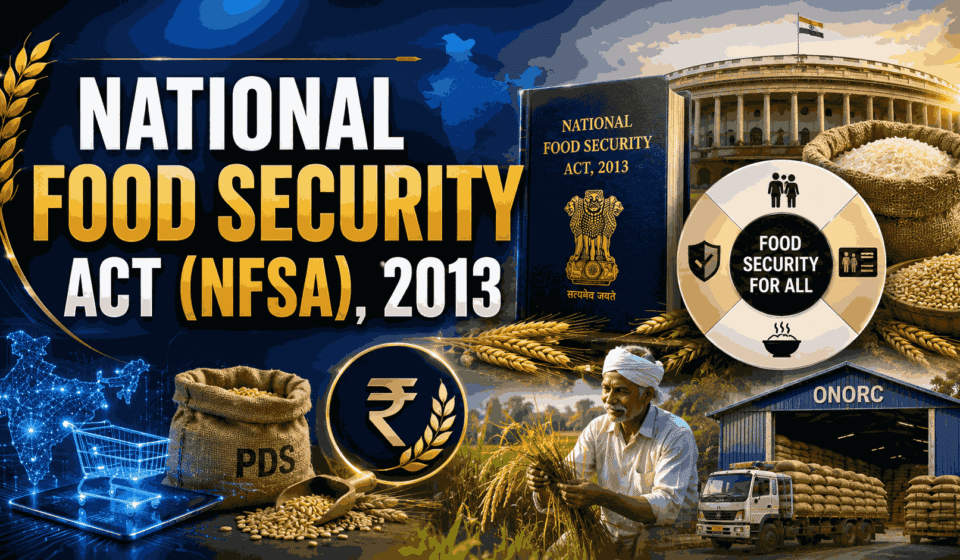
National Food Security Act (NFSA) 2013 Explained: Features, PDS, MSP, ONORC, Challenges & UPSC Notes

Introduction
Food security is not merely about ensuring that food grains are available in the market. It is fundamentally about guaranteeing that every individual has regular access to adequate, safe, nutritious, and affordable food necessary for leading an active and healthy life. In a country as vast and diverse as India, where socio-economic inequalities coexist with remarkable agricultural achievements, food security occupies a central place in public policy. India is today one of the world’s largest producers of rice, wheat, milk, pulses, fruits, and vegetables. Yet, despite these achievements, hunger, malnutrition, stunting, wasting, and anaemia continue to affect millions. This apparent paradox highlights a crucial distinction between food production and food security. Producing sufficient food does not automatically ensure that every citizen can access it. Recognizing that food security is essential for human dignity and social justice, Parliament enacted the National Food Security Act (NFSA), 2013. Rather than treating food assistance as a discretionary welfare measure, the Act transformed access to subsidized food into a legal entitlement for a large section of India’s population. It represents one of the world’s largest rights-based social protection programmes and reflects India’s constitutional commitment to building a welfare state.
Understanding the NFSA requires more than memorizing its provisions. It demands an appreciation of India’s historical experience with famine, the evolution of agricultural policy, constitutional jurisprudence on the right to food, institutional mechanisms such as the Public Distribution System (PDS), and contemporary challenges relating to nutrition, fiscal sustainability, and governance. This chapter explores these foundational concepts before examining the Act in detail.
Why is the National Food Security Act Important?
Although enacted in 2013, the NFSA remains one of the most relevant topics for UPSC because food security continues to evolve in response to changing economic conditions, technological reforms, and public policy innovations.
Recent developments have renewed attention on the Act, including:
- Continuation of free foodgrain distribution under the Pradhan Mantri Garib Kalyan Anna Yojana (PMGKAY) framework integrated with NFSA.
- Nationwide implementation of the One Nation One Ration Card (ONORC) system, enabling portability of food entitlements.
- Increasing emphasis on digitization, Aadhaar-based authentication, e-POS devices, and transparency in the Public Distribution System.
- Persistent concerns regarding malnutrition highlighted by national surveys and global hunger assessments.
- Ongoing debates on updating beneficiary coverage based on the latest population estimates, as current NFSA coverage is still linked to the 2011 Census.
These developments make NFSA a dynamic topic connecting governance, agriculture, nutrition, social justice, technology, and public finance.
What is Food Security?
Food security is often misunderstood as merely the availability of food. In reality, it is a multidimensional concept encompassing production, distribution, access, affordability, utilization, and stability over time.
According to the Food and Agriculture Organization (FAO), food security exists when all people, at all times, have physical, social, and economic access to sufficient, safe, and nutritious food that meets their dietary needs and food preferences for an active and healthy life.
This definition emphasizes four interconnected pillars:
| Pillar | Meaning | Why It Matters |
|---|---|---|
| Availability | Adequate production, imports, and stocks | Ensures sufficient food exists nationally. |
| Accessibility | Physical and economic access | Food must reach every individual regardless of income or location. |
| Utilization | Proper nutrition, sanitation, and healthcare | Availability alone cannot prevent malnutrition. |
| Stability | Continuous access despite shocks | Food security should persist during disasters, conflicts, inflation, or pandemics. |
Thus, a country may produce abundant food yet still experience widespread hunger if distribution systems fail or purchasing power is inadequate.
Understanding Hunger, Malnutrition, and Food Security
UPSC frequently distinguishes between these related concepts.
Hunger refers to the physical sensation caused by insufficient calorie intake. It primarily concerns the quantity of food consumed.
Malnutrition, however, is broader. It includes deficiencies, excesses, or imbalances in nutrient intake. A person consuming enough calories may still suffer from protein deficiency, iron deficiency, vitamin deficiency, or micronutrient malnutrition.
Food security goes beyond both hunger and malnutrition by ensuring continuous access to adequate, safe, and nutritious food.
This distinction explains why India can simultaneously maintain large buffer stocks of food grains while continuing to face high levels of child stunting and anaemia. Addressing food insecurity therefore requires integrated interventions in agriculture, healthcare, sanitation, women’s empowerment, education, and social protection.
Evolution of Food Security in India
India’s approach to food security has evolved significantly over the past century. The journey reflects changing national priorities, from preventing famine to ensuring legal entitlements.
Phase I: Colonial Period – Food Availability Without Security
During British rule, India witnessed several devastating famines, the most infamous being the Bengal Famine of 1943, in which millions perished. Contrary to popular belief, the famine was not caused solely by inadequate food production. Economic historian Amartya Sen later argued through his Entitlement Theory that many people died because they lost the economic means to access food, even when food was available in markets.
This insight fundamentally transformed global understanding of food security. It shifted the focus from aggregate food supply to people’s ability to obtain food.
Phase II: Post-Independence – Achieving Self-Sufficiency
After Independence, India inherited chronic food shortages and dependence on imports, particularly under the PL-480 programme from the United States. Frequent droughts during the 1960s exposed the vulnerability of India’s food system.
The response came through the Green Revolution, characterized by high-yielding varieties of wheat and rice, irrigation expansion, fertilizer use, rural infrastructure, and institutional support through the Food Corporation of India (FCI) and the Agricultural Prices Commission (now the Commission for Agricultural Costs and Prices).
India gradually transformed from a food-deficit nation into one of the world’s largest food producers.
Phase III: From Production to Distribution
Increasing agricultural production solved only part of the problem. Policymakers realized that poor households continued to face food insecurity because of poverty and unequal access. This led to the development of the Public Distribution System (PDS), which supplied essential food grains at subsidized prices through Fair Price Shops.
Initially universal in character, the PDS later evolved into the Targeted Public Distribution System (TPDS) in 1997, focusing subsidies on poorer households.
Phase IV: Rights-Based Welfare
The early twenty-first century marked a significant shift in India’s welfare philosophy. Instead of treating food assistance as government charity, policymakers increasingly viewed it as a legal entitlement linked to constitutional values.
This transformation was influenced by:
- Judicial recognition of the Right to Food.
- Civil society advocacy.
- Recommendations of expert committees.
- Growing international emphasis on social protection and human rights.
The culmination of this process was the enactment of the National Food Security Act, 2013, which legally guaranteed subsidized food grains to nearly two-thirds of India’s population.
Constitutional Basis of Food Security
One of the most important aspects of the NFSA is its constitutional foundation. Although the Constitution does not explicitly mention a “Right to Food,” several provisions collectively establish the State’s obligation to ensure food security.
Article 21 – Right to Life
The Supreme Court has consistently interpreted the Right to Life under Article 21 to include the right to live with dignity. This interpretation extends beyond mere survival and encompasses access to adequate nutrition and food.
Thus, food security derives constitutional legitimacy through judicial interpretation.
Directive Principles of State Policy
Several Directive Principles reinforce this obligation:
| Article | Relevance |
|---|---|
| Article 38 | Promote social welfare and reduce inequalities |
| Article 39(b) | Distribution of material resources for the common good |
| Article 39(c) | Prevent concentration of wealth |
| Article 41 | Public assistance in cases of need |
| Article 47 | Duty of the State to raise nutrition and public health |
Among these, Article 47 is particularly significant because it explicitly directs the State to improve nutritional standards and public health.
Right to Food Jurisprudence
An important milestone came with the landmark People’s Union for Civil Liberties (PUCL) vs Union of India (Right to Food Case, 2001). The case arose when food grains were lying unused in government warehouses while millions faced hunger during severe drought conditions.
The Supreme Court held that the State has an obligation to ensure that food reaches vulnerable populations and converted several food-related schemes into enforceable legal entitlements through interim orders.
The judgment strengthened the interpretation of Article 21 and laid the intellectual and legal foundation for the enactment of the National Food Security Act.
From Welfare Scheme to Legal Right
Before 2013, food distribution largely depended on executive policy. Governments could modify or discontinue schemes through administrative decisions. The NFSA fundamentally changed this approach.
Instead of merely operating welfare programmes, the State assumed a statutory obligation to provide specified food entitlements. Eligible beneficiaries gained legally enforceable rights rather than discretionary benefits.
This transition represents one of the defining characteristics of India’s rights-based welfare legislation, alongside laws such as:
- Right to Education Act, 2009
- Mahatma Gandhi National Rural Employment Guarantee Act (MGNREGA), 2005
- Forest Rights Act, 2006
What is the National Food Security Act, 2013?
The National Food Security Act, 2013 is a landmark social welfare legislation that seeks to provide food and nutritional security by ensuring access to adequate quantities of quality food at affordable prices.
The Act covers approximately 67% of India’s population, comprising 75% of the rural population and 50% of the urban population, subject to identification by State Governments.
Rather than focusing only on food grain distribution, the Act also recognizes the nutritional needs of pregnant women, lactating mothers, and children, thereby integrating food security with maternal and child welfare.
Objectives of the NFSA
The philosophy behind the Act extends beyond poverty alleviation. It aims to:
- Guarantee food security as a legal right.
- Reduce hunger and chronic undernutrition.
- Improve nutritional outcomes among women and children.
- Strengthen social justice and inclusive development.
- Promote human capital formation through better nutrition.
- Fulfil India’s constitutional commitment to a welfare state.
Mind Map
                     FOOD SECURITY
                           │
        ┌──────────────────┼───────────────────┐
        │                  │                   │
 Availability        Accessibility        Utilization
        │                  │                   │
 Production        Purchasing Power     Nutrition
 Imports           PDS                  Health
 Buffer Stocks     Affordability        Sanitation
        │
        └────────────── Stability ──────────────┘
                       │
             National Food Security Act
                       │
        Legal Right to Affordable Food
National Food Security Act, 2013: A Rights-Based Framework
The National Food Security Act (NFSA), 2013 is one of the world’s largest legally enforceable social welfare legislations. Unlike earlier food assistance programmes that depended largely on executive decisions, the Act creates statutory entitlements. This means that eligible beneficiaries possess a legal right to receive subsidised foodgrains, and governments have a corresponding legal obligation to provide them.
The Act aims not only to address hunger but also to improve nutritional outcomes, reduce inequality, protect vulnerable populations, and fulfil the constitutional vision of a welfare state.
Objectives of the Act
The objectives of the NFSA are multidimensional and extend beyond mere foodgrain distribution. The Act seeks to:
- Ensure food and nutritional security.
- Protect poor and vulnerable households from hunger.
- Guarantee affordable access to essential foodgrains.
- Improve maternal and child nutrition.
- Strengthen human capital through better nutrition.
- Promote social justice and inclusive development.
- Reduce inter-generational poverty caused by malnutrition.
The emphasis on nutrition, rather than simply calorie intake, reflects the changing understanding of food security in public policy.
Coverage under the NFSA
One of the defining features of the Act is its extensive coverage.
| Category | Coverage |
|---|---|
| Rural Population | Up to 75% |
| Urban Population | Up to 50% |
| Overall National Coverage | Approximately 67% of India’s population |
The identification of beneficiaries is undertaken by the State Governments and Union Territory Administrations, based on criteria prescribed by them within the framework of the Act.
A significant policy issue is that the present coverage continues to be based on the 2011 Census, despite substantial population growth. This has led to debates on whether beneficiary limits should be revised using updated population estimates.
Categories of Beneficiaries
The Act recognises two principal categories of beneficiaries.
1. Priority Households (PHH)
Priority Households constitute the majority of NFSA beneficiaries. These households are identified by State Governments according to socio-economic criteria such as income levels, deprivation indicators, and vulnerability. Each eligible individual is entitled to receive subsidised foodgrains every month.
2. Antyodaya Anna Yojana (AAY) Households
The Antyodaya Anna Yojana, launched in 2000 and incorporated into the NFSA framework, targets the poorest of the poor. Unlike Priority Households, where entitlement is calculated on a per-person basis, AAY households receive a fixed quantity of foodgrains per household, recognising their greater vulnerability.
Typical beneficiaries include:
- Landless agricultural labourers
- Elderly persons without social support
- Destitute households
- Households headed by widows
- Persons with severe disabilities
- Tribal households in remote areas
- Particularly Vulnerable Tribal Groups (PVTGs), where notified
The distinction reflects the principle of equity, whereby those with greater need receive greater support.
Foodgrain Entitlements
The NFSA specifies legally guaranteed foodgrain entitlements.
| Beneficiary Category | Monthly Entitlement |
|---|---|
| Priority Household | 5 kg per person |
| Antyodaya Anna Yojana Household | 35 kg per household |
Initially, the Act prescribed highly subsidised issue prices:
| Foodgrain | Original Central Issue Price |
|---|---|
| Rice | ₹3/kg |
| Wheat | ₹2/kg |
| Coarse Grains | ₹1/kg |
Subsequently, under the integrated Pradhan Mantri Garib Kalyan Anna Yojana (PMGKAY) framework, eligible beneficiaries have been receiving foodgrains free of cost under current Union Government policy.
Nutritional Security: Beyond Foodgrains
A distinguishing feature of the NFSA is that it broadens the concept of food security to include nutrition security. The Act recognises that vulnerable groups—especially women and children—require specialised nutritional interventions rather than only access to cereals. This reflects a life-cycle approach to nutrition.
Pregnant Women and Lactating Mothers
Every pregnant woman and lactating mother is entitled to:
- Nutritious meals during pregnancy and lactation through notified programmes.
- A maternity benefit of not less than ₹6,000, subject to applicable government schemes.
The objective is to improve maternal health, reduce low birth weight, and break the cycle of intergenerational malnutrition.
Nutritional Support for Children
The Act guarantees age-appropriate nutritional support for children.
| Age Group | Entitlement |
|---|---|
| 6 months–6 years | Nutritious meals through the Integrated Child Development Services (ICDS) network |
| 6–14 years | Cooked meals through the PM POSHAN Scheme (formerly Mid-Day Meal Scheme) in schools |
Thus, the NFSA integrates food security with child development and educational outcomes.
Why Nutrition Matters
Modern nutrition science demonstrates that hunger and malnutrition are distinct problems. A child may consume sufficient calories but still suffer from:
- Protein deficiency
- Iron deficiency
- Vitamin A deficiency
- Zinc deficiency
- Anaemia
- Stunting
- Wasting
Therefore, nutritional diversity, dietary quality, sanitation, healthcare, breastfeeding practices, and women’s education are all essential for achieving the objectives of the NFSA. This understanding explains why foodgrain distribution alone cannot eliminate malnutrition.
Public Distribution System (PDS)
The Public Distribution System (PDS) is the principal delivery mechanism through which NFSA entitlements reach beneficiaries. The PDS is a nationwide network that procures, stores, transports, and distributes essential foodgrains through Fair Price Shops. It acts as the operational bridge between agricultural production and household food consumption.
Evolution of the Public Distribution System
Universal PDS
Initially, the PDS functioned as a universal programme. All households could purchase subsidised foodgrains irrespective of income. While this promoted broad access, it also imposed a heavy fiscal burden and allowed subsidies to reach relatively affluent households.
Targeted Public Distribution System (TPDS)
In 1997, the Government introduced the Targeted Public Distribution System (TPDS) to focus subsidies on economically weaker sections. The NFSA built upon this framework by providing a statutory basis for food entitlements and refining beneficiary categories.
Flow of Foodgrains Under the NFSA
Farmers
    │
    ▼
Government Procurement (MSP)
    │
    ▼
Food Corporation of India (FCI)
    │
    ▼
Central Buffer Stocks
    │
    ▼
Allocation to States/UTs
    │
    ▼
State Warehouses
    │
    ▼
Fair Price Shops (FPS)
    │
    ▼
Eligible Beneficiaries
This chain illustrates how agricultural policy, procurement, logistics, and welfare delivery are integrated under the NFSA.
Minimum Support Price (MSP): The Foundation of Food Security
Food security begins with supporting farmers. The Government announces a Minimum Support Price (MSP) for major crops to ensure remunerative prices. Procurement at MSP encourages farmers to produce foodgrains while protecting them from market volatility.
The procured grains become the primary source for:
- Public Distribution System
- Buffer stocks
- Emergency food relief
- Welfare schemes
Thus, MSP is not only an agricultural policy instrument but also a key pillar of India’s food security architecture.
Food Corporation of India (FCI)
The Food Corporation of India (FCI), established in 1965, plays a pivotal role in implementing the NFSA.
Its major responsibilities include:
- Procuring foodgrains from farmers at MSP.
- Maintaining strategic and operational buffer stocks.
- Ensuring safe scientific storage.
- Transporting foodgrains across states.
- Supplying foodgrains for welfare programmes.
- Supporting price stabilisation during shortages.
The FCI therefore connects agricultural production with social welfare delivery.
Buffer Stocks: Insurance Against Food Insecurity
A buffer stock refers to foodgrains procured and stored by the Government to meet future requirements. Buffer stocks serve multiple purposes:
- Ensuring food availability during droughts, floods, or natural disasters.
- Stabilising market prices.
- Meeting NFSA obligations.
- Supporting emergency humanitarian assistance.
- Protecting national food security during crises such as pandemics.
The COVID-19 pandemic demonstrated the strategic importance of maintaining adequate buffer stocks.
Institutional Architecture of the NFSA
Successful implementation of the Act requires coordination across multiple institutions.
| Institution | Primary Responsibility |
|---|---|
| Ministry of Consumer Affairs, Food & Public Distribution | Overall policy formulation and implementation |
| Department of Food & Public Distribution | Procurement, allocation, food subsidy management |
| Food Corporation of India (FCI) | Procurement, storage, transport, buffer stocks |
| State Governments | Beneficiary identification, distribution, grievance redressal |
| Fair Price Shops (FPS) | Last-mile delivery of foodgrains |
| Panchayati Raj Institutions & Urban Local Bodies | Local monitoring, transparency, community oversight |
This cooperative federal structure requires close coordination between the Union and the States.
Transparency and Accountability Measures
Recognising the risks of corruption and leakages, the NFSA mandates several transparency provisions. These include:
- Digitisation of ration cards.
- Public disclosure of beneficiary lists.
- Social audits.
- Vigilance Committees at various levels.
- Computerisation of supply chains.
- Grievance Redressal Officers.
- State Food Commissions.
- Mandatory display of stock positions and entitlements at Fair Price Shops.
These mechanisms aim to make the system more accountable, reduce diversion of foodgrains, and strengthen public trust.
Grievance Redressal Mechanism
A legal entitlement is meaningful only if beneficiaries have effective remedies in case of denial. Accordingly, the NFSA provides for:
- District Grievance Redressal Officers (DGROs).
- State Food Commissions.
- Independent monitoring of implementation.
- Time-bound disposal of complaints.
- Penalties for non-compliance where applicable under the Act.
These provisions distinguish the NFSA from earlier welfare schemes by embedding accountability within the statutory framework.
How the NFSA Fits into India’s Welfare Ecosystem
             Constitutional Vision
                     │
                     ▼
            National Food Security Act
                     │
     ┌───────────────┼────────────────┐
     ▼               ▼                ▼
  Food Security   Nutrition      Social Justice
                     │
                     ▼
      ICDS • PM POSHAN • PDS • AAY
                     │
                     ▼
       Human Capital & Inclusive Development
The Act thus functions not as an isolated food distribution programme but as a central pillar of India’s broader social protection architecture.
Critical Analysis, Contemporary Reforms, Governance Challenges, International Comparisons, and the Way Forward
The National Food Security Act (NFSA), 2013 is often described as the world’s largest food security programme. However, its significance extends beyond the sheer scale of beneficiaries. It represents India’s attempt to balance three competing objectives:
- Protecting vulnerable households from hunger and malnutrition.
- Ensuring remunerative prices and income security for farmers through procurement.
- Maintaining fiscal sustainability while delivering an extensive welfare programme.
This balancing act is inherently complex. Food security is not merely a welfare issue; it is simultaneously an agricultural, economic, governance, public health, federal, and fiscal challenge. The success of the NFSA therefore depends not only on distributing foodgrains but also on continuously reforming institutions, improving technology, strengthening transparency, and adapting to emerging threats such as climate change and urbanisation.
Why Food Security Remains a Challenge Despite Large Food Stocks
India regularly produces more than enough cereals to meet domestic requirements and maintains one of the world’s largest public buffer stocks. Yet hunger and malnutrition persist. This apparent contradiction arises because food security depends on much more than production.
Several structural factors continue to undermine nutritional outcomes:
- Poverty limits purchasing power.
- Dietary diversity remains inadequate.
- Regional inequalities affect access to nutritious food.
- Women and children often face intra-household nutritional discrimination.
- Poor sanitation and unsafe drinking water reduce nutrient absorption.
- Climate variability affects agricultural production and food prices.
Thus, increasing production alone cannot guarantee food security. The challenge is to ensure that food reaches the right people, in the right quantity, at the right time, and in a nutritionally adequate form.
Major Challenges in the Implementation of the NFSA
1. Identification of Beneficiaries
One of the most persistent criticisms of the NFSA relates to beneficiary identification. Although the Act legally guarantees food security, it leaves the identification of eligible households largely to State Governments. This has resulted in considerable variation across States.
Two types of errors commonly occur:
Exclusion Errors
These arise when genuinely poor households are left out of the beneficiary list due to outdated records, documentation issues, migration, or administrative shortcomings. Such exclusion is particularly problematic because the NFSA is a rights-based legislation. Denial of benefits effectively means denial of a statutory entitlement.
Inclusion Errors
Conversely, some relatively well-off households continue to receive benefits despite no longer meeting eligibility criteria. Inclusion errors increase fiscal costs and reduce the efficiency of subsidy delivery. The continued reliance on 2011 Census population data further compounds these problems. Population growth since then has left millions outside the coverage limits prescribed under the Act.
2. Leakages and Diversion of Foodgrains
Historically, the Public Distribution System suffered from significant leakages. Foodgrains intended for beneficiaries were often diverted to the open market through corrupt intermediaries.
Major causes included:
- Fake ration cards.
- Ghost beneficiaries.
- Weak monitoring.
- Manual record keeping.
- Poor transportation oversight.
- Political patronage.
- Inadequate social accountability.
Although digitisation has significantly reduced these leakages in many States, challenges persist in certain regions.
3. Quality of Foodgrains
The NFSA guarantees access to foodgrains, but ensuring quality remains equally important. Beneficiaries have often reported issues such as:
- Poor grain quality.
- Damaged stocks due to improper storage.
- Delays in transportation.
- Inadequate storage infrastructure.
- Pest infestation.
Improving warehouse management and scientific storage remains an important policy priority.
4. Fiscal Burden
The NFSA represents one of the largest subsidy programmes in the Union Budget. Food subsidy expenditure includes:
- Procurement at Minimum Support Price (MSP).
- Storage costs.
- Transportation.
- Distribution through Fair Price Shops.
- Operational expenses of the Food Corporation of India (FCI).
While these expenditures are essential for social protection, they also place significant pressure on public finances.
5. Nutritional Deficiencies Beyond Cereals
The NFSA primarily guarantees cereals such as wheat and rice. However, modern nutrition science recognises that a healthy diet requires:
- Proteins.
- Pulses.
- Fruits.
- Vegetables.
- Eggs.
- Milk.
- Healthy fats.
- Micronutrients.
Consequently, merely distributing cereals cannot eliminate:
- Stunting.
- Wasting.
- Anaemia.
- Micronutrient deficiencies.
Several States have therefore experimented with including pulses, fortified rice, edible oil, and millets within public nutrition programmes.
Technology-Led Reforms
Recognising implementation challenges, the Government has undertaken extensive digitisation reforms.
Aadhaar-Based Authentication
Biometric authentication has reduced duplication of beneficiaries. Major benefits include:
- Elimination of fake ration cards.
- Better targeting.
- Improved transparency.
- Reduced diversion.
However, policymakers must ensure that authentication failures do not result in genuine beneficiaries being denied food. Technology should improve inclusion rather than create new barriers.
End-to-End Computerisation
The computerisation of the Public Distribution System has transformed foodgrain management. It includes:
- Online allocation.
- GPS tracking.
- Digital stock monitoring.
- Automated supply chain management.
- Electronic Point of Sale (e-POS) devices.
These reforms have substantially improved transparency and accountability.
One Nation One Ration Card (ONORC)
One of the most significant reforms under the NFSA ecosystem is the One Nation One Ration Card (ONORC) initiative.
What is ONORC?
ONORC enables eligible beneficiaries to obtain their subsidised foodgrains from any Fair Price Shop across India, irrespective of the State in which their ration card was originally issued.
Why Was ONORC Needed?
India has millions of seasonal and migrant workers. Before ONORC:
- Workers migrating from Bihar to Gujarat or from Odisha to Delhi often lost access to subsidised food.
- Families were forced to choose between employment opportunities and food security.
ONORC addresses this problem by ensuring portability of food entitlements.
Benefits
- Supports migrant workers.
- Promotes national integration.
- Reduces exclusion.
- Strengthens labour mobility.
- Improves beneficiary convenience.
- Enhances transparency.
The COVID-19 pandemic highlighted the importance of this reform when millions of migrant workers returned to their native places.
PM Garib Kalyan Anna Yojana (PMGKAY)
The COVID-19 pandemic posed an unprecedented threat to food security. In response, the Government launched the Pradhan Mantri Garib Kalyan Anna Yojana (PMGKAY). Initially introduced as an emergency measure, PMGKAY provided additional free foodgrains to NFSA beneficiaries. Subsequently, the programme was integrated with the NFSA framework, ensuring free foodgrain distribution under current policy. The pandemic demonstrated the strategic importance of maintaining robust buffer stocks and an efficient public distribution network.
Climate Change and Food Security
One of the greatest future challenges to food security is climate change. Its effects include:
- Erratic monsoons.
- Heat waves.
- Floods.
- Droughts.
- Pest outbreaks.
- Reduced crop productivity.
- Water scarcity.
These developments threaten agricultural production and increase food price volatility. Climate-resilient agriculture, diversification, improved irrigation, crop insurance, and sustainable farming practices will therefore become increasingly important for ensuring long-term food security.
Diversification Towards Nutri-Cereals
Traditional food security policy focused mainly on wheat and rice. However, dietary diversification is increasingly recognised as essential. The Government has promoted millets (Shree Anna) because they are:
- Nutrient-rich.
- Climate resilient.
- Water efficient.
- Suitable for dryland farming.
The celebration of the International Year of Millets (2023) has encouraged several States to include millets in nutrition programmes. This represents an important shift from food security towards nutrition security.
International Experiences
Comparative analysis helps understand different approaches to food security.
| Country | Approach | Key Learning for India |
|---|---|---|
| Brazil | Zero Hunger Programme integrating food, nutrition, and poverty reduction | Integrate food distribution with livelihood generation |
| United States | Supplemental Nutrition Assistance Program (SNAP) using electronic benefit cards | Technology-enabled beneficiary choice |
| China | Strategic grain reserves and domestic food self-sufficiency | Importance of long-term food reserves |
| Japan | Focus on food quality, nutrition, and domestic production | Emphasise dietary diversity and nutrition |
India’s NFSA stands out because it combines legal entitlement, large-scale procurement, price support for farmers, and subsidised distribution under a single legislative framework.
Critical Evaluation of the NFSA
The Act has produced significant achievements:
Strengths
- Largest food security programme globally.
- Legal recognition of the Right to Food.
- Improved protection of vulnerable households.
- Reduced extreme hunger.
- Strengthened social protection during crises.
- Enhanced women’s nutritional support.
- Improved transparency through digitisation.
- Strengthened cooperative federalism.
However, important concerns remain.
Limitations
- Coverage based on outdated Census data.
- Continued dependence on cereals.
- High fiscal burden.
- Regional implementation disparities.
- Storage inefficiencies.
- Nutritional deficiencies persist.
- Climate vulnerability.
- Procurement concentrated in a few States.
Thus, while the NFSA has substantially strengthened food access, achieving comprehensive nutrition security requires broader reforms.
Committee and Institutional Recommendations
High Level Committee on Restructuring FCI (Shanta Kumar Committee, 2015)
The Committee recommended:
- Rationalising procurement.
- Decentralised procurement by States.
- Improving storage infrastructure.
- Reducing excess buffer stocks.
- Increasing efficiency in subsidy delivery.
- Encouraging Direct Benefit Transfer (DBT) where appropriate.
NITI Aayog
NITI Aayog has emphasised:
- Nutrition-sensitive agriculture.
- Diversification towards pulses and millets.
- Improved targeting through technology.
- Greater convergence between agriculture, health, and nutrition programmes.
- Strengthening cooperative federalism.
Way Forward
The future of India’s food security policy lies not in replacing the NFSA but in strengthening it through evidence-based reforms.
A comprehensive strategy should include:
- Revision of beneficiary coverage using updated population estimates to reduce exclusion errors.
- Diversification of food baskets by incorporating pulses, millets, edible oils, and fortified foods to improve nutrition.
- Strengthening climate-resilient agriculture through sustainable farming, water conservation, and resilient crop varieties.
- Modernising storage infrastructure with scientific warehouses, silos, and better logistics to minimise post-harvest losses.
- Expanding digital governance while ensuring that technology remains inclusive and does not exclude vulnerable beneficiaries due to authentication failures.
- Deepening cooperative federalism, enabling States to innovate while maintaining national standards of transparency and accountability.
- Converging food security with health, sanitation, women’s empowerment, and livelihood programmes, recognising that nutrition outcomes depend on multiple sectors working together.
The long-term objective should be to move from food security to nutrition security, and ultimately towards human development security, where every citizen has the capability to lead a healthy, productive, and dignified life.
Revision
                     Food Security
                           │
                           ▼
               National Food Security Act
                           │
        ┌──────────────────┼───────────────────┐
        ▼                  ▼                   ▼
 Procurement          Distribution        Nutrition
 (MSP + FCI)             (PDS)         Women & Children
        │                  │                   │
        ▼                  ▼                   ▼
 Buffer Stocks      ONORC • e-POS       ICDS • PM POSHAN
        │
        ▼
 Challenges
 │
 ├── Exclusion Errors
 ├── Leakages
 ├── Fiscal Burden
 ├── Climate Change
 ├── Nutrition Gap
 └── Outdated Coverage
        │
        ▼
 Technology + Diversification + Governance Reforms
        │
        ▼
 Sustainable Food & Nutrition Security
Prelims Revision Box
| Topic | Must Remember |
|---|---|
| Enactment | 2013 |
| Coverage | 75% Rural, 50% Urban (≈67% population) |
| PHH Entitlement | 5 kg/person/month |
| AAY Entitlement | 35 kg/household/month |
| Constitutional Basis | Articles 21, 38, 39, 41, 47 |
| Major Institutions | FCI, Department of Food & Public Distribution, State Governments |
| Delivery Mechanism | Targeted Public Distribution System (TPDS) |
| Major Reform | One Nation One Ration Card (ONORC) |
| Key Technology | Aadhaar, e-POS, Digitisation |
| Landmark Case | PUCL v. Union of India (Right to Food Case, 2001) |
Final Mind Map
                    NATIONAL FOOD SECURITY ACT
                               │
        ┌──────────────────────┼────────────────────────┐
        │                      │                        │
 Constitutional          Agriculture              Governance
 Foundation                 │                        │
        │                   MSP                  PDS
 Article 21                 │                 ONORC
 Article 47                 │                 Aadhaar
        │                   │                 e-POS
        │                   │                    │
        └─────────────── Food Security ──────────┘
                               │
                     Nutrition Security
                               │
                 Women • Children • ICDS • PM POSHAN
                               │
                    Human Development & Social Justice
30-Second Prelims Revision
| Topic | Revision |
|---|---|
| Act | National Food Security Act, 2013 |
| Coverage | 75% Rural, 50% Urban |
| PHH | 5 kg/person/month |
| AAY | 35 kg/household/month |
| Major Institution | FCI |
| Procurement | MSP |
| Delivery | TPDS |
| Reform | ONORC |
| Constitutional Basis | Articles 21 & 47 |
| Landmark Case | PUCL vs Union of India (2001) |
Conclusion
The National Food Security Act, 2013 is far more than a food distribution programme. It represents the constitutional promise of a welfare state translated into a legally enforceable entitlement. By integrating agricultural procurement, public distribution, nutritional support, and social protection, the Act has fundamentally reshaped India’s approach to food security.
Yet the future of food security lies not merely in distributing cereals but in ensuring nutrition, resilience, sustainability, and dignity. As India confronts challenges such as climate change, rapid urbanisation, changing dietary patterns, and fiscal constraints, the evolution of the NFSA will require a shift from quantity-based food support to comprehensive nutrition security. For civil services aspirants, this topic exemplifies the intersection of Polity, Economy, Agriculture, Governance, Public Health, Social Justice, and Sustainable Development, making it a perennial favourite for Prelims, Mains, Essay, and Interview.
FAQs
Q1. What is the National Food Security Act (NFSA), 2013?
It is a rights-based legislation that provides eligible households with legal entitlements to subsidised foodgrains and nutritional support, aiming to ensure food and nutrition security.
Q2. What is the difference between Priority Households (PHH) and Antyodaya Anna Yojana (AAY)?
PHH beneficiaries receive foodgrains on a per-person basis (5 kg/person/month), while AAY households—identified as the poorest of the poor—receive 35 kg of foodgrains per household per month.
Q3. How does the One Nation One Ration Card (ONORC) scheme strengthen the NFSA?
ONORC enables beneficiaries to access their foodgrain entitlements from any Fair Price Shop across India, improving portability for migrant workers without changing their statutory entitlements.
Q4. Why is the Food Corporation of India (FCI) important under the NFSA?
FCI procures foodgrains at MSP, maintains buffer stocks, stores and transports foodgrains, and supplies them to States for distribution through the Public Distribution System.
Q5. What are the major challenges in implementing the NFSA?
Key challenges include exclusion and inclusion errors, outdated beneficiary coverage, fiscal burden, storage inefficiencies, persistent malnutrition, and climate-related risks to food systems.
About The Author