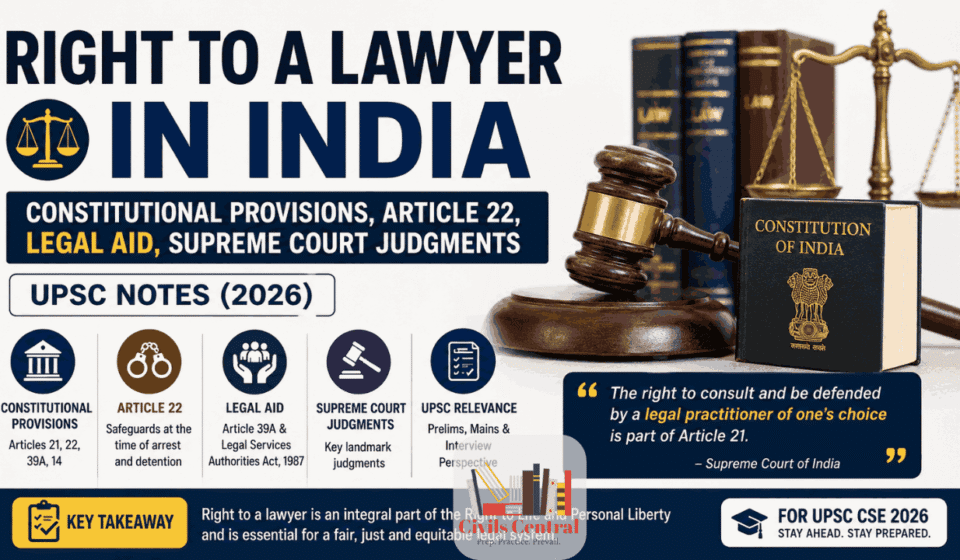
Right to a Lawyer in India: Constitutional Provisions, Article 22, Legal Aid, Supreme Court Judgments

Introduction
Justice is meaningful only when it is accessible. A legal system may contain the finest constitutional guarantees and the most progressive laws, but these promises remain hollow if an individual is unable to understand or defend their rights before the law. The right to a lawyer, therefore, is not merely a procedural safeguard available during criminal proceedings; it is an indispensable component of the rule of law, constitutional democracy, and the administration of justice.
The framers of the Indian Constitution envisioned a legal order in which every individual, irrespective of wealth, education, social status or political influence, would receive equal protection of the law. This vision finds expression in the Preamble’s commitment to justice—social, economic and political—as well as in Fundamental Rights and Directive Principles that collectively seek to eliminate barriers to justice.
In contemporary India, the right to legal representation has acquired even greater significance. Rising crime, complex legislation, preventive detention laws, expanding police powers, digital evidence, cybercrime investigations, and increasing undertrial populations have made legal assistance indispensable rather than optional. For vulnerable groups such as women, children, Scheduled Castes, Scheduled Tribes, migrant workers, persons with disabilities and economically weaker sections, the absence of legal representation can often determine whether constitutional rights are effectively protected or irretrievably lost.
The Supreme Court has repeatedly emphasized that access to a competent lawyer is inseparable from the guarantee of a fair trial under Article 21. Through judicial interpretation, the Court has transformed what was once viewed as a procedural entitlement into an essential ingredient of the right to life and personal liberty. Today, the right to legal representation stands at the intersection of constitutional law, criminal justice, human rights, legal aid, prison reforms and good governance.
Understanding this right, therefore, is essential not only for appreciating India’s constitutional framework but also for evaluating the effectiveness of its justice delivery system.
Why in News?
The issue of the Right to a Lawyer recently came into focus following observations of the Supreme Court emphasizing that access to legal representation is an indispensable constitutional safeguard and that denial of effective legal assistance can vitiate the fairness of criminal proceedings. The Court reiterated that legal representation is not a mere procedural formality but an essential element of the right to life and personal liberty guaranteed under Article 21.
The judgment once again highlighted the judiciary’s continuing effort to strengthen fair trial standards and ensure that constitutional protections are meaningful for every accused person, particularly those belonging to vulnerable and economically disadvantaged sections of society.
While the immediate news relates to a specific judicial decision, the larger issue concerns the constitutional philosophy underlying criminal justice in India. UPSC is therefore more likely to examine the broader concepts of fair trial, legal aid, access to justice, constitutional rights, and judicial interpretation than the factual details of any individual case.
What is the Right to a Lawyer?
At its simplest level, the right to a lawyer means that a person involved in legal proceedings has the opportunity to consult, engage and be represented by a qualified legal practitioner in order to protect his or her legal rights.
However, constitutional jurisprudence gives this concept a much wider meaning.
The right to a lawyer is fundamentally the right to receive professional legal assistance whenever the power of the State is exercised against an individual in a manner that may affect life, liberty or legal rights. It ensures that an accused is not compelled to face the coercive machinery of the State alone.
The criminal justice system is inherently unequal. On one side stands the State, equipped with police, prosecutors, investigative agencies, forensic laboratories and statutory authority. On the other side often stands an ordinary citizen who may possess neither legal knowledge nor financial resources. The presence of a lawyer helps correct this structural imbalance by ensuring that legal procedures are followed, constitutional guarantees are respected and the accused receives a meaningful opportunity to defend himself.
Thus, the right to a lawyer is not intended to protect criminals; rather, it protects the integrity of the justice system itself. A fair trial benefits society because it minimizes wrongful convictions while ensuring that genuine offenders are punished according to law.
Why Does Every Democratic Society Recognize This Right?
Every democratic legal system is founded upon a simple but profound principle: no individual should lose liberty without due process of law. Due process requires much more than a formal courtroom hearing. It requires that the individual understands the charges, knows the evidence, has an opportunity to challenge the prosecution, present a defence, examine witnesses and appeal adverse decisions. Without legal representation, most citizens cannot effectively exercise these rights.
The right to counsel therefore performs several constitutional functions simultaneously. It acts as a shield against arbitrary State action, strengthens judicial accountability, improves the quality of criminal investigations, enhances public confidence in the judiciary and reinforces the rule of law.
Seen from this perspective, access to a lawyer is not merely a personal privilege but a constitutional necessity for maintaining democratic governance.
Historical Evolution of the Right to Legal Representation
The idea that an individual should receive legal assistance did not emerge overnight. It evolved gradually through centuries of legal development, constitutional struggles and human rights movements across the world.
Early Common Law Traditions
In medieval England, criminal trials were heavily weighted in favour of the Crown. Persons accused of serious offences often had little or no opportunity to obtain professional legal assistance. Courts expected the accused to defend themselves, regardless of their education or social background.
This system reflected the belief that judges themselves would ensure fairness during trials. In practice, however, this assumption frequently proved unrealistic because judges could not simultaneously perform the roles of impartial adjudicator and defence counsel.
Over time, legal reformers recognized that equality before law required professional legal representation.
Influence of the Magna Carta (1215)
Although the Magna Carta did not explicitly recognize the right to counsel, it laid the philosophical foundation for later developments by asserting that the King himself was subject to law.
Its famous declaration that no free person shall be deprived of liberty except according to the law of the land gradually evolved into the broader doctrine of due process.
The idea that liberty could be taken away only through fair legal procedures later became one of the strongest arguments in favour of providing legal representation during criminal proceedings.
Development in the United States
The American constitutional experience significantly expanded the concept. The Sixth Amendment to the United States Constitution expressly guarantees the right of an accused person to have the assistance of counsel in criminal prosecutions.
Initially, this protection was interpreted narrowly. However, the landmark judgment in Gideon v. Wainwright (1963) transformed American criminal justice by holding that indigent defendants facing serious criminal charges must be provided lawyers at State expense.
This judgment established that access to legal representation is essential for equal justice.
Emergence as a Human Right
Following the atrocities of the Second World War, the international community increasingly recognized that procedural safeguards were essential to prevent abuse of State power.
The Universal Declaration of Human Rights (1948) declared that everyone is entitled to a fair and public hearing by an independent tribunal.
Subsequently, the International Covenant on Civil and Political Rights (ICCPR) explicitly recognized the right of every accused person to defend himself through legal assistance of his own choosing and to receive free legal assistance whenever the interests of justice require and the accused lacks sufficient means.
India, being a party to the ICCPR, has progressively harmonized its domestic jurisprudence with these international standards.
Evolution of the Right to a Lawyer in India
When the Constitution of India came into force in 1950, it did not contain a separate Fundamental Right specifically titled the “Right to a Lawyer.” Nevertheless, the constitutional architecture clearly reflected the framers’ commitment to procedural fairness.
Article 22 guaranteed that every arrested person shall have the right to consult and be defended by a legal practitioner of his choice. This provision was particularly significant because it recognized legal representation at one of the earliest stages of criminal proceedings—immediately after arrest.
Initially, however, courts interpreted constitutional rights relatively narrowly.
The turning point came after the landmark decision in Maneka Gandhi v. Union of India (1978), where the Supreme Court radically expanded the meaning of Article 21. The Court held that any procedure depriving a person of life or liberty must be “just, fair and reasonable.”
This transformed constitutional jurisprudence. Fair procedure now necessarily included access to competent legal representation.
Subsequent decisions such as Hussainara Khatoon, Khatri, Suk Das, and several others established that free legal aid is not charity or welfare; it is a constitutional obligation flowing directly from Articles 21 and 39A.
Thus, what began as a procedural safeguard under Article 22 gradually evolved into one of the core components of the right to life and personal liberty.
Why the Right to a Lawyer Matters: Beyond the Courtroom
The importance of legal representation extends far beyond defending an accused person during trial. It influences every stage of the criminal justice process, from arrest to investigation, trial, appeal and even post-conviction remedies.
A lawyer ensures that police investigations comply with constitutional safeguards, prevents the extraction of involuntary confessions, safeguards the accused against unlawful detention, assists in obtaining bail, challenges illegally collected evidence and ensures that procedural rights are respected throughout the judicial process.
The presence of competent legal representation also improves the quality of judicial decision-making. Courts receive well-structured arguments, relevant precedents and proper interpretation of statutes, enabling judges to arrive at more accurate and legally sound decisions.
From the perspective of governance, effective legal representation enhances public confidence in institutions. Citizens are more likely to trust courts, police and the legal system when they believe that justice is administered fairly rather than arbitrarily.
Most importantly, the right to a lawyer reflects the constitutional morality of the Indian Republic. It recognizes that the true test of a democracy lies not in how it treats the powerful but in how it protects the rights of the weakest individual standing before the law.
How Does the Indian Constitution Protect the Right to a Lawyer?
One of the remarkable features of the Indian Constitution is that it rarely recognizes rights in isolation. Instead, it creates a web of mutually reinforcing constitutional guarantees that collectively protect individual liberty. The right to a lawyer is one such example. Although there is no separate Fundamental Right explicitly titled “Right to Legal Representation,” several constitutional provisions, when read together and interpreted by the Supreme Court, create a comprehensive framework that safeguards this right.
The constitutional protection of legal representation has evolved through judicial interpretation. What began as a procedural safeguard under Article 22 has gradually become an integral part of the broader guarantee of life, liberty and fair procedure under Article 21. Simultaneously, Articles 14 and 39A ensure that justice is not confined to those who can afford legal services but is available equally to every citizen.
Thus, the constitutional basis of the right to a lawyer rests on the harmonious interpretation of multiple provisions rather than on a single article.
Article 14: Equality Before Law and Equal Protection of Laws
Article 14 guarantees that the State shall not deny to any person equality before the law or the equal protection of the laws within the territory of India.
At first glance, this provision appears to concern only equal treatment. However, constitutional jurisprudence has expanded its meaning significantly. Equality before the law is meaningful only when individuals possess a genuine opportunity to defend themselves. If two accused persons face identical criminal charges but only one can afford an experienced lawyer while the other lacks any legal assistance, the equality promised by Article 14 becomes largely illusory.
The Supreme Court has therefore interpreted Article 14 as requiring not merely formal equality but substantive equality. In many circumstances, substantive equality demands affirmative measures by the State, such as providing free legal aid to economically weaker sections.
This understanding reflects the modern constitutional principle that equal justice cannot exist without equal access to justice.
Article 21: Right to Life and Personal Liberty
Article 21 provides: “No person shall be deprived of his life or personal liberty except according to procedure established by law.”
Initially, the Supreme Court interpreted this provision narrowly. As long as a law prescribed a procedure, deprivation of liberty was considered constitutionally valid. This approach changed fundamentally after the landmark judgment in Maneka Gandhi v. Union of India (1978).
The Court held that the procedure established by law cannot be arbitrary, unfair or unreasonable. Instead, it must satisfy the requirements of fairness, justice and reasonableness.
This transformed Article 21 into the fountainhead of numerous procedural rights, including:
- Right to a fair trial
- Right to speedy trial
- Right against custodial torture
- Right to legal aid
- Right to dignity
- Right to privacy
- Right to free legal representation where necessary
Consequently, the right to a lawyer today is regarded as an inseparable component of the constitutional guarantee of fair procedure under Article 21. Without legal assistance, a person may technically receive a trial but may not receive a fair trial, thereby violating Article 21.
Why Article 21 Became the Cornerstone
The expansion of Article 21 reflects a broader shift in constitutional philosophy. Earlier, constitutional rights were viewed negatively—that is, they merely restrained State action. Modern constitutionalism, however, recognizes that the State must also take positive steps to ensure that rights are effectively enjoyed.
Providing legal aid to poor and vulnerable citizens is one such positive constitutional obligation.
Article 22(1): The Explicit Constitutional Right
Among all constitutional provisions, Article 22(1) is the only one that expressly refers to legal representation.
It states: “No person who is arrested shall be denied the right to consult, and to be defended by, a legal practitioner of his choice.”
This provision serves two important purposes.
First, it recognizes that legal assistance must be available from the earliest stage of criminal proceedings rather than only during the trial. The period immediately following arrest is often the most vulnerable stage, when the accused may face interrogation, coercion or unlawful detention. Early access to legal counsel helps protect constitutional safeguards.
Second, Article 22(1) reinforces the adversarial nature of India’s criminal justice system, where both prosecution and defence present their cases before an impartial judge.
However, Article 22(1) primarily guarantees the right to engage a lawyer of one’s own choice. It does not, by itself, impose a constitutional obligation on the State to provide a lawyer free of cost. That obligation emerged through judicial interpretation of Articles 21 and 39A.
Article 39A: Equal Justice and Free Legal Aid
Article 39A, inserted through the 42nd Constitutional Amendment Act, 1976, occupies a unique place in India’s constitutional philosophy.
It directs the State to ensure that:
- the operation of the legal system promotes justice on the basis of equal opportunity; and
- free legal aid is provided so that opportunities for securing justice are not denied because of economic or other disabilities.
Although Article 39A forms part of the Directive Principles of State Policy and is therefore not directly enforceable in courts, it has profoundly influenced constitutional interpretation. The Supreme Court has repeatedly held that Article 39A must be read together with Articles 14 and 21. Through this integrated interpretation, free legal aid has acquired the status of an enforceable constitutional right.
Thus, Article 39A represents one of the finest examples of Directive Principles shaping Fundamental Rights.
Why Article 39A Matters
The Article reflects the realization that justice cannot depend upon economic capacity. A Constitution committed to social justice cannot permit liberty to become a privilege available only to those who can afford expensive legal representation.
How Different Articles Work Together
The constitutional framework can be understood as an interconnected system rather than isolated provisions.
                 PREAMBLE
                      │
        Justice • Liberty • Equality
                      │
      ┌───────────────┼───────────────┐
      │               │               │
 Article 14      Article 21     Article 22(1)
 Equality        Fair Procedure   Right to Counsel
      │               │               │
      └───────────────┼───────────────┘
                      │
                 Article 39A
           Equal Justice & Legal Aid
                      │
          Constitutional Right to
           Effective Legal Representation
This integrated reading is one of the hallmarks of Indian constitutional jurisprudence.
Is the Right to a Lawyer a Fundamental Right?
This question frequently appears in UPSC examinations because it requires conceptual understanding rather than rote memorization.
The answer is nuanced. The Constitution does not expressly list the “Right to a Lawyer” as an independent Fundamental Right.
However, the Supreme Court has interpreted Articles 21 and 22 together to hold that effective legal representation forms an essential component of the Fundamental Right to life and personal liberty.
Therefore, while the right originates from multiple constitutional provisions, its enforceability today flows primarily from Article 21.
In constitutional law, this is an example of judicially expanded Fundamental Rights.
Distinguishing Related Concepts
Many students confuse several closely related constitutional concepts. Understanding their differences is essential for both Prelims and Mains.
| Concept | Meaning | Why It Matters |
|---|---|---|
| Right to a Lawyer | Right to consult and be represented by a legal practitioner. | Ensures effective defence against State action. |
| Right to Legal Aid | Right of indigent persons to receive legal assistance at State expense. | Prevents economic inequality from becoming legal inequality. |
| Right to Fair Trial | Guarantee that judicial proceedings are impartial, transparent and just. | Upholds public confidence in the justice system. |
| Right Against Self-Incrimination | Protection against being compelled to testify against oneself under Article 20(3). | Prevents coercive investigations and custodial abuse. |
The relationship among these rights is complementary rather than competitive. Legal representation strengthens the exercise of all other procedural safeguards.
Statutory Framework Supporting the Right to a Lawyer
While the Constitution provides the normative foundation, Parliament has enacted several laws to operationalize this right. These statutes transform constitutional ideals into practical legal mechanisms that function within the criminal justice system.
The most significant among them are:
- Bharatiya Nagarik Suraksha Sanhita (BNSS), 2023
- Bharatiya Sakshya Adhiniyam (BSA), 2023
- Legal Services Authorities Act, 1987
- Advocates Act, 1961
Together, these laws regulate criminal procedure, legal representation, evidentiary standards and institutional mechanisms for legal aid.
Bharatiya Nagarik Suraksha Sanhita (BNSS), 2023
The BNSS, which replaced the Code of Criminal Procedure, 1973, retains the essential procedural safeguards relating to fair investigation and legal representation while introducing reforms aimed at improving efficiency and the use of technology in criminal justice.
Its provisions ensure that an accused person has opportunities to engage legal counsel during investigation, arrest, remand, bail proceedings and trial. Judicial oversight during these stages helps prevent arbitrary deprivation of liberty.
The BNSS also seeks to reduce procedural delays, thereby complementing the constitutional right to a speedy and fair trial under Article 21.
Bharatiya Sakshya Adhiniyam (BSA), 2023
The Bharatiya Sakshya Adhiniyam governs the admissibility and evaluation of evidence in criminal and civil proceedings. The increasing use of electronic records, digital communications and forensic evidence has made criminal litigation far more complex than before.
Competent legal representation is therefore essential for:
- challenging illegally obtained evidence,
- cross-examining expert witnesses,
- testing forensic reliability,
- protecting constitutional rights during evidentiary proceedings.
Thus, developments in evidence law have further strengthened the practical necessity of legal counsel.
Legal Services Authorities Act, 1987
The Legal Services Authorities Act operationalizes Article 39A by creating an institutional framework for providing free legal aid to eligible persons. The Act recognizes that legal assistance is a public service rather than a commercial privilege.
It establishes legal services authorities at the national, state and district levels, enabling economically weaker sections to obtain legal representation without financial hardship.
The Act also promotes:
- Lok Adalats,
- legal literacy,
- mediation,
- alternative dispute resolution,
- legal awareness programmes.
This legislation represents one of India’s most significant efforts to democratize access to justice.
Institutional Architecture for Legal Aid
India has developed a multi-tier institutional framework to ensure that legal assistance reaches citizens across the country.
| Institution | Primary Role |
|---|---|
| NALSA | National policy formulation, coordination and legal aid programmes. |
| State Legal Services Authorities (SLSAs) | Implement legal aid policies within States and Union Territories. |
| District Legal Services Authorities (DLSAs) | Provide legal aid at the district level and conduct legal awareness activities. |
| Taluk Legal Services Committees | Extend legal aid to rural and semi-urban populations. |
| Legal Aid Clinics | Offer free legal advice, especially in villages, educational institutions and prisons. |
This decentralized structure reflects the constitutional objective of bringing justice closer to citizens rather than expecting citizens to navigate complex legal institutions on their own.
Constitutional Framework at a Glance
| Article | Core Principle | UPSC Importance |
|---|---|---|
| Article 14 | Equality before Law | Substantive Equality |
| Article 20(3) | Protection against Self-Incrimination | Criminal Justice |
| Article 21 | Fair Procedure | Expansive Judicial Interpretation |
| Article 22(1) | Right to Consult and be Defended by a Lawyer | Arrest Safeguards |
| Article 39A | Equal Justice & Free Legal Aid | DPSP linked with FR |
How the Supreme Court Transformed the Right to a Lawyer into a Fundamental Right
The Constitution laid the foundation for the right to legal representation, but it was the judiciary that gave this right substantive meaning. Through a series of landmark judgments spanning several decades, the Supreme Court converted what appeared to be a procedural safeguard into an indispensable component of the right to life and personal liberty under Article 21.
This evolution reflects one of the defining characteristics of Indian constitutional law: the dynamic interpretation of Fundamental Rights to meet the needs of a changing society. Rather than treating the Constitution as a static legal document, the Court has interpreted it as a living instrument capable of responding to new challenges in governance and justice.
A study of these judgments is essential because UPSC frequently tests not only constitutional provisions but also the judicial doctrines that emerge from them.
From Procedure to Justice: The Constitutional Transformation
In the early decades after Independence, courts generally viewed procedural rights in a formal manner. As long as a trial was conducted according to the procedure prescribed by law, constitutional requirements were considered satisfied.
However, this approach often ignored the realities of Indian society. A poor, illiterate or marginalized accused person could technically undergo a trial while remaining completely unaware of legal rights, unable to challenge evidence, and incapable of presenting an effective defence.
The Supreme Court gradually realized that formal compliance with procedure is not the same as substantive justice.
This shift became particularly evident after Maneka Gandhi v. Union of India (1978), where the Court held that the procedure contemplated under Article 21 must be “just, fair and reasonable.” Once this principle was established, the logical consequence was clear: a trial conducted without meaningful legal representation could hardly be described as fair.
Thus, the right to a lawyer became an integral element of constitutional due process.
Landmark Supreme Court Judgments
1. Maneka Gandhi v. Union of India (1978): The Foundation of Procedural Fairness
Although the case concerned the impounding of a passport rather than criminal law, its constitutional significance extends far beyond its immediate facts.
Facts
The Government impounded the petitioner’s passport without providing adequate reasons, raising questions about personal liberty and procedural fairness.
Constitutional Issue
Whether the expression “procedure established by law” under Article 21 permits any procedure enacted by Parliament, or whether such procedure must satisfy standards of fairness and reasonableness.
Judgment
The Supreme Court held that any law depriving a person of life or liberty must prescribe a procedure that is fair, just and reasonable, not arbitrary or oppressive.
Significance for the Right to a Lawyer
This judgment became the constitutional foundation for numerous procedural rights, including:
- Right to legal aid
- Right to speedy trial
- Right against arbitrary detention
- Right to fair investigation
- Right to effective legal representation
Without Maneka Gandhi, many later judgments on legal aid would not have been possible.
2. Hussainara Khatoon v. State of Bihar (1979): Legal Aid as a Constitutional Right
This is perhaps the most influential judgment concerning access to justice in India.
Background
The case exposed the shocking condition of thousands of undertrial prisoners in Bihar who had remained in jail for periods longer than the maximum punishment prescribed for their alleged offences. Many prisoners had never received legal representation.
Supreme Court’s Observation
The Court declared that free legal services are an essential ingredient of reasonable, fair and just procedure under Article 21. Justice P.N. Bhagwati observed that justice cannot depend upon the economic capacity of an individual.
Constitutional Contribution
The judgment established that:
- Free legal aid is not charity.
- It is a constitutional obligation.
- The State has a positive duty to provide legal assistance.
- Poverty cannot become a barrier to justice.
3. Khatri (II) v. State of Bihar (1981): Duty of the State to Inform
The Bhagalpur Blinding Case shocked the nation and raised serious questions about police brutality and legal protection.
Issue
Whether the State is obligated to provide legal aid only when an accused requests it, or whether the obligation exists automatically.
Supreme Court’s Ruling
The Court held that many poor and illiterate persons may not even know that they possess such rights.
Therefore:
- The State must inform the accused about the availability of free legal aid.
- The obligation begins from the first production before the Magistrate.
- Waiting for a request defeats the purpose of constitutional protection.
Why This Judgment Matters
This decision shifted the burden from the accused to the State. Rights become meaningful only when citizens know they possess them.
4. Suk Das v. Union Territory of Arunachal Pradesh (1986): Conviction without Counsel is Unfair
Facts
The accused was tried and convicted without being informed of his entitlement to free legal assistance.
Supreme Court’s Decision
The Court held that failure to provide legal aid to an eligible accused vitiates the fairness of the trial. The conviction was set aside.
Constitutional Principle
The Court observed: Free legal aid is an essential element of reasonable, fair and just procedure. This judgment firmly established that legal representation is not merely desirable but constitutionally mandatory in appropriate cases.
5. Nandini Satpathy v. P.L. Dani (1978): Protection During Investigation
Unlike earlier cases focusing on trials, this judgment dealt with police interrogation.
Issue
Can an accused seek legal advice during questioning?
Judgment
The Supreme Court emphasized that constitutional protections do not begin inside the courtroom. An accused has the right to legal consultation during investigation, ensuring protection against coercion and involuntary self-incrimination.
Broader Significance
The judgment linked:
- Article 20(3)
- Article 21
- Article 22
into a unified framework protecting personal liberty.
6. D.K. Basu v. State of West Bengal (1997): Safeguards Against Custodial Abuse
Although primarily remembered for arrest guidelines, this judgment has immense relevance for legal representation.
Context
Increasing incidents of custodial torture, illegal detention and deaths in police custody prompted judicial intervention.
Major Guidelines
The Court prescribed mandatory safeguards, including:
- Identification of arresting officers.
- Preparation of arrest memo.
- Informing relatives or friends.
- Medical examination.
- Production before Magistrate within 24 hours.
- Maintenance of arrest records.
Relevance to Right to Lawyer
Access to legal counsel forms an important safeguard against custodial violence. A lawyer acts as an external check on the exercise of police powers.
7. Mohd. Hussain @ Julfikar Ali v. State (NCT of Delhi) (2012)
Principle Established
The Supreme Court reiterated that conducting a serious criminal trial without effective legal representation violates Article 21. Merely appointing a lawyer in name is insufficient. Legal representation must be effective, competent and meaningful.
8. Zahira Habibullah Sheikh v. State of Gujarat (Best Bakery Case) (2004)
This landmark judgment emphasized that the criminal justice system serves society as a whole. The Court held that:
- Fair trial protects both the accused and victims.
- Justice requires equality between prosecution and defence.
- Courts have an active responsibility to preserve fairness.
The judgment broadened the concept of fair trial beyond individual rights to include public confidence in the judicial system.
Emerging Judicial Doctrine
Taken together, these decisions establish several important constitutional principles:
1. Legal Representation is a Fundamental Right
Although not expressly mentioned as an independent Fundamental Right, it flows directly from Articles 21 and 22.
2. Free Legal Aid is a State Obligation
Providing legal assistance to eligible persons is not a matter of governmental discretion or charity. It is a constitutional duty.
3. Fair Trial Begins Before Trial
Protection starts from:
- Arrest
- Police interrogation
- First production before Magistrate
- Bail hearings
- Investigation
rather than only during courtroom proceedings.
4. Effective Representation Matters
Merely appointing a lawyer satisfies neither constitutional morality nor Article 21. Representation must be genuine, competent and meaningful.
5. Access to Justice is Part of Rule of Law
Justice cannot depend upon wealth. Economic inequality must not translate into legal inequality.
National Legal Services Authority (NALSA)
Judicial pronouncements alone cannot guarantee access to justice. They must be supported by institutional mechanisms capable of implementing constitutional promises on the ground. The most important institution in this regard is the National Legal Services Authority (NALSA), established under the Legal Services Authorities Act, 1987.
NALSA serves as the apex body responsible for ensuring that free legal services reach those who cannot afford legal representation. It formulates policies, coordinates legal aid programmes across the country, monitors implementation by State Legal Services Authorities, and promotes legal awareness among citizens. Its work extends beyond courtroom representation to include legal literacy, victim compensation, prison legal aid, mediation, Lok Adalats and alternative dispute resolution mechanisms.
One of NALSA’s significant contributions has been the institutionalization of legal aid clinics in villages, educational institutions and prisons. These clinics help bridge the gap between constitutional guarantees and everyday realities, especially for marginalized communities who may have little awareness of their legal rights.
Who is Entitled to Free Legal Aid?
The Legal Services Authorities Act identifies several categories of persons who are entitled to receive free legal services. The objective is to ensure that social and economic disadvantages do not prevent individuals from accessing justice.
Eligible beneficiaries include:
- Women and children.
- Members of Scheduled Castes and Scheduled Tribes.
- Persons with disabilities.
- Victims of trafficking and bonded labour.
- Industrial workmen.
- Persons in custody, including prisoners and juvenile inmates.
- Victims of disasters, ethnic violence or mass calamities.
- Individuals whose annual income falls below the prescribed threshold.
The inclusion of these categories reflects the constitutional commitment to substantive equality. Rather than treating all individuals identically, the law recognizes that some sections require additional institutional support to enjoy equal access to justice.
Access to Justice for Vulnerable Groups
The importance of legal representation becomes even more pronounced when viewed through the lens of social justice. Marginalized groups often face multiple barriers simultaneously—poverty, illiteracy, geographical isolation, social discrimination and lack of awareness about legal rights.
For instance, an undertrial prisoner from a remote tribal area may not understand the language of the court, the charges framed against them or the procedural remedies available. Similarly, women facing domestic violence, migrant labourers involved in labour disputes, or children in conflict with the law often require specialized legal assistance tailored to their circumstances.
Recognizing these realities, courts and legal services institutions increasingly emphasize legal empowerment rather than merely legal representation. Legal empowerment seeks to equip individuals with the knowledge, confidence and institutional support necessary to claim their constitutional rights.
Timeline of Judicial Evolution
| Year | Judgment | Contribution |
|---|---|---|
| 1978 | Maneka Gandhi | Fair, just and reasonable procedure under Article 21 |
| 1978 | Nandini Satpathy | Legal consultation during investigation |
| 1979 | Hussainara Khatoon | Free legal aid and speedy trial as constitutional rights |
| 1981 | Khatri (II) | Duty of the State to inform accused about legal aid |
| 1986 | Suk Das | Conviction without legal aid may violate Article 21 |
| 1997 | D.K. Basu | Arrest safeguards and protection against custodial abuse |
| 2004 | Zahira Sheikh | Fair trial as a public constitutional value |
| 2012 | Mohd. Hussain | Effective—not merely nominal—legal representation |
Has India Truly Realised the Right to a Lawyer?
The constitutional recognition of the right to legal representation and the progressive jurisprudence of the Supreme Court have undoubtedly strengthened India’s criminal justice system. Yet, constitutional promises are meaningful only when they translate into lived realities. Despite an elaborate legal framework, millions of Indians continue to face significant barriers in accessing competent legal assistance.
The challenge today is no longer the absence of constitutional recognition; rather, it lies in ensuring effective implementation. A person may formally have the right to consult a lawyer, but if legal aid is delayed, inaccessible, poorly resourced or ineffective, the constitutional guarantee becomes merely symbolic.
This implementation gap is one of the most important governance challenges facing India’s justice delivery system and has significant implications for human rights, prison reforms and public trust in institutions.
Challenge 1: The Undertrial Prison Crisis
Perhaps the clearest indicator of the inadequacy of legal representation is India’s large undertrial population. An undertrial prisoner is a person who has been arrested and charged with an offence but whose guilt has not yet been determined by a court of law. Constitutionally, such individuals continue to enjoy the presumption of innocence.
However, a significant proportion of prison inmates in India are undertrials. Many remain incarcerated not because they have been convicted, but because they are unable to secure bail, engage legal counsel, or navigate lengthy judicial procedures. The consequences are profound. Extended detention disrupts employment, family life and social standing, often imposing a punishment before any judicial determination of guilt. For economically weaker sections, the inability to afford legal representation can effectively transform pre-trial detention into a form of injustice.
This challenge highlights why the right to a lawyer is closely connected with the rights to speedy trial, bail, dignity and personal liberty.
Challenge 2: Unequal Access to Quality Legal Representation
Legal aid is not merely about appointing a lawyer; it is about ensuring effective representation. In practice, however, disparities in the quality of legal services remain a major concern. Several factors contribute to this problem:
- Heavy workload of legal aid lawyers.
- Limited remuneration.
- Inadequate training in specialized areas such as cybercrime, financial offences and forensic evidence.
- Short preparation time before court proceedings.
- Lack of continuous professional development.
As a result, economically weaker litigants may formally receive legal representation but still remain disadvantaged in comparison to those who can afford experienced private counsel.
The constitutional objective of equal justice therefore requires attention not only to the availability but also to the quality of legal assistance.
Challenge 3: Lack of Legal Awareness
A significant proportion of India’s population remains unaware of basic legal rights, including the availability of free legal aid. This problem is particularly acute among:
- Rural populations.
- Migrant workers.
- Tribal communities.
- Women facing domestic violence.
- Senior citizens.
- Persons with disabilities.
- Prison inmates.
Without legal awareness, constitutional rights often remain dormant. Citizens cannot claim protections they do not know exist. Consequently, legal literacy has become an essential component of access to justice.
Challenge 4: Geographical and Social Barriers
India’s diversity presents unique challenges in the delivery of legal services. Remote tribal areas, hilly regions, islands and border districts often suffer from shortages of lawyers, judicial infrastructure and legal aid centres. Linguistic diversity and varying literacy levels further complicate communication between litigants and legal institutions.
Social discrimination also continues to affect access to justice. Vulnerable communities may hesitate to approach legal institutions due to fear, stigma or historical experiences of exclusion.
These realities underscore the need for decentralized legal services and community-based legal empowerment.
Challenge 5: Emerging Challenges in the Digital Age
The rapid digitization of governance and criminal justice has created both opportunities and new complexities.
Electronic evidence, artificial intelligence, cybercrime investigations, digital financial fraud and online dispute resolution require specialized legal expertise. While technology can improve access through virtual hearings and online legal services, it may also deepen inequalities if digital literacy and internet connectivity remain uneven.
Bridging the digital divide is therefore an increasingly important dimension of ensuring effective legal representation.
Government Initiatives to Strengthen Access to Justice
Recognizing these challenges, the Government of India, in collaboration with the judiciary and legal services institutions, has introduced several initiatives aimed at improving access to legal assistance.
1. Tele-Law Programme
Launched under the Department of Justice, the Tele-Law Programme seeks to connect citizens, particularly those in rural and remote areas, with legal professionals through digital technology.
Using Common Service Centres (CSCs), individuals can obtain legal advice without travelling long distances. This initiative reduces geographical barriers and promotes early legal intervention. Tele-Law exemplifies the use of digital governance to advance constitutional rights.
2. e-Courts Mission Mode Project
The e-Courts Mission Mode Project aims to modernize judicial administration through the use of information and communication technology.
Key features include:
- e-Filing of cases.
- Digital case management.
- Virtual hearings.
- Online cause lists.
- Electronic payment of court fees.
- Digital access to judgments and orders.
These reforms enhance transparency, reduce procedural delays and improve the accessibility of courts, thereby indirectly strengthening the right to legal representation.
3. Nyaya Bandhu (Pro Bono Legal Services)
The Nyaya Bandhu Programme encourages advocates to voluntarily provide legal services to deserving individuals who cannot afford legal representation.
By promoting a culture of professional responsibility and public service within the legal profession, the programme supplements the formal legal aid system.
4. Legal Literacy and Awareness Campaigns
NALSA and State Legal Services Authorities regularly organize:
- Legal awareness camps.
- Prison legal aid clinics.
- School and college outreach programmes.
- Village legal services camps.
- Women’s legal empowerment initiatives.
These efforts seek to transform legal aid from a reactive service into a proactive instrument of social justice.
How Other Democracies Protect the Right to Counsel?
The right to legal representation is recognized across democratic constitutional systems, though institutional arrangements vary considerably.
| Country / Instrument | Key Feature | Lessons for India |
|---|---|---|
| United States | Sixth Amendment guarantees assistance of counsel in criminal prosecutions; Gideon v. Wainwright mandates State-funded counsel for indigent defendants in serious criminal cases. | Highlights the constitutional obligation to provide competent defence where liberty is at stake. |
| United Kingdom | A comprehensive legal aid system supports eligible individuals in criminal and certain civil matters, subject to statutory criteria. | Demonstrates the importance of institutional funding and periodic review of legal aid schemes. |
| South Africa | The Constitution expressly guarantees legal representation, particularly where substantial injustice would otherwise result. | Illustrates how constitutional text can explicitly recognize legal aid as a justiciable right. |
| European Convention on Human Rights (Article 6) | Ensures the right to a fair trial, including legal assistance where the interests of justice require it. | Reinforces that effective representation is an essential element of procedural fairness. |
| International Covenant on Civil and Political Rights (ICCPR) | Article 14 recognizes the right to defend oneself through legal assistance and to receive free legal aid when necessary. | Serves as an international benchmark influencing Indian constitutional interpretation. |
Although institutional designs differ, the common principle is unmistakable: justice loses legitimacy when individuals are denied meaningful legal representation due to poverty or social disadvantage.
Expert Committee and Commission Recommendations
Over the years, several expert bodies have emphasized the need to strengthen legal aid and access to justice.
Law Commission of India
Various reports of the Law Commission have stressed:
- Expansion of legal aid services.
- Reduction of procedural delays.
- Improvement in legal literacy.
- Simplification of court procedures.
- Greater accessibility of justice for marginalized communities.
Committee on Reforms of Criminal Justice System (Justice V.S. Malimath Committee)
The Committee recommended:
- Strengthening legal aid institutions.
- Improving investigation standards.
- Enhancing victim participation in criminal proceedings.
- Reducing delays through procedural reforms.
- Greater coordination between police, prosecution and judiciary.
National Police Commission
The Commission emphasized:
- Protection of detainees’ rights.
- Transparency during arrest.
- Accountability of police authorities.
- Strict adherence to constitutional safeguards.
These recommendations collectively underline that legal representation must be viewed as part of broader criminal justice reforms rather than as an isolated issue.
A Constitutional Perspective on the Way Forward
Ensuring the right to a lawyer requires reforms that combine constitutional fidelity with administrative efficiency. A sustainable framework should address institutional capacity, professional competence, technological innovation and public awareness simultaneously.
Several measures deserve priority:
- Strengthen the quality of legal aid by improving remuneration, specialized training and performance evaluation of legal aid lawyers.
- Expand legal literacy programmes, especially in rural and marginalized communities, so that citizens are aware of their constitutional rights before they come into conflict with the law.
- Leverage technology responsibly through wider implementation of Tele-Law, virtual consultations and multilingual digital legal services, while ensuring that the digital divide does not exclude vulnerable populations.
- Improve coordination among police, prosecutors, judiciary and legal services authorities to ensure that legal assistance is provided immediately after arrest and not merely at the commencement of trial.
- Reduce judicial delays through procedural reforms, increased judicial capacity and greater use of alternative dispute resolution where appropriate.
- Strengthen prison legal aid systems, ensuring regular interaction between legal aid lawyers and undertrial prisoners to facilitate bail applications, appeals and legal counselling.
- Promote a culture of constitutionalism, where access to justice is viewed not as welfare but as an indispensable component of democratic governance.
Conclusion
The right to a lawyer represents far more than the ability to engage professional legal assistance. It embodies the constitutional commitment that no individual should stand alone against the coercive power of the State. It is the practical expression of the ideals of equality, liberty and justice that animate the Constitution of India.
The Supreme Court has transformed this right from a procedural safeguard into a substantive guarantee flowing from Articles 14, 21 and 22, reinforced by the directive of Article 39A. Yet, constitutional recognition is only the beginning. The true measure of justice lies in whether every citizen—irrespective of wealth, education, gender, caste or geography—can effectively access competent legal representation when liberty is at stake.
For India, strengthening the right to a lawyer is not merely a legal reform; it is an investment in constitutional governance, public trust and the rule of law. A justice system that is accessible, fair and inclusive reinforces the legitimacy of democratic institutions and affirms the Constitution’s promise that justice shall not be denied to any person because of economic or social disadvantage.
MIND MAP
                    RIGHT TO A LAWYER
                            │
      ┌─────────────────────┼─────────────────────┐
      │                     │                     │
 Constitution         Statutory Law        Judicial Doctrine
      │                     │                     │
Art.14 21 22 39A      BNSS BSA LSA Act     Maneka Gandhi
      │                     │               Hussainara
      │                     │               Suk Das
      │                     │               Khatri
      │                     │               D.K. Basu
      │                     │
      └──────────────┬──────┘
                     │
               Access to Justice
                     │
      ┌──────────────┼───────────────┐
      │              │               │
  Legal Aid      Fair Trial     Rule of Law
      │              │               │
      └──────────────┼───────────────┘
                     │
              Constitutional Democracy
REVISION SHEET
| Topic | Key Points |
|---|---|
| Constitutional Articles | 14, 20(3), 21, 22(1), 39A |
| Major Act | Legal Services Authorities Act, 1987 |
| Apex Institution | NALSA |
| Important Cases | Maneka Gandhi, Hussainara Khatoon, Khatri, Suk Das, D.K. Basu, Nandini Satpathy, Zahira Sheikh, Mohd. Hussain |
| International Instruments | UDHR, ICCPR, European Convention on Human Rights |
| Government Initiatives | Tele-Law, e-Courts Mission Mode Project, Nyaya Bandhu |
| Key Concepts | Fair Trial, Rule of Law, Access to Justice, Due Process, Legal Aid |
Frequently Asked Questions (FAQs)
1. What is the Right to a Lawyer in India?
The Right to a Lawyer is the constitutional guarantee that every arrested or accused person has the right to consult and be defended by a legal practitioner of their choice. In India, this right primarily flows from Article 22(1) of the Constitution and has been expanded by the Supreme Court as an essential part of the Right to Life and Personal Liberty under Article 21.
2. Is the Right to a Lawyer a Fundamental Right?
The Constitution does not expressly mention the Right to a Lawyer as a separate Fundamental Right. However, the Supreme Court has held that effective legal representation is an integral part of the right to a fair trial under Article 21, making it an enforceable constitutional right.
3. Which Article of the Indian Constitution provides the Right to a Lawyer?
Article 22(1) explicitly states that every arrested person has the right to consult and be defended by a legal practitioner of their choice. Additionally, Article 21 and Article 39A strengthen this right by ensuring fair procedure and free legal aid.
4. What is the difference between the Right to a Lawyer and the Right to Legal Aid?
The Right to a Lawyer allows a person to be represented by a legal practitioner of their choice. The Right to Legal Aid ensures that individuals who cannot afford a lawyer receive free legal assistance from the State. While Article 22(1) guarantees legal representation, Article 39A and the Legal Services Authorities Act, 1987, provide the foundation for free legal aid.
5. Can the police deny an accused person access to a lawyer?
No. An arrested person has the constitutional right to consult a lawyer. Any unjustified denial of access to legal counsel may violate Articles 21 and 22 of the Constitution and can affect the fairness of criminal proceedings.
6. What is Article 39A of the Constitution?
Article 39A is a Directive Principle of State Policy that directs the State to ensure equal justice and provide free legal aid so that no person is denied access to justice because of economic or other disabilities. It was inserted by the 42nd Constitutional Amendment Act, 1976.
7. Who is eligible for free legal aid in India?
Under the Legal Services Authorities Act, 1987, free legal aid is available to eligible persons such as women, children, members of Scheduled Castes and Scheduled Tribes, persons with disabilities, victims of trafficking, persons in custody, industrial workmen, and individuals belonging to economically weaker sections, subject to the prescribed eligibility criteria.
8. What is NALSA and what is its role?
The National Legal Services Authority (NALSA) is the apex statutory body established under the Legal Services Authorities Act, 1987. It coordinates legal aid programmes across India, promotes legal awareness, organizes Lok Adalats, and ensures that eligible citizens receive free legal services.
9. Which Supreme Court judgment recognized free legal aid as a constitutional right?
The landmark case of Hussainara Khatoon v. State of Bihar (1979) recognized free legal aid as an essential component of the Right to Life and Personal Liberty under Article 21. The judgment also emphasized the importance of a speedy trial.
10. Why is the Right to a Lawyer important in a democracy?
The Right to a Lawyer protects individuals against arbitrary State action and ensures that every accused person receives a fair opportunity to defend themselves. It strengthens the rule of law, safeguards human rights, and promotes public confidence in the justice delivery system.
11. What is the Legal Services Authorities Act, 1987?
The Legal Services Authorities Act, 1987, establishes a nationwide framework for providing free legal aid and promoting equal access to justice. It created institutions such as NALSA, State Legal Services Authorities (SLSAs), and District Legal Services Authorities (DLSAs).
12. How is the Right to a Lawyer relevant for UPSC?
The Right to a Lawyer is an important topic for UPSC under Indian Polity and Governance (GS Paper II). It is linked with Fundamental Rights, Directive Principles of State Policy, access to justice, judicial reforms, criminal justice administration, prison reforms, human rights, ethics, and constitutional governance. It is also relevant for Essay, Interview, and State PSC examinations.
About The Author