
Why in News?
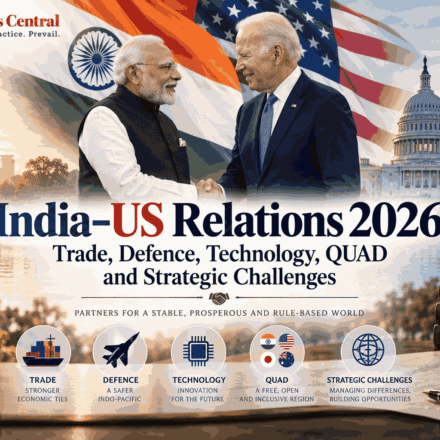
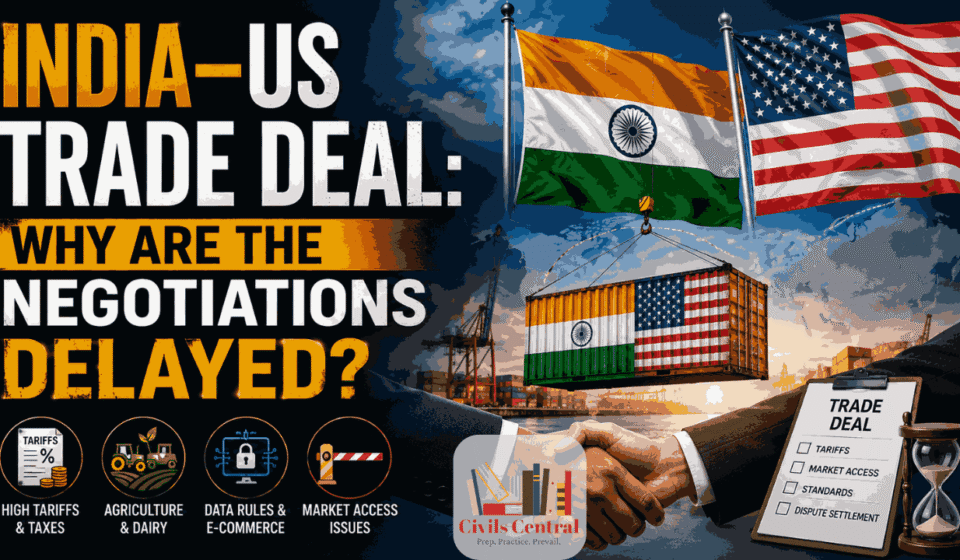
India–US are engaged in intensive negotiations to conclude a bilateral trade agreement aimed at expanding trade, improving market access, reducing trade barriers, and strengthening economic cooperation. Despite several rounds of negotiations and positive political engagement, the agreement has not yet been finalized because of differences over tariffs, agriculture, dairy products, digital trade, intellectual property rights, and non-tariff barriers.
The delay has attracted considerable attention because both countries have repeatedly expressed their commitment to enhancing bilateral trade and have set an ambitious target of significantly increasing trade in goods and services over the coming years. At a time when global supply chains are being reconfigured due to geopolitical tensions, the growing emphasis on the “China+1” strategy, and rapid technological transformations, a comprehensive India–US trade agreement is viewed as strategically important not only for the two countries but also for the broader Indo-Pacific region.
For UPSC aspirants, this topic is highly relevant as it combines concepts from International Relations (GS Paper II), Indian Economy (GS Paper III), Globalisation, World Trade Organization (WTO), India’s Foreign Trade Policy, and India’s strategic partnerships. Questions can be asked in the Prelims on trade terminology and WTO principles, while the Mains examination may require analytical understanding of India’s trade policy, economic diplomacy, and balancing of national interests.
India–US Economic Relations: More Than Just Trade
The India–US relationship has evolved from limited economic engagement during the Cold War to one of the world’s most comprehensive strategic partnerships. Today, cooperation extends far beyond the exchange of goods and services and encompasses defence, technology, clean energy, education, healthcare, innovation, critical minerals, semiconductor manufacturing, digital infrastructure, and space cooperation.
Economic relations have emerged as one of the strongest pillars of this partnership. The United States is among India’s largest trading partners and one of the leading sources of foreign direct investment (FDI), advanced technology, and innovation. Conversely, India has become an important destination for American businesses due to its large consumer market, skilled workforce, expanding digital economy, and rapidly growing manufacturing sector.
Trade has therefore become a strategic instrument rather than merely an economic activity. A successful trade agreement has the potential to deepen supply chain integration, attract investments, enhance technological collaboration, create employment opportunities, and strengthen resilience against global economic shocks.
Evolution of India–US Trade Relations
Understanding the present negotiations requires an appreciation of how bilateral economic relations have evolved over time.
Phase I: Limited Economic Engagement (1947–1991)
Following Independence, India adopted a mixed economic model characterised by import substitution, high tariffs, industrial licensing, and significant state control over economic activity. These policies limited India’s integration with the global economy.
During the same period, geopolitical factors also influenced bilateral relations. India’s policy of non-alignment and its close strategic ties with the Soviet Union contrasted with the United States’ alliances during the Cold War. Consequently, economic cooperation between the two countries remained modest.
Trade volumes were relatively small, investment was limited, and economic relations lacked strategic depth.
Key Characteristics
- High tariff barriers
- Import substitution strategy
- Limited private investment
- Restricted foreign participation
- Minimal bilateral trade
Phase II: Economic Liberalisation (1991–2004)
India’s balance of payments crisis in 1991 marked a turning point in its economic history. The government introduced comprehensive reforms that liberalised trade, reduced industrial licensing, encouraged foreign investment, and integrated India with the global economy.
These reforms significantly transformed India–US economic relations. American multinational corporations increased their presence in India, particularly in sectors such as information technology, telecommunications, financial services, pharmaceuticals, and manufacturing.
Indian software companies also emerged as major global players, supplying IT services to American businesses.
Major Developments
- Opening of Indian markets
- Increase in FDI
- Expansion of IT services
- Greater private sector collaboration
- Rise of outsourcing and business process management
Phase III: Strategic Partnership (2005–2016)
The signing of the India–US Civil Nuclear Agreement fundamentally transformed bilateral relations. Economic cooperation expanded alongside defence collaboration and strategic dialogue.
Trade diversified into several new sectors, including:
- Defence equipment
- Aviation
- Renewable energy
- Higher education
- Healthcare
- Infrastructure
- Research and innovation
The United States increasingly viewed India as an important strategic partner in Asia, while India recognised the importance of American technology, investment, and global market access.
Phase IV: Strategic Economic Partnership (2017–Present)
Recent years have witnessed a significant broadening of economic cooperation. Both countries now collaborate in areas that barely featured in bilateral discussions two decades ago, including:
- Artificial Intelligence
- Semiconductor manufacturing
- Critical minerals
- Quantum technologies
- Biotechnology
- Cyber security
- Space technology
- Clean energy
- Defence manufacturing
- Supply chain resilience
At the same time, disagreements over tariffs, market access, agriculture, and digital regulations have become more visible, making trade negotiations increasingly complex.
India–US Trade: Current Profile
The economic relationship today is multifaceted and includes several components.
Merchandise Trade
Merchandise trade covers physical goods such as engineering products, pharmaceuticals, electronics, agricultural products, chemicals, machinery, petroleum products, and precious stones.
India exports a wide range of manufactured products to the United States while importing advanced machinery, aircraft, energy products, electronic equipment, and high-value technology.
Trade in Services
Services have become one of the strongest pillars of bilateral economic relations. India is a global leader in:
- Information Technology
- Software services
- Business Process Outsourcing (BPO)
- Financial services
- Professional consulting
American firms are among the largest consumers of Indian IT and business services.
Foreign Direct Investment (FDI)
The United States remains one of the leading investors in India. Major investment sectors include:
- Information Technology
- Renewable Energy
- Manufacturing
- Healthcare
- Financial Services
- E-commerce
- Logistics
These investments contribute to employment generation, technology transfer, and productivity improvements.
Technology Partnership
Technology cooperation has emerged as one of the defining features of India–US relations. Recent initiatives focus on:
- Semiconductor ecosystem development
- Artificial Intelligence
- Critical and Emerging Technologies (iCET)
- Defence innovation
- Advanced telecommunications
- Space cooperation
This reflects a shift from a purely trade-based relationship to one centred on innovation and strategic technologies.
What Is the Proposed India–US Trade Deal?
Contrary to popular perception, the current negotiations are not for a traditional comprehensive Free Trade Agreement (FTA). Instead, both countries are working towards a phased bilateral trade arrangement that seeks to resolve priority issues before expanding cooperation into additional sectors.
The broad objectives include:
- Enhancing bilateral trade
- Improving market access
- Reducing unnecessary trade barriers
- Promoting investment
- Strengthening supply chains
- Facilitating technology transfer
- Encouraging innovation
- Creating a predictable trade environment
A phased approach enables both countries to build confidence while addressing politically sensitive sectors gradually rather than attempting a comprehensive agreement in a single stage.
Static Concepts
Before analysing the negotiations, it is essential to understand the trade terminology frequently used in newspapers and policy discussions.
Bilateral Trade Agreement (BTA)
A Bilateral Trade Agreement is an agreement between two countries to facilitate trade by reducing barriers, improving market access, and establishing common rules governing commercial exchanges.
Unlike multilateral agreements negotiated through the WTO, BTAs are tailored to the interests of the participating countries.
Free Trade Agreement (FTA)
A Free Trade Agreement aims to eliminate or substantially reduce tariffs and other trade barriers between participating countries. However, FTAs generally do not create a customs union because each member retains its own tariff policy towards non-member countries.
India has concluded FTAs with several countries and regional groupings, making FTAs an increasingly important instrument of its trade policy.
Tariff
A tariff is a tax imposed on imported goods. Governments use tariffs for multiple purposes:
- Protect domestic industries
- Generate government revenue
- Correct trade imbalances
- Promote domestic manufacturing
However, excessively high tariffs may increase consumer prices and reduce international competitiveness.
Non-Tariff Barriers (NTBs)
Trade can also be restricted without imposing customs duties. Such restrictions are called Non-Tariff Barriers.
Examples include:
- Quality standards
- Import licensing
- Product certification
- Technical regulations
- Sanitary and phytosanitary measures
- Labelling requirements
Many modern trade disputes arise from NTBs rather than tariffs.
Rules of Origin
Rules of Origin determine the country where a product is considered to have been manufactured. These rules are important because they prevent third countries from exploiting preferential tariff arrangements by routing products through member countries.
Trade Deficit and Trade Surplus
A trade surplus occurs when exports exceed imports. A trade deficit occurs when imports exceed exports. These indicators are closely monitored during trade negotiations because they influence domestic political and economic priorities.
Most Favoured Nation (MFN)
The Most Favoured Nation (MFN) principle under the World Trade Organization requires member countries to extend any trade advantage granted to one member to all other WTO members unless covered by permitted exceptions such as Free Trade Agreements.
MFN is one of the foundational principles of the multilateral trading system.
Why These Concepts Matter?
The ongoing India–US negotiations are not merely about reducing tariffs. They involve balancing trade liberalisation with domestic priorities, strategic autonomy, food security, technological competitiveness, and regulatory sovereignty.
Understanding these concepts provides the foundation for analysing why negotiations have proved difficult despite the close strategic partnership between the two countries.
Why Is the India–US Trade Deal Delayed?
In international trade negotiations, disagreements are common because every country seeks to maximize national economic gains while protecting sensitive domestic sectors. The ongoing India–US trade negotiations are no exception. Although both countries acknowledge the strategic importance of strengthening economic ties, differences persist over tariffs, agriculture, digital trade, intellectual property rights, market access, and regulatory standards.
Unlike traditional diplomatic disagreements, these issues directly affect millions of farmers, manufacturers, consumers, technology companies, pharmaceutical firms, and workers in both countries. Consequently, neither India nor the United States is willing to make concessions that could adversely affect domestic economic interests.
1. Tariff Disputes
Tariffs remain one of the oldest and most contentious issues in international trade. A tariff is a tax imposed by a country on imported goods. Governments use tariffs to protect domestic industries, generate revenue, and encourage local production.
The United States has repeatedly argued that India maintains relatively high tariffs on several imported products, making it difficult for American exporters to compete in the Indian market. Sectors such as automobiles, agricultural products, alcoholic beverages, and industrial goods have often been cited as examples where American exporters seek lower import duties.
India, however, views tariffs differently. As a developing economy with a large manufacturing base and millions of small producers, India considers tariffs an important policy instrument to safeguard domestic industries from sudden import surges. Tariffs also support initiatives such as Make in India and Atmanirbhar Bharat, which aim to strengthen domestic manufacturing and reduce excessive dependence on imports.
From India’s perspective, premature tariff reductions could expose micro, small and medium enterprises (MSMEs) to intense foreign competition before they become globally competitive. Therefore, while India is open to gradual tariff rationalisation, it prefers a calibrated approach rather than immediate liberalisation.
2. Agriculture
Agriculture represents one of the most difficult aspects of the negotiations because it carries significant economic, political and social implications.
For the United States, India is an enormous consumer market with rising demand for high-value agricultural products. American producers seek greater market access for products such as apples, almonds, pulses, poultry products, and processed foods. India, however, approaches agricultural liberalisation with considerable caution.
Unlike many developed countries, agriculture remains the primary source of livelihood for a substantial proportion of India’s population. Millions of small and marginal farmers depend on agriculture for income and food security. Opening agricultural markets without adequate safeguards could expose them to competition from highly mechanised and heavily subsidised farms in developed countries.
India’s negotiating position is therefore guided by three important principles:
- Protection of farmers’ livelihoods.
- National food security.
- Rural economic stability.
India also argues that developed countries continue to provide significant domestic support and subsidies to their agricultural sectors. Consequently, expecting complete market opening from developing countries without addressing subsidy-related concerns would create an uneven playing field.
Exam Tip
Whenever discussing agriculture in trade negotiations, link the answer with:
- Food security
- Rural livelihoods
- MSP debate
- WTO Agreement on Agriculture
- Sustainable Development Goals
3. Dairy Products
The dairy sector represents one of the most sensitive components of India–US trade negotiations. The United States seeks greater access for its dairy exports to the Indian market. However, India’s dairy industry is unique in both its economic structure and cultural significance.
India is the world’s largest milk producer, with production driven largely by millions of small dairy farmers and cooperative institutions rather than large industrial farms. Dairy farming provides supplementary income to rural households, particularly women, making it an important instrument of rural development and financial inclusion.
India has also expressed concerns regarding certain production practices followed in some exporting countries, particularly with respect to animal feed. These concerns extend beyond economics and involve consumer preferences, cultural values and regulatory standards. Consequently, India remains cautious about opening its dairy market without ensuring that imports comply with domestic regulatory and societal expectations.
4. Digital Trade and Data Governance
Digital trade has emerged as one of the defining issues of twenty-first century trade negotiations. Unlike conventional trade involving physical goods, digital trade concerns the movement of data, online services, cloud computing, digital payments, artificial intelligence, software, e-commerce and digital platforms.
The United States generally advocates:
- Free cross-border data flows.
- Limited restrictions on digital services.
- Open digital markets.
- Reduced localisation requirements.
India adopts a different approach. India believes that data generated within its territory has strategic and economic value. Consequently, it has increasingly emphasised concepts such as:
- Data sovereignty.
- Data localisation.
- User privacy.
- Cybersecurity.
- National security.
- Consumer protection.
India argues that unrestricted movement of sensitive data outside national borders may create vulnerabilities relating to privacy, cybercrime and strategic autonomy. The debate therefore extends beyond trade into areas of governance, security and technological independence.
Why This Matters
Digital trade is expected to become one of the most important components of future global commerce. The manner in which India and the United States reconcile their differing approaches will shape future cooperation in artificial intelligence, fintech, cloud computing and digital innovation.
5. Intellectual Property Rights (IPR)
Intellectual Property Rights have long been among the most debated issues in India–US economic relations.
The United States places considerable emphasis on strong patent protection, copyright enforcement and innovation incentives. American companies, particularly in pharmaceuticals, biotechnology, software and entertainment, seek greater assurance that their innovations will receive adequate legal protection.
India recognises the importance of innovation but simultaneously emphasises public welfare. India’s patent regime seeks to balance innovation with access to affordable medicines. It supports intellectual property protection while ensuring that essential medicines remain accessible through the flexibilities available under international agreements.
This difference in policy priorities explains why IPR continues to feature prominently in bilateral negotiations.
6. Pharmaceuticals: Innovation versus Accessibility
India has earned global recognition as the “Pharmacy of the World” because of its large-scale production of affordable generic medicines. Indian pharmaceutical companies export medicines to numerous countries, including the United States.
While this creates opportunities for bilateral trade, it also generates differences relating to:
- Patent protection.
- Regulatory approvals.
- Drug pricing.
- Market access.
- Quality standards.
The United States encourages stronger patent protection to reward innovation, whereas India emphasises affordable healthcare and the availability of low-cost medicines for developing countries. The challenge lies in balancing commercial incentives for research with public health objectives.
7. Medical Devices
Another area of disagreement concerns medical devices such as cardiac stents and knee implants. India has introduced price regulation on certain essential medical devices to improve affordability and ensure wider healthcare access. American manufacturers argue that extensive price controls reduce commercial incentives and affect profitability.
India counters that healthcare affordability is a legitimate public policy objective and that essential medical technologies should remain accessible to citizens. This illustrates how trade policy often intersects with healthcare policy.
8. Non-Tariff Barriers (NTBs)
Modern trade disputes increasingly revolve around non-tariff barriers rather than customs duties.
Examples include:
- Product certification.
- Technical standards.
- Quality regulations.
- Import licensing.
- Packaging requirements.
- Labelling rules.
- Sanitary and phytosanitary measures.
The United States argues that some Indian regulatory requirements increase compliance costs for exporters. India similarly points to regulatory barriers affecting its exports in sectors such as agriculture, pharmaceuticals and engineering goods. Reducing unnecessary regulatory obstacles while maintaining legitimate safety standards remains an important objective of the negotiations.
9. Rules of Origin
Rules of Origin determine the economic nationality of a product. These rules are essential because many modern products are manufactured using components sourced from multiple countries. If Rules of Origin are weak, products from third countries may enter a preferential trade arrangement through indirect routing, thereby defeating the purpose of tariff concessions.
Both India and the United States seek transparent and robust Rules of Origin that prevent trade diversion while facilitating legitimate commerce.
10. Labour and Environmental Standards
Recent trade agreements increasingly include provisions relating to labour rights, environmental sustainability and climate commitments. The United States often advocates stronger labour protections and environmental standards within trade agreements.
India supports sustainable development but maintains that such standards should not become disguised forms of protectionism or create unnecessary barriers for developing countries. India argues that developmental priorities, differing income levels and national circumstances must be taken into account when designing trade obligations.
Why the Negotiations Are Complex
The delay in concluding the India–US trade agreement should not be interpreted as a lack of political will. Rather, it reflects the complexity of reconciling two large, democratic and economically significant countries with distinct developmental priorities.
For India, the agreement must support economic growth while safeguarding farmers, MSMEs, public health, digital sovereignty and policy autonomy. For the United States, the agreement should provide greater market access, stronger protection for innovation, reduced trade barriers and a more predictable business environment.
The challenge lies in designing a framework that advances bilateral trade without compromising legitimate domestic interests. As global supply chains continue to evolve and geopolitical realities reshape international commerce, both countries have strong incentives to move towards a balanced, phased and mutually beneficial agreement.
Strategic Significance, Challenges and the Way Forward
Having understood the issues delaying the India–US trade agreement, it is equally important to appreciate why both countries continue negotiations despite these differences. The answer lies in the changing global economic and geopolitical landscape. Trade today is no longer confined to the exchange of goods and services; it has become a strategic instrument for achieving economic resilience, technological leadership, supply chain security and geopolitical influence.
For India and the United States, a successful trade agreement would complement their broader Comprehensive Global Strategic Partnership and contribute to a stable, rules-based economic order in the Indo-Pacific.
Why Is the Trade Deal Strategically Important for India?
1. Expanding Export Opportunities
The United States is one of India’s largest export destinations. Greater market access would create significant opportunities for Indian industries, particularly in sectors where India enjoys a comparative advantage.
Major beneficiaries could include:
- Pharmaceuticals
- Engineering goods
- Textiles and apparel
- Gems and jewellery
- Chemicals
- Leather products
- Information Technology services
- Electronics
Higher exports would contribute to foreign exchange earnings, employment generation and industrial growth.
2. Attracting High-Quality Investment
Trade agreements often encourage investment because businesses gain greater certainty regarding market access and regulatory policies. A stronger economic partnership with the United States could increase investments in:
- Semiconductor manufacturing
- Electronics
- Renewable energy
- Defence production
- Biotechnology
- Artificial Intelligence
- Logistics
- Advanced manufacturing
Such investments are particularly important as India seeks to become a global manufacturing hub.
3. Supporting the “Make in India” Initiative
India aims to transform itself into a global manufacturing centre. An improved trade relationship can help by:
- Expanding export markets
- Increasing technology transfer
- Bringing advanced manufacturing practices
- Creating employment
- Improving productivity
Rather than replacing domestic manufacturing, a well-designed agreement can strengthen India’s integration into Global Value Chains (GVCs).
4. Supply Chain Diversification
The COVID-19 pandemic and geopolitical tensions exposed the vulnerabilities of highly concentrated global supply chains. Many multinational companies are now adopting the “China+1” strategy, under which production is diversified across multiple countries instead of depending excessively on one location.
India has emerged as a preferred destination because of:
- Large domestic market
- Skilled workforce
- Improving infrastructure
- Democratic governance
- Policy reforms
Closer economic cooperation with the United States could accelerate India’s role in global supply chains.
5. Technology and Innovation
Modern trade agreements increasingly involve cooperation in advanced technologies rather than merely reducing tariffs.
India stands to benefit through collaboration in:
- Artificial Intelligence (AI)
- Semiconductors
- Quantum Computing
- Biotechnology
- Advanced telecommunications
- Space technology
- Cybersecurity
Technology partnerships can improve India’s innovation ecosystem while reducing dependence on limited suppliers.
6. Employment Generation
Higher investment, stronger exports and manufacturing expansion can generate employment across multiple sectors. Employment opportunities may arise in:
- Manufacturing
- Logistics
- IT services
- Electronics
- Renewable energy
- Defence production
- Research and Development
This supports India’s demographic dividend by creating productive jobs for its young workforce.
Why Is the Trade Deal Important for the United States?
The agreement is equally significant from the American perspective.
Access to One of the World’s Fastest Growing Markets
India’s rapidly expanding middle class represents one of the largest consumer markets globally. American companies seek greater access to sectors such as:
- Agriculture
- Healthcare
- Financial services
- Digital services
- Energy
- Consumer goods
Long-term demand growth makes India an attractive destination for American businesses.
Trusted Supply Chains
The United States seeks to reduce excessive dependence on concentrated manufacturing centres.
India offers an attractive alternative because of:
- Political stability
- Democratic institutions
- Skilled human resources
- Expanding manufacturing capability
Strengthening economic ties with India contributes to resilient global supply chains.
Strategic Competition with China
Economic cooperation with India also complements broader American strategic objectives in the Indo-Pacific. Although the agreement is not directed against any specific country, deeper India–US economic engagement contributes to diversification of production networks and strengthens regional economic resilience.
Technology Collaboration
American firms increasingly view India as a major innovation partner. Joint initiatives in:
- Semiconductors
- Artificial Intelligence
- Defence technology
- Space
- Clean energy
create long-term opportunities extending well beyond traditional trade.
Economic Significance of the Agreement
If successfully concluded, the agreement could produce benefits extending across the economy.
Increase in Bilateral Trade
Reduction of unnecessary trade barriers is expected to increase both exports and imports, expanding overall economic activity.
Higher trade generally promotes:
- Greater competition
- Better consumer choice
- Improved productivity
- Lower production costs
Greater Investment Flows
Trade liberalisation often encourages multinational corporations to establish manufacturing facilities closer to target markets.
This can increase:
- Foreign Direct Investment
- Technology transfer
- Research collaboration
- Skill development
Enhanced Competitiveness
Exposure to international competition encourages firms to improve:
- Product quality
- Efficiency
- Innovation
- Productivity
Such improvements strengthen India’s long-term competitiveness in global markets.
Integration into Global Value Chains
Modern manufacturing rarely occurs within a single country. Products such as smartphones, automobiles and electronic equipment involve components sourced from multiple countries. Participation in Global Value Chains allows India to specialise in specific stages of production while benefiting from international trade.
Geopolitical Significance
Trade negotiations today cannot be separated from geopolitics.
Indo-Pacific Strategy
Both India and the United States support a free, open, inclusive and rules-based Indo-Pacific. Economic cooperation strengthens this vision by encouraging resilient trade networks and reducing vulnerabilities.
Critical and Emerging Technologies
The two countries have expanded cooperation under the Initiative on Critical and Emerging Technology (iCET). Priority sectors include:
- Artificial Intelligence
- Quantum technologies
- Semiconductors
- Space cooperation
- Defence innovation
Economic cooperation supports these broader strategic initiatives.
Energy Security
Trade also facilitates cooperation in:
- Liquefied Natural Gas (LNG)
- Renewable energy
- Green Hydrogen
- Civil nuclear cooperation
- Battery technologies
Diversified energy partnerships contribute to long-term energy security.
Defence Industrial Cooperation
Growing defence collaboration increasingly includes:
- Co-development
- Co-production
- Defence innovation
- Advanced manufacturing
Economic cooperation therefore reinforces national security objectives.
Major Challenges Before India
While the agreement offers substantial opportunities, India must carefully balance liberalisation with domestic priorities.
Protecting Farmers
Agriculture continues to support millions of livelihoods. Negotiators must ensure that increased imports do not adversely affect vulnerable farming communities.
Safeguarding MSMEs
Micro, Small and Medium Enterprises form the backbone of India’s economy. Sudden exposure to intense foreign competition could create adjustment challenges. Supportive policies, technology adoption and improved competitiveness are therefore essential.
Maintaining Policy Autonomy
India seeks to preserve flexibility in important policy areas such as:
- Industrial policy
- Digital governance
- Food security
- Healthcare
- Public procurement
Trade agreements should not unduly restrict legitimate public policy objectives.
Regulatory Capacity
Implementing high-standard trade commitments requires strong regulatory institutions capable of ensuring compliance with agreed standards. Capacity building therefore becomes an important component of successful implementation.
Inclusive Growth
The benefits of trade must reach all sections of society. Policies promoting skill development, infrastructure, innovation and social protection can help ensure inclusive outcomes.
Government Initiatives Supporting Trade Competitiveness
Several policy initiatives strengthen India’s ability to benefit from international trade.
Production Linked Incentive (PLI) Scheme
The PLI Scheme promotes domestic manufacturing by providing financial incentives linked to incremental production.
Key sectors include:
- Electronics
- Pharmaceuticals
- Telecom
- Automobiles
- Solar modules
- Semiconductors
Make in India
This initiative seeks to increase manufacturing’s contribution to GDP, attract investment and generate employment.
PM Gati Shakti
PM Gati Shakti integrates infrastructure planning across multiple sectors to improve logistics efficiency and reduce transportation costs. Improved logistics directly enhance export competitiveness.
National Logistics Policy
The policy aims to reduce logistics costs, improve supply chain efficiency and strengthen India’s position in global trade.
Foreign Trade Policy 2023
The policy focuses on:
- Export promotion
- Ease of Doing Business
- Digitalisation of trade procedures
- Districts as Export Hubs
- Integration with Global Value Chains
The Way Forward
A successful agreement requires flexibility, mutual trust and realistic expectations from both sides.
Adopt a Phased Approach
Instead of attempting a comprehensive agreement immediately, both countries can conclude negotiations in areas where consensus already exists before expanding cooperation into more sensitive sectors.
Protect Sensitive Sectors While Promoting Liberalisation
Agriculture, dairy and MSMEs require calibrated liberalisation accompanied by appropriate safeguards and adjustment mechanisms.
Enhance Regulatory Cooperation
Regular dialogue between regulators can reduce misunderstandings relating to standards, certification and compliance. Greater transparency will facilitate trade while maintaining legitimate public policy objectives.
Strengthen Technology Partnerships
Economic cooperation should increasingly focus on innovation-driven sectors such as:
- AI
- Semiconductors
- Biotechnology
- Clean energy
- Advanced manufacturing
These sectors are likely to define future economic competitiveness.
Invest in Human Capital
Trade agreements yield maximum benefits when supported by:
- Skilled workforce
- Research institutions
- Innovation ecosystems
- Digital infrastructure
Continued investment in education and skill development remains essential.
Uphold a Rules-Based Trading System
Both India and the United States have an interest in strengthening transparent, predictable and rules-based international trade. A balanced agreement consistent with international obligations can contribute to global economic stability while respecting national developmental priorities.
Conclusion
The India–US trade negotiations are far more than discussions on tariffs or market access. They represent an effort to build an economic partnership suited to the realities of the twenty-first century—one that balances trade liberalisation with strategic autonomy, innovation with inclusivity, and economic growth with national priorities.
While differences remain over agriculture, digital trade, intellectual property rights and regulatory standards, these challenges are characteristic of negotiations between two large democracies with diverse economic interests. The continued political commitment on both sides indicates that the objective is not merely to conclude an agreement, but to create a durable framework capable of supporting long-term economic cooperation.
For India, the challenge is to secure greater market access, investment and technology without compromising the interests of farmers, MSMEs, public health and digital sovereignty. For the United States, the focus remains on expanding commercial opportunities in one of the world’s fastest-growing major economies.
A balanced, phased and mutually beneficial trade agreement has the potential to strengthen bilateral relations, reinforce resilient global supply chains, and contribute to a more stable and prosperous Indo-Pacific region.
Previous Year UPSC Questions
Note: UPSC has frequently tested themes relating to international trade, WTO, globalisation, India’s external economic relations, and India–US relations rather than asking direct factual questions on a specific bilateral trade negotiation.
UPSC Mains
GS Paper II
- India–US relations have acquired strategic importance in the changing global order. Discuss.
- India’s foreign policy is increasingly influenced by economic diplomacy. Examine.
GS Paper III
- Examine the impact of Free Trade Agreements on India’s economy.
- Discuss the role of the World Trade Organization in promoting a rules-based trading system.
- How can India integrate itself into Global Value Chains?
Essay Themes
- Trade as an instrument of diplomacy.
- Globalisation in a changing world order.
- Economic cooperation and strategic partnerships.
- Balancing national interests with global integration.
Possible UPSC Prelims Questions
Q1. With reference to the World Trade Organization, consider the following statements:
- The Most Favoured Nation (MFN) principle requires equal treatment among WTO members, subject to certain exceptions.
- Rules of Origin determine whether a product qualifies for preferential tariff treatment.
- Non-Tariff Barriers refer only to customs duties.
Which of the statements given above are correct?
A. 1 and 2 only
B. 2 and 3 only
C. 1 and 3 only
D. 1, 2 and 3
Answer: A
Explanation: Non-Tariff Barriers include licensing, standards, certification and regulatory requirements, not customs duties.
Q2. Which of the following would most likely increase India’s export competitiveness?
- Lower logistics costs
- Improved port infrastructure
- Greater participation in Global Value Chains
Select the correct answer:
A. 1 only
B. 2 and 3 only
C. 1 and 3 only
D. 1, 2 and 3
Answer: D
Q3. The term “China+1 Strategy” refers to:
A. A military alliance.
B. Diversification of manufacturing away from dependence on one country.
C. China’s trade surplus.
D. WTO dispute settlement reforms.
Answer: B
Q4. Which of the following sectors has remained particularly sensitive during India–US trade negotiations?
A. Tourism
B. Dairy
C. Fisheries
D. Civil Aviation
Answer: B
Q5. Which one of the following is an example of a Non-Tariff Barrier?
A. Customs Duty
B. Import Tariff
C. Product Certification Requirement
D. Export Tax
Answer: C
Q6. Data Localisation primarily refers to:
A. Local software production.
B. Domestic taxation of digital firms.
C. Storage of specified data within national borders.
D. Local internet service providers.
Answer: C
Q7. Which of the following are expected benefits of deeper India–US trade cooperation?
- Greater technology transfer
- Increased investment
- Stronger supply chain resilience
- Employment generation
Select the correct answer.
A. 1 and 2 only
B. 2 and 3 only
C. 1, 2, 3 and 4
D. 1 and 4 only
Answer: C
Q8. Which initiative aims to promote domestic manufacturing through production-linked incentives?
A. Startup India
B. PM Gati Shakti
C. Production Linked Incentive Scheme
D. Digital India
Answer: C
Q9. Which organisation administers the global multilateral trading system?
A. IMF
B. WTO
C. OECD
D. UNCTAD
Answer: B
Q10. A phased trade agreement generally means:
A. Immediate elimination of all tariffs.
B. Trade liberalisation implemented gradually across sectors.
C. Withdrawal from WTO commitments.
D. A customs union.
Answer: B
UPSC Mains Practice Questions
Q1. Why have the India–US trade negotiations witnessed repeated delays? Discuss the major issues involved.
Q2. Explain the importance of digital trade in contemporary international economic relations.
Q3. “Trade negotiations today extend far beyond tariffs.” Examine this statement with reference to India–US trade relations.
Q4. Analyse how a successful India–US trade agreement can contribute to India’s economic growth and strategic objectives.
Q5. Critically examine the opportunities and challenges associated with India’s pursuit of bilateral trade agreements.
India–US Trade Negotiations
Growing Strategic Partnership
            │
            ▼
 Expanding Bilateral Trade
            │
            ▼
 Trade Negotiations Begin
            │
            ▼
 Major Issues
 ├── Tariffs
 ├── Agriculture & Dairy
 ├── Digital Trade
 ├── IPR
 ├── Medical Devices
 ├── NTBs
 └── Rules of Origin
            │
            ▼
 Continued Negotiations
            │
            ▼
 Balanced & Phased Agreement
            │
            ▼
 Trade Growth + Investment +
 Technology + Strategic Partnership
Conclusion
The India–US trade negotiations illustrate the changing nature of international economic diplomacy. Today’s trade agreements are no longer confined to tariffs and customs duties; they increasingly encompass digital governance, technology, intellectual property, resilient supply chains, sustainability and strategic partnerships.
For India, the challenge lies in integrating more deeply with the global economy while safeguarding the interests of farmers, MSMEs, public health and policy autonomy. For the United States, the objective is to secure greater market access and strengthen cooperation with a trusted strategic partner in the Indo-Pacific.
A balanced, phased and mutually beneficial agreement would not only expand bilateral trade but also reinforce the broader Comprehensive Global Strategic Partnership, making it an important milestone in India’s economic diplomacy and a significant topic for UPSC preparation.
About The Author