Skip to content
-
Subscribe to our newsletter & never miss our best posts. Subscribe Now!
Civilscentral.com Civils Central

Prep.Practice.Prevail.

Civilscentral.com Civils Central

Prep.Practice.Prevail.

  • Home
  • History
    • Ancient History
    • Medieval History
  • Contact Us
  • About Us
  • Home
  • History
    • Ancient History
    • Medieval History
  • Contact Us
  • About Us
  • https://www.facebook.com/
  • https://twitter.com/
  • https://t.me/
  • https://www.instagram.com/
  • https://youtube.com/
Civilscentral.com Civils Central

Prep.Practice.Prevail.

Civilscentral.com Civils Central

Prep.Practice.Prevail.

  • Home
  • History
    • Ancient History
    • Medieval History
  • Contact Us
  • About Us
  • Home
  • History
    • Ancient History
    • Medieval History
  • Contact Us
  • About Us
  • https://www.facebook.com/
  • https://twitter.com/
  • https://t.me/
  • https://www.instagram.com/
  • https://youtube.com/
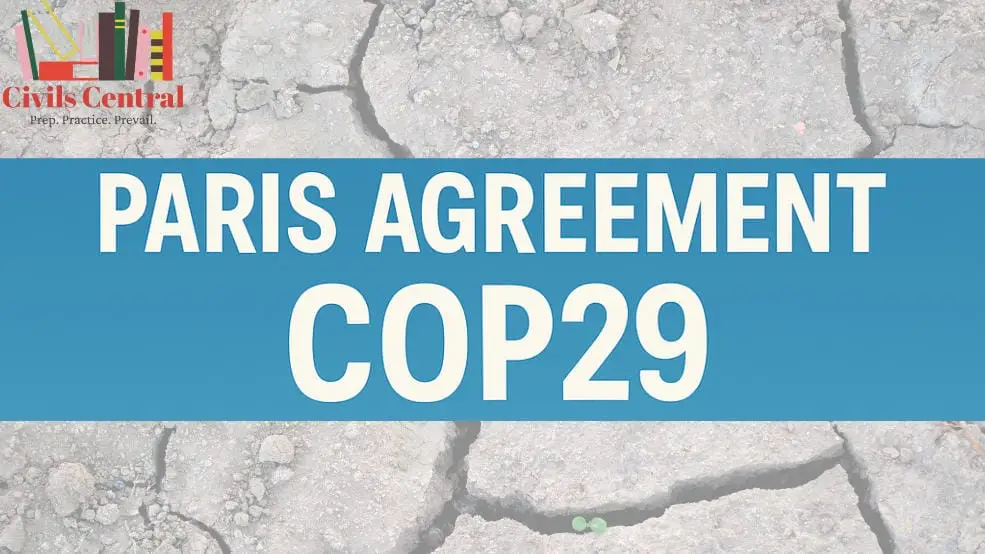
Home/Current Affairs/Paris Agreement & COP29 Explained: A Complete Guide for UPSC & JKAS Aspirants
“COP29 Azerbaijan logo representing the 2024 UN Climate Change Conference held in Baku”
Current AffairsEnvironment & EcologyInternational Relations

Paris Agreement & COP29 Explained: A Complete Guide for UPSC & JKAS Aspirants

By Rohit Thapa

Climate change remains one of the most pressing issues of the 21st century. This article dives deep into the Paris Agreement (COP21) and the recent COP29 Summit held in Baku, Azerbaijan, covering key outcomes, India’s role, and their significance for UPSC and JKAS exams.

📌 1. What is the Paris Agreement?

  • Adopted: December 2015 (COP21, Paris)
  • Came into Force: 4 November 2016
  • Parties: 196 countries

Goal:

  • Keep global average temperature rise well below 2°C, and pursue efforts to limit the increase to 1.5°C above pre-industrial levels.

Key Elements:

  • Nationally Determined Contributions (NDCs)
  • Climate Finance (Article 9)
  • Carbon Market Mechanism (Article 6)
  • Adaptation and Transparency Frameworks

🧭 2. India’s Commitments Under Paris Agreement

  • Reduce emissions intensity of GDP by 33–35% by 2030 (from 2005 levels)
  • Achieve 40% installed electricity capacity from non-fossil fuels
  • Create an additional carbon sink of 2.5–3 billion tonnes via afforestation
  • Leadership roles in International Solar Alliance (ISA) and LiFE Mission

📰 3. COP29: Held in Baku (Azerbaijan) | 11–22 November 2024

✅ Key Outcomes of COP29:

🔹 Area🔍 Outcome
Climate FinanceNew Collective Quantified Goal (NCQG): $300 billion/year by 2035, with a roadmap toward $1.3 trillion/year
Carbon MarketsFinalized Article 6.2 & 6.4 mechanisms for transparent carbon credit trading
Loss & DamageOperationalization of the Loss & Damage Fund to aid vulnerable countries
AdaptationUrged all countries to submit National Adaptation Plans by 2025
Gender and EquityLima Work Programme extended by 10 years; gender action plan to be framed at COP30
Global StocktakeFirst ever Global Stocktake concluded; countries urged to raise ambition in 2025 NDCs

📖 4. Relevance for UPSC & JKAS

📝 Prelims:

  • Definitions: NDCs, NCQG, Article 6, Loss & Damage
  • Facts: COP29 location (Baku), NCQG target, India’s NDCs, UNFCCC bodies

📚 Mains (GS-III: Environment):

  • Sample Questions:
    • “Discuss the significance of COP29 for climate finance and carbon market reforms.”
    • “Critically evaluate the evolution from Kyoto Protocol to the Paris Agreement and its relevance to India.”
  • Answer Structure Tip:
    • Introduction: State Paris Agreement goals
    • Body: Cover outcomes from COP29, their implications
    • Conclusion: Evaluate progress + challenges, especially from India’s standpoint

🇮🇳 5. India’s Stand at COP29

  • Advocated for equity and Common But Differentiated Responsibilities (CBDR)
  • Demanded clear climate finance pathways for developing nations
  • Sought operational and simplified carbon market mechanisms
  • Pushed for consideration of lifestyle changes (Mission LiFE) as mitigation strategy

🔮 6. Way Forward to COP30 (Belém, Brazil – Nov 2025)

  • Formal adoption of the Gender Action Plan
  • Submission of updated NDCs by major emitters
  • Progress toward methane emissions cuts, deforestation reversal
  • Clarification of public vs private finance share in NCQG

📚 References:

  • UNFCCC Official Reports
  • Drishti IAS | Vision IAS | PMF IAS
  • The Hindu | Indian Express | Down to Earth
  • COP29 Summary Reports by UN & Media Outlets

🧠 Final Tip for Aspirants

  • Keep revising climate frameworks (UNFCCC, Paris, Kyoto, COP outcomes) with timelines and India’s policy responses. This topic is highly probable for both Prelims and Mains!

About The Author

Rohit Thapa

See author's posts

Tags:

Article 6 Carbon MarketsClimate FinanceCOP29JKAS MainsNCQGNDCParis AgreementUNFCCCUPSC Environment
Author

Rohit Thapa

Follow Me
Other Articles
Concept of Mixopathy in Indian healthcare system
Previous

Mixopathy Debate in India – Health Ethics & Policy Issues

Judges engaged in discussion representing dissent in the judiciary
Next

Dissent in the Indian Judiciary: Meaning, Role & Landmark Cases

No Comment! Be the first one.

    Leave a Reply Cancel reply

    Your email address will not be published. Required fields are marked *

    This site uses Akismet to reduce spam. Learn how your comment data is processed.

    Recent Posts

    • Venezuela Earthquake: Key Disaster Management Lessons for India | UPSC Current Affairs
    • Historical Significance of the Revolt of 1857: Was it a Sepoy Mutiny, a Popular Revolt, or the First War of Independence?
    • Consequences of the Revolt of 1857: Political, Administrative, Military, Economic and Social Impact
    • Why Did the Revolt of 1857 Fail? A Critical Analysis
    • Major Leaders of the Revolt of 1857: Contributions, Role and Legacy

    Categories

    • Ancient History
    • Current Affairs
    • Defence
    • Disaster Management
    • Environment & Ecology
    • Exam Strategy
    • Finance
    • Governance
    • International Organisations
    • International Relations
    • Latest Notifications
    • Medieval History
    • Modern History
    • Modern History
    • Physics
    • polity
    • Polity & Constitution
    • Science & Technology
    • Statutory Bodies
    • UPSC

    RECENT POSTS

    • Venezuela Earthquake: Key Disaster Management Lessons for India | UPSC Current Affairs
    • Historical Significance of the Revolt of 1857: Was it a Sepoy Mutiny, a Popular Revolt, or the First War of Independence?
    • Consequences of the Revolt of 1857: Political, Administrative, Military, Economic and Social Impact
    • Why Did the Revolt of 1857 Fail? A Critical Analysis
    • Major Leaders of the Revolt of 1857: Contributions, Role and Legacy
    • Ancient History (15)
    • Current Affairs (19)
    • Defence (1)
    • Disaster Management (1)
    • Environment & Ecology (3)
    • Exam Strategy (1)
    • Finance (3)
    • Governance (2)
    • International Organisations (3)
    • International Relations (5)
    • Latest Notifications (1)
    • Medieval History (13)
    • Modern History (5)
    • Modern History (11)
    • Physics (1)
    • polity (1)
    • Polity & Constitution (4)
    • Science & Technology (4)
    • Statutory Bodies (1)
    • UPSC (14)

    Archives

    • June 2026
    • March 2026
    • February 2026
    • August 2025
    • July 2025
    • June 2025

    You May Have Missed

    Venezuela Earthquake Key Disaster Lessons for India
    Current Affairs Disaster Management

    Venezuela Earthquake: Key Disaster Management Lessons for India | UPSC Current Affairs

    Rohit Thapa
    By Rohit Thapa
    June 28, 2026
    Modern History UPSC

    Historical Significance of the Revolt of 1857: Was it a Sepoy Mutiny, a Popular Revolt, or the First War of Independence?

    Rohit Thapa
    By Rohit Thapa
    June 7, 2026
    Modern History

    Consequences of the Revolt of 1857: Political, Administrative, Military, Economic and Social Impact

    Rohit Thapa
    By Rohit Thapa
    June 7, 2026
    Modern History

    Why Did the Revolt of 1857 Fail? A Critical Analysis

    Rohit Thapa
    By Rohit Thapa
    June 7, 2026
    Modern History

    Major Leaders of the Revolt of 1857: Contributions, Role and Legacy

    Rohit Thapa
    By Rohit Thapa
    June 6, 2026
    Modern History

    Revolt of 1857: Causes, Events, Leaders, Consequences and Historical Significance

    Rohit Thapa
    By Rohit Thapa
    June 6, 2026
    Charter Act of 1853 – features, significance, and impact on British administration in India for UPSC and JKAS exam preparation
    Modern History UPSC

    Charter Act of 1853: Features, Significance, Impact on British Administration | UPSC/JKAS

    civilscentral@gmail.com
    By civilscentral@gmail.com
    March 11, 2026
    UPSC/JKAS history lecture titled “Charter Act of 1833: Features, Significance, Impact on British Administration,” featuring colonial-era imagery, British Parliament symbolism
    Modern History UPSC

    Charter Act of 1833: Features, Significance, Impact on British Administration (UPSC/JKAS)

    civilscentral@gmail.com
    By civilscentral@gmail.com
    March 8, 2026
    Charter Act of 1813 – features, significance, and impact on British rule in India | UPSC JKAS modern history.
    Modern History UPSC

    Charter Act of 1813: Features, Significance & Impact on British Administration 

    Rohit Thapa
    By Rohit Thapa
    March 7, 2026
    Civilscentral.com
    • Venezuela Earthquake: Key Disaster Management Lessons for India | UPSC Current Affairs
    • Historical Significance of the Revolt of 1857: Was it a Sepoy Mutiny, a Popular Revolt, or the First War of Independence?
    • Consequences of the Revolt of 1857: Political, Administrative, Military, Economic and Social Impact
    • Why Did the Revolt of 1857 Fail? A Critical Analysis
    • Major Leaders of the Revolt of 1857: Contributions, Role and Legacy
    • Venezuela Earthquake: Key Disaster Management Lessons for India | UPSC Current Affairs
    • Historical Significance of the Revolt of 1857: Was it a Sepoy Mutiny, a Popular Revolt, or the First War of Independence?
    • Consequences of the Revolt of 1857: Political, Administrative, Military, Economic and Social Impact
    • Why Did the Revolt of 1857 Fail? A Critical Analysis
    • Major Leaders of the Revolt of 1857: Contributions, Role and Legacy
    Copyright 2026 — Civils Central. All rights reserved.