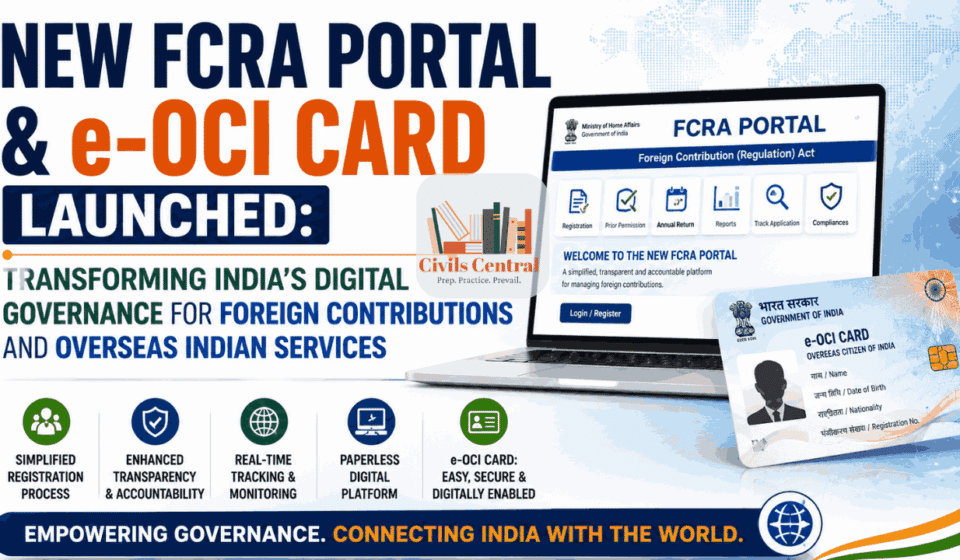
New FCRA Portal & e-OCI Card Launched: Transforming India’s Digital Governance for Foreign Contributions and Overseas Indian Services

Introduction
Digital governance has emerged as one of the defining pillars of India’s administrative reforms during the past decade. The transformation is no longer confined to digitising individual government services; it increasingly seeks to redesign the entire relationship between citizens, institutions, and the State through integrated digital platforms. The launch of the new Foreign Contribution (Regulation) Act (FCRA) Portal alongside the electronic Overseas Citizen of India (e-OCI) Card represents another important milestone in this journey.
At first glance, these initiatives may appear to be routine technological upgrades. However, from a UPSC perspective, they touch upon several foundational themes: governance reforms, transparency in public administration, regulation of foreign funding, diaspora engagement, digital public infrastructure, cybersecurity, ease of doing business for non-profit organisations, and citizen-centric service delivery.
Understanding these initiatives therefore requires much more than memorising the names of two digital platforms. One must appreciate how the Indian State regulates foreign influence while simultaneously strengthening engagement with the global Indian diaspora. The coexistence of tighter regulatory oversight and improved public service delivery illustrates the evolving philosophy of modern governance—one that combines accountability with convenience through technology.
Why is this in News?
The Government of India has launched:
- A new digital FCRA portal to simplify, secure, and make transparent the regulation of foreign contributions received by eligible organisations.
- A fully electronic Overseas Citizen of India (e-OCI) Card, replacing the earlier physical documentation process with a digitally verifiable identity credential.
These initiatives are part of the broader vision of Digital India, Minimum Government, Maximum Governance, and Next Generation e-Governance, where public services become faster, paperless, transparent, and technology-driven.
The reforms also align with India’s broader objective of strengthening regulatory compliance while improving ease of access for citizens and institutions.
Digital Governance in India
Before examining the FCRA portal or the e-OCI card individually, it is important to understand the broader evolution of digital governance in India. Governance traditionally relied upon paper files, physical verification, manual approvals, and fragmented departmental databases. Such systems often suffered from delays, duplication of records, lack of transparency, corruption risks, and poor coordination among government agencies.
The Digital India Mission fundamentally altered this model by promoting integrated digital platforms, interoperable databases, electronic authentication, paperless documentation, online grievance redressal, and real-time monitoring. Instead of digitising paperwork alone, modern governance increasingly seeks to redesign administrative workflows from the ground up.
Examples include:
| Digital Governance Initiative | Administrative Objective | Governance Impact |
|---|---|---|
| DigiLocker | Digital document storage | Paperless governance |
| Aadhaar | Digital identity | Efficient service delivery |
| GSTN | Tax administration | Transparent indirect taxation |
| CoWIN | Vaccination management | Real-time public health governance |
| Government e-Marketplace (GeM) | Public procurement | Transparency and efficiency |
| National Single Window System | Investment facilitation | Ease of Doing Business |
| New FCRA Portal | Regulatory compliance | Better monitoring of foreign funding |
| e-OCI Card | Citizen services | Seamless diaspora engagement |
Thus, the FCRA Portal and e-OCI Card are not isolated reforms but components of India’s expanding Digital Public Governance ecosystem.
What is Foreign Contribution?
To understand the significance of the FCRA portal, one must first understand what constitutes a foreign contribution. In everyday language, foreign contribution refers to financial or material assistance received from outside India. However, under Indian law, the concept has a much more precise legal meaning.
A foreign contribution may include:
- Donations in foreign currency.
- Financial grants from foreign governments.
- Contributions from foreign foundations.
- Assistance from international charitable organisations.
- Securities or financial instruments received from foreign entities.
- Certain transfers from foreign companies or multinational organisations.
Such contributions are commonly received by:
- Non-Governmental Organisations (NGOs)
- Charitable trusts
- Educational institutions
- Research organisations
- Religious organisations
- Social development agencies
- Think tanks
- Healthcare institutions
Foreign funding often supports projects relating to education, healthcare, women empowerment, disaster relief, rural development, environmental conservation, scientific research, and humanitarian assistance.
However, because foreign money may also influence domestic politics, public opinion, elections, media narratives, or national security, governments across the world regulate such inflows through dedicated legal frameworks. India’s principal legislation for this purpose is the Foreign Contribution (Regulation) Act.
Why Does India Regulate Foreign Contributions?
The regulation of foreign contributions is rooted in the constitutional obligation of the State to preserve national sovereignty, democratic integrity, and public order. The issue is not whether foreign funding is inherently good or bad.
Rather, the concern lies in ensuring that financial assistance from abroad does not become a vehicle for:
- Political interference
- Electoral influence
- Religious radicalisation
- Terror financing
- Money laundering
- Illegal conversion activities
- Strategic influence operations
- Anti-national activities
- Financing unlawful organisations
At the same time, legitimate charitable organisations should continue receiving genuine foreign assistance for developmental work.
Thus, the regulatory philosophy of FCRA seeks to balance two competing objectives:
International Philanthropy
           │
           ▼
Supports Development
           │
           ▼
Needs Government Oversight
           │
           ▼
Protect National Interest
           │
           ▼
Ensure Transparency & Accountability
This balance between openness and national security is central to understanding FCRA.
Historical Evolution of FCRA
The Foreign Contribution (Regulation) framework has evolved in response to changing geopolitical realities.
The FCRA, 1976
The original Foreign Contribution (Regulation) Act was enacted during the Emergency period. The principal objective was to prevent foreign powers from influencing India’s democratic institutions through financial contributions.
Initially, the law focused mainly on:
- Political parties
- Election candidates
- Legislators
- Journalists
- Government servants
The concern was external political interference during the Cold War era. However, as India’s economy globalised after 1991, the scale and diversity of foreign funding expanded significantly. Thousands of NGOs began receiving international grants for developmental activities. This required a more modern regulatory framework.
The FCRA, 2010
The 1976 Act was repealed and replaced by the Foreign Contribution (Regulation) Act, 2010. The new legislation introduced:
- Registration procedures
- Renewal mechanisms
- Annual reporting requirements
- Banking regulations
- Financial auditing
- Government monitoring powers
- Suspension provisions
- Cancellation mechanisms
It also recognised technological developments and sought to create a more structured compliance ecosystem.
The 2020 Amendments
One of the most significant developments came through the FCRA (Amendment) Act, 2020. The amendments aimed to improve transparency, prevent diversion of foreign funds, and strengthen accountability.
Major changes included:
| Reform | Purpose |
|---|---|
| Mandatory FCRA Account in SBI New Delhi Main Branch | Centralised monitoring |
| Reduction in administrative expenditure limit | More funds directed towards developmental activities |
| Aadhaar identification for office bearers | Better identity verification |
| Restriction on transfer of foreign contributions to other NGOs | Prevent fund diversion |
| Enhanced compliance requirements | Stronger financial transparency |
While the Government argued that these reforms enhanced accountability and prevented misuse, several civil society organisations expressed concerns regarding operational flexibility, administrative burden, and the impact on smaller NGOs. This has led to an ongoing debate on balancing regulatory oversight with the constitutional space available for voluntary organisations.
Why Does the State Regulate Foreign Contributions?
The regulation of foreign contributions in India is not merely an administrative exercise; it is deeply rooted in the constitutional philosophy of balancing individual freedoms with the sovereignty and security of the State. The Constitution guarantees citizens the freedom to associate, express opinions, and pursue charitable activities. However, these freedoms are not absolute. The State has a legitimate interest in ensuring that foreign funding does not undermine democratic institutions, public order, or national security.
This constitutional balance explains why India permits legitimate foreign donations for developmental and humanitarian purposes while simultaneously imposing regulatory safeguards through the Foreign Contribution (Regulation) Act (FCRA).
Unlike taxation laws that primarily seek revenue, the FCRA is fundamentally a regulatory legislation designed to protect India’s political sovereignty and institutional integrity.
Constitutional Provisions Connected with FCRA
Although the Constitution does not explicitly mention foreign contributions, several constitutional provisions collectively provide the legal and philosophical basis for the FCRA.
| Constitutional Provision | Relevance to FCRA | Why it Matters |
|---|---|---|
| Article 19(1)(a) | Freedom of Speech and Expression | Foreign funding must not distort free democratic discourse through covert influence. |
| Article 19(1)(c) | Freedom to Form Associations | NGOs and voluntary organisations enjoy constitutional protection, but reasonable restrictions are permissible. |
| Article 19(2) & 19(4) | Reasonable Restrictions | The State may restrict rights in the interests of sovereignty, integrity, public order, and security. |
| Article 51 | Promotion of International Peace | Encourages international cooperation, including humanitarian partnerships, while respecting national interests. |
| Article 355 | Duty of the Union | Obliges the Union to protect states against threats affecting national integrity, including potential foreign interference. |
Thus, the constitutional framework does not prohibit international cooperation. Rather, it insists that such cooperation should not compromise India’s sovereignty or democratic functioning.
The Philosophy Behind FCRA Regulation
One of the most common misconceptions among aspirants is to view the FCRA solely as a law governing NGOs. In reality, its scope is much broader. The legislation seeks to regulate the source and purpose of foreign contributions rather than the existence of civil society organisations themselves.
The underlying philosophy can be understood through three interconnected objectives:
- Protecting National Sovereignty: Preventing external actors from exercising undue influence over India’s political, social, or policy processes.
- Ensuring Transparency: Creating a traceable and auditable mechanism for the receipt and utilisation of foreign funds.
- Promoting Legitimate Philanthropy: Allowing genuine charitable, educational, cultural, scientific, and developmental activities to continue with appropriate regulatory oversight.
This balancing approach reflects the broader constitutional principle that rights must coexist with responsibilities and accountability.
Who Can Receive Foreign Contributions?
The FCRA does not prohibit foreign contributions altogether. Instead, it specifies who may receive them, under what conditions, and for what purposes.
Eligible entities include:
- Registered charitable trusts
- Societies registered under relevant laws
- Section 8 companies engaged in not-for-profit activities
- Educational institutions
- Research organisations
- Religious organisations
- Healthcare institutions
- Social development organisations
To receive foreign contributions, an organisation generally requires either:
- FCRA Registration, or
- Prior Permission from the Ministry of Home Affairs (MHA).
The choice between these two mechanisms depends on the organisation’s history, eligibility, and the nature of the proposed foreign contribution.
FCRA Registration vs Prior Permission
Understanding the distinction between these two mechanisms is essential for UPSC Prelims.
| Parameter | FCRA Registration | Prior Permission |
|---|---|---|
| Purpose | Regular receipt of foreign contributions | Receipt of a specific foreign contribution |
| Eligibility | Established organisations meeting prescribed conditions | Newly formed or otherwise ineligible organisations for registration |
| Duration | Valid for a specified period, subject to renewal | Limited to the approved donor, amount, and project |
| Compliance | Continuous reporting obligations | Compliance specific to the approved contribution |
This distinction reflects a risk-based regulatory approach. Organisations with a proven track record may receive broader authorisation, whereas new entities are assessed on a case-by-case basis.
Who Cannot Receive Foreign Contributions?
To safeguard democratic institutions, the FCRA prohibits certain categories of persons and entities from accepting foreign contributions.
These include:
- Election candidates
- Legislators
- Political parties
- Office bearers of political parties
- Judges
- Government servants
- Members of the legislature
- Certain media organisations involved in news and current affairs
- Organisations declared to be of a political nature under the Act
The rationale is straightforward: institutions directly involved in governance, lawmaking, electoral politics, or public administration should remain insulated from potential external financial influence.
Institutional Architecture of FCRA Administration
The implementation of the FCRA involves multiple institutions working together to ensure transparency, compliance, and enforcement.
                  Ministry of Home Affairs (MHA)
                             │
         ┌───────────────────┼───────────────────┐
         │                   │                   │
 Registration &         Compliance          Enforcement
 Prior Permission       Monitoring          Actions
         │                   │                   │
         └───────────────────┼───────────────────┘
                             │
               SBI New Delhi Main Branch
          (Designated FCRA Account)
                             │
                             ▼
                 Registered Organisation
                             │
                             ▼
          Annual Returns • Audit • Reporting
This architecture reflects the integration of regulatory oversight, banking systems, and digital compliance.
Role of the Ministry of Home Affairs (MHA)
The Ministry of Home Affairs is the nodal authority responsible for administering the FCRA. Its key responsibilities include:
- Granting registration and prior permission.
- Renewing registrations.
- Monitoring compliance.
- Conducting inspections where necessary.
- Suspending or cancelling registrations in accordance with the law.
- Issuing rules, guidelines, and notifications.
- Developing and maintaining the digital FCRA portal.
The MHA thus performs both regulatory and supervisory functions.
Why Was a New FCRA Portal Needed?
India’s earlier digital systems significantly improved administrative efficiency compared to paper-based processes. However, the increasing scale of foreign contributions, evolving compliance requirements, and advancements in digital governance created the need for a more robust, integrated platform. Some of the challenges with legacy systems included:
- Fragmented workflows requiring multiple manual interventions.
- Delays in document verification.
- Limited real-time tracking of application status.
- Duplication of data entry.
- Increased compliance burden for organisations.
- Difficulty in integrating with modern digital identity and payment systems.
- Need for stronger cybersecurity and data integrity measures.
The new portal seeks to address these limitations by adopting a more user-centric and technology-driven architecture.
Objectives of the New FCRA Portal
The redesigned portal represents a shift from simple digitisation to digital transformation. Its objectives extend beyond moving forms online. The portal seeks to:
- Simplify registration and renewal procedures.
- Improve transparency through end-to-end digital workflows.
- Reduce processing time.
- Enable paperless submissions.
- Strengthen identity verification.
- Facilitate secure digital record management.
- Improve interoperability with banking and government databases.
- Enhance compliance monitoring through real-time analytics.
- Provide a better user experience for registered organisations.
These objectives align closely with the principles of Digital India, Ease of Doing Business, and Minimum Government, Maximum Governance.
Key Features of the New FCRA Portal
The new portal incorporates several technology-enabled features that enhance both user convenience and regulatory effectiveness.
1. End-to-End Online Services
Applicants can complete the entire lifecycle of FCRA-related services online, including:
- New registration.
- Prior permission applications.
- Renewal requests.
- Annual return filing.
- Submission of mandatory documents.
- Tracking application status.
This significantly reduces dependence on physical paperwork and in-person visits.
2. User-Friendly Interface
The portal has been redesigned with a more intuitive interface, making navigation easier for organisations of varying digital capacities.
3. Digital Document Management
Documents can be uploaded, stored, and verified electronically, reducing administrative delays and improving record management.
4. Enhanced Security
Given the sensitive nature of financial information, the portal incorporates stronger authentication mechanisms, secure data transmission, and improved cybersecurity safeguards to protect user information and maintain system integrity.
5. Real-Time Status Tracking
Applicants can monitor the progress of their applications without repeated correspondence, improving transparency and reducing uncertainty.
6. Better Compliance Monitoring
The portal enables regulatory authorities to analyse compliance data more efficiently, identify irregularities, and undertake risk-based supervision.
Digital Governance Principles Reflected in the New Portal
The new FCRA portal exemplifies several core principles of contemporary public administration.
| Governance Principle | Manifestation in the New Portal |
|---|---|
| Transparency | Real-time application tracking and digital records |
| Accountability | Comprehensive audit trails and compliance reporting |
| Efficiency | Automated workflows reducing processing time |
| Accessibility | Online services available from any location |
| Responsiveness | Faster communication and status updates |
| Security | Improved authentication and cybersecurity measures |
| Interoperability | Integration with banking and government systems |
These principles are increasingly relevant in UPSC questions on governance reforms and digital public administration.
Governance Significance of the New Portal
The launch of the new FCRA portal signifies a broader administrative transition from process-centric governance to platform-based governance. Rather than merely computerising existing procedures, the government is redesigning service delivery to make it more transparent, efficient, and accountable.
For UPSC aspirants, the portal should therefore be viewed not only as a regulatory tool but also as a case study in Digital Governance, e-Governance reforms, RegTech (Regulatory Technology), and Good Governance.
It illustrates how technology can simultaneously enhance citizen convenience and strengthen regulatory oversight—an increasingly important theme in India’s governance reforms.
From Foreign Contribution Regulation to Diaspora Engagement
While the launch of the new FCRA Portal strengthens India’s regulatory framework over foreign contributions, the introduction of the electronic Overseas Citizen of India (e-OCI) Card represents the other side of India’s engagement with the world. One initiative focuses on regulating financial inflows into India; the other seeks to deepen ties with millions of people of Indian origin living abroad.
At first glance, these two reforms may appear unrelated. However, they are united by a common philosophy: leveraging digital governance to make public administration more transparent, efficient, secure, and citizen-centric. Just as the FCRA portal modernises regulatory administration, the e-OCI card modernises the delivery of services to the Indian diaspora.
For UPSC aspirants, the OCI framework is significant because it lies at the intersection of Polity, Citizenship, Governance, International Relations, and India’s soft power strategy. Understanding the e-OCI initiative therefore requires first understanding India’s citizenship policy and its unique approach to engaging with overseas Indians.
Understanding Citizenship
Citizenship is the legal bond between an individual and a sovereign State. It defines who belongs to the political community and determines the rights, duties, and obligations that flow from that relationship. Citizens enjoy a range of constitutional and legal rights—such as political participation, protection by the State, and access to public offices—while also bearing duties such as allegiance to the Constitution and the nation.
The Constitution of India initially dealt with citizenship under Part II (Articles 5 to 11). These provisions determined who would be considered citizens at the commencement of the Constitution on 26 January 1950. Recognising that citizenship issues would evolve over time, Article 11 empowered Parliament to enact laws relating to the acquisition and termination of citizenship. Acting under this authority, Parliament enacted the Citizenship Act, 1955, which remains the principal legislation governing citizenship in India.
Unlike some countries that constitutionally recognise dual citizenship, India has consistently followed the principle of single citizenship. Every Indian citizen owes allegiance only to India, regardless of the State or Union Territory in which they reside. This approach strengthens national unity and ensures uniform political rights across the country.
Why Doesn’t India Permit Dual Citizenship?
One of the most frequently tested conceptual areas in UPSC examinations is the distinction between OCI status and dual citizenship. Many aspirants mistakenly equate the two, but they are fundamentally different.
Dual citizenship means that an individual simultaneously holds the nationality of two sovereign States, enjoying political rights and constitutional protections in both. Such individuals may vote, contest elections, or hold public office in each country, subject to domestic laws.
India has consciously refrained from adopting this model. The reasons are rooted in constitutional philosophy, historical experience, and administrative considerations. At the time of independence, the Constituent Assembly was deeply conscious of the challenges posed by Partition, migration, and the need to foster a unified national identity. A system of single citizenship was therefore considered more appropriate for preserving political cohesion.
Over time, another concern emerged: allowing full dual citizenship could create complex issues relating to taxation, diplomatic protection, military obligations, electoral participation, and national security. Consequently, India opted instead for a model that encourages cultural and economic engagement with the diaspora without extending full political citizenship.
This compromise eventually took shape in the form of the Overseas Citizen of India (OCI) scheme.
Evolution of India’s Diaspora Policy
India’s engagement with its overseas population has evolved considerably since independence.
During the early decades after 1947, the Government adopted a cautious approach, emphasising that people who voluntarily acquired foreign citizenship should integrate into the political systems of their adopted countries. However, as globalisation accelerated and the Indian diaspora expanded in size, influence, and economic significance, policymakers recognised the need for a more structured relationship.
The Indian diaspora today is among the largest in the world. It contributes significantly through:
- Remittances that support the Indian economy.
- Investments in Indian businesses and infrastructure.
- Transfer of technology and professional expertise.
- Academic and scientific collaboration.
- Promotion of India’s culture and heritage abroad.
- Advocacy for India’s interests in foreign countries.
Recognising this strategic value, successive governments sought mechanisms to strengthen ties without altering the constitutional principle of single citizenship.
From PIO to OCI
India’s current OCI framework is the culmination of a gradual evolution in diaspora policy.
Person of Indian Origin (PIO) Card
The first major initiative was the Person of Indian Origin (PIO) Card scheme, introduced to facilitate travel and long-term engagement for eligible foreign nationals of Indian origin. While useful, the PIO scheme suffered from procedural complexities and offered limited benefits compared to what the diaspora increasingly expected.
Overseas Citizen of India (OCI) Scheme
To provide a more comprehensive and streamlined framework, the Government introduced the OCI scheme through amendments to the Citizenship Act, 1955. Subsequently, the PIO and OCI schemes were merged to eliminate duplication and simplify the legal framework.
The merger created a single, more robust category of overseas affiliation with India, offering enhanced facilities while preserving the constitutional prohibition on dual citizenship.
What Exactly Is an Overseas Citizen of India?
Despite its name, an Overseas Citizen of India is not a citizen of India in the constitutional or legal sense. The term “citizen” in the scheme’s title is historical and descriptive rather than literal.
An OCI cardholder is a foreign national of Indian origin who has been granted a lifelong immigration status and a range of privileges under the Citizenship Act, 1955. The status facilitates closer engagement with India while stopping short of conferring political citizenship.
This distinction is critical for UPSC examinations: OCI is a form of lifelong visa and special residency privilege—not dual citizenship.
Understanding this conceptual distinction helps eliminate many incorrect options in Prelims questions.
Legal Basis of the OCI Scheme
The OCI framework derives its authority from the Citizenship Act, 1955, as amended from time to time. The Act lays down:
- Eligibility criteria.
- Registration procedures.
- Rights and privileges.
- Circumstances under which OCI status may be cancelled.
- Administrative powers of the Government.
The Ministry of Home Affairs is the nodal authority responsible for administering the scheme, while Indian Missions and Posts abroad facilitate applications from eligible foreign nationals.
Who Is Eligible for OCI?
Broadly, the scheme is intended for foreign nationals who can establish Indian origin through prescribed legal criteria. Eligibility generally extends to persons who were themselves Indian citizens or whose parents, grandparents, or great-grandparents were eligible to become Indian citizens at the commencement of the Constitution, subject to statutory conditions.
However, the law also contains exclusions. Persons who are or have been citizens of countries specified by the Government on national security grounds are not eligible for OCI registration.
The eligibility framework reflects India’s attempt to balance openness towards the diaspora with security considerations.
Rights and Benefits of OCI Cardholders
OCI cardholders enjoy several important facilities that significantly ease their engagement with India.
These include:
- Multiple-entry, lifelong visa for visiting India.
- Exemption from registration with the Foreigners Regional Registration Office (FRRO) for any duration of stay.
- Parity with Non-Resident Indians (NRIs) in specified economic, financial, and educational matters as notified by the Government.
- Easier access for long-term travel and family visits.
- Simplified participation in business and investment activities where permitted by law.
These benefits reduce administrative barriers and strengthen people-to-people connections between India and its global diaspora.
Rights That OCI Cardholders Do Not Enjoy
An OCI cardholder, despite enjoying extensive travel and residency benefits, does not possess the political rights of an Indian citizen.
An OCI cardholder cannot:
- Vote in elections.
- Contest elections to Parliament or State Legislatures.
- Hold constitutional offices such as President or Vice-President.
- Become a Judge of the Supreme Court or High Courts.
- Hold most public offices requiring Indian citizenship.
- Obtain an Indian passport.
- Exercise political rights reserved exclusively for Indian citizens.
This distinction reinforces the constitutional principle of single citizenship.
OCI, NRI, and Indian Citizen: Understanding the Difference
A recurring UPSC theme is the comparison between different categories of overseas Indians. The following table captures the conceptual distinctions.
| Feature | Indian Citizen | NRI | OCI Cardholder |
|---|---|---|---|
| Citizenship | Indian | Indian | Foreign citizen with OCI status |
| Indian Passport | Yes | Yes | No |
| Voting Rights | Yes | Yes (subject to law) | No |
| Constitutional Rights as Citizen | Yes | Yes | No |
| Lifelong Visa Required | Not applicable | Not applicable | Granted under OCI |
| Political Participation | Full | Full | Not permitted |
| Foreign Citizenship | No (unless citizenship renounced) | No | Yes |
The key takeaway is that NRI is a residential classification, whereas OCI is an immigration and legal status for foreign citizens of Indian origin.
Why Was the e-OCI Card Introduced?
Although the OCI scheme substantially improved diaspora engagement, the traditional system relied heavily on physical cards and documentary verification. This often created challenges relating to:
- Loss or damage of physical documents.
- Delays in reissuance.
- Manual verification.
- Administrative inconvenience during travel.
- Difficulty in updating personal information.
- Dependence on physical records.
The growing emphasis on Digital India and paperless governance created the need for a more secure and efficient digital alternative. The introduction of the e-OCI Card addresses these issues by transforming the OCI document into a digitally verifiable credential.
Key Features of the e-OCI Card
The e-OCI Card is designed to modernise service delivery while enhancing security and convenience.
Its notable features include:
- Digitally accessible OCI credentials.
- Improved authentication and verification mechanisms.
- Reduced dependence on physical documentation.
- Faster access to OCI-related services.
- Enhanced integration with digital governance platforms.
- Better protection against document loss and forgery.
- Easier updating of records where required.
The initiative aligns with India’s broader move towards secure digital identities, similar in philosophy to DigiLocker and other digital public services.
Governance Significance of the e-OCI Card
Beyond convenience, the e-OCI initiative has broader implications for governance. It demonstrates how digital technologies can improve:
- Citizen-centric service delivery.
- Administrative efficiency.
- Record management.
- Data integrity.
- Cybersecurity.
- Trust in public institutions.
For the Indian diaspora, it strengthens long-term engagement with the homeland while reducing procedural friction. For the Government, it improves the management of a large and geographically dispersed user base.
e-OCI and India’s Soft Power
India’s diaspora is often described as one of its greatest strategic assets. By facilitating easier engagement with overseas Indians, the OCI framework contributes to India’s soft power in several ways:
- Strengthening cultural connections.
- Encouraging investment and entrepreneurship.
- Promoting educational and scientific collaboration.
- Enhancing India’s global image through diaspora networks.
- Building stronger people-to-people ties that complement diplomatic relations.
In this sense, the e-OCI Card is not merely an administrative reform—it is also an instrument of India’s broader foreign policy and diaspora diplomacy.
Why Were the New FCRA Portal and e-OCI Card Launched Together?
Although the new FCRA Portal and the e-OCI Card serve different categories of users—one regulates organisations receiving foreign contributions, while the other facilitates services for overseas Indians—they represent a common transformation in the philosophy of public administration.
Traditionally, government departments functioned through fragmented processes. Citizens or institutions had to navigate multiple offices, submit repeated documentation, and wait for manual verification. Such systems were often characterised by delays, opacity, and high transaction costs.
The two new initiatives reflect a shift towards platform-based governance, where digital technologies are used not merely to automate existing processes but to redesign them for greater efficiency, transparency, and accountability.
This transformation aligns with the Government’s broader objective of creating a paperless, faceless, cashless, and seamless governance ecosystem, where technology acts as an enabler of better public administration rather than an end in itself.
Digital Governance and Digital Public Infrastructure (DPI)
The launch of the FCRA Portal and e-OCI Card should also be viewed within the broader framework of Digital Public Infrastructure (DPI).
Digital Public Infrastructure refers to foundational digital systems that enable governments, businesses, and citizens to interact efficiently through secure, interoperable, and inclusive digital platforms. India’s DPI ecosystem has received global recognition for demonstrating how digital technologies can support governance at scale.
The DPI approach rests on three interrelated layers:
- Digital Identity – Secure authentication of individuals or institutions.
- Digital Payments – Efficient and traceable financial transactions.
- Digital Data Exchange – Seamless and secure sharing of information across authorised entities.
The new FCRA Portal leverages digital identity verification, secure financial tracking, and electronic record management to strengthen regulatory compliance. Similarly, the e-OCI Card digitises identity credentials for overseas Indians, reducing dependence on physical documents while improving service delivery.
Thus, both initiatives extend the logic of DPI into specialised domains of governance.
Principles of Good Governance Reflected in These Initiatives
The reforms embody several widely accepted principles of good governance that are frequently discussed in UPSC GS-II and Public Administration.
| Principle | Application in the New FCRA Portal | Application in the e-OCI Card | UPSC Relevance |
|---|---|---|---|
| Transparency | Online application tracking, digital records | Digitally verifiable credentials | Reduces information asymmetry and enhances trust. |
| Accountability | Audit trails, compliance monitoring | Secure identity management | Facilitates institutional responsibility. |
| Efficiency | Automated workflows and faster approvals | Reduced documentation and quicker verification | Improves administrative productivity. |
| Accessibility | Remote online access for organisations | Convenient access for the diaspora | Promotes citizen-centric governance. |
| Responsiveness | Real-time updates and status tracking | Faster service delivery | Improves user experience. |
| Security | Stronger authentication and monitoring | Protection against forgery and misuse | Enhances confidence in digital systems. |
| Interoperability | Integration with banking and government databases | Potential integration with digital identity systems | Enables coordinated governance. |
These principles collectively demonstrate how technology can improve both regulatory administration and public service delivery.
Governance Dimensions: Beyond Technology
While these initiatives are technological in form, their implications extend into multiple dimensions of governance.
Administrative Dimension
The digitisation of workflows reduces paperwork, minimises duplication, and enables standardised processes across jurisdictions. Automated record management also facilitates better coordination between departments and improves the speed of decision-making.
Economic Dimension
For organisations receiving legitimate foreign contributions, streamlined digital procedures reduce compliance costs and administrative burdens. Efficient regulation can encourage greater confidence among genuine donors while ensuring that funds are used for intended developmental purposes.
For the diaspora, easier access to OCI services can support investment, entrepreneurship, tourism, and knowledge exchange, contributing indirectly to India’s economic development.
Social Dimension
Civil society organisations play an important role in delivering education, healthcare, disaster relief, and social welfare, particularly in underserved regions. A transparent regulatory framework can strengthen public confidence in the voluntary sector while discouraging misuse of foreign funds.
The e-OCI initiative also reinforces emotional and cultural ties between overseas Indians and their ancestral homeland.
Political and Constitutional Dimension
The FCRA reflects the State’s responsibility to protect national sovereignty and democratic institutions, while the OCI framework demonstrates India’s commitment to engaging its diaspora without compromising the constitutional principle of single citizenship.
Both initiatives illustrate how constitutional values and governance reforms can coexist within a technology-driven administrative framework.
National Security Perspective
One of the most significant objectives of the FCRA regime is safeguarding national security.
Foreign contributions can play a valuable role in supporting developmental activities. However, if regulatory oversight is weak, financial flows may be diverted towards activities that threaten public order, internal security, or democratic processes.
The new portal strengthens the State’s capacity to:
- Monitor foreign funding patterns.
- Detect irregular transactions.
- Improve risk-based supervision.
- Enhance financial transparency.
- Facilitate timely regulatory action where necessary.
Similarly, the e-OCI Card incorporates improved digital verification mechanisms, reducing the risk of document misuse or identity fraud. Thus, digital governance contributes not only to efficiency but also to national security.
Challenges and Concerns
Despite their potential benefits, these initiatives also face several challenges that require careful policy attention.
1. Digital Divide
Not all organisations or OCI applicants possess equal levels of digital literacy or access to reliable internet connectivity. Smaller NGOs operating in remote areas may encounter difficulties in adapting to fully digital procedures.
2. Cybersecurity Risks
As sensitive financial and personal data are increasingly stored and processed digitally, cybersecurity becomes a critical concern. Data breaches, phishing attacks, or unauthorised access could undermine trust in the system.
3. Balancing Regulation with Civil Society Autonomy
The FCRA has been the subject of public debate regarding the appropriate balance between legitimate regulatory oversight and the operational independence of civil society organisations. Excessive compliance burdens may disproportionately affect smaller organisations with limited administrative capacity.
4. Data Privacy
Digital platforms handling personal information must ensure compliance with evolving data protection principles. The collection, storage, and processing of user data should adhere to the principles of necessity, proportionality, and purpose limitation.
5. Capacity Building
Successful digital transformation requires continuous training of government officials, NGOs, and users to ensure effective adoption of new system.
Government Initiatives Supporting Digital Governance
The launch of the new FCRA Portal and e-OCI Card complements several broader government initiatives aimed at modernising governance.
| Initiative | Objective | Link to Current Topic |
|---|---|---|
| Digital India Programme | Transform governance through technology | Umbrella framework for both initiatives. |
| India Stack | Digital infrastructure for public services | Enables secure and scalable digital service delivery. |
| DigiLocker | Digital document management | Supports paperless governance philosophy. |
| Aadhaar | Digital identity | Illustrates secure authentication mechanisms. |
| UMANG | Unified access to government services | Reflects citizen-centric digital platforms. |
| National e-Governance Plan (NeGP) | Improve service delivery | Institutional foundation for digital reforms. |
These initiatives collectively illustrate India’s transition from isolated e-governance projects to an integrated digital governance ecosystem.
Regulating Foreign Funding and Engaging the Diaspora
Many countries regulate foreign funding to protect their political systems, though the specific approaches vary.
| Country | Foreign Funding Regulation | Diaspora Engagement |
|---|---|---|
| United States | Disclosure requirements for foreign influence under relevant federal laws | Extensive engagement with overseas citizens through consular services. |
| Australia | Transparency measures for foreign political influence | Digital services for citizens abroad. |
| United Kingdom | Regulatory oversight for charities and foreign funding | Comprehensive digital consular support. |
| Singapore | Strong regulatory mechanisms for foreign interference | Efficient digital public services for overseas citizens. |
| India | FCRA regulates foreign contributions while OCI strengthens diaspora engagement | Balances regulatory oversight with facilitation through digital platforms. |
The comparative perspective highlights that regulating foreign influence and engaging the diaspora are common governance challenges across democracies.
Critical Evaluation
The new FCRA Portal and e-OCI Card represent significant advances in digital governance. They demonstrate how technology can improve administrative efficiency, transparency, and service delivery while strengthening regulatory oversight. However, technology is not a substitute for sound institutions. The long-term success of these initiatives will depend on:
- Fair and consistent implementation.
- Robust cybersecurity.
- Protection of individual privacy.
- User-friendly design.
- Capacity building for stakeholders.
- Continuous feedback and system improvement.
A governance platform is only as effective as the institutional ecosystem that supports it.
Way Forward
To maximise the benefits of these reforms, several measures deserve consideration:
- Strengthen digital literacy programmes for NGOs and overseas applicants.
- Invest continuously in cybersecurity infrastructure and incident response mechanisms.
- Ensure interoperability with other government digital platforms while maintaining privacy safeguards.
- Simplify compliance procedures for smaller civil society organisations without compromising transparency.
- Institutionalise regular stakeholder consultations to improve portal usability.
- Adopt advanced analytics for risk-based regulation rather than excessive procedural compliance.
- Periodically review legal and technological frameworks to keep pace with emerging digital challenges.
Such measures would reinforce the objectives of transparent, accountable, and citizen-centric governance.
Conclusion
The launch of the new FCRA Portal and the e-OCI Card reflects India’s broader transition towards Digital Governance 2.0—a model in which technology is integrated with constitutional values, institutional accountability, and citizen-centric service delivery.
The FCRA Portal strengthens the regulation of foreign contributions through greater transparency, digital compliance, and enhanced oversight, thereby contributing to national security and public trust. Simultaneously, the e-OCI Card modernises India’s engagement with its global diaspora by making services more accessible, secure, and efficient.
Together, these initiatives illustrate an important lesson for governance: effective public administration is not merely about creating new laws or institutions but about redesigning processes to make them transparent, responsive, and inclusive. For UPSC aspirants, they serve as valuable case studies in digital transformation, constitutional governance, diaspora policy, and the evolving role of technology in the Indian State.
FAQ
1. What is the New FCRA Portal?
The New FCRA Portal is a digital platform developed by the Ministry of Home Affairs to simplify registration, renewal, compliance and monitoring under the Foreign Contribution (Regulation) Act.
2. What is the objective of the New FCRA Portal?
Its objective is to improve transparency, efficiency, accountability and digital governance while regulating foreign contributions received by eligible organisations.
3. What is the e-OCI Card?
The e-OCI Card is a digital version of the Overseas Citizen of India card that enables secure, paperless and convenient access to OCI services.
4. Does OCI mean dual citizenship?
No. OCI is not dual citizenship. It is a lifelong immigration status with certain privileges under the Citizenship Act, 1955.
5. Which ministry administers FCRA?
The Ministry of Home Affairs administers the Foreign Contribution (Regulation) Act.
About The Author