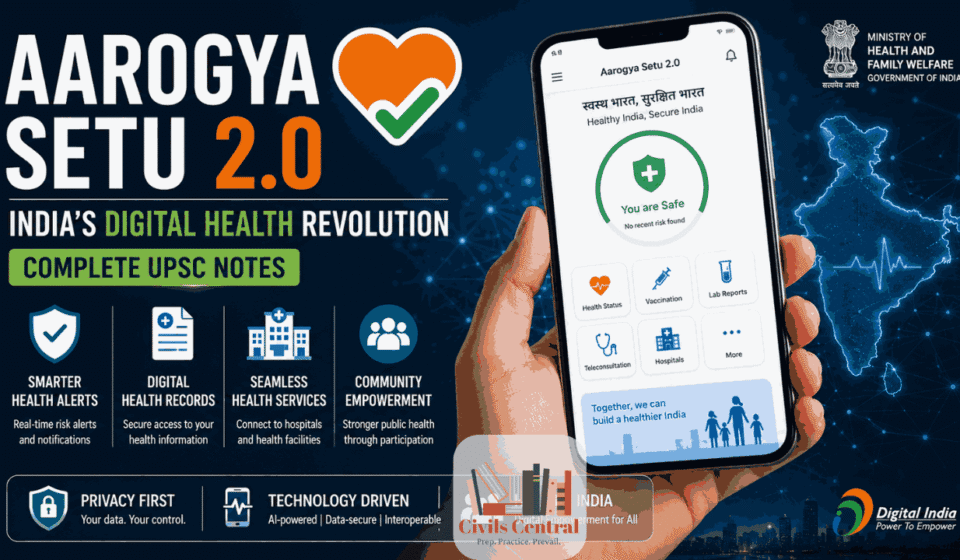
Aarogya Setu 2.0 and India’s Digital Health Revolution: Complete UPSC Notes

Introduction
India’s healthcare sector is undergoing a profound digital transformation. What began as the Aarogya Setu mobile application during the COVID-19 pandemic has evolved into a comprehensive digital health platform that aims to provide citizens with seamless, secure, and interoperable healthcare services. This transformation reflects the Government of India’s broader vision of building Digital Public Infrastructure (DPI) for healthcare, similar to the success achieved through Aadhaar, UPI, DigiLocker, and CoWIN.
In June 2026, the Government unveiled Aarogya Setu 2.0, marking a significant shift from a pandemic-focused contact tracing application to an integrated digital health ecosystem. The revamped platform is designed to act as a one-stop gateway for managing personal health records, accessing healthcare services, discovering nearby hospitals, availing government health schemes, facilitating digital consultations, and enabling consent-based sharing of medical information.
Unlike its predecessor, Aarogya Setu 2.0 is no longer merely an emergency response application. Instead, it forms an integral part of the Ayushman Bharat Digital Mission (ABDM) and supports the creation of a nationwide interoperable digital health ecosystem where citizens, healthcare providers, hospitals, laboratories, pharmacies, insurers, and government agencies can securely exchange health information while ensuring individual privacy and consent.
The launch also demonstrates India’s commitment to leveraging emerging technologies such as Artificial Intelligence (AI), standardized digital health records, interoperability frameworks, and Digital Public Infrastructure to achieve the goals of Universal Health Coverage (UHC), improve healthcare accessibility, reduce administrative inefficiencies, and strengthen evidence-based public health governance.
For UPSC aspirants, Aarogya Setu 2.0 is far more than a current affairs update. It integrates multiple themes from the syllabus, including digital governance, public health, e-governance, artificial intelligence, data protection, Digital India, Ayushman Bharat, health financing, and citizen-centric service delivery. Understanding this initiative provides valuable insights for both the Preliminary and Main examinations, particularly in GS Paper II (Governance and Health), GS Paper III (Science & Technology), Essays on Digital India, and the Personality Test.
Why in News?
The Government of India officially launched Aarogya Setu 2.0 as the next-generation digital health platform to accelerate the implementation of the Ayushman Bharat Digital Mission (ABDM) and strengthen India’s Digital Public Infrastructure for healthcare.
The upgraded platform introduces several new citizen-centric features and integrates multiple national digital health initiatives into a unified ecosystem. Alongside the launch, the Government also introduced several complementary digital health innovations, including:
- National Health Claims Exchange (NHCX)
- Unified Health Interface (UHI)
- Enhanced Ayushman App
- Ayushman Sarathi
- e-Sushrut Hospital Management System
- Drug Registry
- Bharat Health Terminology Service (BHTS)
- Common LOINC Codes for India (CLCI)
- AI-enabled Medical Data Toolkit
Collectively, these initiatives seek to create an interoperable, secure, and technology-driven healthcare ecosystem that simplifies healthcare delivery, improves patient experience, accelerates insurance claim processing, enhances disease surveillance, and supports evidence-based policymaking.
Why is Aarogya Setu 2.0 Significant?
The launch of Aarogya Setu 2.0 represents a paradigm shift in India’s digital health strategy for several reasons.
1. Evolution Beyond the Pandemic
Originally launched in 2020 to support COVID-19 management through Bluetooth and GPS-based contact tracing, Aarogya Setu has now evolved into a comprehensive digital health platform serving citizens throughout their healthcare journey rather than only during health emergencies.
2. Strengthening Digital Public Infrastructure (DPI)
India has successfully developed globally recognized Digital Public Infrastructure in sectors such as identity (Aadhaar), payments (UPI), document storage (DigiLocker), taxation (GSTN), and e-commerce (ONDC).
Aarogya Setu 2.0 extends this approach to healthcare by creating interoperable digital infrastructure that enables secure exchange of health information among various stakeholders while maintaining citizen ownership of personal health data.
3. Enabling Citizen-Centric Healthcare
Instead of repeatedly carrying physical prescriptions, diagnostic reports, insurance documents, and medical histories, citizens can securely store and access their health records digitally using a consent-based architecture. This reduces duplication of medical tests, improves continuity of care, and enables healthcare providers to make informed clinical decisions.
4. Supporting Universal Health Coverage
One of India’s major healthcare challenges is ensuring equitable access to quality healthcare across urban and rural regions. By integrating telemedicine, digital records, insurance services, hospital discovery, and public health schemes into one platform, Aarogya Setu 2.0 supports the broader objective of achieving Universal Health Coverage under the Sustainable Development Goals (SDGs).
5. Promoting Data-Driven Public Health
Standardized and anonymized health data generated through digital platforms can significantly improve disease surveillance, epidemiological research, health planning, and policy formulation while preserving patient privacy. This strengthens India’s preparedness for future public health emergencies.
Key Terms at a Glance
| Term | Meaning |
|---|---|
| Aarogya Setu 2.0 | India’s integrated digital health platform providing citizen-centric healthcare services. |
| ABDM | Ayushman Bharat Digital Mission, the national framework for digital health interoperability. |
| ABHA | Ayushman Bharat Health Account, a unique digital health identity for individuals. |
| DPI | Digital Public Infrastructure enabling interoperable public digital services. |
| UHI | Unified Health Interface connecting healthcare service providers through open protocols. |
| NHCX | National Health Claims Exchange for streamlined and paperless insurance claims processing. |
| PHR | Personal Health Records maintained digitally under citizen control. |
Evolution of Aarogya Setu (2020–2026)
Understanding the evolution of Aarogya Setu is essential because it reflects India’s broader transition from using digital technology for emergency response to building a permanent, citizen-centric Digital Public Infrastructure (DPI) for healthcare. The application has evolved from a COVID-19 contact tracing tool into a comprehensive health services platform integrated with the Ayushman Bharat Digital Mission (ABDM).
Evolution of Aarogya Setu: A Timeline
| Year | Major Development | Significance |
|---|---|---|
| 2020 | Aarogya Setu launched | COVID-19 contact tracing and self-assessment |
| 2020–21 | ePass, vaccination information, CoWIN integration | Assisted pandemic management |
| 2021 | Integration with vaccination certificates | Digital proof of vaccination |
| 2022 | Linkages with Ayushman Bharat Digital Mission (ABDM) | Transition toward digital healthcare |
| 2023–25 | Addition of ABHA services, digital health records, healthcare discovery | Expansion beyond pandemic response |
| 2026 | Launch of Aarogya Setu 2.0 | Comprehensive Digital Health Super App |
Phase I (2020): Responding to the COVID-19 Pandemic
Aarogya Setu was launched by the Government of India in April 2020 during the COVID-19 pandemic as a public health intervention to help contain the spread of the virus. The application primarily relied on:
- Bluetooth-based proximity detection
- GPS-based location services
- Self-health assessment questionnaires
- Risk notifications
- Information on COVID-19 testing centres
- Public health advisories
Its objective was to identify individuals who may have come into contact with infected persons and provide timely alerts, thereby supporting contact tracing and breaking the chain of transmission.
Major Functions During COVID-19
- Digital contact tracing
- Self-risk assessment
- COVID-19 awareness
- Test centre locator
- Emergency helplines
- State-wise advisories
- Quarantine monitoring support
- Public health notifications
The application became one of the world’s largest government-backed digital health applications, with millions of downloads during the pandemic.
Phase II: Supporting India’s Vaccination Programme
As India shifted from pandemic containment to mass vaccination, the role of Aarogya Setu also evolved. The application was integrated with the CoWIN platform, enabling users to:
- Register for vaccination
- Book vaccination appointments
- Download vaccination certificates
- Access vaccination history
- Receive vaccination reminders
This phase demonstrated how digital platforms could improve service delivery at a national scale. The successful integration of Aarogya Setu with CoWIN showcased India’s ability to build interoperable digital platforms capable of handling large-scale public service delivery efficiently.
Phase III: Transition Towards Digital Healthcare
After the pandemic subsided, the Government recognized that the digital infrastructure created during COVID-19 could be repurposed to strengthen routine healthcare delivery. Instead of discontinuing the platform, Aarogya Setu was gradually transformed into a gateway for digital health services. During this period, new capabilities were introduced, including:
- Creation of Ayushman Bharat Health Account (ABHA) IDs
- Access to Personal Health Records (PHRs)
- Digital health document management
- Healthcare provider discovery
- Consent-based sharing of health records
- Integration with the Ayushman Bharat Digital Mission ecosystem
This marked a strategic shift from disease surveillance to lifecycle health management, allowing the platform to support citizens throughout their healthcare journey.
Phase IV: Aarogya Setu 2.0 (2026)
The launch of Aarogya Setu 2.0 represents the culmination of this transformation. The platform has now become a comprehensive digital health application offering integrated services across preventive, promotive, curative, and follow-up healthcare. Rather than focusing on a single disease or emergency, it provides a unified interface for:
- Managing health records
- Accessing government health schemes
- Booking healthcare services
- Finding nearby hospitals
- Sharing medical records securely
- Processing insurance claims
- Accessing AI-powered health insights
- Connecting with the broader digital health ecosystem
This evolution aligns with the vision of making healthcare digital, accessible, interoperable, and citizen-centric.
Why Was Aarogya Setu Revamped?
Several policy, technological, and governance considerations motivated the transition to Aarogya Setu 2.0.
1. Leveraging Existing Digital Infrastructure
The original Aarogya Setu application had already established a significant user base and demonstrated the feasibility of delivering public health services digitally. Building upon this existing platform was more efficient than creating an entirely new application.
2. Supporting the Ayushman Bharat Digital Mission
The Ayushman Bharat Digital Mission (ABDM) aims to establish a nationwide interoperable digital health ecosystem. Aarogya Setu 2.0 serves as one of the primary citizen-facing applications for accessing ABDM services, thereby accelerating the mission’s implementation.
3. Improving Continuity of Care
Healthcare in India is often fragmented, with patients carrying physical prescriptions, diagnostic reports, and medical histories across different providers. The revamped platform enables citizens to maintain longitudinal digital health records that can be securely shared with healthcare providers, improving continuity of care and reducing duplication of tests.
4. Enhancing Citizen Convenience
Aarogya Setu 2.0 consolidates multiple health-related services into a single platform, reducing the need to navigate different applications for appointments, records, insurance, and scheme benefits. This “single-window” approach simplifies access to healthcare services and improves the user experience.
5. Enabling Data-Driven Health Governance
With standardized and interoperable digital health records, policymakers can access anonymized, aggregated data to:
- Monitor disease trends
- Identify public health priorities
- Allocate resources effectively
- Evaluate programme outcomes
- Strengthen epidemic preparedness
Such data-driven governance can improve both routine healthcare planning and emergency response.
What is Aarogya Setu 2.0? | Architecture, Objectives and Digital Health Ecosystem
What is Aarogya Setu 2.0?
Aarogya Setu 2.0 is India’s next-generation integrated digital health platform that serves as a unified gateway to the country’s Digital Public Infrastructure (DPI) for healthcare. It enables citizens to securely access, manage, and share their health information while connecting them with hospitals, healthcare professionals, laboratories, pharmacies, health insurance services, and various government health programmes.
Unlike the original Aarogya Setu, which primarily focused on COVID-19 contact tracing, the revamped platform is designed to support individuals throughout their healthcare journey—from preventive care and routine consultations to hospitalization, insurance claims, and long-term health record management.
The platform functions as the citizen-facing interface of the Ayushman Bharat Digital Mission (ABDM), allowing users to seamlessly access multiple digital health services through a single application.
Vision Behind Aarogya Setu 2.0
The Government of India envisions creating a healthcare ecosystem where every citizen can access quality health services without being constrained by fragmented records, geographical barriers, or administrative inefficiencies.
The core vision can be summarized as: “One Citizen – One Digital Health Identity – One Integrated Digital Health Ecosystem.”
This vision aligns with the broader objectives of:
- Universal Health Coverage (UHC)
- Digital India Programme
- Ayushman Bharat Digital Mission
- National Digital Health Ecosystem
- Citizen-centric governance
- Digital Public Infrastructure (DPI)
Core Objectives of Aarogya Setu 2.0
The platform has been developed with several strategic objectives.
1. Create a Single Digital Health Gateway
Instead of using multiple applications for appointments, prescriptions, laboratory reports, insurance claims, and government schemes, citizens can access these services through a unified platform.
2. Empower Citizens with Ownership of Health Data
A fundamental principle of Aarogya Setu 2.0 is that health data belongs to the individual, not to hospitals or government agencies. Citizens decide:
- who can access their records,
- what information can be shared,
- for how long access is granted, and
- when consent can be withdrawn.
This consent-based architecture strengthens privacy while enabling efficient healthcare delivery.
3. Improve Continuity of Healthcare
Medical information is often scattered across different hospitals, laboratories, and clinics. The platform enables individuals to maintain a longitudinal digital health record that follows them throughout their lives. Benefits include:
- Better diagnosis
- Reduced duplication of medical tests
- Faster emergency treatment
- Improved chronic disease management
- Better referral systems
4. Promote Interoperability
One of the biggest challenges in healthcare is that different hospitals often use different software systems. Aarogya Setu 2.0 addresses this by supporting interoperability, allowing diverse healthcare systems to communicate using common standards. This ensures that digital health records remain accessible across institutions, subject to the patient’s consent.
5. Strengthen Public Health Governance
Anonymized and aggregated health data can help governments:
- identify disease outbreaks,
- monitor public health trends,
- improve vaccination strategies,
- allocate healthcare resources efficiently,
- formulate evidence-based policies.
Importantly, individual privacy is protected through consent mechanisms and data protection safeguards.
Guiding Principles of Aarogya Setu 2.0
The platform has been designed around five foundational principles.
Citizen-Centric
The citizen remains at the centre of the ecosystem. Services are designed to improve accessibility, convenience, and user experience.
Consent-Based Data Sharing
Health information is shared only with the informed consent of the individual. Consent is:
- explicit,
- purpose-specific,
- time-bound,
- revocable.
This represents a significant shift from institution-controlled records to citizen-controlled digital health information.
Interoperability
The platform uses standardized digital health protocols to ensure seamless communication between healthcare providers, laboratories, insurers, and government agencies.
Inclusiveness
The digital ecosystem aims to benefit:
- urban populations,
- rural communities,
- public hospitals,
- private healthcare providers,
- small clinics,
- diagnostic centres,
- pharmacies,
- health insurance providers.
The objective is to create a nationwide digital health network rather than a platform limited to selected institutions.
Security and Privacy
Security measures include:
- encrypted data exchange,
- secure authentication,
- consent management,
- role-based access,
- compliance with national digital health standards.
Institutional Architecture
Aarogya Setu 2.0 does not function independently. It operates within a broader institutional framework.
| Institution | Role |
|---|---|
| Ministry of Health and Family Welfare | Policy direction and overall implementation |
| National Health Authority (NHA) | Development and implementation of the Ayushman Bharat Digital Mission |
| Ayushman Bharat Digital Mission (ABDM) | National digital health framework |
| Healthcare Providers | Delivery of medical services and digital record generation |
| Laboratories | Upload diagnostic reports |
| Pharmacies | Support digital prescriptions and medication records |
| Insurance Companies | Process digital health claims through NHCX |
| Citizens | Owners and controllers of their digital health data |
How Aarogya Setu 2.0 Fits into India’s Digital Health Ecosystem
Aarogya Setu 2.0 should not be viewed as a standalone application. Instead, it acts as the entry point to an interconnected ecosystem of digital health services.
Conceptual Flow
Citizen
     │
     ▼
Aarogya Setu 2.0
     │
──────────────────────────────────────────
│          │           │          │
▼          ▼           ▼          ▼
ABHA      UHI       NHCX      PM-JAY
│           │           │          │
▼           ▼           ▼          ▼
Hospitals  Telemedicine Insurance Health Benefits
│
▼
Digital Health Records
This interconnected architecture enables seamless movement of health information while ensuring that citizens retain control over data sharing.
Relationship with the Ayushman Bharat Digital Mission (ABDM)
The Ayushman Bharat Digital Mission provides the foundational digital infrastructure for India’s healthcare ecosystem. Aarogya Setu 2.0 serves as the user interface, enabling citizens to access services built on this infrastructure. A useful analogy is:
- ABDM is the highway.
- Aarogya Setu 2.0 is the vehicle through which citizens travel on that highway.
Without ABDM, the platform would lack interoperability. Without a citizen-facing application like Aarogya Setu 2.0, the infrastructure would remain inaccessible to the public.
Stakeholders in the Ecosystem
The success of Aarogya Setu 2.0 depends on collaboration among multiple stakeholders.
Citizens
- Create and manage digital health identities.
- Store health records.
- Provide consent for data sharing.
- Access healthcare services.
Doctors
- View patient records with consent.
- Upload prescriptions.
- Improve continuity of treatment.
Hospitals
- Generate digital discharge summaries.
- Share records securely.
- Reduce paperwork.
Diagnostic Laboratories
- Upload test reports.
- Ensure standardized reporting.
Pharmacies
- Process digital prescriptions.
- Maintain medication histories.
Insurance Providers
- Verify records digitally.
- Process claims efficiently through the National Health Claims Exchange (NHCX).
Government
- Strengthen public health planning.
- Improve programme implementation.
- Monitor health indicators using anonymized data.
Why Aarogya Setu 2.0 is a Digital Public Infrastructure (DPI)?
Digital Public Infrastructure consists of foundational digital systems that enable secure, scalable, and interoperable public services. Aarogya Setu 2.0 exhibits all the key characteristics of a DPI:
- Open Standards: It relies on common technical standards that allow different health systems to communicate.
- Interoperability: Data can move securely across hospitals, laboratories, insurers, and pharmacies with the user’s consent.
- Scalability: The platform is designed to support a population of over 1.4 billion people.
- Public Utility: It serves as a foundational layer for delivering public health services, much like Aadhaar for identity or UPI for payments.
- Innovation Ecosystem: Open interfaces enable private innovators, startups, and healthcare providers to build new services on top of the digital infrastructure.
Digital Public Infrastructure (DPI): Three Major Pillars in India
| Sector | Digital Public Infrastructure |
|---|---|
| Identity | Aadhaar |
| Payments | UPI |
| Documents | DigiLocker |
| Commerce | ONDC |
| Health | Ayushman Bharat Digital Mission + Aarogya Setu 2.0 |
| Logistics | Unified Logistics Interface Platform (ULIP) |
Exam Tip: In GS Paper II or III answers, use Aarogya Setu 2.0 as an example of how India is extending the Digital Public Infrastructure model beyond finance into healthcare, enabling citizen-centric, interoperable, and consent-driven public service delivery.
Major Features of Aarogya Setu 2.0
Aarogya Setu 2.0 has evolved into a comprehensive digital health platform that integrates multiple healthcare services into a single application. Rather than functioning as a standalone app, it serves as the citizen-facing gateway to India’s Digital Public Infrastructure (DPI) for healthcare under the Ayushman Bharat Digital Mission (ABDM).
The newly introduced features aim to make healthcare more accessible, interoperable, citizen-centric, paperless, and efficient.
1. Personal Health Records (PHR)
One of the most significant features of Aarogya Setu 2.0 is the ability to maintain a Personal Health Record (PHR). A Personal Health Record is a digitally stored, longitudinal record of an individual’s medical history that remains under the citizen’s control. It can include:
- Doctor prescriptions
- Laboratory reports
- Radiology reports
- Vaccination records
- Discharge summaries
- Allergies
- Chronic disease history
- Medication records
Unlike traditional paper records that are scattered across hospitals, laboratories, and clinics, the PHR creates a single, lifelong digital health record.
Why is it important?
- Eliminates loss of medical records.
- Reduces repeated diagnostic tests.
- Improves continuity of care.
- Enables faster treatment during emergencies.
- Assists doctors in making informed clinical decisions.
2. ABHA Creation and Management
Aarogya Setu 2.0 enables users to create and manage their Ayushman Bharat Health Account (ABHA). ABHA is a 14-digit unique digital health identifier that allows individuals to securely link and access their health records across participating healthcare facilities. Through the app, users can:
- Create a new ABHA.
- Retrieve an existing ABHA.
- Update profile information.
- Link healthcare records.
- Manage consent for data sharing.
Significance
- Establishes a unique digital identity in the health ecosystem.
- Facilitates interoperability among healthcare providers.
- Simplifies access to digital health services.
3. Consent-Based Health Record Sharing
One of the defining characteristics of Aarogya Setu 2.0 is its consent manager. Medical records are not automatically accessible to hospitals, doctors, insurers, or government agencies. Instead, citizens have complete control over:
- Who can access their records.
- Which records can be shared.
- The purpose of sharing.
- Duration of access.
- Withdrawal of consent.
Importance
This strengthens:
- Privacy
- Data security
- Trust in digital healthcare
- Citizen ownership of health data
UPSC Link: This is a practical example of privacy by design and aligns with India’s evolving data governance framework.
4. Digital Health Record Storage
The platform acts as a secure repository for important health documents. Users can digitally store:
- Prescriptions
- Medical certificates
- Laboratory reports
- Imaging reports
- Hospital discharge summaries
- Vaccination certificates
Because these records remain digitally available, they can be accessed anytime and anywhere.
Benefits
- Reduces paperwork.
- Prevents record loss.
- Facilitates telemedicine.
- Supports portability across states.
5. Access to Digital Prescriptions
Doctors can issue electronic prescriptions that are stored securely within the platform. This reduces problems associated with:
- Lost prescriptions
- Illegible handwriting
- Duplicate medicines
- Medication errors
Patients can also retrieve previous prescriptions during follow-up consultations.
6. AI-Powered Health Insights
One of the most notable additions in Aarogya Setu 2.0 is the integration of Artificial Intelligence (AI) to improve healthcare delivery. The platform can analyse available health information and provide:
- Preventive health recommendations.
- Lifestyle guidance.
- Risk alerts.
- Medication reminders.
- Wellness suggestions.
Potential Applications
- Early identification of chronic diseases.
- Diabetes management.
- Hypertension monitoring.
- Preventive healthcare.
- Public health analytics.
UPSC Link: AI in healthcare is increasingly important for GS Paper III, particularly in discussions on emerging technologies and governance.
7. Smart Health Reports
Rather than presenting raw medical information, the platform converts health data into easy-to-understand summaries. Citizens can obtain:
- Consolidated health timelines.
- Disease history.
- Vaccination history.
- Laboratory trends.
- Medication summaries.
This improves health literacy and enables individuals to make informed decisions regarding their care.
8. Wearable Device Integration
Aarogya Setu 2.0 supports integration with wearable health devices. These devices may track:
- Heart rate
- Daily activity
- Sleep patterns
- Blood oxygen levels
- Physical fitness indicators
Such integration enables continuous health monitoring and encourages preventive healthcare.
9. Medication Reminders
The application helps improve treatment adherence through medication reminders. Users can receive alerts for:
- Daily medicines.
- Follow-up consultations.
- Vaccinations.
- Scheduled health screenings.
This is particularly beneficial for patients managing chronic conditions such as diabetes, hypertension, and cardiovascular diseases.
10. Family Health Management
Healthcare decisions often involve multiple family members. Aarogya Setu 2.0 enables users to manage the health records of dependent family members where applicable. Possible uses include:
- Children’s vaccination records.
- Elderly parents’ prescriptions.
- Family medical history.
- Appointment management.
This feature simplifies healthcare management for households.
11. Scan & Register for OPD Services
The platform introduces Scan & Register, allowing patients to register for outpatient consultations by scanning a QR code at participating healthcare facilities.
Benefits
- Reduces waiting time.
- Minimises paperwork.
- Speeds up patient registration.
- Improves hospital efficiency.
- Reduces overcrowding.
12. Hospital Discovery
Citizens can locate nearby healthcare facilities through the application. The feature enables searches based on:
- Location
- Specialty
- Type of healthcare facility
- Available services
This helps users identify appropriate healthcare providers quickly, especially during emergencies.
13. Blood Bank Locator
Users can identify nearby blood banks and access relevant information, facilitating timely access to blood during medical emergencies. This contributes to improved emergency healthcare response.
14. Ambulance Services
The application provides information on ambulance services, helping users access emergency transportation more efficiently. This feature supports quicker response during critical medical situations.
15. Jan Aushadhi Locator
Aarogya Setu 2.0 integrates information related to Pradhan Mantri Bhartiya Janaushadhi Pariyojana (PMBJP). Users can locate nearby Jan Aushadhi Kendras, enabling them to purchase quality generic medicines at affordable prices.
Importance
- Reduces out-of-pocket healthcare expenditure.
- Improves access to affordable medicines.
- Supports universal healthcare objectives.
16. PM-JAY Integration
The platform is integrated with the Pradhan Mantri Jan Arogya Yojana (PM-JAY). Eligible beneficiaries can:
- Verify eligibility.
- Access scheme-related information.
- Use integrated digital health services.
- Connect with empanelled hospitals.
This enhances the accessibility of India’s flagship health insurance programme.
17. DigiLocker Integration
The integration with DigiLocker enables secure retrieval and storage of authenticated digital documents. Examples include:
- Identity documents.
- Health certificates.
- Vaccination certificates.
- Other relevant records.
This reduces the need to carry physical documents during hospital visits.
18. One Unified Digital Health Experience
The greatest strength of Aarogya Setu 2.0 lies not in any individual feature but in the integration of multiple healthcare services into a single, interoperable platform. Instead of navigating separate applications for appointments, health records, insurance, medicines, and government schemes, citizens can access these services through one interface.
Key Features of Aarogya Setu 2.0
| Feature | Purpose | Benefit |
|---|---|---|
| Personal Health Records | Store lifelong medical records | Better continuity of care |
| ABHA Integration | Unique digital health identity | Easy access to services |
| Consent Manager | Citizen-controlled data sharing | Privacy and trust |
| Digital Prescriptions | Electronic prescriptions | Reduced medication errors |
| AI Health Insights | Preventive healthcare guidance | Early risk detection |
| Smart Health Reports | Simplified health summaries | Improved health literacy |
| Wearable Integration | Continuous health monitoring | Preventive care |
| Medication Reminders | Treatment adherence | Better disease management |
| Family Health Management | Manage dependent records | Household healthcare convenience |
| Scan & Register | QR-based OPD registration | Reduced waiting time |
| Hospital Discovery | Locate healthcare facilities | Faster access to care |
| Blood Bank Locator | Identify nearby blood banks | Emergency support |
| Ambulance Services | Access emergency transport | Improved response time |
| Jan Aushadhi Locator | Find generic medicine outlets | Affordable medicines |
| PM-JAY Integration | Access health insurance services | Financial protection |
| DigiLocker Integration | Secure document storage | Paperless healthcare |
India’s Digital Health Ecosystem
The Government of India is building an interoperable Digital Public Infrastructure (DPI) where multiple platforms work together to deliver seamless healthcare services. Aarogya Setu 2.0 serves as the citizen-facing gateway, while several backend systems enable identity management, health record exchange, insurance claim processing, healthcare discovery, and digital document storage.
Understanding this interconnected architecture is crucial for both the Prelims and Mains examinations.
India’s Digital Health Ecosystem at a Glance
                    Government of India
                            │
                            ▼
         Ayushman Bharat Digital Mission (ABDM)
                            │
 ┌──────────────┬──────────────┬──────────────┬──────────────┐
 ▼              ▼              ▼              ▼
ABHA        Aarogya Setu 2.0     UHI         NHCX
 │              │                │            │
 ▼              ▼                ▼            ▼
Health ID   Citizen Services   Telemedicine  Insurance Claims
 │
 ▼
Hospitals ─ Labs ─ Pharmacies ─ Doctors ─ PM-JAY ─ DigiLocker
1. Ayushman Bharat Digital Mission (ABDM)
The Ayushman Bharat Digital Mission (ABDM) is the flagship initiative of the Government of India for creating a national digital health ecosystem.
Launched in 2021, its objective is to establish an interoperable digital framework where patients, hospitals, laboratories, pharmacies, insurers, and healthcare professionals can securely exchange health information with the individual’s consent.
Objectives of ABDM
- Create digital health infrastructure.
- Improve healthcare accessibility.
- Enable interoperability.
- Strengthen continuity of care.
- Reduce administrative inefficiencies.
- Empower citizens with control over their health data.
Think of ABDM as the operating system of India’s digital health ecosystem.
2. ABHA: The Digital Health Identity
The Ayushman Bharat Health Account (ABHA) is a unique digital health identifier that enables individuals to access healthcare services across participating institutions.
Functions of ABHA
- Establishes a unique digital identity.
- Links health records generated at different hospitals.
- Enables secure record sharing.
- Facilitates continuity of care.
- Simplifies authentication within the digital health ecosystem.
Without ABHA, interoperable digital health records would not be possible.
3. Aarogya Setu 2.0: The Citizen Interface
Aarogya Setu 2.0 acts as the front-end application through which citizens interact with the digital health ecosystem. It enables users to:
- Create and manage ABHA.
- Access Personal Health Records.
- Discover hospitals.
- Locate Jan Aushadhi Kendras.
- Access PM-JAY services.
- Share medical records securely.
- Receive AI-powered health insights.
- Access digital prescriptions.
- Manage family health records.
Instead of functioning independently, it connects citizens to all major digital health services through one interface.
4. Unified Health Interface (UHI)
The Unified Health Interface (UHI) is an open, interoperable network that enables digital discovery and delivery of healthcare services. It is conceptually similar to how the Unified Payments Interface (UPI) transformed digital payments.
Purpose
UHI allows patients to discover and connect with healthcare providers without being restricted to a single application or hospital network.
Key Features
- Open network architecture.
- Interoperable digital consultations.
- Provider discovery.
- Appointment booking.
- Telemedicine services.
Why is UHI Important?
Instead of every hospital developing its own isolated digital platform, UHI enables different healthcare providers to communicate through common protocols. This promotes:
- Competition.
- Innovation.
- Wider patient choice.
- Better healthcare accessibility.
5. National Health Claims Exchange (NHCX)
Insurance claim processing has traditionally been slow, paper-intensive, and fragmented. The National Health Claims Exchange (NHCX) addresses this challenge by creating a standardized digital platform for processing health insurance claims.
Objectives
- Standardize claims processing.
- Reduce paperwork.
- Improve transparency.
- Accelerate settlement of claims.
- Minimize fraud.
- Improve interoperability among insurers and hospitals.
Stakeholders
- Hospitals.
- Insurance companies.
- Third-Party Administrators (TPAs).
- Government health schemes.
- Beneficiaries.
The platform benefits both public and private health insurance ecosystems.
6. PM-JAY Integration
The Pradhan Mantri Jan Arogya Yojana (PM-JAY) is India’s flagship publicly funded health assurance scheme. Integration with Aarogya Setu 2.0 allows eligible beneficiaries to:
- Verify eligibility.
- Access empanelled hospitals.
- Retrieve treatment information.
- Use digital health services linked to PM-JAY.
This improves beneficiary convenience and enhances the efficiency of scheme implementation.
7. DigiLocker Integration
Healthcare requires the secure storage and retrieval of multiple documents. Through integration with DigiLocker, users can access authenticated digital documents such as:
- Identity proofs.
- Vaccination certificates.
- Medical certificates.
- Other health-related records.
This supports paperless healthcare and reduces administrative burdens.
8. Ayushman App
The enhanced Ayushman App complements Aarogya Setu 2.0 by providing dedicated access to services under PM-JAY and the Ayushman Bharat Digital Mission. Key functionalities include:
- Beneficiary verification.
- Scheme information.
- Hospital search.
- Health card management.
- Digital health services.
9. Ayushman Sarathi
Ayushman Sarathi has been introduced to improve citizen awareness and facilitate easier access to government health schemes. Its objectives include:
- Providing guidance on available health services.
- Assisting beneficiaries in navigating digital platforms.
- Enhancing awareness of PM-JAY and ABDM.
- Supporting citizen engagement with digital healthcare.
10. Healthcare Providers
The ecosystem also includes:
- Government hospitals.
- Private hospitals.
- Primary Health Centres (PHCs).
- Community Health Centres (CHCs).
- Clinics.
- Laboratories.
- Pharmacies.
These institutions generate and update digital health records while delivering healthcare services.
Why Interoperability Matters?
Interoperability refers to the ability of different digital systems to exchange and use information effectively. In healthcare, this means that:
- Hospitals can access relevant patient records with consent.
- Laboratories can upload reports in standardized formats.
- Pharmacies can process digital prescriptions.
- Insurance providers can verify claims efficiently.
- Patients do not need to repeatedly submit the same information.
Without interoperability, digital health systems would remain fragmented and inefficient.
India’s Digital Health Ecosystem
| Component | Primary Function | Comparable Digital Public Infrastructure |
|---|---|---|
| ABDM | Digital health framework | India Stack (Health) |
| ABHA | Digital health identity | Aadhaar |
| Aarogya Setu 2.0 | Citizen interface | BHIM/UPI apps |
| UHI | Healthcare discovery and service delivery | UPI (Open Network Model) |
| NHCX | Digital insurance claims | GSTN for standardized transactions |
| DigiLocker | Digital document repository | National document wallet |
| PM-JAY | Financial protection for healthcare | Flagship health assurance scheme |
Benefits of an Integrated Digital Health Ecosystem
For Citizens
- One platform for multiple health services.
- Better continuity of care.
- Reduced paperwork.
- Faster access to treatment.
- Secure control over personal health data.
- Improved access to government schemes.
For Doctors
- Access to previous medical records.
- Better clinical decision-making.
- Reduced duplication of investigations.
- Improved treatment outcomes.
For Hospitals
- Faster patient registration.
- Efficient record management.
- Simplified claim processing.
- Reduced administrative costs.
For Insurance Companies
- Standardized documentation.
- Faster claim settlement.
- Reduced fraud.
- Better transparency.
For Government
- Improved disease surveillance.
- Better health planning.
- Efficient implementation of schemes.
- Evidence-based policymaking.
New Digital Health Initiatives Launched Alongside Aarogya Setu 2.0
The launch of Aarogya Setu 2.0 was accompanied by several important digital health initiatives aimed at strengthening India’s Digital Public Infrastructure (DPI) for healthcare. While Aarogya Setu 2.0 serves as the citizen-facing application, these initiatives provide the underlying infrastructure necessary for interoperable, efficient, and standardized healthcare delivery.
1. National Health Claims Exchange (NHCX)
What is NHCX?
The National Health Claims Exchange (NHCX) is a digital platform developed to standardize and streamline the exchange of health insurance claims between hospitals, insurers, and government health schemes. It acts as a common digital gateway for processing health insurance claims, reducing dependence on paper-based documentation and manual verification.
Why Was It Needed?
Traditionally, health insurance claims in India have faced several challenges:
- Multiple claim formats used by different insurers.
- Lengthy processing times.
- Manual verification of documents.
- Administrative inefficiencies.
- Higher chances of fraud.
- Delayed reimbursement to hospitals.
NHCX seeks to address these bottlenecks through a common interoperable framework.
Key Features
- Standardized claim formats.
- Paperless claim submission.
- Faster verification.
- Secure data exchange.
- Interoperability across insurers.
- Digital audit trails.
- Reduced administrative burden.
Benefits
For Patients
- Faster claim settlement.
- Reduced paperwork.
- Better transparency.
For Hospitals
- Quicker reimbursement.
- Lower administrative costs.
- Simplified documentation.
For Insurance Companies
- Standardized workflows.
- Better fraud detection.
- Improved operational efficiency.
2. Unified Health Interface (UHI)
What is UHI?
The Unified Health Interface (UHI) is an open, interoperable digital network that enables citizens to discover, access, and receive healthcare services across different digital platforms. It is conceptually similar to the Unified Payments Interface (UPI) in the financial sector.
Just as UPI allows users of different banking applications to transfer money seamlessly, UHI allows patients to connect with healthcare providers irrespective of the application they use.
Objectives
- Promote interoperability.
- Improve healthcare accessibility.
- Encourage innovation.
- Create an open healthcare marketplace.
- Reduce platform monopolies.
Services Enabled
- Teleconsultation.
- Appointment booking.
- Healthcare provider discovery.
- Digital prescriptions.
- Referral services.
Importance
UHI enables hospitals, clinics, startups, and digital health applications to communicate using common protocols. This creates a competitive and innovative healthcare ecosystem.
3. e-Sushrut Hospital Management Information System
What is e-Sushrut?
e-Sushrut is a Hospital Management Information System (HMIS) developed to digitize hospital administration and clinical workflows. It supports the management of healthcare institutions by integrating administrative and medical functions into a unified digital platform.
Key Functions
- Patient registration.
- OPD management.
- IPD management.
- Electronic Medical Records (EMRs).
- Laboratory management.
- Pharmacy management.
- Billing.
- Inventory management.
- Appointment scheduling.
Benefits
- Improves hospital efficiency.
- Reduces paperwork.
- Enhances patient experience.
- Enables better resource utilization.
- Supports data-driven hospital administration.
4. Drug Registry
What is the Drug Registry?
The Drug Registry is a standardized digital database of medicines used within the national digital health ecosystem. It provides uniform information about medicines prescribed and dispensed across healthcare providers.
Objectives
- Standardize medicine identification.
- Reduce prescription errors.
- Improve interoperability.
- Facilitate digital prescriptions.
- Enhance pharmacovigilance.
Benefits
- Accurate medicine records.
- Better prescription management.
- Improved patient safety.
- Easier integration with pharmacy systems.
5. Bharat Health Terminology Service (BHTS)
What is BHTS?
The Bharat Health Terminology Service (BHTS) provides standardized medical terminology for India’s digital health ecosystem. Healthcare providers often use different terms for similar medical conditions, procedures, and diagnoses. BHTS establishes a common vocabulary to ensure consistency across institutions.
Why is Standardization Necessary?
Without common terminology:
- Records become difficult to interpret.
- Data sharing becomes inefficient.
- Research quality suffers.
- AI applications become less reliable.
- Public health analysis becomes inconsistent.
Functions
- Standardize disease terminology.
- Standardize clinical procedures.
- Support electronic health records.
- Improve interoperability.
- Facilitate AI applications.
6. Common LOINC Codes for India (CLCI)
What is CLCI?
The Common LOINC Codes for India (CLCI) is an initiative to standardize laboratory investigations using internationally recognized coding systems adapted for Indian healthcare. LOINC stands for Logical Observation Identifiers Names and Codes.
Purpose
Different laboratories often use different names for the same diagnostic test. CLCI provides standardized coding for laboratory investigations.
Benefits
- Uniform laboratory reporting.
- Improved interoperability.
- Better disease surveillance.
- Easier exchange of laboratory data.
- Enhanced medical research.
Example
A blood glucose test performed in different laboratories can be identified using the same standardized code. This enables healthcare providers to interpret reports consistently.
7. AI-Enabled Medical Data Toolkit
What is the AI Medical Data Toolkit?
The Government has introduced an AI-enabled toolkit to support the standardization and intelligent utilization of digital medical data. Rather than replacing healthcare professionals, the toolkit is designed to assist them by improving the organization, analysis, and usability of health information.
Objectives
- Standardize medical datasets.
- Improve AI readiness.
- Support healthcare research.
- Enhance clinical decision support.
- Strengthen public health analytics.
Potential Applications
- Disease prediction.
- Risk assessment.
- Population health management.
- Early disease detection.
- Clinical decision support.
- Medical research.
How These Initiatives Complement Aarogya Setu 2.0?
Each initiative addresses a different component of the healthcare ecosystem.
| Initiative | Primary Function |
|---|---|
| Aarogya Setu 2.0 | Citizen-facing health platform |
| ABDM | National digital health framework |
| ABHA | Digital health identity |
| UHI | Healthcare discovery and service delivery |
| NHCX | Insurance claims processing |
| e-Sushrut | Hospital management system |
| Drug Registry | Standardized medicine database |
| BHTS | Standardized medical terminology |
| CLCI | Standardized laboratory codes |
| AI Medical Data Toolkit | AI-ready health data |
Together, they create an interoperable ecosystem where health information can flow securely and efficiently while remaining under the citizen’s control.
Challenges in Implementing These Initiatives
While these initiatives hold significant promise, successful implementation requires addressing several challenges:
- Ensuring interoperability across diverse healthcare providers.
- Maintaining cybersecurity and data privacy.
- Building digital capacity among healthcare workers.
- Expanding digital infrastructure in rural and remote areas.
- Ensuring data quality and standardization.
- Encouraging adoption by private healthcare institutions.
- Strengthening digital literacy among citizens.
Addressing these issues will be crucial to realizing the full potential of India’s digital health transformation.
Important Correction for UPSC Aspirants
The PIB release specifically mentions the launch and strengthening of these digital health components as part of the broader Ayushman Bharat Digital Mission ecosystem. In examination answers, avoid presenting them as isolated projects. Instead, emphasize that they collectively form India’s Digital Public Infrastructure for Health, with Aarogya Setu 2.0 serving as the unified citizen interface.
Artificial Intelligence in Healthcare – Transforming India’s Digital Health Ecosystem
One of the most significant aspects of the Aarogya Setu 2.0 initiative is the integration of Artificial Intelligence (AI) into India’s digital health ecosystem. While earlier digital health initiatives primarily focused on digitizing records and improving access to healthcare services, the next phase aims to use AI for better diagnosis, preventive healthcare, clinical decision support, and public health planning.
The Government’s vision is not to replace doctors with AI but to augment healthcare delivery, improve efficiency, and enable data-driven decision-making while ensuring that citizens retain control over their personal health information.
Why AI is Important in Healthcare?
Healthcare systems generate enormous volumes of data from hospitals, laboratories, pharmacies, wearable devices, and insurance claims. However, raw data alone has limited value unless it can be analyzed meaningfully. Artificial Intelligence enables computers to identify patterns, analyze large datasets, predict health risks, and assist healthcare professionals in making informed decisions.
In the context of Aarogya Setu 2.0, AI has the potential to:
- Improve preventive healthcare.
- Enhance disease surveillance.
- Support early diagnosis.
- Reduce administrative workload.
- Personalize healthcare services.
- Strengthen public health planning.
AI in Aarogya Setu 2.0
The PIB announcement highlights the integration of AI-driven capabilities to make the platform more intelligent and citizen-centric. These capabilities include:
1. AI-Powered Health Insights
Instead of merely storing health records, the platform can analyze available health information to generate personalized insights.
Examples include:
- Lifestyle recommendations.
- Preventive health advice.
- Risk alerts for chronic diseases.
- Follow-up reminders.
- Vaccination alerts.
- Wellness guidance.
Such insights encourage citizens to adopt healthier lifestyles and seek timely medical attention.
2. Personalized Preventive Healthcare
Traditional healthcare systems often focus on treating diseases after they occur. AI shifts this approach towards preventive healthcare by identifying potential health risks based on available information. Potential applications include:
- Identifying individuals at risk of diabetes.
- Monitoring hypertension trends.
- Detecting cardiovascular risk factors.
- Recommending preventive screenings.
- Encouraging healthy behavioural changes.
This supports the broader public health objective of reducing the burden of non-communicable diseases (NCDs).
3. Clinical Decision Support
AI can assist healthcare professionals by analysing patient records and presenting relevant clinical information. Potential applications include:
- Highlighting drug interactions.
- Identifying allergies.
- Reviewing previous medical history.
- Suggesting evidence-based treatment options.
- Flagging abnormal laboratory values.
Importantly, AI provides decision support, while the final medical judgement remains with qualified healthcare professionals.
4. Population Health Analytics
Digital health platforms generate anonymized and aggregated health data that can help governments monitor health trends at the population level. AI can assist in:
- Detecting disease outbreaks.
- Monitoring vaccination coverage.
- Identifying regional disease patterns.
- Forecasting healthcare demand.
- Assessing programme performance.
These insights enable evidence-based policymaking and improve preparedness for public health emergencies.
Open Medical Data Toolkit
The Government has also introduced an Open Medical Data Toolkit to support the effective use of AI within the digital health ecosystem.
What is the Open Medical Data Toolkit?
It is a framework designed to standardize and organize medical data so that it can be used efficiently by AI systems while maintaining data quality and interoperability. Without standardized datasets, AI algorithms cannot reliably analyse health information or generate meaningful outputs.
Objectives
- Improve data quality.
- Standardize medical information.
- Facilitate interoperability.
- Support AI model development.
- Enable healthcare innovation.
- Promote responsible use of medical data.
Why Standardized Data Matters?
Artificial Intelligence is only as reliable as the data on which it is trained. Poor-quality or inconsistent health records can lead to inaccurate recommendations. Standardization ensures that:
- Medical terminology is uniform.
- Laboratory reports follow common coding systems.
- Clinical records are interoperable.
- AI models receive consistent and reliable data.
This is why initiatives such as the Bharat Health Terminology Service (BHTS) and Common LOINC Codes for India (CLCI) are essential components of the digital health ecosystem.
Potential Applications of AI in India’s Healthcare System
Disease Surveillance
AI can identify unusual patterns in health data, helping authorities detect disease outbreaks earlier and respond more effectively.
Early Diagnosis
AI-assisted analysis of medical records and diagnostic reports can support the early detection of diseases, enabling timely intervention.
Resource Allocation
Governments can use AI-generated insights to allocate healthcare resources more efficiently, such as deploying medical personnel or supplies to regions with greater need.
Telemedicine
AI can improve telemedicine by assisting with preliminary assessments, triaging patients, and organizing relevant medical information before consultations.
Public Health Research
Researchers can use anonymized datasets to study disease trends, evaluate health programmes, and develop new interventions while safeguarding patient privacy.
Benefits of AI in Healthcare
For Citizens
- Personalized health guidance.
- Improved preventive care.
- Better access to healthcare information.
- Timely reminders and alerts.
- Enhanced continuity of care.
For Healthcare Professionals
- Faster access to relevant patient information.
- Reduced administrative workload.
- Improved clinical decision support.
- Better treatment planning.
For Government
- Evidence-based policymaking.
- Improved disease surveillance.
- Efficient resource allocation.
- Better monitoring of national health programmes.
For Researchers
- Access to standardized health datasets.
- Enhanced medical research.
- Opportunities for innovation in digital health.
Challenges and Ethical Concerns
While AI offers transformative potential, several challenges must be addressed.
Data Privacy
AI systems require access to large volumes of health data. This raises concerns regarding:
- Unauthorized access.
- Data misuse.
- Confidentiality of medical information.
Strong consent mechanisms and data protection safeguards are therefore essential.
Algorithmic Bias
AI models trained on incomplete or unrepresentative datasets may generate biased recommendations. Such bias can adversely affect vulnerable populations and undermine equitable healthcare delivery. Ensuring diverse and representative datasets is crucial.
Transparency
Healthcare decisions can have significant consequences. Citizens and healthcare providers should be able to understand how AI-generated recommendations are produced. Transparent and explainable AI systems are therefore important.
Accountability
AI should support—not replace—medical professionals. Responsibility for diagnosis and treatment must remain with qualified healthcare practitioners.
Digital Divide
The benefits of AI-enabled healthcare will not be fully realized unless:
- Digital infrastructure reaches rural and remote areas.
- Healthcare workers receive adequate training.
- Citizens possess the necessary digital literacy to access these services.
Government Safeguards
To promote responsible AI adoption, the digital health ecosystem incorporates several safeguards.
- Consent-based access to personal health records.
- Standardized data through BHTS and CLCI.
- Interoperability under the Ayushman Bharat Digital Mission.
- Secure digital architecture with encrypted data exchange.
- Citizen ownership of health information.
These measures aim to balance innovation with privacy, security, and trust.
AI in Healthcare: Opportunities vs. Challenges
| Opportunities | Challenges |
|---|---|
| Early disease detection | Data privacy concerns |
| Preventive healthcare | Algorithmic bias |
| Clinical decision support | Lack of transparency |
| Better resource allocation | Digital divide |
| Improved disease surveillance | Cybersecurity risks |
| Efficient health administration | Need for skilled workforce |
| Personalized healthcare | Ethical governance |
Digital Public Infrastructure (DPI) for Health
One of the most important conceptual developments in India’s governance model over the past decade has been the emergence of Digital Public Infrastructure (DPI). Rather than building isolated digital applications, India is creating foundational digital platforms that can be used by governments, private enterprises, startups, and citizens to deliver public services efficiently and at scale.
Aarogya Setu 2.0 should therefore be understood not merely as a mobile application but as a citizen-facing layer of India’s Digital Public Infrastructure for Health, built on the Ayushman Bharat Digital Mission (ABDM).
What is Digital Public Infrastructure (DPI)?
Digital Public Infrastructure refers to a set of shared digital systems, standards, and networks that provide foundational services for governments, businesses, and citizens.
Unlike standalone digital applications, DPI creates common digital building blocks that multiple stakeholders can use to deliver innovative and interoperable services.
Characteristics of DPI
- Open and interoperable architecture.
- Population-scale implementation.
- Secure digital infrastructure.
- Public utility with private innovation.
- Citizen-centric design.
- Reusable digital building blocks.
- Trust-based governance.
India’s DPI Journey
India has developed one of the world’s most advanced Digital Public Infrastructure ecosystems.
| Sector | Digital Public Infrastructure |
|---|---|
| Identity | Aadhaar |
| Payments | Unified Payments Interface (UPI) |
| Digital Documents | DigiLocker |
| Taxation | Goods and Services Tax Network (GSTN) |
| Commerce | Open Network for Digital Commerce (ONDC) |
| Logistics | Unified Logistics Interface Platform (ULIP) |
| Agriculture | Agri Stack (under development) |
| Health | Ayushman Bharat Digital Mission (ABDM) + Aarogya Setu 2.0 |
Each layer addresses a different sector while following common principles of interoperability, scalability, and citizen empowerment.
Why Healthcare Needed a Digital Public Infrastructure?
Before the implementation of ABDM, India’s healthcare system faced several structural challenges:
- Fragmented medical records.
- Limited interoperability between hospitals.
- Paper-based documentation.
- Slow insurance claim processing.
- Repeated diagnostic tests.
- Difficulty in accessing medical history across healthcare providers.
- Administrative inefficiencies.
A Digital Public Infrastructure for Health seeks to overcome these issues by creating common digital standards and enabling secure exchange of health information.
Advantages of a Digital Public Infrastructure Approach
1. Interoperability
Different hospitals, laboratories, insurers, and healthcare providers can communicate using common standards, ensuring that digital health records remain portable across institutions.
2. Scalability
The infrastructure is designed to support a population of over 1.4 billion people while accommodating millions of healthcare transactions daily.
3. Innovation
Open digital standards allow startups, private companies, and technology providers to build innovative health solutions without creating isolated systems.
4. Competition
Since the infrastructure is open and interoperable, multiple service providers can compete, improving quality and expanding user choice.
5. Citizen Empowerment
Individuals maintain control over their health information through consent-based data sharing, reinforcing trust in digital healthcare.
Comparison with Other Digital Public Infrastructure Initiatives
| Feature | UPI | ONDC | ABDM |
|---|---|---|---|
| Sector | Payments | Commerce | Healthcare |
| Identity | Bank Accounts | Buyer/Seller Accounts | ABHA |
| Open Network | Yes | Yes | Yes |
| Interoperability | Yes | Yes | Yes |
| Citizen Control | Financial Transactions | Commercial Choices | Health Data (Consent-Based) |
| Innovation by Private Sector | High | High | High |
The table illustrates how the same governance principles underpin digital transformation across different sectors.
India’s DPI Model and Global Recognition
India’s Digital Public Infrastructure model has received international attention for demonstrating how open, interoperable digital systems can accelerate inclusive development. The approach has been discussed in various global forums as a model for delivering public services at scale while encouraging innovation and safeguarding user interests.
The extension of this model to healthcare through the Ayushman Bharat Digital Mission reflects India’s commitment to leveraging technology for universal and equitable access to health services.
Opportunities Presented by Health DPI
Improved Access
Digital platforms can bridge geographical barriers, enabling citizens in remote areas to access consultations, health records, and government schemes more easily.
Better Continuity of Care
A longitudinal digital health record ensures that healthcare providers have access to relevant medical information, reducing duplication and improving treatment outcomes.
Efficient Public Health Administration
Standardized and interoperable health data supports disease surveillance, health programme monitoring, and evidence-based policymaking.
Innovation Ecosystem
Health DPI creates opportunities for:
- Telemedicine platforms.
- Health-tech startups.
- AI-driven diagnostic tools.
- Digital pharmacies.
- Remote monitoring solutions.
Challenges in Building Health DPI
Despite its transformative potential, several challenges remain.
Digital Divide
Unequal access to smartphones, internet connectivity, and digital literacy may limit adoption, particularly in rural and underserved regions.
Data Privacy
Health information is highly sensitive. Robust safeguards are required to prevent unauthorized access, misuse, or breaches.
Cybersecurity
As digital health infrastructure expands, protecting systems against cyber threats becomes increasingly important.
Interoperability Across Legacy Systems
Many hospitals continue to use different or outdated software systems, making integration with common standards a complex task.
Capacity Building
Healthcare professionals require training to effectively use digital platforms and integrate them into routine clinical practice.
Health DPI and the Sustainable Development Goals (SDGs)
Digital Public Infrastructure for Health contributes to several Sustainable Development Goals:
| SDG | Contribution |
|---|---|
| SDG 3: Good Health and Well-being | Improved access to quality healthcare and Universal Health Coverage |
| SDG 9: Industry, Innovation and Infrastructure | Development of resilient digital infrastructure and innovation ecosystems |
| SDG 10: Reduced Inequalities | Enhanced access to healthcare services across regions and populations |
| SDG 16: Peace, Justice and Strong Institutions | Transparent, accountable, and citizen-centric governance |
| SDG 17: Partnerships for the Goals | Collaboration between government, private sector, and technology providers |
India’s Digital Public Infrastructure
Aadhaar
      ↓
Digital Identity

UPI
      ↓
Digital Payments

DigiLocker
      ↓
Digital Documents

ONDC
      ↓
Digital Commerce

ABDM
      ↓
Digital Health

Aarogya Setu 2.0
      ↓
Citizen Interface for Digital Healthcare
Benefits of Aarogya Setu 2.0 and India’s Digital Health Ecosystem
The true value of Aarogya Setu 2.0 lies not in its technological features alone but in its ability to transform healthcare delivery across the entire ecosystem. By integrating digital identity, interoperable health records, AI-enabled services, insurance processing, and citizen-centric governance, the platform seeks to make healthcare more accessible, affordable, efficient, transparent, and inclusive.
The benefits extend to multiple stakeholders, including citizens, healthcare professionals, hospitals, insurers, researchers, startups, and governments.
1. Benefits for Citizens
The primary objective of Aarogya Setu 2.0 is to place the citizen at the centre of the healthcare ecosystem.
Easy Access to Health Records
Citizens can securely access their medical records from anywhere, eliminating the need to carry physical prescriptions, laboratory reports, and discharge summaries. This ensures that medical history is readily available during consultations or emergencies.
Better Continuity of Care
Patients often receive treatment from multiple hospitals and specialists over time. With interoperable digital records linked through ABHA, healthcare providers can access previous medical information (with consent), leading to more informed diagnoses and continuity of treatment.
Reduced Paperwork
Digitization minimizes the need for repeated submission of documents, making registration, consultations, insurance claims, and follow-up care faster and more convenient.
Improved Access to Government Schemes
Integration with Pradhan Mantri Jan Arogya Yojana (PM-JAY) and other public health initiatives enables eligible beneficiaries to verify their status and access scheme-related services more efficiently.
Affordable Healthcare
Features such as the Jan Aushadhi Kendra locator help citizens identify nearby outlets providing quality generic medicines at affordable prices, thereby reducing out-of-pocket expenditure.
Empowerment Through Data Ownership
Unlike traditional systems where hospitals often retain control over medical records, Aarogya Setu 2.0 empowers individuals to decide:
- who can access their health records,
- what information can be shared,
- for what purpose,
- and for how long.
This strengthens trust in digital healthcare.
2. Benefits for Doctors and Healthcare Professionals
Healthcare professionals gain access to better quality information, enabling more effective clinical decision-making.
Comprehensive Medical History
With patient consent, doctors can review previous prescriptions, laboratory reports, allergies, chronic conditions, and treatment histories before making clinical decisions. This reduces uncertainty and improves treatment quality.
Reduced Diagnostic Duplication
Availability of prior diagnostic reports helps avoid unnecessary investigations, saving time and reducing healthcare costs.
Better Clinical Decision Support
AI-assisted tools and standardized digital records can help healthcare professionals:
- identify potential drug interactions,
- review previous illnesses,
- interpret laboratory trends,
- support evidence-based clinical decisions.
Importantly, these systems complement—not replace—the expertise of healthcare professionals.
Improved Follow-up Care
Digital records facilitate monitoring of chronic conditions, ensuring continuity of treatment across multiple consultations.
3. Benefits for Hospitals
Hospitals benefit from streamlined workflows and improved administrative efficiency.
Faster Registration
Features such as Scan & Register simplify outpatient registration, reducing queues and waiting times.
Digital Documentation
Electronic records reduce dependence on paper-based systems, improving storage, retrieval, and record management.
Better Resource Utilization
Automated workflows reduce administrative burdens, allowing healthcare personnel to devote more time to patient care.
Improved Coordination
Interoperable digital records facilitate coordination among departments, laboratories, pharmacies, and specialists within healthcare institutions.
4. Benefits for Insurance Companies
Insurance claim processing has traditionally been one of the most time-consuming aspects of healthcare administration. Integration with the National Health Claims Exchange (NHCX) offers several advantages.
Faster Claims Processing
Standardized digital documentation reduces delays associated with manual verification.
Reduced Fraud
Digital audit trails and standardized claim formats improve transparency and help detect fraudulent claims.
Lower Administrative Costs
Automation reduces paperwork and operational inefficiencies.
Better Customer Experience
Timely settlement of claims improves trust among policyholders.
5. Benefits for Government
The Government gains access to a modern digital infrastructure that supports evidence-based governance and efficient programme implementation.
Improved Disease Surveillance
Anonymized and aggregated health data can help authorities monitor disease trends and identify emerging public health concerns.
Better Health Planning
Digital health information supports informed decision-making regarding:
- healthcare infrastructure,
- workforce deployment,
- vaccination strategies,
- procurement of medicines,
- allocation of financial resources.
Efficient Implementation of Health Schemes
Digital integration improves the delivery and monitoring of schemes such as PM-JAY and the Ayushman Bharat Digital Mission.
Evidence-Based Policymaking
Reliable health data enables policymakers to design targeted interventions and evaluate programme outcomes more effectively.
6. Benefits for Researchers
High-quality, standardized health data creates new opportunities for medical research. Researchers can use anonymized datasets to:
- study disease patterns,
- evaluate public health interventions,
- develop predictive models,
- improve healthcare planning.
This contributes to scientific innovation while safeguarding individual privacy.
7. Benefits for Health-Tech Startups
India’s Digital Public Infrastructure approach encourages innovation by allowing startups to build interoperable solutions. Potential areas include:
- telemedicine,
- remote patient monitoring,
- AI-driven diagnostics,
- digital therapeutics,
- preventive healthcare applications,
- health analytics.
Open standards reduce barriers to entry and foster a competitive innovation ecosystem.
8. Benefits for Rural and Remote Areas
Digital health platforms have the potential to bridge geographical disparities in healthcare access.
Telemedicine
Patients in remote regions can consult healthcare professionals without travelling long distances.
Digital Records
Portable health records ensure continuity of care even when patients visit different healthcare facilities.
Improved Access to Government Services
Digital platforms facilitate access to health schemes and information for underserved populations. However, achieving these benefits depends on expanding digital infrastructure and improving digital literacy.
Broader Socio-Economic Benefits
The impact of Aarogya Setu 2.0 extends beyond healthcare.
Reduced Healthcare Costs
Digitization minimizes duplication of tests, administrative expenses, and delays, improving overall system efficiency.
Improved Productivity
Healthier populations contribute to higher workforce productivity and economic growth.
Strengthened Public Trust
Transparent, consent-based data sharing enhances citizen confidence in digital governance.
Disaster and Pandemic Preparedness
Integrated digital health systems improve the ability to respond rapidly to future public health emergencies by enabling timely surveillance and coordinated action.
Summary
| Stakeholder | Key Benefits |
|---|---|
| Citizens | Digital health records, easier access to services, data ownership, reduced paperwork |
| Doctors | Better clinical information, reduced duplication of tests, AI-assisted decision support |
| Hospitals | Efficient administration, digital workflows, faster registration |
| Insurance Companies | Standardized claims, faster settlements, reduced fraud |
| Government | Disease surveillance, evidence-based policymaking, efficient scheme implementation |
| Researchers | Access to standardized anonymized datasets for public health research |
| Health-Tech Startups | Open standards, interoperability, innovation opportunities |
Contribution to Universal Health Coverage (UHC)
Universal Health Coverage aims to ensure that all people receive the health services they need without suffering financial hardship. Aarogya Setu 2.0 contributes to this objective by:
- improving access to healthcare services,
- enhancing continuity of care,
- integrating public health schemes,
- reducing administrative barriers,
- promoting affordable medicines through Jan Aushadhi,
- enabling efficient insurance claim processing.
While technology alone cannot achieve UHC, it serves as an important enabler of equitable and efficient healthcare delivery.
Challenges and Concerns Associated with Aarogya Setu 2.0 and India’s Digital Health Ecosystem
While Aarogya Setu 2.0 marks a significant step towards building a citizen-centric digital healthcare ecosystem, its success depends not only on technological innovation but also on addressing important challenges related to privacy, cybersecurity, digital inclusion, interoperability, institutional capacity, and ethical governance.
1. Data Privacy and Protection
Health information is among the most sensitive categories of personal data. Digital health platforms store medical histories, diagnostic reports, prescriptions, insurance information, and other confidential records. Unauthorized access or misuse of such data could have serious consequences for individuals.
Key Concerns
- Unauthorized sharing of health records.
- Data breaches and cyberattacks.
- Misuse of personal health information.
- Profiling of individuals.
- Identity theft.
Why It Matters
Citizens are more likely to adopt digital health platforms when they trust that their personal information will remain secure and be used only with their informed consent.
2. Cybersecurity Risks
As healthcare systems become increasingly digitized, they also become more attractive targets for cybercriminals. Potential risks include:
- Ransomware attacks on hospitals.
- Theft of health databases.
- Disruption of digital health services.
- Manipulation of medical records.
- Unauthorized access to patient information.
Given the critical nature of healthcare, cybersecurity must remain a top priority.
3. Digital Divide
India has made significant progress in digital connectivity, but disparities remain. Many citizens, particularly in rural and remote areas, face challenges such as:
- Limited internet connectivity.
- Lack of smartphones.
- Low digital literacy.
- Limited awareness of digital health services.
Unless these barriers are addressed, the benefits of Aarogya Setu 2.0 may not reach all sections of society equally.
4. Interoperability Challenges
Although the Ayushman Bharat Digital Mission promotes interoperability, practical implementation can be complex. Challenges include:
- Different software systems used by hospitals.
- Legacy information technology infrastructure.
- Variations in data standards.
- Integration of private healthcare providers.
- Capacity constraints in smaller healthcare facilities.
Achieving seamless interoperability requires continuous standardization and coordination across stakeholders.
5. Data Quality and Standardization
Artificial Intelligence and digital health systems rely on accurate, standardized, and complete data. Poor-quality records can result from:
- Incomplete medical documentation.
- Inconsistent terminology.
- Errors in data entry.
- Non-standard laboratory reporting.
Such issues reduce the reliability of digital health services and AI-enabled analytics.
6. Adoption by Healthcare Providers
Technology alone cannot transform healthcare unless it is widely adopted. Some healthcare providers may face challenges such as:
- Limited digital infrastructure.
- High implementation costs.
- Resistance to organizational change.
- Shortage of trained personnel.
- Additional workload during the transition period.
Capacity building and change management are therefore essential.
7. Artificial Intelligence and Ethical Concerns
AI offers considerable opportunities but also introduces ethical challenges.
Algorithmic Bias
AI systems trained on incomplete or unrepresentative datasets may produce inaccurate or biased recommendations, particularly for underserved populations.
Transparency
Healthcare professionals and patients should understand the basis of AI-generated recommendations. Opaque “black-box” systems may reduce trust and accountability.
Human Oversight
AI should assist healthcare professionals rather than replace them. Clinical decisions involving diagnosis and treatment must remain under the supervision of qualified medical practitioners.
8. Consent Management
The digital health ecosystem is based on informed consent. However, practical challenges include:
- Ensuring that citizens fully understand what they are consenting to.
- Managing consent across multiple healthcare providers.
- Allowing easy withdrawal of consent.
- Preventing consent fatigue caused by frequent requests.
Effective consent mechanisms should be simple, transparent, and user-friendly.
9. Institutional Capacity
Successful implementation requires strong institutional support. Challenges include:
- Coordination among central and state governments.
- Integration across public and private healthcare systems.
- Training healthcare professionals.
- Ensuring adequate financial resources.
- Continuous technological upgrades.
Institutional capacity is therefore as important as technological capability.
10. Legal and Regulatory Issues
The rapid evolution of digital health technologies requires a robust regulatory framework. Key areas requiring attention include:
- Protection of personal health data.
- Standards for interoperability.
- Regulation of AI in healthcare.
- Accountability in case of system failures.
- Cross-border data governance where applicable.
A clear and predictable legal framework helps build trust among citizens and healthcare providers.
11. Exclusion Risks
Certain sections of society may face greater barriers in accessing digital healthcare services. These include:
- Elderly individuals.
- Persons with disabilities.
- Economically weaker sections.
- People with limited digital literacy.
- Residents of remote and tribal areas.
Digital transformation should therefore complement—not replace—traditional healthcare delivery mechanisms.
12. Financial Sustainability
Developing and maintaining nationwide digital infrastructure requires continuous investment in:
- Technology.
- Cybersecurity.
- Cloud infrastructure.
- Capacity building.
- Software upgrades.
- Technical support.
Long-term sustainability depends on adequate financing and efficient governance.
Government Measures to Address These Challenges
The Government has incorporated several safeguards into the digital health ecosystem.
Consent-Based Architecture
Health records are shared only after obtaining explicit consent from the individual. This strengthens citizen control over personal health information.
Standardization
Initiatives such as:
- Bharat Health Terminology Service (BHTS),
- Common LOINC Codes for India (CLCI),
- Drug Registry,
promote interoperability and improve data quality.
Secure Digital Infrastructure
The Ayushman Bharat Digital Mission incorporates:
- secure authentication,
- encrypted data exchange,
- role-based access controls,
- standardized protocols.
These measures strengthen the security of digital health systems.
Capacity Building
The Government is working to:
- promote digital literacy,
- strengthen digital infrastructure,
- encourage adoption among healthcare providers,
- support innovation in digital health technologies.
Way Forward
To fully realize the potential of Aarogya Setu 2.0, India should focus on:
Strengthening Data Protection
Robust implementation of data protection principles and cybersecurity measures is essential to maintain public trust.
Bridging the Digital Divide
Expanding internet connectivity, improving digital literacy, and promoting affordable access to digital devices will help ensure inclusive healthcare.
Enhancing Institutional Capacity
Training healthcare professionals and strengthening coordination among stakeholders will improve implementation.
Promoting Responsible AI
AI systems should remain transparent, explainable, and subject to human oversight. Ethical guidelines should accompany technological innovation.
Continuous Standardization
Regular updates to technical standards will ensure interoperability across evolving healthcare technologies.
Challenges vs. Government Response
| Challenge | Government Response |
|---|---|
| Data privacy | Consent-based architecture and secure data sharing |
| Cybersecurity | Encryption, authentication, and secure digital infrastructure |
| Interoperability | ABDM standards, BHTS, Drug Registry, CLCI |
| Fragmented records | ABHA-linked Personal Health Records |
| Insurance delays | National Health Claims Exchange (NHCX) |
| Administrative inefficiency | Digital workflows through Aarogya Setu 2.0 and e-Sushrut |
| Data quality | Standardized terminology and laboratory coding |
SWOT Analysis of Aarogya Setu 2.0
| Strengths | Weaknesses |
|---|---|
| Integrated Digital Public Infrastructure | Digital divide |
| Citizen-controlled health data | Uneven digital literacy |
| Interoperable ecosystem | Dependence on internet connectivity |
| AI-enabled healthcare services | Implementation complexity |
| Opportunities | Threats |
|---|---|
| Universal Health Coverage | Cybersecurity attacks |
| Health-tech innovation | Data breaches |
| Better disease surveillance | AI bias |
| Evidence-based policymaking | Resistance to adoption |
Practice MCQs
MCQ 1
Which of the following best describes Aarogya Setu 2.0?
A. A COVID-19 contact tracing application only
B. A digital payment platform
C. A citizen-facing digital health platform integrated with the Ayushman Bharat Digital Mission
D. A hospital management software
Answer: C
MCQ 2
The primary purpose of the Ayushman Bharat Health Account (ABHA) is to:
A. Provide health insurance.
B. Generate vaccination certificates.
C. Serve as a unique digital health identity.
D. Monitor disease outbreaks.
Answer: C
MCQ 3
The Unified Health Interface (UHI) is conceptually similar to:
A. Aadhaar.
B. DigiLocker.
C. Unified Payments Interface (UPI).
D. GSTN.
Answer: C
MCQ 4
The National Health Claims Exchange (NHCX) primarily aims to:
A. Monitor disease outbreaks.
B. Manage digital prescriptions.
C. Standardize health insurance claims.
D. Register hospitals.
Answer: C
MCQ 5
Which principle is fundamental to the Ayushman Bharat Digital Mission?
A. Mandatory sharing of health records.
B. Consent-based sharing of digital health information.
C. Centralized ownership of health data.
D. Paper-based documentation.
Answer: B
UPSC Mains Practice Questions
GS Paper II (10 Marks)
Q1. Examine the role of Aarogya Setu 2.0 in strengthening citizen-centric healthcare delivery under the Ayushman Bharat Digital Mission.
GS Paper II (15 Marks)
Q2. Digital Public Infrastructure has emerged as a transformative model of governance in India. Discuss with special reference to healthcare.
GS Paper III (15 Marks)
Q3. Evaluate the role of Artificial Intelligence in transforming healthcare delivery in India. Highlight the opportunities and challenges.
GS Paper III (15 Marks)
Q4. Interoperability is the cornerstone of modern digital health ecosystems. Explain its significance in the context of India’s Ayushman Bharat Digital Mission.
Mind Map
                           Aarogya Setu 2.0
                                   │
        ┌──────────────────────────┼───────────────────────────┐
        ▼                          ▼                           ▼
 Citizen Services            Digital Identity             Health Records
        │                          │                           │
   AI Insights                 ABHA                     Personal Health Records
        │
        ▼
  ABDM Ecosystem
        │
 ┌──────┼──────────┬────────────┬─────────────┐
 ▼      ▼          ▼            ▼             ▼
UHI    NHCX     PM-JAY      DigiLocker   Jan Aushadhi
        │
        ▼
Digital Public Infrastructure
        │
  Interoperability
  Consent
  AI
  Privacy
  Universal Health Coverage
Conclusion
Aarogya Setu 2.0 represents the next phase of India’s digital governance journey, where Digital Public Infrastructure is being extended from sectors such as identity and payments to healthcare. By integrating digital identity, interoperable health records, AI-enabled services, insurance claim processing, and citizen-controlled data sharing, the platform seeks to create a secure, inclusive, and efficient digital health ecosystem.
However, technology is only an enabler. Real transformation will depend on robust governance, strong legal safeguards, widespread digital literacy, institutional preparedness, and continued investments in healthcare infrastructure. If implemented effectively, Aarogya Setu 2.0 can become a significant catalyst in achieving Universal Health Coverage, strengthening public health systems, and positioning India as a global leader in digital health innovation.
About The Author