

Current Affairs
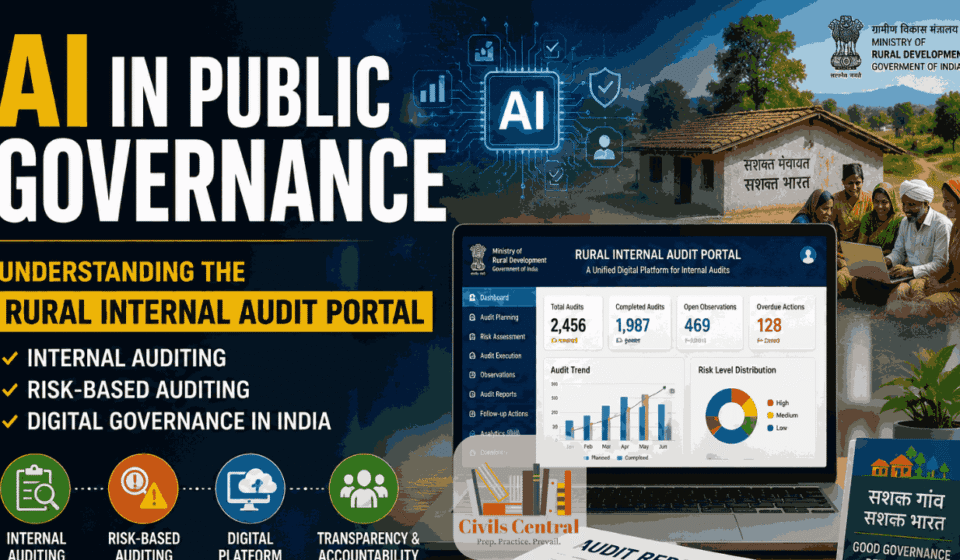
On 28 June 2026, Union Minister for Rural Development Shri Shivraj Singh Chouhan launched the AI-enabled Rural Internal Audit Portal during the Rashtriya Gramin Vikas Sammelan held at Pusa Campus, New Delhi. The portal has been described as India’s first unified digital platform for end-to-end management of internal audits covering both compliance audits and risk-based audits within the Ministry of Rural Development.
While the announcement concerns a new digital platform, the larger UPSC themes extend far beyond the portal itself. The development brings together several important concepts such as good governance, transparency, accountability, artificial intelligence, internal auditing, public financial management, digital governance, rural development, and technology-driven administration.
Introduction
Governments throughout history have sought to answer a fundamental question: How can public resources be managed honestly, efficiently, and for the benefit of citizens? As societies became more complex, governments expanded their responsibilities to include education, healthcare, infrastructure, social protection, agriculture, environmental conservation, and economic development. With increasing public expenditure came the equally important responsibility of ensuring that public money was used efficiently, legally, and transparently.
Traditional administrative systems relied heavily on manual record-keeping, periodic inspections, and post-facto audits. Although these mechanisms played an important role in maintaining accountability, they were often time-consuming, fragmented, and reactive. Irregularities were frequently detected only after significant financial losses had occurred, making corrective action difficult and reducing public confidence in government institutions.
The rapid advancement of digital technologies has transformed this landscape. Governments around the world are increasingly adopting digital platforms, data analytics, artificial intelligence, cloud computing, and real-time monitoring systems to strengthen governance. These technologies enable public authorities to detect risks earlier, automate routine processes, improve service delivery, and make evidence-based policy decisions.
India’s governance ecosystem has undergone a similar transformation over the past decade. Initiatives such as Digital India, Direct Benefit Transfer (DBT), Government e-Marketplace (GeM), Public Financial Management System (PFMS), Digital Public Infrastructure (DPI), and Aadhaar-enabled service delivery have demonstrated how technology can improve efficiency while reducing leakages and corruption. The launch of the AI-enabled Rural Internal Audit Portal represents another milestone in this journey by applying advanced technologies to public auditing and financial oversight.
However, to appreciate the significance of this initiative, it is necessary to understand the broader concepts of governance, good governance, digital governance, and the evolving role of technology in public administration.
Understanding Governance
The term governance refers to the processes, institutions, mechanisms, and relationships through which decisions are made, implemented, monitored, and evaluated within a society. It encompasses not only the activities of governments but also the interactions among public institutions, private organisations, civil society, and citizens.
Governance is therefore broader than the concept of government. While government refers to formal institutions exercising political authority, governance includes the entire framework through which public affairs are managed and collective decisions are translated into action.
In a democratic country such as India, governance involves multiple stakeholders, including:
- Parliament and State Legislatures.
- The Executive.
- The Judiciary.
- Constitutional Bodies.
- Statutory Institutions.
- Local Self-Governments.
- Civil Society Organisations.
- Private Sector.
- Citizens.
Effective governance requires coordination among these institutions to achieve public objectives while respecting constitutional values.
Government and Governance
The terms government and governance are often used interchangeably, but they represent distinct concepts.
| Government | Governance |
|---|---|
| Refers to formal political institutions exercising authority. | Refers to the overall process of decision-making and implementation involving multiple stakeholders. |
| Primarily involves elected representatives and public officials. | Includes government, civil society, private sector, and citizens. |
| Focuses on exercising authority. | Focuses on how authority is exercised effectively, transparently, and accountably. |
| Institutional concept. | Process-oriented concept. |
Thus, governance is concerned not merely with who governs but how governance is conducted.
Evolution of Governance
The concept of governance has evolved significantly over time.
Traditional Administration
Historically, public administration was characterised by:
- Centralised decision-making.
- Rigid bureaucratic procedures.
- Paper-based records.
- Limited citizen participation.
- Hierarchical control.
Success was often measured by adherence to rules rather than outcomes. Although this system ensured administrative order, it frequently resulted in delays, inefficiency, and limited responsiveness to citizens’ needs.
New Public Management
During the late twentieth century, many countries introduced reforms inspired by the principles of New Public Management (NPM). These reforms emphasised:
- Efficiency.
- Performance measurement.
- Decentralisation.
- Customer orientation.
- Results-based management.
- Financial accountability.
Governments increasingly adopted management practices traditionally associated with the private sector while maintaining public accountability.
Digital Governance
The rapid expansion of information technology transformed governance further. Governments began using digital platforms to:
- Deliver services electronically.
- Improve transparency.
- Reduce administrative delays.
- Enhance accessibility.
- Improve record management.
Digital governance represented a shift from paper-based administration towards integrated electronic systems.
Intelligent Governance
The emergence of Artificial Intelligence, Big Data, Machine Learning, Blockchain, and predictive analytics has introduced a new stage in governance. Instead of merely digitising existing processes, governments now seek to make governance:
- Predictive.
- Data-driven.
- Intelligent.
- Proactive.
- Personalised.
- Evidence-based.
The Rural Internal Audit Portal exemplifies this transition by applying AI to audit planning, risk assessment, compliance monitoring, and financial oversight.
What is Good Governance?
The concept of Good Governance gained global prominence during the 1990s through organisations such as the World Bank, the United Nations Development Programme (UNDP), and the Organisation for Economic Co-operation and Development (OECD).
Good governance refers to the manner in which public institutions conduct public affairs, manage public resources, and guarantee the realisation of human rights while ensuring efficiency, accountability, transparency, participation, and the rule of law. It is not simply about administrative efficiency; it is about governing in a manner that serves citizens fairly, responsibly, and effectively.
Characteristics of Good Governance
Although different institutions use slightly different frameworks, good governance generally incorporates the following principles.
Participation
Citizens should have meaningful opportunities to participate in public decision-making through elections, consultations, local self-government institutions, and public engagement. Participation strengthens democratic legitimacy and improves policy outcomes.
Rule of Law
Governance must operate within the framework of constitutional and legal principles. All individuals and institutions, including the government itself, are subject to the law. The rule of law prevents arbitrary exercise of power and protects citizens’ rights.
Transparency
Government decisions, policies, procedures, and expenditure should be open and accessible. Transparency reduces opportunities for corruption while increasing public confidence in institutions. Digital platforms increasingly strengthen transparency by making information publicly available in real time.
Accountability
Public officials must remain answerable for their decisions and actions. Accountability mechanisms include:
- Internal audits.
- External audits.
- Parliamentary oversight.
- Judicial review.
- Social audits.
- Citizen feedback.
- Performance evaluation.
The Rural Internal Audit Portal directly strengthens this pillar by improving internal accountability within government programmes.
Responsiveness
Governments should respond promptly and effectively to citizens’ needs. Technology enables faster grievance redressal, improved communication, and real-time service delivery.
Effectiveness and Efficiency
Public resources should be utilised optimally to achieve intended developmental outcomes. Efficiency involves reducing waste, delays, duplication, and unnecessary administrative costs.
Equity and Inclusiveness
Development should benefit all sections of society, particularly vulnerable and marginalised communities. Inclusive governance promotes social justice and equal opportunities.
Consensus Orientation
Governance often requires balancing diverse interests through dialogue, consultation, and consensus-building. This promotes social harmony and sustainable policymaking.
Why Good Governance Matters?
Good governance is not merely an administrative ideal—it is the foundation of sustainable development. Efficient institutions ensure that public funds reach intended beneficiaries, welfare schemes achieve their objectives, and citizens develop trust in the state.
Conversely, weak governance can result in corruption, leakages, policy failures, delays, and inefficient use of scarce public resources. In a country like India, where large-scale programmes such as MGNREGA, PMAY-G, PMGSY, and NRLM involve substantial public expenditure, robust governance mechanisms are essential to ensure transparency, accountability, and effective service delivery.
The launch of the AI-enabled Rural Internal Audit Portal reflects this broader shift towards technology-enabled good governance. Rather than relying solely on periodic manual inspections, the government is moving towards continuous, data-driven oversight capable of identifying risks early, strengthening internal controls, and improving the overall quality of public administration.
From Good Governance to Digital Governance
The principles of good governance—transparency, accountability, efficiency, participation, responsiveness, and the rule of law—remain constant. What has changed dramatically is the method through which these principles are implemented.
Traditionally, governance depended heavily on paper records, physical files, manual verification, face-to-face interactions, and periodic inspections. While these methods established the foundation of public administration, they were often slow, resource-intensive, and vulnerable to delays, human error, duplication of work, and corruption.
The rapid development of Information and Communication Technology (ICT) has fundamentally transformed this landscape. Governments today increasingly use digital platforms, cloud computing, artificial intelligence, geospatial technologies, big data analytics, and mobile applications to improve the design, implementation, monitoring, and evaluation of public policies.
The result is the emergence of Digital Governance—a governance model that leverages technology to deliver public services more efficiently, transparently, and citizen-centrically. The launch of the AI-enabled Rural Internal Audit Portal is part of this broader transition from conventional administration to intelligent digital governance.
Understanding Digital Governance
Digital Governance refers to the strategic use of digital technologies to improve the functioning of government institutions, enhance public service delivery, strengthen accountability, and increase citizen participation.
It is much broader than simply computerising government offices. Digital Governance seeks to redesign administrative processes so that they become faster, data-driven, integrated, and outcome-oriented.
Instead of asking “How can we digitise an existing paper process?”, digital governance asks “How can technology fundamentally improve the way government functions?” Thus, digital governance represents a transformation of governance itself rather than merely a technological upgrade.
Objectives of Digital Governance
Digital governance aims to achieve several interrelated objectives.
Improve Service Delivery
Digital platforms reduce procedural delays and enable faster delivery of public services. Examples include:
- Online applications.
- Digital certificates.
- Electronic payments.
- Online grievance redressal.
- Real-time beneficiary tracking.
Increase Transparency
Digital systems automatically generate electronic records that are easier to monitor, verify, and audit. Transparency improves because:
- Transactions leave digital trails.
- Information becomes publicly accessible.
- Manual manipulation becomes more difficult.
- Decision-making can be monitored.
Strengthen Accountability
Technology enables governments to monitor implementation continuously rather than periodically. Real-time dashboards, automated alerts, and digital reporting systems improve administrative accountability at every level.
Improve Efficiency
Automation reduces repetitive manual work, minimises paperwork, and allows officials to focus on higher-value decision-making. Efficiency also improves because digital systems reduce duplication of effort and streamline administrative workflows.
Promote Evidence-Based Policymaking
Digital governance generates large volumes of high-quality administrative data. Such data help policymakers:
- Identify implementation gaps.
- Monitor programme performance.
- Allocate resources efficiently.
- Evaluate policy outcomes.
- Predict future challenges.
Enhance Citizen Participation
Digital platforms facilitate:
- Public consultations.
- Online feedback.
- Grievance redressal.
- Social accountability.
- Open government initiatives.
Technology therefore strengthens democratic governance.
e-Governance and Digital Governance
Although the two terms are often used interchangeably, they represent different stages of administrative evolution.
| e-Governance | Digital Governance |
|---|---|
| Focuses primarily on using ICT to deliver government services electronically. | Focuses on transforming governance using digital technologies. |
| Digitises existing administrative processes. | Redesigns administrative systems around digital technologies. |
| Emphasises service delivery. | Emphasises governance transformation. |
| Government-centric. | Citizen-centric and data-driven. |
| Limited integration. | Integrated digital ecosystems with real-time monitoring and analytics. |
Thus, e-Governance may be considered the first stage of digital transformation, whereas Digital Governance represents a more comprehensive and intelligent governance model.
Evolution of Digital Governance in India
India’s digital governance journey has evolved through several major phases.
Phase I: Computerisation
The earliest reforms focused on introducing computers into government offices for record management and basic administrative tasks.
Examples included:
- Computerised land records.
- Digital payroll systems.
- Electronic databases.
Although important, these initiatives largely replicated existing manual processes.
Phase II: e-Governance
The launch of the National e-Governance Plan (NeGP) accelerated the delivery of public services through digital platforms.
Government departments increasingly introduced:
- Online applications.
- Electronic certificates.
- Digital payments.
- Citizen service centres.
This phase significantly improved accessibility and convenience.
Phase III: Digital India
Launched in 2015, the Digital India Programme sought to transform India into a digitally empowered society and knowledge economy.
Its three core vision areas include:
- Digital infrastructure as a utility to every citizen.
- Governance and services on demand.
- Digital empowerment of citizens.
Digital India expanded digital governance across virtually every sector of public administration.
Phase IV: Digital Public Infrastructure (DPI)
India subsequently developed one of the world’s most advanced Digital Public Infrastructure (DPI) ecosystems.
Key components include:
- Aadhaar.
- Unified Payments Interface (UPI).
- DigiLocker.
- CoWIN.
- Account Aggregator Framework.
- Open Network for Digital Commerce (ONDC).
These interoperable platforms demonstrate how digital infrastructure can support inclusive governance at scale.
Phase V: Intelligent Governance
India is now entering the next stage of governance transformation through the integration of:
- Artificial Intelligence.
- Machine Learning.
- Big Data Analytics.
- Internet of Things.
- Cloud Computing.
- Predictive Analytics.
The AI-enabled Rural Internal Audit Portal represents one such initiative where governance moves beyond digitisation towards intelligent decision-making.
Artificial Intelligence in Public Administration
Artificial Intelligence (AI) refers to the ability of computer systems to perform tasks that normally require human intelligence.
These tasks include:
- Learning from data.
- Pattern recognition.
- Natural language processing.
- Predictive analysis.
- Decision support.
- Automation.
Unlike conventional software, AI systems improve their performance by analysing large volumes of data and identifying complex relationships that may not be immediately visible to human administrators.
Why Governments are Adopting AI
Modern governments manage enormous quantities of information relating to:
- Taxation.
- Welfare schemes.
- Healthcare.
- Agriculture.
- Infrastructure.
- Education.
- Financial management.
- Public grievances.
Manual analysis of such large datasets is increasingly impractical. Artificial Intelligence enables governments to process this information rapidly while identifying trends, risks, and anomalies. Consequently, AI supports better policymaking and more efficient administration.
Applications of AI in Governance
Artificial Intelligence is transforming multiple areas of public administration.
Fraud Detection
AI algorithms can analyse financial transactions to identify suspicious expenditure patterns. Potential frauds may be detected before significant losses occur. This is particularly relevant for public expenditure programmes involving thousands of implementing agencies.
Risk-Based Auditing
Instead of auditing every programme with equal intensity, AI helps identify projects that present higher financial or operational risks. This enables audit resources to be focused where they are most needed. The Rural Internal Audit Portal adopts precisely this approach.
Public Grievance Analysis
Governments receive millions of citizen complaints every year. AI can:
- Categorise grievances.
- Identify recurring issues.
- Detect emerging trends.
- Prioritise urgent cases.
This improves responsiveness and service delivery.
Policy Evaluation
AI enables governments to analyse programme outcomes across districts, demographic groups, and time periods. Evidence generated through AI supports more informed policymaking.
Resource Allocation
Predictive models help governments allocate financial and human resources according to projected demand rather than historical expenditure alone. This improves efficiency while reducing waste.
Disaster Management
AI supports:
- Flood prediction.
- Drought monitoring.
- Cyclone forecasting.
- Early warning systems.
These applications strengthen disaster preparedness and resilience.
Benefits of AI in Governance
Properly implemented, AI offers several advantages.
Faster Decision-Making
AI rapidly analyses large datasets that would otherwise require extensive manual effort.
Improved Accuracy
Automated analysis reduces computational errors and improves consistency.
Greater Transparency
Digital systems generate audit trails that strengthen accountability.
Predictive Governance
AI enables governments to anticipate problems before they become crises.
Better Resource Utilisation
Public resources can be allocated more efficiently using evidence-based analysis.
Improved Citizen Services
Automation reduces delays while improving accessibility and responsiveness.
Challenges of AI in Governance
Despite its potential, AI also raises important governance challenges.
Data Privacy
AI systems require large volumes of data. Protecting citizens’ personal information is therefore essential.
Algorithmic Bias
AI systems may unintentionally reproduce biases present in training data. This may affect fairness in public decision-making.
Cybersecurity
Digital governance platforms become attractive targets for cyberattacks. Robust cybersecurity measures are therefore indispensable.
Capacity Building
Public officials require specialised training to effectively manage AI-enabled systems.
Ethical Concerns
AI should support human decision-making rather than replace administrative accountability. Government decisions affecting citizens must remain transparent, explainable, and subject to oversight.
Public Financial Management
Every government collects public resources through taxes, borrowing, non-tax revenue, and other sources. These resources must then be allocated, spent, monitored, and evaluated in accordance with constitutional principles and legislative authorisation. This entire process is known as Public Financial Management (PFM).
PFM encompasses:
- Budget preparation.
- Budget execution.
- Public expenditure.
- Financial reporting.
- Accounting.
- Auditing.
- Internal financial controls.
- Performance evaluation.
An effective PFM system ensures that public money is spent economically, efficiently, effectively, and for its intended purposes. The Rural Internal Audit Portal strengthens one of the most important components of PFM—internal auditing.
Why Public Financial Management Matters
Strong public financial management contributes to:
- Fiscal discipline.
- Efficient utilisation of public resources.
- Improved service delivery.
- Better development outcomes.
- Reduced corruption.
- Increased investor confidence.
- Higher public trust in government institutions.
Conversely, weak financial management may result in:
- Wasteful expenditure.
- Leakages.
- Fraud.
- Delays.
- Poor programme implementation.
- Reduced accountability.
Thus, sound financial management forms the backbone of good governance.
Internal Financial Controls, Internal Auditing, and the Foundations of Accountable Governance
No government, regardless of its administrative capacity or technological sophistication, can achieve good governance without robust systems for monitoring how public money is collected, managed, and spent. Every year, governments allocate enormous financial resources to sectors such as education, healthcare, rural development, infrastructure, agriculture, social protection, and environmental conservation. These public funds are entrusted to thousands of ministries, departments, public sector undertakings, autonomous bodies, local governments, and implementing agencies.
The success of public policy depends not only on the amount of money allocated but also on whether it is utilised efficiently, legally, transparently, and for the intended purpose. Even well-designed welfare schemes can fail if funds are mismanaged, diverted, delayed, or spent without achieving the desired outcomes.
Traditionally, governments relied heavily on post-facto inspections and external audits to identify irregularities. While these mechanisms remain essential, they often detect problems only after financial losses have already occurred. Modern public administration therefore places increasing emphasis on preventive governance, where risks are identified early and corrective action is taken before serious irregularities emerge.
This preventive approach is made possible through Internal Financial Controls (IFCs) and Internal Auditing, which together form the first line of defence against financial mismanagement, inefficiency, fraud, and weak programme implementation.
The AI-enabled Rural Internal Audit Portal reflects this shift towards continuous, technology-driven oversight. Rather than waiting for annual reviews, the portal seeks to identify risks proactively, strengthen internal controls, and support evidence-based decision-making across rural development programmes.
Internal Financial Controls (IFCs)
Before understanding internal audits, it is important to understand Internal Financial Controls (IFCs). Internal Financial Controls are the policies, procedures, organisational structures, and administrative mechanisms established within an organisation to ensure that financial resources are managed responsibly and organisational objectives are achieved.
They are designed to provide reasonable assurance that:
- Public money is used only for authorised purposes.
- Financial transactions are accurately recorded.
- Assets are safeguarded against loss or misuse.
- Laws, rules, and regulations are followed.
- Fraud and errors are prevented or detected promptly.
- Operational efficiency is continuously improved.
Unlike audits, which periodically examine organisational performance, internal financial controls operate every day as part of routine administration.
Objectives of Internal Financial Controls
A robust system of internal financial controls seeks to achieve several important objectives.
1. Safeguarding Public Resources
Governments manage enormous public assets, including financial resources, infrastructure, equipment, records, and public property. Internal controls help prevent:
- Theft.
- Misappropriation.
- Unauthorised expenditure.
- Damage to public assets.
- Financial leakages.
2. Ensuring Financial Accuracy
Reliable financial information is essential for effective decision-making. Internal controls promote:
- Accurate accounting.
- Proper documentation.
- Timely financial reporting.
- Reliable financial statements.
Decision-makers can therefore allocate resources more effectively.
3. Ensuring Legal Compliance
Government departments operate within an extensive legal framework. Internal controls ensure compliance with:
- Financial Rules.
- Budget provisions.
- Procurement procedures.
- Service rules.
- Departmental guidelines.
- Statutory regulations.
This reduces the risk of administrative irregularities.
4. Improving Operational Efficiency
Effective controls eliminate unnecessary delays, duplication of work, and inefficient administrative practices. Improved efficiency ultimately benefits both government institutions and citizens.
5. Strengthening Public Trust
Transparent financial management enhances public confidence in government institutions. Citizens are more likely to trust public programmes when resources are managed responsibly.
Components of Internal Financial Controls
An effective internal control system consists of several interconnected elements.
Control Environment
The control environment refers to the organisational culture that promotes ethical behaviour, accountability, integrity, and responsible financial management. Leadership commitment plays a decisive role in creating this environment.
Risk Assessment
Government departments must continuously identify risks that could affect programme implementation. These risks may include:
- Financial fraud.
- Procurement irregularities.
- Weak documentation.
- Delayed fund utilisation.
- Technological failures.
- Cybersecurity threats.
Understanding these risks enables administrators to design appropriate control mechanisms.
Control Activities
Control activities are the specific procedures implemented to minimise identified risks. Examples include:
- Approval hierarchies.
- Segregation of duties.
- Budgetary controls.
- Procurement checks.
- Financial authorisations.
- Digital verification systems.
Information and Communication
Reliable information must flow efficiently across the organisation. Timely reporting enables managers to identify emerging issues and take corrective action.
Monitoring
Internal controls require continuous monitoring to ensure that they remain effective over time. Monitoring may involve:
- Internal audits.
- Supervisory reviews.
- Performance assessments.
- Digital dashboards.
- Compliance reports.
Why Governments Need Internal Audits
Even the strongest internal control system cannot eliminate every risk. Unexpected circumstances, human error, technological failures, changing regulations, and evolving fraud techniques require continuous independent evaluation. This is the role of Internal Audit.
Internal auditing is a systematic, independent, and objective process that evaluates whether an organisation’s governance, risk management, and internal control systems are functioning effectively. Unlike external audits conducted after financial statements are prepared, internal audits operate continuously throughout the year.
They help organisations identify weaknesses before they become major administrative failures.
Objectives of Internal Auditing
Internal auditing supports organisational improvement rather than merely identifying mistakes. Its major objectives include:
- Evaluating internal controls.
- Assessing compliance with rules and regulations.
- Identifying operational risks.
- Improving efficiency.
- Detecting financial irregularities.
- Strengthening governance.
- Supporting informed decision-making.
Thus, internal audit functions as an advisory as well as an assurance mechanism.
Evolution of Internal Auditing
Historically, auditing focused primarily on verifying financial transactions and detecting fraud. Over time, the scope of internal auditing expanded significantly.
Traditional Internal Audit
Earlier audits primarily examined:
- Accounting records.
- Vouchers.
- Receipts.
- Financial statements.
- Cash balances.
The emphasis was on financial accuracy.
Modern Internal Audit
Contemporary internal auditing adopts a much broader perspective. It evaluates:
- Governance.
- Risk management.
- Internal controls.
- Programme implementation.
- Operational efficiency.
- Information systems.
- Organisational performance.
Thus, internal audit has evolved from a narrow accounting exercise into a strategic governance function.
Difference Between Audit, Inspection, Vigilance, Investigation, and Social Audit
One of the most common areas of confusion in public administration is the distinction among these mechanisms. Although all seek to improve accountability, they differ significantly in purpose and methodology.
| Mechanism | Primary Objective | Conducted By | Nature |
|---|---|---|---|
| Audit | Evaluates financial management, compliance, efficiency, and internal controls | Internal auditors or external audit institutions | Independent and systematic |
| Inspection | Examines day-to-day functioning and implementation | Supervisory officers | Administrative review |
| Vigilance | Prevents and detects corruption and misconduct | Vigilance organisations | Preventive and disciplinary |
| Investigation | Determines facts relating to specific allegations or offences | Investigative agencies | Fact-finding and evidence collection |
| Social Audit | Enables citizens to verify programme implementation | Community members, Gram Sabhas, civil society | Participatory accountability |
Understanding these differences is essential because each mechanism complements the others rather than replacing them.
Internal Audit vs External Audit
Another important distinction is between internal and external auditing.
| Internal Audit | External Audit |
|---|---|
| Conducted by the organisation or an independent internal audit unit. | Conducted by an independent external authority such as the Comptroller and Auditor General (CAG) in the public sector. |
| Continuous throughout the year. | Periodic, usually after the completion of financial activities. |
| Focuses on improving governance, risk management, and internal controls. | Focuses on providing independent assurance regarding financial statements, legality, and performance. |
| Primarily serves management. | Primarily serves Parliament, legislatures, and the public. |
| Advisory as well as assurance-oriented. | Independent assurance and accountability-oriented. |
Both are essential components of a robust public financial management system.
Why AI is Transforming Internal Auditing
Traditional internal audits relied heavily on manual document verification, sample-based testing, and periodic field visits. While effective, these approaches had limitations in terms of speed, scalability, and real-time risk detection.
Artificial Intelligence is fundamentally transforming this process.
AI-enabled audit systems can:
- Analyse millions of transactions within seconds.
- Detect unusual expenditure patterns.
- Identify duplicate payments.
- Highlight procurement anomalies.
- Generate risk scores for projects.
- Prioritise high-risk cases for detailed examination.
- Produce automated dashboards and reports.
Instead of reviewing only a sample of transactions, AI enables auditors to analyse entire datasets, improving both the efficiency and accuracy of audits. This shift from reactive auditing to predictive and risk-based auditing represents one of the most significant reforms in modern public financial management.
The Rural Internal Audit Portal is an important example of this transformation. By integrating AI with internal auditing, the Ministry of Rural Development aims to strengthen financial oversight, improve compliance, identify risks proactively, and enhance transparency across rural development programmes.
Understanding Auditing – Meaning, Evolution, Principles, and Objectives
Every organised institution—whether a government ministry, private company, university, non-governmental organisation, cooperative society, or international organisation—manages resources entrusted to it by stakeholders. Governments manage taxpayers’ money, companies manage shareholders’ investments, banks manage depositors’ savings, and charitable organisations administer public donations. In each case, those who provide resources expect them to be used honestly, efficiently, and for the intended purpose.
This expectation creates a fundamental governance question: How can stakeholders be assured that resources are being managed responsibly? The answer lies in auditing.
Auditing is one of the oldest and most important mechanisms for ensuring accountability. It provides an independent assessment of whether financial transactions, administrative processes, and organisational activities conform to applicable laws, policies, standards, and objectives.
Although auditing is often associated with checking accounts or detecting fraud, its contemporary role extends much further. Modern auditing evaluates governance systems, risk management practices, operational efficiency, programme implementation, internal controls, information systems, environmental performance, and achievement of organisational objectives.
Consequently, auditing has evolved from a bookkeeping exercise into a strategic instrument of good governance.
What is an Audit?
An audit is a systematic, independent, objective, and evidence-based examination of an organisation’s financial records, operations, processes, systems, or programmes to determine whether they comply with established criteria and whether organisational objectives are being achieved efficiently, effectively, economically, and ethically.
Several features distinguish auditing from routine administrative supervision. First, auditing is systematic. It follows a structured methodology rather than relying on ad hoc observations. Second, auditing is independent. Auditors must maintain objectivity and avoid conflicts of interest. Third, auditing is evidence-based. Findings are supported by verifiable documents, records, interviews, physical observations, and analytical procedures rather than assumptions.
Finally, auditing aims not merely to identify deficiencies but also to recommend improvements that strengthen governance and organisational performance.
Key Characteristics of Auditing
An effective audit possesses several defining characteristics.
Independence
Auditors must remain free from undue influence by the management whose activities they examine. Independence ensures credibility and public confidence in audit findings.
Objectivity
Audit conclusions should be based exclusively on evidence rather than personal opinions, political considerations, or institutional bias. Objectivity enhances fairness and reliability.
Systematic Process
Auditing follows a structured sequence involving:
- Planning.
- Risk assessment.
- Evidence collection.
- Analysis.
- Reporting.
- Follow-up.
This methodology promotes consistency across different audit assignments.
Evidence-Based Assessment
Reliable audit conclusions require sufficient and appropriate evidence. Auditors therefore examine:
- Financial documents.
- Administrative records.
- Contracts.
- Procurement files.
- Digital databases.
- Physical assets.
- Interviews.
- Field observations.
Evidence strengthens the validity of audit recommendations.
Improvement-Oriented
Modern auditing seeks to improve governance rather than merely identify mistakes. Its recommendations help organisations strengthen internal controls, reduce risks, improve efficiency, and enhance accountability.
Evolution of Auditing
The history of auditing closely parallels the evolution of organised administration.
Ancient Civilisations
Evidence of auditing practices can be traced to ancient Egypt, Mesopotamia, Greece, Rome, and India. Ancient rulers appointed officials to verify tax collections, monitor public expenditure, and prevent misuse of state resources. In ancient India, texts such as the Arthashastra emphasised meticulous record-keeping, financial accountability, and regular inspection of state officials.
Kautilya recognised that officials entrusted with public money required continuous supervision because opportunities for financial irregularities inevitably arise wherever public resources are managed. This observation remains remarkably relevant in contemporary public administration.
Medieval Period
As kingdoms expanded, specialised officials increasingly supervised revenue collection and expenditure. Auditing remained primarily focused on verifying financial accounts and detecting fraud.
Industrial Revolution
The Industrial Revolution transformed auditing fundamentally. Large corporations emerged with thousands of shareholders who were separated from day-to-day management. This separation created an agency problem.
Owners required independent verification that managers were using company resources responsibly. Consequently, professional auditing expanded rapidly.
Twentieth Century
During the twentieth century, governments assumed much broader developmental responsibilities. Public expenditure increased dramatically in sectors such as:
- Education.
- Health.
- Agriculture.
- Infrastructure.
- Social welfare.
Auditing therefore expanded beyond financial verification to include programme implementation and performance assessment.
Twenty-First Century
Modern auditing incorporates:
- Risk management.
- Governance evaluation.
- Information technology.
- Environmental sustainability.
- Cybersecurity.
- Artificial Intelligence.
- Data analytics.
- Performance auditing.
Auditors increasingly function as strategic advisors supporting organisational improvement rather than merely financial inspectors.
Why Auditing is Necessary
Every organisation faces uncertainty. Resources may be misused intentionally through fraud or unintentionally through administrative inefficiency, weak controls, inadequate training, or poor decision-making. Auditing provides assurance that these risks are appropriately managed. Its importance extends across multiple dimensions.
Promoting Accountability
Auditing ensures that officials entrusted with public resources remain answerable for their decisions. Accountability strengthens democratic governance by reinforcing public trust.
Preventing Fraud and Corruption
Although auditing cannot eliminate corruption completely, strong audit systems significantly increase the likelihood that irregularities will be detected. This deterrent effect discourages financial misconduct.
Improving Financial Management
Auditing evaluates whether financial resources are utilised:
- Economically.
- Efficiently.
- Effectively.
Better financial management ultimately improves development outcomes.
Ensuring Legal Compliance
Government departments must comply with numerous laws, regulations, financial rules, procurement guidelines, and administrative procedures. Auditing verifies adherence to these legal requirements.
Supporting Better Decision-Making
Audit findings provide valuable information regarding organisational strengths, weaknesses, risks, and opportunities for improvement. Management can therefore make more informed decisions.
Enhancing Public Confidence
Transparent audit processes strengthen citizens’ confidence in public institutions. Trust is particularly important for governments managing large welfare programmes funded by taxpayers.
Objectives of Auditing
Although different organisations conduct audits for different purposes, most audits pursue several common objectives.
Verify Accuracy
Auditors verify whether financial records accurately reflect organisational transactions. Reliable accounting forms the basis of sound decision-making.
Assess Compliance
Audits examine whether organisational activities comply with:
- Laws.
- Financial rules.
- Procurement regulations.
- Government guidelines.
- Internal policies.
Compliance reduces legal and administrative risks.
Evaluate Internal Controls
Auditors assess whether existing internal control systems effectively prevent errors, fraud, and inefficiency. Weak controls are often identified before significant losses occur.
Improve Operational Efficiency
Modern auditing examines whether organisational resources are being utilised optimally. Recommendations frequently focus on:
- Reducing delays.
- Eliminating duplication.
- Improving workflow.
- Enhancing productivity.
Support Risk Management
Auditors identify emerging risks that may threaten organisational objectives. Management can then implement preventive measures before risks materialise.
Promote Good Governance
Ultimately, auditing strengthens:
- Transparency.
- Accountability.
- Integrity.
- Ethical conduct.
- Public trust.
Thus, auditing serves as an essential pillar of democratic governance.
Fundamental Principles of Auditing
Professional auditing is guided by universally recognised principles.
Integrity
Auditors must demonstrate honesty, fairness, and ethical conduct throughout the audit process. Integrity forms the foundation of professional credibility.
Independence
Auditors should remain free from external pressure or conflicts of interest. Independent audits generate greater public confidence.
Professional Competence
Auditors require specialised knowledge in:
- Accounting.
- Finance.
- Law.
- Public administration.
- Information systems.
- Risk management.
Continuous professional development is therefore essential.
Confidentiality
Auditors frequently access sensitive organisational information. They must protect confidential data while using it solely for legitimate audit purposes.
Due Professional Care
Audit work should be performed diligently using appropriate methodologies and sufficient evidence. Carelessness may compromise audit quality.
Evidence-Based Conclusions
Audit findings should always be supported by reliable, relevant, and sufficient evidence. Unsupported allegations undermine the credibility of the audit process.
Auditing in Democratic Governance
In democratic societies, auditing serves purposes extending far beyond financial management. It strengthens constitutional governance by ensuring that executive authorities remain accountable for their use of public resources.
Auditing therefore contributes directly to:
- Fiscal responsibility.
- Rule of law.
- Transparency.
- Accountability.
- Responsible public expenditure.
- Effective implementation of welfare schemes.
Institutions such as internal audit units, finance departments, legislative committees, and supreme audit institutions collectively reinforce democratic accountability.
As governments increasingly adopt digital platforms and artificial intelligence, auditing itself is undergoing profound transformation. Rather than relying solely on retrospective examination, modern audit systems increasingly support continuous assurance, predictive analytics, and real-time risk identification.
The AI-enabled Rural Internal Audit Portal represents one such innovation, demonstrating how technology can strengthen governance by making internal auditing faster, smarter, and more preventive.
Types of Audits
Auditing is not a single, uniform activity. Different organisations face different objectives, risks, legal obligations, and operational challenges. Consequently, no single audit can evaluate every aspect of an organisation’s functioning.
For example, verifying whether expenditure has been recorded correctly requires a different approach from assessing whether a welfare programme has improved the lives of beneficiaries. Similarly, examining compliance with procurement rules differs from investigating suspected financial fraud or evaluating the security of an information technology system.
Over time, the discipline of auditing has therefore evolved into several specialised branches, each designed to address a distinct aspect of organisational governance.
Collectively, these audits strengthen transparency, accountability, efficiency, and public trust by ensuring that organisations not only spend resources lawfully but also achieve intended outcomes.
The AI-enabled Rural Internal Audit Portal integrates several of these approaches—particularly internal auditing, compliance auditing, and risk-based auditing—into a unified digital platform.
Classification of Audits
Audits may be classified on the basis of their purpose, scope, timing, methodology, or institutional responsibility.
The major categories include:
- Financial Audit
- Compliance Audit
- Performance Audit
- Operational Audit
- Internal Audit
- External Audit
- Forensic Audit
- Information Systems (IT) Audit
- Environmental Audit
- Risk-Based Audit
- Continuous Audit
Each type complements the others rather than replacing them.
Financial Audit
A Financial Audit examines whether an organisation’s financial statements accurately present its financial position in accordance with applicable accounting standards and legal requirements.
It is the most traditional and widely recognised form of auditing. The primary objective is to provide assurance that financial records are free from material misstatements caused by fraud or error.
Objectives
Financial audits seek to:
- Verify the accuracy of financial statements.
- Ensure proper accounting of income and expenditure.
- Confirm existence of assets and liabilities.
- Detect accounting errors.
- Strengthen financial credibility.
Importance
Reliable financial information enables:
- Better decision-making.
- Investor confidence.
- Public accountability.
- Effective financial management.
In the public sector, financial audits reassure taxpayers that government accounts accurately reflect public expenditure.
Compliance Audit
A Compliance Audit examines whether organisational activities comply with applicable:
- Laws.
- Rules.
- Regulations.
- Government guidelines.
- Administrative procedures.
- Contractual obligations.
Rather than asking whether expenditure was accurately recorded, compliance audits ask whether the expenditure was authorised and legally permissible.
Objectives
Compliance audits verify:
- Adherence to financial rules.
- Procurement procedures.
- Budget provisions.
- Service regulations.
- Statutory requirements.
Example
Suppose a government department purchases medical equipment.
A compliance audit would examine whether:
- Proper procurement procedures were followed.
- Competitive bidding requirements were satisfied.
- Financial approvals were obtained.
- Expenditure remained within budgetary limits.
Importance
Compliance auditing promotes:
- Rule of law.
- Administrative discipline.
- Prevention of irregular expenditure.
- Institutional accountability.
The Rural Internal Audit Portal places significant emphasis on compliance auditing.
Performance Audit
A Performance Audit evaluates whether government programmes achieve their intended objectives while utilising resources economically, efficiently, and effectively. Unlike financial audits, performance audits focus primarily on results rather than accounts.
Example
In the case of a rural housing scheme, performance auditors may examine:
- Number of houses completed.
- Construction quality.
- Timeliness.
- Beneficiary satisfaction.
- Achievement of programme objectives.
Importance
Performance auditing strengthens:
- Public policy evaluation.
- Outcome-based governance.
- Efficient utilisation of public resources.
It has become increasingly important as governments shift towards results-oriented administration.
Operational Audit
An Operational Audit evaluates organisational processes, systems, and procedures to identify opportunities for improving efficiency and productivity.
Operational audits focus primarily on how work is performed.
Objectives
Operational audits seek to:
- Reduce administrative delays.
- Improve workflow.
- Eliminate duplication.
- Strengthen internal coordination.
- Improve service delivery.
Example
An operational audit of a district office may examine:
- File movement.
- Approval timelines.
- Staff deployment.
- Digital workflows.
- Resource utilisation.
Importance
Operational auditing supports administrative reforms by improving organisational effectiveness.
Internal Audit
An Internal Audit is an independent, objective assurance and advisory activity conducted within an organisation to improve governance, risk management, and internal control systems.
Unlike external audits, internal audits function continuously throughout the year.
Objectives
Internal audits seek to:
- Evaluate governance systems.
- Assess internal controls.
- Identify operational risks.
- Improve organisational performance.
- Strengthen accountability.
Characteristics
Internal audits are:
- Continuous.
- Preventive.
- Improvement-oriented.
- Advisory.
- Risk-focused.
Importance
Modern organisations increasingly rely upon internal audits as a strategic management tool rather than merely a compliance mechanism.
The Rural Internal Audit Portal primarily supports this type of auditing.
External Audit
An External Audit is conducted by an independent authority outside the organisation.
In India, the Comptroller and Auditor General (CAG) performs external audits of government accounts and public sector entities in accordance with constitutional provisions.
Objectives
External audits provide independent assurance regarding:
- Financial statements.
- Compliance.
- Performance.
- Accountability.
Importance
External auditing strengthens legislative oversight because audit reports are examined by Parliament and State Legislatures through committees such as the Public Accounts Committee (PAC).
Forensic Audit
A Forensic Audit is a specialised investigation undertaken when fraud, corruption, embezzlement, or financial misconduct is suspected.
Unlike routine audits, forensic audits collect evidence that may be used in judicial proceedings.
Objectives
Forensic audits seek to:
- Identify fraudulent transactions.
- Trace financial irregularities.
- Collect admissible evidence.
- Support criminal investigations.
Importance
Forensic auditing plays an increasingly important role in combating financial crimes and strengthening anti-corruption efforts.
Information Systems (IT) Audit
An Information Systems Audit evaluates whether information technology systems adequately protect organisational data while supporting operational objectives.
As governments increasingly digitise their services, IT auditing has become essential.
Areas Covered
IT audits examine:
- Cybersecurity.
- Data integrity.
- System availability.
- Access controls.
- Disaster recovery.
- Software reliability.
Importance
Digital governance cannot succeed without secure and reliable information systems.
Environmental Audit
An Environmental Audit evaluates whether organisational activities comply with environmental laws and sustainable development objectives.
Objectives
Environmental audits assess:
- Pollution control.
- Waste management.
- Resource efficiency.
- Environmental compliance.
- Climate sustainability.
Importance
Growing global concern regarding climate change has increased the significance of environmental auditing in both public and private sectors.
Risk-Based Audit
Traditional auditing allocated similar attention to all organisational activities regardless of their relative importance.
Modern auditing adopts a different philosophy.
A Risk-Based Audit (RBA) focuses audit resources on areas presenting the greatest risk to organisational objectives.
Rather than auditing everything equally, auditors identify high-risk activities and prioritise them for detailed examination.
Risk Assessment
Risk-based auditing begins by identifying potential threats such as:
- Financial irregularities.
- Procurement risks.
- Weak internal controls.
- Delayed programme implementation.
- Cybersecurity vulnerabilities.
- High-value contracts.
Each risk is evaluated according to:
- Probability of occurrence.
- Potential impact.
Benefits
Risk-based auditing:
- Improves audit efficiency.
- Optimises resource allocation.
- Detects emerging problems earlier.
- Supports preventive governance.
The Rural Internal Audit Portal incorporates AI to strengthen precisely this type of auditing.
Continuous Audit
Traditional audits were conducted annually or periodically.
Continuous auditing represents a significant evolution.
Using digital technologies, continuous audits monitor transactions almost in real time rather than waiting until the end of the financial year.
Advantages
Continuous auditing enables:
- Early detection of irregularities.
- Faster corrective action.
- Real-time monitoring.
- Improved compliance.
- Better governance.
Artificial Intelligence significantly enhances continuous auditing by analysing large datasets automatically.
Comparative Overview of Major Audit Types
| Audit Type | Primary Focus | Key Question |
|---|---|---|
| Financial Audit | Financial statements | Are the accounts accurate? |
| Compliance Audit | Laws and rules | Were procedures followed? |
| Performance Audit | Outcomes | Were objectives achieved economically, efficiently, and effectively? |
| Operational Audit | Administrative processes | Can organisational efficiency be improved? |
| Internal Audit | Governance, controls, risks | Are internal systems functioning effectively? |
| External Audit | Independent assurance | Is the organisation accountable to stakeholders? |
| Forensic Audit | Fraud investigation | Has financial misconduct occurred? |
| IT Audit | Information systems | Are digital systems secure and reliable? |
| Environmental Audit | Environmental performance | Are sustainability obligations being fulfilled? |
| Risk-Based Audit | High-risk activities | Where should audit attention be concentrated? |
| Continuous Audit | Real-time monitoring | Can problems be identified before they escalate? |
Why These Audit Types Matter for the Rural Internal Audit Portal
The AI-enabled Rural Internal Audit Portal is not limited to one form of auditing. It brings together multiple audit concepts within a single digital ecosystem.
The portal:
- Strengthens internal audits by providing continuous oversight.
- Enhances compliance audits through automated rule-based verification.
- Supports risk-based audits using AI-driven risk identification.
- Facilitates elements of continuous auditing through digital workflows and real-time monitoring.
- Improves governance by integrating data analytics with public financial management.
This integrated approach represents a major shift from manual, periodic, and reactive audits to intelligent, technology-enabled, and preventive governance.
Risk Management and Risk-Based Auditing
Traditional auditing was largely reactive. Auditors examined records after transactions had been completed and programmes had been implemented. Although such audits remain essential, they often identify irregularities only after financial losses have occurred, resources have been wasted, or programme objectives have already been compromised.
Modern governance increasingly demands a different approach—one that identifies risks before they materialise and enables administrators to take preventive action. This philosophy has given rise to Risk-Based Auditing (RBA).
Instead of allocating equal audit attention to every office, programme, or transaction, Risk-Based Auditing prioritises areas where the likelihood and consequences of failure are greatest. In doing so, it enables governments to use limited audit resources more effectively while strengthening transparency, accountability, and programme performance.
The AI-enabled Rural Internal Audit Portal operationalises this philosophy by integrating artificial intelligence with audit planning, allowing the Ministry of Rural Development to identify high-risk programmes and institutions for focused internal audits.
Understanding Risk
Before studying Risk-Based Auditing, it is necessary to understand the concept of risk. A risk is the possibility that an event or circumstance may prevent an organisation from achieving its objectives. Risk does not necessarily imply that something undesirable will definitely occur. Rather, it reflects uncertainty regarding future events and their potential impact on organisational performance.
Every organisation—whether public or private—faces risks because future conditions are never completely predictable.
Risk in Public Administration
Government programmes operate in complex environments involving multiple stakeholders, diverse geographical conditions, evolving regulations, and significant financial resources. Consequently, public institutions face numerous risks.
Examples include:
- Financial mismanagement.
- Procurement irregularities.
- Delays in project implementation.
- Cost overruns.
- Weak documentation.
- Information technology failures.
- Cybersecurity incidents.
- Natural disasters.
- Human resource shortages.
- Policy changes.
These risks may reduce programme effectiveness, increase costs, or undermine public trust.
Characteristics of Risk
Several characteristics define organisational risk.
Uncertainty
Risk relates to uncertain future events rather than known outcomes.
Probability
Every risk has a likelihood of occurring. Some risks are highly probable, whereas others occur rarely.
Impact
Different risks produce different consequences. Some may cause minor administrative inconvenience, while others may result in major financial losses or programme failure.
Dynamic Nature
Risks continuously evolve because of changing technologies, economic conditions, laws, and organisational structures. Risk management must therefore remain an ongoing process.
Categories of Risk in Government
Public administration involves multiple categories of risk.
Financial Risk
Financial risks arise from:
- Fraud.
- Misappropriation.
- Budget overruns.
- Unauthorised expenditure.
- Weak accounting systems.
Operational Risk
Operational risks result from failures in organisational processes. Examples include:
- Delayed approvals.
- Inefficient workflows.
- Human error.
- Equipment failure.
Compliance Risk
Government organisations must comply with numerous legal and regulatory requirements. Failure to comply may result in:
- Legal disputes.
- Administrative action.
- Financial penalties.
- Loss of credibility.
Strategic Risk
Strategic risks affect an organisation’s ability to achieve its long-term objectives. Examples include:
- Poor policy design.
- Inadequate planning.
- Demographic changes.
- Climate-related challenges.
Reputational Risk
Public confidence may decline because of:
- Corruption.
- Poor service delivery.
- Data breaches.
- Administrative failures.
Reputational damage often affects organisational effectiveness even when financial losses are limited.
Technological Risk
Increasing digitalisation exposes governments to risks relating to:
- Cybersecurity.
- System failures.
- Data corruption.
- Artificial Intelligence errors.
- Software vulnerabilities.
What is Risk Management?
Risk management is the systematic process of identifying, analysing, evaluating, mitigating, monitoring, and reviewing risks that may affect organisational objectives.
Contrary to popular belief, risk management does not seek to eliminate all risks. Such an objective would be impossible because every organisation operates under conditions of uncertainty.
Instead, risk management seeks to:
- Understand risks.
- Prioritise them.
- Reduce unacceptable risks.
- Prepare contingency measures.
- Improve organisational resilience.
Thus, risk management supports informed decision-making rather than risk avoidance.
Objectives of Risk Management
Effective risk management seeks to:
- Protect public resources.
- Improve programme implementation.
- Strengthen governance.
- Enhance organisational resilience.
- Improve public confidence.
- Support better policymaking.
- Facilitate informed decision-making.
Risk Management Process
Risk management follows a structured sequence of activities.
Step 1: Risk Identification
The first step involves identifying events that could affect organisational objectives.
Information may be obtained from:
- Previous audit reports.
- Financial statements.
- Field inspections.
- Stakeholder consultations.
- Data analytics.
- Citizen grievances.
- Management reviews.
Step 2: Risk Assessment
Identified risks are evaluated according to two principal criteria.
Probability
How likely is the risk to occur?
Impact
If the risk occurs, how severe will its consequences be?
Risks combining high probability with high impact receive the highest priority.
Step 3: Risk Prioritisation
Since organisational resources are limited, all risks cannot receive equal attention.
Risks are therefore prioritised according to:
- Severity.
- Urgency.
- Organisational significance.
This prioritisation forms the foundation of Risk-Based Auditing.
Step 4: Risk Mitigation
Appropriate measures are implemented to reduce identified risks.
Examples include:
- Strengthening internal controls.
- Staff training.
- Policy revisions.
- Technology upgrades.
- Enhanced supervision.
Step 5: Continuous Monitoring
Risk management is not a one-time activity.
Organisations continuously monitor risk indicators because circumstances evolve over time.
Digital dashboards and AI-powered analytics increasingly support continuous monitoring.
Risk Matrix
A Risk Matrix is a tool used to classify risks based on their probability and impact.
| Probability | Low Impact | Medium Impact | High Impact |
|---|---|---|---|
| Low | Low Risk | Low–Medium Risk | Medium Risk |
| Medium | Low–Medium Risk | Medium Risk | High Risk |
| High | Medium Risk | High Risk | Very High Risk |
Risks classified as Very High Risk generally receive immediate management attention and are prioritised during audit planning.
What is Risk-Based Auditing (RBA)?
Risk-Based Auditing is an audit methodology that allocates audit resources according to the level of risk faced by different organisational activities.
Rather than auditing every programme with identical intensity, RBA focuses on those areas where failures would have the greatest likelihood or consequences.
In simple terms:
Traditional Audit asks: What should we audit?
Risk-Based Audit asks: Where are the greatest risks to achieving organisational objectives?
This shift makes auditing more efficient, strategic, and preventive.
Evolution of Risk-Based Auditing
Traditional audit systems often followed fixed schedules or rotational cycles.
Every office or programme received similar audit attention irrespective of:
- Financial size.
- Operational complexity.
- Historical performance.
- Risk exposure.
Modern governance recognises that this approach may not optimise limited audit resources.
Consequently, Risk-Based Auditing has emerged as an internationally accepted best practice.
Today, governments, supreme audit institutions, multilateral organisations, and private enterprises increasingly adopt RBA to improve audit effectiveness.
Principles of Risk-Based Auditing
Risk-Based Auditing is guided by several core principles.
Focus on Organisational Objectives
Audit planning begins with organisational objectives rather than accounting records alone.
Prioritisation of High-Risk Areas
Limited audit resources should focus on activities posing the greatest threats.
Dynamic Planning
Audit plans should evolve as organisational risks change.
Continuous Risk Assessment
Risk identification continues throughout the audit cycle.
Evidence-Based Decisions
Risk assessments should rely upon objective evidence rather than assumptions.
Advantages of Risk-Based Auditing
Risk-Based Auditing offers numerous benefits.
Better Resource Allocation
Audit resources concentrate on areas where they generate maximum value.
Early Detection
Potential problems are identified before they become major administrative failures.
Improved Governance
Management receives timely information regarding emerging risks.
Enhanced Accountability
High-risk programmes receive greater scrutiny, strengthening financial discipline.
Better Decision-Making
Evidence-based risk analysis improves managerial decisions.
Stronger Public Trust
Preventing failures is generally more effective than correcting them after they occur.
Challenges of Risk-Based Auditing
Despite its advantages, RBA also faces challenges.
- Reliable data may not always be available.
- Risk assessment requires specialised expertise.
- Organisational risks change continuously.
- AI models may generate false positives or overlook emerging risks.
- Capacity building is essential for successful implementation.
These challenges highlight the importance of combining technology with human professional judgment.
Artificial Intelligence and Risk-Based Auditing
Artificial Intelligence has transformed Risk-Based Auditing by enabling continuous analysis of vast datasets.
Instead of relying primarily on manual sampling, AI systems can:
- Analyse millions of transactions simultaneously.
- Detect unusual expenditure patterns.
- Identify duplicate or suspicious payments.
- Generate automated risk scores.
- Predict emerging financial risks.
- Recommend audit priorities.
- Produce real-time dashboards.
This significantly improves the efficiency, coverage, and timeliness of internal audits.
Why Risk-Based Auditing Matters for Rural Development
The Ministry of Rural Development implements some of India’s largest public expenditure programmes, including rural housing, rural roads, livelihoods, wage employment, and social protection initiatives. These programmes involve:
- Thousands of implementing agencies.
- Millions of beneficiaries.
- Large financial outlays.
- Diverse geographical conditions.
- Multiple levels of administration.
Auditing every activity with equal intensity is neither practical nor efficient.
Risk-Based Auditing enables the Ministry to identify districts, schemes, or implementing agencies with higher risk profiles and allocate audit resources accordingly. This improves oversight, strengthens internal controls, and supports better utilisation of public funds.
The AI-enabled Rural Internal Audit Portal is designed around this principle, making risk assessment a central element of internal audit planning.
Rural Internal Audit Portal – AI-Driven Internal Auditing for Transparent and Accountable Rural Governance
Current Affairs Trigger
On 28 June 2026, Union Minister for Rural Development Shri Shivraj Singh Chouhan launched the AI-enabled Rural Internal Audit Portal during the Rashtriya Gramin Vikas Sammelan held at Pusa Campus, New Delhi. The Ministry described the platform as India’s first unified digital platform for end-to-end management of internal audits, integrating compliance audits and risk-based audits within a single technology-enabled framework.
The initiative represents an important milestone in India’s transition from periodic, manual audits to continuous, intelligent, and data-driven internal auditing.
Why Was the Rural Internal Audit Portal Needed?
The Ministry of Rural Development administers some of India’s largest and most financially significant development programmes. These include initiatives relating to wage employment, rural housing, rural roads, self-employment, livelihood promotion, watershed development, and social protection.
Implementation of these programmes involves:
- The Central Government.
- State Governments.
- District administrations.
- Panchayati Raj Institutions.
- Programme implementation agencies.
- Financial institutions.
- Community organisations.
This multi-tier governance structure results in:
- Large financial flows.
- Millions of beneficiaries.
- Thousands of implementing agencies.
- Complex administrative processes.
- Extensive documentation.
- Diverse implementation conditions.
Traditionally, internal audits relied on manual documentation, periodic inspections, and sample-based verification. While these approaches served important accountability functions, they faced several limitations.
Audits were often:
- Conducted after significant delays.
- Dependent upon physical records.
- Limited by available manpower.
- Focused primarily on detecting past irregularities.
- Less capable of identifying emerging risks.
As public expenditure expanded and governance became increasingly digital, conventional audit methods became insufficient for managing the complexity of modern rural development programmes.
The Rural Internal Audit Portal was therefore conceived as a technology-driven solution capable of strengthening internal financial oversight through Artificial Intelligence, automation, and data analytics.
Vision of the Rural Internal Audit Portal
The portal reflects a broader transformation in public administration.
Its vision is not merely to digitise audit documentation but to create an integrated governance ecosystem where:
- Risks are identified proactively.
- Internal controls are continuously strengthened.
- Audit planning becomes evidence-based.
- Compliance monitoring becomes automated.
- Decision-makers receive real-time insights.
- Public resources are managed more efficiently.
Thus, the initiative represents a shift from reactive auditing to predictive governance.
Objectives of the Portal
The Rural Internal Audit Portal pursues several interrelated objectives.
1. Strengthening Transparency
Transparent governance requires that financial transactions, administrative decisions, and audit findings be documented systematically.
Digital platforms reduce information asymmetry by creating verifiable electronic records.
This strengthens institutional credibility and public trust.
2. Improving Accountability
Internal audits help ensure that programme implementing agencies remain accountable for:
- Financial management.
- Compliance with rules.
- Programme implementation.
- Achievement of objectives.
The portal provides a structured mechanism for monitoring this accountability across different administrative levels.
3. Promoting Risk-Based Auditing
Rather than allocating equal audit attention to all programmes, the portal supports prioritisation based on risk assessment. This enables audit resources to focus on high-risk activities where oversight is most needed.
4. Standardising Internal Audit Processes
Historically, audit practices often varied across implementing agencies. The portal seeks to establish:
- Uniform procedures.
- Standardised documentation.
- Common reporting formats.
- Consistent audit methodologies.
Standardisation improves comparability and audit quality.
5. Improving Audit Efficiency
Digital workflows reduce administrative burdens associated with:
- Paper documentation.
- Manual compilation.
- Repetitive reporting.
- Physical record management.
Auditors can therefore devote greater attention to analysis and problem-solving.
6. Supporting Better Decision-Making
The portal generates structured information that assists administrators in:
- Identifying implementation gaps.
- Prioritising corrective action.
- Monitoring programme performance.
- Strengthening internal controls.
Thus, auditing becomes a management tool rather than merely a compliance exercise.
Major Features of the Rural Internal Audit Portal
The portal integrates several advanced governance features into a single digital platform.
Unified Audit Management
One of its defining characteristics is the integration of the entire internal audit lifecycle within a single platform. Activities supported include:
- Audit planning.
- Risk assessment.
- Audit scheduling.
- Field observations.
- Documentation.
- Reporting.
- Follow-up.
- Closure of audit observations.
This end-to-end digital workflow improves coordination while reducing administrative fragmentation.
Artificial Intelligence Integration
Artificial Intelligence is among the most innovative components of the portal. Rather than replacing auditors, AI functions as a decision-support system.
Potential applications include:
- Identifying unusual expenditure patterns.
- Detecting anomalies in financial transactions.
- Highlighting deviations from expected trends.
- Generating risk scores.
- Prioritising audit assignments.
- Supporting evidence-based planning.
AI therefore enables auditors to focus on areas requiring greater professional judgment.
Risk Profiling
The portal facilitates systematic assessment of programme risks. Risk indicators may relate to:
- Financial size.
- Historical audit observations.
- Delays in implementation.
- Procurement patterns.
- Compliance history.
- Geographic vulnerabilities.
- Operational complexity.
Such profiling enables audit resources to be allocated more strategically.
Compliance Monitoring
The portal supports continuous monitoring of compliance with:
- Financial rules.
- Administrative guidelines.
- Procurement procedures.
- Internal control requirements.
- Departmental instructions.
Automated monitoring strengthens financial discipline while reducing the possibility of procedural lapses.
Digital Documentation
Traditional audit files often consisted of extensive paper records. The portal enables secure digital management of:
- Audit plans.
- Working papers.
- Evidence.
- Reports.
- Management responses.
- Corrective action plans.
Digital documentation improves accessibility, consistency, and institutional memory.
Dashboard-Based Monitoring
Senior administrators require concise yet comprehensive information. Interactive dashboards provide visual summaries of:
- Audit progress.
- Pending observations.
- High-risk programmes.
- Compliance status.
- Corrective actions.
- Performance indicators.
Dashboards improve managerial oversight and facilitate timely intervention.
Real-Time Reporting
Instead of waiting until the completion of lengthy audit cycles, administrators can receive timely updates regarding:
- Audit findings.
- Emerging risks.
- Implementation status.
- Corrective measures.
Real-time reporting enables more responsive governance.
Governance Significance of the Portal
The Rural Internal Audit Portal represents more than an administrative software application. Its broader governance significance lies in several institutional transformations.
From Manual to Digital Governance
Paper-based audit systems are replaced by integrated digital workflows.
From Periodic to Continuous Oversight
Monitoring becomes ongoing rather than limited to annual audit cycles.
From Reactive to Preventive Governance
Risks are identified before serious irregularities occur.
From Sample-Based Review to Data Analytics
Large datasets can be analysed systematically rather than relying exclusively on limited samples.
From Administrative Compliance to Strategic Management
Audit information increasingly supports policy improvement and organisational learning.
Alignment with National Governance Reforms
The Rural Internal Audit Portal complements several ongoing governance reforms in India. It aligns with:
- Digital India.
- Artificial Intelligence adoption in governance.
- Digital Public Infrastructure.
- Evidence-Based Policymaking.
- Public Financial Management reforms.
- Administrative modernisation.
- Good Governance initiatives.
The portal therefore represents one component of India’s broader digital transformation strategy.
Why This Matters for Rural Development
Rural development programmes account for a significant share of public expenditure and directly influence livelihoods, employment, housing, infrastructure, and poverty reduction. Improved internal auditing contributes to:
- Better utilisation of public funds.
- Stronger programme implementation.
- Reduced financial irregularities.
- Faster corrective action.
- Improved service delivery.
- Increased public confidence.
Thus, stronger audit systems ultimately contribute to more effective rural development.
Artificial Intelligence in Public Auditing
The integration of Artificial Intelligence into public administration represents one of the most significant governance transformations of the twenty-first century. Governments are increasingly moving beyond the digitisation of records and services towards intelligent systems capable of analysing vast datasets, identifying patterns, predicting risks, and supporting evidence-based decision-making.
In public financial management, this transformation is particularly important. Traditional auditing relied heavily on manual verification, sample-based testing, and periodic reviews. While these methods remain valuable, they are increasingly inadequate for monitoring complex government programmes involving thousands of implementing agencies, millions of beneficiaries, and large volumes of financial transactions.
The AI-enabled Rural Internal Audit Portal reflects this shift from conventional auditing towards continuous, data-driven, and predictive governance. Rather than replacing human auditors, Artificial Intelligence functions as an analytical tool that enhances professional judgment, improves audit planning, and strengthens institutional accountability.
How Artificial Intelligence Supports Internal Auditing
Artificial Intelligence enhances the audit process at multiple stages.
1. Automated Data Analysis
Government programmes generate enormous quantities of administrative and financial data. Examples include:
- Financial transactions.
- Procurement records.
- Beneficiary databases.
- Project progress reports.
- Inspection reports.
- Geographical information.
- Digital payment records.
Manual examination of these datasets is time-consuming and often impractical. AI systems can rapidly analyse millions of records, identify relationships, and detect unusual patterns that may require further investigation.
2. Anomaly Detection
One of AI’s most valuable capabilities is identifying anomalies. An anomaly refers to a transaction or pattern that differs significantly from expected behaviour. Examples include:
- Duplicate payments.
- Repeated payments to the same beneficiary.
- Unusual expenditure spikes.
- Procurement costs significantly higher than comparable projects.
- Delays inconsistent with historical trends.
Anomalies do not necessarily indicate fraud, but they help auditors identify areas requiring closer scrutiny.
3. Intelligent Risk Scoring
AI enables programmes, districts, projects, or implementing agencies to be assigned risk scores based on multiple indicators. These indicators may include:
- Financial magnitude.
- Previous audit observations.
- Delays in implementation.
- Procurement irregularities.
- Frequency of complaints.
- Compliance history.
High-risk entities can then be prioritised for detailed audit.
4. Predictive Analytics
Unlike traditional audits, AI can identify trends suggesting future risks. For example, predictive models may indicate that a project exhibiting repeated implementation delays is at increased risk of financial irregularities. Such insights enable preventive interventions before problems escalate.
5. Decision Support
Artificial Intelligence supports—but does not replace—professional judgment. Auditors continue to evaluate evidence, conduct field verification, and determine final conclusions. AI simply provides analytical assistance by highlighting high-priority issues and reducing routine manual work.
Benefits of the Rural Internal Audit Portal
The AI-enabled Rural Internal Audit Portal offers benefits at multiple levels of governance.
Benefits for Government
Improved Financial Discipline
Continuous monitoring encourages implementing agencies to maintain better financial records and comply with established procedures.
Better Resource Allocation
Risk-based auditing enables scarce audit resources to be concentrated where oversight is most needed.
Stronger Governance
AI strengthens:
- Internal controls.
- Accountability.
- Transparency.
- Programme monitoring.
These improvements contribute directly to good governance.
Faster Corrective Action
Real-time reporting enables administrators to address emerging issues before they become major administrative failures.
Better Policy Evaluation
Audit findings provide valuable evidence regarding implementation challenges, enabling policymakers to improve programme design.
Benefits for Auditors
Artificial Intelligence enhances professional productivity rather than replacing auditors. Benefits include:
- Reduced manual data analysis.
- Better audit planning.
- Improved documentation.
- Faster identification of high-risk areas.
- Higher-quality evidence.
Consequently, auditors can devote greater attention to analytical work requiring professional expertise.
Benefits for Rural Development Programmes
The Ministry of Rural Development administers schemes involving extensive public expenditure. Improved internal auditing contributes to:
- Better utilisation of public funds.
- Reduced leakages.
- Improved implementation quality.
- Enhanced monitoring.
- Stronger institutional learning.
Ultimately, stronger governance supports more effective rural development.
Benefits for Citizens
Although citizens rarely interact directly with internal audit systems, they remain the ultimate beneficiaries. Improved auditing leads to:
- Better service delivery.
- Reduced corruption.
- Faster programme implementation.
- Greater accountability.
- Improved utilisation of taxpayers’ money.
Thus, technology strengthens public trust in government institutions.
Ethical Dimensions of AI in Public Governance
Artificial Intelligence offers enormous opportunities but also raises important ethical questions. Technology must strengthen democratic governance without compromising citizens’ rights.
Transparency
AI-supported decisions affecting public administration should remain understandable and explainable. Opaque algorithms may reduce public confidence. Governments should therefore ensure appropriate transparency regarding AI-assisted decision-making.
Accountability
AI cannot replace administrative responsibility. Public officials remain accountable for decisions even when analytical tools support those decisions. Human oversight remains indispensable.
Fairness
Algorithms should not systematically disadvantage particular regions, communities, or categories of beneficiaries. Risk models require continuous evaluation to prevent unintended bias.
Privacy
Government datasets often contain sensitive personal information. AI applications must operate within appropriate legal safeguards protecting citizens’ privacy.Responsible data governance is therefore essential.
Human-Centred Governance
Artificial Intelligence should support public servants rather than replace democratic accountability. Final decisions involving citizens should remain subject to human review.
Challenges in Implementing AI-Based Auditing
Despite its considerable potential, implementation involves several practical challenges.
Data Quality
Artificial Intelligence performs effectively only when trained on reliable, complete, and accurate data. Poor-quality administrative records may reduce analytical accuracy.
Digital Infrastructure
Successful implementation requires:
- Reliable internet connectivity.
- Secure cloud infrastructure.
- Modern computing systems.
- Standardised digital records.
Infrastructure disparities may affect implementation across regions.
Capacity Building
Government officials require training in:
- Digital systems.
- Data interpretation.
- Risk analysis.
- AI-assisted auditing.
Technology alone cannot improve governance without corresponding institutional capacity.
Cybersecurity
Digital audit platforms contain highly sensitive financial information. Robust cybersecurity measures are essential to protect:
- Government records.
- Financial transactions.
- Confidential audit observations.
- Citizen information.
Algorithmic Bias
Risk models trained on incomplete or biased historical data may produce inaccurate risk assessments. Regular review and validation of AI systems are therefore essential.
Legal and Regulatory Framework
Rapid technological change often outpaces legal reforms. Governments must continuously update regulatory frameworks governing:
- Data protection.
- AI ethics.
- Digital evidence.
- Accountability mechanisms.
Way Forward
The Rural Internal Audit Portal represents an important beginning rather than the final stage of governance reform. Several measures can further strengthen AI-enabled public auditing.
Strengthen Data Governance
Reliable administrative data should become a strategic public asset. Improving data quality enhances AI performance and policy effectiveness.
Expand Digital Capacity
Continuous training should be provided to:
- Auditors.
- Financial officers.
- Programme managers.
- Administrative officials.
Human capacity remains central to successful digital transformation.
Promote Interoperability
Future governance platforms should increasingly integrate information from multiple government systems while respecting legal and privacy safeguards. Such integration would improve risk assessment and programme monitoring.
Develop Ethical AI Frameworks
AI applications in governance should remain:
- Transparent.
- Explainable.
- Fair.
- Accountable.
- Human-centric.
Ethical principles must guide technological innovation.
Strengthen Cybersecurity
As governance becomes increasingly digital, protecting public information systems becomes a national priority. Regular security audits, encryption, and incident response mechanisms should accompany AI adoption.
Encourage Continuous Innovation
Public administration should remain open to emerging technologies such as:
- Machine Learning.
- Blockchain.
- Geospatial analytics.
- Internet of Things.
- Advanced data visualisation.
These technologies can further strengthen evidence-based governance.
Conclusion
The launch of the AI-enabled Rural Internal Audit Portal marks an important step in India’s continuing efforts to modernise governance through digital technologies. By integrating Artificial Intelligence with internal auditing, the Ministry of Rural Development seeks to strengthen transparency, accountability, and financial discipline while improving the efficiency of rural development programmes.
More broadly, the initiative reflects a shift in public administration from retrospective verification towards predictive governance, where risks are identified early and corrective action is taken proactively. This evolution is consistent with global trends that increasingly combine data analytics, automation, and human expertise to improve public financial management.
However, technology alone cannot guarantee good governance. The success of AI-enabled auditing will depend upon the quality of data, institutional capacity, ethical safeguards, cybersecurity, and continued human oversight. When implemented responsibly, such systems can help ensure that public resources are utilised effectively, programmes achieve their intended outcomes, and citizens’ trust in public institutions is strengthened.
For India, where rural development programmes play a critical role in inclusive growth and social justice, initiatives such as the Rural Internal Audit Portal demonstrate how technological innovation can reinforce constitutional values of accountability, transparency, and responsible governance. They illustrate that the future of public administration lies not merely in digitising existing processes, but in creating intelligent governance systems capable of delivering better outcomes for every citizen.
About The Author