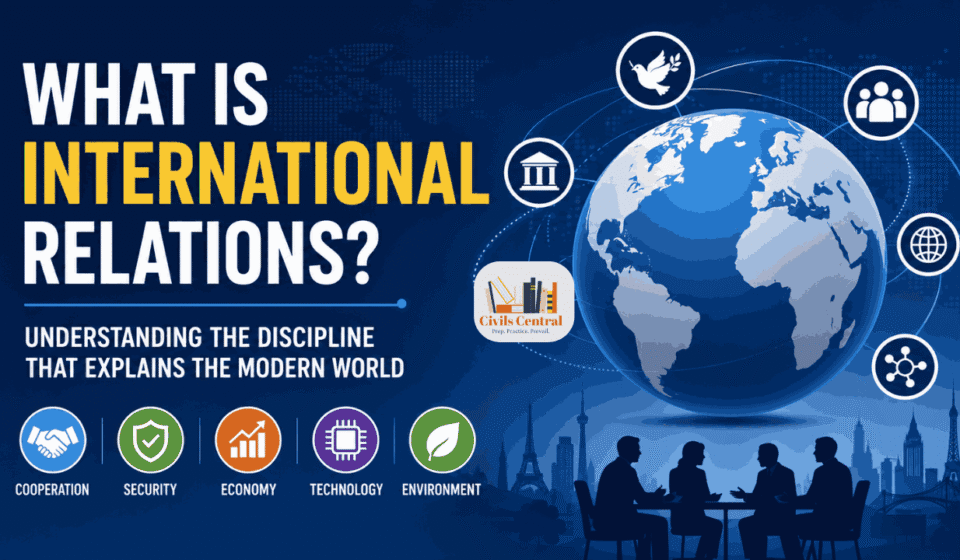
What is International Relations? Understanding the Discipline That Explains the Modern World

What is International Relations?
Every day, newspapers across the world report hundreds of international developments. One country signs a defence agreement with another. A trade dispute erupts between major economies. The United Nations adopts a new resolution. Regional organisations hold summits to discuss economic cooperation. Conflicts emerge in one part of the world, while humanitarian assistance is delivered in another. Advances in technology reshape global competition, climate negotiations influence national policies, and economic sanctions alter the behaviour of states.
To an ordinary reader, these events appear independent. They involve different countries, different organisations, different issues, and occur in different parts of the world. Consequently, they are often understood as isolated incidents reported under the broad category of international news.
However, scholars of International Relations approach these developments differently. They begin with a fundamental assumption: international events rarely occur in isolation. Behind every treaty, alliance, conflict, diplomatic negotiation, trade agreement, or international institution lies a complex network of political, economic, historical, geographical, strategic, technological, and legal factors. These factors influence how states behave, why they cooperate in some situations and compete in others, why conflicts arise, why international organisations are created, and how the global order continuously evolves.
International Relations emerged as an academic discipline because merely reporting international events was not enough. Governments needed to understand why wars occurred, why peace sometimes endured and sometimes collapsed, why alliances formed, why empires expanded, and why economic interdependence increasingly connected distant societies. Explaining these patterns required a systematic field of study that went beyond history, beyond politics, and beyond diplomacy. That field became known as International Relations.
For a Civil Services aspirant, this distinction is particularly important. The Civil Services Examination does not merely expect candidates to remember that a summit was held or a treaty was signed. It expects them to understand why those events occurred, what larger concepts they represent, how they affect India’s interests, and how they fit into the changing structure of world politics. In other words, UPSC tests understanding rather than information. International Relations provides the conceptual framework necessary to transform current affairs into meaningful knowledge.
This chapter therefore marks the beginning of the CivilsCentral International Relations Knowledge Library. Before studying states, sovereignty, diplomacy, foreign policy, international organisations, or India’s external relations, it is essential to understand the discipline that connects them all. Just as every branch of science begins by understanding its subject matter, the study of International Relations must begin by understanding what the discipline actually seeks to explain.
The Fundamental Question
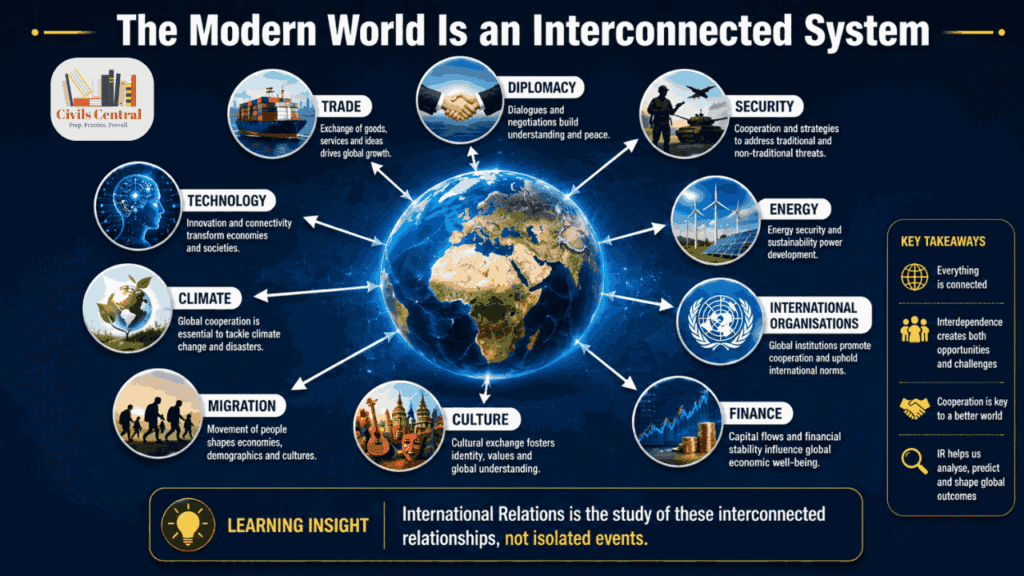
At first sight, the world appears politically fragmented. Nearly two hundred sovereign states possess their own governments, constitutions, laws, economies, militaries, and national interests. Each exercises authority within its own territory and claims the right to determine its domestic affairs independently. Yet despite this apparent independence, no modern state exists in complete isolation.
India imports crude oil from West Asia to meet its growing energy requirements. Japan depends heavily upon imported natural resources because of its limited domestic reserves. China relies upon maritime trade routes to sustain its export-oriented economy. European countries cooperate through institutions that regulate trade, security, and economic integration. Small island nations negotiate collectively in international climate conferences because rising sea levels threaten their very existence. Even countries separated by thousands of kilometres influence one another through trade, investment, migration, technology, finance, environmental change, cyber security, and public health.
These realities raise an important question.
If every state is sovereign and politically independent, why do they remain so deeply connected?
Why do countries negotiate agreements instead of resolving every disagreement through force?
Why do international organisations exist despite the absence of a world government?
Why do alliances emerge in some regions while rivalries dominate others?
Why does an armed conflict in one continent influence fuel prices, food security, supply chains, inflation, and diplomatic decisions across the world?
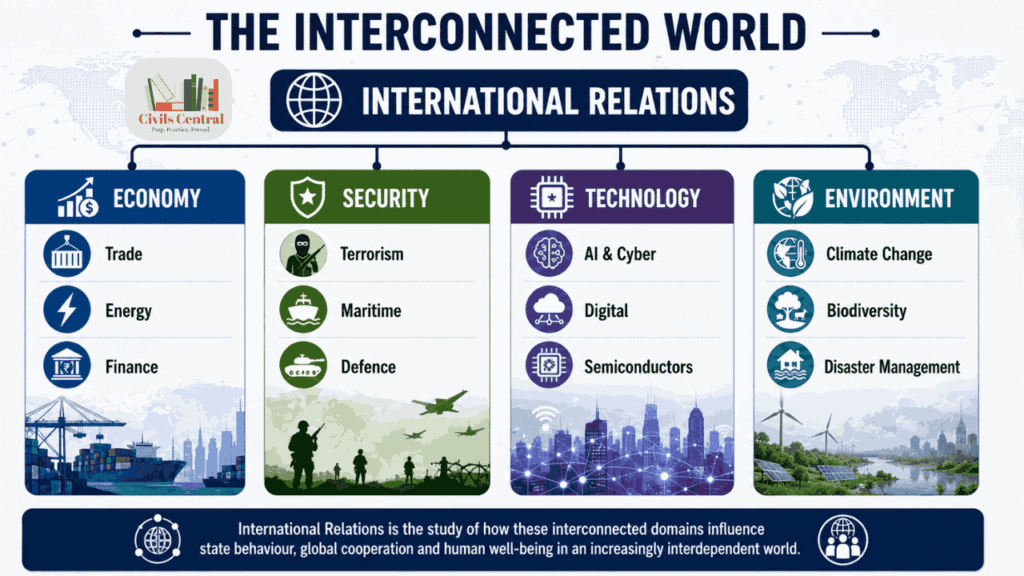
Questions such as these cannot be answered by studying a single country in isolation. They require an understanding of the broader system within which all countries operate. International Relations is the discipline that studies this system. It seeks to explain not only the behaviour of individual states but also the complex web of interactions that shape international politics, global economics, collective security, environmental cooperation, technological competition, and the evolving structure of world order.
In essence, International Relations begins with a simple observation: no nation today exists entirely alone. Every country influences others and is, in turn, influenced by them. Understanding these relationships is the central purpose of the discipline.
What Exactly Is International Relations?
Every academic discipline begins by attempting to answer a fundamental question about the world. Economics asks how societies allocate scarce resources. Political Science seeks to understand the organization and exercise of political power within a state. Sociology examines human society and the relationships that shape social life. Geography studies the interaction between humans and their physical environment. In the same manner, International Relations seeks to answer a question that has become increasingly important in the modern world:
How and why do nations interact with one another?
Although this question appears straightforward, it opens the door to one of the most complex fields of human inquiry. Nations cooperate, compete, negotiate, trade, wage wars, form alliances, establish international organizations, sign treaties, impose sanctions, exchange technology, combat climate change, respond to pandemics, and increasingly confront challenges that no single country can solve independently. Understanding the logic behind these interactions is the central objective of International Relations.
The expression International Relations itself is composed of two words—“International” and “Relations.” Understanding these two terms individually helps us appreciate the broader meaning of the discipline.
The word “international” literally means “between nations” or, more accurately in modern political science, “between sovereign states.” The term was popularized by the English philosopher Jeremy Bentham in the late eighteenth century, who used it to describe the legal and political interactions that occur beyond the boundaries of individual countries. Over time, the scope of the term expanded significantly. Today, “international” encompasses not only the relationships between states but also the activities of international organizations, multinational corporations, non-governmental organizations, global financial institutions, transnational social movements, and even influential individuals who shape international affairs.
The second word, “relations,” refers to the various forms of interaction that exist among these actors. These interactions are neither uniformly peaceful nor permanently hostile. They include cooperation and competition, friendship and rivalry, diplomacy and conflict, trade and sanctions, dialogue and deterrence. Relations may be political, economic, military, cultural, technological, environmental, legal, or humanitarian. They are dynamic because they evolve continuously in response to changing national interests, shifting distributions of power, technological innovations, and emerging global challenges.
When these two ideas are combined, International Relations may initially appear to mean simply the study of relations among nations. While this description captures the broad essence of the subject, it is insufficient because it does not explain what the discipline actually seeks to understand. International Relations is not merely interested in the existence of relationships between countries; it seeks to explain why those relationships take particular forms, why they change over time, and what consequences they produce for the international system.
Consider India’s relationship with different countries. India maintains close strategic cooperation with France in defence and space technology, extensive economic engagement with the United States, historical defence ties with Russia, complex competition and cooperation with China, deep civilizational and developmental links with Nepal and Bhutan, and growing partnerships with countries across Africa and the Indo-Pacific. Each of these relationships is different. They cannot be understood merely by listing agreements or diplomatic visits. They reflect differences in geography, history, economics, security concerns, technological capabilities, domestic politics, and national priorities. International Relations attempts to identify the underlying principles that explain these differences.
This distinction is extremely important for Civil Services aspirants. Newspapers report events. International Relations explains them. A newspaper may inform us that two countries have signed a defence agreement, imposed economic sanctions, or concluded a trade negotiation. The discipline of International Relations asks deeper questions. Why was the agreement necessary? What national interests does it serve? Why did negotiations succeed in one case but fail in another? How will this development alter regional or global power dynamics? These are the questions that transform current affairs into conceptual understanding.
For this reason, scholars generally describe International Relations as the systematic study of interactions among states and other international actors within the international system. The emphasis should be placed on the word systematic. International events are not viewed as random occurrences. They are studied through established concepts, theories, evidence, and analytical frameworks that help explain recurring patterns of cooperation, conflict, negotiation, and institutional development. Like every mature academic discipline, International Relations seeks not merely to observe reality but to understand the principles that shape it.
At CivilsCentral, we define International Relations in a manner that is both academically accurate and examination-oriented.
International Relations is the systematic study of how states and other international actors interact with one another in pursuit of their interests within an interconnected global system, and how these interactions shape peace, conflict, cooperation, development, and the evolving world order.
This definition deserves careful attention because every part of it carries significance.
The expression “systematic study” reminds us that International Relations is not a collection of newspaper headlines but a structured academic discipline governed by concepts and theories. The phrase “states and other international actors” reflects the reality that governments are no longer the only participants in global affairs. International organizations, multinational corporations, financial institutions, civil society organizations, technology companies, terrorist groups, and even influential individuals increasingly shape international outcomes. The words “pursuit of their interests” recognize that every actor seeks particular political, economic, strategic, environmental, or humanitarian objectives. Finally, the phrase “interconnected global system” acknowledges that the modern world functions as a network in which developments in one region frequently produce consequences far beyond national borders.
CivilsCentral Insight
A common misconception among beginners is that International Relations is simply the study of foreign policy or diplomacy. This understanding is incomplete.
Foreign policy is only one instrument through which a country conducts its external relations. Diplomacy is one of the methods used to implement foreign policy. International Relations is much broader. It studies not only foreign policy and diplomacy but also international organizations, international law, trade, security, conflict, environmental cooperation, global governance, technology, migration, and the changing structure of the international system itself.
Understanding this distinction at the beginning of your preparation will prevent one of the most common conceptual errors made by aspirants and provide a stronger foundation for every chapter that follows in the CivilsCentral Knowledge Library.
How International Relations Became an Academic Subject?
One of the most common misconceptions among beginners is that International Relations has existed as an academic discipline for as long as nations themselves have existed. Since kingdoms, empires, diplomacy, alliances, and wars have been part of human history for thousands of years, it is natural to assume that people have always studied International Relations in the way it is taught today. This assumption, however, is historically incorrect.
Human societies have interacted with one another since the earliest civilizations. Ancient India maintained commercial and cultural contacts with Southeast Asia. The Roman Empire negotiated treaties with neighbouring kingdoms. Chinese dynasties exchanged diplomatic missions with Central Asia. Medieval European kingdoms constantly formed alliances, fought wars, and negotiated peace agreements. These interactions undoubtedly formed part of what we today call international relations in practice. Yet there was no independent academic discipline known as International Relations. Such interactions were studied within History, Political Philosophy, Law, Military Strategy, or Diplomacy, but not as a separate field of systematic inquiry.
This distinction is important because the practice of International Relations is much older than the academic discipline of International Relations. Countries interacted long before universities began teaching students how and why those interactions occurred.
For centuries, rulers and statesmen were primarily concerned with managing immediate political challenges rather than developing general theories about international behaviour. Diplomats negotiated treaties, military commanders planned campaigns, merchants established trade routes, and political thinkers reflected upon questions of power, sovereignty, and justice. Although these activities generated valuable knowledge, they remained scattered across different disciplines. There was no unified framework that attempted to explain international politics as a distinct system governed by identifiable patterns and principles.
The transformation began during the nineteenth and early twentieth centuries. The Industrial Revolution dramatically increased international trade and economic interdependence. Improvements in transportation and communication reduced geographical barriers between societies. European imperial expansion connected distant regions through political and economic networks. Nationalism reshaped the political map of Europe, while advances in military technology made warfare increasingly destructive. The world was becoming more interconnected than ever before, yet existing academic disciplines struggled to explain this growing complexity. Scholars increasingly realised that understanding relations among states required a specialised field of study rather than occasional discussions within history or political science.
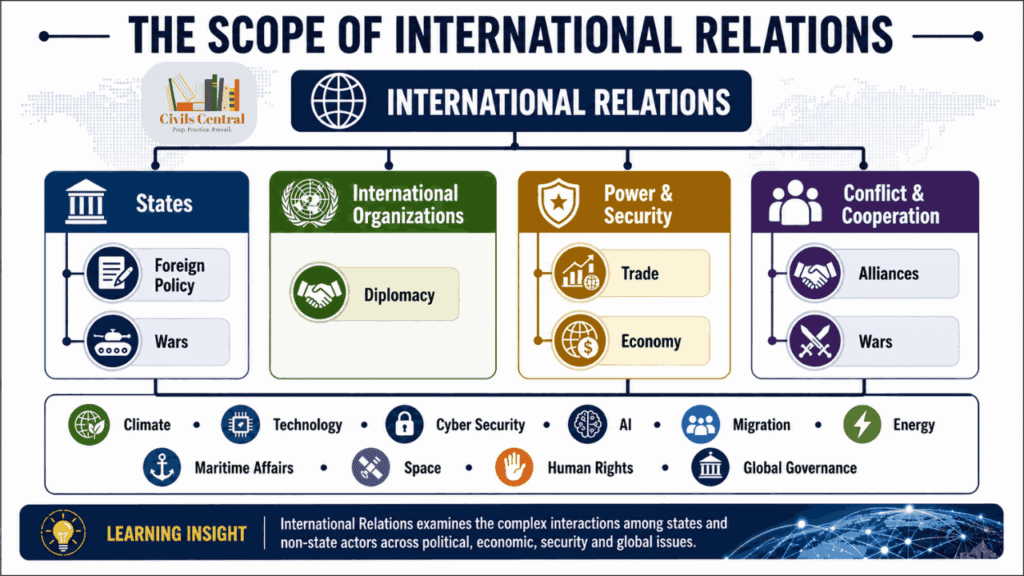
The decisive turning point came with the outbreak of the First World War in 1914. Few events in modern history transformed intellectual thinking as profoundly as this conflict. What many political leaders had expected to be a short regional war quickly escalated into a devastating global catastrophe. More than thirty countries became directly involved. Millions of soldiers and civilians lost their lives, vast economic resources were destroyed, and several long-standing empires—including the German, Austro-Hungarian, Ottoman, and Russian Empires—collapsed. The sheer scale of destruction shocked governments, scholars, and ordinary citizens alike.
Perhaps the most disturbing question that emerged after the war was not simply how the conflict had been fought but why it had occurred in the first place. Europe possessed experienced diplomats, established alliances, expanding international trade, and centuries of political experience. Yet none of these had prevented one of the deadliest conflicts in human history. This failure prompted a profound intellectual reassessment. If humanity wished to avoid another global catastrophe, it could no longer rely solely upon traditional diplomacy or historical experience. It needed a systematic understanding of the forces that produced war, shaped peace, encouraged cooperation, and influenced the behaviour of states.
It was within this historical context that International Relations began to emerge as an independent academic discipline. Universities gradually recognised that explaining international politics required specialised teaching and research. One of the earliest and most significant milestones occurred in 1919, when the world’s first university chair dedicated specifically to International Politics was established at the University of Wales, Aberystwyth. This development is widely regarded as the formal institutional birth of International Relations as an academic discipline. Although scholars had long reflected upon international affairs, the establishment of dedicated departments, research programmes, and university courses marked the beginning of a systematic field of study devoted exclusively to understanding the international system.
The timing of this development was not accidental. The founders of the discipline believed that rigorous academic study could contribute to a more peaceful international order. By analysing the causes of war, the functioning of diplomacy, the role of international law, and the possibilities of collective security, scholars hoped that governments would make better-informed decisions and reduce the likelihood of future conflicts. In this sense, International Relations was born not merely out of intellectual curiosity but also out of a practical desire to prevent the recurrence of global tragedy.
The optimism of the inter-war period was soon challenged by the outbreak of the Second World War, which demonstrated that understanding international politics was even more complex than many early scholars had imagined. Rather than weakening the discipline, however, the Second World War strengthened it. The emergence of the United Nations, the beginning of the Cold War, the spread of decolonisation, the rise of nuclear weapons, the expansion of international organisations, and later the forces of globalisation transformed International Relations into one of the fastest-growing fields within the social sciences. Today, the discipline extends far beyond the study of war and diplomacy. It encompasses international economics, global governance, environmental cooperation, cyber security, space policy, international development, migration, public health, artificial intelligence, and numerous other issues that increasingly shape relations among nations.
For Civil Services aspirants, this historical journey offers an important lesson. International Relations is not simply the study of events taking place outside India’s borders. It is a discipline that evolved because humanity recognised that global problems require systematic understanding. Every concept you will study in the chapters that follow—State, Sovereignty, National Interest, Power, Diplomacy, Foreign Policy, International Law, and Global Governance—represents an attempt by scholars and policymakers to explain how the international system functions and how peace, security, and cooperation can be better managed in an increasingly interconnected world.
What Does International Relations Actually Study?
Having understood why International Relations emerged as an academic discipline and how it gradually developed into an independent field of study, we are now in a position to answer another important question. If International Relations is a discipline, what exactly is its subject matter? In other words, what does an expert in International Relations actually study?
At first glance, the answer appears deceptively simple. One might assume that International Relations studies the relations between countries. Although this statement is broadly correct, it is far too narrow to capture the true scope of the discipline. Modern International Relations is concerned not merely with the existence of relationships among states but with the entire international system within which those relationships evolve. It seeks to understand the forces that shape cooperation and conflict, the institutions that regulate global affairs, the distribution of power, the behaviour of states and non-state actors, and the increasingly complex problems that transcend national boundaries.
To appreciate the breadth of the discipline, it is useful to begin with a simple observation. Every sovereign state exists within two distinct political environments. The first is the domestic environment, where a government exercises authority through a constitution, laws, courts, administrative institutions, and law enforcement agencies. The second is the international environment, where no single government exercises supreme authority over all states. Countries remain sovereign, yet they must continuously interact with one another to secure their interests, promote economic development, address security concerns, protect the environment, and respond to global challenges. International Relations studies this second environment.
Because the international system lacks a world government capable of enforcing decisions upon every sovereign state, interactions among countries are fundamentally different from interactions within a country. States negotiate rather than legislate. They persuade rather than command. They cooperate voluntarily, compete strategically, and occasionally resort to conflict when peaceful mechanisms fail. Understanding these distinctive patterns of behaviour constitutes one of the central concerns of International Relations.
The discipline therefore begins with the study of states, which continue to remain the principal actors in world politics. Every sovereign state possesses its own territory, population, government, and legal authority. Yet states rarely pursue identical objectives. Their foreign policies are shaped by geography, historical experiences, economic capabilities, security concerns, political systems, cultural identities, technological capacities, and national interests. International Relations examines how these factors influence state behaviour and why different countries often respond differently to similar international situations.
However, limiting the discipline to states alone would no longer reflect the realities of the twenty-first century. Modern international affairs are increasingly shaped by non-state actors whose influence extends across national boundaries. International organisations such as the United Nations coordinate collective responses to global challenges. Financial institutions influence economic stability. Multinational corporations shape investment, technology, and global supply chains. Non-governmental organisations advocate for humanitarian causes, environmental protection, and human rights. Terrorist organisations create transnational security threats. Even technology companies increasingly influence cybersecurity, digital governance, artificial intelligence, and the global flow of information. Consequently, International Relations studies not only how states interact with one another but also how these diverse actors collectively shape international outcomes.
Another major area of study concerns power. Few concepts occupy a more central position in International Relations than the distribution and exercise of power. Why are some countries able to influence global events more effectively than others? Why do military strength, economic capacity, technological innovation, demographic resources, diplomatic influence, and cultural appeal all contribute to national power? Why do emerging powers challenge existing ones? Why do weaker states often seek alliances with stronger partners? These questions cannot be answered through historical description alone. They require a systematic analysis of how power is acquired, maintained, exercised, and balanced within the international system. For this reason, the study of power forms one of the intellectual pillars of International Relations.
Closely connected with power is the study of conflict and cooperation. Contrary to popular perception, International Relations is not merely the study of wars. Conflict certainly remains an important subject because wars have profoundly shaped international history and continue to influence contemporary geopolitics. However, the discipline is equally concerned with understanding why countries cooperate despite competing interests. International trade agreements, climate negotiations, public health initiatives, maritime security arrangements, disaster relief operations, scientific collaborations, and regional organisations all demonstrate that cooperation is as much a feature of international politics as competition. Explaining the conditions under which cooperation becomes possible remains one of the discipline’s most significant objectives.
International Relations also studies the institutions and rules that attempt to regulate global affairs. Unlike domestic political systems, where laws are enforced by governments, the international system functions primarily through treaties, conventions, customary practices, and international organisations. These institutions do not eliminate conflict, but they provide mechanisms through which disputes may be negotiated, trade regulated, environmental commitments coordinated, and humanitarian concerns addressed. Understanding how international law and global governance operate despite the absence of a world government represents one of the most intellectually fascinating aspects of the discipline.
In recent decades, the scope of International Relations has expanded even further. Contemporary scholars increasingly examine issues that earlier generations rarely considered part of international politics. Climate change, cyber security, artificial intelligence, global pandemics, food security, energy transitions, space governance, digital infrastructure, critical minerals, supply chain resilience, migration, and sustainable development have all become integral components of modern International Relations. These issues illustrate an important reality: many of the most significant challenges confronting humanity today cannot be solved by any single nation acting alone. They require international cooperation, shared institutions, negotiated rules, and coordinated policies.
For India, this expanded scope carries profound implications. India’s aspirations for rapid economic growth, technological leadership, energy security, climate resilience, maritime influence, regional stability, and global governance reform all depend upon effective engagement with the international system. Consequently, understanding International Relations is no longer relevant only for diplomats or foreign policy specialists. It has become essential for administrators, policymakers, economists, security professionals, environmental planners, and civil servants whose decisions increasingly intersect with global developments.
The true subject matter of International Relations may therefore be understood as the study of interactions within the international system and the forces that shape those interactions. It seeks to explain how power, interests, institutions, ideas, geography, economics, technology, and law collectively influence the behaviour of states and other international actors. Rather than studying isolated events, it studies the patterns that connect them. Rather than memorising diplomatic developments, it seeks to understand the principles that explain why those developments occur.
This broader understanding is what distinguishes International Relations from the daily reporting of international news. News informs us about what has happened. International Relations helps us understand why it happened, why it matters, and how similar developments are likely to shape the future.
CivilsCentral Insight
One of the biggest mistakes beginners make is believing that International Relations is synonymous with Foreign Policy. In reality, foreign policy is only one component of the discipline. International Relations is much broader because it studies the entire international system, the actors within it, the rules governing it, and the forces that shape global interactions. Recognising this distinction at an early stage makes the rest of the subject significantly easier to understand.
The Nature of International Relations: What Makes This Discipline Unique?
Every academic discipline possesses certain defining characteristics that distinguish it from other fields of study. Economics differs from Sociology because it focuses primarily on the production, distribution, and consumption of resources. Political Science differs from History because it examines political institutions, authority, and governance rather than merely recording past events. Similarly, International Relations possesses a distinct character that reflects the unique environment within which states and other international actors interact.
Understanding the nature of International Relations is important because it explains why international politics often appears more uncertain, complex, and unpredictable than domestic politics. Many questions that seem straightforward within a country become remarkably difficult when viewed at the international level. Why can a government enforce laws upon its citizens but no global authority can compel sovereign states to obey every international rule? Why do countries cooperate in one area while simultaneously competing in another? Why do long-standing allies sometimes become rivals, while former adversaries evolve into strategic partners? The answers lie in the distinctive nature of the international system itself.
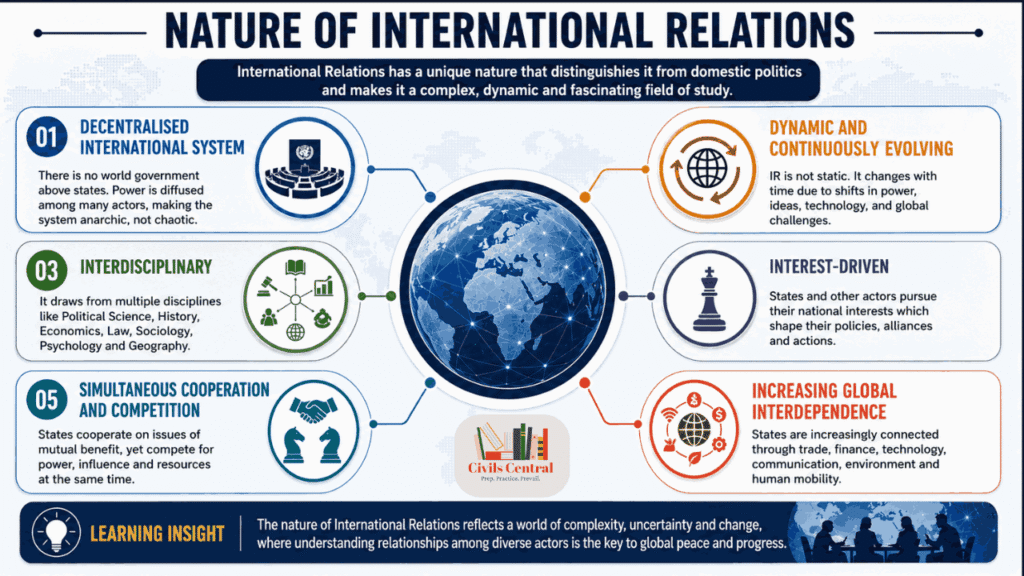
The first and perhaps most fundamental characteristic of International Relations is that it operates within a decentralised international system. Every sovereign state exercises authority within its own territory, yet beyond national borders there exists no single government possessing universal legislative, executive, and judicial powers comparable to those found within individual countries. International society therefore functions through sovereign equality, voluntary agreements, diplomacy, negotiations, customary practices, and international institutions rather than through a central political authority. This absence of a world government does not imply the absence of order. Rather, it means that order must be created through cooperation, shared interests, and mutually accepted rules instead of compulsory domestic enforcement.
This feature distinguishes International Relations from domestic politics in a fundamental way. Within India, Parliament enacts laws, the executive implements them, and the judiciary interprets and enforces them through constitutionally recognised institutions. Citizens cannot ordinarily choose whether to obey legislation enacted under constitutional authority. In contrast, the international system functions through a far more complex process of consent and negotiation. International agreements derive much of their effectiveness from the willingness of states to honour commitments because doing so often serves their long-term interests. Understanding this distinction is essential because it explains why diplomacy occupies such a central position in international affairs.
A second defining characteristic of International Relations is that it is dynamic rather than static. The international system is constantly changing in response to political transformations, technological innovations, demographic shifts, economic developments, environmental challenges, and changes in the distribution of power. History demonstrates this clearly. The world that existed before the First World War differed profoundly from the bipolar order of the Cold War. The international environment following the collapse of the Soviet Union differed once again from both earlier periods. Today, emerging technologies, artificial intelligence, cyber security, climate change, global health challenges, and the rise of new economic powers are reshaping international politics in ways that earlier generations could scarcely imagine.
For this reason, International Relations cannot be understood merely through memorisation of contemporary events. Every international development must be interpreted within its broader historical and structural context. What appears to be a new geopolitical development is often the continuation of historical trends whose origins may extend back decades or even centuries. A student who understands these underlying patterns is far better equipped to interpret current affairs than one who relies solely upon newspaper reporting.
Another defining characteristic of the discipline is its interdisciplinary nature. International Relations does not exist in isolation from other branches of knowledge. On the contrary, it draws extensively from Political Science, History, Economics, Geography, Law, Sociology, Strategic Studies, Environmental Science, Technology, and even Psychology. This interdisciplinary character reflects the reality that international events rarely have a single cause. A border dispute may involve historical claims, geographical features, legal interpretations, security concerns, economic interests, technological capabilities, domestic political pressures, and cultural identities simultaneously. Analysing such issues therefore requires perspectives drawn from multiple disciplines rather than dependence upon a single explanatory framework.
This characteristic has particular relevance for the Civil Services Examination because UPSC itself increasingly adopts an interdisciplinary approach. A question concerning the Indo-Pacific may require knowledge of geography, maritime trade, security studies, international law, environmental governance, and India’s foreign policy. Similarly, a question relating to climate diplomacy may combine concepts from international negotiations, environmental science, economics, technology, and sustainable development. International Relations therefore acts as a bridge connecting several components of the General Studies syllabus into a coherent framework.
A fourth characteristic is that International Relations is fundamentally interest-driven. Although ideals such as peace, justice, equality, and international cooperation remain important, states ultimately formulate foreign policy primarily to protect and promote their national interests. These interests may include territorial integrity, national security, economic prosperity, technological advancement, energy security, food security, environmental sustainability, or the welfare of citizens abroad. The precise priorities differ from one country to another, but the pursuit of national interest remains a constant feature of international politics. Appreciating this reality enables students to interpret diplomatic decisions more objectively, avoiding simplistic assumptions that countries act solely on the basis of friendship, ideology, or morality.
At the same time, International Relations cannot be reduced entirely to competition. The modern world is characterised by simultaneous competition and cooperation. Countries that compete strategically may nevertheless cooperate in trade, climate negotiations, disaster management, scientific research, public health, or counter-terrorism. India and several major powers provide useful examples of this phenomenon. Bilateral relationships frequently combine elements of partnership, competition, negotiation, and disagreement at the same time. Understanding this complexity is essential because international politics rarely operates through absolute categories such as permanent friends or permanent enemies. Relationships evolve continuously in response to changing circumstances and interests.
Perhaps the most significant feature of contemporary International Relations is its growing interdependence. Advances in communication, transportation, digital technologies, finance, and global supply chains have created unprecedented levels of connectivity among nations. Economic disruptions in one region rapidly influence markets elsewhere. Armed conflicts affect energy prices across continents. Pandemics spread beyond national borders within weeks. Climate change, cyber security, migration, and transnational terrorism all demonstrate that many modern challenges cannot be contained within the territorial boundaries of individual states. Consequently, national policies increasingly require international cooperation, making International Relations more relevant than at any previous point in history.
For India, this interdependence has profound implications. India’s economic growth depends upon secure trade routes, stable financial systems, access to energy resources, technological partnerships, resilient supply chains, and constructive engagement with international institutions. National development is therefore closely linked with developments occurring far beyond India’s borders. Understanding these linkages is one of the principal objectives of International Relations and one of the reasons why the subject occupies such an important place within the Civil Services Examination.
The nature of International Relations may therefore be summarised through one central idea: it is the study of a world composed of sovereign yet interdependent actors operating within a decentralised international system where cooperation, competition, conflict, and negotiation coexist simultaneously. Recognising these characteristics enables students to move beyond viewing international events as isolated news items and instead understand them as interconnected manifestations of a larger global system.
Domestic Politics vs International Relations
| Dimension | Domestic Politics | International Relations |
|---|---|---|
| Political Authority | Central government exercises legal authority | No world government with universal authority |
| Law | Enforced through constitutional institutions | Based on treaties, customary law, consent, and international institutions |
| Primary Actors | Citizens, political parties, governments | States, international organisations, corporations, NGOs, and other global actors |
| Decision-Making | Legally binding within the state | Negotiation, diplomacy, cooperation, and consensus |
| Primary Objective | Governance of society | Management of relations among international actors |
Why International Relations Matters in the Twenty-First Century
For much of human history, the fortunes of one kingdom or empire were largely determined by developments occurring within its immediate geographical neighbourhood. Although trade routes connected distant civilizations and wars occasionally reshaped entire regions, most societies remained relatively insulated from events taking place thousands of kilometres away. Geography imposed natural barriers, communication was slow, transportation was limited, and political interactions rarely extended beyond neighbouring states.
The modern world bears little resemblance to that historical reality. Today, an economic crisis originating in one country can disrupt financial markets across continents within hours. A military conflict in a distant region can alter global energy prices, interrupt food supplies, and influence inflation in countries that are not directly involved in the conflict. A virus emerging in one part of the world can spread across international borders in a matter of weeks, challenging healthcare systems and economies simultaneously. Decisions concerning artificial intelligence, cyber security, climate change, maritime trade, or digital technology taken by a handful of countries frequently produce consequences for billions of people.
This transformation has fundamentally altered the significance of International Relations. It is no longer a specialised subject relevant only to diplomats, ambassadors, or foreign ministries. It has become a discipline that influences almost every aspect of governance, public policy, economic planning, national security, environmental management, technological development, and even the daily lives of ordinary citizens.
One of the principal reasons for this transformation is the unprecedented growth of global interdependence. Nations today remain politically sovereign, yet they are economically, technologically, environmentally, and strategically interconnected to an extent never witnessed in human history. Every modern economy depends upon international trade, global financial systems, cross-border investment, technological collaboration, energy imports, critical minerals, maritime transport, and digital communication networks. No major country, regardless of its size or military capability, possesses complete self-sufficiency across all sectors of national development.
India provides an excellent illustration of this reality. India’s aspiration to become a developed economy depends upon stable access to global markets, uninterrupted maritime trade routes, foreign investment, advanced technologies, reliable energy supplies, resilient supply chains, and constructive partnerships with countries across different regions of the world. Consequently, many decisions that appear domestic in nature are deeply influenced by international developments. The price of petroleum products, the availability of semiconductors, the export of pharmaceutical products, the security of sea lanes in the Indian Ocean, or the regulation of digital technologies cannot be understood exclusively through domestic policy. Each reflects the interaction between India’s internal priorities and the wider international environment.
The importance of International Relations has grown even further because many contemporary challenges are transnational in character. Unlike traditional military threats, these problems cannot be contained within national borders and cannot be solved by any country acting alone. Climate change affects the entire planet irrespective of political boundaries. Terrorist networks operate across multiple jurisdictions. Cyber attacks frequently originate in one country while targeting infrastructure located elsewhere. Pandemics spread through global mobility. Marine pollution ignores territorial waters. Illegal trafficking, money laundering, organised crime, and migration similarly transcend national frontiers. Such challenges demonstrate that sovereignty alone is insufficient to address many of the most pressing issues confronting humanity.
This changing reality has strengthened the importance of international institutions and multilateral cooperation. Organisations such as the United Nations, the World Health Organization, the World Trade Organization, the International Monetary Fund, and numerous regional organisations were established because certain problems require collective responses rather than unilateral action. Although these institutions are often criticised for their limitations, their continued existence reflects a fundamental truth of contemporary international politics: cooperation has become an essential complement to sovereignty rather than its opposite.
At the same time, increasing interdependence has not eliminated competition. On the contrary, the twenty-first century has witnessed the emergence of new forms of strategic rivalry. Competition over advanced technologies, semiconductor manufacturing, artificial intelligence, rare earth minerals, digital infrastructure, cyber capabilities, outer space, maritime influence, and global supply chains has become central to contemporary geopolitics. Countries increasingly cooperate in some domains while competing intensely in others. This coexistence of cooperation and competition represents one of the defining characteristics of the present international order and demonstrates why simplistic explanations based solely upon friendship or hostility fail to capture the complexity of modern state behaviour.
For India, understanding these transformations is not merely an academic exercise. As one of the world’s largest democracies, a rapidly growing economy, a major maritime power, a nuclear-weapon state, and an increasingly influential participant in global governance, India occupies a position of considerable strategic importance. Decisions taken in New Delhi influence regional stability, economic partnerships, climate negotiations, maritime security, development cooperation, and the reform of international institutions. Similarly, decisions taken in Washington, Beijing, Moscow, Brussels, Tokyo, or at the United Nations increasingly influence India’s developmental trajectory and strategic environment. Effective public administration therefore requires a clear understanding of the international system within which national policy is formulated.
This expanding significance explains why International Relations has become an indispensable component of the Civil Services Examination. A future civil servant is expected to appreciate not merely the constitutional and administrative dimensions of governance but also the international context within which governance increasingly operates. Policies relating to energy, trade, technology, agriculture, health, infrastructure, environment, security, and economic development are today shaped by both domestic priorities and international commitments. Consequently, understanding International Relations is no longer optional; it has become an essential element of informed governance.
Ultimately, the importance of International Relations in the twenty-first century may be understood through a simple but profound observation. The world has become too interconnected for any nation to prosper in isolation and too diverse for any single nation to govern it alone. The future of global politics will therefore depend upon the ability of states to balance national interests with international cooperation, strategic competition with collective responsibility, and sovereignty with growing interdependence. Understanding this balance lies at the very heart of International Relations.
CivilsCentral Insight
Many beginners think International Relations belongs only to GS Paper II.
This is misleading.
International Relations cuts across almost every General Studies paper:
- GS I – Historical evolution of the world order, decolonisation, geopolitical developments.
- GS II – Foreign policy, bilateral relations, international organisations, global governance.
- GS III – Economy, energy security, cyber security, maritime security, technology, environment, disaster management.
- Essay – Globalisation, peace, development, climate change, international cooperation.
- Interview – Contemporary international developments and India’s role in the world.
A strong conceptual understanding of International Relations therefore strengthens performance across the entire Civil Services Examination rather than in a single subject alone.
The Building Blocks of International Relations: The Core Concepts Every Student Must Master
No academic discipline can be understood merely by reading isolated topics. Every subject possesses a set of foundational concepts that together create its intellectual framework. In Economics, ideas such as demand, supply, markets, inflation, and growth provide the conceptual language through which economic problems are analysed. In Political Science, concepts such as the State, Constitution, Democracy, Rights, Representation, and Governance perform a similar role. International Relations is no different. Beneath every diplomatic negotiation, international agreement, military conflict, trade partnership, or global institution lies a relatively small group of core concepts that explain why international actors behave in particular ways.
Recognising these foundational ideas is perhaps the most important step in mastering International Relations. Many aspirants make the mistake of studying international events directly from newspapers or current affairs magazines without first understanding the concepts that give those events meaning. As a result, every diplomatic visit appears to be a new topic, every summit introduces unfamiliar terminology, and every geopolitical development demands separate memorisation. The subject gradually becomes an ever-expanding collection of disconnected information.
A concept-based approach produces the opposite result. Once the learner understands the intellectual foundations of the discipline, current affairs begin to organise themselves naturally. Different international developments no longer appear unrelated because they can be explained through concepts that remain constant even though events continue to change. This is precisely the approach followed throughout the CivilsCentral Knowledge Library.
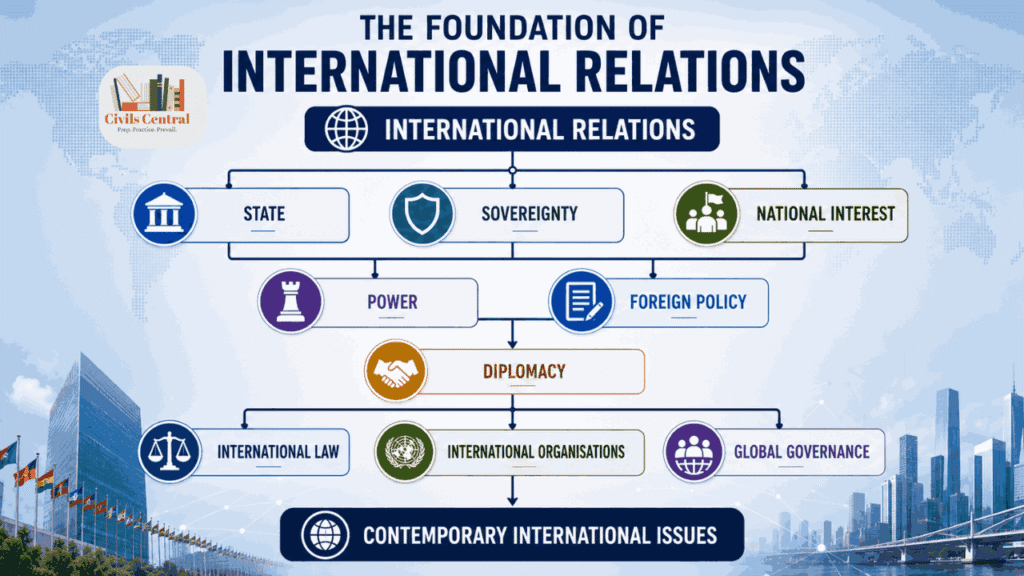
The first and most fundamental concept is the State. The modern international system is organised primarily around sovereign states. Every country recognised in the contemporary international order functions as a state possessing a defined territory, a permanent population, an organised government, and the capacity to conduct relations with other states. Without understanding what constitutes a state, it is impossible to appreciate why international law operates in its present form, why diplomatic recognition matters, why territorial disputes arise, or why sovereignty occupies such a central position in international politics. The study of International Relations therefore begins not with organisations or treaties but with the State itself.
Closely related to the State is the concept of Sovereignty, one of the defining principles of the modern international system. Sovereignty refers to the supreme authority exercised by a state within its own territory and its independence from external political control. Although the concept appears straightforward, it lies at the heart of many contemporary international debates. Humanitarian intervention, cyber security, cross-border terrorism, climate governance, international criminal justice, and digital regulation all raise important questions concerning the limits and evolution of sovereign authority. For this reason, sovereignty remains one of the most frequently examined concepts in both academic literature and the Civil Services Examination.
A third foundational concept is National Interest. Every government, irrespective of its political ideology or geographical location, formulates foreign policy with the objective of protecting and promoting what it considers to be its national interests. These interests may relate to national security, territorial integrity, economic development, technological advancement, energy security, environmental sustainability, or the welfare of citizens abroad. Understanding national interest enables students to interpret international behaviour more objectively because it explains why countries often pursue policies that appear contradictory when viewed only through the lens of ideology or political rhetoric.
The concept of Power occupies an equally central position within International Relations. International politics has never been shaped solely by legal principles or moral ideals. The ability of states to influence the behaviour of others through military strength, economic capability, technological innovation, diplomatic influence, cultural attraction, or strategic geography has always affected the distribution of influence within the international system. Modern discussions concerning hard power, soft power, smart power, technological leadership, cyber capabilities, and economic statecraft all represent different dimensions of this broader concept. Appreciating how power is acquired, exercised, and balanced is essential for understanding global politics.
Another indispensable concept is Diplomacy. Contrary to popular perception, diplomacy extends far beyond formal meetings between ambassadors or heads of government. It is the principal mechanism through which states communicate, negotiate, resolve disputes, build partnerships, and advance national interests without resorting to the use of force. As international issues have become increasingly complex, diplomacy itself has evolved to include economic diplomacy, climate diplomacy, digital diplomacy, public diplomacy, and multilateral diplomacy. The growing importance of these forms of engagement reflects the changing character of international politics in the twenty-first century.
Closely connected with diplomacy is the concept of Foreign Policy, which may be understood as the framework guiding a state’s external relations. Foreign policy determines how a country engages with the international community in pursuit of its national objectives. It reflects the interaction of geography, history, domestic politics, economic priorities, military capabilities, public opinion, leadership, and international circumstances. Every bilateral relationship, multilateral initiative, or strategic partnership undertaken by a country ultimately forms part of its foreign policy.
Beyond these classical concepts, modern International Relations also requires an understanding of International Law, International Organisations, Global Governance, Geopolitics, Geoeconomics, Security, Climate Diplomacy, Technology Governance, and numerous other ideas that have emerged in response to changing global realities. Each of these concepts represents a specialised lens through which international interactions may be analysed. Together, they form the intellectual architecture of the discipline.
One of the distinctive features of the CivilsCentral Knowledge Library is that these concepts will not be studied independently. Instead, every chapter has been designed to connect naturally with the others. Understanding the State prepares the learner to understand Sovereignty. Sovereignty leads naturally to National Interest. National Interest explains Foreign Policy. Foreign Policy is implemented through Diplomacy. Diplomacy increasingly operates within institutions of Global Governance. In this manner, every concept becomes part of a larger conceptual network rather than an isolated topic requiring separate memorisation.
This interconnected approach reflects the reality of international politics itself. International events rarely arise from a single cause. A maritime dispute, for example, may simultaneously involve questions of sovereignty, national interest, international law, diplomacy, security, energy resources, technological capabilities, and regional geopolitics. Only a learner who understands these concepts as parts of an integrated framework can analyse such issues confidently and comprehensively.
The purpose of the chapters that follow is therefore not merely to introduce new terminology but to gradually construct this conceptual framework. By the time you complete the Foundations Module of the CivilsCentral Knowledge Library, you should possess the intellectual vocabulary necessary to interpret almost every major international development reported in contemporary current affairs. Newspapers will no longer appear as collections of unrelated headlines. Instead, they will become practical illustrations of concepts you already understand.
International Relations, International Politics, Foreign Policy and Diplomacy: Understanding the Difference
One of the first conceptual challenges encountered by students of International Relations is the tendency to use several closely related terms as though they mean the same thing. Expressions such as International Relations, International Politics, Foreign Policy, and Diplomacy frequently appear in newspapers, policy documents, academic discussions, and even examination questions. Because all of them concern interactions beyond national borders, beginners often assume that they are interchangeable. This assumption, however, creates considerable confusion and weakens conceptual understanding.
A mature understanding of International Relations requires recognising that these terms describe different levels of analysis within the same broad field. They are connected, but they are not identical. Just as a Constitution, a government, and public administration are closely related yet distinct concepts in Polity, International Relations, International Politics, Foreign Policy, and Diplomacy each perform a separate role in explaining how the international system functions.
The broadest of these concepts is International Relations itself. As explained in the previous sections, International Relations is an academic discipline that studies the interactions among states and other international actors within the international system. It seeks to explain political relations, economic cooperation, security challenges, international law, global governance, environmental negotiations, technological competition, humanitarian issues, migration, public health, and many other dimensions of global interaction. It is therefore an umbrella discipline that incorporates numerous specialised areas of study.
Within this broader discipline lies International Politics. While International Relations examines the entire spectrum of international interactions, International Politics concentrates primarily on the political dimension of those interactions. It studies how power is acquired, exercised, and balanced among states; how strategic interests shape foreign behaviour; why alliances emerge; how conflicts develop; and how political competition influences the international order. Questions relating to the balance of power, deterrence, military alliances, strategic rivalries, or geopolitical competition belong primarily to International Politics.
The distinction may be understood through a simple illustration. Suppose two countries negotiate a free trade agreement. An economist may analyse its impact on investment and employment. A legal scholar may examine the treaty provisions. An environmental expert may study its ecological implications. A political scientist specialising in International Politics may ask whether the agreement shifts the regional balance of power or strengthens strategic influence. An expert in International Relations, however, attempts to integrate all these perspectives because the discipline encompasses political, economic, legal, environmental, technological, and social dimensions simultaneously. In other words, International Politics forms an important component of International Relations, but it does not exhaust the discipline.
The next concept is Foreign Policy, which operates at an entirely different level. Unlike International Relations, Foreign Policy is not an academic discipline. It is a practical instrument of governance. Every sovereign state formulates a foreign policy to guide its external relations in accordance with its national interests. It establishes objectives, identifies priorities, determines strategic partnerships, manages relations with neighbouring countries, responds to global developments, and protects national security and economic interests. Foreign Policy therefore represents the blueprint through which a country conducts its relations with the outside world.
An important distinction should be noted here. International Relations studies the behaviour of all international actors collectively, whereas Foreign Policy examines the external behaviour of one particular state. When we analyse India’s Neighbourhood First Policy, Act East Policy, Indo-Pacific vision, or engagement with multilateral organisations, we are studying India’s Foreign Policy. When we compare India’s policies with those of other countries, examine the responses of international organisations, or analyse how these interactions influence the global order, we move into the broader discipline of International Relations.
The fourth concept is Diplomacy, which may be described as the principal method through which Foreign Policy is implemented. If Foreign Policy defines what a country seeks to achieve internationally, Diplomacy determines how those objectives are pursued peacefully. Negotiations, dialogue, treaties, summit meetings, ambassadorial exchanges, multilateral conferences, confidence-building measures, cultural exchanges, public diplomacy, digital diplomacy, and economic diplomacy all constitute instruments of diplomatic engagement. Diplomacy therefore transforms foreign policy objectives into practical action.
The relationship among these four concepts may now be understood clearly. International Relations provides the academic framework for analysing global interactions. International Politics examines the political and strategic dimensions of those interactions. Foreign Policy expresses the objectives pursued by an individual state within that international environment. Diplomacy serves as the mechanism through which those objectives are implemented.
Understanding these distinctions has become increasingly important because modern international affairs rarely involve only one dimension. Consider India’s engagement in the Indo-Pacific. From the perspective of Foreign Policy, India seeks to promote security, economic cooperation, maritime stability, and a rules-based regional order. Diplomacy enables India to pursue these objectives through dialogue, bilateral agreements, regional forums, and strategic partnerships. International Politics examines how these initiatives influence the balance of power in the Indo-Pacific, particularly in relation to the interests of other major powers. International Relations studies the broader picture by integrating political, economic, legal, technological, environmental, and institutional aspects of the region into a comprehensive analysis.
For Civil Services aspirants, this conceptual clarity is invaluable. UPSC increasingly frames questions that require candidates to distinguish closely related ideas rather than merely reproduce definitions. A candidate who understands the relationship among these four concepts will find it easier to analyse contemporary international developments and avoid common conceptual errors during both the Preliminary and Main Examinations.
International Relations vs International Politics vs Foreign Policy vs Diplomacy
| Aspect | International Relations | International Politics | Foreign Policy | Diplomacy |
|---|---|---|---|---|
| Nature | Academic discipline | Sub-field of International Relations | Government policy | Instrument of policy implementation |
| Focus | Entire international system | Political and strategic interactions | External objectives of one state | Negotiation and peaceful engagement |
| Scope | Broadest | Narrower | Country-specific | Operational mechanism |
| Main Question | How does the international system function? | How do power and politics shape international behaviour? | What does a country want to achieve internationally? | How will those objectives be achieved? |
| Example | Study of global governance and international cooperation | Analysis of the balance of power in Asia | India’s Act East Policy | India–ASEAN Summit negotiations |
Who Participates in International Relations? Understanding the Actors of the International System
Every interaction, whether it occurs within a country or across national borders, necessarily involves participants. Politics cannot exist without political actors, economics cannot function without economic actors, and similarly, International Relations cannot exist without actors that shape the behaviour of the international system.
The term “actor” in International Relations refers to any entity capable of influencing international affairs or participating in interactions that extend beyond national boundaries. These actors make decisions, pursue interests, negotiate agreements, compete for influence, create institutions, resolve disputes, or sometimes contribute to conflicts. They collectively shape the international order.
When students begin studying International Relations, they often assume that countries alone determine everything that happens in world politics. This assumption was reasonably accurate until the middle of the twentieth century, when sovereign states dominated almost every aspect of international affairs. However, the international system has changed significantly. While states continue to remain the principal actors, they no longer act alone. Today’s international system is influenced by governments, international organisations, multinational corporations, financial institutions, non-governmental organisations, terrorist groups, technology companies, influential individuals, and even global public opinion. Understanding this transformation is essential because many contemporary international issues cannot be explained by examining states alone.
Among all these participants, the State continues to occupy the central position. The modern international system is fundamentally organised around sovereign states. Every recognised state possesses defined territory, a permanent population, an organised government, and the legal capacity to enter into relations with other states. International law, diplomacy, treaties, alliances, international organisations, and foreign policy are all built upon the existence of sovereign states. For this reason, the State is generally described as the primary actor in International Relations.
Yet modern international politics demonstrates that states frequently depend upon other actors to pursue their objectives. The United Nations facilitates peacekeeping operations and humanitarian assistance. The World Trade Organization establishes rules governing international commerce. The International Monetary Fund influences macroeconomic stability through financial assistance and policy advice. The World Health Organization coordinates responses to global health emergencies. None of these institutions possess sovereignty comparable to states, yet each exercises considerable influence over international decision-making.
Economic globalisation has also elevated the importance of multinational corporations. Companies operating across multiple countries increasingly shape international trade, investment, technology transfer, employment, and innovation. Decisions taken by major technology firms influence cybersecurity, artificial intelligence, digital governance, and even geopolitical competition. Similarly, international financial institutions and credit rating agencies affect borrowing costs, investment flows, and economic confidence across national economies.
Another important category consists of non-governmental organisations (NGOs) and civil society groups. Although they do not possess formal governmental authority, organisations working in humanitarian relief, environmental protection, education, health, disaster response, and human rights often influence international negotiations and public policy. Their participation reflects an important reality of contemporary International Relations: influence is not exercised solely through military or economic power. Ideas, advocacy, expertise, and public opinion also shape global governance.
The international system has also witnessed the emergence of actors that challenge stability rather than promote cooperation. Terrorist organisations, transnational criminal networks, cyber criminals, and extremist groups increasingly operate across borders, exploiting advances in communication and technology. Unlike sovereign states, these actors do not derive legitimacy from international law, yet they frequently influence foreign policy, national security strategies, intelligence cooperation, and international legal frameworks. Their activities demonstrate that contemporary security challenges extend far beyond conventional interstate warfare.
Technological change has introduced another category of influential actors. Global digital platforms, artificial intelligence companies, satellite operators, cybersecurity firms, and social media corporations increasingly affect diplomacy, elections, information flows, national security, and even military operations. Questions relating to digital sovereignty, data governance, artificial intelligence regulation, and cyber warfare illustrate how technological actors are reshaping the landscape of International Relations. Their growing influence represents one of the defining characteristics of twenty-first-century global politics.
Despite this expanding diversity, an important principle should be remembered. Not all actors possess equal authority or influence. Sovereign states remain the foundation of the international system because they alone possess internationally recognised legal sovereignty, territorial jurisdiction, and the authority to formulate foreign policy. Most other actors operate either with the cooperation of states or within international legal frameworks created by states. Consequently, although International Relations has become increasingly pluralistic, it has not ceased to be fundamentally state-centric.
For Civil Services aspirants, this distinction has considerable examination value. UPSC frequently frames questions requiring candidates to distinguish between state actors and non-state actors or to identify the changing role of international organisations, multinational corporations, and emerging technological actors in global affairs. A clear conceptual understanding of these categories enables candidates to analyse contemporary developments more systematically rather than treating each issue as an isolated current affairs topic.
The evolution of international actors also explains why International Relations has expanded far beyond traditional diplomacy. Modern global governance requires cooperation among governments, international institutions, businesses, scientists, civil society organisations, and technology innovators. The discipline therefore studies not merely interactions among states but the increasingly complex relationships among all actors that collectively shape the international system.
UPSC Thinking Box
Question for Reflection
Why is the State still considered the primary actor in International Relations even though multinational corporations, international organisations, and technology companies exercise enormous global influence?
The answer lies in the concept of sovereignty. States alone possess internationally recognised legal authority over territory, population, and governance. Other actors may influence international outcomes, but they generally operate within legal, political, or institutional frameworks established by sovereign states. This distinction becomes clearer in the upcoming chapters on The State, Sovereignty, and International Organisations.
Understanding International Relations Through the Eyes of Great Scholars
One characteristic shared by every mature academic discipline is that it rarely possesses a single universally accepted definition. Economics, Political Science, Sociology, and Law have all been defined differently by different scholars depending upon the historical period, intellectual tradition, and problems they sought to address. International Relations is no exception. Since the discipline examines a constantly changing international environment, scholars have interpreted its scope and purpose in different ways over time.
This diversity of definitions should not be viewed as a weakness. On the contrary, it reflects the richness of the discipline. Every definition highlights a particular dimension of International Relations. Some scholars emphasise the behaviour of sovereign states. Others focus on the struggle for power. Some view International Relations as the study of international organisations and law, while contemporary scholars increasingly recognise the importance of economics, technology, environmental governance, multinational corporations, and other non-state actors. Collectively, these definitions illustrate how the discipline has evolved from the study of diplomacy and interstate conflict into a comprehensive examination of the international system.
For students preparing for the Civil Services Examination, the objective is not to memorise definitions mechanically. Instead, each definition should be understood as an intellectual window through which scholars have attempted to explain the changing nature of world politics. Appreciating these different perspectives strengthens conceptual clarity and prepares candidates for analytical questions in both the Preliminary and Main Examinations.
Hans J. Morgenthau: International Relations as a Struggle for Power
Few scholars have influenced the discipline of International Relations as profoundly as Hans J. Morgenthau, one of the principal architects of the Realist school of thought. Writing in the aftermath of the Second World War, Morgenthau argued that international politics is fundamentally shaped by the pursuit of power. According to him, states exist in an international environment where no supreme authority guarantees their security. Consequently, governments must continuously protect and promote their national interests, and power becomes the principal means of achieving that objective.
Morgenthau did not reduce International Relations to warfare alone. Rather, he argued that diplomacy, alliances, negotiations, and international institutions are all influenced by calculations of national interest and power. His work shifted attention from moral aspirations to political realities and continues to influence contemporary strategic thinking.
Key Insight:
International Relations seeks to understand how states pursue their national interests in an environment where power remains a decisive factor.
Palmer and Perkins: International Relations as the Study of the International Community
Norman D. Palmer and Howard C. Perkins adopted a broader perspective. They described International Relations as the study of the international community in all its dimensions. Instead of limiting the discipline to political rivalry or military conflict, they emphasised that relations among nations encompass political, economic, cultural, legal, technological, and social interactions.
Their approach reflected the rapidly changing post-war world, where international organisations, trade, development, and scientific cooperation had become increasingly important. They recognised that understanding the international system required examining both cooperation and conflict rather than concentrating exclusively on power politics.
Key Insight:
International Relations studies the entire network of interactions that connects states and societies within the international community.
Quincy Wright: International Relations as an Interdisciplinary Field
The American political scientist Quincy Wright regarded International Relations as an interdisciplinary field that could not be adequately explained through a single academic discipline. He argued that understanding international affairs requires insights from history, political science, economics, sociology, geography, psychology, law, and military studies.
Wright believed that wars, alliances, diplomacy, international law, economic cooperation, and cultural exchanges were interconnected phenomena that demanded a comprehensive analytical framework. His contribution significantly expanded the scope of International Relations by demonstrating that international events usually arise from multiple interacting causes rather than a single political factor.
Key Insight:
International Relations is interdisciplinary because international problems themselves are multidimensional.
Harold and Margaret Sprout: The Importance of Environment
Harold Sprout and Margaret Sprout introduced another important perspective by emphasising the relationship between states and their physical and political environments. They argued that geography, natural resources, technological conditions, and environmental factors influence how governments perceive opportunities and threats.
Their work highlighted the importance of geographical location in shaping foreign policy decisions. Countries surrounded by hostile neighbours, dependent upon maritime trade, or vulnerable to climate change naturally develop different international priorities from geographically secure states. Their contribution laid the foundation for later developments in geopolitics and environmental security studies.
Key Insight:
International behaviour cannot be understood without considering the geographical and environmental context within which states operate.
Hedley Bull: International Relations as an International Society
The British scholar Hedley Bull, associated with the English School of International Relations, challenged the assumption that the world consists merely of independent states competing for power. He argued that despite the absence of a world government, states collectively form an international society governed by shared rules, diplomatic practices, international law, and common institutions.
According to Bull, countries cooperate not only because of immediate national interests but also because they recognise the value of maintaining a stable and orderly international system. This perspective helped bridge the gap between realism and idealism by acknowledging both competition and cooperation within world politics.
Key Insight:
International Relations studies not only power and conflict but also the institutions and norms that sustain order among states.
What Do These Definitions Teach Us?
Although each scholar approaches International Relations from a different perspective, a common pattern emerges.
Morgenthau reminds us that power and national interest remain central to international politics.
Palmer and Perkins demonstrate that the discipline extends beyond political conflict to include economic, cultural, legal, and social interactions.
Quincy Wright shows that International Relations cannot be understood without drawing upon multiple academic disciplines.
Harold and Margaret Sprout explain that geography and environment shape international behaviour.
Hedley Bull highlights the importance of international law, institutions, and shared norms in maintaining order within the international system.
Rather than contradicting one another, these perspectives complement each other. Together they reveal that International Relations is simultaneously concerned with power, interests, institutions, cooperation, conflict, law, geography, economics, technology, and global governance.
The CivilsCentral Definition
After examining the contributions of leading scholars, we can now formulate a comprehensive definition that reflects both the traditional and contemporary scope of the discipline.
International Relations is the systematic and interdisciplinary study of how states and other international actors interact within the international system to pursue their interests, exercise power, resolve conflicts, promote cooperation, and collectively address global challenges through diplomacy, international law, institutions, and governance.
This definition deliberately integrates the principal ideas developed by different schools of thought. It recognises the importance of states without ignoring non-state actors. It acknowledges the role of power while also recognising cooperation and international institutions. It reflects the historical evolution of the discipline and captures the realities of the twenty-first-century international system.
| Scholar | Core Idea | Contribution to International Relations |
|---|---|---|
| Hans J. Morgenthau | Power and National Interest | Explained international politics through the struggle for power. |
| Palmer & Perkins | International Community | Expanded the discipline beyond political conflict to include wider interactions. |
| Quincy Wright | Interdisciplinary Approach | Demonstrated that international affairs require insights from multiple disciplines. |
| Harold & Margaret Sprout | Environmental Perspective | Highlighted the influence of geography and environment on state behaviour. |
| Hedley Bull | International Society | Emphasised the role of rules, institutions, and shared norms in maintaining order. |
The Expanding Scope of International Relations: From Wars and Diplomacy to Global Governance
When International Relations first emerged as an academic discipline in the early twentieth century, its primary concern was the political relationship among sovereign states. Scholars were largely interested in understanding why wars occurred, how peace could be maintained, why alliances were formed, and how diplomacy influenced international politics. This narrow focus reflected the historical circumstances of the time. The two World Wars, imperial rivalries, territorial disputes, and military competition dominated international affairs, making political and strategic questions the natural centre of academic inquiry.
The world of the twenty-first century, however, is fundamentally different. International Relations today extends far beyond diplomacy and military affairs. Globalisation, technological innovation, economic integration, environmental challenges, cyber threats, pandemics, international migration, artificial intelligence, energy transitions, and space exploration have dramatically expanded the discipline. Consequently, International Relations has evolved into one of the broadest and most interdisciplinary fields within the social sciences. Understanding its scope is therefore essential because it reveals that almost every major issue confronting humanity today possesses an international dimension.
The broad scope of International Relations does not imply that the discipline lacks focus. Rather, it reflects the reality that international interactions influence nearly every sphere of national and global life. Whether a country seeks economic development, technological advancement, environmental sustainability, national security, or social welfare, its success increasingly depends upon developments occurring beyond its own borders. International Relations studies these interconnections systematically.
Political Dimension
The political dimension remains the traditional foundation of International Relations. It examines how sovereign states interact within the international system, how governments formulate foreign policies, how alliances emerge, why conflicts occur, and how international organisations contribute to global governance.
Political interactions determine the structure of the international order itself. Questions concerning the balance of power, strategic partnerships, diplomatic recognition, territorial disputes, sovereignty, and international law all belong primarily to this dimension. Contemporary developments such as the Indo-Pacific strategy, the reform of the United Nations Security Council, and changing geopolitical alignments continue to demonstrate that political considerations remain central to international affairs.
However, modern political interactions rarely operate independently. They increasingly intersect with economic, technological, environmental, and security concerns, making political analysis only one component of a much broader discipline.
Economic Dimension
Economic relations have become one of the strongest forces shaping international politics. Trade, investment, global financial markets, supply chains, development assistance, international financial institutions, and economic sanctions influence not only national prosperity but also diplomatic relationships and strategic decision-making.
The expansion of economic globalisation has transformed the international system into an interconnected economic network. A financial crisis originating in one country can rapidly influence currencies, stock markets, commodity prices, and employment opportunities across continents. Similarly, disruptions in international supply chains affect manufacturing, technology, healthcare, and food security worldwide.
For India, economic diplomacy has become an indispensable component of foreign policy. Negotiations concerning free trade agreements, investment partnerships, critical minerals, digital trade, and energy security illustrate how economic considerations increasingly shape international engagement.
International Relations therefore examines not merely international trade but the broader relationship between economics and global politics.
Security and Strategic Dimension
Security has always occupied a central place within International Relations, but its meaning has evolved significantly over time.
Traditionally, security referred primarily to the protection of territorial integrity against military aggression. Modern security, however, extends beyond conventional warfare to include maritime security, cyber security, energy security, food security, health security, technological security, and even environmental security.
The emergence of terrorism, cyber attacks, artificial intelligence, autonomous weapons, misinformation campaigns, and hybrid warfare demonstrates that contemporary security challenges rarely originate solely from conventional military threats. Consequently, International Relations increasingly studies how governments cooperate to address both traditional and non-traditional security concerns.
For India, issues such as maritime security in the Indian Ocean, border management, terrorism, cybersecurity, and critical infrastructure protection highlight the strategic importance of this dimension.
Legal and Institutional Dimension
International Relations also encompasses the study of international law and global institutions that regulate interactions among states.
Unlike domestic political systems, the international system lacks a central government capable of enforcing laws universally. Nevertheless, countries voluntarily participate in treaties, conventions, customary international law, arbitration mechanisms, and international organisations that establish commonly accepted rules governing international behaviour.
Institutions such as the United Nations, the World Trade Organization, the International Court of Justice, the International Monetary Fund, and numerous specialised agencies illustrate how legal frameworks and institutional cooperation contribute to global governance despite the absence of a world government.
This dimension demonstrates that International Relations studies not merely power and competition but also the mechanisms through which international order is maintained.
Scientific and Technological Dimension
One of the most significant expansions in the scope of International Relations has occurred in the fields of science and technology.
Artificial intelligence, quantum computing, semiconductor manufacturing, cybersecurity, biotechnology, satellite communications, digital infrastructure, and space exploration have become major determinants of international influence. Technological leadership increasingly affects national security, economic competitiveness, diplomatic partnerships, and strategic autonomy.
Questions concerning digital sovereignty, cross-border data flows, cyber governance, artificial intelligence regulation, and outer space governance illustrate that technological developments are no longer domestic issues alone. They have become central subjects of International Relations because technological competition increasingly shapes the global distribution of power.
Environmental Dimension
Environmental issues have transformed International Relations in ways unimaginable during the early decades of the discipline.
Climate change, biodiversity loss, marine pollution, desertification, deforestation, transboundary river management, and sustainable development represent challenges that transcend political boundaries. Since environmental systems operate independently of national borders, effective solutions require international cooperation.
International climate negotiations, biodiversity conventions, global environmental funds, and carbon transition strategies demonstrate that environmental governance has become one of the fastest-growing areas within International Relations.
India’s participation in initiatives such as the International Solar Alliance, the Coalition for Disaster Resilient Infrastructure, and global climate negotiations illustrates the increasing integration of environmental concerns into foreign policy.
Humanitarian and Social Dimension
International Relations today also studies issues directly affecting human welfare.
International migration, refugee protection, humanitarian assistance, disaster response, global public health, education, labour mobility, human rights, gender equality, and sustainable development increasingly influence diplomatic relations and international cooperation.
The COVID-19 pandemic demonstrated how public health has become a central issue of international politics. Vaccine diplomacy, international research collaboration, global health financing, and pandemic preparedness highlighted the growing relationship between humanitarian concerns and foreign policy.
This expansion reflects an important transformation within the discipline. International Relations is no longer concerned solely with the security of states but also with the security and well-being of people.
The Modern Scope of International Relations
The scope of International Relations today may therefore be understood as the systematic study of all interactions that influence relations among states and other international actors. Political negotiations, economic cooperation, technological competition, environmental governance, security challenges, humanitarian concerns, international law, and global institutions collectively shape the contemporary international system.
Rather than replacing one another, these dimensions overlap continuously. A dispute concerning rare earth minerals may simultaneously involve economics, technology, security, diplomacy, environmental sustainability, and international law. Similarly, climate change negotiations involve science, economics, development, technology, governance, and global justice. The modern discipline therefore seeks to understand international affairs through an integrated perspective rather than through isolated subjects.
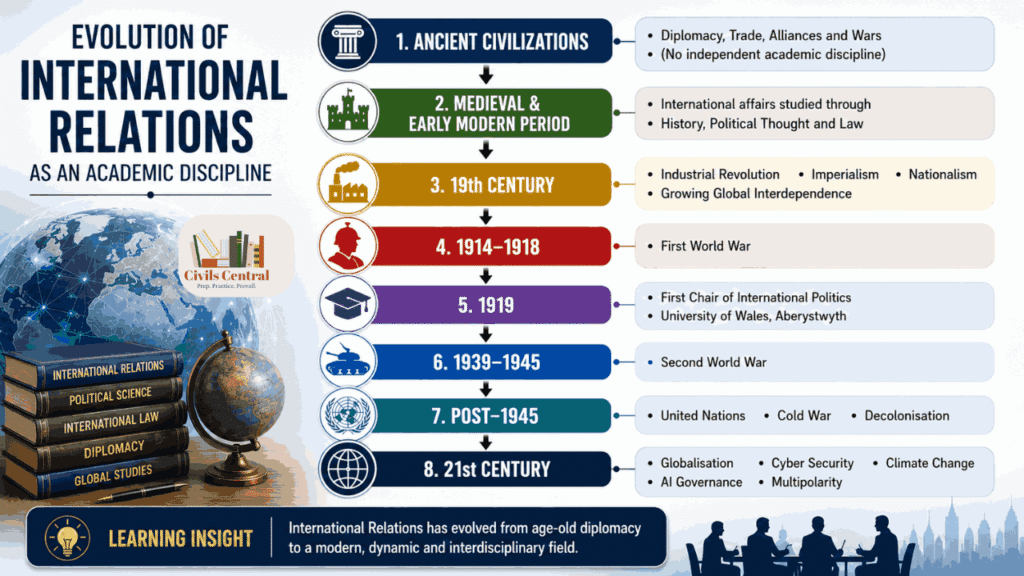
International Relations in the UPSC Civil Services Examination: Beyond Current Affairs
One of the most common misconceptions among Civil Services aspirants is that International Relations is synonymous with current affairs. This misunderstanding often leads students to prepare the subject by reading newspapers, monthly magazines, or compilations of international events while neglecting the conceptual foundations discussed throughout this chapter. Such an approach may create familiarity with recent developments, but it rarely produces the depth of understanding required by the Civil Services Examination.
The UPSC does not test whether a candidate has merely followed international news. Instead, it evaluates whether the candidate understands the concepts, institutions, historical developments, and strategic considerations that explain why those events occur. In other words, current affairs provide the context, while conceptual understanding provides the ability to analyse that context.
This distinction has become increasingly evident over the past decade. Questions are no longer confined to identifying international organisations or recalling the names of treaties. Instead, they frequently combine static concepts with contemporary developments, requiring candidates to interpret unfamiliar situations through established principles of International Relations. Consequently, students who rely exclusively upon current affairs often struggle when the Commission frames analytical or statement-based questions that require conceptual clarity rather than factual recall.
Another important feature of UPSC is its integrated approach. International Relations is formally included in General Studies Paper II of the Main Examination under India’s relations with neighbouring countries, bilateral relations, international organisations, and global groupings. However, limiting the subject to GS Paper II creates an incomplete understanding of its role within the examination.
In the Preliminary Examination, International Relations frequently appears in the form of questions on international organisations, multilateral institutions, treaties, conventions, regional groupings, international law, global initiatives, maritime issues, climate negotiations, and emerging geopolitical developments. These questions increasingly demand conceptual understanding because the Commission often frames statement-based questions requiring careful interpretation rather than simple factual recall.
The influence of International Relations extends beyond General Studies Paper II. Historical developments such as colonialism, decolonisation, the World Wars, and the Cold War frequently appear in General Studies Paper I, providing the historical foundation of the modern international order. Topics such as cyber security, energy security, supply chains, maritime security, critical technologies, artificial intelligence, food security, climate change, and disaster resilience connect International Relations with General Studies Paper III. Ethical issues concerning humanitarian intervention, refugee protection, global justice, international cooperation, and environmental responsibility occasionally intersect with General Studies Paper IV, while essays increasingly require candidates to analyse global themes such as peace, globalisation, technological change, sustainability, or India’s evolving international role.
The Personality Test also reflects the growing importance of International Relations. Candidates are expected to demonstrate balanced judgement, awareness of contemporary international developments, and the ability to analyse global issues from India’s perspective. Interview questions rarely reward extreme opinions or ideological positions. Instead, they assess whether candidates can appreciate multiple dimensions of international affairs while remaining consistent with India’s constitutional values and national interests.
This integrated approach explains why International Relations should never be prepared as an isolated subject. Every major international issue intersects with economics, geography, security, technology, environment, governance, and public policy. A dispute concerning semiconductor supply chains involves international trade, strategic competition, technological capability, industrial policy, and national security simultaneously. Climate negotiations combine environmental science, economics, diplomacy, international law, and development policy. Maritime disputes require knowledge of geography, international law, naval strategy, energy security, and foreign policy. The Civil Services Examination increasingly rewards candidates who recognise these interconnections rather than studying each subject in isolation.
For this reason, the CivilsCentral Knowledge Library has been designed around concepts rather than current affairs. Concepts remain relatively stable, while international events continuously change. A student who understands sovereignty, national interest, power, diplomacy, international law, and global governance can interpret new developments independently because the conceptual framework already exists. By contrast, a student who memorises only current events must repeatedly begin preparation from the beginning whenever international circumstances change.
The objective of this Knowledge Library is therefore not merely to help candidates answer today’s questions but to equip them with the intellectual framework necessary to analyse tomorrow’s questions as well. This approach reflects the broader philosophy of the Civil Services Examination itself, which seeks administrators capable of understanding complex policy environments rather than individuals possessing only temporary factual knowledge.
UPSC Trap Alert
One of the most common mistakes made by aspirants is to prepare International Relations only after reading newspapers or current affairs magazines.
The correct sequence is the reverse:
Concept → Static Foundation → Current Affairs → Revision
Current affairs become meaningful only when interpreted through concepts. Without that conceptual framework, even the most comprehensive newspaper reading often results in fragmented understanding and weak retention.
International Relations: A Discipline for Understanding the World
By this stage of the chapter, one important idea should have become clear. International Relations is not simply the study of what happens beyond a country’s borders. It is the systematic attempt to understand why the international system functions in the way it does.
Throughout this chapter, we have repeatedly encountered a common theme. International events are rarely isolated. Every diplomatic negotiation, every military alliance, every trade agreement, every international institution, every climate conference, every humanitarian crisis, and every technological competition represents only the visible expression of deeper political, economic, historical, geographical, legal, and strategic forces. Newspapers report these events as daily developments, but International Relations seeks to uncover the principles that connect them.
This distinction fundamentally changes the way one approaches global affairs. Instead of memorising international events individually, a student trained in International Relations begins to identify recurring patterns. Questions naturally arise. Which actors are involved? What national interests are being pursued? How is power being exercised? Which institutions are influencing the outcome? Which principles of international law are applicable? Why has this issue emerged now rather than earlier? How does it affect regional stability? What implications does it hold for India? These questions transform information into understanding.
The discipline therefore encourages analytical thinking rather than factual accumulation. A candidate preparing only through current affairs may know that a summit has taken place or that a new strategic partnership has been announced. A student grounded in International Relations, however, seeks to understand why that partnership emerged, how it reflects changing geopolitical realities, what strategic objectives it serves, and how it may influence the international balance of power. The difference lies not in the quantity of information but in the quality of analysis.
Another important lesson emerging from this chapter is that International Relations has become increasingly comprehensive. The discipline no longer revolves exclusively around diplomacy or interstate conflict. It now encompasses trade, technology, cyber security, artificial intelligence, energy transitions, climate change, maritime governance, global health, migration, international law, and numerous other issues that shape contemporary world politics. As the international system has become more interconnected, the discipline itself has expanded to explain this growing complexity.
For India, understanding International Relations has acquired unprecedented significance. As one of the world’s largest democracies, a rapidly growing economy, a major maritime nation, a nuclear power, and an increasingly influential participant in global governance, India cannot formulate domestic policy in isolation from international developments. Decisions relating to economic growth, technological advancement, energy security, environmental sustainability, defence preparedness, and strategic partnerships increasingly depend upon the international environment. Consequently, International Relations has become an essential area of knowledge not only for diplomats but also for administrators, policymakers, economists, security professionals, and every future civil servant.
This chapter has intentionally avoided beginning with definitions alone. Instead, it has attempted to build a conceptual framework within which every subsequent topic of the CivilsCentral Knowledge Library can be understood. The chapters that follow will examine individual concepts—such as the State, Sovereignty, National Interest, Power, Diplomacy, and Foreign Policy—in far greater depth. Yet each of those concepts derives its meaning from the broader understanding developed here. Without appreciating the nature of the international system, individual topics risk becoming isolated fragments of information. With this foundation, they become interconnected components of a coherent discipline.
Ultimately, International Relations teaches a way of thinking about the world. It encourages us to recognise that cooperation and conflict often coexist, that national interests shape international behaviour, that geography continues to influence strategy, that institutions matter even in the absence of a world government, and that the challenges of the twenty-first century increasingly require collective responses. More importantly, it reminds us that understanding global affairs requires both intellectual curiosity and analytical discipline.
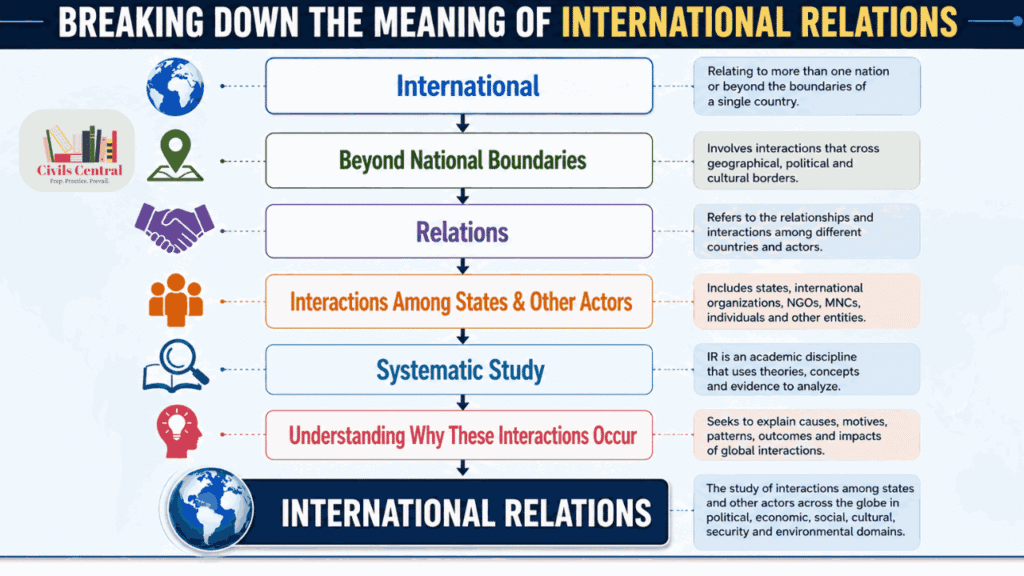
Common Misconceptions About International Relations
One of the greatest obstacles to mastering any academic discipline is not the absence of information but the presence of incorrect assumptions. Students often begin studying International Relations with ideas formed through newspaper reading, television debates, social media discussions, or popular political commentary. While these sources create awareness of international events, they frequently oversimplify complex issues and encourage misconceptions that hinder deeper understanding.
Before moving to the subsequent chapters of the CivilsCentral Knowledge Library, it is important to identify and correct some of the most common misunderstandings associated with International Relations.
Misconception 1: International Relations Is the Same as Foreign Policy
This is perhaps the most widespread misunderstanding among beginners. Since newspapers frequently discuss India’s foreign policy alongside international developments, many students conclude that the two terms mean the same thing.
In reality, Foreign Policy is only one component of International Relations.
International Relations is an academic discipline that studies the behaviour of all states and other international actors within the international system. Foreign Policy, on the other hand, refers to the external policy adopted by a single country to protect and promote its national interests.
When we study India’s Act East Policy, Neighbourhood First Policy, or Indo-Pacific strategy, we are studying India’s Foreign Policy. When we analyse how India’s policies interact with the strategies of other countries, influence regional stability, or reshape the international order, we are studying International Relations.
Misconception 2: International Relations Is Only About Wars
Popular media often associates International Relations with military conflicts, border disputes, and geopolitical rivalries. Although war remains an important area of study, it represents only one aspect of the discipline.
Modern International Relations is equally concerned with trade, finance, climate change, public health, energy security, cyber security, artificial intelligence, migration, maritime governance, international law, scientific cooperation, humanitarian assistance, and sustainable development.
In fact, much of contemporary international politics revolves around cooperation rather than armed conflict. Countries negotiate agreements, coordinate policies, establish institutions, and jointly address global challenges far more frequently than they engage in war.
Misconception 3: International Relations Is Only for Diplomats
Many students assume that International Relations is relevant only for diplomats, ambassadors, or officers serving in the Ministry of External Affairs. The reality is much broader.
Economic reforms depend upon international trade and investment.
Energy security depends upon global markets.
Climate policy depends upon international negotiations.
Technology policy increasingly involves digital governance and international standards.
Public health requires international cooperation during pandemics.
Cyber security demands collaboration across national boundaries.
Consequently, administrators working in almost every branch of government increasingly require an understanding of International Relations. This explains why the subject has become an important component of the Civil Services Examination.
Misconception 4: Current Affairs Alone Are Sufficient
Some aspirants attempt to prepare International Relations exclusively through newspapers and monthly current affairs compilations. This approach creates familiarity with recent events but rarely develops conceptual understanding.
Current affairs constantly change. Concepts remain comparatively stable.
A student who understands sovereignty, national interest, power, diplomacy, international law, and global governance can analyse new developments independently because the conceptual framework already exists.
Without that foundation, preparation becomes an endless exercise in memorising events.
Misconception 5: International Relations Is Only About Politics
Political interactions certainly form the traditional core of International Relations, but the discipline has expanded far beyond political diplomacy.
Today it encompasses economics, technology, climate science, law, geography, strategic studies, environmental governance, international organisations, digital infrastructure, artificial intelligence, and numerous other fields.
This interdisciplinary character is one of the defining features of modern International Relations and one of the reasons it occupies an increasingly important place within the Civil Services Examination.
Misconception 6: There Are Permanent Friends and Permanent Enemies
Public discourse often portrays international politics in absolute terms, suggesting that countries remain either permanent allies or permanent adversaries. History demonstrates otherwise.
Relationships among states evolve continuously in response to changing national interests, strategic circumstances, economic opportunities, technological developments, and regional security environments.
Countries may cooperate in one sector while competing in another. Strategic partners may disagree on trade, and geopolitical rivals may still collaborate on climate change or public health.
International Relations therefore teaches that national interest, rather than permanent friendship or hostility, generally guides the behaviour of states.
Misconception 7: International Organisations Control the World
International organisations such as the United Nations, World Trade Organization, or International Monetary Fund exercise considerable influence, but they do not function as world governments. Most international organisations derive their authority from agreements voluntarily accepted by sovereign states.
Their effectiveness depends largely upon the willingness of member states to cooperate, implement decisions, and fulfil international commitments. Understanding this distinction is essential because it explains both the strengths and the limitations of global governance.
Myth vs Reality
| Myth | Reality |
|---|---|
| International Relations is Foreign Policy. | Foreign Policy is only one component of International Relations. |
| International Relations studies only wars. | It studies cooperation, trade, law, technology, environment, governance, and security. |
| International Relations is only for diplomats. | It is relevant for every policymaker, administrator, and civil servant. |
| Current Affairs are enough. | Current affairs require conceptual foundations to be understood properly. |
| Countries have permanent friends and enemies. | States primarily pursue their national interests. |
| International organisations govern the world. | They function through the consent and cooperation of sovereign states. |
How UPSC Thinks: Learning from Previous Year Questions
One of the defining characteristics of the Civil Services Examination is that it rarely rewards mechanical memorisation. While factual knowledge remains important, the Commission consistently designs questions that assess whether a candidate has developed conceptual understanding. This is particularly evident in International Relations, where the focus has gradually shifted from recalling isolated facts towards analysing institutions, interpreting international developments, understanding strategic relationships, and applying established concepts to unfamiliar situations.
For this reason, Previous Year Questions (PYQs) should never be treated merely as practice exercises to be solved after completing preparation. They should instead be viewed as a window into the thinking process of the examiner. Every question reveals not only what UPSC asked, but more importantly why it asked it and which concept it expected the candidate to understand.
The objective of this section is therefore different from conventional coaching material. Rather than simply presenting questions with answers, we will analyse the conceptual foundation behind each question. This approach enables students to identify recurring examination patterns and prepares them to tackle future questions even when the specific issue or current affair is entirely new.
Pattern 1: UPSC Prefers Concepts Over Isolated Facts
Many beginners assume that International Relations is primarily a factual subject requiring the memorisation of organisations, treaties, headquarters, member countries, or summit meetings. Although factual knowledge certainly has value, an examination of previous years clearly demonstrates that UPSC increasingly favours conceptual understanding.
For example, instead of asking candidates merely to identify an international organisation, the Commission often frames statement-based questions requiring an understanding of the organisation’s mandate, powers, legal status, relationship with member states, or role within the international system. Similarly, rather than testing whether candidates know the name of an agreement, UPSC frequently examines the underlying principle or objective of that agreement.
The lesson is clear. Facts should be learned within a conceptual framework rather than in isolation.
Pattern 2: Static Knowledge and Current Affairs Are Always Connected
Another striking feature of UPSC is its ability to combine static concepts with contemporary international developments. A recent summit may become the basis for testing the functions of an international organisation. A geopolitical conflict may be used to examine concepts such as sovereignty, territorial integrity, or the balance of power.
A climate negotiation may test understanding of international environmental governance rather than the event itself. This explains why the CivilsCentral Knowledge Library begins with static foundations before moving towards current affairs. Once concepts become clear, new developments can be understood naturally without memorising every individual event separately.
Pattern 3: Statement-Based Questions Require Conceptual Clarity
In recent years, statement-based questions have become one of the most important features of the Preliminary Examination.
Rather than asking direct factual questions, UPSC presents multiple statements containing subtle conceptual distinctions. Candidates must evaluate the accuracy of each statement before selecting the correct answer.
Such questions cannot be solved reliably through guesswork or superficial newspaper reading. They demand a clear understanding of concepts such as sovereignty, international organisations, treaties, foreign policy, diplomacy, jurisdiction, or international law.
This is one of the principal reasons why conceptual preparation consistently outperforms purely factual preparation.
Pattern 4: India’s Perspective Is Always Important
Regardless of the international issue being discussed, UPSC frequently expects candidates to analyse developments from India’s perspective.
A question concerning the Indo-Pacific is not merely about geography.
A question on climate negotiations is not merely about environmental agreements.
A question concerning international trade is not merely about economics.
The examination expects candidates to understand how these developments influence India’s security, economic interests, technological advancement, energy requirements, strategic autonomy, and role within global governance. For this reason, every chapter of the CivilsCentral Knowledge Library integrates an India Connect instead of treating India’s perspective as an isolated topic.
Pattern 5: UPSC Rewards Analytical Thinking
Perhaps the most important lesson emerging from previous year questions is that UPSC increasingly rewards candidates capable of connecting concepts across disciplines.
An apparently simple question concerning maritime security may require knowledge of geography, international law, strategic studies, trade, and India’s foreign policy simultaneously.
Similarly, questions relating to technology governance may combine international organisations, cybersecurity, artificial intelligence, economic competition, and global governance.
This integrated approach reflects the actual nature of International Relations itself and reinforces the importance of building conceptual understanding before attempting current affairs.
What This Means for Your Preparation
As you progress through the CivilsCentral Knowledge Library, resist the temptation to memorise every international development separately. Instead, cultivate the habit of identifying the underlying concept.
Whenever you encounter an international issue, ask yourself:
- Which chapter of International Relations explains this event?
- Which concept is being illustrated?
- Which actor is involved?
- Which national interest is being pursued?
- Which international institution or legal principle is relevant?
- How does this development affect India?
- If UPSC asks a question tomorrow, what concept is it likely to test?
If you consistently approach international developments through these questions, you will gradually begin thinking like the examiner rather than merely preparing for the examination.
CivilsCentral Examination Principle
Do not prepare to remember yesterday’s news. Prepare to understand the concepts that will explain tomorrow’s news.
This principle forms the foundation of the CivilsCentral Knowledge Library. Current affairs will continue to change every day, but the conceptual framework developed through these chapters will remain relevant throughout your preparation and, more importantly, throughout your career as a civil servant.
Chapter Synthesis: The Big Picture of International Relations
Throughout this chapter, we have travelled from a simple question—“What is International Relations?”—to a comprehensive understanding of one of the most important disciplines in the contemporary world. Rather than beginning with definitions alone, we started by examining why the discipline emerged, how it evolved, what it studies, and why it has become indispensable in an increasingly interconnected international system.
The first and perhaps most important lesson is that International Relations is not merely the study of events taking place outside national borders. It is the systematic study of interactions among states and other international actors within a complex global system. These interactions are shaped by political interests, economic priorities, historical experiences, geographical realities, technological developments, legal principles, environmental concerns, and strategic calculations. Consequently, International Relations seeks not simply to describe international events but to explain the forces that produce them.
We also observed that the discipline itself is relatively young when compared with the long history of diplomacy and interstate relations. Although kingdoms, empires, and civilizations interacted for thousands of years, International Relations emerged as an independent academic discipline only after the First World War, when scholars recognised the need for a systematic understanding of war, peace, cooperation, and the international order. Since then, the discipline has expanded dramatically, evolving from the study of diplomacy and military conflict into a comprehensive examination of global governance, economic interdependence, technological competition, environmental sustainability, international law, and humanitarian cooperation.
Another central idea developed throughout this chapter is that the international system differs fundamentally from domestic political systems. Within a country, governments exercise authority through constitutions, laws, courts, and administrative institutions. At the international level, however, sovereign states coexist without a central world government. Cooperation therefore depends upon diplomacy, treaties, international organisations, customary practices, and the willingness of states to pursue common objectives while protecting their national interests. Understanding this unique structure is essential because it explains why international politics often appears more complex and less predictable than domestic governance.
Equally important is the recognition that states are no longer the only participants in international affairs. While sovereign states remain the principal actors, the modern international system also includes international organisations, multinational corporations, financial institutions, non-governmental organisations, technology companies, humanitarian agencies, and numerous other non-state actors. Their growing influence reflects the changing character of global politics, where economic integration, technological innovation, digital connectivity, and transnational challenges increasingly shape international outcomes.
The chapter further demonstrated that International Relations cannot be reduced to diplomacy or foreign policy alone. Diplomacy represents the method through which states communicate and negotiate. Foreign Policy expresses the external objectives of an individual country. International Politics examines the political struggle for power among states. International Relations, however, provides the broader academic framework within which all these concepts are studied and connected. Appreciating this distinction is essential because it prevents one of the most common conceptual errors encountered among beginners.
We also explored how the scope of International Relations has expanded far beyond traditional military and diplomatic concerns. Contemporary international politics encompasses global trade, financial systems, cyber security, artificial intelligence, climate change, maritime governance, public health, migration, sustainable development, international law, and numerous other issues that transcend national borders. This expansion reflects a simple but profound reality: the challenges confronting the modern world increasingly require cooperation among nations rather than isolated national action.
From the perspective of the Civil Services Examination, perhaps the most valuable lesson emerging from this chapter is that conceptual understanding is more important than factual accumulation. Current affairs change continuously, but the concepts that explain them remain relatively stable. A student who understands sovereignty, national interest, power, diplomacy, international law, and global governance will find it easier to analyse new international developments than a student who has merely memorised recent events. This is precisely why the CivilsCentral Knowledge Library emphasises conceptual learning before current affairs integration.
Ultimately, this chapter establishes the intellectual foundation upon which the entire International Relations Knowledge Library will be built. Every subsequent chapter—whether discussing the State, Sovereignty, National Interest, Diplomacy, Foreign Policy, International Organisations, India’s External Relations, or Global Governance—will repeatedly return to the principles introduced here. The purpose of this foundation is not merely to prepare you for the Civil Services Examination but to develop a disciplined and analytical understanding of the international system itself.
If there is one idea that should remain with you after completing this chapter, it is this:
International Relations is not the study of international events; it is the study of the ideas, interests, institutions, and interactions that explain why those events occur.
Once this perspective is adopted, newspapers cease to be collections of disconnected headlines. They become real-world illustrations of concepts that you already understand. That transformation—from reading the news to analysing the world—is the true beginning of mastering International Relations.
International Relations at a Glance
                     INTERNATIONAL RELATIONS
                                │
     ┌──────────────────────────┼──────────────────────────┐
     │                          │                          │
  Foundations              Core Concepts             Modern Scope
     │                          │                          │
 Why it emerged           State • Sovereignty      Economy
 Historical evolution     National Interest        Security
 Nature of IR             Power                    Technology
 Actors                   Diplomacy                Environment
                           Foreign Policy          Global Governance
                                │
                                ▼
                     Understanding the International System
                                │
                                ▼
                    Analysing Contemporary World Affairs
                                │
                                ▼
                  UPSC • Governance • Public Policy • India
What You Should Remember from This Chapter
Every chapter in the CivilsCentral Knowledge Library is designed to answer a set of fundamental questions rather than merely present information. Before proceeding to the next chapter, it is useful to pause and revisit the central ideas that have emerged from this discussion. These ideas form the intellectual foundation upon which every subsequent chapter of International Relations will build.
The first idea is that International Relations is an academic discipline, not merely a collection of international events. Newspapers and news channels inform us about developments taking place across the world, but International Relations explains why those developments occur, how they are connected, and what larger principles govern them. The discipline therefore transforms information into understanding.
The second idea is that International Relations studies interactions within the international system. Although sovereign states remain the principal actors, they are no longer the only participants in global affairs. International organisations, multinational corporations, financial institutions, civil society organisations, technology companies, and other non-state actors increasingly influence the behaviour of the international system. Modern International Relations therefore studies the relationships among all these actors rather than limiting itself to governments alone.
The third idea is that the international system is fundamentally different from domestic political systems. Within a country, governments exercise authority through constitutions, legislatures, executives, courts, and administrative institutions. In contrast, the international system functions without a world government. Cooperation is achieved through diplomacy, international law, negotiations, treaties, institutions, and the voluntary participation of sovereign states. Understanding this distinction is essential because it explains many of the unique characteristics of international politics.
The fourth idea is that national interest remains one of the most important driving forces behind the behaviour of states. Countries cooperate, compete, negotiate, establish alliances, conclude trade agreements, or occasionally engage in conflict primarily because they seek to protect and promote their national interests. Appreciating this principle enables students to analyse international developments more objectively and avoid interpreting global politics solely through the language of friendship, ideology, or emotion.
The fifth idea is that International Relations is inherently interdisciplinary. Political decisions are influenced by economic conditions, geographical realities, technological developments, environmental challenges, legal obligations, historical experiences, and strategic considerations. Consequently, no international issue can be fully understood from a single disciplinary perspective. This interdisciplinary character also explains why International Relations connects naturally with History, Geography, Economy, Environment, Science and Technology, Security Studies, and Governance within the Civil Services Examination.
The sixth idea is that the scope of International Relations has expanded dramatically in the twenty-first century. The discipline is no longer confined to diplomacy and military affairs. It now encompasses trade, finance, artificial intelligence, cybersecurity, climate change, maritime governance, international law, migration, public health, sustainable development, and numerous other issues that increasingly shape global politics. This expansion reflects the growing interconnectedness of the modern world.
The seventh idea is perhaps the most important from the perspective of the Civil Services Examination. Current affairs should always be understood through concepts rather than memorised as isolated events. A summit, treaty, conflict, or international initiative becomes meaningful only when interpreted through concepts such as sovereignty, national interest, power, diplomacy, foreign policy, international law, or global governance. Once these concepts become clear, even unfamiliar international developments become easier to analyse.
Finally, this chapter establishes the intellectual mindset required for studying International Relations. The objective is not to memorise every international event but to cultivate the habit of asking deeper questions. Instead of asking only what happened, a student of International Relations asks why it happened, which actors are involved, what interests are being pursued, what larger concept explains the event, and what implications it holds for India and the international system. This analytical approach is the defining characteristic of the discipline and will remain central to every chapter that follows.
Quick Revision
Remember These Seven Foundations
1. International Relations explains the international system.

2. States are the primary actors, but not the only actors.

3. The international system has no world government.

4. National Interest drives state behaviour.

5. International Relations is interdisciplinary.

6. The scope of International Relations now includes
   politics, economics, technology, environment,
   security, law, and global governance.

7. UPSC tests conceptual understanding,
   not isolated current affairs.
Conclusion
International Relations is often introduced as the study of relations among nations, but as this chapter has demonstrated, it is far more than that. It is a systematic and interdisciplinary discipline that seeks to explain how states and other international actors interact within an increasingly interconnected global system. Every treaty, diplomatic negotiation, military alliance, trade agreement, international institution, and global initiative represents a manifestation of deeper forces such as national interests, power, geography, history, economics, technology, and international law.
The importance of International Relations has grown enormously in the twenty-first century. Issues such as climate change, cyber security, artificial intelligence, energy security, global health, maritime governance, migration, and economic interdependence have blurred the distinction between domestic and international affairs. Consequently, understanding International Relations is no longer relevant only for diplomats or foreign policy specialists. It has become an essential field of knowledge for administrators, policymakers, economists, security professionals, and every Civil Services aspirant seeking to understand how the modern world functions.
For UPSC and JKAS aspirants, the greatest lesson from this chapter is that International Relations should never be prepared as a collection of current affairs. Newspapers provide information, but concepts provide understanding. Once the conceptual foundations of the discipline become clear, contemporary international developments become easier to analyse, connect, and remember. This concept-first approach is the guiding philosophy of the CivilsCentral Knowledge Library.
As you proceed to the next chapter, remember that this chapter has answered only the first question: What is International Relations? The next chapter will answer an even more fundamental question: Why do countries interact? Understanding that question will reveal the forces that drive diplomacy, cooperation, competition, conflict, and the international order itself.
Frequently Asked Questions (FAQs)
1. What is International Relations in simple words?
International Relations (IR) is the academic discipline that studies how countries and other international actors interact with one another. It seeks to explain why states cooperate, compete, negotiate, trade, establish alliances, create international organisations, and sometimes engage in conflict.
2. Is International Relations the same as Foreign Policy?
No. Foreign Policy is only one component of International Relations.
International Relations is the broader discipline that studies the international system as a whole, while Foreign Policy refers to the external policy adopted by an individual country to protect and promote its national interests.
3. What is the difference between International Relations and International Politics?
International Relations is a comprehensive discipline that studies political, economic, legal, environmental, technological, and social interactions among international actors.
International Politics is a sub-field of International Relations that primarily focuses on political power, strategic competition, diplomacy, alliances, and conflict among states.
4. Why is International Relations important for UPSC and JKAS?
International Relations forms an important part of the General Studies syllabus, particularly GS Paper II. However, its relevance extends far beyond one paper because it connects with history, geography, economy, environment, science and technology, internal security, essay writing, and the Personality Test. A strong conceptual understanding of International Relations helps aspirants analyse contemporary world affairs from India’s perspective.
5. Do I need to study current affairs before learning International Relations?
No. The recommended approach is the opposite.
Begin with the static concepts of International Relations, such as the State, Sovereignty, National Interest, Power, Diplomacy, and Foreign Policy. Once these concepts are understood, current affairs become much easier to analyse and remember.
6. Who are the main actors in International Relations?
Sovereign states remain the primary actors in the international system. However, modern International Relations also studies international organisations, multinational corporations, non-governmental organisations, financial institutions, technology companies, terrorist organisations, and other non-state actors that increasingly influence global affairs.
7. Why is International Relations considered an interdisciplinary subject?
International Relations draws knowledge from Political Science, History, Economics, Geography, International Law, Strategic Studies, Environmental Science, Sociology, and Technology Studies. Most international issues involve multiple dimensions and therefore cannot be understood through a single discipline.
8. How should beginners start preparing International Relations for UPSC?
A structured approach is recommended:
- Build conceptual clarity by studying the static foundations of International Relations.
- Understand India’s foreign policy and major international organisations.
- Follow current affairs through a concept-based approach rather than memorising events.
- Regularly revise using conceptual maps, timelines, and previous year questions.
9. Is International Relations useful only for the Civil Services Examination?
No. International Relations is valuable for anyone interested in public policy, diplomacy, global governance, economics, security studies, journalism, international business, law, or contemporary world affairs. It helps explain how global events influence national policies and everyday life.
10. What should I study after completing this chapter?
The next step is Why Do Countries Interact?
This chapter will explain the fundamental reasons behind international cooperation, competition, diplomacy, trade, alliances, and conflict, providing the conceptual bridge to later chapters on National Interest, Power, Diplomacy, and Foreign Policy.
About The Author