
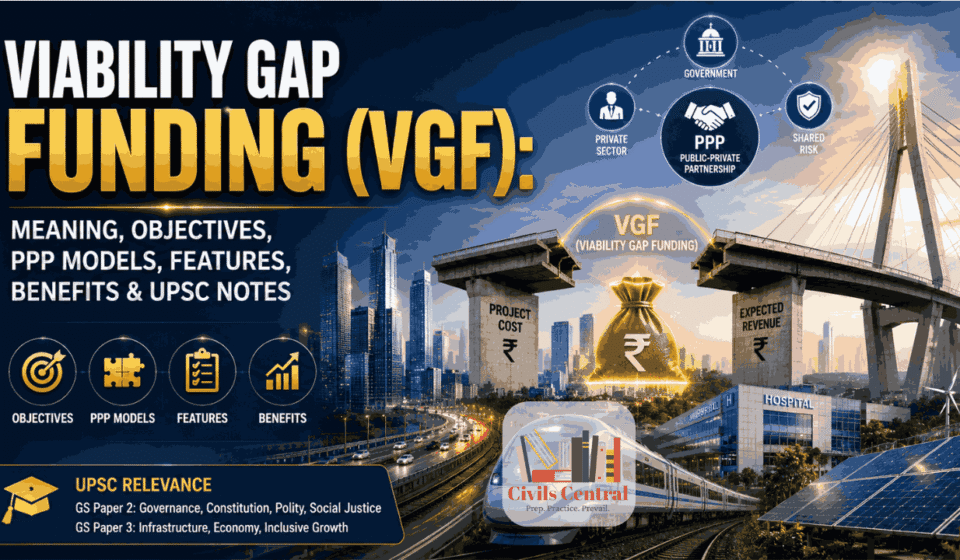
Viability Gap Funding (VGF): Meaning, Objectives, PPP Models, Features, Benefits & UPSC Notes

Premium CivilsCentral Learning Resource | GS-III (Infrastructure, Public Finance, PPP) | Economy | Governance
Introduction
Infrastructure has long been regarded as the backbone of economic development. Roads, railways, ports, airports, metro systems, irrigation networks, renewable energy parks, logistics hubs, hospitals, schools, water supply systems, and digital communication infrastructure collectively determine the productive capacity of an economy. No country has achieved sustained high economic growth without making substantial investments in infrastructure. For a rapidly developing nation like India, infrastructure is not merely a facilitator of growth but also an instrument for reducing regional disparities, improving ease of doing business, generating employment, enhancing competitiveness, and improving the quality of life.
However, infrastructure projects are fundamentally different from ordinary commercial ventures. They require massive upfront capital investment, have long gestation periods, involve significant regulatory and political risks, and often generate returns only after many years. Many socially desirable projects, especially in sectors such as rural connectivity, urban sanitation, affordable housing, healthcare, renewable energy, and water supply, do not generate sufficient commercial revenue to attract private investors despite yielding enormous economic and social benefits.
This creates a classic policy dilemma. The government alone cannot finance the country’s vast infrastructure requirements because fiscal resources are limited, while the private sector is reluctant to invest in projects that are economically beneficial but commercially unviable. Bridging this gap between social desirability and commercial feasibility is one of the central challenges of public policy.
It is in this context that Viability Gap Funding (VGF) assumes critical importance. VGF is an innovative policy instrument through which the government provides a one-time or deferred financial grant to infrastructure projects implemented under the Public-Private Partnership (PPP) model. By reducing the initial financial burden on private developers, VGF transforms projects that would otherwise remain financially unattractive into commercially viable investments.
Rather than replacing private investment, VGF complements it. It enables governments to leverage private sector efficiency, technology, innovation, and project management capabilities while ensuring that essential infrastructure is created in sectors where market forces alone may fail. Consequently, VGF has emerged as one of India’s most important tools for infrastructure financing and has played a significant role in sectors such as highways, airports, ports, metro rail systems, renewable energy, and urban infrastructure.
Why in News?
Viability Gap Funding frequently appears in policy discussions because the Government of India has increasingly relied on it to accelerate infrastructure development while maintaining fiscal prudence. In recent years, VGF has been extended beyond traditional transport infrastructure to support sectors such as:
- Battery Energy Storage Systems (BESS)
- Offshore wind energy
- Green hydrogen ecosystem
- Urban infrastructure
- Ropeways
- Social infrastructure
- Renewable energy integration
- Emerging climate-resilient infrastructure
The growing emphasis on National Infrastructure Pipeline (NIP), PM Gati Shakti, National Monetisation Pipeline (NMP), renewable energy expansion, and the objective of achieving a $5 trillion economy has further increased the relevance of VGF as a financing mechanism.
Understanding Infrastructure Financing
Before studying Viability Gap Funding, it is important to understand why infrastructure financing itself is uniquely challenging. Unlike ordinary businesses that begin generating profits shortly after investment, infrastructure projects exhibit several distinctive characteristics:
- They require enormous capital investment.
- Construction periods are often very long.
- Revenue generation begins only after project completion.
- Payback periods may extend over 20–40 years.
- Demand uncertainty remains high.
- Regulatory interventions can affect profitability.
- Political and environmental clearances introduce additional risks.
For example, constructing an expressway may require thousands of crores of rupees. Toll collections may recover these investments only over several decades. If projected traffic remains below expectations, the project may become financially unsustainable despite being socially indispensable.
This divergence between social usefulness and commercial profitability forms the theoretical foundation of Viability Gap Funding.
Infrastructure Projects: Economic Benefits vs Financial Returns
A crucial distinction in economics is between economic viability and financial viability. A project may generate enormous benefits for society even if the revenues earned by the project developer remain modest.
Consider a rural bridge connecting isolated villages. Financially, the bridge may collect little or no toll revenue.
Economically, however, it may:
- Reduce transportation costs
- Improve school attendance
- Enhance access to healthcare
- Increase agricultural incomes
- Generate employment
- Reduce regional inequality
- Improve disaster response
Thus, the project’s economic rate of return may be very high even though its financial rate of return is inadequate. Governments therefore intervene to bridge this mismatch.
Concept Box
| Economic Viability | Financial Viability |
|---|---|
| Measures benefits to society | Measures profitability to investor |
| Includes externalities | Based on cash flows |
| National perspective | Private investor perspective |
| Long-term welfare | Commercial return |
| Basis of public policy | Basis of investment decisions |
Market Failure and the Need for Government Intervention
The intellectual basis of Viability Gap Funding lies in the concept of market failure. Markets efficiently allocate resources when prices fully reflect costs and benefits. However, infrastructure often produces benefits that cannot be fully captured by the private investor.
For instance, a metro rail project reduces:
- Traffic congestion
- Fuel consumption
- Air pollution
- Road accidents
- Travel time
These benefits accrue to society rather than solely to the metro operator. Economists refer to these as positive externalities. Since investors cannot monetize all these benefits, they tend to underinvest in such projects. Government intervention through VGF corrects this market failure.
Public Goods and Infrastructure
Many infrastructure facilities exhibit characteristics of public goods or quasi-public goods. Examples include:
- Flood protection systems
- Urban drainage
- Public parks
- Rural roads
- Drinking water systems
Such projects improve welfare but rarely generate sufficient user charges. Without government support, private participation remains unlikely.
What is Viability Gap Funding (VGF)?
Viability Gap Funding is a financial support mechanism through which the government provides capital assistance to infrastructure projects undertaken through the Public-Private Partnership (PPP) model when such projects are economically justified but financially unviable. The objective is not to subsidize private profits but to enable infrastructure creation that would otherwise not attract investment.
The grant bridges the difference between: Project Cost and Commercially Viable Investment Level. Hence the term “Viability Gap.”
Simple Illustration
Imagine a metro rail project costing ₹10,000 crore. Private investors estimate that expected revenues justify investing only ₹8,000 crore. The remaining ₹2,000 crore represents the viability gap.
If the government provides this amount as VGF, the project becomes commercially feasible.
Project Cost
₹10,000 Crore
       │
       │
Private Investment Capacity
₹8,000 Crore
       │
       ▼
Viability Gap
₹2,000 Crore
       │
Government Grant (VGF)
       │
Project becomes financially viable
Viability Gap Funding is a grant provided by the Government of India (and, where applicable, State Governments) to infrastructure projects developed through PPPs that are economically justified but fail to attract sufficient private investment because expected revenues are inadequate.
It is typically provided as a capital grant during project construction, though certain sectors may permit deferred support depending on policy design.
Core Philosophy Behind VGF
VGF is founded on a simple but powerful principle: Public money should be used not to replace private investment but to catalyse it. Instead of financing entire infrastructure projects through the public budget, the government contributes only the minimum amount necessary to make the project financially attractive.
This achieves multiple objectives simultaneously:
- Leverages private capital
- Reduces fiscal burden
- Improves efficiency
- Encourages innovation
- Accelerates project completion
- Enhances accountability through contractual obligations
Thus, every rupee of VGF aims to mobilise several additional rupees of private investment.
Historical Evolution of Viability Gap Funding in India
The concept of government support for commercially weak but socially beneficial projects existed even before liberalisation. However, India’s infrastructure expansion accelerated only after the economic reforms of 1991, which recognised that public resources alone were insufficient to meet the country’s infrastructure needs.
During the 1990s, India increasingly adopted the Public-Private Partnership (PPP) model, particularly in sectors such as roads, ports, airports, and power. While PPPs improved efficiency and attracted private expertise, it soon became evident that many economically desirable projects remained unattractive to investors because projected revenues could not cover costs.
To address this challenge, the Government of India introduced the Scheme for Financial Support to Public-Private Partnerships in Infrastructure, commonly known as the Viability Gap Funding (VGF) Scheme, in 2005 under the Ministry of Finance. The scheme institutionalised a transparent mechanism for providing capital grants to PPP projects that were economically justified but commercially unviable.
Initially, the scheme focused on core infrastructure sectors such as national highways, ports, airports, railways, and urban transport. Over time, recognising the changing developmental needs of the country, its scope expanded to include social infrastructure, renewable energy, water supply, sanitation, affordable housing, and emerging sectors like battery energy storage systems and green infrastructure.
The evolution of VGF reflects India’s transition from a state-led infrastructure model to a partnership-based approach, where public funds are strategically used to leverage private investment rather than replace it.
Evolution at a Glance
| Period | Major Development |
|---|---|
| Pre-1991 | Infrastructure financed predominantly through public expenditure |
| 1991 onwards | Economic reforms encourage private participation |
| Late 1990s | Expansion of Public-Private Partnership (PPP) projects |
| 2005 | Launch of the Viability Gap Funding Scheme by the Ministry of Finance |
| 2010s | Wider adoption in highways, airports, metro rail, ports, and urban infrastructure |
| 2020 onwards | Extension to social infrastructure, renewable energy, and strategic sectors such as battery storage |
Concept Flow
Infrastructure Need
        │
Government Budget Constraints
        │
Need for Private Investment
        │
Public-Private Partnership (PPP)
        │
Many Projects Not Financially Viable
        │
Government Introduces VGF
        │
Private Investment Becomes Feasible
        │
Infrastructure Creation
        │
Economic Growth + Social Welfare
Objectives of Viability Gap Funding
Viability Gap Funding was conceived not merely as a subsidy mechanism but as a strategic public policy instrument to address one of the most persistent problems in infrastructure development: the divergence between economic desirability and commercial feasibility. The objective is to ensure that projects which generate significant public welfare are not abandoned simply because they do not promise sufficiently high financial returns to private investors.
The foremost objective of VGF is to mobilise private capital for infrastructure development. India’s infrastructure requirements are enormous, running into several lakh crore rupees annually. Financing these entirely through budgetary allocations would exert immense pressure on public finances, increase fiscal deficits, and crowd out expenditure on health, education, social protection, and defence. VGF enables the government to use limited public resources strategically, leveraging substantially larger private investments.
Another important objective is to improve the bankability of infrastructure projects. Financial institutions evaluate projects based on projected cash flows and debt-servicing capacity. Projects with inadequate projected revenues often fail to secure financing despite their economic significance. By reducing the initial capital burden, VGF enhances the project’s financial viability, thereby increasing lender confidence and facilitating access to credit.
VGF also seeks to promote balanced regional development. Infrastructure projects in economically backward or geographically challenging regions often suffer from lower demand and consequently lower financial returns. Without government intervention, private investors naturally gravitate towards economically prosperous regions where revenues are more predictable. VGF enables investment in less-developed regions, thereby supporting inclusive growth and reducing regional disparities.
A further objective is to encourage efficient public service delivery through private sector participation. While the government retains policy oversight and regulatory responsibility, the private sector contributes managerial efficiency, technological innovation, operational expertise, and timely project execution. Thus, VGF supports a partnership model rather than complete public or private ownership.
Increasingly, VGF is also being used to facilitate green and sustainable infrastructure. Emerging sectors such as renewable energy integration, battery energy storage systems, green hydrogen, and climate-resilient infrastructure often involve high initial costs and uncertain commercial returns. Targeted VGF can accelerate investment in these sectors, aligning infrastructure development with India’s climate commitments and sustainable development goals.
Ultimately, VGF represents a policy choice to maximise economic welfare rather than merely financial profitability. It recognises that infrastructure generates broad social benefits—such as reduced travel time, cleaner air, better health outcomes, and increased productivity—that private markets alone may undervalue.
Key Features of the VGF Scheme
The design of the VGF Scheme reflects the principle that public financial support should be targeted, transparent, and limited to what is necessary. It is not intended to guarantee profits for private firms but to bridge only the minimum financial gap required for project viability.
The scheme primarily supports Public-Private Partnership (PPP) projects in infrastructure sectors. Assistance is generally provided as a capital grant, reducing the amount of investment that private developers must recover through user charges or project revenues.
Another defining feature is that VGF is competitive and project-specific. Projects are selected based on established criteria, and support is determined through transparent appraisal mechanisms rather than discretionary allocation. This minimises the risk of arbitrary subsidies and promotes efficient use of public resources.
The scheme also emphasises risk sharing. While the government provides financial support, the private concessionaire continues to bear significant responsibilities relating to construction, operation, maintenance, and performance. Thus, VGF does not eliminate private-sector risk; rather, it reallocates risks in a manner that makes investment feasible while preserving incentives for efficiency.
Furthermore, VGF is linked to clearly defined contractual obligations under concession agreements. Disbursement is generally tied to project milestones, ensuring accountability and reducing the likelihood of misuse of public funds.
Characteristics of an Ideal VGF Project
| Characteristic | Why It Matters |
|---|---|
| High economic benefits | Justifies public financial support |
| Low commercial returns | Explains why private investment is insufficient |
| Public-Private Partnership structure | Ensures shared responsibilities and risk allocation |
| Transparent bidding | Promotes competition and value for money |
| Long-term public utility | Maximises social returns on public investment |
| Financial sustainability after support | Ensures that the project remains operational without recurring subsidies |
Institutional Architecture of Viability Gap Funding
The implementation of VGF involves multiple institutions, each performing distinct functions to ensure technical appraisal, financial discipline, and policy oversight. At the apex is the Department of Economic Affairs (DEA), Ministry of Finance, which administers the VGF Scheme, frames policy guidelines, and evaluates proposals for financial support. The DEA acts as the nodal authority for approving central assistance under the scheme.
The Sponsoring Authority—which may be a Central Ministry, State Government, statutory authority, or public sector undertaking—identifies infrastructure needs, prepares project proposals, and initiates the PPP process. It is responsible for demonstrating that the project is economically justified but commercially unviable without VGF.
The Private Concessionaire, selected through a transparent competitive bidding process, undertakes the construction, operation, and maintenance of the infrastructure asset in accordance with the concession agreement. The concessionaire invests capital, assumes specified project risks, and delivers services over the agreed concession period.
Financial institutions and lenders also play a crucial role by assessing project viability, extending long-term debt, and monitoring financial performance. Their participation imposes additional financial discipline on project implementation.
Regulatory authorities oversee sector-specific compliance, tariff regulation, service quality, environmental standards, and contractual obligations where applicable.
Institutional Framework
Government of India
(Department of Economic Affairs)
            │
            ▼
Sponsoring Authority
(Central Ministry / State Government / Agency)
            │
Project Identification
            │
PPP Structuring
            │
Competitive Bidding
            │
Private Concessionaire
            │
Construction
            │
Operation & Maintenance
            │
Public Infrastructure Service Delivery
Eligibility Criteria for VGF
Not every infrastructure project qualifies for Viability Gap Funding. Since public resources are limited, assistance is restricted to projects that satisfy specific policy and financial conditions.
The project must first belong to an eligible infrastructure sector identified under the scheme. Traditionally, these include transport infrastructure, urban infrastructure, water supply, sanitation, ports, airports, railways, renewable energy, and selected social infrastructure sectors.
Secondly, the project should ordinarily be implemented through the Public-Private Partnership (PPP) model. This requirement ensures that VGF complements rather than substitutes private investment.
Thirdly, the project should demonstrate economic justification. Independent appraisal must establish that the project generates substantial public benefits in terms of productivity, connectivity, employment, environmental improvement, or social welfare.
At the same time, detailed financial analysis should indicate that projected revenues are insufficient to attract adequate private investment without government support. Thus, both economic desirability and commercial infeasibility must coexist.
Finally, the private developer must normally be selected through transparent competitive bidding, ensuring fairness, competition, and efficient utilisation of public funds.
Economic Justification vs Commercial Feasibility
A project may be:
- Economically beneficial because it creates employment, improves logistics, reduces pollution, enhances productivity, or promotes regional development.
- Commercially weak because expected user charges cannot recover investment costs within a reasonable time.
VGF exists precisely to bridge this divergence.
Funding Pattern under the VGF Scheme
One of the most frequently tested aspects in competitive examinations is the pattern of financial assistance provided under the scheme. While specific percentages may evolve with policy revisions, the underlying principle remains consistent: public support should be limited to the minimum required to make the project viable.
Traditionally, the Government of India has provided capital support up to a specified proportion of the total project cost, subject to appraisal and approval. In many cases, State Governments or sponsoring authorities may supplement this support with additional assistance where justified.
The funding pattern is deliberately structured to avoid excessive dependence on government grants. The majority of project financing continues to come from private equity, debt financing, and other commercial sources. Consequently, VGF acts as a catalytic rather than dominant source of funding.
Typical Financing Structure
Total Project Cost
        │
 ┌──────┼───────────────┐
 │      │               │
 │      │               │
VGF   Private Equity   Long-term Debt
 │          │               │
 └──────────┼───────────────┘
            │
 Infrastructure Project
This blended financing approach distributes financial responsibility among the government, private investors, and lenders, thereby reducing risks while maintaining commercial discipline.
Why is VGF Preferable to Full Government Financing?
An important policy question is why the government does not simply finance the entire infrastructure project instead of providing partial support. The answer lies in the principles of efficiency, fiscal sustainability, and incentive alignment.
When projects are implemented solely through public expenditure, governments bear the entire financial burden, construction risk, operational responsibility, and maintenance obligations. Budgetary constraints often delay projects, increase costs, and reduce efficiency.
By contrast, under a VGF-supported PPP model:
- The government contributes only the minimum necessary financial support.
- Private investors bear significant project risks.
- Operational efficiency improves due to performance-linked contracts.
- Innovation and technology adoption are encouraged.
- Public funds are conserved for other developmental priorities.
Thus, VGF allows governments to achieve greater infrastructure creation per rupee of public expenditure, making it an important instrument of fiscal prudence.
VGF and the Principle of Fiscal Multiplication
A useful way to understand VGF is through the concept of fiscal multiplication. Suppose the government provides ₹1,000 crore as VGF for a major infrastructure project. If this support enables the mobilisation of ₹5,000–₹10,000 crore of private investment, the economic impact of the original public expenditure is multiplied several times.
This multiplier effect is particularly significant in developing economies where infrastructure shortages constrain growth. Improved infrastructure enhances productivity, attracts further investment, creates employment, reduces logistics costs, and increases tax revenues, generating benefits that far exceed the initial government grant.
Viability Gap Funding is a targeted capital grant that enables economically desirable but commercially unviable Public-Private Partnership projects to become financially feasible, thereby leveraging private investment for public infrastructure development.
Public-Private Partnership (PPP): The Foundation of Viability Gap Funding
To understand Viability Gap Funding, one must first understand the concept of the Public-Private Partnership (PPP). VGF does not operate in isolation; rather, it is a financial instrument designed specifically to strengthen the PPP model where projects are economically desirable but commercially weak.
A Public-Private Partnership is a long-term contractual arrangement between a government entity and a private partner for the provision of public infrastructure or services. Unlike traditional public procurement, where the government finances, constructs, owns, and operates an asset, a PPP distributes responsibilities, risks, and rewards between the public and private sectors according to their respective strengths.
The government contributes by identifying public needs, creating an enabling policy and regulatory environment, facilitating land acquisition where appropriate, and safeguarding public interest. The private partner brings capital, technical expertise, managerial efficiency, innovation, and operational capabilities.
The essence of a PPP lies not merely in private participation but in optimal risk allocation. Risks should be borne by the party best equipped to manage them. This principle distinguishes PPPs from conventional outsourcing or privatization.
India began experimenting with PPPs during the economic reforms of the 1990s. As infrastructure demand grew rapidly and fiscal resources became constrained, PPPs emerged as an effective mechanism to mobilise private investment for highways, ports, airports, metro rail systems, power projects, and urban infrastructure. However, experience soon revealed that many socially valuable projects remained unattractive to investors because projected revenues were insufficient to recover costs. The introduction of VGF in 2005 addressed this gap by making such PPP projects financially feasible.
Why Infrastructure is Particularly Suitable for PPPs
Infrastructure projects possess characteristics that make them well suited for long-term partnerships between the public and private sectors. They require substantial upfront investment, often extending into thousands of crores of rupees. Once operational, they generate benefits over several decades. They also demand specialised technical expertise, sophisticated project management, and continuous maintenance.
Governments often face fiscal constraints and administrative limitations in delivering such projects efficiently. The private sector, on the other hand, possesses access to capital markets, advanced technology, and managerial capabilities. By combining public oversight with private efficiency, PPPs seek to achieve better outcomes than either sector could deliver independently.
However, PPPs are not a universal solution. They succeed only when projects are carefully structured, contracts are transparent, risks are allocated appropriately, and regulatory institutions function effectively.
PPP versus Traditional Public Procurement
Understanding the distinction between traditional procurement and PPPs is crucial for UPSC examinations.
| Aspect | Traditional Government Procurement | Public-Private Partnership |
|---|---|---|
| Financing | Government finances entire project | Shared financing between public and private sectors |
| Construction | Government contractors | Private concessionaire |
| Ownership | Government | Usually remains with government, though contractual arrangements vary |
| Operations | Government departments | Private operator during concession period |
| Risk | Mostly borne by government | Shared according to contractual allocation |
| Innovation | Limited incentives | Greater incentives due to performance-based contracts |
| Efficiency | Depends on administrative capacity | Driven by commercial incentives and contractual obligations |
Essential Characteristics of a PPP
Although PPPs differ across sectors, successful partnerships generally exhibit several common features.
First, they involve a long-term contractual relationship, often extending from fifteen to thirty years or even longer. Such duration allows the private partner to recover investments through project revenues.
Second, the private partner assumes substantial responsibility for financing, designing, constructing, operating, and maintaining the infrastructure asset. Unlike ordinary contractors, PPP concessionaires have continuing obligations throughout the concession period.
Third, payment mechanisms are linked to performance. Revenue may arise through user charges, annuity payments, government support, or a combination of these sources.
Finally, PPPs require carefully designed contracts specifying service standards, risk allocation, dispute resolution mechanisms, performance indicators, termination clauses, and asset transfer arrangements.
The Economics of Risk Allocation
Risk allocation is the most important principle governing PPP design.
Every infrastructure project involves uncertainty. These uncertainties—or risks—must be allocated to the party most capable of managing them. Efficient risk allocation reduces project costs, improves service quality, and enhances financial sustainability.
If governments transfer excessive risks to private investors, projects become unattractive or financially expensive because investors demand higher returns. Conversely, if governments assume almost all risks, PPPs lose much of their efficiency advantage and become little different from traditional public procurement.
The objective is therefore optimal, not maximum, risk transfer.
Major Risks in Infrastructure Projects
| Type of Risk | Best Managed By | Reason |
|---|---|---|
| Construction risk | Private partner | Better project management and engineering expertise |
| Design risk | Private partner | Technical capability and innovation |
| Cost overrun risk | Private partner | Incentive to control expenditure |
| Land acquisition risk | Government | Statutory authority and legal powers |
| Environmental clearance risk | Government | Regulatory jurisdiction |
| Political and policy risk | Government | Public policy responsibility |
| Demand (traffic) risk | Depends on project model | May be shared in uncertain sectors |
| Operational and maintenance risk | Private partner | Efficiency incentives |
| Force majeure (natural disasters, war) | Shared | Neither party has control |
Relationship between PPP and Viability Gap Funding
A common misconception is that VGF is itself a PPP model. This is incorrect.
PPP is the institutional framework through which infrastructure projects are implemented. VGF is a financial support mechanism that assists certain PPP projects when projected revenues are insufficient to attract private investment.
The relationship may be understood as follows:
Infrastructure Need
        │
Government chooses PPP
        │
Financial Analysis
        │
Commercially Viable?
     ┌───────┴────────┐
     │                │
   Yes               No
     │                │
PPP without VGF    PPP with VGF
     │                │
Project Implemented  Government Grant Bridges Gap
Thus, every VGF-supported project is generally a PPP, but not every PPP project requires VGF.
Major PPP Models in India
India has adopted several PPP models depending on the nature of the infrastructure asset, revenue potential, and risk profile. Understanding these models is particularly important for UPSC because questions often test the distinction between them.
1. Build-Operate-Transfer (BOT)
Under the BOT model, the private developer finances, constructs, operates, and maintains the project for a specified concession period. During this period, it recovers investment through user charges such as tolls. At the end of the concession period, ownership reverts to the government. This model was widely used for national highways.
Risk Profile:
- High private investment
- High traffic risk
- High operational responsibility
2. BOT (Toll)
In BOT (Toll), the concessionaire collects tolls directly from users. Revenue depends entirely on traffic projections. Consequently, the private partner bears substantial demand risk.
3. BOT (Annuity)
Instead of collecting tolls, the concessionaire receives predetermined annuity payments from the government. This substantially reduces demand risk for the private investor while ensuring predictable cash flows.
4. Design-Build-Finance-Operate-Transfer (DBFOT)
DBFOT expands the BOT concept by explicitly assigning responsibility for project design in addition to financing, construction, operation, and transfer. This model provides greater flexibility for innovation while maintaining lifecycle accountability.
5. Hybrid Annuity Model (HAM)
The Hybrid Annuity Model was introduced primarily for highway development to address declining investor interest under BOT.
Under HAM:
- Government contributes a significant portion of construction cost during project development.
- The remaining investment comes from the private concessionaire.
- Revenue is received through annuity payments rather than toll collection.
- Traffic risk largely remains with the government.
HAM represents a balance between EPC contracts and BOT projects.
6. Engineering, Procurement and Construction (EPC)
EPC is not a PPP. Under EPC:
- Government finances the project entirely.
- Private contractor only constructs the asset.
- Contractor bears limited post-construction responsibility.
- Government owns and operates the infrastructure.
This distinction is frequently tested in UPSC examinations.
7. Toll-Operate-Transfer (TOT)
TOT involves leasing an already operational public infrastructure asset to a private operator. The private entity pays an upfront concession fee and recovers investment by collecting toll revenue over the concession period. Unlike BOT, no new construction is involved.
Comparative Analysis of PPP Models
| Model | Private Financing | Construction | Traffic Risk | Government Support | Ownership |
|---|---|---|---|---|---|
| EPC | No | Yes | Government | Full public funding | Government |
| BOT (Toll) | High | Yes | Private | Limited | Government after transfer |
| BOT (Annuity) | High | Yes | Government | Annuity payments | Government |
| DBFOT | High | Yes | Mostly private | Limited | Government after transfer |
| HAM | Shared | Yes | Mostly government | Significant | Government |
| TOT | Upfront concession payment | Existing asset | Private | None | Government |
Where Does VGF Fit?
VGF is particularly useful where:
- Infrastructure demand exists but user charges are insufficient.
- Economic benefits exceed financial returns.
- Investors require partial government support.
- Government seeks private participation without assuming complete financial responsibility.
For example:
| Sector | Typical Need for VGF |
|---|---|
| Rural roads | High |
| Metro rail | High |
| Urban water supply | High |
| Ropeways | Moderate to High |
| Renewable energy storage | High |
| Ports in low-traffic regions | Moderate |
| Airports in remote regions | High |
Project Life Cycle of a VGF-Supported Infrastructure Project
Viability Gap Funding is not simply a grant that the government provides at the beginning of a project. It is part of a carefully structured project development cycle involving technical appraisal, financial evaluation, competitive bidding, contract management, monitoring, and long-term asset management.
Understanding this life cycle is important because it explains how governments ensure that public funds are used efficiently while attracting private investment.
A typical VGF-supported infrastructure project begins with the identification of a public infrastructure need. This need may arise from increasing urbanisation, inadequate transport connectivity, growing demand for electricity, water scarcity, or regional development objectives. The concerned Ministry, State Government, or implementing agency conducts feasibility studies to assess the project’s technical, financial, environmental, and socio-economic dimensions.
If the project is found to be economically desirable but financially unattractive, the sponsoring authority considers implementing it under the Public-Private Partnership (PPP) model with Viability Gap Funding support.
The project proposal is then subjected to detailed appraisal by the competent authorities. Financial models estimate expected revenues, construction costs, operational expenses, debt servicing, and required government support. Only after establishing that the project genuinely requires VGF is the proposal processed for approval.
Following approval, the project is awarded through transparent competitive bidding. The selected concessionaire undertakes construction, operation, and maintenance according to contractual obligations. Government agencies monitor compliance throughout the concession period. At the end of the concession, depending on the PPP model, the infrastructure asset is generally transferred back to the government in prescribed operating condition.
Complete Project Life Cycle
Infrastructure Need Identified
            │
            ▼
Preliminary Feasibility Study
            │
            ▼
Technical, Economic &
Financial Appraisal
            │
            ▼
PPP Structuring
            │
            ▼
Assessment of Viability Gap
            │
            ▼
Approval of VGF Support
            │
            ▼
Competitive Bidding
            │
            ▼
Selection of Concessionaire
            │
            ▼
Financial Closure
            │
            ▼
Construction Phase
            │
            ▼
Operation & Maintenance
            │
            ▼
Monitoring & Performance Review
            │
            ▼
Completion of Concession Period
            │
            ▼
Transfer of Asset (where applicable)
This sequence illustrates that VGF is only one component of a much larger institutional and contractual framework.
How is the Viability Gap Calculated?
One of the most important conceptual questions is how governments determine the amount of VGF required. The objective is not to maximise financial assistance but to provide only the minimum support necessary to make the project commercially viable.
The calculation begins with an estimate of the total project cost, including land development (where applicable), civil works, machinery, financing costs, and other capital expenditures. Next, projected revenues are estimated based on user charges, demand forecasts, concession periods, and operating costs. Financial models then determine the level of investment that private developers are willing to undertake while earning a reasonable return.
If this amount falls short of the total project cost, the difference constitutes the viability gap. Government support is calibrated to bridge this gap without overcompensating the developer.
This approach ensures that public funds are used efficiently while preserving incentives for private investment and operational efficiency.
Illustrative Example
Suppose a metropolitan water supply project requires an investment of ₹8,000 crore. Detailed financial analysis indicates that, based on expected tariff revenues, the private sector is willing to invest only ₹6,500 crore. The remaining ₹1,500 crore represents the viability gap.
If the project yields significant public benefits—such as improved health outcomes, reduced groundwater depletion, and enhanced urban productivity—the government may provide VGF of up to the approved amount, thereby making the project financially feasible.
Financial Structure of a Typical VGF Project
Infrastructure projects generally involve multiple sources of finance. VGF constitutes only one element of this financing mix.
Total Project Cost
        │
 ┌──────┼───────────────┬──────────────┐
 │      │               │              │
Equity  Debt          VGF Grant   Other Sources
 │      │               │              │
 └──────┴───────────────┴──────────────┘
                │
                ▼
       Infrastructure Project
This diversified financing structure distributes financial risk across various stakeholders and enhances project resilience.
Governance Principles Underlying VGF
The design of Viability Gap Funding reflects several important principles of good governance.
1. Transparency
Projects are ordinarily awarded through competitive bidding. This minimises discretionary decision-making and promotes value for money.
2. Accountability
Concession agreements clearly define the responsibilities of both the government and the private partner. Performance standards, monitoring mechanisms, penalties, and dispute resolution provisions ensure accountability.
3. Efficiency
Private participation encourages innovation, better project management, timely completion, and lifecycle cost optimisation.
4. Fiscal Prudence
Instead of financing the entire project, the government contributes only the minimum support necessary, thereby conserving scarce fiscal resources.
5. Public Interest
Although private entities participate in implementation, the ultimate objective remains the provision of affordable, accessible, and high-quality public infrastructure.
Constitutional Perspective
Although the Constitution of India does not explicitly mention Viability Gap Funding, the scheme is closely connected with several constitutional principles and directives.
Article 38
The State shall strive to promote the welfare of the people by securing a social order informed by justice. Infrastructure development supports inclusive growth and equitable access to economic opportunities.
Article 39(b)
Material resources of the community should be distributed to subserve the common good. Infrastructure created through VGF contributes directly to this constitutional objective.
Article 41
Provision of public services such as healthcare, transport, and education often depends upon adequate infrastructure.
Article 47
Improving public health requires investments in sanitation, drinking water, and healthcare infrastructure, sectors where VGF may play a significant role.
Seventh Schedule
Infrastructure responsibilities are distributed between the Union, States, and Concurrent Lists. Consequently, VGF-supported projects often require cooperation between multiple levels of government. Thus, VGF represents an operational instrument through which constitutional goals of social welfare and economic development are advanced.
Economic Significance of VGF
From an economic perspective, Viability Gap Funding performs several important functions beyond merely financing individual projects.
It helps address market failures arising from positive externalities and public goods. Infrastructure investments frequently generate productivity gains that are not fully captured through user charges. VGF internalises these broader societal benefits.
It also reduces the cost of capital for infrastructure projects, making long-gestation investments more attractive to private investors. By mobilising private finance, VGF increases total infrastructure investment without proportionately increasing government borrowing.
Improved infrastructure lowers logistics costs, enhances industrial competitiveness, increases labour mobility, promotes regional integration, and stimulates long-term economic growth. Consequently, VGF contributes not only to infrastructure creation but also to macroeconomic development.
Advantages of Viability Gap Funding
The success of VGF lies in its ability to combine public policy objectives with market-based efficiency. Its principal advantages include:
| Advantage | Explanation |
|---|---|
| Mobilises private investment | Attracts private capital to infrastructure sectors |
| Improves fiscal efficiency | Government leverages limited public funds |
| Supports socially beneficial projects | Enables projects with high economic returns but low commercial viability |
| Promotes balanced regional development | Encourages investment in underserved areas |
| Enhances project efficiency | Private sector expertise improves construction and operations |
| Encourages innovation | Performance-based contracts incentivise technological improvements |
| Reduces implementation delays | Professional project management often leads to faster execution |
Limitations and Challenges
Despite its strengths, VGF is not free from limitations. The first challenge concerns accurate estimation of viability gaps. Overestimation may result in excessive public subsidies, while underestimation may discourage private participation or jeopardise project completion.
Demand forecasting also remains difficult. Many infrastructure projects, particularly highways and airports, have experienced lower-than-expected traffic, affecting financial sustainability.
Another concern relates to contract design. Poorly drafted concession agreements can lead to disputes, renegotiations, and delays, increasing project costs. Land acquisition, environmental clearances, and litigation continue to pose significant implementation challenges, often delaying projects and escalating costs.
There is also the risk of moral hazard. If developers expect government support irrespective of project quality, incentives for efficient project selection may weaken. Therefore, rigorous appraisal and transparent bidding are essential.
Finally, VGF should not become a substitute for broader structural reforms. Improving regulatory certainty, strengthening dispute resolution mechanisms, enhancing project preparation, and deepening corporate bond markets remain equally important for sustainable infrastructure financing.
VGF in India’s Infrastructure Strategy
Viability Gap Funding should be viewed as one component of India’s broader infrastructure financing ecosystem. It complements initiatives such as:
- National Infrastructure Pipeline (NIP)
- PM Gati Shakti National Master Plan
- National Monetisation Pipeline (NMP)
- Public-Private Partnership reforms
- Infrastructure Investment Trusts (InvITs)
- Development Finance Institutions (such as NaBFID)
- Green financing initiatives
- Municipal bonds
- Sovereign Green Bonds
Together, these mechanisms seek to mobilise public and private resources for achieving sustained infrastructure-led economic growth.
Remember the Logic
Infrastructure Need
        │
High Economic Benefits
        │
Low Commercial Returns
        │
Private Sector Hesitant
        │
Government Provides VGF
        │
PPP Project Becomes Viable
        │
Infrastructure Created
        │
Growth + Employment + Welfare
Key Concepts
| Concept | Essence |
|---|---|
| Viability Gap | Difference between project cost and commercially viable investment |
| VGF | Government capital support to bridge the viability gap |
| PPP | Partnership framework for infrastructure delivery |
| BOT | Private sector builds, operates, and transfers the asset |
| HAM | Shared financing with government annuity support |
| EPC | Government-funded construction contract; not a PPP |
| Positive Externalities | Social benefits not fully reflected in project revenues |
| Fiscal Leverage | Small public grant mobilises larger private investment |
Confused Terms
| Term | Meaning | Common Mistake |
|---|---|---|
| VGF | Financial support mechanism | Mistaken as a PPP model |
| PPP | Institutional arrangement | Confused with privatization |
| BOT | PPP concession model | Treated as a funding source |
| HAM | Hybrid PPP model | Confused with VGF itself |
| EPC | Public procurement model | Incorrectly classified as PPP |
| Asset Monetisation | Leasing existing public assets | Confused with financing new infrastructure |
Conclusion
Viability Gap Funding represents a sophisticated policy instrument that bridges the gap between public welfare and private investment incentives. It acknowledges that many infrastructure projects create immense social and economic value even when they are not commercially attractive. By strategically deploying limited public funds to unlock substantially larger private investments, VGF enables governments to expand infrastructure while maintaining fiscal discipline.
However, the effectiveness of VGF depends not merely on financial support but on robust project preparation, transparent procurement, balanced risk allocation, sound regulatory institutions, and continuous monitoring. In this sense, VGF is best understood not as a subsidy but as a catalyst for infrastructure-led development.
Key Terms
| Term | Meaning |
|---|---|
| Viability Gap | Difference between project cost and commercially viable investment level. |
| Viability Gap Funding (VGF) | Government grant provided to bridge the viability gap. |
| Public-Private Partnership (PPP) | Long-term contractual partnership between the public and private sectors for infrastructure development. |
| Positive Externality | Benefit enjoyed by society without direct payment, such as reduced pollution or improved connectivity. |
| Economic Viability | Overall benefits to society, including social and economic gains. |
| Financial Viability | Ability of a project to generate sufficient revenue for investors. |
| Concession Agreement | Contract governing the rights and obligations of the government and private partner. |
| Concession Period | Duration for which the private partner operates the infrastructure asset before transfer (where applicable). |
| Project Finance | Financing based primarily on the project’s future cash flows rather than the sponsor’s balance sheet. |
| Fiscal Prudence | Efficient utilisation of public finances while maintaining fiscal sustainability. |
| Risk Allocation | Assignment of project risks to the party best capable of managing them. |
| User Charges | Fees collected from users for infrastructure services (e.g., tolls, tariffs). |
| Capital Grant | One-time financial assistance provided to reduce initial project cost. |
| Bankability | The ability of a project to secure financing from lenders. |
| Infrastructure Financing | Mobilisation of financial resources for infrastructure creation and maintenance. |
Important Government Initiatives, Institutions and Reports Linked to VGF
1. National Infrastructure Pipeline (NIP)
A long-term infrastructure investment programme aimed at accelerating economic growth through coordinated public and private investment across key sectors.
Relevance to VGF: Many infrastructure projects under the NIP can leverage VGF where commercial viability is weak but economic benefits are substantial.
2. PM Gati Shakti National Master Plan
An integrated, GIS-based platform that promotes multimodal connectivity and coordinated infrastructure planning across Ministries.
Relevance to VGF: Better planning improves project preparation, reducing risks and enhancing the effectiveness of VGF-supported projects.
3. National Monetisation Pipeline (NMP)
A programme to monetise brownfield public infrastructure assets and recycle capital into new infrastructure development.
Relevance to VGF: Monetisation proceeds can complement public investment in new PPP projects requiring VGF support.
4. National Bank for Financing Infrastructure and Development (NaBFID)
India’s dedicated Development Finance Institution (DFI) established to provide long-term financing for infrastructure projects.
Relevance to VGF: NaBFID strengthens the financing ecosystem by providing long-tenure debt to infrastructure projects alongside VGF support.
5. Infrastructure Investment Trusts (InvITs)
Investment vehicles that enable institutional and retail investors to invest in operational infrastructure assets.
Relevance to VGF: InvITs facilitate long-term capital mobilisation and asset recycling, improving infrastructure financing.
6. Public-Private Partnership (PPP) Appraisal Framework
Institutional mechanisms established by the Government for appraisal, approval, and monitoring of PPP projects.
Relevance to VGF: Ensures that only economically justified and properly structured projects receive financial support.
7. Kelkar Committee on PPPs (2015)
Recommended comprehensive reforms to strengthen India’s PPP ecosystem, including improved project preparation, balanced risk allocation, transparent dispute resolution, and institutional capacity building.
Relevance to VGF: Many recommendations indirectly improve the effectiveness of VGF-supported projects.
8. National Logistics Policy
Aims to reduce logistics costs, improve multimodal transport, and enhance India’s global competitiveness.
Relevance to VGF: Infrastructure created through VGF contributes directly to achieving the policy’s objectives.
About The Author