Google India Tourism MoU & UPI in Greece Explained for UPSC

Introduction
India’s digital transformation is increasingly shaping not only governance and financial inclusion but also the country’s global economic diplomacy and tourism strategy. Two recent developments highlight this transformation.
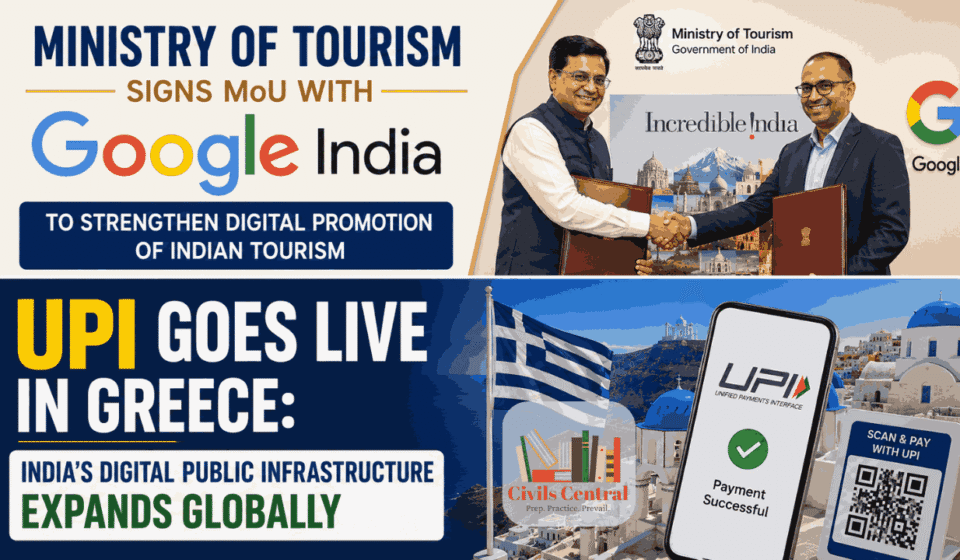
First, the Ministry of Tourism signed a Memorandum of Understanding (MoU) with Google India to enhance the digital visibility of India’s tourism destinations, improve tourist experiences, and promote sustainable and inclusive tourism through digital technologies.
Second, Unified Payments Interface (UPI) was officially launched in Greece, with the launch witnessed by the Union Minister of Commerce and Industry at Eurobank. This marks another milestone in India’s effort to internationalize its Digital Public Infrastructure (DPI), making cross-border digital payments easier for Indian travellers, businesses, and the global Indian diaspora.
Although these developments appear unrelated at first glance, both reflect India’s broader strategy of leveraging technology as an instrument of economic growth, soft power, digital diplomacy, and global integration. For UPSC, this topic connects governance, economy, tourism, international relations, digital public infrastructure, fintech, soft power, and India’s vision of becoming a leading digital economy.
Why in News?
Recently,
- The Ministry of Tourism signed an MoU with Google India to strengthen the digital promotion of Indian tourism.
- The collaboration aims to improve digital discoverability of destinations, promote lesser-known tourist sites, support capacity building for tourism stakeholders, and leverage emerging technologies such as Artificial Intelligence.
- Separately, UPI services were launched in Greece through Eurobank in the presence of the Union Commerce and Industry Minister.
- Greece joins a growing list of countries accepting India’s UPI ecosystem, further strengthening India’s Digital Public Infrastructure (DPI) diplomacy.
These developments indicate India’s growing emphasis on combining digital innovation with economic diplomacy.
Why Tourism and Digital Payments Matter Together
Modern tourism extends far beyond sightseeing. A tourist’s experience now begins online—through digital search, virtual exploration, online bookings, digital maps, AI-based recommendations, digital payments, multilingual assistance, and social media engagement.
Consequently, governments across the world increasingly view tourism through the lens of the digital economy.
India’s recent initiatives demonstrate this convergence. While Google helps travellers discover India digitally, UPI enables them to transact seamlessly across borders. Together, these initiatives contribute to building a complete digital tourism ecosystem.
The relationship can be visualized as follows:
Digital Discovery
        ↓
Travel Planning
        ↓
Online Booking
        ↓
Digital Payments (UPI)
        ↓
Tourist Experience
        ↓
Reviews & Promotion
        ↓
Higher Tourist Footfall
Thus, digital platforms influence every stage of the tourism value chain.
Understanding Tourism as an Economic Sector
Tourism is often described as a “multiplier industry” because expenditure by tourists generates income across multiple sectors simultaneously. A tourist visiting a destination spends money on:
- Transport
- Hotels
- Restaurants
- Local handicrafts
- Entertainment
- Heritage sites
- Local guides
- Shopping
This spending stimulates employment and local entrepreneurship. Unlike many industries concentrated in urban areas, tourism creates employment in rural, tribal, coastal, mountain, and border regions, making it an important instrument of balanced regional development.
Tourism in the Indian Economy
India possesses exceptional tourism potential because of its remarkable diversity.
The country offers:
- Himalayan tourism
- Coastal tourism
- Wildlife tourism
- Spiritual tourism
- Wellness tourism
- Ayurveda tourism
- Medical tourism
- Adventure tourism
- Heritage tourism
- Eco-tourism
- Rural tourism
- Cultural tourism
Despite possessing one of the world’s richest cultural and natural heritage assets, India’s share in global international tourist arrivals remains relatively modest compared to its potential. One major reason has been inadequate global digital visibility of many destinations.
The MoU with Google India seeks to bridge precisely this gap.
Ministry of Tourism–Google India MoU: What Does It Aim to Achieve?
The agreement seeks to combine Google’s technological capabilities with the Ministry’s tourism development objectives. Rather than focusing solely on advertising, the collaboration aims to digitally transform how tourists discover and experience India.
The major objectives include improving digital discoverability of tourist destinations, promoting hidden gems beyond traditional circuits, supporting destination branding, enhancing multilingual digital content, strengthening digital skills among tourism stakeholders, and exploring Artificial Intelligence-based solutions to improve visitor experiences.
This represents a shift from conventional tourism marketing towards data-driven destination management.
Why Digital Promotion Has Become Essential
Tourists increasingly rely on digital platforms before making travel decisions. Most international travellers search for:
- Best destinations
- Reviews
- Virtual tours
- Weather
- Accessibility
- Transport options
- Hotels
- Nearby attractions
- Local experiences
Search engines therefore influence tourist flows. If destinations have limited digital visibility, they receive fewer visitors regardless of their actual tourism potential. This is particularly relevant for India’s lesser-known heritage sites, ecotourism destinations, tribal tourism circuits, and rural tourism locations.
Digital promotion helps reduce this information asymmetry.
Tourism in India: From Cultural Heritage to an Engine of Economic Growth
Tourism in India has undergone a remarkable transformation over the past seven decades. Immediately after Independence, tourism was largely perceived as a cultural and diplomatic activity aimed at showcasing India’s rich civilizational heritage to the world. The emphasis was on preserving monuments, promoting pilgrimage, and welcoming foreign visitors. Tourism was not yet viewed as a major contributor to economic growth or employment.
With economic liberalisation in 1991, India began integrating more deeply with the global economy. Rising incomes, improved air connectivity, expansion of the hospitality sector, and increasing international mobility transformed tourism into a significant component of the services sector. Policymakers gradually recognized tourism as an important driver of employment generation, regional development, foreign exchange earnings, and cultural diplomacy.
The emergence of the internet, smartphones, and digital platforms has now ushered in a third phase of tourism policy. Today’s tourism ecosystem is increasingly data-driven, technology-enabled, and digitally interconnected. The Ministry of Tourism’s partnership with Google India reflects this evolution from traditional destination marketing to intelligent digital destination management.
Evolution of Tourism Policy in India
| Period | Major Characteristics | Significance |
|---|---|---|
| 1950s–1970s | Focus on heritage conservation and pilgrimage tourism | Cultural identity and nation-building |
| 1980s | Expansion of domestic tourism infrastructure | Recognition of tourism’s economic role |
| 1991 onwards | Liberalisation and private sector participation | Tourism integrated into the service economy |
| 2002 National Tourism Policy | Promotion of tourism as an engine of inclusive growth | Focus on infrastructure, branding and sustainability |
| 2014 onwards | Digital India, Swadesh Darshan, PRASHAD, Incredible India 2.0 | Technology-driven tourism ecosystem |
| Present Phase | AI, GIS, Digital Public Infrastructure, Google partnership, smart destinations | Data-driven tourism governance |
Tourism as a Pillar of India’s Service Economy
Tourism is one of the most employment-intensive sectors of the economy. Unlike capital-intensive industries that require substantial investment but employ relatively fewer people, tourism creates jobs across a broad spectrum of skill levels.
A single tourist visit generates economic activity across airlines, railways, taxis, hotels, restaurants, local handicrafts, entertainment services, tour operators, digital platforms, photographers, artisans, and small businesses. This creates a powerful multiplier effect in the economy.
For developing countries like India, tourism has three major economic advantages. First, it generates substantial employment, particularly for women, youth, and informal workers. Second, tourism earns valuable foreign exchange through international visitors. Third, it stimulates infrastructure development in roads, airports, sanitation, urban amenities, digital connectivity, and public services, benefiting both tourists and local residents. Consequently, tourism is increasingly regarded not merely as a leisure industry but as a strategic sector supporting inclusive economic development.
Why Digital Tourism Has Become the New Global Standard
The global tourism industry has experienced a profound digital transformation over the last decade. Earlier, tourists depended on travel agents, printed brochures, guidebooks, and personal recommendations. Today, almost every stage of travel is mediated through digital technologies.
A modern traveller typically discovers destinations through search engines or social media, compares reviews on online platforms, books flights and accommodation digitally, navigates using GPS-enabled maps, makes cashless payments, accesses AI-powered travel recommendations, and shares experiences through digital content after completing the journey.
Thus, tourism has become a complete digital value chain.
Destination Search
        ↓
Online Reviews
        ↓
Virtual Exploration
        ↓
Travel Booking
        ↓
Digital Navigation
        ↓
Digital Payments
        ↓
Experience Sharing
        ↓
Destination Branding
This transformation explains why collaboration with a global technology company like Google has become strategically important for India’s tourism promotion.
What Does “Digital Promotion of Tourism” Actually Mean?
Digital promotion extends far beyond advertising destinations on the internet. It involves using digital technologies to improve every aspect of destination visibility, accessibility, visitor engagement, and tourism management.
The Ministry of Tourism’s collaboration with Google India is expected to support several dimensions of this transformation.
1. Enhanced Discoverability of Tourist Destations
Many culturally significant locations in India remain relatively unknown because they have limited digital presence.
By improving search visibility, integrating destinations into digital maps, enhancing multilingual information, and using AI-assisted recommendations, these locations can become more accessible to domestic and international travellers.
This aligns with the government’s objective of promoting “Dekho Apna Desh” and reducing excessive concentration of tourists at a few iconic destinations.
2. Promotion of Lesser-Known Destinations
India’s tourism landscape extends far beyond destinations such as the Taj Mahal, Jaipur, Goa, Kerala, and Varanasi.
The country possesses thousands of archaeological sites, UNESCO heritage locations, biodiversity hotspots, tribal cultural landscapes, spiritual circuits, and rural tourism destinations that remain underexplored.
Digital promotion can redistribute tourist flows by highlighting these lesser-known attractions, thereby reducing pressure on overcrowded destinations while generating income in emerging tourism regions.
This contributes to balanced regional development.
3. Artificial Intelligence in Tourism
Artificial Intelligence is increasingly transforming the tourism sector worldwide. AI can analyse user preferences, search behaviour, language choices, travel budgets, and seasonal trends to generate personalised travel recommendations.
Potential applications include:
- AI-powered travel assistants
- Personalised itinerary planning
- Real-time language translation
- Crowd management
- Visitor forecasting
- Smart destination management
- Dynamic tourism analytics
- Chatbots for tourist assistance
For policymakers, AI also enables evidence-based planning by analysing tourist behaviour, seasonal demand, and infrastructure requirements.
4. Strengthening Digital Skills in the Tourism Sector
Digital transformation cannot succeed unless tourism stakeholders possess adequate digital capabilities. The partnership aims to improve digital literacy among:
- Tour operators
- Local guides
- Hotel owners
- Homestay operators
- Rural entrepreneurs
- Handicraft sellers
- Hospitality workers
Improved digital skills enable local businesses to market themselves globally, accept digital payments, manage online bookings, and engage with international customers. This supports inclusive digital growth.
Tourism and the Digital India Mission
The Google India partnership complements several flagship initiatives under the Digital India programme. Digital India seeks to transform governance, public service delivery, and economic participation through digital technologies. Tourism naturally benefits from this ecosystem because tourists increasingly rely on digital infrastructure throughout their travel journey.
The relationship can be understood as follows:
| Digital India Initiative | Contribution to Tourism |
|---|---|
| BharatNet | Internet connectivity in rural tourism destinations |
| DigiLocker | Digital identity and document access |
| UPI | Seamless cashless payments |
| Open Network for Digital Commerce (ONDC) | Greater market access for tourism businesses |
| PM Gati Shakti | Better logistics and multimodal connectivity |
| GIS Mapping | Improved destination planning |
| AI Mission | Smart tourism solutions |
Together, these initiatives create a comprehensive digital ecosystem that enhances both tourist convenience and administrative efficiency.
Tourism and India’s Soft Power
Tourism is not merely an economic activity; it is also an instrument of soft power. Every foreign tourist who visits India experiences its cultural diversity, democratic values, hospitality, cuisine, traditions, and innovation ecosystem. Positive travel experiences strengthen India’s international image and foster long-term cultural and economic ties.
Digital platforms amplify this effect. User-generated content, virtual tours, influencer campaigns, and online reviews shape global perceptions of India far beyond traditional government publicity. By partnering with Google India, the Ministry of Tourism seeks to leverage these digital channels to project India’s civilizational heritage and contemporary achievements to a global audience.
Thus, digital tourism promotion complements India’s broader objectives of cultural diplomacy, economic engagement, and nation branding.
UPI Goes Live in Greece – India’s Digital Public Infrastructure Expands Beyond Borders
The second major development accompanying the Ministry of Tourism’s digital initiative is equally significant from the perspective of India’s economic diplomacy and technological leadership. The launch of Unified Payments Interface (UPI) in Greece marks another milestone in India’s efforts to transform its successful domestic digital payment system into a globally accepted payment network.
The launch, witnessed by the Union Minister of Commerce and Industry at Eurobank, is much more than the introduction of another payment option for Indian travellers. It represents the growing international recognition of India’s Digital Public Infrastructure (DPI), demonstrates the global competitiveness of Indian fintech innovation, and strengthens India’s economic engagement with Europe.
Understanding UPI
Many people equate UPI with mobile applications such as BHIM, Google Pay, PhonePe, or Paytm. However, this is a misconception. These applications merely provide the interface through which users access UPI services.
UPI itself is a real-time interoperable digital payment system developed by the National Payments Corporation of India (NPCI). It enables instant transfer of money between bank accounts using mobile devices without requiring users to enter lengthy bank account details for every transaction.
The true innovation of UPI lies in its ability to connect all participating banks on a common digital platform, making payments simple, secure, and instantaneous.
Evolution of Digital Payments in India
India’s journey toward a digital payment ecosystem did not begin with UPI. It has evolved through several stages, each addressing limitations of the previous system.
Initially, electronic fund transfers relied on systems such as NEFT and RTGS, which required bank account numbers, IFSC codes, and often involved processing delays. The Immediate Payment Service (IMPS) introduced real-time transfers but still required relatively more complex transaction details.
Recognizing the need for a simpler, interoperable, and mobile-first payment architecture, NPCI launched UPI in 2016. The platform allowed users to transfer money instantly using a Virtual Payment Address (VPA), QR codes, or mobile numbers, eliminating many barriers associated with traditional banking.
The combination of widespread smartphone adoption, affordable internet access, the Digital India Mission, the Jan Dhan-Aadhaar-Mobile (JAM) trinity, and supportive regulatory policies led to an unprecedented expansion of UPI. Today, it processes billions of transactions every month and has become the backbone of India’s digital economy.
Institutional Architecture Behind UPI
Understanding the institutional framework is essential for UPSC.
| Institution | Role |
|---|---|
| Reserve Bank of India (RBI) | Regulates payment systems under the Payment and Settlement Systems Act, 2007 |
| National Payments Corporation of India (NPCI) | Developed and operates UPI |
| NPCI International Payments Limited (NIPL) | Promotes UPI and RuPay internationally |
| Banks | Provide customer accounts and payment services |
| Payment Service Providers (PSPs) | Offer user interfaces such as BHIM and other UPI-enabled applications |
| Merchants | Accept UPI payments through QR codes and interoperable platforms |
How Does UPI Work?
Although the user experience appears simple, UPI operates through a sophisticated digital infrastructure.
Customer
     │
     ▼
UPI Application
     │
     ▼
NPCI Switch
     │
 ┌───┴────┐
 ▼        ▼
Payer Bank   Payee Bank
      │
      ▼
Real-Time Settlement
The NPCI switch acts as the central interoperable platform, securely routing payment instructions between banks while ensuring authentication and settlement within seconds.
Why Is UPI Considered a Digital Public Infrastructure (DPI)?
Digital Public Infrastructure refers to foundational digital systems that enable governments, businesses, and citizens to interact efficiently, securely, and inclusively.
Unlike proprietary digital ecosystems controlled by private corporations, DPI provides interoperable public digital rails upon which innovation can flourish.
India’s Digital Public Infrastructure is often described as consisting of three foundational layers:
| DPI Layer | Example | Function |
|---|---|---|
| Digital Identity | Aadhaar | Secure identity verification |
| Digital Payments | UPI | Instant interoperable transactions |
| Data Empowerment | Account Aggregator Framework | Consent-based data sharing |
Additional components such as DigiLocker, FASTag, CoWIN, ONDC, and the Open Credit Enablement Network (OCEN) further strengthen India’s DPI ecosystem.
The international acceptance of UPI demonstrates that India’s public digital infrastructure is increasingly viewed as a global public good.
Why Is Greece Significant?
At first glance, Greece may appear to be a relatively small market compared to larger economies. However, its significance extends beyond transaction volumes. Greece serves as an important gateway between Europe, the Mediterranean, and Asia. It is a major tourism destination, a maritime hub, and an integral part of the European financial ecosystem.
The introduction of UPI through Eurobank offers several advantages:
- Indian tourists can make seamless digital payments without relying extensively on cash or international card networks.
- Indian businesses engaged in trade and services gain greater payment convenience.
- The Indian diaspora benefits from familiar and efficient payment mechanisms.
- It strengthens economic engagement between India and Greece, complementing broader strategic cooperation.
Thus, the launch reflects both commercial and diplomatic considerations.
Cross-Border UPI: How Does It Work?
International deployment of UPI is enabled through partnerships between NPCI International Payments Limited (NIPL) and foreign banks or payment service providers.
The process generally involves:
Indian Customer
        │
UPI-enabled Application
        │
NPCI International (NIPL)
        │
Foreign Partner Bank
        │
Merchant in Host Country
Such partnerships ensure interoperability while complying with the regulatory frameworks of the host country.
Countries Accepting or Integrating UPI
India has steadily expanded the international footprint of UPI through bilateral partnerships and payment connectivity initiatives. Besides Greece, UPI has been introduced or integrated in several countries across Asia, the Middle East, Europe, and beyond.
The objectives vary from facilitating merchant payments for Indian travellers to enabling cross-border remittances and promoting interoperable payment systems with partner countries.
This gradual expansion reflects India’s broader strategy of positioning UPI as a trusted, low-cost, secure, and inclusive global payment platform.
Economic Significance of Internationalising UPI
The global expansion of UPI has implications that extend far beyond convenience for tourists.
1. Facilitating International Tourism
Indian outbound tourism has grown significantly over the past decade. Availability of UPI enables travellers to make payments using familiar digital platforms, reducing dependence on cash and expensive foreign exchange cards.
Similarly, future reciprocal arrangements may make travel to India easier for foreign visitors through interoperable payment systems.
2. Supporting Trade and Commerce
Efficient payment systems reduce transaction costs for businesses, particularly small and medium enterprises engaged in international trade. Faster settlements improve liquidity and strengthen commercial ties.
3. Promoting Financial Innovation
UPI showcases India’s capability to develop world-class digital infrastructure at scale. Its international adoption enhances the reputation of India’s fintech ecosystem and encourages further innovation.
4. Strengthening India’s Soft Power
Technological success increasingly contributes to a nation’s international influence. Just as India’s pharmaceutical industry and space programme have enhanced its global standing, Digital Public Infrastructure is emerging as another pillar of India’s soft power.
Countries adopting Indian digital payment solutions implicitly acknowledge India’s leadership in inclusive digital governance.
5. Advancing Digital Economic Diplomacy
India is increasingly incorporating Digital Public Infrastructure into its foreign policy and development partnerships. Sharing digital solutions with partner countries enhances cooperation in areas such as governance, financial inclusion, public service delivery, and economic development.
This approach aligns with India’s vision of being a “technology partner” for the Global South while simultaneously strengthening ties with advanced economies.
Challenges in Global Expansion of UPI
Despite its remarkable success, international expansion presents several challenges that policymakers must address.
| Challenge | Explanation |
|---|---|
| Regulatory Diversity | Each country has distinct financial regulations and licensing requirements. |
| Cybersecurity Risks | Cross-border digital payments increase exposure to cyber threats and fraud. |
| Data Governance | Compliance with differing data protection and privacy laws is essential. |
| Currency Conversion | Efficient foreign exchange mechanisms are needed for seamless transactions. |
| Merchant Acceptance | Widespread merchant onboarding is necessary to maximise usability. |
| Interoperability | Technical integration with existing foreign payment infrastructures remains complex. |
Addressing these challenges requires sustained cooperation between governments, regulators, financial institutions, and technology providers.
India and the Future of Global Digital Payments
The internationalisation of UPI illustrates a broader shift in the global digital economy. Rather than merely importing technological solutions, India is increasingly exporting digital governance models and public digital infrastructure.
If this momentum continues, India could play a leading role in shaping future global standards for interoperable, inclusive, and affordable digital payment systems. Alongside initiatives such as Aadhaar, DigiLocker, ONDC, and Account Aggregators, UPI demonstrates how Digital Public Infrastructure can become an instrument of economic development, international cooperation, and strategic influence.
The launch of UPI in Greece is therefore not an isolated event—it is another step in India’s emergence as a global digital innovation leader.
Government Initiatives Promoting Tourism in India
India’s tourism policy has evolved from promoting iconic monuments to developing integrated tourism ecosystems. The focus today is on infrastructure creation, destination management, digital promotion, sustainability, skill development, and community participation.
1. Incredible India Campaign
Launched in 2002, the Incredible India campaign transformed India’s tourism branding by projecting the country’s cultural diversity, natural beauty, spiritual heritage, wildlife, cuisine, and traditions to a global audience.
Over time, the campaign has shifted from conventional advertising to digital storytelling through websites, mobile applications, virtual tours, social media engagement, influencer collaborations, and multilingual content. The MoU with Google India represents the next phase of this digital evolution.
2. Swadesh Darshan Scheme
Swadesh Darshan is a flagship initiative of the Ministry of Tourism aimed at developing thematic tourism circuits across the country. Instead of promoting isolated destinations, the scheme adopts an integrated approach by connecting places that share a common historical, cultural, religious, ecological, or geographical identity.
Examples include:
- Buddhist Circuit
- Coastal Circuit
- Desert Circuit
- Himalayan Circuit
- Eco Circuit
- North-East Circuit
- Heritage Circuit
- Tribal Circuit
- Ramayana Circuit
- Krishna Circuit
The objective is to improve connectivity, visitor amenities, interpretation centres, sanitation, and local economic development.
3. PRASHAD Scheme
The Pilgrimage Rejuvenation and Spiritual, Heritage Augmentation Drive (PRASHAD) focuses on developing pilgrimage destinations through improved infrastructure, sanitation, accessibility, heritage conservation, and visitor facilities.
Given India’s immense religious diversity, pilgrimage tourism constitutes a significant share of domestic travel. Improving pilgrimage infrastructure also generates employment and stimulates local economies.
4. Dekho Apna Desh Initiative
The initiative encourages domestic tourism by motivating Indian citizens to explore diverse regions of the country.
Beyond increasing tourist numbers, it aims to strengthen national integration, promote local cultures, support regional economies, and reduce dependence on international tourism during periods of global uncertainty.
5. National Digital Tourism Mission
India is gradually moving toward creating an integrated digital tourism ecosystem through the National Digital Tourism Mission (NDTM).
The vision includes:
- Digital tourist identity
- Seamless online booking
- Integrated destination information
- Smart tourism analytics
- AI-based recommendations
- Digital visitor management
- Interoperable tourism services
The collaboration with Google India complements these objectives by improving discoverability and digital engagement.
Government Initiatives Supporting India’s Digital Economy
India’s success in expanding UPI internationally is rooted in a broader digital transformation agenda.
Digital India Mission
Launched in 2015, Digital India aims to transform governance through technology by improving digital infrastructure, online public services, and digital literacy. Its vision rests on three pillars:
- Digital infrastructure as a core utility
- Governance and services on demand
- Digital empowerment of citizens
UPI is one of the most successful outcomes of this mission.
JAM Trinity
The Jan Dhan–Aadhaar–Mobile (JAM) framework forms the backbone of India’s digital governance architecture.
Jan Dhan Accounts
         +
      Aadhaar
         +
     Mobile Phones
         ↓
Financial Inclusion
         ↓
Direct Benefit Transfers
         ↓
Digital Economy
This ecosystem created the foundation upon which UPI achieved nationwide adoption.
India Stack
India Stack refers to a collection of interoperable digital public platforms that enable paperless, cashless, and presence-less service delivery.
Major components include:
| Component | Purpose |
|---|---|
| Aadhaar | Digital Identity |
| e-KYC | Paperless verification |
| DigiLocker | Secure digital documents |
| e-Sign | Digital authentication |
| UPI | Instant digital payments |
| Account Aggregator | Consent-based financial data sharing |
| ONDC | Open digital commerce |
| OCEN | Open credit ecosystem |
Together, these systems represent one of the world’s most comprehensive Digital Public Infrastructure ecosystems.
International Comparisons
Studying international experiences helps UPSC aspirants evaluate India’s strengths and identify areas for improvement.
| Country | Digital Strength | Lessons for India |
|---|---|---|
| Estonia | Fully digital governance ecosystem | Deep integration of digital public services |
| Singapore | Smart Nation initiative | AI-enabled urban governance and tourism management |
| United Arab Emirates | Smart tourism and digital government | Seamless visitor experience through integrated platforms |
| South Korea | Advanced digital infrastructure | High-speed connectivity and smart city integration |
| European Union | Digital Single Market | Cross-border digital interoperability and data governance |
| India | Digital Public Infrastructure (Aadhaar, UPI, DigiLocker, ONDC) | Large-scale, inclusive, low-cost digital innovation |
India’s comparative advantage lies in delivering digital public goods at population scale while maintaining affordability and interoperability.
Digital Tourism: Opportunities for India
Digital technologies have the potential to fundamentally reshape India’s tourism sector.
Enhancing Global Visibility
Search engines, virtual tours, AI-generated recommendations, and multilingual digital content can significantly increase awareness of India’s diverse tourism offerings.
Promoting Inclusive Growth
Digital platforms enable small hotels, homestays, artisans, local guides, and rural entrepreneurs to reach national and international audiences without relying solely on large intermediaries.
Sustainable Destination Management
Real-time data analytics can help authorities monitor visitor flows, prevent overcrowding, manage waste, and protect environmentally sensitive destinations.
Strengthening Cultural Diplomacy
Digital storytelling allows India to project its civilizational heritage, festivals, cuisine, yoga, Ayurveda, crafts, and cultural diversity to a global audience, reinforcing its soft power.
Opportunities Created by Global Expansion of UPI
The international acceptance of UPI extends benefits across multiple sectors. It enhances convenience for Indian travellers, facilitates cross-border trade, reduces transaction costs, encourages fintech innovation, supports remittances, and strengthens India’s credibility as a provider of Digital Public Infrastructure.
Over time, broader international acceptance may contribute to greater interoperability among global payment systems and reinforce India’s position in international digital governance discussions.
Challenges Before India’s Digital Tourism Strategy
Despite considerable progress, several structural challenges remain.
Digital Divide
Many rural and remote tourism destinations still face inadequate internet connectivity, limiting the benefits of digital promotion.
Cybersecurity
The growing dependence on digital platforms increases exposure to cyberattacks, online fraud, identity theft, and data breaches.
Capacity Constraints
Many small tourism operators lack digital literacy and struggle to utilise online marketing tools, booking platforms, and digital payment systems effectively.
Overtourism
Improved digital visibility may lead to excessive concentration of tourists in ecologically fragile or culturally sensitive destinations unless visitor flows are managed scientifically.
Data Privacy
The increasing use of AI and digital platforms necessitates robust safeguards for personal data, transparency, and ethical use of algorithms.
Challenges in Internationalising UPI
Global expansion also requires addressing several policy and operational issues.
| Challenge | Policy Concern |
|---|---|
| Regulatory harmonisation | Aligning with diverse legal frameworks across countries |
| Currency settlement | Efficient foreign exchange mechanisms |
| Cyber resilience | Preventing fraud and securing cross-border transactions |
| Merchant acceptance | Expanding the network of participating businesses |
| Consumer awareness | Familiarising international users with UPI |
| Technical interoperability | Integrating with foreign payment systems |
These issues highlight that technological innovation must be accompanied by strong institutional coordination and international cooperation.
Expert Recommendations and Policy Directions
Several national and international institutions have emphasised the importance of digital infrastructure and sustainable tourism.
G20 New Delhi Leaders’ Declaration
The declaration recognised Digital Public Infrastructure as an important enabler of inclusive development and encouraged voluntary sharing of digital solutions among countries.
National Strategy for Artificial Intelligence
India’s AI strategy identifies tourism as one of the sectors that can benefit from intelligent analytics, language technologies, predictive planning, and personalised digital services.
UN Sustainable Development Goals (SDGs)
Tourism contributes directly and indirectly to multiple SDGs, including:
- SDG 8 – Decent Work and Economic Growth
- SDG 9 – Industry, Innovation and Infrastructure
- SDG 11 – Sustainable Cities and Communities
- SDG 12 – Responsible Consumption and Production
- SDG 17 – Partnerships for the Goals
The Ministry of Tourism’s collaboration with Google India and the expansion of UPI support these broader developmental objectives.
Way Forward
India should now move beyond isolated digital initiatives toward building a fully integrated digital tourism ecosystem. Artificial Intelligence, Geographic Information Systems (GIS), multilingual digital platforms, immersive technologies such as virtual and augmented reality, and real-time analytics should be combined to enhance destination planning and visitor experiences.
Digital promotion must also prioritise sustainability. Increased visibility should not result in ecological degradation or cultural commodification. Carrying-capacity assessments, community participation, and scientific destination management must accompany tourism expansion.
On the financial side, India should continue expanding UPI through bilateral partnerships while strengthening cybersecurity, regulatory cooperation, consumer protection, and cross-border interoperability. Wider acceptance of UPI, combined with India’s broader Digital Public Infrastructure ecosystem, can enhance India’s role as a trusted technology partner for both developed and developing countries.
Ultimately, the success of these initiatives will depend not only on technological innovation but also on institutional capacity, international collaboration, and citizen-centric governance.
Conclusion
The Ministry of Tourism’s partnership with Google India and the launch of UPI in Greece illustrate two dimensions of India’s digital transformation. One seeks to improve the global discoverability of India’s cultural and natural heritage, while the other extends India’s world-class Digital Public Infrastructure beyond national borders.
Together, these initiatives reflect a broader vision of technology-enabled governance, inclusive economic growth, digital diplomacy, and global leadership in public digital infrastructure. They reinforce India’s aspiration to emerge not merely as a consumer of technology but as a creator of scalable, inclusive, and interoperable digital solutions for the world.
For UPSC aspirants, this topic exemplifies the importance of integrating Economy, Governance, International Relations, Science & Technology, Tourism, and Public Policy into a single analytical framework—an approach increasingly reflected in the evolving pattern of the Civil Services Examination.
FAQ
1. Why did the Ministry of Tourism sign an MoU with Google India?
The partnership aims to digitally promote Indian tourism by improving destination discoverability, leveraging Artificial Intelligence, strengthening digital skills, and enhancing the online visibility of tourist destinations.
2. Why is UPI’s launch in Greece important?
UPI’s launch in Greece expands India’s Digital Public Infrastructure internationally, enabling seamless digital payments for Indian travellers and strengthening India’s fintech diplomacy.
3. What is Digital Public Infrastructure (DPI)?
Digital Public Infrastructure refers to interoperable digital systems such as Aadhaar, UPI, DigiLocker, and Account Aggregator that provide secure digital identity, payments, and data-sharing infrastructure.
4. Which institution developed UPI?
UPI was developed by the National Payments Corporation of India (NPCI) and is regulated by the Reserve Bank of India (RBI).
5. What role does Google India play in tourism promotion?
Google India will support digital marketing, AI-driven destination promotion, multilingual content, digital capacity building, and improved online discoverability of India’s tourism destinations.
6. How does UPI strengthen India’s soft power?
UPI demonstrates India’s technological innovation and Digital Public Infrastructure model, enhancing India’s global reputation and supporting economic diplomacy.
7. How is tourism linked to India’s digital economy?
Digital technologies improve destination marketing, online bookings, navigation, digital payments, analytics, and visitor experiences, making tourism an important part of India’s digital economy.
8. Why is this topic important for UPSC?
The topic integrates Economy, Governance, International Relations, Science & Technology, Tourism, Digital India, Artificial Intelligence, FinTech, and Digital Public Infrastructure, making it relevant for both Prelims and GS-II and GS-III Main
About The Author